Physician Wellness at Mid-Career: Investing Your Time, Investing Your Money

After the early-career gauntlet of residency, fellowship, and the first few years of an attending role, most physicians find themselves in an interesting place: they have significantly more disposable income than before. They also have the chance to set up practices and rhythms in their work lives that enhance their experience of their profession. The question facing most physicians at mid-career is where to invest two of the most valuable resources: their time and their money. Within the clinician wellness model, there is a recognition that this phase of a physician’s career presents opportunities to reshape and reinvest professionally in ways that were not previously available. Tricia James, Director of Clinician Experience at Providence, recommends physicians consider the following questions:
Consider your top priorities for your life in the next 10 years. What needs to shift in your current life and schedule to be in alignment with those priorities? This might include moving, adjusting your work commitments, exploring more travel or a new hobby.
What are your professional priorities? By mid-career many physicians reach a lull professionally and it can help to think about what growth opportunities are exciting to explore. This could be a leadership role, taking on teaching, developing a specialized clinical interest or pursuing other non-clinical opportunities.
Investment Vehicles
In the same way that you have a choice of how to invest your time, you also have a choice of how and where to invest your money. Depending on your employer, you will have a range of vehicles in which to save for retirement. Here are our recommendations on where to invest first and each dollar thereafter:
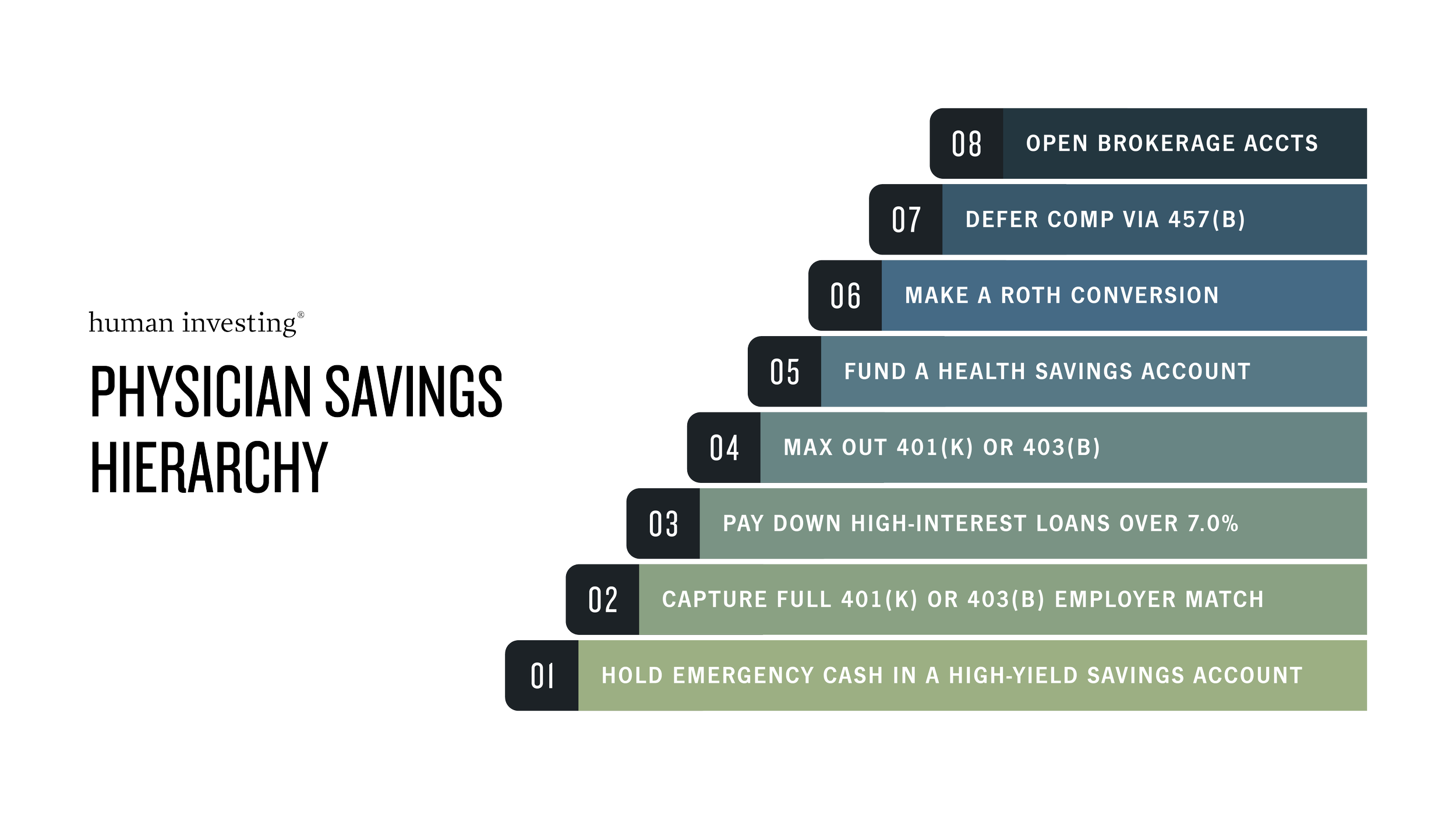
Physician Savings Hierarchy is an illustration intended to serve as a general educational framework and that individual investment priorities may vary based on personal circumstances.
Every step in this hierarchy builds on the last, but a few deserve a closer look. Below are where physicians often have more questions:
1. Hold emergency cash in a High-Yield Savings Account
A healthy financial plan begins with a savings account. Located within a HYSA (high-yield savings account), generating somewhere between 2-4% in interest, physicians should plan to save 3-6 months of living expenses. This baseline level of savings ensures that your financial plan can withstand significant shocks, such as gaps in employment or an emergency. Having cash readily available allows you to cover unexpected expenses without drawing from retirement and investment accounts prematurely.
2 & 4. Max Out Your 401(k) or 403(b) Accounts
Workplace retirement plans like a 401(k) or 403(b) are important savings vehicles that allow physicians to save directly from their paycheck. If contributing in a pre-tax format, physicians can lower their tax liability in the short-term, opting to pay taxes down the road in retirement. We recommend contributing at least the amount needed to maximize any matching contributions offered by your employer. However, “maxing out” your contributions each year is a good goal for most physicians who have few ways to make pre-tax contributions to a retirement account.
5. Health Savings Account (HSA)
Funds can be contributed to a Health Savings Account (HSA) on a pre-tax basis, grow tax-free, and be withdrawn tax-free for qualified medical expenses. This gives HSAs a unique “triple tax benefit”: tax-free contributions, tax-free growth, and tax-free withdrawals for qualified medical expenses. For 2026, families can contribute up to $8,750. After age 65, HSA withdrawals for non-medical expenses are no longer subject to a penalty and are taxed similarly to withdrawals from a traditional 401(k), while qualified medical expenses remain tax-free. The primary caveat is that you must be covered by an HSA-eligible high-deductible health plan to contribute, and the higher potential out-of-pocket costs may not make sense for every family.
6. After-Tax Contributions “Mega Backdoor Roth”
After maxing out the pre-tax source of a 401(k), some retirement plans offer “After-Tax” contributions. This separate source within your 401(k) allows you to contribute after-tax dollars above the normal annual contribution limit to 401(k)s. After making these contributions, convert after-tax dollars to Roth within the 401(k), thereby ensuring that the investment growth of those contributions will remain tax free. This strategy is known as the ‘mega backdoor Roth’ and is only available in 401(k) plans that offer this contribution type.
7. 457(b) Deferred Compensation Plans
Some physicians in non-profit health systems and academic medicine have access to a 457(b) deferred compensation plan. These plans defer a portion of your compensation to retirement (or when you leave the organization), thereby lowering your current taxable income. The tax savings on these deferred compensation plans can be significant, but they differ from 401(k) accounts slightly. While dollars in a 401(k) account are legally owned by you, contributions to a 457(b) account are held as a liability on an organization’s balance sheet. Although rare, dollars in a 457(b) account could be used to pay a company’s creditors in bankruptcy proceedings. Despite the understandable concern some physicians may have about these accounts, we recommend using them due to the benefit of lowering your tax burden during your highest earning years. Moreover, many of these 457(b) plans provide the flexibility to change your distribution type (lump sum, installments) and schedule (3 year, 5 year, etc.) when leaving the organization.
8. Individual Brokerage Accounts
After maximizing available retirement accounts, a brokerage account provides an opportunity to invest additional funds without annual contribution limits. Although investment gains may be taxable, these accounts offer greater flexibility in accessing your money and can create valuable tax-planning opportunities, including tax-loss harvesting to offset realized capital gains. A brokerage account can also serve as a flexible source of funds for goals that arise before or during retirement.
Final Thoughts
As a physician’s discretionary income grows, they have greater ability to contribute dollars into accounts that will serve them for the long haul. Each retirement and investment account is designed to facilitate a different form of savings. Physicians will benefit from utilizing a diversity of accounts to achieve different goals within their long-term financial plan. Advisors at Human Investing are available to develop a baseline strategy for physicians at mid-career, helping direct which investment vehicles are a higher priority depending on one’s individual situation and long-term financial goals.
To learn more about the Clinician Experience Program at Providence, including coaching, peer groups, and leadership development designed specifically for clinicians, visit the Providence Clinician Experience Program.


This is the second in a co-authored series on financial wellness as a core component of clinician wellbeing, covering each major stage of a physician's career.
Disclosure: Human Investing is an SEC-registered investment adviser. Registration does not imply a certain level of skill or training. This content is for informational and educational purposes only and does not constitute personalized investment advice or a recommendation. Past performance is not indicative of future results. All investments carry risk, including potential loss of principal. Readers should consult with a qualified professional regarding their specific financial situation.