Posts tagged ssm2
Four Unique advantages of Social Security
 
blog image.jpg

Social Security is something we contribute to all our working years, so why don’t we know much about it? What sets it apart from other retirement benefits? I want to briefly share some of the characteristics that make Social Security unique and helpful for retirement planning purposes.

Social Security Includes Spousal Benefits

Social Security spousal income is a benefit provided to married couples. If you have a working income that is less than 50% of your spouse’s normal retirement age benefit, a spousal benefit will be added to your Social Security income to make it equal to 50% of your spouse’s income. Even with no working income (homemaker), 50% of the spouse’s normal retirement age income will be received.

To receive this increase in income, the higher-earning spouse must start their benefits before the spousal payments begin. Check your eligibility for spousal benefits here.

Two more things to note:

  • There is no benefit to delaying spousal income after normal retirement age as it does not continue to grow.

  • If the spouse with the higher income predeceases the spouse with the lower income, the surviving spouse will receive the higher of the two incomes for the rest of their life. For example, let’s say Joe has a social security benefit of $2,800 per month, and his wife, Shirley, has a benefit of $1,400 monthly. At Joe’s death, Shirley will receive $2,800 per month rather than $1,400 per month.

Social Security income is not fully taxable

If you are Married Filing Jointly and have a combined income below $25,000 in 2021, you will not owe taxes on social security benefits. If your income is between $25,000 and $34,000 in 2021, 50% of benefits will be subject to taxation. With income over $44,000 in 2021, a maximum of 85% of benefits will be taxable. Social security income is not subject to Oregon state income tax.

Social Security Income varies based on retirement age

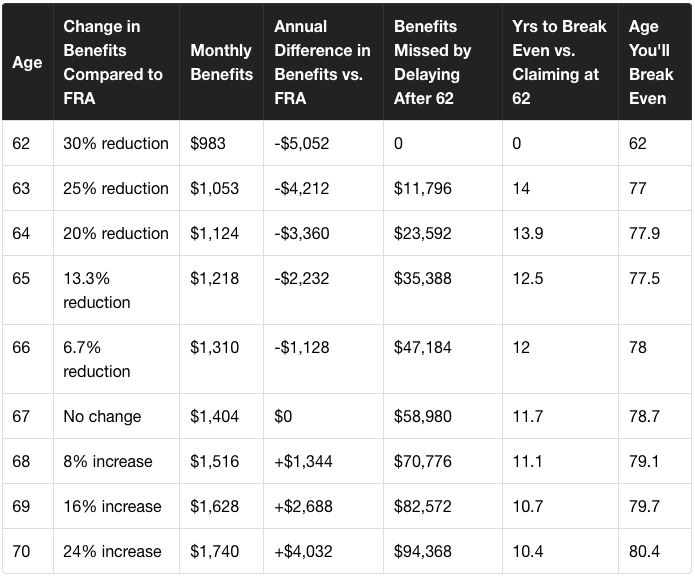
You can start taking social security retirement benefits at the age of 62, but if you are able, it is best to delay taking benefits until normal retirement age (typically age 66). Furthermore, delaying benefits until the age of 70 is even more advantageous, as your income will continue to increase by a certain percentage (based on birth year) until then.

Remember: If benefits are claimed before normal retirement age, half of the benefits will be withheld if income is over $18,960. Benefits will be recalculated at normal retirement age, but it is more beneficial to delay taking social security if someone is planning to work. After reaching normal retirement age, unlimited earned income will not reduce your social security income.

Social Security Income is protected from inflation

Each January the IRS/SSA increases benefits by the amount of inflation experienced over the previous year. These cost-of-living adjustments (COLA’s) are credited even when delaying benefits to a later age. The most recent cost of living adjustment was 1.3% in January 2021. The average estimates over a long period of time are 2.6% annually.

Things to note when applying for benefits:

  • Ensure you have Federal withholdings taken from your benefits, often at 12%.

  • Remember, your Medicare Part B premiums ($148.50 per check) will be deducted from your benefit if you are over age 65.

  • Apply online at www.socialsecurity.gov, by phone at (800) 772-1213, or in person at a Social Security office using the office locator. If you have any questions about social security benefits, please schedule a time to chat.

References:

www.ssa.gov

The Baby Boomer’s Guide to Social Security, Elaine Floyd, CFP®

 

Related Articles

Making the Most of Your Social Security Benefit
 

The more I work through financial planning scenarios with individuals and families the more I realize how important it is to have a clear understanding of your social security benefit. A study in 2014 showed that 55% of retirees defined social security as their main source of retirement income and 88% responded saying that social security would need to be a steady source of income in order to meet retirement goals. These numbers make perfect sense due to longer lifespans, increased healthcare costs, and corporations using 401k accounts rather than pension plans. Now more than ever, it is becoming necessary to have a steady stream of income that has the ability to last the rest of your life.

The goal of this post is simple; equip you with tools on how to best take advantage of your Social Security benefit. See below for three things to consider when looking to get the most out of a program you’ve been paying into your entire working career:

1. The Waiting Game

Generally speaking, you’re eligible to receive 100% of your Social Security benefit at your full retirement age (FRA) which is currently between the ages of 66 and 67. If you decide to claim before your FRA, the benefit amount will be reduced. For each month you delay claiming Social Security your benefit increases until you reach age 70. If you were born between 1943 and 1954 here’s an illustration that provides some context to your benefit percentage:

Social Security.png

Notice that between your FRA and age 70 your benefit increases at a rate of 8% per year. This is risk free rate of return that you receive just for delaying your benefit. Note that investors in the stock market who have the potential to lose 10% of their money in a given week are very pleased with an 8% rate of return in a given year!

2. Finding Break Even Points

Once you have an understanding of why it might make sense to wait to take your benefit, combine that with a knowledge of your personal health and family history, and you're ready to make an educated guess regarding when to take your benefit. Below are a couple key numbers to keep in mind.

Between 77 and 78

Is the age where an individual who files at FRA today catches up and exceeds the age 62 filer in total money collected. Also remember that the FRA filer has higher monthly payments going forward so the gap is only going to increase.

Between 80 and 81

Is the age where an individual who files at age 70 catches up with and exceeds the age 62 filer in total money collected.

Between 82 and 83:

Is the age when the age 70 filer catches up with and exceeds the FRA filer in total money collected. Many variables can factor into these equations such as; taxes, employment status, and other financial considerations. While I encourage you to dig into these calculations on your own, make sure to consult a financial professional (like Human Investing) when making these decisions.

3. Additional Income and Social Security

While there are many things to consider when filing for Social Security don’t forget how other income affects your benefit. Many people that I've spoken with about this issue commonly confuse "keeping" your benefit at FRA vs. "being taxed on" your benefit at FRA. The short of it is once you reach FRA you can keep all of your benefits, but you can also be taxed on those benefits contrary to what some people think. See below for a summary on the differences between keeping your benefit and being taxed on your benefit when accounting for additional income:

  • If you work, and are full retirement age or older, you may keep all of your benefit, no matter how much you earn. If you’re younger than full retirement age, there is a limit to how much you can earn and still receive full Social Security benefits. If you’re younger than full retirement age during all of 2015, the government must deduct $1 from your benefits for each $2 you earn above $15,720. If you reach full retirement age during 2015, the government must deduct $1 from your benefits for each $3 you earn above $41,880 until the month you reach full retirement age. This brochure provides some additional commentary on how working income factors into your benefit.

  • Some people have to pay federal income taxes on their Social Security benefits. This usually happens only if you have other substantial income (such as wages, self-employment, interest, dividends and other taxable income that must be reported on your tax return) in addition to your benefits. This link provides some more details on the taxes you pay on your social security when factoring in other income. Lastly, this web page gives the best example I've seen when factoring in taxes and Social Security.

By looking at the advantages of waiting to take your benefit, some break-even points, and tax strategies for social security hopefully you see that it takes time and effort to make the most of your benefit. It’s possible to literally leave tens of thousands, if not hundreds of thousands of dollars on the government's table if you’re not thoughtful in how you receive this benefit.

So, if you have questions on your Social Security benefit and how it affects your retirement timeline, feel free to email or call Human Investing at any point. We’d love to partner with you in making the most of this benefit.


Related Articles