Human Investing Journal
Scroll

Download Our Free Guide
Latest Posts
Featured

Today's bond market may represent the most important shift in retirement strategy in over a decade. To understand why, we need to start with where equities have been. Over the 15 years ending in September 2026, the Vanguard S&P 500 ETF (VOO) generated an annualized return of more than 15%.

Being a financial advisor means friends and family feel comfortable asking you their most personal money questions. A friend pulled me aside at coffee last week with a question we hear all the time: How do you know when you can actually afford to retire?

Investing isn’t just about numbers. For many, it’s about making choices that reflect personal values while still aiming for long-term investment growth. One of the more common questions we hear from both clients and prospective clients is, “How can my portfolio better reflect what I care about?”

Every year starts the same way. A fresh set of market forecasts arrives, confidently predicting what stocks will do next. And every year, markets remind us how unreliable those predictions can be.
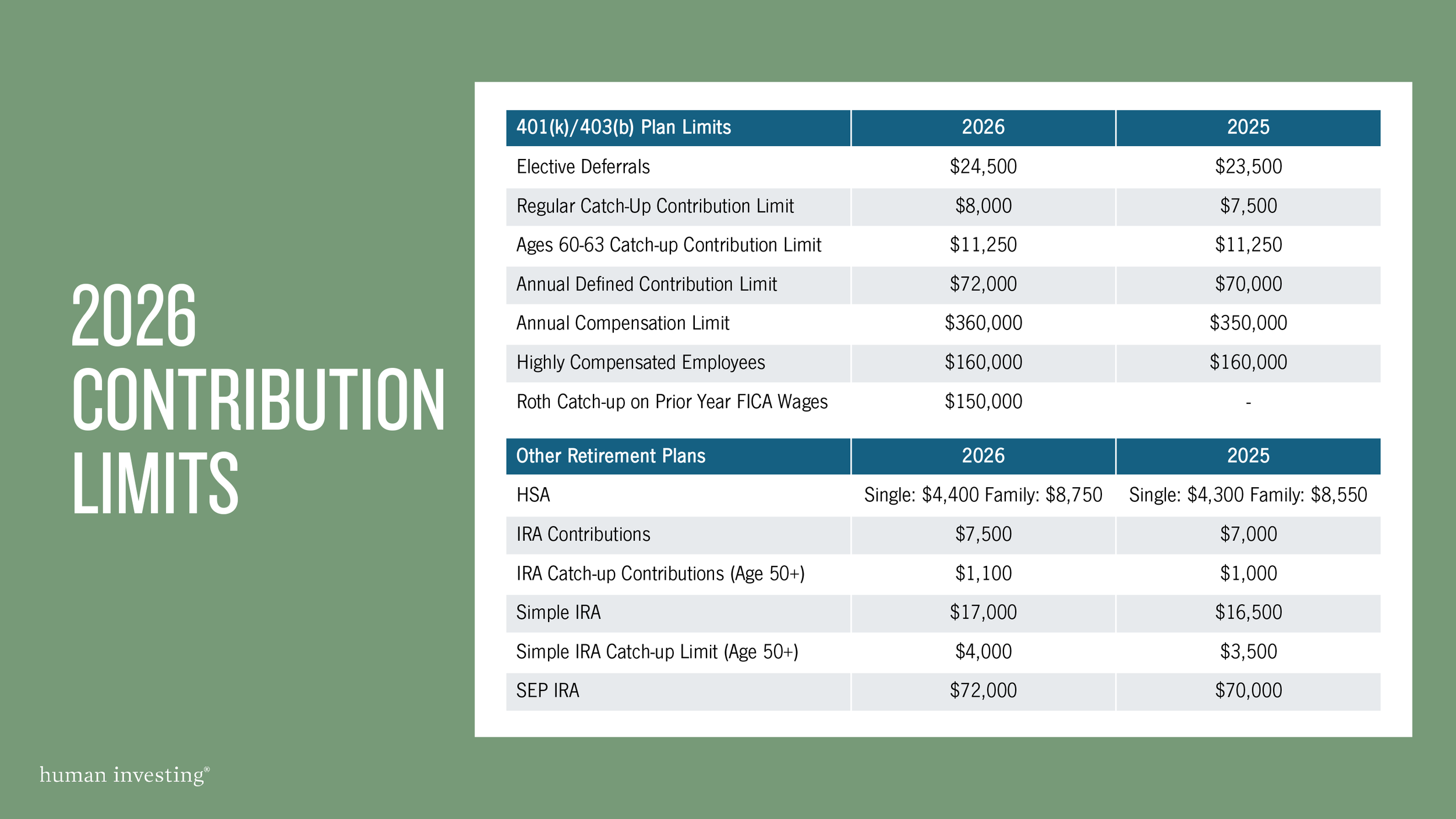
There is good news for retirement accounts! The IRS has increased the contribution limits for the upcoming year. As you can see below, there are many notable changes that will allow investors to save more money.
How do I make the most of my 401(k), IRA, and HSA?
Most retirement progress comes from getting more out of the accounts you already have.
Featured
There is good news for retirement accounts! The IRS has increased the contribution limits for the upcoming year. As you can see below, there are many notable changes that will allow investors to save more money.

The typical baby boomer will have an average of 13 jobs over their working career, according to the Bureau of Labor Statistics. While job moves are practically unavoidable, there are both internal and external challenges to navigate. A common mistake that many investors make is abandoning their old company’s retirement plan with the hopes of figuring it out later.

If you are reading this article, it’s likely that we have already spent some time reviewing the benefits of Roth together and you have sensed some of my fervor.
Featured

401(k) plans are powerful tools individuals can use to save and invest for retirement. I would argue that with high individual contribution limits, tax advantages, and employer contributions, a 401(k) is the best tool to save for retirement.


Health Savings Accounts (HSA) made the roster of tax-deferred accounts. For this reason, these accounts can be a favorable component in a financial plan both today and in the future (65+ years old). Here’s how.
How do I turn my savings into retirement income?
Most people learn how to save for retirement. Very few learn how to take money out of it.
Featured
Today's bond market may represent the most important shift in retirement strategy in over a decade. To understand why, we need to start with where equities have been. Over the 15 years ending in September 2026, the Vanguard S&P 500 ETF (VOO) generated an annualized return of more than 15%.
Being a financial advisor means friends and family feel comfortable asking you their most personal money questions. A friend pulled me aside at coffee last week with a question we hear all the time: How do you know when you can actually afford to retire?

As the golden years approach, retirement promises relaxation and newfound freedom. However, during this period of life, there's an often misjudged financial responsibility - Required Minimum Distributions (RMD).
Featured


Saving for retirement can seem straightforward compared to the daunting task of converting your hard-earned savings into retirement income. When building a retirement income plan knowing what questions to ask will potentially save you money, lower your overall tax bill, and provide you peace of mind.

When should I claim Social Security and how does Medicare work?
Social Security and Medicare are the two biggest financial decisions of your 60s, and the most misunderstood.
Featured

Social Security remains a cornerstone of American retirement planning, yet it’s often shrouded with concern and misinformation. As the dialogue about its future grows increasingly pessimistic, many people question its reliability and role in their retirement income plans. Understanding the current state of Social Security is crucial for making informed decisions about your financial future.

Medicare is an important part of your retirement plan. We hope this overview is a helpful resource to know when to apply and how much it may cost.

Featured

Social Security is something we contribute to all our working years. So why don’t we know much about it? What sets it apart from other retirement benefits? I want to briefly share some of the characteristics that make Social Security unique and helpful for retirement planning purposes.

Now more than ever, it is becoming necessary to have a steady stream of income that has the ability to last the rest of your life.
Am I ready to retire?
The five years before retirement are when small mistakes get expensive, but the small fixes still have time to compound.
Featured

In mid-September, the IRS and Treasury finalized how a piece of the SECURE 2.0 Act will work. The short version: starting in 2026, certain higher-earning workers will only be able to make their catch-up contributions as Roth (after-tax) dollars.

The Rule of 55 is an IRS provision that allows employees who leave their job on or after age 55 to take penalty-free distributions from their retirement accounts. It’s a life hack!

Transitioning into retirement can be an exciting time. For many it can also be a daunting reality. We hope the following Pre-Retirement Checklist is a helpful as you intentionally prepare for your retirement years.



What makes a great employer retirement plan?
A retirement plan is one of the few benefits where doing it well costs about the same as doing it poorly.
Featured
There is good news for retirement accounts! The IRS has increased the contribution limits for the upcoming year. As you can see below, there are many notable changes that will allow investors to save more money.
In mid-September, the IRS and Treasury finalized how a piece of the SECURE 2.0 Act will work. The short version: starting in 2026, certain higher-earning workers will only be able to make their catch-up contributions as Roth (after-tax) dollars.

There are several retirement solutions that can help you secure your future and that of your employees, but the decision-making process can be challenging.
Featured

Oregonians are not saving enough for retirement. OregonSaves is a state-sponsored retirement plan for employers that that do not offer an employer-sponsored retirement plan for their employees.