
Posts in Plan Sponsors
What The New IRS Rule Means For Plan Sponsors & Workers Over 50


If you’re 50 or older and use catch-up contributions to bulk up your retirement savings, or you help run a plan that offers them, there’s a rule change that should be on your radar.

In mid-September, the IRS and Treasury finalized how a piece of the SECURE 2.0 Act will work. The short version: starting in 2026, certain higher-earning workers will only be able to make their catch-up contributions as Roth (after-tax) dollars.

Getting ahead of the change now will make 2026 a lot less painful.

First, What Are Catch-Up Contributions and Why Do THey Matter?

Once you hit age 50, you can put extra money into your 401(k), 403(b), or similar plan, above the standard IRS limit. That’s been true for years.

Here is the breakdown for 2026:

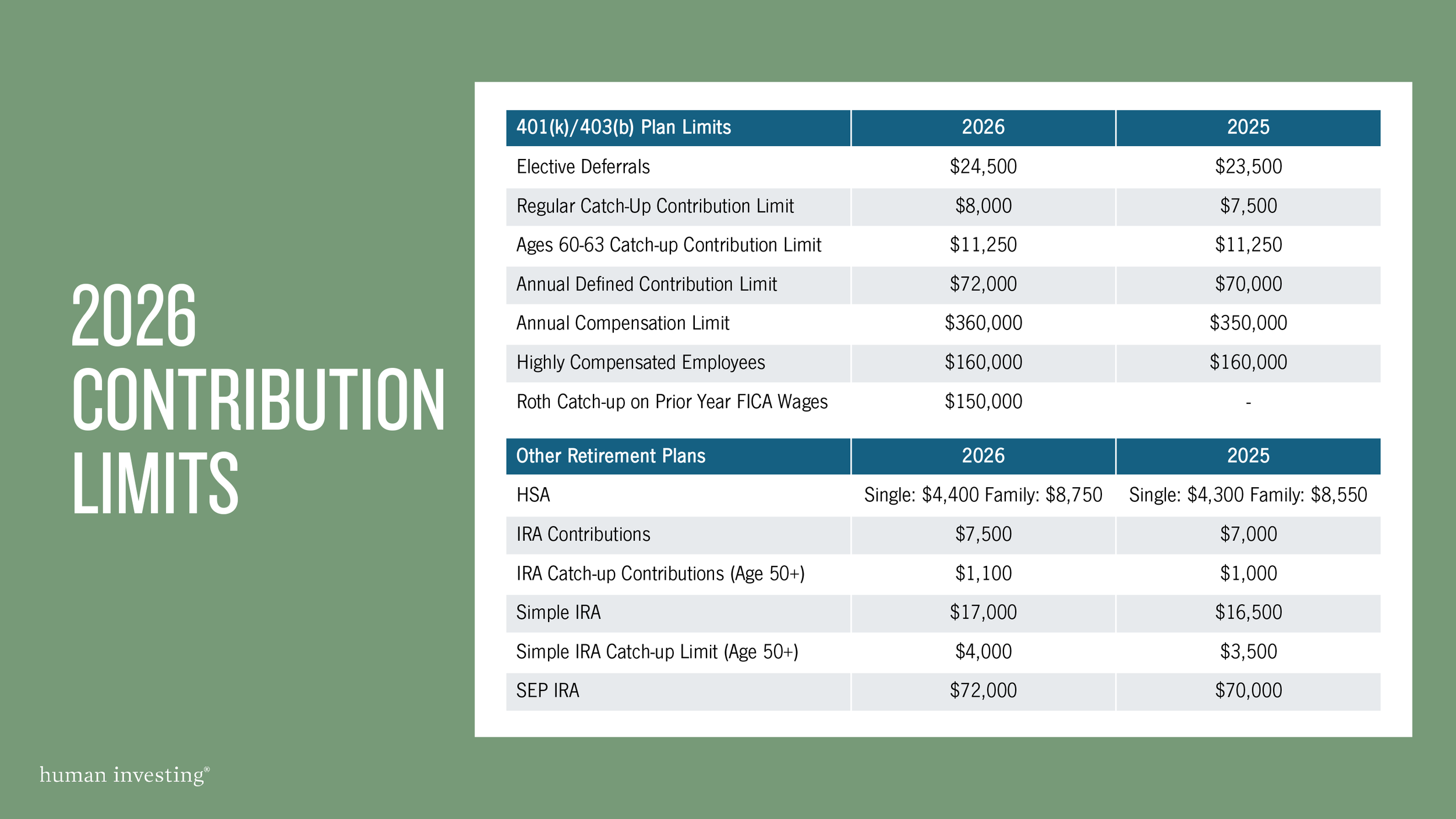
  • Under age 50: $24,500

  • Ages 50–59 and 64+: $32,500 (includes a $8,000 catch-up)

  • Ages 60–63: $35,750 (includes an $11,250 “super” catch-up)

SECURE 2.0 added another layer on top: starting in 2025, workers ages 60–63 get access to “super” catch-up contributions, up to 150% of the regular catch-up limit (or 110% for SIMPLE plans).

It is possible that catch-up contribution may be required to be made as a Roth contribution, especially if your income exceeds certain thresholds.

For employees, the downside is giving up the upfront tax break on catch-up contributions. The upside? Tax-free withdrawals later.

For employers, the stakes are higher: if the plan isn’t set up to handle Roth catch-ups, some employees could lose access to them entirely.

Diving Into the New Rule: Roth Required for Some

Here’s the key change:

If you make more than $150,000 in FICA wages in 2026 (adjusted annually), all your catch-up dollars will have to go in as Roth contributions, after tax dollars, starting January 1, 2026.

This means if you fall into the higher-income category, your Roth catch-up will be automatically applied to your eligible contributions once you hit age 50.

A few quick clarifications:

  • This does not apply to SIMPLE IRAs or SEP plans.

  • Wages are measured using Box 3 on your W-2.

  • If your plan does not include a Roth deferral option, catch-up contributions won’t be permitted in your plan regardless of income.

Congress delayed this rule once (from 2024 to 2026) to give employers time to adjust. That grace period is ending soon.

Two Types of Catch-Up Contributions

Depending on your age and plan setup, catch-ups may fall into these buckets:

  1. Standard age-50 catch-ups
    These are the usual “extra” contributions, and the ones subject to the Roth rule if you’re over the wage limit.

  2. “Super” catch-ups at ages 60–63
    Optional, but attractive for late-career savers (and yes, Roth rule applies to these as well).

If You Sponsor a Plan, Start Here

A survey from the Plan Sponsor Council of America says only 5% of plan sponsors feel fully ready.

Payroll providers will bear the heavy lifting here. Plan sponsors should lean on their payroll providers and ensure that there is clarity on how catch-up contributions are being made.

To facilitate administration of this new rule and employee experience, we suggest permitting “Deemed” Roth contributions. This means that there is an assumption that catch-up contributions will be considered Roth, even if an employee has elected pre-tax deferrals for their base contribution. Deemed Roth feature is typically setup as a function of payroll and must be included in your governing plan documents.

To avoid last-minute scrambling, here’s what employers should be doing in 2025 and into 2026:

  • Check whether your plan even offer Roth - this is a great deferral option for all employees, regardless of income.

  • Talk to payroll and your recordkeeper about tracking who’s subject to the rule.

  • Permit “Deemed” Roth contributions and amend plan document(s).  

  • Review catch-up provisions for ages 60–63 and for 403(b) service-based rules.

  • Create employee communications, especially for those over the wage limit.

  • Work with your Recordkeeper or TPA on plan amendments.

What’s the Timeline?

Here’s how the rollout shakes out:

  • Now — Setup a call with payroll and recordkeeper.

  • December 31, 2025 — New catch-up limits kick in.

  • January 1, 2026 — Roth requirement becomes real.

  • Late 2026 — Formal plan amendments are due.

We’re here to help

For the workers affected, the downside is giving up the upfront tax break on catch-up contributions. The upside? Tax-free withdrawals later.

For employers, the stakes are higher: if the plan isn’t set up to handle Roth catch-ups, some employees could lose access to them entirely.

Bottom line: Roth is about to move from optional to unavoidable for a lot of savers. Getting ahead of the change now will make 2026 less stressful. If you or someone you know may need assistance, let’s meet!


Disclosure: This material is for informational and educational purposes only and should not be considered personalized tax, legal, or investment advice. You should consult your own qualified tax, legal, and financial professionals before making any decisions based on this information. Tax laws and regulations, including those discussed here, may change and can vary based on individual circumstances. The examples and explanations provided are for general understanding and should not be relied upon to predict or guarantee outcomes. Investing and retirement planning involve risk, including possible loss of principal. Past performance does not guarantee future results. Advisory services are offered through Human Investing, LLC, an SEC-registered investment adviser.


 

Related Articles

Retire Early With the Rule of 55
 

Taking a distribution from a tax-qualified retirement plan, like a 401(k) before age 59.5, is generally subject to a 10% penalty for early withdrawal. The exceptions to paying this 10% penalty are:

Are you familiar with how the Rule of 55 works? If you want to retire early, this blog post is significant for you.

What is the Rule of 55?

The Rule of 55 is an IRS provision that allows employees who leave their job on or after age 55 to take penalty-free distributions from their retirement accounts. It’s a life hack! Typically, individuals would face a 10% early-withdrawal penalty if they access their retirement account before age 59.5. The 10% penalty and account accessibility are two of the reasons why people plan to work until at least age 59.5. 

If you are someone who is thinking about retiring early, the following Rule of 55 requirements are necessary:

  1. You leave your job (voluntarily or involuntarily) in or after the year you turn 55 years old.

  2. Your plan must allow for withdrawals before age 59.5.

  3. Your dollars must be kept in your employer’s retirement plan. If you roll them over to an IRA, you lose the Rule of 55 protection.

  4. You will likely want your plan to allow partial distributions when you are terminated.

Access to your retirement account at age 55 is available for all employees with an employer-sponsored retirement account. However, if you are considering retiring after age 55 and using funds from this retirement account, you must check whether your plan allows partial distributions. This feature is an opt-in feature for employers to select. We recommend that you work closely with your recordkeeper to ensure you can take advantage of the Rule of 55 in a way that benefits you.

3 Examples of the Rule of 55

Look at a few examples of employees with partial distributions compared to employees without partial distributions allowed in their plan.

Example 1: Partial Distributions Allowed

Danielle can take any amount from her PDX 401(k) account. For example, in October 2022, she can request $30,000. She doesn’t have to take anything out in 2023. She could take another $65,000 out in January 2024.

EXAMPLE 2: Partial Distributions Disallowed

Martin’s employer-sponsored retirement plan does not permit partial distributions. If he wants to access his retirement account at age 57 without incurring a 10% early-withdrawal penalty, he would have to withdraw the entire $450,000. This would result in reporting $450,000 of taxable income for the year of his distribution. Given the tax bracket optimization strategies that exist during retirement years, this may not be Martin’s best solution for accessing dollars before age 59.5.

A couple of alternative solutions for Martin are:

  1. Ideally, Martin would have a cash-flow plan to support his expenses until he reaches age 59.5.

  2. Initiate a direct rollover of his $450,000 retirement account into a IRA account. Then take distributions as needed but expect to pay a 10% penalty on these dollars. Before paying a 10% penalty on an early-distribution from a IRA, we would recommend that Martin review other cashflow options he may have.

Example 3: Partial Distributions Disallowed

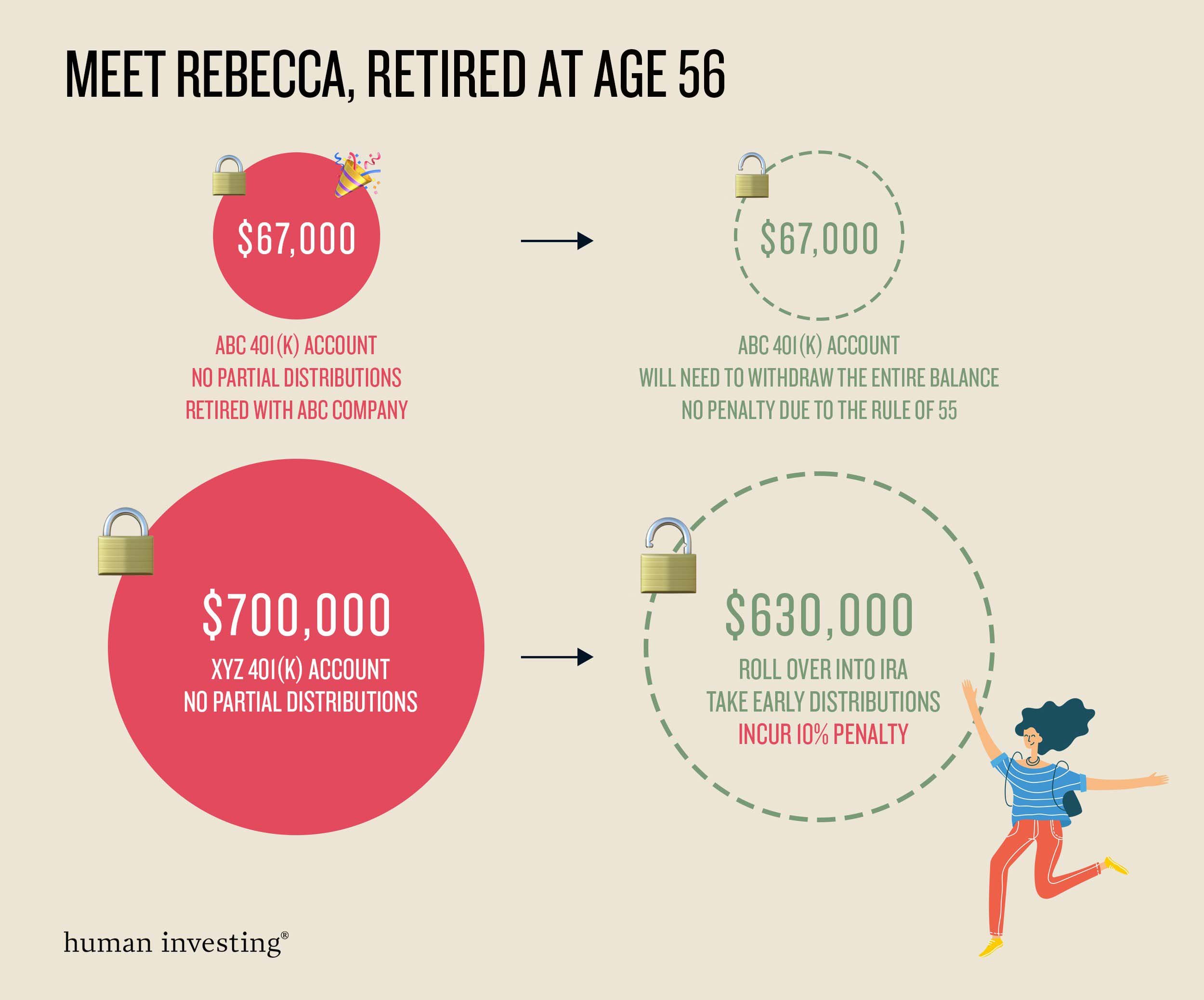
Rebecca, age 56, has $67,000 saved in her most recent 401(k) account with ABC Company. She also has $700,000 saved in her previous 401(k) account with XYZ Company. Neither of these retirement plans allow for partial distributions.

Rebecca retired at age 56 from ABC Company, so she can take the entire $67,000 balance out in one lump sum distribution. She will not owe a 10% penalty on these dollars due to the Rule of 55.

If she were to access any of her $700,000 saved in her previous 401(k) account with XYZ Company before age 59.5, then she would incur a 10% penalty. Not to mention the $700,000 is sitting in a plan that disallows partial distributions so that would be significant taxable income to report in the same tax year. Similar to the example above, Rebecca may consider initiating a direct rollover of her $700,000 into a IRA account for more flexible distribution choices.


What About Other 401(k) Accounts from Previous Jobs?

To qualify for the Rule of 55, you must be terminated as an employee on or after age 55. Therefore, if you have multiple retirement accounts, the only ones that will qualify for a penalty-free distribution between ages 55 and 59.5 are accounts with your termination date reflecting that age range.

One consideration is to roll over a previous retirement account into your current account before you retire. We recommend speaking with your recordkeeper to confirm that your retirement plan features are designed so rollover sources can be accessible by partial distributions.

For example, if Danielle from above had another 401(k) account, she could have rolled that into her PDX 401(k) account before retiring. All the dollars in the account would be eligible for Rule of 55 distributions.

What if I Decide to go Back to Work but have Taken Distributions Already?

Going back to work after you have taken a Rule of 55 distribution should not result in a 10% penalty. If you go back to work for the same company, then you may lose the ability to access funds as an active employee. However, your distributions will not be impacted if you go back to work at another organization.

How are Rule of 55 Distributions Tracked for Tax Reasons?

Custodians and recordkeepers are responsible for providing a Form 1099-R. This tax form reports any distributions from a retirement account. If you take a distribution under the Rule of 55, you would expect to see code 2 in box 7 of your 1099-R form. Code 2 specifies the following:

2 - Early distribution, exception applies (under age 59.5)

If your 1099-R form includes Code 2 in box 7, you will not owe a 10% penalty. Before you initiate a withdrawal between ages 55-59.5, we recommend confirming your record keeper will issue the 1099 in this format.

What Other Resources do you Have?

Retirement is a transition that only happens once in life. You probably haven’t retired before, and you likely won’t retire again. Retirement transitions involve several financial planning considerations and we wanted to conclude this article with additional resources that may be helpful to you:

Your Pre-Retirement Checklist

The 3 Questions to Ask to Build a Solid Retirement Income Plan

Why an IRA Makes More Sense in Retirement than your 401(k)

While the articles are supplemental information, we believe the best way to prepare for your upcoming retirement is to collaborate with our team at Human Investing. Please use this scheduling link to meet with our team to review your unique financial landscape before you start planning your retirement celebration(s): Schedule here.


Related Articles

Finding Inspiration as an HR Leader
 
Don’t worry, they look like they’re six feet apart

Don’t worry, they look like they’re six feet apart

In these days I am reminded on a regular basis of the challenge we’re facing and the mountain we are all being asked (or expected) to climb. Whether we’ve been practicing the right skills or not seems to be a bit of a pointless question at this exact moment as the time is now. Right now, it’s go time. But what does that even mean?

Lifting up our employees

As the person charged with Human Resources for our “under 25 employees” small company, I’ve asked more self-reflective questions than any person might if not for living smack dab in the middle of a global pandemic. I’ve been inspired by all the heroic first responders. I’ve wondered what to start, stop and do more of. I’ve leaned on the many agencies churning out updated work/job-related information relating to this current crisis. Agencies like the Department of Labor (DOL), Wage and Hour Division (WHD), the Bureau of Labor and Industry (BOLI-OR) and the Internal Revenue Service (IRS). Our vendors and providers are also working tirelessly to keep us connected, plugged in and functioning. So instead of resharing information that is coming directly from these various sources that have helped my firm,  I wanted to share three specific insights I’m learning as I seek outside my usual “Resources” to help buoy up myself and my “Humans.”

1. What were your daily routines?

As I experience the ups-and-downs of it all I’ve been more intently drawing upon what I’ve practiced in pre-pandemic times. These practices include both spiritual and physical exercises. I’ve encouraged my team to do the same. It’s daily, it’s sometimes hard, but it’s good and it’s a good starting point. I’ll share a bit from my experience today. I listened to a morning message and was reminded of courage. I’ve certainly been seeing and hearing about it in the news. Great feats of courage revealing the true human virtue that it is. This morning I decided to stop and spend a few minutes pondering courage. And even thinking on the word brought me inspiration which lead to new motivation for the day. Author Melanie Greenburg, PH. D gives some great highlights and quote’s around courage. If interested, check out her article, “The Six Attributes of Courage,” where she presents several elements of courage and a courage building exercise.

2. W.I.N

Next, I thought I’d share what I learned from a recent webinar I listened to. The webinar, titled “Mental Skills for the COVID crisis” caught my eye on my Instagram story feed so I signed up to listen and learn! One of the things I learned (and a great takeaway) was from the pratice’s co-founder Dr. Jonatan Fader, who shared the acronym WIN: What’s Important Now. I loved this for several reasons: it’s short, I can remember it, and it’s totally applicable right now. I wasted no time in sharing WIN with my team and continue to draw on it daily for both inspiration and focus. If you’ve got time or need a break from what’s in front of you check out the full webinar at Mental Skills for the COVID crisis.

3. FIND inspiration from the Least Expected places

And lastly, a simple story of personal inspiration. This week is the start of spring term for my 2 college kids. They are both home, both in creative majors requiring studio’s and currently sharing what we now call ‘dorm room north.’ At about 6:30am I heard the coffee pot brewing and then the sound of a sewing machine getting warmed up. It was my son’s industrial sewing class. No Zoom meeting offered and with little direction he proceeded to make something from nothing. Trying to keep our sense of humor I looked over and mentioned what a great job he did to hear him say with a note of wit “welcome to my forte.”  And then came 2pm and my daughter’s painting class. While we don’t have an easel or a separate studio, other than the front entry that also doubles as a workout area, she began mixing her colors as if she were crafting a new recipe. I’ve seen (and felt) their disappointment, discouragement and then coming to terms with the fact that their art classes would be at-home in makeshift locations.  They have pressed on past their current limitations, not without gratitude, but certainly with a level of grit and courage. As I looked up at each of them over my morning coffee, I took inspiration to also push past my fears today and get started.

So my question to you is what’s in front of you today that might inspire you in some new way? Keep watch for that daily inspiration, especially aware of the usual and mundane. You may find yourself inspired by regular life as much as you’ve been inspired by the most courageous on the front lines. And as my 81 year old mom says – take what helps and leave the rest and take heart.


Related Articles

CARES Act: What 401(k) Plan Sponsors Need to Know  
 

This week the Senate unanimously passed the Coronavirus Aid, Relief, and Economic Security Act (CARES Act), a massive stimulus bill targeting the economic turmoil caused by the coronavirus pandemic. The 883-page bill aims to help Americans through these financially trying times. While as of this writing the CARES Act had yet to pass the House, all indicators point to the bill passing and being signed by the president.  

Specific to 401(k) plans, the CARES Act includes provisions around hardship distributions, 401(k) loans, and RMDs (Required Minimum Distributions) for 2020. Additionally, the Families First Coronavirus Response Act (FFCRA) was also passed and expands paid-leave coverage to employees affected by coronavirus. We are working closely with our ERISA consultation team and industry partners to determine the specifics of how plan sponsors should adapt administrative practices to accommodate these special 2020 provisions.  

 Hardship Withdrawals  

  • The 10% early withdrawal penalty has been waived for distributions up to $100,000. Eligible participants under the age of 59 ½ may be able to request a distribution due to financial distress related to coronavirus through the end of 2020.  

  • It is left to the plan sponsor’s discretion to determine that the request is for a qualifying coronavirus-related reason (such as adverse financial consequences due to being quarantined, furloughed, having work hours reduced, or not being able to work due to childcare coverage).  

  • The taxes due on the withdrawal amount may be paid out over a three-year period.  

  • Participants have the option to repay the distribution amount back into their 401(k) accounts within three years. 

 401(k) Loans 

  • Participants with a new or existing 401(k) loan can delay any repayments due in 2020 for one year. 

  • This covers loans due in full in 2020 – the CARES Act allows the repayment to be delayed for one year from the original due date. (Participants who terminate employment in 2020 will thus have additional time to repay their loan prior to it being considered a deemed distribution.)  

  • The maximum loan amount has been increased to the lesser of $100,000 or the maximum account balance available.  

  • The same risks regarding 401(k) loans still exist.  

Required Minimum Distributions 

  • Retired participants and owners 70 ½ and older may waive 2020 required distributions from their 401(k) and other retirement savings accounts such as an IRA. 

  • Individuals may find this beneficial as the 2020 RMD is calculated on account balances as of December 31, 2019 but due to recent market declines, a retiree could be withdrawing from an already reduced account balance.  

  • Participants should speak with their financial advisor or tax consultant in determining whether to waive their 2020 RMD.  

 FFCRA 

  • Some employers may be exempt, such as those with fewer than fifty employees, but in general, employees must be provided with up to ten weeks of paid leave for specific coronavirus-related reasons.  

  • Additional guidelines for employers can be found here.   

 Your Human Investing 401(k) Team is here to be a resource for you and your employees. We will be sure to share additional updates and guidance as they are provided. Please don’t hesitate to reach out to us with any questions in the meantime!  


Related Articles