
Posts in Retirement
What The New IRS Rule Means For Plan Sponsors & Workers Over 50


If you’re 50 or older and use catch-up contributions to bulk up your retirement savings, or you help run a plan that offers them, there’s a rule change that should be on your radar.

In mid-September, the IRS and Treasury finalized how a piece of the SECURE 2.0 Act will work. The short version: starting in 2026, certain higher-earning workers will only be able to make their catch-up contributions as Roth (after-tax) dollars.

Getting ahead of the change now will make 2026 a lot less painful.

First, What Are Catch-Up Contributions and Why Do THey Matter?

Once you hit age 50, you can put extra money into your 401(k), 403(b), or similar plan, above the standard IRS limit. That’s been true for years.

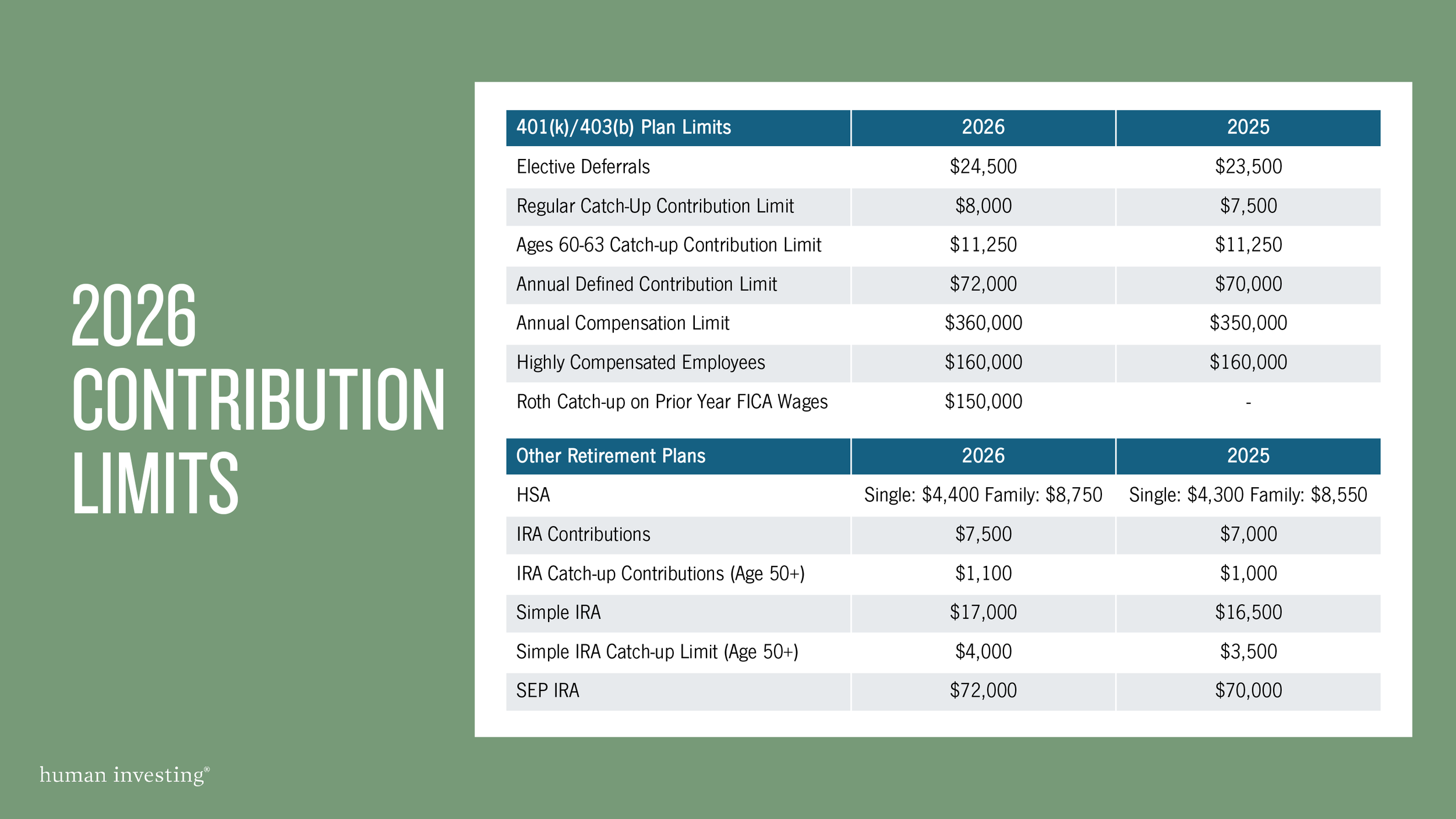
Here is the breakdown for 2026:

  • Under age 50: $24,500

  • Ages 50–59 and 64+: $32,500 (includes a $8,000 catch-up)

  • Ages 60–63: $35,750 (includes an $11,250 “super” catch-up)

SECURE 2.0 added another layer on top: starting in 2025, workers ages 60–63 get access to “super” catch-up contributions, up to 150% of the regular catch-up limit (or 110% for SIMPLE plans).

It is possible that catch-up contribution may be required to be made as a Roth contribution, especially if your income exceeds certain thresholds.

For employees, the downside is giving up the upfront tax break on catch-up contributions. The upside? Tax-free withdrawals later.

For employers, the stakes are higher: if the plan isn’t set up to handle Roth catch-ups, some employees could lose access to them entirely.

Diving Into the New Rule: Roth Required for Some

Here’s the key change:

If you make more than $150,000 in FICA wages in 2026 (adjusted annually), all your catch-up dollars will have to go in as Roth contributions, after tax dollars, starting January 1, 2026.

This means if you fall into the higher-income category, your Roth catch-up will be automatically applied to your eligible contributions once you hit age 50.

A few quick clarifications:

  • This does not apply to SIMPLE IRAs or SEP plans.

  • Wages are measured using Box 3 on your W-2.

  • If your plan does not include a Roth deferral option, catch-up contributions won’t be permitted in your plan regardless of income.

Congress delayed this rule once (from 2024 to 2026) to give employers time to adjust. That grace period is ending soon.

Two Types of Catch-Up Contributions

Depending on your age and plan setup, catch-ups may fall into these buckets:

  1. Standard age-50 catch-ups
    These are the usual “extra” contributions, and the ones subject to the Roth rule if you’re over the wage limit.

  2. “Super” catch-ups at ages 60–63
    Optional, but attractive for late-career savers (and yes, Roth rule applies to these as well).

If You Sponsor a Plan, Start Here

A survey from the Plan Sponsor Council of America says only 5% of plan sponsors feel fully ready.

Payroll providers will bear the heavy lifting here. Plan sponsors should lean on their payroll providers and ensure that there is clarity on how catch-up contributions are being made.

To facilitate administration of this new rule and employee experience, we suggest permitting “Deemed” Roth contributions. This means that there is an assumption that catch-up contributions will be considered Roth, even if an employee has elected pre-tax deferrals for their base contribution. Deemed Roth feature is typically setup as a function of payroll and must be included in your governing plan documents.

To avoid last-minute scrambling, here’s what employers should be doing in 2025 and into 2026:

  • Check whether your plan even offer Roth - this is a great deferral option for all employees, regardless of income.

  • Talk to payroll and your recordkeeper about tracking who’s subject to the rule.

  • Permit “Deemed” Roth contributions and amend plan document(s).  

  • Review catch-up provisions for ages 60–63 and for 403(b) service-based rules.

  • Create employee communications, especially for those over the wage limit.

  • Work with your Recordkeeper or TPA on plan amendments.

What’s the Timeline?

Here’s how the rollout shakes out:

  • Now — Setup a call with payroll and recordkeeper.

  • December 31, 2025 — New catch-up limits kick in.

  • January 1, 2026 — Roth requirement becomes real.

  • Late 2026 — Formal plan amendments are due.

We’re here to help

For the workers affected, the downside is giving up the upfront tax break on catch-up contributions. The upside? Tax-free withdrawals later.

For employers, the stakes are higher: if the plan isn’t set up to handle Roth catch-ups, some employees could lose access to them entirely.

Bottom line: Roth is about to move from optional to unavoidable for a lot of savers. Getting ahead of the change now will make 2026 less stressful. If you or someone you know may need assistance, let’s meet!


Disclosure: This material is for informational and educational purposes only and should not be considered personalized tax, legal, or investment advice. You should consult your own qualified tax, legal, and financial professionals before making any decisions based on this information. Tax laws and regulations, including those discussed here, may change and can vary based on individual circumstances. The examples and explanations provided are for general understanding and should not be relied upon to predict or guarantee outcomes. Investing and retirement planning involve risk, including possible loss of principal. Past performance does not guarantee future results. Advisory services are offered through Human Investing, LLC, an SEC-registered investment adviser.


 

Related Articles

The Dangerous Reality Of Using Your 401k To Finance Your Vacation
 

Looking to go on a “once in a lifetime” trip to Fiji? Remodel your kitchen? Buy a new car? If your employer plan allows it, you may be tempted to take out a loan from your 401(k) to help fund that major expense.

Before you do, let’s talk through what a 401k loan looks like today and why borrowing from your future self can cost far more than you expect.

The Details

If your 401(k) plan allows loans, you can technically borrow up to $50,000 or 50% of your owned retirement savings (vested balance), whichever is less. There’s no credit check, and repayments are automatically taken from your paycheck.

For 2025, the interest rate on a 401k loan is roughly 9.50% (Rate of Prime + 1%). That’s a high rate for borrowing from yourself, and it can add up quickly. While the interest you pay goes back into your account, it’s still your retirement money being used, which could slow long-term growth.

Even though it’s allowed, taking a loan from your 401(k) isn’t usually recommended: about 1 in 5 people with a 401(k) have a loan at any given time, but doing so can put your future financial security at risk.

The Dangerous Reality

Still sounds pretty good, right? Well… not so fast.

A 401(k) loan can come at a real cost and not just the money you pull out today. It’s the potential long-term growth and retirement dollars you lose out on by stepping out of the market and halting contributions.

Here’s what you need to understand:

You lose tax-advantaged growth
Loan repayments are made with after-tax dollars. Then you’ll likely pay tax again when withdrawing the funds in retirement. That double-tax effect makes the math harder to win.

You could face a tax bill and penalty if you change jobs
If you leave your employer before the loan is repaid, the remaining balance typically must be paid back by tax filing time. If not, the balance becomes taxable and if you are under 59½, you may face a 10% early withdrawal penalty.

Stopping contributions
Many borrowers pause contributions while repaying the loan. If your plan gives an employer match, that means you may miss out on free money.

Dollars stop compounding
The money you borrow no longer participates in the market. In periods of growth, missing out on compounding has long-term consequences.

A Real-Life Example

Say you make $75,000 a year and want to borrow $15,000 from your 401(k) to fund a big trip or home project. To make the loan payments easier, you pause your 401(k) contributions while you pay it back.

Let’s also assume you already have $50,000 saved in your 401(k) when you take this loan.

Here’s what happens:

  • You normally save 7% of your pay ($5,250/year)

  • Your employer matches another 3% ($2,250/year)

By stopping contributions for three years, you miss:

  • $15,750 you would have put in

  • $6,750 your employer would have matched

That’s $22,500 total that never gets invested.

Now let’s look at the long-term impact.

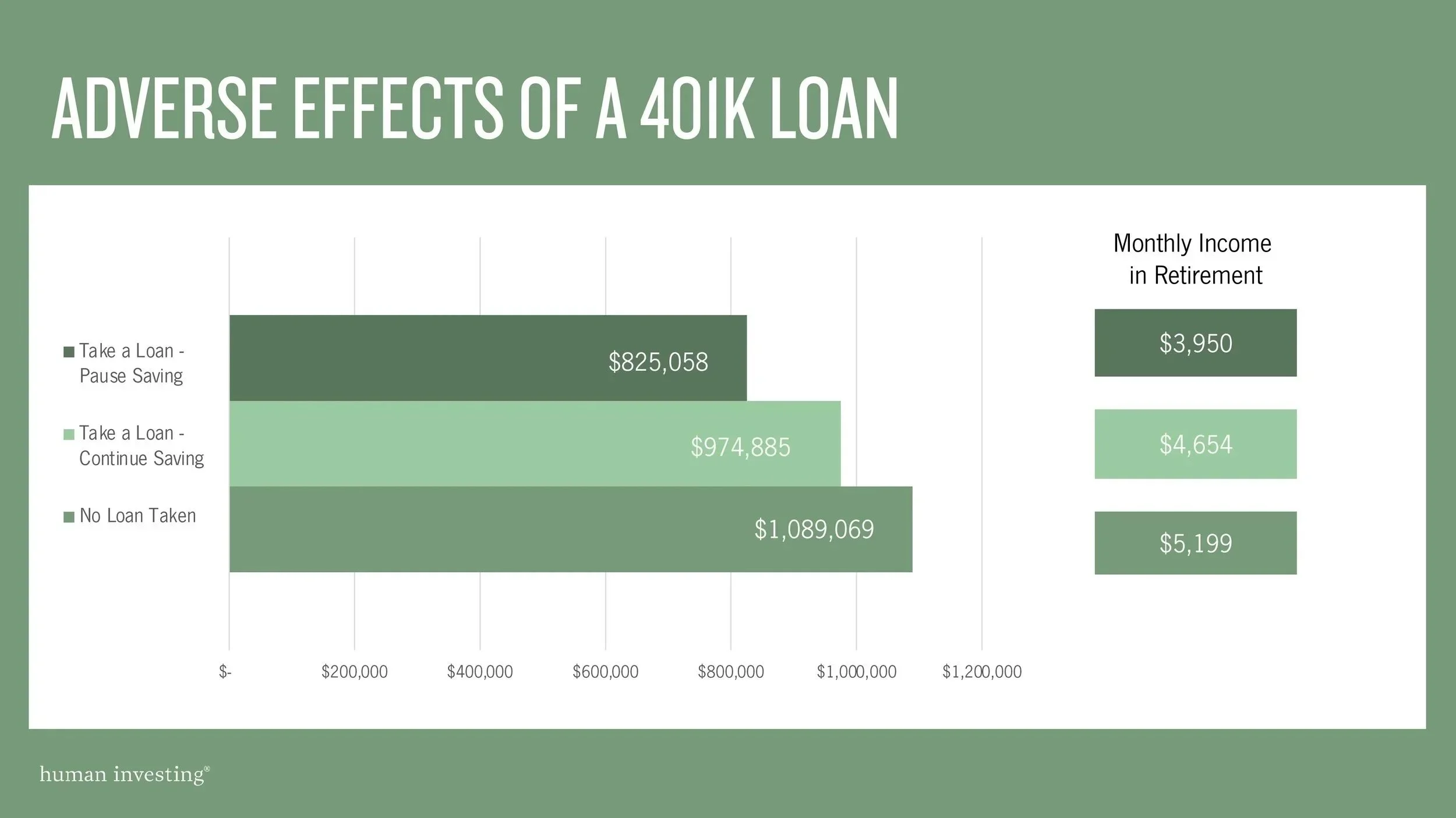
This graph is for illustration purposes only. It highlights the impact a loan has on an individual’s retirement balance and monthly retirement income after 30 years of investment growth during working years (assuming 7% annual market return and annual contributions of $7,500) and 30 years of income through retirement (assuming 4% rate of return). In this example an individual takes a $15k 401(k) loan from a $50k balance to pay down some bills and a finance a vacation.

If that $22,500 had been invested and grew at a reasonable long-term rate of 7% per year over 30 years it could grow to roughly $265,000 by retirement age.

That also means potentially $1,250 less per month during retirement all to fund something that might only last a week or two, today.

Options to Consider

For some people, a 401(k) loan may be a necessary tool for true emergencies. But for vacations, renovations, or lifestyle upgrades, think twice.

Here’s what to do instead:

  • Build a dedicated savings fund for big trips or purchases

  • Maintain an emergency reserve (3–6 months of expenses)

  • Continue contributions if a loan is taken, especially if employer match is available

  • Talk with your plan administrator or financial advisor to understand your plan’s rules

Borrowing from your retirement plan may feel easy, but the long-term cost can be steep. Give your future self the chance to enjoy a comfortable retirement without sacrificing peace of mind today.


Disclosure: This material is for informational purposes only and is not intended to provide investment, tax, or legal advice. The examples provided are hypothetical and for illustration only. Actual results will vary. Retirement plan loans and withdrawals may have long-term effects on your savings and tax situation. Consider consulting a qualified financial professional before making decisions about your 401(k) or other retirement accounts.

Investing involves risk, including the possible loss of principal. Past performance does not guarantee future results. Human Investing is an SEC-registered investment adviser. Registration does not imply any level of skill or training.

 

Related Articles

Why Your Advisor Matters More Than Ever: The Real Value of Financial Advice
 

Financial markets have become increasingly complex, making it difficult for individual investors to navigate successfully on their own. Investors often face the question of whether hiring a financial advisor truly provides enough value to justify the fees.

Recent comprehensive research by Vanguard, DALBAR, and other industry experts provides compelling evidence that professional financial advice offers significant value beyond basic investment selection. 

A case for having a pro on your side

Skepticism toward the financial advice industry is understandable—bad experiences, opaque fee structures, or conflicts of interest have burned many investors. Stories of sales-driven advice and misaligned incentives have cast a long shadow. This article is not a defense of every advisor, but rather a case for how true fiduciary advice—delivered transparently and with accountability, can provide measurable value in an increasingly emotional and volatile investing environment.

This emotional volatility is not hypothetical. We live in an era of heightened uncertainty, with rapid market shifts and global instability testing investor patience. As Fisher (2025) highlights in The Psychology of Market Patience, staying invested through turbulence demands far more than logic—it requires resilience. In these moments, the steady presence of a fiduciary advisor can serve as both guide and guardrail, helping investors remain committed to their long-term goals.

Professional advisors serve not only as planners and portfolio managers but also as behavioral coaches and accountability partners. This role is becoming even more essential as emotional decision-making erodes individual investor returns. The following sections explore how advisors can help improve portfolio outcomes, increase the likelihood of meeting financial goals, and reduce the emotional cost of investing.

They help enhance your portfolio performance

One of the most critical aspects of working with a financial advisor is the potential for improved portfolio performance. Contrary to the popular belief that advisors primarily add value by outperforming the market, research indicates that the most meaningful advisor contributions come from disciplined investment strategies. Advisors employ practices such as improved diversification, regular portfolio rebalancing, and tax-efficient investing, each enhancing long-term returns (Pagliaro & Utkus, 2019).

Vanguard’s research quantifies this benefit, estimating that financial advisors may add about 3% per year in net returns compared to a typical self-directed investor (Kinniry et al., 2022). This incremental gain, compounded over years, translates into significantly greater wealth accumulation.  

They can walk with you through turbulent times

According to DALBAR’s 2024 Quantitative Analysis of Investor Behavior (QAIB) report, the average equity investor significantly underperformed the market. In 2023 alone, the typical equity investor earned 5.5% less than the S&P 500, marking the third-largest performance gap in the past decade (DALBAR, 2024). This underperformance primarily results from emotionally driven investment decisions, such as selling assets during downturns and missing subsequent rebounds.

DALBAR’s findings further illustrate this emotional cost during turbulent periods. For example, the average equity investor saw returns of -21.17% in 2022, compared to the S&P 500’s -18.11%. Even in the strong market rebound of 2023, investors again lagged the market substantially, achieving only 20.79% returns versus the S&P 500’s 26.29% (DALBAR, 2024). Such significant performance gaps highlight the crucial role of advisors in mitigating harmful investor behaviors.

they can lead you to your goals with precision

Beyond portfolio management, financial advisors significantly enhance investors' ability to achieve long-term financial goals such as retirement security. Vanguard’s study on Personal Advisor Services (PAS) reveals that advised investors have an 80% or higher chance of successfully meeting their retirement goals compared to investors without professional guidance (Pagliaro & Utkus, 2019).

The role of fiduciary advisors—professionals legally obligated to act in the best interests of their clients—is particularly critical. According to Sheldon Geller, fiduciary advisors are required to disclose and mitigate conflicts of interest, ensuring investment decisions prioritize client goals over personal or company gain. This fiduciary responsibility provides investors with assurance and confidence, contributing to better financial outcomes (Geller, 2017).

They provide emotional stability

One of the most valuable yet often overlooked benefits of financial advice is the emotional stability it provides. Behavioral finance studies show that individual investors frequently succumb to emotional biases such as overconfidence, excessive trading, and holding onto losing investments too long.

Maymin and Fisher (2011) emphasize the value financial advisors add through behavioral coaching, helping clients avoid impulsive decisions during market downturns. Vanguard's research quantifies this emotional benefit, attributing between 0 and 2% in additional annual returns to behavioral coaching alone (Kinniry et al., 2022). Trust and personal connection further account for nearly half of the perceived value in advisor-client relationships, empowering clients to stay committed to their investment strategies during volatile periods (Pagliaro & Utkus, 2019). 

They will help you stick to a long-term strategy

Investor discipline, encouraged by advisors, remains critical for achieving optimal returns. DALBAR’s findings underscore how investor behavior significantly impacts returns. The report indicates that investors who maintain long-term strategies, supported by professional guidance, substantially outperform those who make emotional decisions (DALBAR, 2024).

The historical evidence from DALBAR’s extensive research over the past 30 years consistently shows that emotional investment decisions are detrimental. Advisors counteract this by instilling discipline, maintaining structured investment strategies, and reinforcing long-term thinking, resulting in better investment outcomes.

find an advisor who helps you go further than you could alone

Despite substantial evidence supporting the value of financial advice, some investors remain skeptical, often due to isolated cases of underperformance by certain advisors. However, focusing solely on short-term investment returns can be misleading. The primary value of financial advice lies in comprehensive financial planning, disciplined behavioral coaching, and fiduciary oversight.

Investors should critically evaluate advisors based on their holistic service offerings, transparency, and fiduciary commitment rather than just short-term market performance. Effective advisors deliver measurable benefits through strategic planning, emotional guidance, and long-term investment discipline.  

being a FIDUCIARY matters

Understanding the differences among fiduciary, quasi-fiduciary, and non-fiduciary advice is essential. According to Fisher (2025), only about 4.92% of financial professionals in the U.S. operate as fee-only fiduciaries, legally obligated to place their clients' best interests above their own and disclose any potential conflicts of interest. Quasi-fiduciary advisors might follow fiduciary standards selectively or in certain situations but may still receive commissions or have other conflicts of interest. Non-fiduciary advisors, such as brokers, typically operate under suitability standards rather than fiduciary obligations, often leading to decisions that may not align with optimal client outcomes (Fisher, 2025).

The distinction between these advisory models is critical for investors. True fiduciary advisors provide greater transparency, reduce conflicts of interest, and often result in higher client satisfaction and better long-term financial outcomes. 

Invest wisely with professional guidance

Navigating today's financial landscape alone poses substantial risks, primarily due to emotional biases and complex market dynamics. Research from Vanguard, DALBAR, and leading financial experts clearly demonstrates the profound impact professional financial advisors have on investor outcomes. Advisors not only enhance portfolio returns but also significantly increase the likelihood of achieving critical financial goals and provide invaluable emotional reassurance.

Ultimately, investors who recognize and leverage the full spectrum of benefits offered by professional financial advice position themselves to achieve greater financial security, resilience, and long-term success.

References:

DALBAR. (2024). Quantitative Analysis of Investor Behavior (QAIB) Report. DALBAR, Inc. Retrieved from www.qaib.com

Fisher, P. (2025, April 6). The psychology of market patience. Human Investing. Human Investing. https://www.humaninvesting.com/450-journal/psychology-of-market-patience

Fisher, P. (2025, February 14). An analysis of investment advisor representatives and bureau of labor statistics data: Determining the percentage of financial advisors acting as true fiduciaries. https://www.humaninvesting.com/450-journal/only-5-percent-of-advisors-are-true-fiduciaries. Human Investing.

Geller, S. M. (2017). Retaining a fiduciary investment advisor. The CPA Journal, 72-73.

Kinniry, F. M. Jr., Jaconetti, C. M., DiJoseph, M. A., Walker, D. J., & Quinn, M. C. (2022). Putting a value on your value: Quantifying Vanguard Advisor’s Alpha. Vanguard Research.

Maymin, P. Z., & Fisher, G. S. (2011). Preventing emotional investing: An added value of an investment advisor. The Journal of Wealth Management, 13(4), 34-43. https://doi.org/10.3905/jwm.2011.13.4.034

Pagliaro, C. A., & Utkus, S. P. (2019).Assessing the value of advice. Vanguard Research.


A BOOK FOR THE SAVER IN ALL OF US

Becoming a 401(k) Millionaire isn’t your typical retirement guide. With 30 years in finance, Dr. Peter Fisher shares personal insights and real stories to help you plan with confidence.

Disclosure: Human Investing is a registered investment adviser with the U.S. Securities and Exchange Commission (SEC). Registration with the SEC does not imply a certain level of skill or training. This article is provided for informational and educational purposes only and should not be construed as personalized investment advice. The information contained herein is believed to be accurate as of the publication date but is subject to change without notice. Past performance is not indicative of future results. Index performance is shown for illustrative purposes only and does not represent the performance of any specific investment. Investors cannot invest directly in an index, and index returns do not reflect fees, expenses, or taxes. The estimated value added by advisors is based on research and modeling assumptions that may not reflect actual investor experiences. Actual results will vary based on individual circumstances, market conditions, and advisor practices. Investing involves risk, including the potential loss of principal. Readers should consult with a qualified financial advisor to assess their individual circumstances before making any financial decisions.


Related Articles

The Psychology of Market Patience: Navigating Volatility With a Steady Hand


Volatile markets test more than portfolios—they test patience. It’s easy to feel unsettled when headlines scream, and market volatility ensues. But the most important thing you can do as an investor is also the simplest: don’t let emotions get the best of you. 

In my nearly 30 years of advising clients, I’ve seen over and over again: the clients who succeed are the ones who manage their emotions, not just their money. The smartest thing you can do right now is stay calm and stay the course. The plan is working—even when it doesn’t feel like it. My experience has been that history has a way of rewarding those who stay calm, stay invested, and stay focused on their well-crafted financial plan.

At Human Investing, we believe that behavior, not timing or speculation, is what separates long-term success from short-term regret. For clients who have been with us for over 20 years, you’ve seen firsthand how a steady, disciplined approach can weather storms and grow wealth through them. For those new to our firm, please know that trust is the foundation of everything we do. We don’t just manage portfolios, we help guide people through uncertainty with clarity, care, and confidence.

To better understand the importance of maintaining a disciplined investment approach, it is helpful to examine five common psychological biases that often lead investors to deviate from sound decision-making. Drawing on both empirical research and professional experience, this section explores how emotional responses can override strategic thinking—particularly during periods of heightened uncertainty and market volatility—and outlines methods used to help clients remain focused on long-term objectives.

1. Loss aversion: When pain is louder than logic 

Researchers Kahneman, Knetsch, and Thaler (1991) discuss the psychological factors that drive loss aversion. Loss aversion is not just an investing concept; it’s a fundamental part of human psychology. Research shows that losses are felt about twice as painful as equivalent gains are perceived as pleasurable. In the brain, a $100 loss doesn’t just “sting”—it screams. And when markets drop, that emotional volume can drown out logic, strategy, and even years of sound advice.

This isn’t just a theory. I've seen it firsthand for a few decades—watching clients grapple with fear during the dotcom bust, the 2008 financial crisis, the 2020 COVID crash, and more recent volatility. In each case, the market eventually recovered. But those who let fear dictate their choices often miss the recovery, lock in their losses, and derail their long-term plans.

Here’s what makes loss aversion so dangerous: it feels rational. When the market drops 20%, the brain doesn’t think, “This is temporary.” It thinks, “Get out before it gets worse.” That impulse can feel like wisdom. But in reality, it's a trap.

The dislocation occurs when investors stop viewing a dip as part of the journey and begin to see it as the destination. Their long-term goals fade from view. The carefully designed plan becomes irrelevant. All that matters is stopping the pain.

But that short-term relief often comes at a prohibitive cost. Investors who sell at the bottom lock in their losses and are frequently too emotionally exhausted—or too afraid—to re-enter the market in time for the rebound. And rebound it almost always does. History shows that the market has consistently rewarded those who stay invested through downturns, not those who try to time their exits and re-entries.

2. Herding: When “everyone’s doing it” feels safer than thinking 

There’s a reason why stampedes are dangerous—not everyone in the crowd is running toward opportunity. Some are running from fear. 

In investing, we refer to this behavior as herding—the instinct to follow the crowd, particularly during times of uncertainty. Scharfstein and Stein (1990) were among the earliest to formally investigate and publish on the concept of herd mentality. We are indeed social creatures, hardwired to look to others for cues when we’re unsure. But in the markets, that instinct can be costly.

When prices drop and headlines grow loud, it’s natural to wonder: “What does everyone else know that I don’t?” You see friends moving to cash, analysts shouting about doom, and articles predicting disaster. The pull to join the herd becomes magnetic. But the crowd is often most unified at the wrong time, buying high out of excitement or selling low out of fear.

Here’s the cognitive dislocation: when fear spreads, we confuse consensus with correctness. If enough people are panicking, their emotion starts to feel like evidence. But markets are not democratic. The loudest voices are not always the wisest, and just because many are moving in the same direction doesn’t mean it’s the right one.

3. Recency bias: When yesterday becomes forever 

Tversky and Kahneman (1974) laid the foundational research on recency bias. They determine that “…the impact of seeing a house burning on the subjective probability of such accidents is probably greater than reading about a fire in the local paper. Furthermore, recent occurrences are likely to be relatively more available than earlier occurrences (p. 1127).” 

Put differently, individuals often extrapolate recent market movements into the future, believing that a market decline will persist or that a rally will continue indefinitely. This cognitive distortion, known as recency bias, reflects the tendency to overweight recent experiences when forming expectations about future outcomes.

It’s a mental shortcut that makes sense on the surface. After all, if it’s been raining for three days, we naturally reach for an umbrella on day four. But in the markets, this shortcut becomes a trap.

The dislocation happens when investors confuse a recent event with a long-term trend. They think: “The market’s been down the last two months—maybe this time is different. Maybe it won’t recover.” Or: “Tech has been hot all year—maybe it always will be.” This kind of thinking leads to chasing what has already happened or fleeing from what is already priced in.

Here’s the problem: the market doesn’t move in straight lines. It zigs, zags, and surprises. The best days often follow the worst. Yet, when recency bias takes hold, investors tend to anchor on the latest data point and overlook the broader context.

I’ve witnessed this bias unfold in every major market event since 1996. This ‘cognitive dislocation’ was particularly acute during the downturn from 2000 to 2002, when markets declined by 10%, 10%, and then 20%. But those who were paralyzed by recency bias—those who assumed the storm would never end—missed the sunshine that followed.

4. Sentiment: When moods masquerade as markets

The market is often described as a voting machine in the short term and a weighing machine in the long term (Graham, 2006). That’s another way of saying: in the short term, emotion can drive price more than value. And that emotion, called market sentiment, can be just as contagious and unpredictable as the weather.

Sentiment isn’t about fundamentals. It’s about how investors feel about the future. When people feel optimistic, they see opportunity in every dip. When they feel anxious, even the strongest companies look shaky. This is where the dislocation happens: investors begin to substitute their mood for actual analysis.

In times of high sentiment, people often buy more than they should, take on more risk than they realize, or ignore warning signs. During low sentiment, they often underinvest, sell too soon, or abandon long-term strategies altogether—not because the plan changed, but because their feelings did.

I’ve witnessed this in action many times since 1996, particularly in 2008, when panic dominated sentiment, and many investors fled the market near the bottom. The truth is, markets don’t care how we feel. But our feelings often shape how we interpret the market. That’s why at Human Investing, we spend as much time helping clients manage their emotions as we do managing their investments. We help you separate how you feel from what’s actually happening.

Your plan is designed to withstand emotional swings. It assumes there will be times when the market is overconfident, and times when it’s too afraid. That’s why we don’t react to moods. We respond to goals. Because when you confuse sentiment for truth, your portfolio becomes a mirror of your emotions. But when you trust your plan, your portfolio becomes a reflection of your purpose.

5. Emotional echo chambers: When biases team up to derail you

If loss aversion, herding, recency bias, and sentiment were minor on their own, we might be able to brush them off. But they don’t stay in their lanes. These biases often compound, amplifying each other until an investor is no longer thinking clearly. That’s what we call an emotional echo chamber—a space where your own fears are repeated and reinforced until they sound like facts.

Here’s how it plays out:

  • The market dips, triggering loss aversion—“I can’t afford to lose more.”

  • You see others selling, which activates herding—“Everyone’s getting out. Maybe I should, too.”

  • You assume the recent downturn is the new normal—recency bias—“It’s just going to get worse.”

  • Your confidence drops, and negative sentiment clouds your judgment—“I don’t feel safe, so maybe I’m not.” 

Suddenly, your investment decisions are no longer tied to your long-term goals—a chorus of emotional responses drives them, each one echoing the others. This is the moment investors often make their biggest mistakes: abandoning well-designed plans, selling at market lows, or shifting strategies midstream out of fear.

I’ve seen this cycle emerge during every major downturn. What I’ve learned is this: when fear gets loud, clarity gets quiet. Investors don’t just lose money in these moments—they lose confidence, perspective, and peace of mind.

At Human Investing, our job is to help you break out of that echo chamber. We’re here to re-center you when everything feels off-balance, to remind you of the purpose of your financial plan, and to bring you back to your long-term vision when the short-term noise becomes deafening.

We believe that staying invested is not just a financial decision, it’s an emotional discipline. That’s why we design portfolios that align with your comfort zone and why we lead with planning. Because a sound financial plan doesn’t just grow your wealth, it protects your thinking.

When emotional noise is high, we help you find quiet confidence. When biases clash in your head, we help you hear your goals again. And most importantly, when you start to feel like you’re the only one holding steady, we’re here to remind you—you’re not.

Empirical evidence

If the five behavioral prompts are not enough to encourage you to focus on your plan, a 40-year perspective on market ups and downs can provide an essential viewpoint. 

Please see Figure 1 at the end of this document. In it, you’ll see the average intra-year drop for the S&P 500 is approximately 14%, based on historical data going back several decades.

This means that in a typical year, the market will experience a peak-to-trough decline of around 14%—even in years that end up positive overall.

Here’s a quick breakdown:

From 1980 through 2023, the S&P 500 had: 

  • Positive returns in about 75% of those years

  • But it still experienced an average intra-year decline of ~14%

Why it matters:

Many investors panic during temporary drops, thinking something abnormal is happening. In reality, a 10–15% drop in a given year is a feature, not a flaw, of long-term investing. It’s part of the process, not a sign to change course.

References:

Graham, B. (2006). The intelligent investor: The definitive book on value investing (Rev. ed., J. Zweig, Commentary). Harper-Business. (Original work published 1949)

Kahneman, D., Knetsch, J. L., & Thaler, R. H. (1991). Anomalies: The endowment effect, loss aversion, and status quo bias. Journal of Economic perspectives, 5(1), 193-206.

Scharfstein, D. S., & Stein, J. C. (1990). Herd behavior and investment. The American economic review, 465-479.

Tversky, A., & Kahneman, D. (1974). Judgment under Uncertainty: Heuristics and Biases: Biases in judgments reveal some heuristics of thinking under uncertainty. science, 185(4157), 1124-1131.


Disclosures: These market returns are based on past performance of an index for illustrative purposes only. Past performance does not guarantee future results. All investing involves risk, including the loss of principal.  Index performance is provided for illustrative purposes only and does not reflect the performance of an actual investment. Investors cannot invest directly in an index.

The information provided in this communication is for informational and educational purposes only and should not be construed as investment advice, a recommendation, or an offer to buy or sell any securities. Market conditions can change at any time, and there is no assurance that any investment strategy will be successful.

Diversification does not guarantee a profit or protect against a loss in declining markets. Asset allocation and portfolio strategies do not ensure a profit or guarantee against loss.

The opinions expressed in this communication reflect our best judgment at the time of publication and are subject to change without notice. Any references to specific securities, asset classes, or financial strategies are for illustrative purposes only and should not be considered individualized recommendations.

Human Investing is a SEC Registered Investment Adviser. Registration as an investment adviser does not imply any level of skill or training and does not constitute an endorsement by the Comission. Please consult with your financial advisor to determine the appropriateness of any investment strategy based on your individual circumstances.



A BOOK FOR THE SAVER IN ALL OF US

Becoming a 401(k) Millionaire isn’t your typical retirement guide. With 30 years in finance, Dr. Peter Fisher shares personal insights and real stories to help you plan with confidence.


Related Articles

How to take care of your spouse financially if something happens to you


As the person who manages most of the financial decisions in your household, it's natural to want to ensure your spouse is financially secure if you're no longer around. The financial burden on a widow can be overwhelming, especially with the lesser-known tax implications that often follow the death of a spouse. By planning ahead, you can safeguard your spouse from unnecessary financial stress.

Taking a few proactive steps now can help shield your spouse from these challenges and give them peace of mind. This guide will walk you through the financial implications of losing a spouse and what you can do today to ensure you preserve your assets for their well-being.

There are two common tax shocks you want to get ahead of:

Tax shock #1: The “survivor's penalty”

After a spouse dies, the widow is often left facing what’s called the "survivor’s penalty," which refers to higher taxes that result from a change in filing status. While you may currently file taxes jointly as a married couple, your spouse would be required to file as a single taxpayer after your death. This change can increase their tax bill substantially.

Here’s why this matters:

  • Higher Marginal Tax Brackets: After your passing, your spouse’s income could fall into a higher tax bracket due to the narrower brackets for single filers compared to married couples.

  • Reduced Standard Deduction: In 2024, the standard deduction for married couples filing jointly will be $29,200, but for single filers, it will be just $14,600. This reduction will increase the amount of income subject to taxes.

Looking ahead, it’s important to note that individual tax brackets are set to revert to pre-2018 levels in 2026, further increasing the tax burden on your spouse if you’re no longer here.

Tax shock #2: Hefty taxes on IRA distributions

If your spouse inherits your retirement accounts, such as an IRA, they’ll also face higher taxes due to Required Minimum Distributions (RMDs). These distributions are considered ordinary income, and combined with their new single filing status, could push them into an even higher tax bracket! The larger your IRA, the bigger this tax burden becomes.

What may seem like a well-planned nest egg now could become a source of financial strain later on due to taxes. By understanding this, you can take steps now to lessen the impact on your spouse’s financial future.

Firsthand example from a retired couple

When Spouse #1 and Spouse #2 file jointly, both receive Social Security and must take Required Minimum Distributions (RMDs) from their retirement accounts. Let’s look at their income and tax bill while filing as Married Filing Jointly (MFJ):

Now, if Spouse #1 passes, Spouse #2 becomes the sole taxpayer, facing a shift to the Single filing status. Spouse #2 is still required to take the same RMD amount as the beneficiary of the retirement accounts and claims Spouse #1’s higher Social Security benefit under the survivor benefit rules. However, Spouse #2 cannot receive both Social Security payments, so Spouse 2’s income is reduced. Here’s what their tax situation would look like:

Despite an almost 16% drop in income, Spouse #2's tax bill increases by over 30%, showing the impact of the survivor’s penalty on income and tax liability.

This example highlights why it’s essential to plan ahead to help lessen the financial burden on surviving spouses.

Four strategies to protect your spouse from a heavy tax burden

Fortunately, there are several strategies you can use to reduce the tax burden on your spouse in the future:

  1. Complete Tax Projections: To best plan for the future and make calculated decisions, it’s necessary to understand your expected lifetime tax bill. A comprehensive tax projection will identify your current and future tax rates, potential gaps, and overall lifetime tax obligations. This helps you make informed decisions today.

  2. Partial Roth IRA Conversions: Converting part of your traditional IRA into a Roth IRA over time can help reduce the tax impact on your spouse later. While you’ll pay taxes on the conversion now, the Roth IRA’s future growth will be tax-free, meaning less taxable income for your spouse when they inherit it.

  3. Take Advantage of the Step-Up in Basis: For non-retirement investments, your spouse can benefit from a "step-up in basis." This allows the cost basis of assets to reset to their value at the time of your death, potentially eliminating capital gains taxes if they were to sell those assets. Understanding this advantage can save your spouse from an unexpected tax bill down the road.

  4. Naming Non-Spouse Beneficiaries: Another option to reduce taxes is to name non-spouse beneficiaries for some of your retirement accounts, such as your children and grandchildren. While this can lessen the tax burden for your spouse, it’s essential that these non-spouse beneficiaries understand the new withdrawal rules set by the SECURE Act. This law requires that non-spouse beneficiaries fully distribute inherited IRA funds within 10 years, which could trigger substantial tax liabilities for them if not carefully planned. Additionally, consider adding a qualified charity as a beneficiary to your IRA for a tax-free transfer gift.

You can start planning ahead with your spouse now

Planning for your spouse's financial future can be an impactful gift. While it may be uncomfortable to think about what happens if you're no longer here, taking proactive steps now will ease your spouse’s transition during a difficult time. Here are a few key actions to consider:

Have Regular Financial Discussions: Make sure your spouse understands your financial plan, knows how to manage accounts, and is familiar with where to find important documents.

Work with a Fiduciary Financial Advisor: A financial advisor can help you develop a plan tailored to your family’s situation. By understanding your overall financial situation, an advisor can provide guidance now and assist your spouse when you're no longer there. They can also help with tax projections, Roth conversions, beneficiary updates, and staying ahead of tax law changes.

Create a Clear, Organized Estate Plan: Ensure your estate plan is up to date, including wills, trusts, health care directives, power of attorney, and beneficiary designations. This will help prevent unnecessary complications for your spouse during an already challenging time.

Be Proactive About Taxes: By planning for your spouse’s future tax obligations, you can reduce the “survivor’s penalty” and give your spouse more financial security.

You’ve worked hard to provide for your family, and planning for your spouse’s financial future if something happens to you is a vital part of that legacy. While it may seem difficult to know the "right" time to prepare, we can't predict the future. Whether you're already in retirement or facing a serious diagnosis, projecting out scenarios can make all the difference for your spouse’s security.

Don’t wait until it’s too late—start planning now to protect your loved one from unnecessary financial strain.


Related Articles

The IRS has increased contribution limits for 2025, including a new catch-up opportunity for 60-63 year olds
 

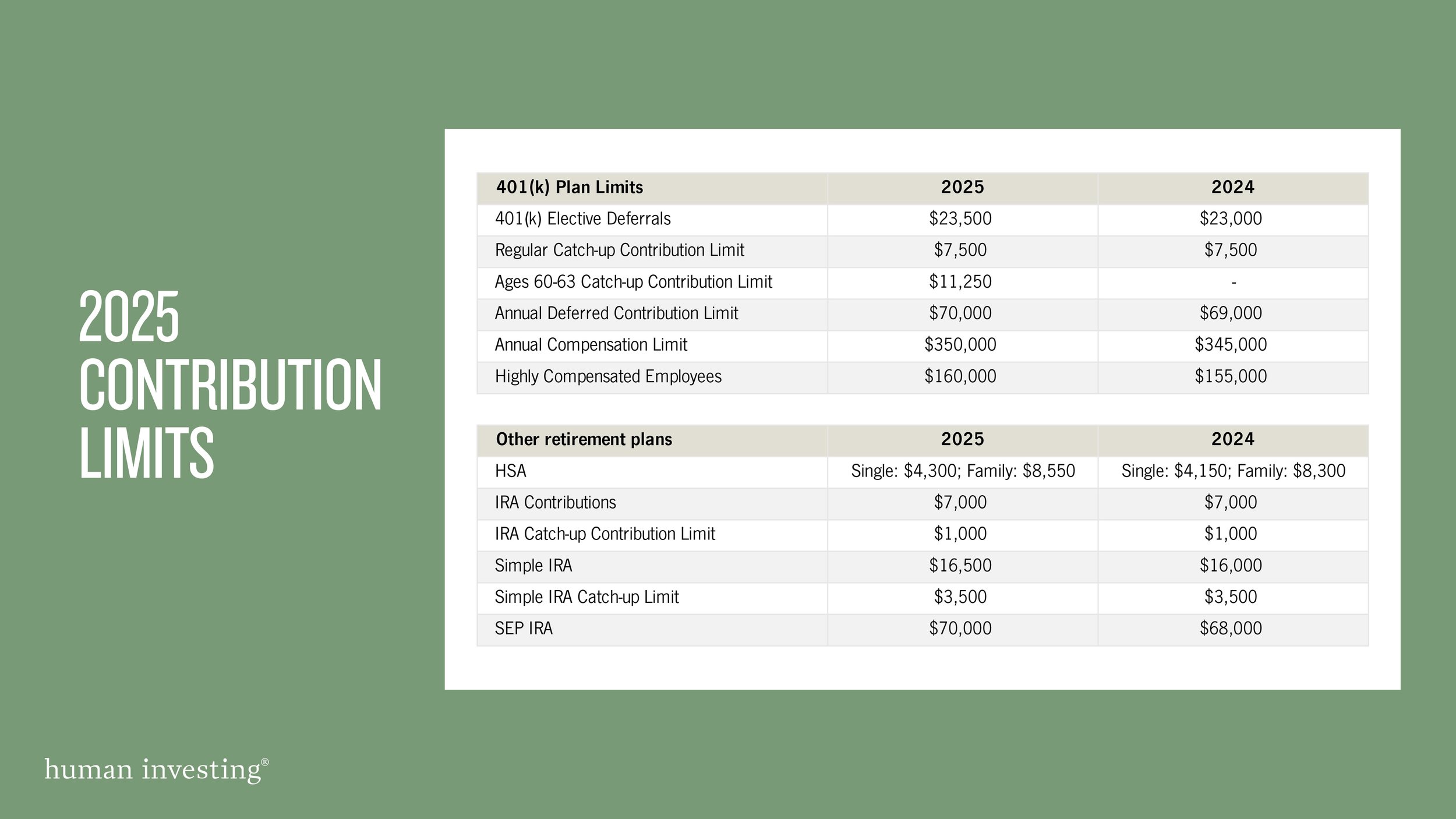
There is good news for retirement accounts! The IRS has increased the contribution limits for the upcoming year. As you can see below, there are many notable changes that will allow investors to save more money.

One important update for 2025 is that under a change made in SECURE 2.0, a higher catch-up contribution limit applies for employees aged 60, 61, 62 and 63 who participate in eligible retirement plans.

How do these changes impact your savings in the upcoming year? Are there any changes you should be making? Use this link to schedule a time to meet one-on-one with our team. We look forward to working with you in 2025!


Related Articles

The Reality Behind Social Security: Sifting through Myths and Solutions


Social Security remains a cornerstone of American retirement planning, yet it’s often shrouded with concern and misinformation. As the dialogue about its future grows increasingly pessimistic, many people question its reliability and role in their retirement income plans. Understanding the current state of Social Security is crucial for making informed decisions about your financial future.

Perception vs. Reality:  The Role of the Trust Fund

Much of the anxiety around Social Security comes from media reports highlighting the shrinking trust fund. This often leads to the mistaken belief that the program is on the verge of collapse. But the real issue isn’t mismanagement—it's demographics. As baby boomers retire and people live longer, benefits are outpacing payroll tax revenues.

Historically, Social Security operated on a pay-as-you-go basis. Since 2010, however, benefits have exceeded payroll tax collections. To bridge the gap, the Social Security Administration (SSA) has been tapping into the trust fund, a practice that will continue until the fund is expected to run out by 2033[i]. While this sounds alarming, it doesn't mean Social Security will vanish.

Misunderstandings About Insolvency

A common misconception is that the depletion of the trust fund means Social Security will go bankrupt and cease to exist. In reality, even after the fund is exhausted, payroll tax revenues will still cover approximately 79% of retirement benefits[ii]. This isn’t a doomsday scenario; it’s a call for strategic policy adjustments.

Fixing the Funding Gap – Potential Reforms

The SSA has proposed several solutions to address Social Security’s funding gap. Here are some of the most viable strategies:

  1. Increase Social Payroll Tax – Projections show Social Security's long-run deficit is 3.5% of covered payroll earnings[iii]. Raising payroll taxes by this amount—1.75 percentage points each for employees and employers—could secure full benefits through 2098, with a one-year reserve at the end.

  2. Increase the Social Security Wage Base—In 2024, the first $168,000 of earned income is taxed at 6.2% each for employees and employers; self-employed individuals will pay 12.4%.[iv] Increasing the Social Security wage base can help address the shortfall.

  3. Increase Full Retirement Age (FRA): Currently set at age 67 for individuals born in 1960 and beyond, the FRA dictates when retirees can claim full retirement benefits without reduction. Each one-year increase in the FRA equates to roughly a 7% cut in monthly benefits for affected retirees. Raising the FRA to 70 would reduce benefits by nearly 20% at any given claiming age.[v] This change aligns with historical precedent, as the FRA was originally 65 for most of Social Security’s history.  

  4. Invest in Equities: The SSA could explore investment strategies to enhance returns, following successful models utilized by other countries like Canada or systems such as the US Railroad Retirement System.                    

These measures would require political compromise but could ensure the program’s sustainability and continued support for retirees.

Planning for a Reduced Benefit Scenario

Amid ongoing discussions about Social Security reforms, it’s essential to hope for the best but prepare for the worst—acknowledging the potential for reduced benefits if corrective actions fail to shore up funding. The looming risks of benefit cuts necessitate careful consideration alongside other retirement planning factors, including life expectancy, additional income streams, risk tolerance, inflation, and potential spousal benefits.

Consider your Options in an Ever-evolving Social Security Landscape

Despite the challenges and negative perceptions, Social Security is not on the brink of collapse. With informed decisions and potential policy adjustments, the program can continue to support retirees for many years. It's crucial to stay informed and consider the evolving landscape of Social Security in your retirement planning. We’re here to support you. Contact us to meet with an advisor and learn more about your options.

Sources

[i] Social Security Administration. (2024). The 2024 OASDI Trustees Report. https://www.ssa.gov/oact/tr/2024/

[ii] Munnell, Alicia H. 2024. "Social Security's Financial Outlook: The 2024 Update in Perspective" Issue in Brief 24-11. Chestnut Hill, MA: Center for Retirement Research at Boston College.

[iii] SSA, The 2024 OASDI trustees report. p.17.

[iv]Social Security Administration. (2024). Contribution and benefit base. https://www.ssa.gov/oact/cola/cbb.html

[v] Springstead, G. R. (2011). Distributional effects of accelerating and extending the increase in the full retirement age (Policy Brief No. 2011-01). Social Security Administration. https://www.ssa.gov/policy/docs/policybriefs/pb2011-01.html


Related Articles

My Target-Date Fund reached the target year.. now what?
 

Target-date funds do not stop when they reach the target year. For example, Vanguard Target Date 2015 (VTXVX) still exists today even though it is 2020. Your dollars will not disappear!

Instead, target-date funds are designed to continue to serve the assumed age demographic of a specific retirement year. To provide a deeper understanding, we have outlined what will happen to 2020 target-date funds.

Target-date funds are designed one of two ways:

  1. “Through” target-date funds: Continue to shift their asset mix (less stocks, more bonds) over a predetermined number of years. The dollars invested in a target-date fund will remain inside the fund.

  2. “To” target-date funds: Reach the designated target year and merge with a retirement fund that maintains a specified asset allocation over time.

Either way – “through” or “to” target-date funds continue to be invested, and there is no required action-item for investors once the target year is reached.

2020 Target-Date Fund ExampleS

Since 2020 is a target year; let us look at what will happen to popular target-date funds.


Vanguard Target Retirement 2020 (VTWNX)

Vanguard’s glide path continues through for seven years (in this case 2027) until the asset allocation is 30% stocks and 70% bonds. After the seventh year, dollars merge into Vanguard Target Retirement Income (VTINX).

Fidelity Freedom 2020 Fund (FFFDX)

Fidelity Freedom’s glide path continues through for nearly twenty years (in this case 2040) until the asset allocation is 24% stocks and 76% bonds. After that, dollars merge into Fidelity Freedom Income (FFFAX).

T.Rowe Retirement 2020 Fund )TRRBX)

T.Rowe’s glide path continues through for thirty years (in this case 2050) until the asset allocation is 20% stocks and 80% bonds. These dollars do not merge with another fund, but instead maintain this asset allocation until the investor withdraws all dollars from the account.

AGAIN, YOUR DOLLARS WILL CONTINUE TO BE INVESTED OVER TIME.

The use and protection of retirement dollars (beyond a target year) is embedded in a fund’s lifecycle. Regardless of whether a target-date fund operates ‘through’ or ‘to’ the target year, your dollars will continue to be invested over time.


Related Articles