Posts tagged pre2
What The New IRS Rule Means For Plan Sponsors & Workers Over 50


If you’re 50 or older and use catch-up contributions to bulk up your retirement savings, or you help run a plan that offers them, there’s a rule change that should be on your radar.

In mid-September, the IRS and Treasury finalized how a piece of the SECURE 2.0 Act will work. The short version: starting in 2026, certain higher-earning workers will only be able to make their catch-up contributions as Roth (after-tax) dollars.

Getting ahead of the change now will make 2026 a lot less painful.

First, What Are Catch-Up Contributions and Why Do THey Matter?

Once you hit age 50, you can put extra money into your 401(k), 403(b), or similar plan, above the standard IRS limit. That’s been true for years.

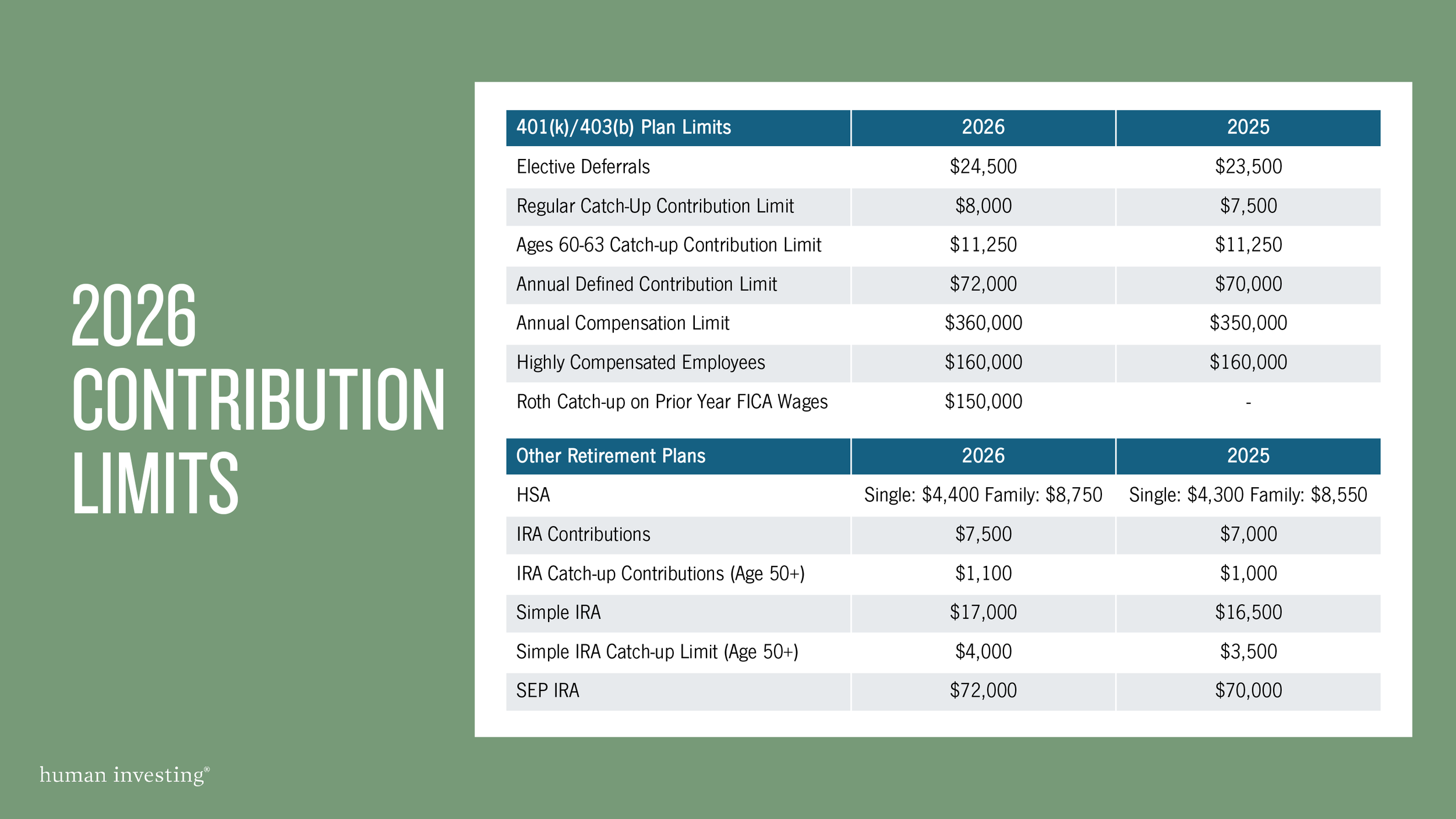
Here is the breakdown for 2026:

  • Under age 50: $24,500

  • Ages 50–59 and 64+: $32,500 (includes a $8,000 catch-up)

  • Ages 60–63: $35,750 (includes an $11,250 “super” catch-up)

SECURE 2.0 added another layer on top: starting in 2025, workers ages 60–63 get access to “super” catch-up contributions, up to 150% of the regular catch-up limit (or 110% for SIMPLE plans).

It is possible that catch-up contribution may be required to be made as a Roth contribution, especially if your income exceeds certain thresholds.

For employees, the downside is giving up the upfront tax break on catch-up contributions. The upside? Tax-free withdrawals later.

For employers, the stakes are higher: if the plan isn’t set up to handle Roth catch-ups, some employees could lose access to them entirely.

Diving Into the New Rule: Roth Required for Some

Here’s the key change:

If you make more than $150,000 in FICA wages in 2026 (adjusted annually), all your catch-up dollars will have to go in as Roth contributions, after tax dollars, starting January 1, 2026.

This means if you fall into the higher-income category, your Roth catch-up will be automatically applied to your eligible contributions once you hit age 50.

A few quick clarifications:

  • This does not apply to SIMPLE IRAs or SEP plans.

  • Wages are measured using Box 3 on your W-2.

  • If your plan does not include a Roth deferral option, catch-up contributions won’t be permitted in your plan regardless of income.

Congress delayed this rule once (from 2024 to 2026) to give employers time to adjust. That grace period is ending soon.

Two Types of Catch-Up Contributions

Depending on your age and plan setup, catch-ups may fall into these buckets:

  1. Standard age-50 catch-ups
    These are the usual “extra” contributions, and the ones subject to the Roth rule if you’re over the wage limit.

  2. “Super” catch-ups at ages 60–63
    Optional, but attractive for late-career savers (and yes, Roth rule applies to these as well).

If You Sponsor a Plan, Start Here

A survey from the Plan Sponsor Council of America says only 5% of plan sponsors feel fully ready.

Payroll providers will bear the heavy lifting here. Plan sponsors should lean on their payroll providers and ensure that there is clarity on how catch-up contributions are being made.

To facilitate administration of this new rule and employee experience, we suggest permitting “Deemed” Roth contributions. This means that there is an assumption that catch-up contributions will be considered Roth, even if an employee has elected pre-tax deferrals for their base contribution. Deemed Roth feature is typically setup as a function of payroll and must be included in your governing plan documents.

To avoid last-minute scrambling, here’s what employers should be doing in 2025 and into 2026:

  • Check whether your plan even offer Roth - this is a great deferral option for all employees, regardless of income.

  • Talk to payroll and your recordkeeper about tracking who’s subject to the rule.

  • Permit “Deemed” Roth contributions and amend plan document(s).  

  • Review catch-up provisions for ages 60–63 and for 403(b) service-based rules.

  • Create employee communications, especially for those over the wage limit.

  • Work with your Recordkeeper or TPA on plan amendments.

What’s the Timeline?

Here’s how the rollout shakes out:

  • Now — Setup a call with payroll and recordkeeper.

  • December 31, 2025 — New catch-up limits kick in.

  • January 1, 2026 — Roth requirement becomes real.

  • Late 2026 — Formal plan amendments are due.

We’re here to help

For the workers affected, the downside is giving up the upfront tax break on catch-up contributions. The upside? Tax-free withdrawals later.

For employers, the stakes are higher: if the plan isn’t set up to handle Roth catch-ups, some employees could lose access to them entirely.

Bottom line: Roth is about to move from optional to unavoidable for a lot of savers. Getting ahead of the change now will make 2026 less stressful. If you or someone you know may need assistance, let’s meet!


Disclosure: This material is for informational and educational purposes only and should not be considered personalized tax, legal, or investment advice. You should consult your own qualified tax, legal, and financial professionals before making any decisions based on this information. Tax laws and regulations, including those discussed here, may change and can vary based on individual circumstances. The examples and explanations provided are for general understanding and should not be relied upon to predict or guarantee outcomes. Investing and retirement planning involve risk, including possible loss of principal. Past performance does not guarantee future results. Advisory services are offered through Human Investing, LLC, an SEC-registered investment adviser.


Related Articles

My Target-Date Fund reached the target year.. now what?
 

Target-date funds do not stop when they reach the target year. For example, Vanguard Target Date 2015 (VTXVX) still exists today even though it is 2020. Your dollars will not disappear!

Instead, target-date funds are designed to continue to serve the assumed age demographic of a specific retirement year. To provide a deeper understanding, we have outlined what will happen to 2020 target-date funds.

Target-date funds are designed one of two ways:

  1. “Through” target-date funds: Continue to shift their asset mix (less stocks, more bonds) over a predetermined number of years. The dollars invested in a target-date fund will remain inside the fund.

  2. “To” target-date funds: Reach the designated target year and merge with a retirement fund that maintains a specified asset allocation over time.

Either way – “through” or “to” target-date funds continue to be invested, and there is no required action-item for investors once the target year is reached.

2020 Target-Date Fund ExampleS

Since 2020 is a target year; let us look at what will happen to popular target-date funds.


Vanguard Target Retirement 2020 (VTWNX)

Vanguard’s glide path continues through for seven years (in this case 2027) until the asset allocation is 30% stocks and 70% bonds. After the seventh year, dollars merge into Vanguard Target Retirement Income (VTINX).

Fidelity Freedom 2020 Fund (FFFDX)

Fidelity Freedom’s glide path continues through for nearly twenty years (in this case 2040) until the asset allocation is 24% stocks and 76% bonds. After that, dollars merge into Fidelity Freedom Income (FFFAX).

T.Rowe Retirement 2020 Fund )TRRBX)

T.Rowe’s glide path continues through for thirty years (in this case 2050) until the asset allocation is 20% stocks and 80% bonds. These dollars do not merge with another fund, but instead maintain this asset allocation until the investor withdraws all dollars from the account.

AGAIN, YOUR DOLLARS WILL CONTINUE TO BE INVESTED OVER TIME.

The use and protection of retirement dollars (beyond a target year) is embedded in a fund’s lifecycle. Regardless of whether a target-date fund operates ‘through’ or ‘to’ the target year, your dollars will continue to be invested over time.




Related Articles

Female Baby Boomers and Retirement: A Status Update
 

Although the front end of the baby boom generation is well into retirement, we are still 10-15 years away from the final boomers to hit retirement age.  With this in mind, we wanted to take a look at this cohort and highlight the research specifically aimed at women.  You may be surprised by the uphill battles they’ve faced over the last few decades.

Limited Career Choices and Gender Bias in Retirement Policies

Although Baby Boomer women were far more likely to go to college and get a job than the previous generation, the concept of “acceptable” careers for women often pointed them toward work with lower compensation.  As a result of these lower paying careers, women had less money to defer into retirement accounts than their male counterparts—if they chose to defer funds at all.

Also, due to part-time work and lower wages these women are looking at significantly smaller Social Security payments in retirement.  This may leave many women either dependent upon a spouse or relying on Social Security and personal savings.  This, coupled with less time in the workforce due to pregnancy and child rearing, has left many female Baby Boomers at a great disadvantage.

Individual Responsibility and the Psychology of Saving

Another challenge facing female Baby Boomers is the fear of risk and the perception that money is something that should be left to men.  The latter mindset may have led some women to leave retirement planning and budgeting up to their spouses.  Couple this with a lack of individual responsibility on the parts of both men and women in this generation, and we are left with a big problem. 

According to several studies conducted in the mid-nineties (O’Neill, 1991; Twentieth Century Services, 1994). Hayes and Parker (1993), Kadlec (1994), and Pope (1994), the Baby Boomer generation was shaped by a more affluent lifestyle than their parents.  They enjoyed a higher median gross income and higher free spending limits.  Additionally, since Boomers are a generation detached from the Great Depression’s influence on the importance of saving, many have more reliance on Social Security for retirement and simply have not saved enough.

Risk Averse and Under Educated

Research dating back to 1994 and prior (NCWRR) found that women tend to be conservative, low-risk investors.  At the time of these studies, 72% of the women who saved chose investments that provided only marginal returns.   In order to keep up, women now need to be willing to take more risk in their investments.  This is counter intuitive to how many women of this generation were raised and educated.  To compound this difficulty, many financial advisors and brokers assume women want less risk and therefore fail to do the planning and education needed to help their clients see the risk-reward return and to understand a pace of investing that keeps up with inflation. 

How We Can Help

In our work over the years with married, divorced or never married women, the answer always seems to be the same: Advisors need to understand their client’s biases, feelings, and fears about money and retirement.  We need to make a concerted effort toward financial literacy and, most importantly, to provide a solid, comprehensive financial plan.  Education and planning enable our clients to see the impact of their spending, savings, and the aggressive/conservative balance of their investments. 

At Human Investing we accomplish this through our process called hiPlan.  The hiPlan goal is to give our clients the peace that comes from the stability of a plan that enables them to live out the retirement they have worked hard and dreamed about.