Posts tagged behavioral1
I Hope You’re Wrong: Why Being Right Can Be More Dangerous Than Being Wrong
 

One of the persistent temptations in investing is the belief that the future can be known, rather than simply estimated or viewed through a lens of probability.

Every so often, markets appear to reinforce this belief. It can happen when an analyst makes a sweeping economic call, a television personality highlights a stock, or an investor acts on a strong conviction about a single event. When such a call lands correctly, an investor’s confidence tends to grow much faster than their actual wisdom. This creates a unique brand of risk where the danger isn't being wrong but rather being "right" in a way that encourages all the wrong lessons.

Experience has taught me to treat these moments with caution, as a successful forecast can lead to increased activity, narrower positioning, and a reduced tolerance for uncertainty.

The pull of prediction

We currently live in an environment where market commentary often comes with an air of certainty. Forecasts with clean narratives and specific numbers can create the impression that the future is more orderly and manageable than it actually is. In this context, investing can begin to resemble wagering on specific outcomes rather than planning for inherent unpredictability.

The reality is that markets are complex adaptive systems shaped by a mix of fundamentals, incentives, psychology, policy decisions, and randomness.

Consequently, when a prediction proves accurate, it is rarely clear whether the result stemmed from genuine insight or mere circumstance. Because markets largely reward outcomes without distinguishing between skill and luck, investors are often left to conclude that their success was due to brilliance rather than chance.

Famous calls and their aftermath

History is generous in celebrating bold forecasts. Michael Burry, for instance, is rightly remembered for identifying the housing market excesses before the Global Financial Crisis. It was a significant call that required immense conviction and a high tolerance for sustained discomfort. However, what receives less attention is what happens after such a call is made. Since that episode, Burry has repeatedly warned of impending market downturns; while some concerns were thoughtful, many were premature, and others have been incorrect.  

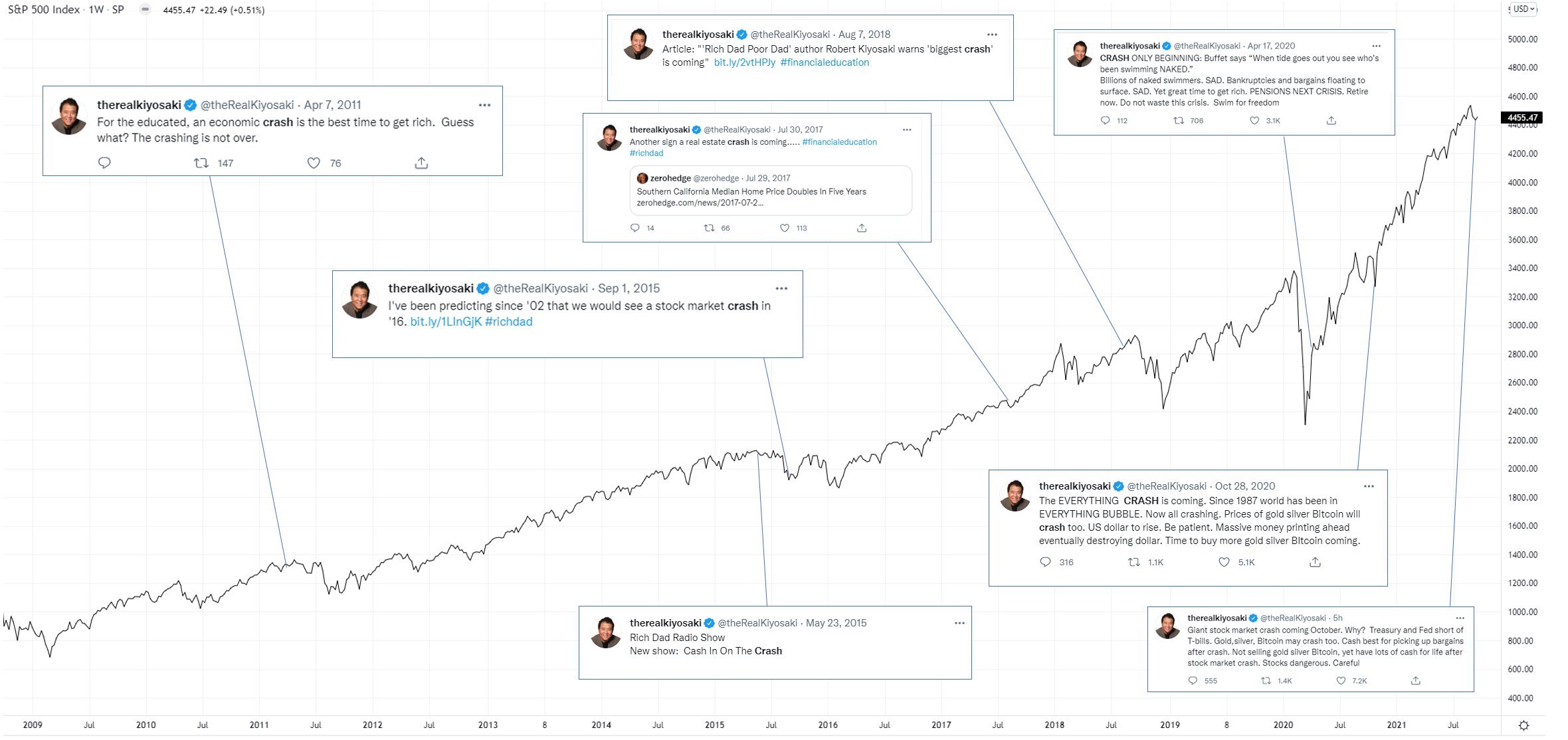
We see a similar dynamic in the warnings issued by public figures. Robert Kiyosaki, for example, has repeatedly forecasted systemic collapse. The chart aligns several of those warnings with the path of the S&P 500, which over that period moved materially higher.

With enough attempts, even low-probability calls will eventually intersect with actual outcomes.
The common thread in both examples is that forecasting is rarely a single bet. One successful prediction often creates pressure to make another, or to double down on a view even after the market has moved on. This pattern reveals a fundamental distinction for investors: the difference between trying to be "right" and actually making a prudent decision. 

The danger of fixating on outcomes

That difference becomes unavoidable when we examine how outcomes are derived.

As professional poker player and author Annie Duke has observed “We are too quick to treat outcomes as a referendum on decision quality, when luck plays a much larger role than we are comfortable admitting.” This insight sits at the core of disciplined investing.

Outcomes, on their own, are an unreliable measure of decision-making. Well-reasoned decisions can lead to disappointing results. Poorly reasoned decisions can occasionally be rewarded. Over short periods of time, randomness can obscure the underlying quality of the process.

The challenge is that investors are wired to equate results with decision quality. If we judge our strategy solely by whether it was correct in the short term, we reinforce behaviors like excessive conviction and a refusal to reassess our positions. A more durable standard is required, one where the most important question is not whether a view proved correct, but whether the plan was robust enough to withstand being wrong.

The high cost of being too certain

When outcomes are mistaken for skill, the resulting overconfidence can quickly become destructive. Investors who believe they can forecast the market often increase their trading activity, bet too heavily on one specific direction, and abandon the protection of diversification in favor of short-term signals.

The irony is that the more certain an investor becomes, the more fragile their strategy tends to be. Portfolios built on specific predictions only work if those predictions come true, which provides a dangerously narrow margin of safety.

A different standard

From a fiduciary perspective, the objective is not to anticipate each market event correctly. It’s to build resilient plans that remain viable across a wide range of outcomes. This requires accepting uncertainty as a permanent feature of the landscape and prioritizing asset allocation, tax awareness, and emotional resilience over the allure of the next big forecast. While a prediction may be correct, any approach that depends on it’s success is fundamentally fragile.

Why I hope you’re wrong

Ultimately, when I hear a confident market prediction, my internal response is often, “I hope you’re wrong.”

My reaction is not born out of cynicism or a desire to see someone fail. Rather, it reflects an awareness of how slippery the slope can be once a prediction proves correct. Being wrong, while uncomfortable, serves an important purpose of reinforcing humility and preserving discipline.

Markets have a long history of humbling those who claim certainty. The investors who truly succeed over decades are those who respect that history, choosing to build financial plans that remain intact across a wide range of outcomes, including those they did not anticipate.



Disclosure: This commentary is for informational purposes only and should not be considered investment, tax, or legal advice. The views expressed are based on current market conditions and are subject to change without notice. Past performance is not indicative of future results, and no investment strategy can guarantee success or protect against loss. References to specific companies are for illustrative purposes only and do not constitute a recommendation to buy or sell any security. Investors should consult with a qualified financial professional before making any investment decisions. Human Investing is an SEC-registered investment adviser. Registration does not imply a certain level of skill or training.

 

Related Articles

The Psychology of Market Patience: Navigating Volatility With a Steady Hand


Volatile markets test more than portfolios—they test patience. It’s easy to feel unsettled when headlines scream, and market volatility ensues. But the most important thing you can do as an investor is also the simplest: don’t let emotions get the best of you. 

In my nearly 30 years of advising clients, I’ve seen over and over again: the clients who succeed are the ones who manage their emotions, not just their money. The smartest thing you can do right now is stay calm and stay the course. The plan is working—even when it doesn’t feel like it. My experience has been that history has a way of rewarding those who stay calm, stay invested, and stay focused on their well-crafted financial plan.

At Human Investing, we believe that behavior, not timing or speculation, is what separates long-term success from short-term regret. For clients who have been with us for over 20 years, you’ve seen firsthand how a steady, disciplined approach can weather storms and grow wealth through them. For those new to our firm, please know that trust is the foundation of everything we do. We don’t just manage portfolios, we help guide people through uncertainty with clarity, care, and confidence.

To better understand the importance of maintaining a disciplined investment approach, it is helpful to examine five common psychological biases that often lead investors to deviate from sound decision-making. Drawing on both empirical research and professional experience, this section explores how emotional responses can override strategic thinking—particularly during periods of heightened uncertainty and market volatility—and outlines methods used to help clients remain focused on long-term objectives.

1. Loss aversion: When pain is louder than logic 

Researchers Kahneman, Knetsch, and Thaler (1991) discuss the psychological factors that drive loss aversion. Loss aversion is not just an investing concept; it’s a fundamental part of human psychology. Research shows that losses are felt about twice as painful as equivalent gains are perceived as pleasurable. In the brain, a $100 loss doesn’t just “sting”—it screams. And when markets drop, that emotional volume can drown out logic, strategy, and even years of sound advice.

This isn’t just a theory. I've seen it firsthand for a few decades—watching clients grapple with fear during the dotcom bust, the 2008 financial crisis, the 2020 COVID crash, and more recent volatility. In each case, the market eventually recovered. But those who let fear dictate their choices often miss the recovery, lock in their losses, and derail their long-term plans.

Here’s what makes loss aversion so dangerous: it feels rational. When the market drops 20%, the brain doesn’t think, “This is temporary.” It thinks, “Get out before it gets worse.” That impulse can feel like wisdom. But in reality, it's a trap.

The dislocation occurs when investors stop viewing a dip as part of the journey and begin to see it as the destination. Their long-term goals fade from view. The carefully designed plan becomes irrelevant. All that matters is stopping the pain.

But that short-term relief often comes at a prohibitive cost. Investors who sell at the bottom lock in their losses and are frequently too emotionally exhausted—or too afraid—to re-enter the market in time for the rebound. And rebound it almost always does. History shows that the market has consistently rewarded those who stay invested through downturns, not those who try to time their exits and re-entries.

2. Herding: When “everyone’s doing it” feels safer than thinking 

There’s a reason why stampedes are dangerous—not everyone in the crowd is running toward opportunity. Some are running from fear. 

In investing, we refer to this behavior as herding—the instinct to follow the crowd, particularly during times of uncertainty. Scharfstein and Stein (1990) were among the earliest to formally investigate and publish on the concept of herd mentality. We are indeed social creatures, hardwired to look to others for cues when we’re unsure. But in the markets, that instinct can be costly.

When prices drop and headlines grow loud, it’s natural to wonder: “What does everyone else know that I don’t?” You see friends moving to cash, analysts shouting about doom, and articles predicting disaster. The pull to join the herd becomes magnetic. But the crowd is often most unified at the wrong time, buying high out of excitement or selling low out of fear.

Here’s the cognitive dislocation: when fear spreads, we confuse consensus with correctness. If enough people are panicking, their emotion starts to feel like evidence. But markets are not democratic. The loudest voices are not always the wisest, and just because many are moving in the same direction doesn’t mean it’s the right one.

3. Recency bias: When yesterday becomes forever 

Tversky and Kahneman (1974) laid the foundational research on recency bias. They determine that “…the impact of seeing a house burning on the subjective probability of such accidents is probably greater than reading about a fire in the local paper. Furthermore, recent occurrences are likely to be relatively more available than earlier occurrences (p. 1127).” 

Put differently, individuals often extrapolate recent market movements into the future, believing that a market decline will persist or that a rally will continue indefinitely. This cognitive distortion, known as recency bias, reflects the tendency to overweight recent experiences when forming expectations about future outcomes.

It’s a mental shortcut that makes sense on the surface. After all, if it’s been raining for three days, we naturally reach for an umbrella on day four. But in the markets, this shortcut becomes a trap.

The dislocation happens when investors confuse a recent event with a long-term trend. They think: “The market’s been down the last two months—maybe this time is different. Maybe it won’t recover.” Or: “Tech has been hot all year—maybe it always will be.” This kind of thinking leads to chasing what has already happened or fleeing from what is already priced in.

Here’s the problem: the market doesn’t move in straight lines. It zigs, zags, and surprises. The best days often follow the worst. Yet, when recency bias takes hold, investors tend to anchor on the latest data point and overlook the broader context.

I’ve witnessed this bias unfold in every major market event since 1996. This ‘cognitive dislocation’ was particularly acute during the downturn from 2000 to 2002, when markets declined by 10%, 10%, and then 20%. But those who were paralyzed by recency bias—those who assumed the storm would never end—missed the sunshine that followed.

4. Sentiment: When moods masquerade as markets

The market is often described as a voting machine in the short term and a weighing machine in the long term (Graham, 2006). That’s another way of saying: in the short term, emotion can drive price more than value. And that emotion, called market sentiment, can be just as contagious and unpredictable as the weather.

Sentiment isn’t about fundamentals. It’s about how investors feel about the future. When people feel optimistic, they see opportunity in every dip. When they feel anxious, even the strongest companies look shaky. This is where the dislocation happens: investors begin to substitute their mood for actual analysis.

In times of high sentiment, people often buy more than they should, take on more risk than they realize, or ignore warning signs. During low sentiment, they often underinvest, sell too soon, or abandon long-term strategies altogether—not because the plan changed, but because their feelings did.

I’ve witnessed this in action many times since 1996, particularly in 2008, when panic dominated sentiment, and many investors fled the market near the bottom. The truth is, markets don’t care how we feel. But our feelings often shape how we interpret the market. That’s why at Human Investing, we spend as much time helping clients manage their emotions as we do managing their investments. We help you separate how you feel from what’s actually happening.

Your plan is designed to withstand emotional swings. It assumes there will be times when the market is overconfident, and times when it’s too afraid. That’s why we don’t react to moods. We respond to goals. Because when you confuse sentiment for truth, your portfolio becomes a mirror of your emotions. But when you trust your plan, your portfolio becomes a reflection of your purpose.

5. Emotional echo chambers: When biases team up to derail you

If loss aversion, herding, recency bias, and sentiment were minor on their own, we might be able to brush them off. But they don’t stay in their lanes. These biases often compound, amplifying each other until an investor is no longer thinking clearly. That’s what we call an emotional echo chamber—a space where your own fears are repeated and reinforced until they sound like facts.

Here’s how it plays out:

  • The market dips, triggering loss aversion—“I can’t afford to lose more.”

  • You see others selling, which activates herding—“Everyone’s getting out. Maybe I should, too.”

  • You assume the recent downturn is the new normal—recency bias—“It’s just going to get worse.”

  • Your confidence drops, and negative sentiment clouds your judgment—“I don’t feel safe, so maybe I’m not.” 

Suddenly, your investment decisions are no longer tied to your long-term goals—a chorus of emotional responses drives them, each one echoing the others. This is the moment investors often make their biggest mistakes: abandoning well-designed plans, selling at market lows, or shifting strategies midstream out of fear.

I’ve seen this cycle emerge during every major downturn. What I’ve learned is this: when fear gets loud, clarity gets quiet. Investors don’t just lose money in these moments—they lose confidence, perspective, and peace of mind.

At Human Investing, our job is to help you break out of that echo chamber. We’re here to re-center you when everything feels off-balance, to remind you of the purpose of your financial plan, and to bring you back to your long-term vision when the short-term noise becomes deafening.

We believe that staying invested is not just a financial decision, it’s an emotional discipline. That’s why we design portfolios that align with your comfort zone and why we lead with planning. Because a sound financial plan doesn’t just grow your wealth, it protects your thinking.


When emotional noise is high, we help you find quiet confidence. When biases clash in your head, we help you hear your goals again. And most importantly, when you start to feel like you’re the only one holding steady, we’re here to remind you—you’re not.

Empirical evidence

If the five behavioral prompts are not enough to encourage you to focus on your plan, a 40-year perspective on market ups and downs can provide an essential viewpoint. 

Please see Figure 1 at the end of this document. In it, you’ll see the average intra-year drop for the S&P 500 is approximately 14%, based on historical data going back several decades.

This means that in a typical year, the market will experience a peak-to-trough decline of around 14%—even in years that end up positive overall.

Here’s a quick breakdown:

From 1980 through 2023, the S&P 500 had: 

  • Positive returns in about 75% of those years

  • But it still experienced an average intra-year decline of ~14%

Why it matters:

Many investors panic during temporary drops, thinking something abnormal is happening. In reality, a 10–15% drop in a given year is a feature, not a flaw, of long-term investing. It’s part of the process, not a sign to change course.

References:

Graham, B. (2006). The intelligent investor: The definitive book on value investing (Rev. ed., J. Zweig, Commentary). Harper-Business. (Original work published 1949)

Kahneman, D., Knetsch, J. L., & Thaler, R. H. (1991). Anomalies: The endowment effect, loss aversion, and status quo bias. Journal of Economic perspectives, 5(1), 193-206.

Scharfstein, D. S., & Stein, J. C. (1990). Herd behavior and investment. The American economic review, 465-479.

Tversky, A., & Kahneman, D. (1974). Judgment under Uncertainty: Heuristics and Biases: Biases in judgments reveal some heuristics of thinking under uncertainty. science, 185(4157), 1124-1131.


Disclosures: These market returns are based on past performance of an index for illustrative purposes only. Past performance does not guarantee future results. All investing involves risk, including the loss of principal.  Index performance is provided for illustrative purposes only and does not reflect the performance of an actual investment. Investors cannot invest directly in an index.

The information provided in this communication is for informational and educational purposes only and should not be construed as investment advice, a recommendation, or an offer to buy or sell any securities. Market conditions can change at any time, and there is no assurance that any investment strategy will be successful.

Diversification does not guarantee a profit or protect against a loss in declining markets. Asset allocation and portfolio strategies do not ensure a profit or guarantee against loss.

The opinions expressed in this communication reflect our best judgment at the time of publication and are subject to change without notice. Any references to specific securities, asset classes, or financial strategies are for illustrative purposes only and should not be considered individualized recommendations.

Human Investing is a SEC Registered Investment Adviser. Registration as an investment adviser does not imply any level of skill or training and does not constitute an endorsement by the Comission. Please consult with your financial advisor to determine the appropriateness of any investment strategy based on your individual circumstances.


A BOOK FOR THE SAVER IN ALL OF US

Becoming a 401(k) Millionaire isn’t your typical retirement guide. With 30 years in finance, Dr. Peter Fisher shares personal insights and real stories to help you plan with confidence.


Related Articles

Hello Speculation, My Old Friend
 

The term speculation[1] has been on the steady decline since 1840. The decline in use is somewhat surprising given the current market environment where speculation runs rampant. In recent weeks, our team inked a well-thought-out article about the speculation du jour titled, The Big Short: Volume II Starring $GME . Interestingly, they could have been writing about any of the past's speculations—like the Dutch Tulipmania in the 1630s and the roaring 20s that ran up to the 1929 crash. More recently, tech stock speculation reached a fevered pitch in the 2000s and was followed by an equally thrilling run-up in housing which peaked in Q1 2007.

“Speculation is easy to spot, but it is difficult to understand what brings speculative environments to an end.”

Memory Lane (1995-2000)

Speculation in technology stocks lasted for six years. Money managers and even the Federal Reserve Board Chairman Alan Greenspan noted the overall frothiness of the markets. In his 1996 public address, Chairman Greenspan pondered, "but how do we know when irrational exuberance has unduly escalated asset values…?" From 1995 to 2000, the Nasdaq grew sixfold (see Figure 1 below). Over several years, beginning in March of 2000, the tech-heavy Nasdaq stock index lost nearly 80% of its value. Even the "blue chip" tech stocks of the day: Cisco, Intel, and Oracle, fell fast. But because they had well established and viable business', they crawled from the rubble and thrived. But the road to recovery took 15 years as the Nasdaq crossed through its previous market peak set in March of 2000 in April of 2015.

Figure 1

Figure 1

Reason for the speculation?

As was the case leading up to the peak of the .com era, much of today's speculation has been brought about by venture capital (VC) investment. Key statistics surrounding VC investment are at or near all-time highs. This includes deal activity, VC-backed IPO's, and VC-backed M & A. You can learn more about VCs and speculation here. The influence of M & A on the market dynamics is meaningful—particularly for retail investors who see what VCs are doing and want a piece of the action. In the book, The Psychology of Money, the author notes that "people have a tendency to be influenced by the actions of other people who are playing a different financial game than they are." VC investors are some of the most sophisticated investors in the world.  Simply put, VC investors are playing a different financial game than most people who want to get a piece of their action.

One reason for concern is that a mass of money is being put into the capital markets, including VCs, with a speculative bent. This changes the market's disposition. The stock market can quickly turn from a place to save for retirement and invest for college to a casino or dog track, where a quick buck can be made. The bottom line is that investing and speculating are not the same thing. In the last 25 years, the most successful investors I have observed have relied on simple truths to accumulate their wealth. They make their money by saving and investing over a lifetime. To be sure, some speculators hit it big, and those will be the stories you hear about. Others, as is the case with most speculative investments, will lose everything.

Access, Gamification, and Human Nature

This go-around, the rise of speculative investing seems to have a social appeal. With stock trading commissions at zero and gamified investment platforms, both access and the fun factor are present at levels I've never seen before. On the one hand, I'm thrilled that more people are interested in the capital markets. But I wonder if tools and access make investing more like a casino or betting app than serious investors' tools to achieve lifelong financial goals. If investing is being marketed to fulfill all your dreams in a couple of keystrokes, why wait a lifetime?

It is human nature to want a piece of what is working—after all, who wouldn't?  We all know someone who made their money quickly. For every person who made an easy buck and won the lottery, millions of us are going to need to do it the hard way. Yes, the wet blanket approach to investing—like spending less than what you earn and putting a little away each month to an emergency fund. Forgoing a slice of your paycheck today so that you have something to live off when you are no longer generating an income from your labor. Driving the same old car so the payments you would otherwise have with a new car can go to your child's college savings account. I know what some of you may be saying, "he just doesn't get it." Maybe not, but what is true is that if investors do not choose a path, it will be selected for them. Or if not, they may bounce around from one path to another, making for a very emotional and disjointed investing experience. One path has a high probability of success because it relies on disciplined saving and investing behavior over a lifetime. The other approach is speculative, looks fun, is incredible to talk about, and has social equity—but unfortunately has a fractional probability of success.

Tesla and bubbles

There are plenty of speculative investments that will make an article like this seem out of touch and tired. Maybe so. Take the electric car manufacturer who recently booked its first full year of profits. Yep, the investor and media darling Tesla is worth $800 billion and just turned a profit in 2020 for the first time since it was founded in 2003. The only issue is that it is not from selling cars. The bulk of their profit comes from selling regulatory tax credits, not from selling cars. Read more about Tesla here. This is fine, and I own a few Tesla shares inside my low-cost Vanguard S&P 500 index fund. The point in sharing a story about Tesla is not to shame those that own the stock, nor is it a knock on the product as they make a good car. Instead, it highlights the influence of VC money and corresponding expectation for speculative investing and returns.

Dr. Olivier Blanchard, the most cited economist in the world, penned a 1979 masterpiece where he said this,

"Self-ending speculative bubbles, i.e., speculative bubbles followed by market crashes, are consistent with the assumptions of rational expectations. More generally, speculative bubbles may take all kinds of shapes. Detecting their presence or rejecting their existence is likely to prove very hard."

If speculation were a person, I would write it a letter. It would be short. It would go like this, "As for our families and how we advise Human Investing clients, we view each dollar as hard earned and essential to a well thought out financial plan. There is no play money or money we can afford to lose. As such, we are not much for speculation." Sincerely, your wet blanket.

[1] Merriam-Webster defines speculation as “a risky undertaking.” Thesaurus notes it is a “theory, guess, risk, or gamble.”


Related Articles

How to Avoid the Investing Cycle of Emotions
 
alice-donovan-rouse-UweNcthlmDc-unsplash.jpg

Do not let your emotions get in the way of making smart investment decisions.

It is difficult to separate emotions from reality. We often view the world through the lens of whatever emotion we are experiencing, and unchecked emotions can give rise to suboptimal financial decisions.

My role as a financial advisor allows me to have many conversations focused around money. Through these conversations over the last 12 months, I have witnessed the gambit of the emotional response to the stock market and its volatility. What I discovered is that an individual’s emotional response tends to be heightened by three things:

  1. The more zeros at the end of their account balance.

  2. The amount of negative news consumed.

  3. The greatest of which, whether they have taken the time to build a financial plan.

In his book The Behavioral Investor, psychologist and behavioral finance expert, Dr. Daniel Crosby reminds us that our emotions can’t be trusted when it comes to making investment decisions.

“The fact that your brain becomes more risk-seeking in bull markets and more conservative in bear markets means that you are neurologically predisposed to violate the first rule of investing, “buy low and sell high.” Our flawed brain leads us to subjectively experience low levels of risk when risk is actually quite high, a concept that Howard Marks refers to as the “perversity of risk.” – Dr. Daniel Crosby

Like the stock market, our emotions are cyclical. This cycle of emotions experienced as an investor can range from pure euphoria to utter despondency (lack of hope).

Source: Russell Investments

Source: Russell Investments

This emotion is often not dictated by the investor, rather it is the investor’s response to the market. The wild thing is, we have seemingly experienced all of these emotions over the last 12-month period. Compare the cycle of emotion to the S&P 500 over the last year.

S&P 500 1 Year as of 8.19.2020

Is it a coincidence that these two images almost mirror each other? I don’t think so.

It is completely normal to have an emotional reaction to your finances. Your account balances are often in direct relationship to your future financial freedom and well-being. However, it is only when an investor acts on these emotions do they get themselves in trouble.

Investor’s making short term emotional changes to their investments hurt their chances at long-term returns. A study conducted by DALBAR, Inc. discovered that over the last 30 years, the average mutual fund investor underperformed the market by almost 6%! Their finding is that investor’s change investment strategies too often to realize the inherent market rates of return.

Here are some action steps for avoiding emotional investment decisions:

  • Look inward — Take an introspective look to acknowledge your emotional response over the last 12-month market cycle. Will you emotionally make it through another market drop? Right now is the time to build self-awareness, because the reality of the market is not IF it will have another correction, but rather WHEN.

  • Look outward — Do you have someone to help you make wise financial decisions throughout life’s many emotions and seasons? Someone, to stand between your emotions and your finances? This is one of the many ways a financial advisor can add value to your comprehensive financial well-being.

  • Look forward — Does your risk profile align with your financial plan? Are you taking on too much risk (or, too little)? Take some time today to review your holistic investment strategy and consider making any changes while the market has rebounded since its market low on March 23rd.

Our team at Human Investing realizes your family’s financial well-being is just as much “human” as it is “investing”. Let us know how we can help, contact us at Human Investing or call at 503.905.3100.


Related Articles