Posts in Economic Commentary
Hi Ground Episode 1: Is SpaceX Actually Going To Do Well?


Disclosure:
This material is provided for informational and educational purposes only. It should not be construed as investment, legal, or tax advice, nor does it constitute a recommendation or solicitation to buy or sell any security. Investors should consult with a qualified financial professional before making any investment decisions. Rebalancing and asset allocation strategies do not ensure a profit or protect against loss in declining markets. There is no guarantee that any investment strategy will achieve its objectives. Any references to historical performance, academic studies, or research are based on past data and should not be considered indicative of future results. Past performance is not a guarantee of future outcomes. Advisory services offered through Human Investing, an SEC-registered investment adviser.


Related Articles

Building Lasting Resilience in an Age of AI
 

“Assuming AI doesn’t take my job first.” We’ve heard some version of that line from clients all year, almost always delivered with a nervous laugh. But behind the humor sits a question a lot of people are wrestling with right now.

Every meaningful shift in technology brings a mix of optimism and concern, and artificial intelligence is no different. For some, this is still a conversation about what might happen. For others, it has already shown up in tangible ways, whether your role has changed, been eliminated, or you're watching your industry transform in real time.

If that's where you are, the uncertainty isn't theoretical, and it isn't just financial. Work is tied to identity, routine, and a sense of progress, which makes disruption especially hard to process. And even if nothing has changed for you yet, it's difficult to ignore the possibility that it could.

Your Most Important Asset

For most people in the accumulation phase of life, the most important asset isn't a number in your portfolio: it's your ability to earn income over the next decade or more. When that ability feels less certain, everything connected to it can feel less stable.

When that uncertainty sets in, the natural instinct is to try to predict what happens next: Should I pivot? Is this temporary? Am I already behind? It's understandable, but what if the path ahead is too uncertain to plan around with confidence?

A more useful shift is to move from prediction to preparation. Rather than guessing the outcome, focus more on understanding how to remain steady across a range of possibilities.

Start With What You Can See

Financial stress often grows in the space between what's happening and what's understood. Not knowing how long savings will last can feel heavier than the actual number, and not knowing which expenses are fixed and which are flexible can make every decision feel harder than it needs to be.

The starting point is visibility. When the future feels undefined, the mind fills in the gaps (usually with worst-case scenarios). Taking even small steps to map the situation eases that pressure, because it turns something vague into something concrete. The numbers don't have to change; they just have to be visible.

In practice, that often starts with mapping your monthly spending in simple terms. What's essential? What's adjustable? A mortgage and insurance premiums are fixed, but a planned trip or a streaming subscription can flex if they need to. This isn't about building a perfect budget. It's about seeing your situation clearly enough to make decisions from a place of information rather than panic.

From there, structured planning does the rest. Turning a broad concern into a set of defined scenarios — What if my income drops 20%? What if I'm out of work for six months? — makes it possible to act with intention, even when the future stays uncertain. A plan that only works when everything goes right tends to feel fragile. Building in room for strain is what makes it hold up.

Margin Changes the Experience

Two households can face the same disruption and experience it very differently. What separates those experiences is often margin.

Cash doesn't eliminate risk, but it creates time. Time is what makes good decisions possible. With room to breathe, you can weigh options, wait out a market, take the right job instead of the first one. Without it, choices narrow and decisions become reactive instead of intentional.

The most useful way to measure margin is through the lens of time: how many months of essential expenses could I cover if my income changed? The number doesn't need to be perfect, but it gives you a runway. If margin already exists, the goal is to protect it. If it doesn't, the goal is to begin restoring it gradually as circumstances allow.

Some households add a second layer of flexibility by putting a line of credit in place while income is stable. A home equity line of credit (HELOC) is a common example. The purpose isn't to rely on it; it's to have access to it if needed. These options are far easier to secure before they're necessary, and much harder to obtain once income has already changed.

While this example is not specifically about AI disruption, it illustrates the broader value of financial flexibility when circumstances change unexpectedly. One family we worked with ran into this while moving between homes. They found the right next home before their current home had sold, creating a temporary cash gap that their savings alone couldn’t comfortably cover. Because they had established a HELOC while their income and balance sheet were still strong, they were able to bridge the timing difference without rushing the sale of their old home or liquidating investments in a way that would have created an unnecessary tax bill. Once the previous home sold, the line was paid back down. What the HELOC provided was time and the flexibility to make decisions from a position of stability instead of pressure.

Margin doesn't stop the disruption, but it shapes how you respond to it.

Optimizing Your Plan Has a Ceiling

During stable periods, optimization feels like the natural move. There are opportunities everywhere to maximize tax efficiencies, increase savings, and align decisions around long-term growth. Each move is prudent on its own. But the more tightly a plan is optimized, the less room it leaves to adjust when something changes.

Retirement accounts illustrate the tension. They're powerful tools for building wealth, but they're built with constraints and hard to access when you need the money now. Assets that remain accessible before traditional retirement age may be less efficient by the numbers, but they offer something the optimized version can't: room to adjust.

The same pattern shows up in spending. As income rises, fixed commitments tend to rise alongside it. Bigger payments rarely feel restrictive in the moment, but when income changes or priorities shift, they can quickly reduce your ability to adjust.

Debt works similarly. Paying down a smaller obligation like a car loan creates real breathing room. Aggressively paying down a mortgage may improve the long-term math, but it locks money into your house that you can't easily get back if you need it.

Optimization assumes the future will look like the present, and flexibility assumes it might not. That's the difference between a plan that holds and a plan that breaks.

Another Form of Resilience

Visibility, margin, and flexibility are forms of resilience. There's another, less visible but increasingly important: what AI can’t replicate.

AI will keep reshaping how work gets done. It can already draft, analyze, and model at remarkable speed, and it will only get better. But the people who become most valuable (employees) won’t simply be the ones who know how to use AI. They’ll be the ones others trust when the stakes are high.

That kind of trust, the trust built when people share what's at stake, is what makes teams hold together when disruption hits. It's earned by showing up, by working through uncertainty together, by taking responsibility when outcomes aren't guaranteed.

AI can accelerate technical work, but it can’t replicate character, judgment, emotional steadiness, or genuine trust. In many ways, the rise of AI may make those qualities more valuable, not less. Used well, AI tends to amplify the people who already do good work, not replace them.

Create Your Adaptive Advantage

Preparing for uncertainty is less about reacting to every new development and more about maintaining a structure you can trust. In our experience, the people who navigate disruption well rarely anticipated every change. They took the time to understand their situation and made calculated adjustments along the way.

Alongside that structure, earning ability is something you can develop, not just protect. Staying current in your field, strengthening professional relationships, and gradually expanding into adjacent areas where your experience still applies all compound over time, even when the progress is hard to see in the moment.

If you're unsure where to begin, start small: understand your numbers, identify where you have flexibility, and take one step to strengthen your position. Clarity tends to build from there.

Preparation doesn't remove uncertainty, but it can keep uncertainty from making your decisions for you. In periods like this, that steadiness tends to matter more than most people expect.



Disclosure:
This material is provided for informational and educational purposes only. It should not be construed as investment, legal, or tax advice, nor does it constitute a recommendation or solicitation to buy or sell any security. Investors should consult with a qualified financial professional before making any investment decisions. Rebalancing and asset allocation strategies do not ensure a profit or protect against loss in declining markets. There is no guarantee that any investment strategy will achieve its objectives. Any references to historical performance, academic studies, or research are based on past data and should not be considered indicative of future results. Past performance is not a guarantee of future outcomes. Advisory services offered through Human Investing, an SEC-registered investment adviser.


Related Articles

Quarterly Economic Update 2026: A Visual Guide to Long-Term Investing
 

The media offers plenty of reasons to worry. The ongoing conflict in the Middle East, AI rendering human workers obsolete, rising energy costs, the list goes on and on. If you’re investing for the long run, know that headlines will consistently try to pull you off course. Remember why you’re investing: You’re aiming to grow your dollars today to ensure you can maintain (or even grow) your spending power in the future. The rollercoaster of owning equities is rewarded with greater returns and spending power in the future.

Understanding the risk and reward of investing can be challenging. The finance industry likes to use terms like Beta or Standard Deviation. While these are statistically sound measures, most people would be hard-pressed to provide a clean and clear definition of what they mean, or how they’re calculated. Even most advisors would struggle to provide accurate definitions on the spot.

We try to communicate in Human terms with our clients, and we’ve built some charts and graphs to help communicate that. Given the current concerns and headlines, I think this is a great time to showcase some of our favorite graphs.

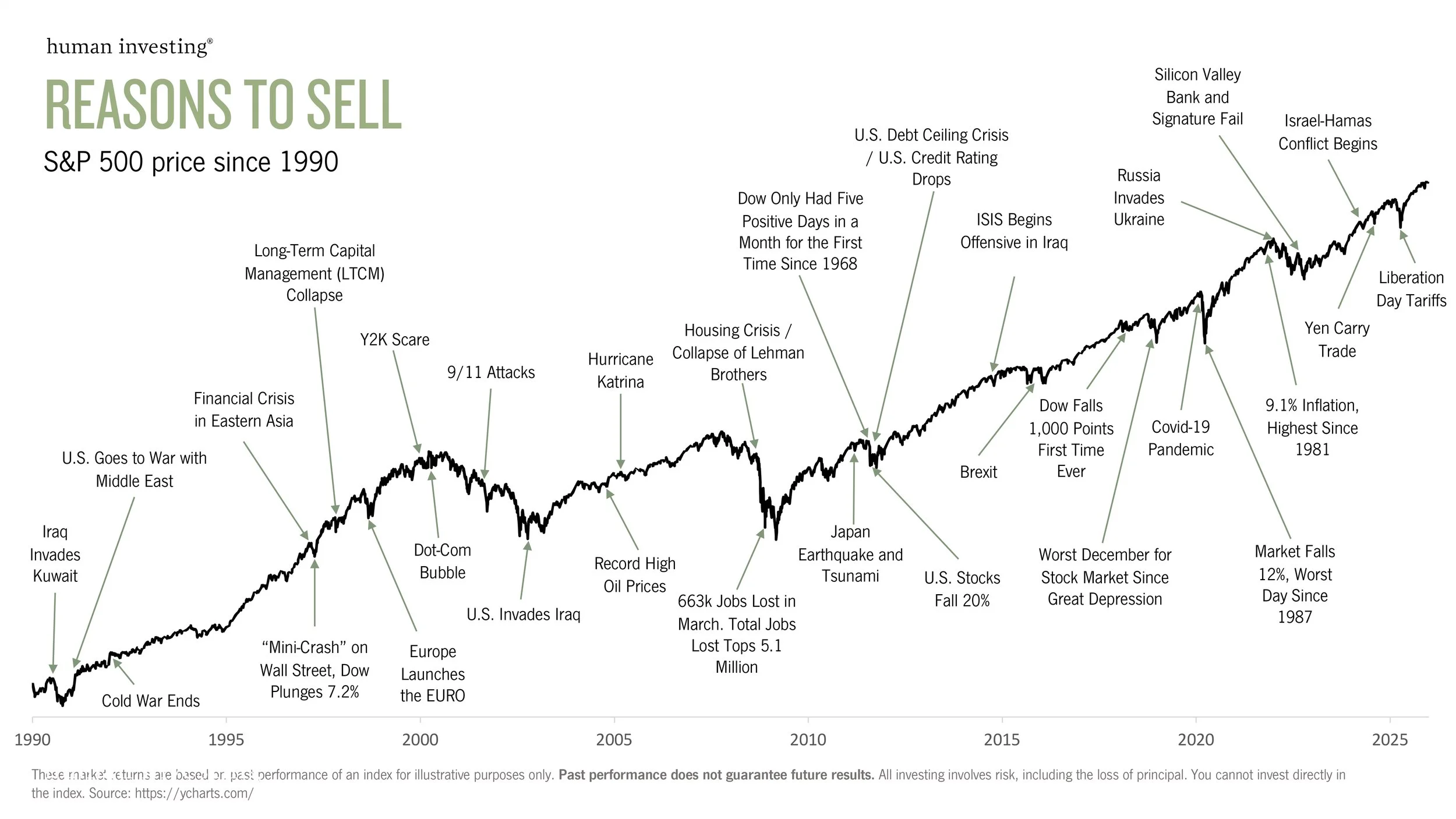
This is one of our favorite graphs. It's always easier to see that yesterday's worries weren't as scary once they're in the rearview mirror. Even through the Dot-Com bubble bursting, the 07-08 global financial crisis, and the COVID-19 global pandemic, stocks have risen. While we may not know the length or extent of a given market downturn, we do know companies have historically navigated challenges and delivered positive returns to long-term investors. We expect that resiliency to continue.

Introducing Intra-Year Declines

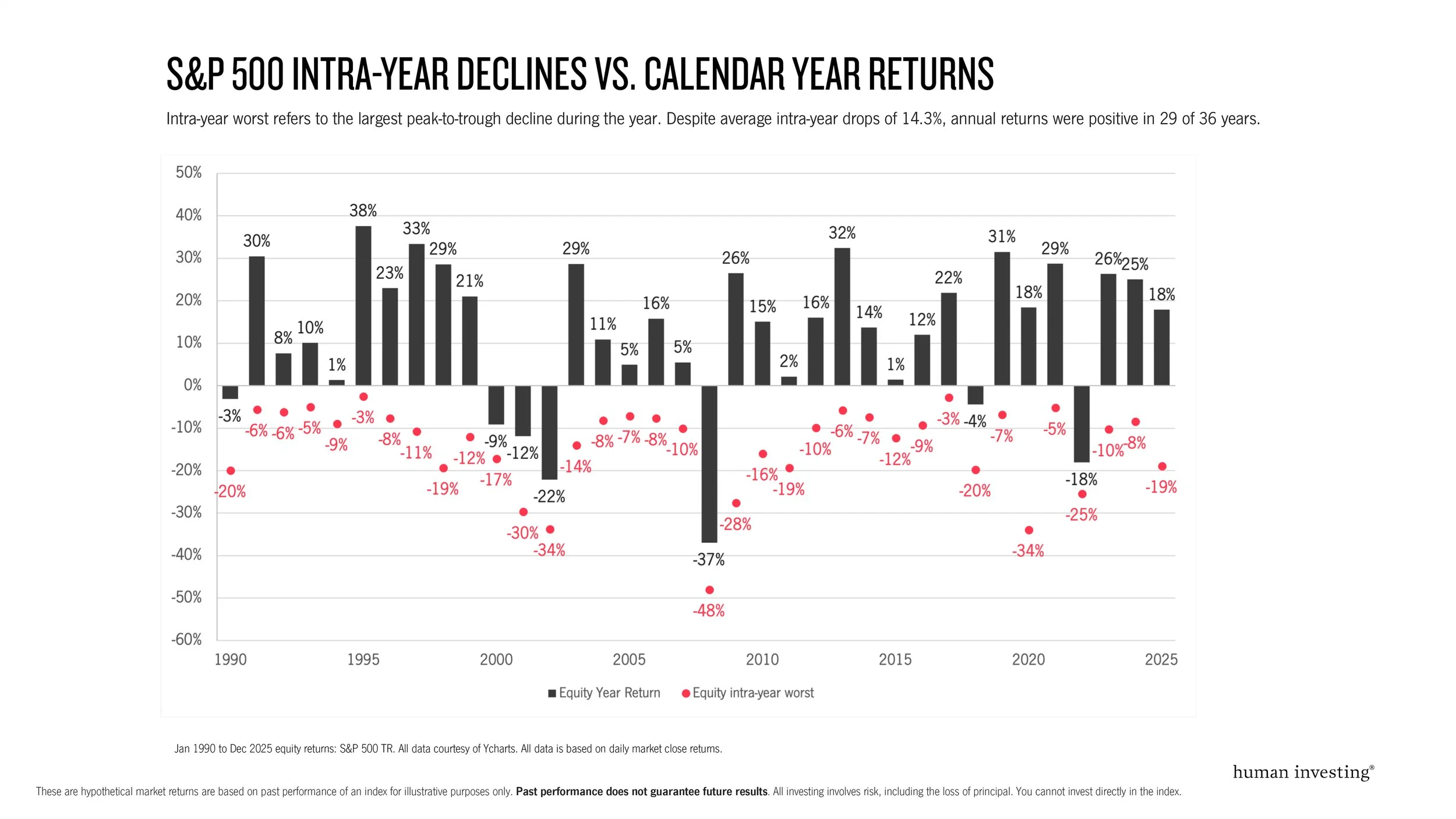
Markets rarely move in a straight line. Even in strong years, there’s almost always at least one significant drop along the way — what we call an intra-year decline. It measures how far the market fell from its highest point before it started recovering. As you can see in the chart below, intra-year declines have occurred every single year in the S&P 500 since 1990.

As I’ve written previously, the stock market is biased towards delivering positive returns. Most calendar years, stocks are up. This graph speaks to the lived experience of investors: every year has a downturn, no exceptions. I’m sure each downturn felt reasonable but worried investors at the time. No investor from 1990-2025 was immune from seeing their portfolio go down. Those who stuck with it saw positive returns in over 80% of those years.

Even amidst recent headlines, the market’s behavior has been typical. The S&P 500 dropped roughly 9% from its January peak to its March low. This is well within the normal range of market volatility where intra-year declines of 10% or more are common.

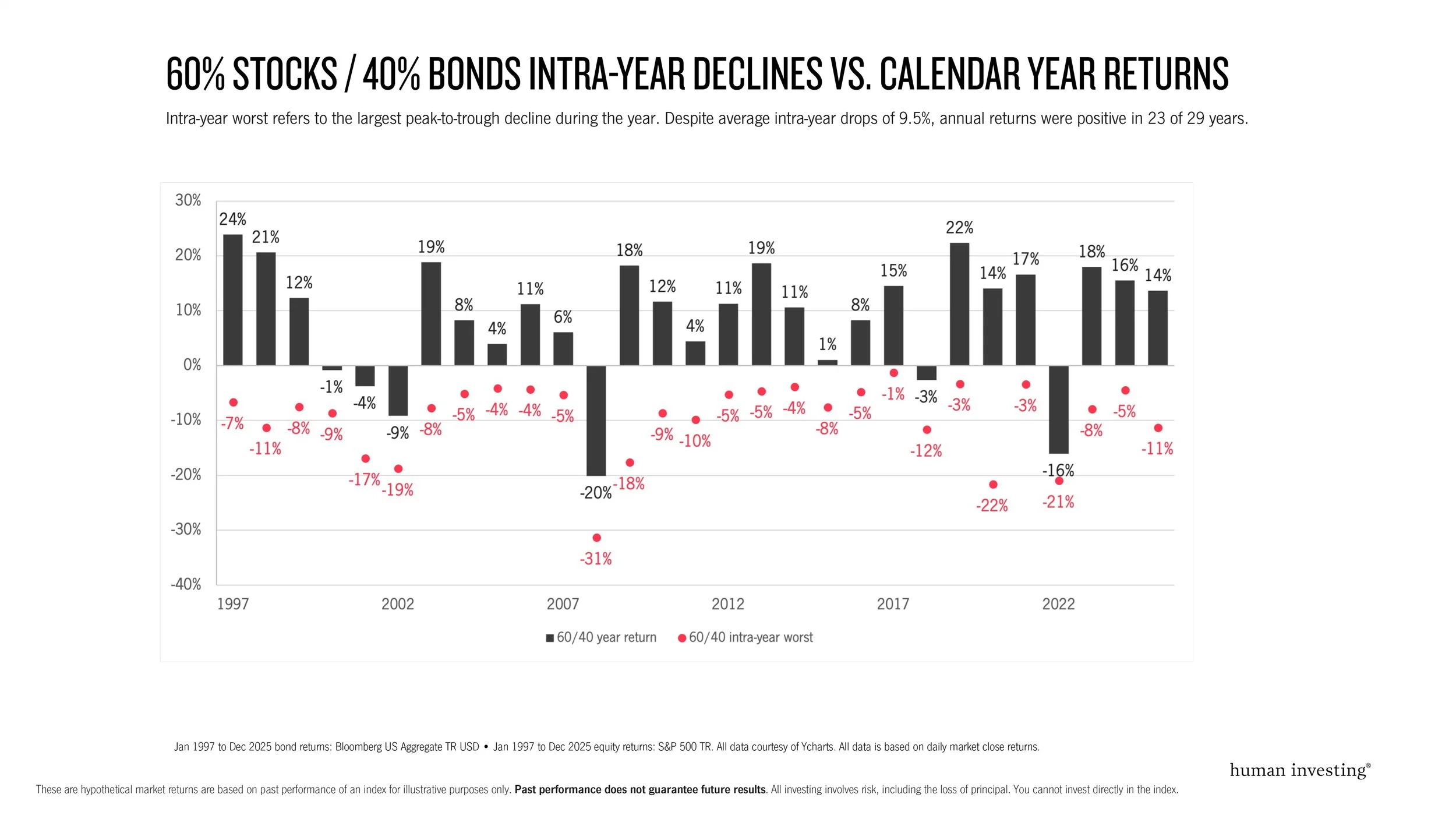
Most investors don’t own 100% equities, so it’s important to understand how introducing bonds can reduce risk. 60% equity and 40% bonds (60/40) is a common allocation because it tends to be a sweet spot between positioning your portfolio to grow and reducing risk enough to weather the volatility. Knowing where your asset allocation should be and when is an important, personal, complicated conversation that should involve a financial planner.

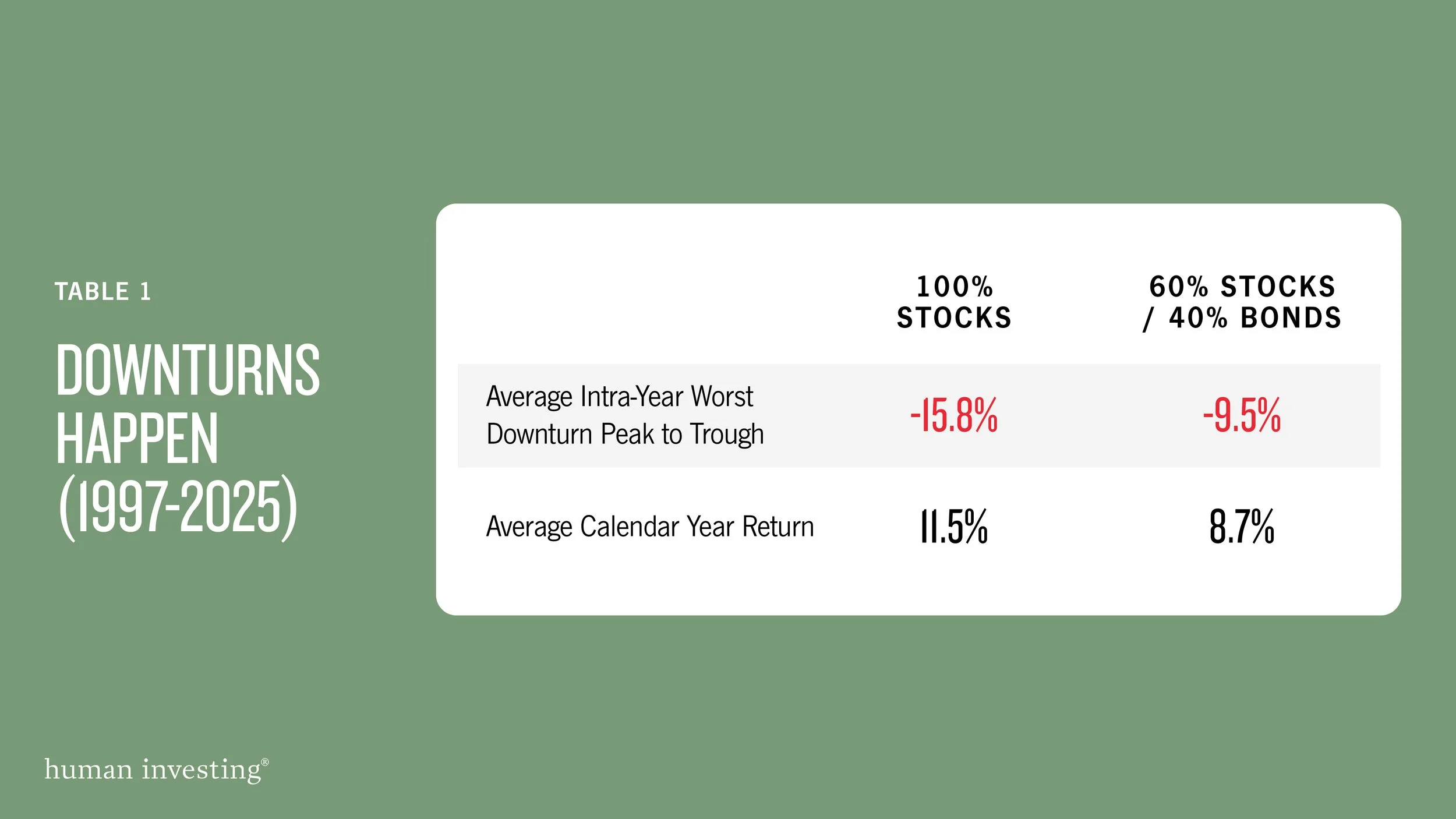
As you can see, while shifting from stocks to bonds doesn’t eliminate downturns, it certainly lessens them. Higher returns tend to come with more ups and downs, while smoother rides usually mean lower long-term growth. There’s no perfectly safe way to grow your dollars faster than inflation, so risk is always going to be part of your investment strategy. The key is finding the right balance between how much risk you’re comfortable with and how much risk you actually need to take to reach your financial goals.

Making plans that last

Anytime we’re designing a portfolio at Human Investing, we’re trying to make decisions we’d be okay with over the timeframe that matters for YOUR goals. That doesn’t mean we don’t revisit or adjust, but we’re not trying to make short-term tactical moves. We know outsmarting the market is incredibly difficult to achieve. We’re planning for our clients’ lifetime, not the next 6 months. We want to ensure our clients are positioned in a way where they are capturing the growth necessary to reach their financial goals, while having enough safety they don’t panic because of a temporary downturn.

No matter how you think about risk, there are a few enduring truths. Stocks are a volatile investment, but they’ve historically been a great growth engine in the long run. Whatever headline or concern today will feel much smaller in the rearview mirror.  

Your financial plan and investments are meant to serve you over your entire life, not the current news cycle. There will be times when it makes sense to revisit your allocation, especially when your personal circumstances change. Those decisions should be driven by your goals, not the headline of the week.

We’re always happy to have conversations to help you understand how your allocation is set to fit your needs. Call us at 503-905-3100, or email hi@humaninvesting.com.


Disclosure: This material is provided for informational and educational purposes only. It should not be construed as investment, legal, or tax advice, nor does it constitute a recommendation or solicitation to buy or sell any security. Any market commentary, forward-looking statements, projections, or return expectations discussed are based on assumptions and current information and are subject to change. There is no guarantee that these views will be realized. Investors should consult with a qualified financial professional before making any investment decisions. There is no guarantee that any investment strategy will achieve its objectives, and investing involves risk, including the potential loss of principal. References to market indexes (including the S&P 500 and blended stock/bond allocations) are for illustrative purposes only, are unmanaged, and do not reflect the performance of any specific investment or client account. Index returns do not reflect the deduction of fees or expenses. Historical returns, projections, or economic conditions are illustrative only and should not be considered indicative of future results. Past performance is not a guarantee of future outcomes. Asset allocation and diversification strategies do not ensure a profit or protect against loss. Advisory services offered through Human Investing, an SEC-registered investment adviser.


Related Articles

Oil Prices and the Economy: What History Suggests
 

Recent developments in the Middle East have once again drawn attention to oil markets. When tensions rise in regions responsible for a meaningful share of global energy production, investors naturally begin to ask how higher oil prices might influence the broader economy and financial markets.

Before discussing the financial implications, it is important to acknowledge the human side of these events. Conflicts like this affect families and communities around the world in ways that extend far beyond markets and economics.

Still, it’s natural for investors to wonder how disruptions in energy markets might affect their investments. Our aim is to provide context that can help frame those concerns.

Why do oil prices matter so much?

Energy plays a central role in the global economy because oil sits near the beginning of the production chain for many industries. It powers transportation networks, supports manufacturing, and is embedded in the production of everyday goods ranging from food to plastics and chemicals. When oil prices rise quickly, those higher costs move through supply chains and eventually reach businesses and households in the form of higher prices.

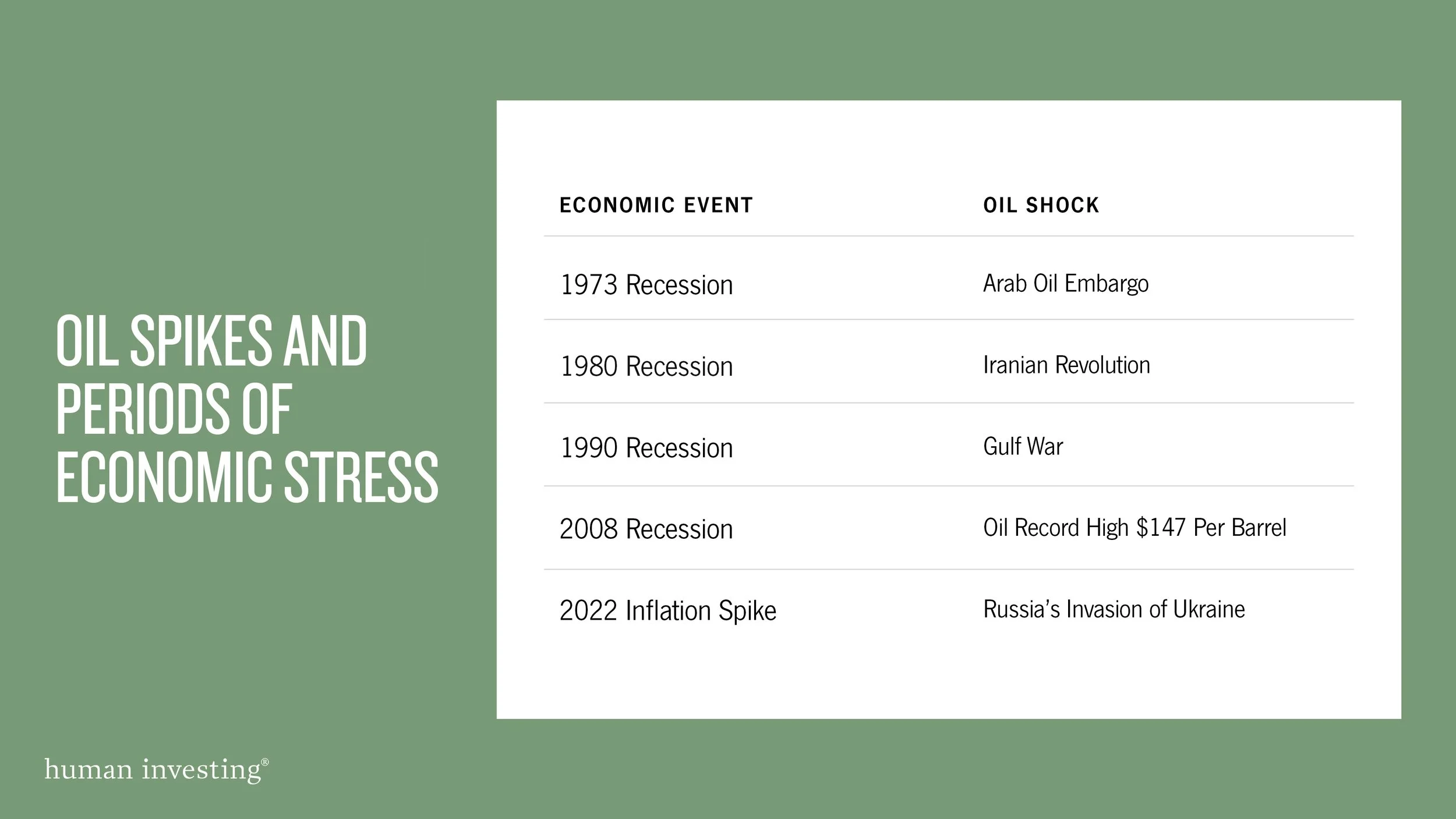
History shows that sharp oil spikes have often coincided with periods of economic stress, though they are rarely the sole cause.

It is understandable that headlines often focus on oil during geopolitical conflicts. When energy costs rise quickly, pressure on the broader economy can follow.

Geopolitical conflicts often bring uncertainty to both energy markets and financial markets. We explored how markets historically respond to war and global conflict in a previous piece, which you can read here: War and the Market: What Does History Teach Us?.

Why today’s energy landscape is more resilient

Looking at several decades of data provides helpful perspective when considering why the economy may respond differently to oil shocks today.

There is useful context when looking at global oil supply. The United States now produces roughly 20% of the world’s oil, while Iran accounts for about 3–5%. That balance looked different during earlier oil shocks. In 1979, Iran produced close to 10% of global supply, while the United States accounted for roughly 15%. This shift means the global energy system is more diversified and less dependent on any single region than it was during past crises.

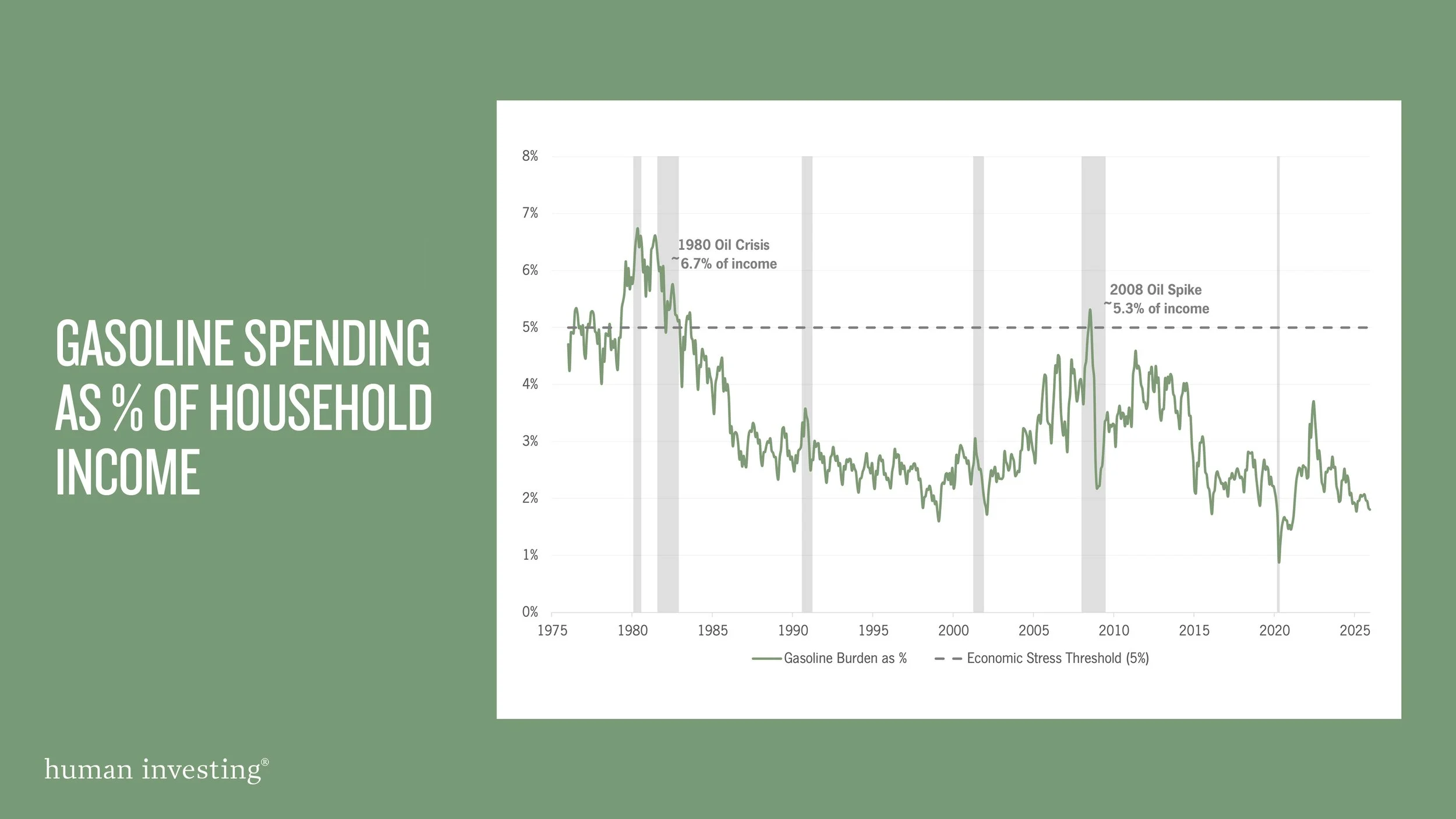
Households also appear to have more buffer against rising fuel prices than in earlier periods. One measure economist often watch is how much households spend on gasoline relative to their income.

Historically, economic stress has tended to increase when gasoline spending rises above about 5% of household income. Today that figure sits closer to 2–3%, suggesting households, broadly, have more room to absorb fluctuations in energy prices than during past oil shocks.

The chart below illustrates how gasoline spending as a percentage of household income has changed over time and why economists often watch this measure during periods of rising oil prices.

Shaded areas indicate U.S. recessions.
Source: U.S. Energy Information Administration, Bureau of Economic Analysis, Federal Reserve Bank of St. Louis

Finding Your Footing During Energy Market Volatility

Periods of geopolitical uncertainty often bring volatility to both energy markets and financial markets. Oil prices can move quickly as investors react to changing expectations about supply and demand.

For investors, the more relevant question is how these developments influence their financial plan.

At Human Investing, portfolios are designed with a range of economic environments in mind. Energy price shocks, while disruptive in the short term, represent only one of many forces that influence markets over time. Diversified portfolios allow different parts of the market to respond differently as economic conditions change.

For example, companies that rely heavily on fuel may face higher costs when energy prices rise, while energy producers may benefit from stronger prices. These adjustments tend to occur within the market rather than outside it.

Because of this, our focus for investors remain on their broader financial plan, investment timeline, and overall diversification.

Oil markets may move quickly in response to geopolitical events, yet long-term investment outcomes are shaped by many forces over time.


Disclosure:
This material is for informational and educational purposes only and is not investment, legal, or tax advice. References to historical events or market trends are illustrative and do not guarantee future results. Investing involves risk, including possible loss of principal. This commentary does not constitute a recommendation to buy or sell any security or adopt any investment strategy. Human Investing, LLC is a registered investment adviser; registration does not imply a certain level of skill or training.

Sources
Energy Institute. (2024). Statistical review of world energy 2024.
Graefe, L. (n.d.). Oil shock of 1978–79. Federal Reserve History.
U.S. Bureau of Economic Analysis. (2026). Disposable personal income (DSPI). Retrieved from FRED, Federal Reserve Bank of St. Louis.
U.S. Bureau of Labor Statistics. (n.d.). U.S. Bureau of Labor Statistics.
U.S. Energy Information Administration. (2026).U.S. product supplied of finished motor gasoline (thousand barrels per day).


Related Articles

I Hope You’re Wrong: Why Being Right Can Be More Dangerous Than Being Wrong
 

One of the persistent temptations in investing is the belief that the future can be known, rather than simply estimated or viewed through a lens of probability.

Every so often, markets appear to reinforce this belief. It can happen when an analyst makes a sweeping economic call, a television personality highlights a stock, or an investor acts on a strong conviction about a single event. When such a call lands correctly, an investor’s confidence tends to grow much faster than their actual wisdom. This creates a unique brand of risk where the danger isn't being wrong but rather being "right" in a way that encourages all the wrong lessons.

Experience has taught me to treat these moments with caution, as a successful forecast can lead to increased activity, narrower positioning, and a reduced tolerance for uncertainty.

The pull of prediction

We currently live in an environment where market commentary often comes with an air of certainty. Forecasts with clean narratives and specific numbers can create the impression that the future is more orderly and manageable than it actually is. In this context, investing can begin to resemble wagering on specific outcomes rather than planning for inherent unpredictability.

The reality is that markets are complex adaptive systems shaped by a mix of fundamentals, incentives, psychology, policy decisions, and randomness.

Consequently, when a prediction proves accurate, it is rarely clear whether the result stemmed from genuine insight or mere circumstance. Because markets largely reward outcomes without distinguishing between skill and luck, investors are often left to conclude that their success was due to brilliance rather than chance.

Famous calls and their aftermath

History is generous in celebrating bold forecasts. Michael Burry, for instance, is rightly remembered for identifying the housing market excesses before the Global Financial Crisis. It was a significant call that required immense conviction and a high tolerance for sustained discomfort. However, what receives less attention is what happens after such a call is made. Since that episode, Burry has repeatedly warned of impending market downturns; while some concerns were thoughtful, many were premature, and others have been incorrect.  

We see a similar dynamic in the warnings issued by public figures. Robert Kiyosaki, for example, has repeatedly forecasted systemic collapse. The chart aligns several of those warnings with the path of the S&P 500, which over that period moved materially higher.

With enough attempts, even low-probability calls will eventually intersect with actual outcomes.

The common thread in both examples is that forecasting is rarely a single bet. One successful prediction often creates pressure to make another, or to double down on a view even after the market has moved on. This pattern reveals a fundamental distinction for investors: the difference between trying to be "right" and actually making a prudent decision. 

The danger of fixating on outcomes

That difference becomes unavoidable when we examine how outcomes are derived.

As professional poker player and author Annie Duke has observed “We are too quick to treat outcomes as a referendum on decision quality, when luck plays a much larger role than we are comfortable admitting.” This insight sits at the core of disciplined investing.

Outcomes, on their own, are an unreliable measure of decision-making. Well-reasoned decisions can lead to disappointing results. Poorly reasoned decisions can occasionally be rewarded. Over short periods of time, randomness can obscure the underlying quality of the process.

The challenge is that investors are wired to equate results with decision quality. If we judge our strategy solely by whether it was correct in the short term, we reinforce behaviors like excessive conviction and a refusal to reassess our positions. A more durable standard is required, one where the most important question is not whether a view proved correct, but whether the plan was robust enough to withstand being wrong.

The high cost of being too certain

When outcomes are mistaken for skill, the resulting overconfidence can quickly become destructive. Investors who believe they can forecast the market often increase their trading activity, bet too heavily on one specific direction, and abandon the protection of diversification in favor of short-term signals.

The irony is that the more certain an investor becomes, the more fragile their strategy tends to be. Portfolios built on specific predictions only work if those predictions come true, which provides a dangerously narrow margin of safety.

A different standard

From a fiduciary perspective, the objective is not to anticipate each market event correctly. It’s to build resilient plans that remain viable across a wide range of outcomes. This requires accepting uncertainty as a permanent feature of the landscape and prioritizing asset allocation, tax awareness, and emotional resilience over the allure of the next big forecast. While a prediction may be correct, any approach that depends on it’s success is fundamentally fragile.

Why I hope you’re wrong

Ultimately, when I hear a confident market prediction, my internal response is often, “I hope you’re wrong.”

My reaction is not born out of cynicism or a desire to see someone fail. Rather, it reflects an awareness of how slippery the slope can be once a prediction proves correct. Being wrong, while uncomfortable, serves an important purpose of reinforcing humility and preserving discipline.

Markets have a long history of humbling those who claim certainty. The investors who truly succeed over decades are those who respect that history, choosing to build financial plans that remain intact across a wide range of outcomes, including those they did not anticipate.


Disclosure: This commentary is for informational purposes only and should not be considered investment, tax, or legal advice. The views expressed are based on current market conditions and are subject to change without notice. Past performance is not indicative of future results, and no investment strategy can guarantee success or protect against loss. References to specific companies are for illustrative purposes only and do not constitute a recommendation to buy or sell any security. Investors should consult with a qualified financial professional before making any investment decisions. Human Investing is an SEC-registered investment adviser. Registration does not imply a certain level of skill or training.


Related Articles

Our 2026 Economic Outlook and Key Topics to watch


After a great run, what should investors expect next?

Every year starts the same way. A fresh set of market forecasts arrives, confidently predicting what stocks will do next. And every year, markets remind us how unreliable those predictions can be.

Even professionals struggle to get it right. In both 2023 and 2024, most Wall Street forecasts underestimated the actual returns of the S&P 500. Markets have a long track record of defying expectations.

This is why long-term investors shouldn’t build portfolios around short-term predictions. Markets move faster than forecasts can adapt. Instead, focus on building portfolios that can compound through a wide range of environments. Still, expectations matter. When investors have a reasonable sense of what outcomes are possible, it’s easier to stay invested when markets don’t behave the way headlines suggest they should.

So as we look ahead to 2026, the useful question isn’t “Will the market keep rallying?”, It’s “What’s reasonable to expect after a strong run?”

The last few years were not normal

It’s hard to overstate how unusual the period from 2020 through 2025 has been. 

A global pandemic shut down large parts of the economy. Inflation surged to levels not seen since the early 1980s. The S&P 500 suffered its worst calendar year since 2008 in 2022. Trade policy and geopolitics added ongoing uncertainty.

And yet, by the end of 2025, the S&P 500 was up nearly 18% for the year. 

When you zoom out, recent returns stand well above long-term averages. Over the past 1, 5, and 10 years, the market has delivered results that are meaningfully better than its 50-year history.

That’s great news for investors. But it also creates a subtle challenge. Strong recent returns have a way of adjusting expectations. What was once exceptional can start to feel normal, even when it isn’t.

Historically, periods of above-average returns are often followed by more moderate ones. Not because markets “owe” us anything, but because starting valuations matter. After a great run, future returns tend to look more ordinary.

The return expectations shown above are derived from publicly available third-party capital market outlooks and represent long-term estimates, not predictions or guarantees. These assumptions are not specific to any individual investor, do not reflect advisory fees, taxes, or other costs, and may differ materially from actual future market results.
[1] Vanguard, Vanguard Capital Markets Model Forecasts, January 22, 2026
[2] Schwab, What’s the 10-Year Outlook for Major Asset Classes?, June 6, 2025
[3] Fidelity, Capital Market Assumptions: A Comprehensive Global Approach for the Next 20 Years, August 2023
[4} BlackRock, Capital Market Assumptions, November 13, 2025

Why “lower” returns aren’t a bad outcome

Many long-term forecasts for U.S. stocks over the next decade fall in the mid–single-digit range. Compared to recent experience, that sounds disappointing. Compared to history, it’s typical.

This is an important distinction. Lower-than-exceptional returns are not the same thing as poor returns. Compounding still works at 5%–6% per year. It just doesn’t feel as exciting when you’re coming off a stretch of double-digit gains.

Experiencing more typical equity returns isn’t inherently an issue. It’s planning as though the unusually strong results of the past decade will repeat that can cause problems.

Why planning matters more than forecasting

For investors saving toward retirement or already retired, expectations matter because small differences compound over time. When returns are more typical, the margin for error narrows. This is exactly where comprehensive planning becomes most valuable.

At Human Investing, we don’t try to outguess markets or build portfolios around forecasts. That means emphasizing diversification, discipline, and resilience rather than reacting to short-term narratives. Our focus is helping clients make better decisions around the things they can control, including how investments interact with taxes, cash flow, retirement timing, and spending choices.

When returns are strong, almost any strategy can feel successful. A well-built financial plan shows which levers impact results, how much flexibility you have, and what adjustments are worth making if conditions change.

Markets will always surprise us. A good plan is designed so those surprises don’t derail long-term goals. That’s the role planning plays in our work, not as a prediction tool, but as a framework for making sound decisions across many possible market outcomes.

Sometimes having a sense of what may be coming can help stay calm during tumultuous times. Lets take some time to review some of the major topics that could cause investors stress in 2026. Good or bad, some version of these topics and the uncertainty around them is reflected in the market today. As more information comes out as time passes, that uncertainty converting into knowledge will cause prices to update. It’s unlikely these will be unforeseen surprises that cause major market movement.

Major 2026 topics we’re watching

Can The Fed maintain its independence?

The Federal Reserve (aka “The Fed”) is in interesting territory. With the attempted dismissal of Fed Governor Lisa Cook, and Department of Justice Investigation, The Fed’s independence is being challenged in new ways. The administration has made their desire for lower rates faster clear. The Fed’s challenge is ensuring rates don’t get too low and stoke inflation.

As unpleasant as it can feel at times, an Independent Fed is a healthy influence on the US economy in the long run. Being willing to raise rates to slow economic activity in the short term to control inflation is an important and painful process. The great challenge of high inflation is it makes any cost today for gains in the future incredibly difficult to make feasible. The lowered investment eventually drags on an economy’s long term growth prospects.

What will AI do to the economy?

No matter where you look, the biggest question for markets and the economy all center around AI. We recently wrote about why the AI boom is different than the dot-com bubble. We do know the upfront costs to build the infrastructure necessary for AI are large. The big concern for investors is the payoff of these AI related investments. If the costs are never fully recovered by increased revenue, companies that are booming today because of their AI investments may end up falling.

What does a modern workplace look like?

Another theme looking at 2026 forecasts: The labor market is going to be an area to watch. With immigration slowing and the aging of the baby boomer generation into retirement, the workforce size is expected to hold relatively steady. The uncertainty of the tariff environment has made long-term decisions outside of AI difficult for companies to navigate. The promise of AI is to enable workers to do more, and so in theory a given company will need fewer people to accomplish a similar amount of work. All this has led to employers generally being less motivated to hire. There aren’t necessarily large layoffs incoming, but hiring may slow enough to increase unemployment slightly.

Staying invested still matters most

The past several years have been exceptionally good for investors. After a run like that, it’s reasonable to expect a more typical environment going forward.

There will always be reasons to sell. There will always be headlines that make staying invested feel uncomfortable. But investing has never required perfect conditions to work.

If you’ve stayed invested through the last 5 to 10 years, you’ve already benefited from an unusually strong period. The next chapter may look different, but the discipline required doesn’t change.

The goal isn’t to predict what 2026 will bring. It’s to own a portfolio that doesn’t need predictions to succeed.


Disclosure: This material is provided for informational and educational purposes only. It should not be construed as investment, legal, or tax advice, nor does it constitute a recommendation or solicitation to buy or sell any security. Any market commentary, forward-looking statements, projections, or return expectations discussed are based on assumptions and current information and may not materialize. Investors should consult with a qualified financial professional before making any investment decisions. There is no guarantee that any investment strategy will achieve its objectives, and investing involves risk, including the potential loss of principal. References to market indexes, historical returns, projections, or economic conditions are illustrative only and should not be considered indicative of future results. Past performance is not a guarantee of future outcomes. Advisory services offered through Human Investing, an SEC-registered investment adviser.


Related Articles

3 Reasons Why the AI Boom Is Not the Dot-Com Bubble
 

There is a growing chorus calling today’s AI surge the next dot-com bubble. Even well-known voices like Michael Burry, who predicted the 2008 housing crisis, have drawn the comparison. It sounds convincing at first, but the comparison breaks down quickly. And for long-term investors, understanding the difference is critical.

Here is the simple truth. This is not another 1999. The foundations are different. The companies are stronger. The sentiment is almost the opposite. If we misunderstand the environment, we risk reacting emotionally rather than investing with discipline and clarity.

FIRST, Valuations Then Were Built on Hope. Today They’re Built on Earnings

During the dot-com era, prices surged with little connection to actual business performance. Cisco is the clearest example. The stock price raced higher while projected earnings stayed relatively flat. That disconnect is one of the clearest signs of a bubble. Investors were buying possibility instead of profitability.

Now look at today’s AI leader, Nvidia. Its stock price has risen but so have its forward earnings per share. Revenue is expanding. Demand is accelerating. Profitability is growing at a historic pace. The price is being pulled higher by fundamentals, not by wishful thinking.

This distinction matters.

In the dot-com era, prices broke away from earnings.

In the AI cycle, prices and earnings rise together.

For long-term investors, this is not a minor detail. It is the difference between speculation and substance. When prices run ahead of earnings, gravity eventually pulls them back. The two lines always reconnect. Prices can sprint or stumble in the short term, but fundamentals set the pace over time. When prices rise because earnings rise, it is the fundamentals doing the work.

NEXT, The Nature of the Companies Is Entirely Different

The second difference is straightforward. The companies simply are not comparable.

During the dot-com era, a clever idea and a domain name were often enough to attract enormous capital. Pets.com is the classic example. It raised over $82 million during its IPO despite having no profits and no evidence that its model worked. It became famous before it became viable. Nine months later, Pets.com closed their virtual doors.

Now compare that with today.

The AI landscape today is nothing like that. The Magnificent Seven leading AI investment are among the most profitable companies ever created. Apple, Microsoft, Alphabet, Amazon, Meta, Nvidia, and Tesla operate with financial strength that rivals entire industries. Together they have acquired more than 846 companies. Their revenue is diversified. Their moats are wide. Their infrastructure spans the globe. Their cash flow is massive.

This difference is not trivial.

Startups with untested ideas tend to burn cash, chase growth at any cost, and rely on investor optimism to stay alive. Established multi-trillion-dollar companies generate consistent profits, fund their own innovation, and can withstand economic shocks. They behave very differently.

The risks, opportunities, and outcomes are not comparable.

FINALLY, Sentiment Today Is Cautious, Not Euphoric

The most important difference may be psychological.

In the late 1990s, consumer sentiment reached historic highs. The University of Michigan index moved above 110. Confidence was overflowing. People believed prosperity would continue indefinitely. Alan Greenspan described the mood as irrational exuberance, and even that felt modest.

A 1999 Time magazine article reported workers quitting stable jobs to day-trade technology stocks. One story described a plumber who refused to fix a leaking pipe because he was too busy trading. That was the climate. Excitement replaced caution. Greed replaced discipline.

Today tells a different story

Consumer sentiment recently sat near 51, weaker than readings during the 2008 financial crisis. It reflects fear and uncertainty, not optimism. In hundreds of conversations advising investors during this season, not one person has pushed to increase equity exposure because of excitement about AI. Most express caution, not confidence.

This matters. Investor psychology often explains more about cycles than spreadsheets do.

Bubbles form when confidence outruns reality. Today, reality is outrunning confidence.

What we see today is not exuberance. It is skepticism.

What Investors Should Take Away

None of this means AI is risk-free. Markets never are. Technologies evolve. Leaders change. Expectations adjust. Some companies will thrive and others will fade. That is the natural rhythm of progress.

Some believe AI will reshape entire industries. Others expect only incremental change. No one knows for sure, and investors do not need perfect foresight to succeed. What they need is discipline, patience, and a strategy that holds up across many possible futures.

Periods like this tend to reward investors who rely on a thoughtful financial plan and avoid emotional decision making. Resiliency matters more than reaction.

At Human Investing, we help clients make clear, confident decisions in moments like this. We separate signal from noise. We keep your strategy rooted in your goals, not the market’s mood.

The biggest mistakes rarely come from missing a prediction. They come from acting too quickly. Our role is to walk with you through uncertainty and ensure your plan remains strong, thoughtful, and centered on what matters most to you.


Sources:

https://www.cnbc.com/2025/11/25/michael-burrys-next-big-short-an-inside-look-at-his-analysis-showing-ai-is-a-bubble.html

https://am.jpmorgan.com/content/dam/jpm-am-aem/global/en/insights/market-insights/emea-investment-outlook-2025.pdf

https://www.nytimes.com/2000/11/08/business/technology-petscom-sock-puppet-s-home-will-close.html

Eric Balchunas

https://time.com/archive/6736122/day-trading-its-a-brutal-world/

Disclosure: This commentary is for informational purposes only and should not be considered investment, tax, or legal advice. The views expressed are based on current market conditions and are subject to change without notice. Past performance is not indicative of future results, and no investment strategy can guarantee success or protect against loss. References to specific companies are for illustrative purposes only and do not constitute a recommendation to buy or sell any security. Investors should consult with a qualified financial professional before making any investment decisions. Human Investing is an SEC-registered investment adviser. Registration does not imply a certain level of skill or training.


Related Articles

Scary Headlines Make Great Clicks But Terrible Investment Strategies


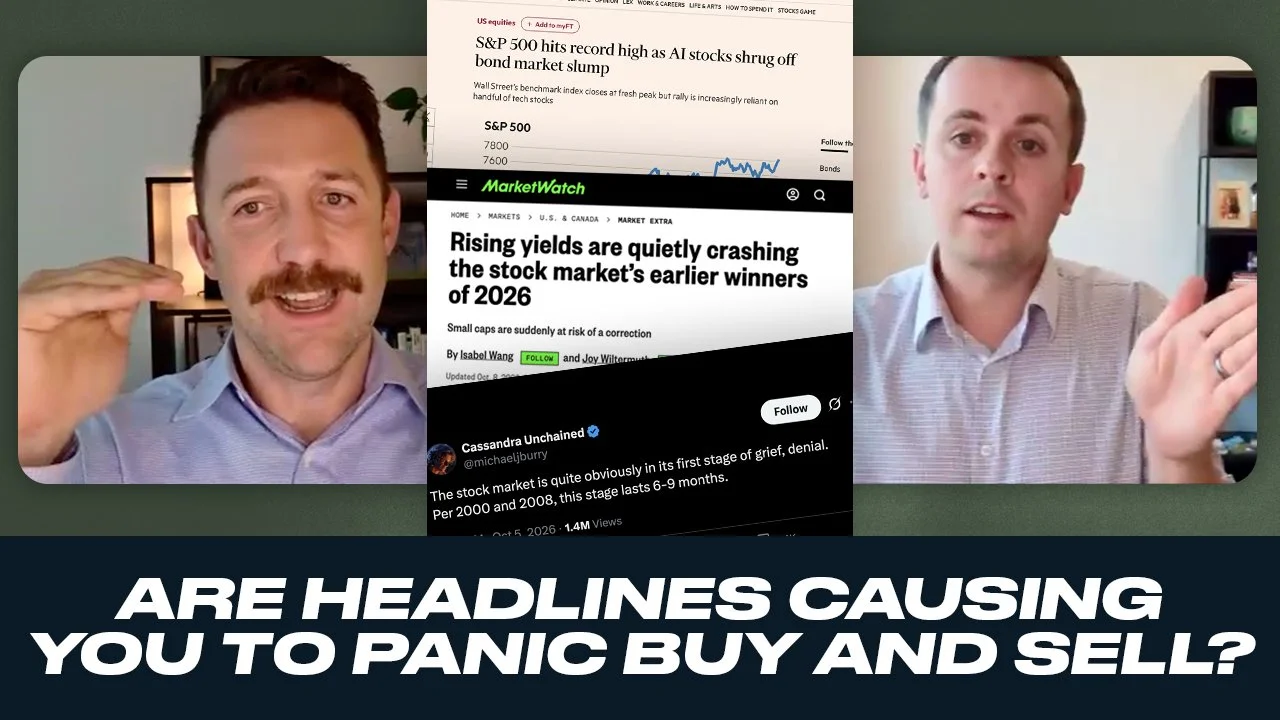
This article explores how financial headlines influence investor behavior, often exacerbating emotional decision-making and undermining long-term investment outcomes. Drawing from behavioral finance research and investor psychology, the article argues that investors should adhere to a written investment plan rather than respond impulsively in the face of uncertainty and sensational news. Selected headlines from Bloomberg and CNBC illustrate the impact of the modern media environment on perception and behavior. The insights of Peter Lynch, Jack Bogle, and Warren Buffett are used to contextualize the long-standing wisdom of patience and discipline in investing.

The rise of financial anxiety

Today’s investors are inundated with a 24/7 news cycle that thrives on urgency. While access to information has never been easier, clarity has never been harder to maintain. Financial headlines are designed to capture attention, often through alarming or emotionally charged language. This reality presents a challenge for investors: distinguishing between signal and noise and avoiding making decisions rooted in emotion rather than logic or planning.

The emotional power of headlines

A review of today’s (4/24/25) major financial media illustrates the challenge. From CNBC, headlines such as:

Bridgewater hedge fund warns Trump policies could induce a recession
The S&P 500 formed an ominous ‘death cross.’ What history says happens next

frame the economic outlook in dramatic, even catastrophic terms. Similarly, Bloomberg ran with:

Odd Lots: Why the Real Tariff Pain Hasn’t Even Begun
One of Wall Street’s Biggest Bulls Slashes View as Tariffs Bite

Despite these headlines, the S&P 500 rose nearly 2% today, and tech stocks surged on strong earnings reports. This disconnect between the emotional tone of news coverage and actual market behavior is a classic example of availability bias—a cognitive distortion where individuals give undue weight to recent, vivid, or emotionally charged information (Tversky & Kahneman, 1973).

This behavioral response, driven by the availability of alarming headlines, often leads investors to abandon sound strategies in favor of reactive decisions. Yet history and experience warn us against this trap. As the following insights from some of the most respected minds in investing make clear, enduring success comes not from responding to noise but from adhering to a disciplined, long-term approach.

Wisdom from the investment greats

The dangers of reactionary investing are not new. Legendary investor Peter Lynch warned:

“Far more money has been lost by investors trying to anticipate corrections than lost in the corrections themselves.”

Jack Bogle, the founder of Vanguard, put it more bluntly:

“The idea that a bell rings to signal when to get into or out of the stock market is simply not credible.”

And Warren Buffett offered perhaps the most elegant summation:

“The stock market is a device to transfer money from the impatient to the patient.”

These insights underscore the importance of focusing not on media narratives but on long-term goals and rational portfolio construction.

Recognizing the wisdom of these investment luminaries is a critical first step—but applying it consistently requires more than agreement; it requires structure. Investors need more than memorable quotes to overcome the behavioral impulses triggered by market volatility.

They need a written financial plan that serves as a behavioral compass, grounding decisions in clearly defined goals, timelines, and risk tolerance. Translating timeless investment principles into practical, repeatable actions makes the financial plan a vital tool for staying the course when emotions run high.

The role of a written financial plan

The antidote to reactionary behavior is a well-crafted financial plan that clearly articulates an investor’s purpose, time horizon, risk tolerance, and rebalancing strategy. Far from being a static worksheet, the plan functions as a behavioral anchor, offering clarity during periods of uncertainty and helping investors resist the temptation to respond emotionally to sensational headlines.

A thoughtfully structured financial plan does more than outline investment choices and target allocations. It proactively defines how to respond to market volatility, eliminating guesswork when clarity is most needed. Doing so transforms abstract wisdom into actionable discipline—bridging the gap between intention and execution.

Planning over panic

In a media landscape dominated by noise, fear, and speculation, the most effective investor response is not reaction—but preparation. Rather than chase headlines, successful investors rely on a carefully constructed financial plan and the discipline to follow it. Behavioral economics and decades of market data affirm that patience, consistency, and structure drive long-term success.

So, when the next wave of headlines warns of crisis or collapse, the wise investor doesn’t panic. They return to the plan—and stay the course.

For more information about our financial planning services, please call (503) 905-3100 or contact us.

References:

Tversky, A., & Kahneman, D. (1974). Judgment under uncertainty: Heuristics and biases. Science, 185(4157), 1124–1131.


A BOOK FOR THE SAVER IN ALL OF US

Becoming a 401(k) Millionaire isn’t your typical retirement guide. With 30 years in finance, Dr. Peter Fisher shares personal insights and real stories to help you plan with confidence.

Disclosures: These market returns are based on past performance of an index for illustrative purposes only. Past performance does not guarantee future results. All investing involves risk, including the loss of principal.  Index performance is provided for illustrative purposes only and does not reflect the performance of an actual investment. Investors cannot invest directly in an index.

The information provided in this communication is for informational and educational purposes only and should not be construed as investment advice, a recommendation, or an offer to buy or sell any securities. Market conditions can change at any time, and there is no assurance that any investment strategy will be successful.

Diversification does not guarantee a profit or protect against a loss in declining markets. Asset allocation and portfolio strategies do not ensure a profit or guarantee against loss.

The opinions expressed in this communication reflect our best judgment at the time of publication and are subject to change without notice. Any references to specific securities, asset classes, or financial strategies are for illustrative purposes only and should not be considered individualized recommendations.

Human Investing is a SEC Registered Investment Adviser. Registration as an investment adviser does not imply any level of skill or training and does not constitute an endorsement by the Comission. Please consult with your financial advisor to determine the appropriateness of any investment strategy based on your individual circumstances.


Related Articles

The Market Will Rise Gradually and Fall Quickly, but It Remains Undefeated


Markets have been moving fast lately — in both directions

Down 10% in two days. Up almost the same the next. Three trading days: A full year’s worth of returns gone, and then mostly back again. 

Looking at the S&P 500 last week feels disorienting. And in a way, that’s the point.

This kind of movement makes people wonder if the system is broken. But this is exactly how markets work. They are brutally efficient at processing new information, whether it’s political, economic, or emotional.

Markets don’t wait for clarity. They move quickly on possibility, repricing risk in real time, regardless of how ready you feel. And when things are uncertain—when leadership seems unpredictable, policy is in flux, or the narrative changes overnight—the swings can be dramatic.

Fast drops, slow climbs — that’s the deal

Volatility is the price of admission for long-term growth. There’s a reason people say, “Markets take the stairs up and the elevator down.” Even looking at the last few years, gains usually build gradually, while losses often arrive quickly and unexpectedly.

Yet, over the decades, the odds have been in your favor. On average, the S&P 500 has risen in 52% of trading days, 73% of calendar years, and 94% of decades. (Source: Capital Group)

Three days of outliers over the last 25 years

The sharp losses of April 3rd and 4th, followed by the rebound on April 9th, are outliers in magnitude but not in pattern. The biggest gains and losses tend to cluster together, and they often show up when they’re least expected. Selling after a big drop means missing the potential surge that follows. Buying after a big rally means forgetting what preceded it.

This isn’t a timing game. It’s a discipline game

Discipline doesn’t mean knowing what happens next. It means staying in the game when it feels like the rules are changing. It means resisting the urge to flinch when the noise gets loud.

The headlines will keep coming, and volatility will return. But the most reliable part of markets is that they change. The market may take the stairs up and the elevator down — but over time, it remains one of the most reliable places to grow long-term wealth.

Hold fast to your financial plan. Stay invested.


Disclosures: These market returns are based on past performance of an index for illustrative purposes only. Past performance does not guarantee future results. All investing involves risk, including the loss of principal.  Index performance is provided for illustrative purposes only and does not reflect the performance of an actual investment. Investors cannot invest directly in an index.

The information provided in this communication is for informational and educational purposes only and should not be construed as investment advice, a recommendation, or an offer to buy or sell any securities. Market conditions can change at any time, and there is no assurance that any investment strategy will be successful.

Diversification does not guarantee a profit or protect against a loss in declining markets. Asset allocation and portfolio strategies do not ensure a profit or guarantee against loss.

The opinions expressed in this communication reflect our best judgment at the time of publication and are subject to change without notice. Any references to specific securities, asset classes, or financial strategies are for illustrative purposes only and should not be considered individualized recommendations.

Human Investing is a SEC Registered Investment Adviser. Registration as an investment adviser does not imply any level of skill or training and does not constitute an endorsement by the Comission. Please consult with your financial advisor to determine the appropriateness of any investment strategy based on your individual circumstances.


Related Articles

When a Nation Sells Itself: Buffett, Tariffs, and the Cost of Imbalance


We live in a world of complex economic forces, but at the heart of many of today’s big-picture challenges lies a simple truth: a country cannot indefinitely consume more than it produces. That is precisely what the United States has been doing for decades through the persistent and growing trade deficit.

This article is meant to educate, not alarm. To help all investors, professionals, and citizens better understand what is happening behind the scenes, why it matters to our long-term prosperity, and how thoughtful policy tools, including modernized tariffs, might help correct course.

Let us start with the core issue.

What is a trade deficit? 

A trade deficit occurs when a country imports more goods and services than it exports. Imagine your household spending more every month than it earns—you would need to make up the difference by drawing down savings or selling off parts of your home. That is essentially what the U.S. does year after year. We purchase foreign goods (such as cars, electronics, and clothing) in excess of what we sell abroad and must finance this gap by issuing debt or selling U.S. assets.

These assets include U.S. Treasury bonds, commercial real estate, stocks in American companies, and ownership stakes in U.S. businesses. That means other countries, such as China, Japan, Germany, and many others, are gradually gaining greater ownership of our economy.

 “Our net worth is being transferred abroad”

Legendary investor Warren Buffett put it bluntly over 20 years ago:

“Our country’s ‘net worth,’ so to speak, is now being transferred abroad at an alarming rate” (Fortune, 2003).

This quote deserves close attention.

Buffett does not talk about some abstract notion of wealth. He is referring to the tangible ownership of American assets—the land, companies, infrastructure, and financial instruments that make up our nation’s economic engine. When we finance our trade deficits, we are often doing so by selling these assets to foreigners or issuing IOUs (bonds) that must be repaid with interest over time.

Imagine a wealthy family that owns a large estate. Every year, to fund vacations and a high standard of living, they sell a few acres of land or take out a bigger mortgage. At first, it seems manageable. But over time, they no longer own the home outright. Their income now goes to paying interest, rent, or dividends to outsiders who bought what used to belong to them.

That is the picture Buffett (and others) paint of America’s trade behavior.

In real terms, this means future generations of Americans will be working to sustain themselves and sending investment returns overseas—to countries that now hold claims on our assets. As foreign ownership increases, so does the investment income flowing out of the U.S., thereby reducing our ability to reinvest in our own future.

The role of tariffs in correcting imbalances

This is where tariffs, when carefully designed and wisely implemented, can play a role—not as a weapon or political cudgel, but as a tool of balance.

Buffett originally proposed a market-based mechanism called Import Certificates, but the underlying principle is simple: If you want to buy more than you sell, you have to fund it—and at some point, that model breaks. A modest, broad-based tariff system could help bring trade into equilibrium, nudging us back toward producing more of what we consume and consuming more of what we produce.

This is not about isolating ourselves from the world. It is about aligning our consumption with our production, and ensuring that we do not gradually erode our national wealth through unchecked deficits.

Yes, tariffs raise prices—especially on imported goods. That is a cost worth recognizing. However, Buffett warns us not to be short-sighted:

“The pain of higher prices on goods imported today dims beside the pain we will eventually suffer if we drift along and trade away ever larger portions of our country’s net worth” (Fortune, 2003).

In other words, the bill comes due. The longer we delay, the more painful it will be to unwind the imbalance.

What does the modern data say?

Recent academic research offers critical insights into how tariffs function in today’s economy.

One study by Furceri, Hannan, Ostry, and Rose (2019) reminds us that, although economists overwhelmingly oppose protectionism, the public is less convinced, possibly because much research on tariffs is outdated or overly theoretical.

Their research examines the macroeconomic effects of tariffs using data from 151 countries over a 50-year period and finds that tariff increases reduce output, productivity, and consumption while increasing unemployment and inequality. These adverse effects are worse in advanced economies and during economic booms.

Tariffs have a limited impact on improving trade balances and can even lead to an appreciation of the exchange rate, offsetting their intended benefits. Overall, tariffs appear to be detrimental to economic welfare.

In another research article by Amiti, Redding, and Weinstein (2019), the authors conclude that in 2018, U.S. tariffs were almost entirely borne by American consumers and importers, rather than foreign exporters. Prices rose for many U.S.-made goods tied to these tariffs, and supply chains were disrupted. Consumers faced fewer product choices, and the overall economic cost was substantial, amounting to approximately $8.2 billion in lost efficiency and an additional $14 billion in costs passed on to consumers. These impacts aligned with basic supply and demand predictions.

The researchers believe their estimates are conservative, as they did not include other significant costs, such as lost product variety, companies reorganizing their supply chains, or the uncertainty caused by changing trade policies. Surprisingly, foreign exporters did not lower their prices to stay competitive, meaning Americans bore nearly all the costs of these tariffs. Why this happened remains a puzzle for future research.

So what do we make of this? Tariffs are not magic bullets. They are levers. Furthermore, like all levers, they require precise calibration. Used strategically and modestly—within a broader framework of trade policy—they may help correct imbalances, such as the persistent U.S. trade deficit. Used carelessly or punitively, they may do more harm than good.

Conclusion: Looking ahead

Warren Buffett’s warning in 2003 was not about politics—it was about sustainability. He argued that a nation cannot afford to consume more than it produces forever without losing control of its financial destiny. His solution was not isolationist, but strategic: to implement mechanisms, such as import certificates or well-designed tariffs, that could restore balance without undermining prosperity.

Today, academic research provides a clearer understanding of the costs and consequences of acting on that vision. Furceri et al. (2019) provide comprehensive macroeconomic evidence: tariffs tend to lower GDP, harm productivity, increase unemployment and inequality, and have little impact on improving trade balances. Amiti et al. (2019) demonstrate, in the U.S. context, that tariffs in 2018 were almost entirely borne by domestic consumers and importers, resulting in billions of dollars in lost efficiency and rising prices. Their conclusion? Tariffs reshaped supply chains and reduced product variety, ultimately burdening American consumers.

Together, these insights remind us that tariffs are not moral judgments—they are instruments. When used bluntly or reactively, they carry real costs. But used surgically, as part of a broader policy framework, they can still serve a purpose.

As we confront record trade deficits and rising foreign ownership of American assets, we are left with essential questions:

  • Are we prepared to prioritize long-term national resilience over short-term consumer convenience?

  • Can we modernize trade policy without repeating past mistakes?

  • If not tariffs, what levers are we willing to pull to protect our economic independence?

Buffett’s voice echoes still: action is required. But today, that action must be informed by data, guided by principle, and measured by impact, not ideology.

References:

Amiti, M., Redding, S. J., & Weinstein, D. E. (2019). The impact of the 2018 tariffs on prices and welfare. Journal of Economic Perspectives, 33(4), 187–210.

Buffett, W. E. (2003, November 10). America's growing trade deficit is selling the nation out from under us. Fortune.

Furceri, D., Hannan, S. A., Ostry, J. D., & Rose, A. K. (2018). Macroeconomic consequences of tariffs (No. w25402). National Bureau of Economic Research.


A BOOK FOR THE SAVER IN ALL OF US

Becoming a 401(k) Millionaire isn’t your typical retirement guide. With 30 years in finance, Dr. Peter Fisher shares personal insights and real stories to help you plan with confidence.


Related Articles

Market volatility, tariffs, and the importance of perspective


Most investors, at some point, experience moments when it feels like the world is shifting beneath them. This week is one of those times. 

On March 4th, the president implemented new tariffs: 

  • 25% on imports from Mexico and Canada (except Canadian energy, which faces a 10% tariff). 

  • An additional 10% tariff on imports from China.  

Markets reacted predictably: the stock market dropped, volatility spiked, and headlines shouted.
 
And even as I write this, the situation continues to evolve. Markets are adjusting, policymakers are responding, and uncertainty remains. But while the news cycle moves quickly, the principles of sound investing remain the same. 

Why do tariffs make investors nervous?

At their core, tariffs increase costs for businesses, which can squeeze profit margins. And if there’s one thing markets care about, it’s profits. 

We read many perspectives on the global economy, and Dr. David Kelly, Chief Global Strategist at J.P. Morgan Asset Management, has been a consistent voice of reason for over a decade. Known for his practical insights, Dr. Kelly asserts that tariffs result in "higher prices, slower economic growth, reduced profits, increased unemployment, greater inequality, lower productivity, and heightened global tensions." 
 
Investors aren’t just reacting to tariffs. They’re reacting to the unknown: 

  • How long will these tariffs remain in place?

  • Are they just a negotiation tactic? 

  • Is this a temporary period of volatility, or the beginning of a longer cycle? 

Markets don’t panic about what they know—they panic about what they don’t.

Investing is messy. It always has been. 

Market downturns often feel like a unique crisis. But history tells a different story. 
 
Recessions, inflation spikes, political uncertainty, trade wars, interest rate hikes—these challenges are not new. The market has faced them all before. And yet, over time, it has moved higher. 
 
As noted by author Seth Godin, “The future is messy, and the past is neat. It's always like that.” 

The importance of perspective

Market downturns feel different when you’re living through them. The news feels bigger. The risks seem higher. The headlines are scarier.  
 
This feeling is amplified after strong market years, when investors feel they have more to lose—at least on paper. In 2023 and 2024, the S&P 500 delivered a total return of nearly 58%, propelling more investors into the ranks of "401(k) millionaires," according to Fidelity. 

It’s natural to feel anxious about market fluctuations, but fear is never a sound investment strategy.  

A strong financial plan is built specifically for you — your goals, your risk tolerance, and your timeline. More importantly, it’s designed with the understanding that markets are unpredictable and often messy. By accounting for uncertainty upfront, your plan provides a steady framework, allowing you to stay the course during volatility instead of reacting to short-term fluctuations. 
  
As John Bogle, the founder of Vanguard, wisely put it, “The stock market is a giant distraction from the business of investing.” 
  
Bad news drives headlines, but bad news should not drive investment decisions. Market downturns are inevitable, but they are also temporary. 

Reasons to sell? There will always be more.

There has never been a time in history when you couldn’t find a reason to sell. 
 
Recessions. Political chaos. Interest rate hikes. Pandemics. Trade wars. Every one of these events made investors think, “Maybe this time is different.” 
 
And yet, over time, the market has rewarded patience, discipline, and long-term thinking. 

Morgan Housel, author of The Psychology of Money, puts it best: "Your success as an investor will be determined by how you respond to punctuated moments of terror, not the years spent on cruise control. A good definition of an investing genius is the man or woman who can do the average thing when all those around them are going crazy." 

What can you control?

While headlines will continue to change, wise investors focus on what they can control: 

  1. Maintain an emergency fund. The best way to endure volatility is to have enough cash to cover the unexpected. 

  2. Manage your news consumption. Headlines are designed to capture attention, not provide perspective. 

  3. Hold enough short-term bonds and cash so that you’re never forced to sell long-term investments during even the longest downturn

  4. Maintain a diversified approach to your portfolio. Lately, the market has been driven by just a handful of the biggest companies. However, as of March 4th, a globally diversified portfolio has outperformed the S&P 500 year to date. 

  5. Stay focused on the long game. Your success as an investor won’t be determined by what happens in the next week or month. It will be determined by how you navigate market noise over decades.

What should you do now?

If you have a financial plan, now is a great time to revisit it. These moments of uncertainty are exactly what your plan was built for. 

If you don’t have a plan, this is a reminder of why you need one. A well-structured investment strategy helps you stay focused when markets get messy. 

At Human Investing, we help investors build financial plans that are designed for the long term; plans that account for uncertainty, so you don’t have to react to every headline. 

If you’re feeling unsure about the road ahead, let’s talk. The best investors aren’t the ones who predict the future—they’re the ones who are prepared for it.

References:

Kelly, D. (2025, March 3). The trouble with tariffs. J.P. Morgan Asset Management. https://am.jpmorgan.com/us/en/asset-management/adv/insights/market-insights/market-updates/notes-on-the-week-ahead/the-trouble-with-tariffs/   

Housel, M. (2020). The psychology of money: Timeless lessons on wealth, greed, and happiness. Harriman House. 


Disclosures:

These market returns are based on past performance of an index for illustrative purposes only. Past performance does not guarantee future results. All investing involves risk, including the loss of principal. Index performance is provided for illustrative purposes only and does not reflect the performance of an actual investment. Investors cannot invest directly in an index.

The information provided in this communication is for informational and educational purposes only and should not be construed as investment advice, a recommendation, or an offer to buy or sell any securities. Market conditions can change at any time, and there is no assurance that any investment strategy will be successful.

Diversification does not guarantee a profit or protect against a loss in declining markets. Asset allocation and portfolio strategies do not ensure a profit or guarantee against loss.

The opinions expressed in this communication reflect our best judgment at the time of publication and are subject to change without notice. Any references to specific securities, asset classes, or financial strategies are for illustrative purposes only and should not be considered individualized recommendations.

The opinions expressed by third-party individuals, including Dr. David Kelly, Seth Godin, Morgan Housel, and John Bogle, are their own and do not necessarily reflect the views of Human Investing or its affiliates. Their inclusion is for illustrative and educational purposes only.

Human Investing is a SEC Registered Investment Adviser. Registration as an investment adviser does not imply any level of skill or training and does not constitute an endorsement by the Commission. Please consult with your financial advisor to determine the appropriateness of any investment strategy based on your individual circumstances.


Related Articles

2024 Q4 Economic Update: Earnings 101 and What Do They Mean For Investors?


When it comes to a company’s stock, earnings are at the heart of its value. A company’s earnings represent its profitability—the actual money it makes after covering all costs—and this bottom line directly influences its stock price. Understanding earnings is key for investors because they reveal how well a company is performing today and provide insight into its potential growth. Let’s break down what earnings really mean and how they impact the value of the stocks you own.

What are earnings?

Earnings are the net income or profit for a business. Publicly traded companies report their earnings every three months in a document called the “net income statement,” which they must submit to the SEC (Securities and Exchange Commission). To find a company’s earnings, you can look up their 10-Q or 10-K filings on the SEC website.
 
Earnings are reported quarterly and are typically compared to the previous quarter and the same quarter from the previous year to show how profits are growing or shrinking. Companies will also release annual earnings, summarizing their financial year. There are also earnings calls where company leaders (like the  CEO or CFO) will discuss recent financial results, and provide guidance for the future.

What determines earnings?

Earnings start with total revenue (the money a company brings in). Then, all the costs are subtracted to see how much profit remains. Some of the main cost categories:

  • Cost of Good Sold (COGS): Raw materials and labor to make the product

  • Sales, General, and Administrative (SG&A): All the costs to keep the company running not involved in making the product. Think human resources, accounting, or marketing

  • Depreciation: This tracks the decrease in value of physical items (like machines) over time.

  • Amortization: This is the decrease in value of non-physical items (like patents) over time.

  • Interest: This is what a company pays on its loans (outstanding bonds)


How should I think about earnings?

Think of earnings as a pie. The total size of the pie represents a company’s total profits. Each slice of the pie shows how much profit belongs to each share of stock. Earnings per share (EPS) measures the profit each share would get if the earnings were divided up evenly. For example, Nike (NKE) had $1.051 billion in net income in August 2024, resulting in EPS of $0.70 per share. Meanwhile Ford (F) had a higher $1.831 billion in net income June 2024. Because Ford has more shares outstanding than Nike, EPS came out lower at $0.456 per share.
 
When evaluating how expensive a single company stock is, investors look at the Price to Earnings (Price/Earnings or P/E) ratio. It’s a measure of how much someone is paying for every dollar of profit at the company. If you expect the company to grow a lot, you should be willing to pay a much higher P/E ratio than for a stable, established company that isn’t expected to grow. Looking at the P/E ratio is a much better way to get a sense of if a company is cheap or expensive. Stock prices reflect both the total earnings and future growth expectations (i.e. the size of the pie) and the number of shares out there (i.e. how big is each piece of the pie).

How do earnings impact stock prices?

Most publicly traded companies have earnings expectations, which is the average of what the professional analysts who track the company expect earnings to be for the next quarter (and beyond). Companies that exceed expectations have a positive surprise, and usually see their stock price go up in response. Conversely, companies that miss earnings (i.e. report lower earnings than expected, or reduce growth expectations) usually see their stock price decline.
 
Stock market reactions to earnings can sometimes seem unpredictable. For example, a company will beat earnings (i.e. report higher earnings than the analysts expected), but they didn’t beat earnings by as much as they did last quarter, so the stock price drops. Expectations can be so low for some companies any positive earnings surprise sends the stock soaring.

Many critique earnings as a measure of stock price. It’s possible to change accounting practices where the reported earnings number is higher, but the increase is more to do with changes in accounting policies than actual business activity. Extreme cases of manipulation can lead to fines and forcing companies to reissue earnings.

What do earnings do for me, the investor?

Earnings represent the company’s profits, which can benefit investors in two main ways:

  1. Reinvest back into the company: typically done by growing companies, sometimes the best use for extra cash is to put more money back into the company to grow

  2. Payout to investors: typically done by stable, established companies. The stockholders are the owners of the company, so the company returns the earnings to the investors in the form of dividends or stock buybacks

In traditional finance theory, the reason you own stock in a company is that your ownership means you will get the earnings returned to you in the form of dividends. Theoretically, any change in stock price is a change in the expected total dividends you’ll receive over the life of the company. While there can be lots of noise around stock prices (economic outlook, new leadership, etc.), ultimately the expectations around earnings (and thus dividends to investors) is the root of stock price fluctuations.
 
Whether your own stocks individually or through a broadly diversified fund, understanding how earnings impact stock price can be a helpful way to evaluate their long-term opportunity.


Related Articles