Posts tagged outlook2
3 Reasons Why the AI Boom Is Not the Dot-Com Bubble
 

There is a growing chorus calling today’s AI surge the next dot-com bubble. Even well-known voices like Michael Burry, who predicted the 2008 housing crisis, have drawn the comparison. It sounds convincing at first, but the comparison breaks down quickly. And for long-term investors, understanding the difference is critical.

Here is the simple truth. This is not another 1999. The foundations are different. The companies are stronger. The sentiment is almost the opposite. If we misunderstand the environment, we risk reacting emotionally rather than investing with discipline and clarity.

FIRST, Valuations Then Were Built on Hope. Today They’re Built on Earnings

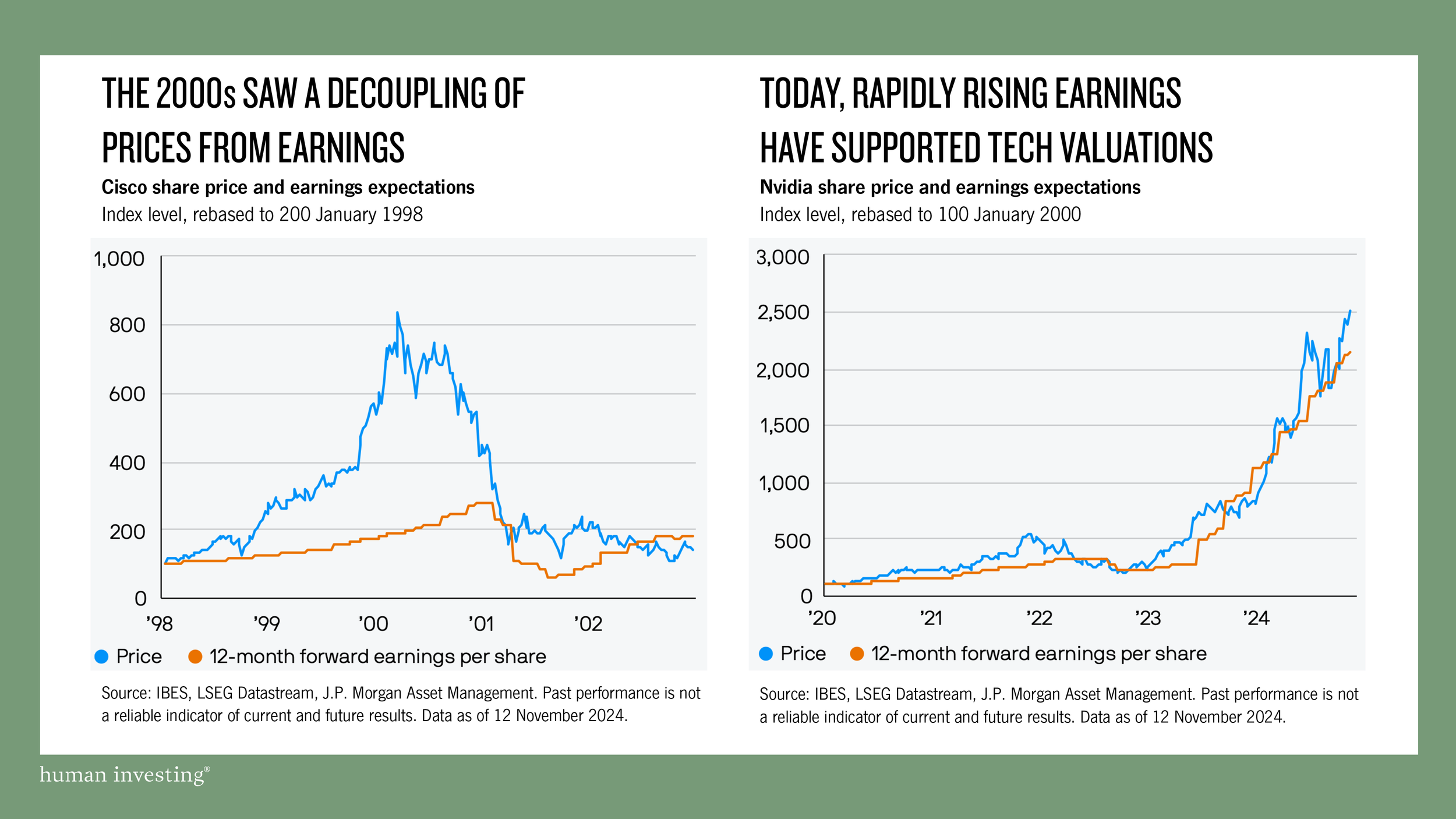
During the dot-com era, prices surged with little connection to actual business performance. Cisco is the clearest example. The stock price raced higher while projected earnings stayed relatively flat. That disconnect is one of the clearest signs of a bubble. Investors were buying possibility instead of profitability.

Now look at today’s AI leader, Nvidia. Its stock price has risen but so have its forward earnings per share. Revenue is expanding. Demand is accelerating. Profitability is growing at a historic pace. The price is being pulled higher by fundamentals, not by wishful thinking.

This distinction matters.

In the dot-com era, prices broke away from earnings.

In the AI cycle, prices and earnings rise together.

For long-term investors, this is not a minor detail. It is the difference between speculation and substance. When prices run ahead of earnings, gravity eventually pulls them back. The two lines always reconnect. Prices can sprint or stumble in the short term, but fundamentals set the pace over time. When prices rise because earnings rise, it is the fundamentals doing the work.

NEXT, The Nature of the Companies Is Entirely Different

The second difference is straightforward. The companies simply are not comparable.

During the dot-com era, a clever idea and a domain name were often enough to attract enormous capital. Pets.com is the classic example. It raised over $82 million during its IPO despite having no profits and no evidence that its model worked. It became famous before it became viable. Nine months later, Pets.com closed their virtual doors.

Now compare that with today.

The AI landscape today is nothing like that. The Magnificent Seven leading AI investment are among the most profitable companies ever created. Apple, Microsoft, Alphabet, Amazon, Meta, Nvidia, and Tesla operate with financial strength that rivals entire industries. Together they have acquired more than 846 companies. Their revenue is diversified. Their moats are wide. Their infrastructure spans the globe. Their cash flow is massive.

This difference is not trivial.

Startups with untested ideas tend to burn cash, chase growth at any cost, and rely on investor optimism to stay alive. Established multi-trillion-dollar companies generate consistent profits, fund their own innovation, and can withstand economic shocks. They behave very differently.

The risks, opportunities, and outcomes are not comparable.

FINALLY, Sentiment Today Is Cautious, Not Euphoric

The most important difference may be psychological.

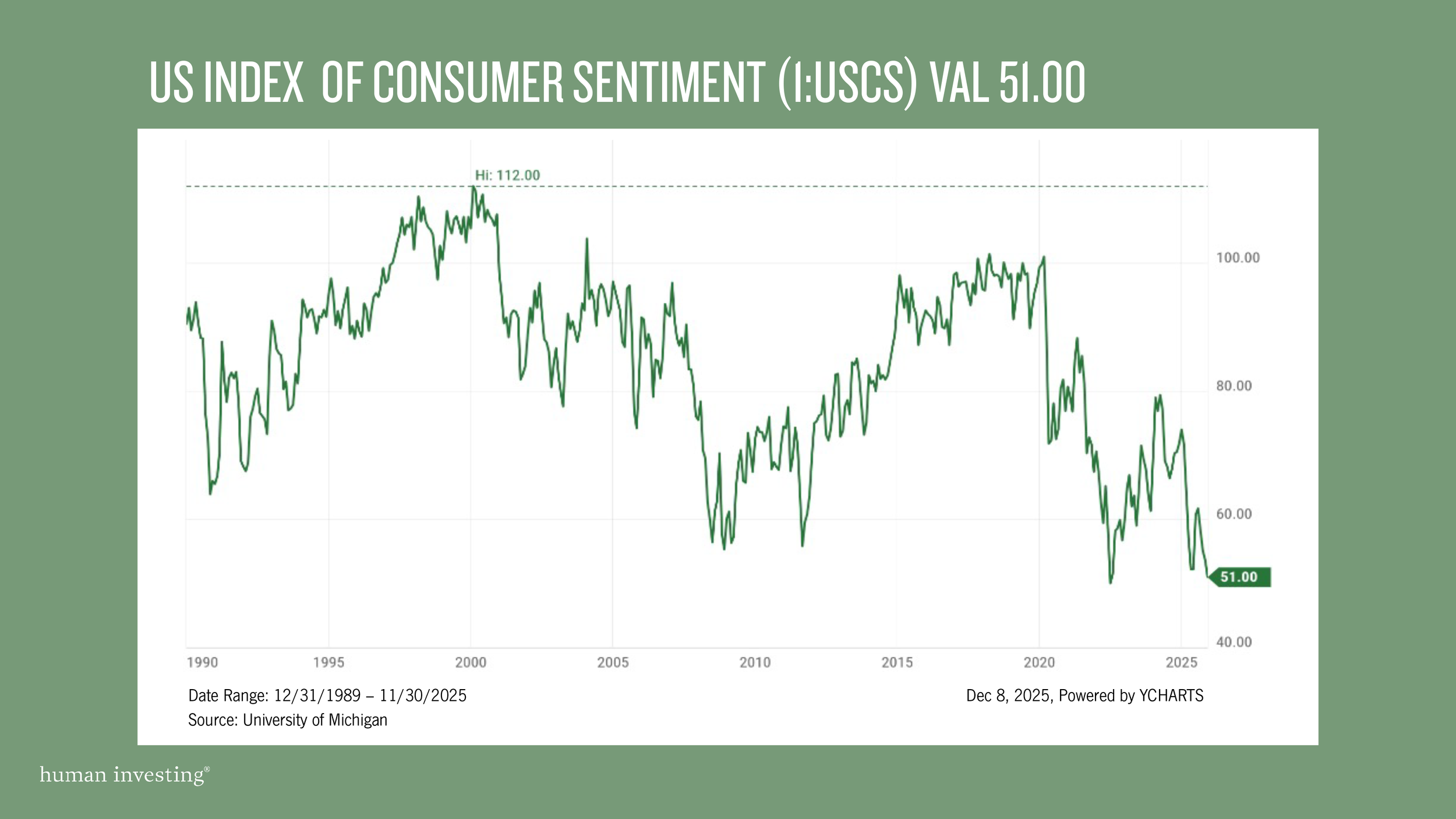
In the late 1990s, consumer sentiment reached historic highs. The University of Michigan index moved above 110. Confidence was overflowing. People believed prosperity would continue indefinitely. Alan Greenspan described the mood as irrational exuberance, and even that felt modest.

A 1999 Time magazine article reported workers quitting stable jobs to day-trade technology stocks. One story described a plumber who refused to fix a leaking pipe because he was too busy trading. That was the climate. Excitement replaced caution. Greed replaced discipline.

Today tells a different story

Consumer sentiment recently sat near 51, weaker than readings during the 2008 financial crisis. It reflects fear and uncertainty, not optimism. In hundreds of conversations advising investors during this season, not one person has pushed to increase equity exposure because of excitement about AI. Most express caution, not confidence.

This matters. Investor psychology often explains more about cycles than spreadsheets do.

Bubbles form when confidence outruns reality. Today, reality is outrunning confidence.

What we see today is not exuberance. It is skepticism.

What Investors Should Take Away

None of this means AI is risk-free. Markets never are. Technologies evolve. Leaders change. Expectations adjust. Some companies will thrive and others will fade. That is the natural rhythm of progress.

Some believe AI will reshape entire industries. Others expect only incremental change. No one knows for sure, and investors do not need perfect foresight to succeed. What they need is discipline, patience, and a strategy that holds up across many possible futures.

Periods like this tend to reward investors who rely on a thoughtful financial plan and avoid emotional decision making. Resiliency matters more than reaction.

At Human Investing, we help clients make clear, confident decisions in moments like this. We separate signal from noise. We keep your strategy rooted in your goals, not the market’s mood.

The biggest mistakes rarely come from missing a prediction. They come from acting too quickly. Our role is to walk with you through uncertainty and ensure your plan remains strong, thoughtful, and centered on what matters most to you.


Sources:

https://www.cnbc.com/2025/11/25/michael-burrys-next-big-short-an-inside-look-at-his-analysis-showing-ai-is-a-bubble.html

https://am.jpmorgan.com/content/dam/jpm-am-aem/global/en/insights/market-insights/emea-investment-outlook-2025.pdf

https://www.nytimes.com/2000/11/08/business/technology-petscom-sock-puppet-s-home-will-close.html

Eric Balchunas

https://time.com/archive/6736122/day-trading-its-a-brutal-world/

Disclosure: This commentary is for informational purposes only and should not be considered investment, tax, or legal advice. The views expressed are based on current market conditions and are subject to change without notice. Past performance is not indicative of future results, and no investment strategy can guarantee success or protect against loss. References to specific companies are for illustrative purposes only and do not constitute a recommendation to buy or sell any security. Investors should consult with a qualified financial professional before making any investment decisions. Human Investing is an SEC-registered investment adviser. Registration does not imply a certain level of skill or training.
 

Related Articles

The Market Will Rise Gradually and Fall Quickly, but It Remains Undefeated


Markets have been moving fast lately — in both directions

Down 10% in two days. Up almost the same the next. Three trading days: A full year’s worth of returns gone, and then mostly back again. 

Looking at the S&P 500 last week feels disorienting. And in a way, that’s the point.

This kind of movement makes people wonder if the system is broken. But this is exactly how markets work. They are brutally efficient at processing new information, whether it’s political, economic, or emotional.

Markets don’t wait for clarity. They move quickly on possibility, repricing risk in real time, regardless of how ready you feel. And when things are uncertain—when leadership seems unpredictable, policy is in flux, or the narrative changes overnight—the swings can be dramatic.

Fast drops, slow climbs — that’s the deal

Volatility is the price of admission for long-term growth. There’s a reason people say, “Markets take the stairs up and the elevator down.” Even looking at the last few years, gains usually build gradually, while losses often arrive quickly and unexpectedly.

Yet, over the decades, the odds have been in your favor. On average, the S&P 500 has risen in 52% of trading days, 73% of calendar years, and 94% of decades. (Source: Capital Group)

Three days of outliers over the last 25 years

The sharp losses of April 3rd and 4th, followed by the rebound on April 9th, are outliers in magnitude but not in pattern. The biggest gains and losses tend to cluster together, and they often show up when they’re least expected. Selling after a big drop means missing the potential surge that follows. Buying after a big rally means forgetting what preceded it.

This isn’t a timing game. It’s a discipline game

Discipline doesn’t mean knowing what happens next. It means staying in the game when it feels like the rules are changing. It means resisting the urge to flinch when the noise gets loud.

The headlines will keep coming, and volatility will return. But the most reliable part of markets is that they change. The market may take the stairs up and the elevator down — but over time, it remains one of the most reliable places to grow long-term wealth.

Hold fast to your financial plan. Stay invested.


Disclosures: These market returns are based on past performance of an index for illustrative purposes only. Past performance does not guarantee future results. All investing involves risk, including the loss of principal.  Index performance is provided for illustrative purposes only and does not reflect the performance of an actual investment. Investors cannot invest directly in an index.

The information provided in this communication is for informational and educational purposes only and should not be construed as investment advice, a recommendation, or an offer to buy or sell any securities. Market conditions can change at any time, and there is no assurance that any investment strategy will be successful.

Diversification does not guarantee a profit or protect against a loss in declining markets. Asset allocation and portfolio strategies do not ensure a profit or guarantee against loss.

The opinions expressed in this communication reflect our best judgment at the time of publication and are subject to change without notice. Any references to specific securities, asset classes, or financial strategies are for illustrative purposes only and should not be considered individualized recommendations.

Human Investing is a SEC Registered Investment Adviser. Registration as an investment adviser does not imply any level of skill or training and does not constitute an endorsement by the Comission. Please consult with your financial advisor to determine the appropriateness of any investment strategy based on your individual circumstances.


Related Articles

When a Nation Sells Itself: Buffett, Tariffs, and the Cost of Imbalance


We live in a world of complex economic forces, but at the heart of many of today’s big-picture challenges lies a simple truth: a country cannot indefinitely consume more than it produces. That is precisely what the United States has been doing for decades through the persistent and growing trade deficit.

This article is meant to educate, not alarm. To help all investors, professionals, and citizens better understand what is happening behind the scenes, why it matters to our long-term prosperity, and how thoughtful policy tools, including modernized tariffs, might help correct course.

Let us start with the core issue.

What is a trade deficit? 

A trade deficit occurs when a country imports more goods and services than it exports. Imagine your household spending more every month than it earns—you would need to make up the difference by drawing down savings or selling off parts of your home. That is essentially what the U.S. does year after year. We purchase foreign goods (such as cars, electronics, and clothing) in excess of what we sell abroad and must finance this gap by issuing debt or selling U.S. assets.

These assets include U.S. Treasury bonds, commercial real estate, stocks in American companies, and ownership stakes in U.S. businesses. That means other countries, such as China, Japan, Germany, and many others, are gradually gaining greater ownership of our economy.

 “Our net worth is being transferred abroad”

Legendary investor Warren Buffett put it bluntly over 20 years ago:

“Our country’s ‘net worth,’ so to speak, is now being transferred abroad at an alarming rate” (Fortune, 2003).

This quote deserves close attention.

Buffett does not talk about some abstract notion of wealth. He is referring to the tangible ownership of American assets—the land, companies, infrastructure, and financial instruments that make up our nation’s economic engine. When we finance our trade deficits, we are often doing so by selling these assets to foreigners or issuing IOUs (bonds) that must be repaid with interest over time.

Imagine a wealthy family that owns a large estate. Every year, to fund vacations and a high standard of living, they sell a few acres of land or take out a bigger mortgage. At first, it seems manageable. But over time, they no longer own the home outright. Their income now goes to paying interest, rent, or dividends to outsiders who bought what used to belong to them.

That is the picture Buffett (and others) paint of America’s trade behavior.

In real terms, this means future generations of Americans will be working to sustain themselves and sending investment returns overseas—to countries that now hold claims on our assets. As foreign ownership increases, so does the investment income flowing out of the U.S., thereby reducing our ability to reinvest in our own future.

The role of tariffs in correcting imbalances

This is where tariffs, when carefully designed and wisely implemented, can play a role—not as a weapon or political cudgel, but as a tool of balance.

Buffett originally proposed a market-based mechanism called Import Certificates, but the underlying principle is simple: If you want to buy more than you sell, you have to fund it—and at some point, that model breaks. A modest, broad-based tariff system could help bring trade into equilibrium, nudging us back toward producing more of what we consume and consuming more of what we produce.

This is not about isolating ourselves from the world. It is about aligning our consumption with our production, and ensuring that we do not gradually erode our national wealth through unchecked deficits.

Yes, tariffs raise prices—especially on imported goods. That is a cost worth recognizing. However, Buffett warns us not to be short-sighted:

“The pain of higher prices on goods imported today dims beside the pain we will eventually suffer if we drift along and trade away ever larger portions of our country’s net worth” (Fortune, 2003).

In other words, the bill comes due. The longer we delay, the more painful it will be to unwind the imbalance.

What does the modern data say?

Recent academic research offers critical insights into how tariffs function in today’s economy.

One study by Furceri, Hannan, Ostry, and Rose (2019) reminds us that, although economists overwhelmingly oppose protectionism, the public is less convinced, possibly because much research on tariffs is outdated or overly theoretical.

Their research examines the macroeconomic effects of tariffs using data from 151 countries over a 50-year period and finds that tariff increases reduce output, productivity, and consumption while increasing unemployment and inequality. These adverse effects are worse in advanced economies and during economic booms.

Tariffs have a limited impact on improving trade balances and can even lead to an appreciation of the exchange rate, offsetting their intended benefits. Overall, tariffs appear to be detrimental to economic welfare.

In another research article by Amiti, Redding, and Weinstein (2019), the authors conclude that in 2018, U.S. tariffs were almost entirely borne by American consumers and importers, rather than foreign exporters. Prices rose for many U.S.-made goods tied to these tariffs, and supply chains were disrupted. Consumers faced fewer product choices, and the overall economic cost was substantial, amounting to approximately $8.2 billion in lost efficiency and an additional $14 billion in costs passed on to consumers. These impacts aligned with basic supply and demand predictions.

The researchers believe their estimates are conservative, as they did not include other significant costs, such as lost product variety, companies reorganizing their supply chains, or the uncertainty caused by changing trade policies. Surprisingly, foreign exporters did not lower their prices to stay competitive, meaning Americans bore nearly all the costs of these tariffs. Why this happened remains a puzzle for future research.

So what do we make of this? Tariffs are not magic bullets. They are levers. Furthermore, like all levers, they require precise calibration. Used strategically and modestly—within a broader framework of trade policy—they may help correct imbalances, such as the persistent U.S. trade deficit. Used carelessly or punitively, they may do more harm than good.

Conclusion: Looking ahead

Warren Buffett’s warning in 2003 was not about politics—it was about sustainability. He argued that a nation cannot afford to consume more than it produces forever without losing control of its financial destiny. His solution was not isolationist, but strategic: to implement mechanisms, such as import certificates or well-designed tariffs, that could restore balance without undermining prosperity.

Today, academic research provides a clearer understanding of the costs and consequences of acting on that vision. Furceri et al. (2019) provide comprehensive macroeconomic evidence: tariffs tend to lower GDP, harm productivity, increase unemployment and inequality, and have little impact on improving trade balances. Amiti et al. (2019) demonstrate, in the U.S. context, that tariffs in 2018 were almost entirely borne by domestic consumers and importers, resulting in billions of dollars in lost efficiency and rising prices. Their conclusion? Tariffs reshaped supply chains and reduced product variety, ultimately burdening American consumers.

Together, these insights remind us that tariffs are not moral judgments—they are instruments. When used bluntly or reactively, they carry real costs. But used surgically, as part of a broader policy framework, they can still serve a purpose.

As we confront record trade deficits and rising foreign ownership of American assets, we are left with essential questions:

  • Are we prepared to prioritize long-term national resilience over short-term consumer convenience?

  • Can we modernize trade policy without repeating past mistakes?

  • If not tariffs, what levers are we willing to pull to protect our economic independence?

Buffett’s voice echoes still: action is required. But today, that action must be informed by data, guided by principle, and measured by impact, not ideology.

References:

Amiti, M., Redding, S. J., & Weinstein, D. E. (2019). The impact of the 2018 tariffs on prices and welfare. Journal of Economic Perspectives, 33(4), 187–210.

Buffett, W. E. (2003, November 10). America's growing trade deficit is selling the nation out from under us. Fortune.

Furceri, D., Hannan, S. A., Ostry, J. D., & Rose, A. K. (2018). Macroeconomic consequences of tariffs (No. w25402). National Bureau of Economic Research.


A BOOK FOR THE SAVER IN ALL OF US

Becoming a 401(k) Millionaire isn’t your typical retirement guide. With 30 years in finance, Dr. Peter Fisher shares personal insights and real stories to help you plan with confidence.


Related Articles