
Posts tagged income2
The Dangerous Reality Of Using Your 401k To Finance Your Vacation
 

Looking to go on a “once in a lifetime” trip to Fiji? Remodel your kitchen? Buy a new car? If your employer plan allows it, you may be tempted to take out a loan from your 401(k) to help fund that major expense.

Before you do, let’s talk through what a 401k loan looks like today and why borrowing from your future self can cost far more than you expect.

The Details

If your 401(k) plan allows loans, you can technically borrow up to $50,000 or 50% of your owned retirement savings (vested balance), whichever is less. There’s no credit check, and repayments are automatically taken from your paycheck.

For 2025, the interest rate on a 401k loan is roughly 9.50% (Rate of Prime + 1%). That’s a high rate for borrowing from yourself, and it can add up quickly. While the interest you pay goes back into your account, it’s still your retirement money being used, which could slow long-term growth.

Even though it’s allowed, taking a loan from your 401(k) isn’t usually recommended: about 1 in 5 people with a 401(k) have a loan at any given time, but doing so can put your future financial security at risk.

The Dangerous Reality

Still sounds pretty good, right? Well… not so fast.

A 401(k) loan can come at a real cost and not just the money you pull out today. It’s the potential long-term growth and retirement dollars you lose out on by stepping out of the market and halting contributions.

Here’s what you need to understand:

You lose tax-advantaged growth
Loan repayments are made with after-tax dollars. Then you’ll likely pay tax again when withdrawing the funds in retirement. That double-tax effect makes the math harder to win.

You could face a tax bill and penalty if you change jobs
If you leave your employer before the loan is repaid, the remaining balance typically must be paid back by tax filing time. If not, the balance becomes taxable and if you are under 59½, you may face a 10% early withdrawal penalty.

Stopping contributions
Many borrowers pause contributions while repaying the loan. If your plan gives an employer match, that means you may miss out on free money.

Dollars stop compounding
The money you borrow no longer participates in the market. In periods of growth, missing out on compounding has long-term consequences.

A Real-Life Example

Say you make $75,000 a year and want to borrow $15,000 from your 401(k) to fund a big trip or home project. To make the loan payments easier, you pause your 401(k) contributions while you pay it back.

Let’s also assume you already have $50,000 saved in your 401(k) when you take this loan.

Here’s what happens:

  • You normally save 7% of your pay ($5,250/year)

  • Your employer matches another 3% ($2,250/year)

By stopping contributions for three years, you miss:

  • $15,750 you would have put in

  • $6,750 your employer would have matched

That’s $22,500 total that never gets invested.

Now let’s look at the long-term impact.
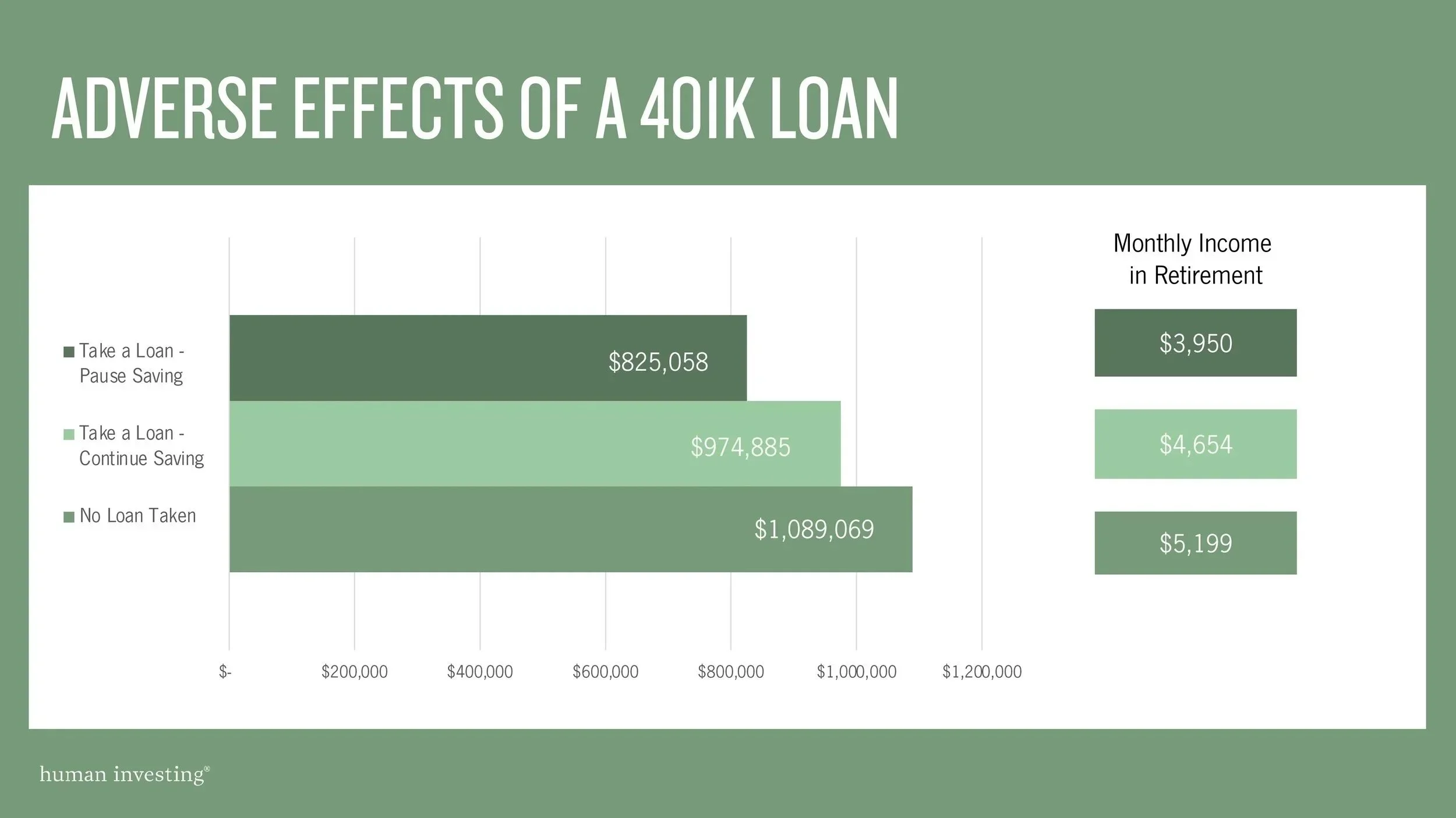
This graph is for illustration purposes only. It highlights the impact a loan has on an individual’s retirement balance and monthly retirement income after 30 years of investment growth during working years (assuming 7% annual market return and annual contributions of $7,500) and 30 years of income through retirement (assuming 4% rate of return). In this example an individual takes a $15k 401(k) loan from a $50k balance to pay down some bills and a finance a vacation.

If that $22,500 had been invested and grew at a reasonable long-term rate of 7% per year over 30 years it could grow to roughly $265,000 by retirement age.

That also means potentially $1,250 less per month during retirement all to fund something that might only last a week or two, today.

Options to Consider

For some people, a 401(k) loan may be a necessary tool for true emergencies. But for vacations, renovations, or lifestyle upgrades, think twice.

Here’s what to do instead:

  • Build a dedicated savings fund for big trips or purchases

  • Maintain an emergency reserve (3–6 months of expenses)

  • Continue contributions if a loan is taken, especially if employer match is available

  • Talk with your plan administrator or financial advisor to understand your plan’s rules

Borrowing from your retirement plan may feel easy, but the long-term cost can be steep. Give your future self the chance to enjoy a comfortable retirement without sacrificing peace of mind today.



Disclosure: This material is for informational purposes only and is not intended to provide investment, tax, or legal advice. The examples provided are hypothetical and for illustration only. Actual results will vary. Retirement plan loans and withdrawals may have long-term effects on your savings and tax situation. Consider consulting a qualified financial professional before making decisions about your 401(k) or other retirement accounts.

Investing involves risk, including the possible loss of principal. Past performance does not guarantee future results. Human Investing is an SEC-registered investment adviser. Registration does not imply any level of skill or training.


 

Related Articles

The 3 Questions to Ask to Build a Solid Retirement Income Plan
 

Saving for retirement can seem straightforward compared to the daunting task of converting your hard-earned savings into retirement income.

When building a retirement income plan knowing what questions to ask will potentially save you money, lower your overall tax bill, and provide you peace of mind. Here are three questions you should ask when building a retirement income plan, as well as some considerations:

Question 1: What sources are available to you?

There are many ways to fund retirement. Thus, no retirement plan looks the same. To begin to understand how you will fund retirement, give yourself a quick assessment. What sources are available to you and how much?

retirement-income-01 copy.jpg

What you should consider: Simplicity in retirement. This can be achieved by consolidating retirement accounts such as your employer-sponsored retirement plans into an IRA. See - Why an IRA makes more sense in retirement than your 401(k)

Question 2: When do you plan on receiving income from your different sources?

There are a lot of unique planning opportunities regarding when to start receiving your sources of income. Knowing when to access these different sources can provide efficiency, lower taxes paid, and increase your retirement income.

 The IRS and Social Security Administration have imposed rules that coincide with specific ages. Familiarizing yourself with these key rules and ages associated with accessing popular income sources can help you begin to answer the question of “When?”. Here are some key ages to consider when building a retirement income plan around these popular sources -

Tax-deferred accounts (401(k)/403(b)/IRAs):

  • Age 59.5 - you can’t access tax-deferred dollars without a 10% early withdrawal penalty before age 59.5. The IRS does highlight some exceptions to the 10% penalty for premature withdrawals.

  • Age 72 (or age 70.5 if you were born before 1951) – The IRS requires that an individual withdraws a minimum amount of their retirement plans (i.e. an IRA) each year starting in the year they reach age 72. This requirement is known as a required minimum distribution or an RMD. Account-holders that do not take their full RMD will be faced with a stiff excise tax equal to 50% of the RMD not withdrawn.

Social Security:

Most Americans can begin claiming Social Security retirement benefits as early as age 62, or as late as age 70. Once you stop working, it can be tempting to claim Social Security as soon as possible to subsidize your income. However, it’s often strategic to delay Social Security as long as possible. The longer you delay claiming your Social Security benefit the greater your guaranteed inflation-adjusted monthly benefit will grow (up to age 70). Factors that should be considered when creating a plan around Social Security are life expectancy, other sources of retirement income, and spousal benefits.

retirement-income-02 copy.jpg

What you should consider:

  • Which sources you will draw first?

  • Should you delay social security as long as possible?

  • How long each source will last?

Question 3: What are the tax implications of accessing your retirement income sources?

Not all income sources are taxed at the same rate. Take the time to understand your applicable taxes and build a tax-sensitive retirement income plan to prevent paying unnecessary amounts to the government.

retirement-income-03.jpg

What you should consider:

  • The tax implications of the aforementioned RMD’s. RMD’s can unknowingly force you to pay a higher than necessary tax bill once you are forced to take required withdrawals.

  • A tax bracket optimization strategy that provides savings on your overall retirement tax bill. This can be especially beneficial in the early years of retirement. Learn more about Tax Bracket Optimization here.

The misfortune of not having a retirement income strategy.

Heading into retirement without an income strategy is financially precarious. To illustrate the benefit of creating an effective plan, we are sharing a hypothetical example.  Meet Charlie and Frankie:

  • Charlie (age 61) and Frankie (age 60) live in Oregon and each plan to retire when they turn age 62.

  • Charlie has $1,000,000 in a 401k/traditional IRA.

  • Frankie has $250,000 in a 401k/traditional IRA.

  • They have $150,000 in joint accounts.

  • At age 67 Charlie and Frankie are eligible to receive $2,990/month and $2,376/month, respectively.

  • Their annual income goal during retirement is $90,000.

In the following charts, we compare the impact of an efficient retirement income strategy to one that is not. The only thing that is different in the two scenarios is the consideration of when to draw specific sources and the associated tax implications. Unfortunately, when managed inefficiently the couple is only able to maintain their target annual income for 26 years. Additionally, the inefficient strategy forces the couple to pay an additional $129,000 tax over 30 years when compared to a more efficient strategy.

 
inefficient-retirement-income.jpg
efficient-retirement-income.jpg
 

Assumptions: 4% investment rate of return on all accounts. No additional contributions are made to investment accounts. Taxes include both Federal and Oregon State income tax.

This is one of the most important financial decisions you can make.

Taking the time to thoroughly answer these questions can provide long-term value.

Engaging with a financial planning firm can be helpful if you are not fully confident in making a retirement income plan. Working with the right financial planning firm for your unique situation can be the difference between a carefree retirement and a stressful one. To learn more about how we think about serving clients through comprehensive financial planning, check out our services here.


Related Articles

Think Twice About 401k Loans
 

401k’s are purposed for long-term retirement savings; for what comes after the working years. They are arguably our best means of influencing our financial futures – through diligent, faithful saving. Still, life happens. And what’s ideal doesn’t always copy and paste perfectly onto each of our own realities. Thus, there are sometimes¹ allowances that permit 401k participants to borrow dollars from their current accounts in the form of a loan. Though borrowing from a 401k is not the intended use of the account, we aren’t saying they’re always the worst option. What we are saying is that 401k loans are worth thinking twice about. And in my experience, there are a few points that consistently surprise people.

For example, do you know what would happen if you stopped working with a company while you had an outstanding 401k loan? In many cases, you’re left with two options:

  1. Pay back the loan in cash within approximately 60 days

  2. Default on the loan, and pay taxes and any applicable penalties on what’s owed

So, especially if you’re considering taking out a larger sum, it’s important to know the implications of what taking a loan means for both the short and the long term. See below for some more thoughts…

401k-Loans.jpg

¹401k loans are not available through all 401k Plans, and the logistics of how they work and when they’re allowed can differ between Plans. With questions, call Human Investing at 503-905-3100 or email 401k@humaninvesting.com.


Related Articles