
Posts tagged pre1
Retire Early With the Rule of 55
 

Taking a distribution from a tax-qualified retirement plan, like a 401(k) before age 59.5, is generally subject to a 10% penalty for early withdrawal. The exceptions to paying this 10% penalty are:

Are you familiar with how the Rule of 55 works? If you want to retire early, this blog post is significant for you.

What is the Rule of 55?

The Rule of 55 is an IRS provision that allows employees who leave their job on or after age 55 to take penalty-free distributions from their retirement accounts. It’s a life hack! Typically, individuals would face a 10% early-withdrawal penalty if they access their retirement account before age 59.5. The 10% penalty and account accessibility are two of the reasons why people plan to work until at least age 59.5. 

If you are someone who is thinking about retiring early, the following Rule of 55 requirements are necessary:

  1. You leave your job (voluntarily or involuntarily) in or after the year you turn 55 years old.

  2. Your plan must allow for withdrawals before age 59.5.

  3. Your dollars must be kept in your employer’s retirement plan. If you roll them over to an IRA, you lose the Rule of 55 protection.

  4. You will likely want your plan to allow partial distributions when you are terminated.

Access to your retirement account at age 55 is available for all employees with an employer-sponsored retirement account. However, if you are considering retiring after age 55 and using funds from this retirement account, you must check whether your plan allows partial distributions. This feature is an opt-in feature for employers to select. We recommend that you work closely with your recordkeeper to ensure you can take advantage of the Rule of 55 in a way that benefits you.

3 Examples of the Rule of 55

Look at a few examples of employees with partial distributions compared to employees without partial distributions allowed in their plan.

Example 1: Partial Distributions Allowed

Danielle can take any amount from her PDX 401(k) account. For example, in October 2022, she can request $30,000. She doesn’t have to take anything out in 2023. She could take another $65,000 out in January 2024.

EXAMPLE 2: Partial Distributions Disallowed

Martin’s employer-sponsored retirement plan does not permit partial distributions. If he wants to access his retirement account at age 57 without incurring a 10% early-withdrawal penalty, he would have to withdraw the entire $450,000. This would result in reporting $450,000 of taxable income for the year of his distribution. Given the tax bracket optimization strategies that exist during retirement years, this may not be Martin’s best solution for accessing dollars before age 59.5.

A couple of alternative solutions for Martin are:

  1. Ideally, Martin would have a cash-flow plan to support his expenses until he reaches age 59.5.

  2. Initiate a direct rollover of his $450,000 retirement account into a IRA account. Then take distributions as needed but expect to pay a 10% penalty on these dollars. Before paying a 10% penalty on an early-distribution from a IRA, we would recommend that Martin review other cashflow options he may have.

Example 3: Partial Distributions Disallowed

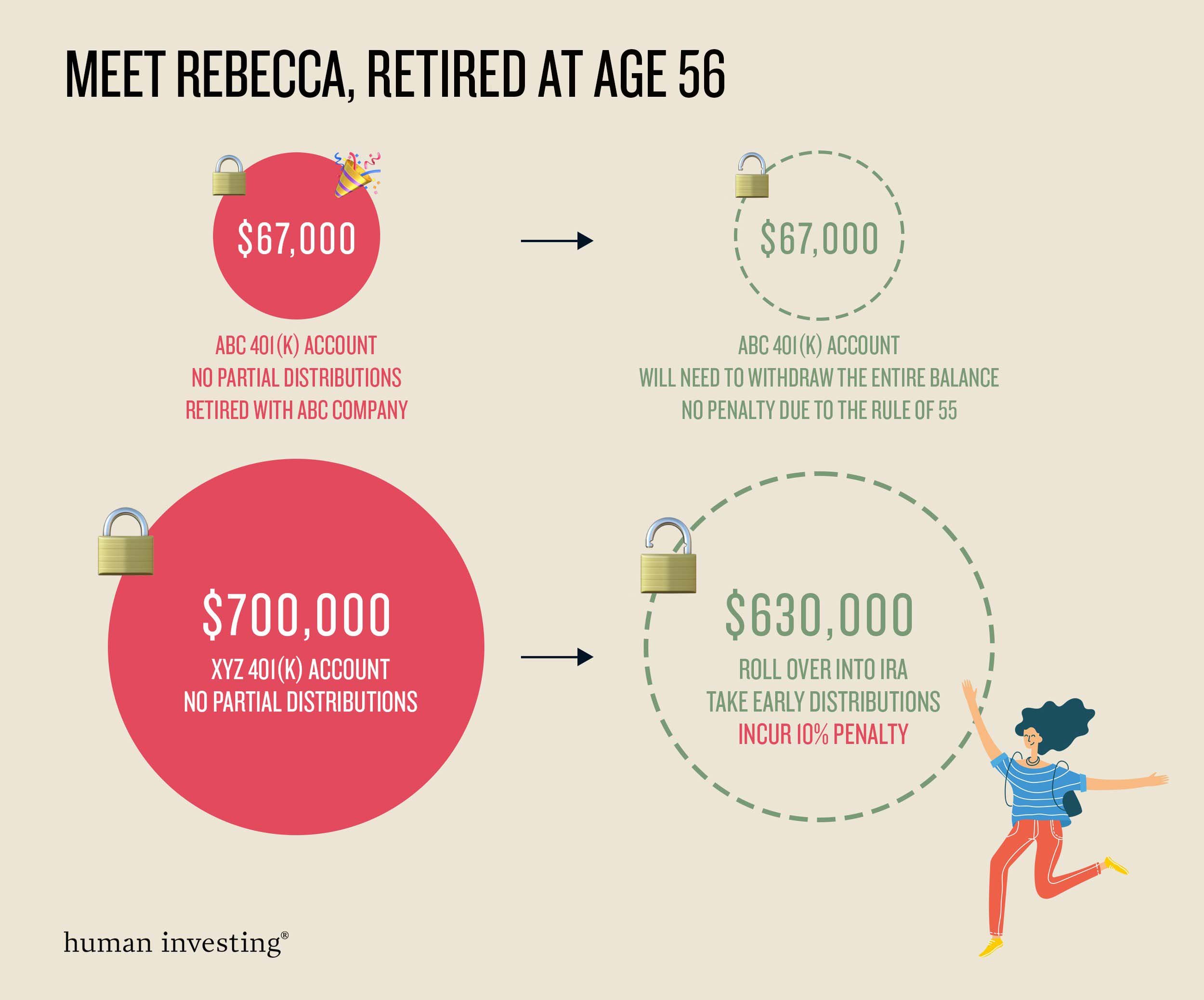
Rebecca, age 56, has $67,000 saved in her most recent 401(k) account with ABC Company. She also has $700,000 saved in her previous 401(k) account with XYZ Company. Neither of these retirement plans allow for partial distributions.

Rebecca retired at age 56 from ABC Company, so she can take the entire $67,000 balance out in one lump sum distribution. She will not owe a 10% penalty on these dollars due to the Rule of 55.

If she were to access any of her $700,000 saved in her previous 401(k) account with XYZ Company before age 59.5, then she would incur a 10% penalty. Not to mention the $700,000 is sitting in a plan that disallows partial distributions so that would be significant taxable income to report in the same tax year. Similar to the example above, Rebecca may consider initiating a direct rollover of her $700,000 into a IRA account for more flexible distribution choices.

What About Other 401(k) Accounts from Previous Jobs?

To qualify for the Rule of 55, you must be terminated as an employee on or after age 55. Therefore, if you have multiple retirement accounts, the only ones that will qualify for a penalty-free distribution between ages 55 and 59.5 are accounts with your termination date reflecting that age range.

One consideration is to roll over a previous retirement account into your current account before you retire. We recommend speaking with your recordkeeper to confirm that your retirement plan features are designed so rollover sources can be accessible by partial distributions.

For example, if Danielle from above had another 401(k) account, she could have rolled that into her PDX 401(k) account before retiring. All the dollars in the account would be eligible for Rule of 55 distributions.

What if I Decide to go Back to Work but have Taken Distributions Already?

Going back to work after you have taken a Rule of 55 distribution should not result in a 10% penalty. If you go back to work for the same company, then you may lose the ability to access funds as an active employee. However, your distributions will not be impacted if you go back to work at another organization.

How are Rule of 55 Distributions Tracked for Tax Reasons?

Custodians and recordkeepers are responsible for providing a Form 1099-R. This tax form reports any distributions from a retirement account. If you take a distribution under the Rule of 55, you would expect to see code 2 in box 7 of your 1099-R form. Code 2 specifies the following:

2 - Early distribution, exception applies (under age 59.5)

If your 1099-R form includes Code 2 in box 7, you will not owe a 10% penalty. Before you initiate a withdrawal between ages 55-59.5, we recommend confirming your record keeper will issue the 1099 in this format.

What Other Resources do you Have?

Retirement is a transition that only happens once in life. You probably haven’t retired before, and you likely won’t retire again. Retirement transitions involve several financial planning considerations and we wanted to conclude this article with additional resources that may be helpful to you:

Your Pre-Retirement Checklist

The 3 Questions to Ask to Build a Solid Retirement Income Plan

Why an IRA Makes More Sense in Retirement than your 401(k)

While the articles are supplemental information, we believe the best way to prepare for your upcoming retirement is to collaborate with our team at Human Investing. Please use this scheduling link to meet with our team to review your unique financial landscape before you start planning your retirement celebration(s): Schedule here.


Related Articles

Your Pre-Retirement Checklist
 

Transitioning into retirement can be an exciting time. For many it can also be a daunting reality. We hope the following Pre-Retirement Checklist is a helpful tool as you intentionally prepare for your retirement years.

5-10 years out 

  • Create a plan to pay down debt.   

  • Maintain Emergency Fund – Emergencies still happen in retirement.  

  • Familiarize yourself with Social Security, Pension, and/or Defined Benefit options.  

  • Consider Long Term Care (LTC) options – LTC Insurance vs Self-insuring using other assets.  

  • Maximize all tax-advantaged savings accounts – 2021 Contribution Limits.  

  • Review your investment strategy to make sure your retirement accounts are in line with your risk tolerance and timeline.   

  • Strategize how to divest from company stock.  

2-4 years out 

  • Devise a retirement spending plan:   

  • Begin developing a plan for a fulfilling retirement (goals, purpose, health).  

  • Practice being retired – take a long vacation in the location you plan to retire and live within your retirement budget. 

  • Retirement Living Plan:  

    • Evaluate downsizing a home or relocation and the associated tax implications.  

    • If a mortgage is required, relocate while you still have the income to qualify for the mortgage preapproval process. 

  • Formulate a plan to exercise your stock options

  • Review insurance needs – potentially to cancel or lower life/disability insurance.  

< 1 Year out 

  • Formulate a health care plan:   

    • Investigate Medicare, Medigap, and Medicare Advantage plans.  

    • Compare Individual Insurance policy or COBRA if you are younger than age 65.  

    • Enroll in Medicare 3 months before age 65.  

  • Apply for Social Security benefits 3-4 months before you want benefits to start.  

  • Determine how much monthly income you need from your portfolio to cover your expenses.   

  • Analyze your retirement income plan.

  • Consider a HELOC while you still have the income to qualify.  

  • Update estate plan documents with retirement changes.  

  • Take advantage of employer medical plans.   

Download this as a printable one-sheeter.

Planning for retirement should be exciting. Please reach out if our team of credentialed experts can help you navigate the road to retirement.


Related Articles

3 Ways to Plan for Healthcare in Retirement
 

At Human Investing our advisors talk a lot about retirement, but more and more so, health care is becoming a larger component of how we need to plan. Below are 3 ways you can prepare for the medical needs that come with retirement years as well as an illustration from my life of what happens when you take your health for granted. This past weekend I competed with a team of coworkers and friends in the Wild Canyon Games, a weekend long multi event adventure race that takes pride in pushing its competitors to “find their limits.”

wildcanyongames.png


My most anticipated event was geocaching. My teammate/coworker Andrew Nelson and I spent 4 hours running 17 miles in the rugged terrain near Antelope, OR hunting for and finding hidden objects (caches) by means of GPS. Leading up to this event we knew preparation was key so we diligently used google maps and GPS software to plot our course to find the most valuable caches. We printed off maps and purchased the necessary gear to compete in this event.

  • GPS

  • The Right Equipment

  • A Winning Strategy

  • Slight Insanity

  • A Below Average Sense of Direction

We were as prepared as a team could be, or so I thought… Now fast-forward to the event. It was mile 13 of 17 total miles and the end was in sight. Andrew and I were running to the finish line, and this is when things started going south for me. My vision blurred, my hamstrings balled up, my mental determination faded and each step was more difficult than the previous one. I didn’t “find my limit,” my limit found me and hit me square in the jaw. I wanted to crawl into a hole and hide. My body was shutting down. In all my preparation, I didn’t take into account my physical health. I didn’t train enough, eat enough or drink enough I didn’t prepare accordingly.

 
beautifulcanyon.png
 

When running the race of life, many make a similar mistake. We become so busy thinking about everything else that we forget to take care of ourselves. Our busyness may hinder our health, especially as we look to the future and see the reality of our situation. The reality: health care in the United States is becoming more expensive: • Premiums, deductibles and other out-of-pocket expenses could cost a 65-year-old couple retiring today a jaw-dropping $220,000 – and that’s in addition to Medicare premiums.” (AARP.org)

• “The cost of health care is rising faster than inflation” (Forbes)

• According to the World Bank the average life expectancy in the US is 79 years, meaning retirement is lasting longer than ever before.

As we look down the trail towards retirement we can expect the same trend of rising health care needs and health care costs. The more you know and plan for you and your family’s health care, the better off you will be in the long run. Here are 3 thoughts to help you make sure your golden years of retirement stay golden:

1. Take advantage of your HSA: Many companies today are going the way of a High Deductible Health Plan (HDHP), frequently paired up with a Health Savings Account (HSA). An HSA has a triple tax advantage when used to save for inevitable health care costs:

1) Contributions (money put into the account) are pretax. 2) Through interest, dividends or capital gains your account can grow tax free. 3) Any withdrawals for qualified medical expenses are tax free.

Some HSA’s also have an option to invest these dollars with the goal of growth for a later date, similar to a retirement plan. If you have access to an HSA don’t miss out on this great opportunity to save for future health care expenses.

2. Save accordingly: Control what you can control. • Start saving, keep saving and stick to your goals. • Take advantage of your company’s 401(k)! Sign up and contribute as much as you can. • Ask questions: call the 401(k) Advisors at Human Investing with questions regarding saving for retirement - 503.905.3100

3. Invest in yourself: Whether you plan to travel the world, spend time with family, or give back to the community you will need good health to achieve your goals and dreams. You can begin making healthy choices today by sticking to those New Year’s Resolutions, eating right and exercising. Invest in yourself - keep your mind and body active and healthy for years to come.

Just like geocaching, it’s necessary to make adequate preparation for your future, but unless you invest in yourself well it becomes difficult to finish strong in the race of life.


Related Articles

Will Kellarpre1