Posts in Plan Details
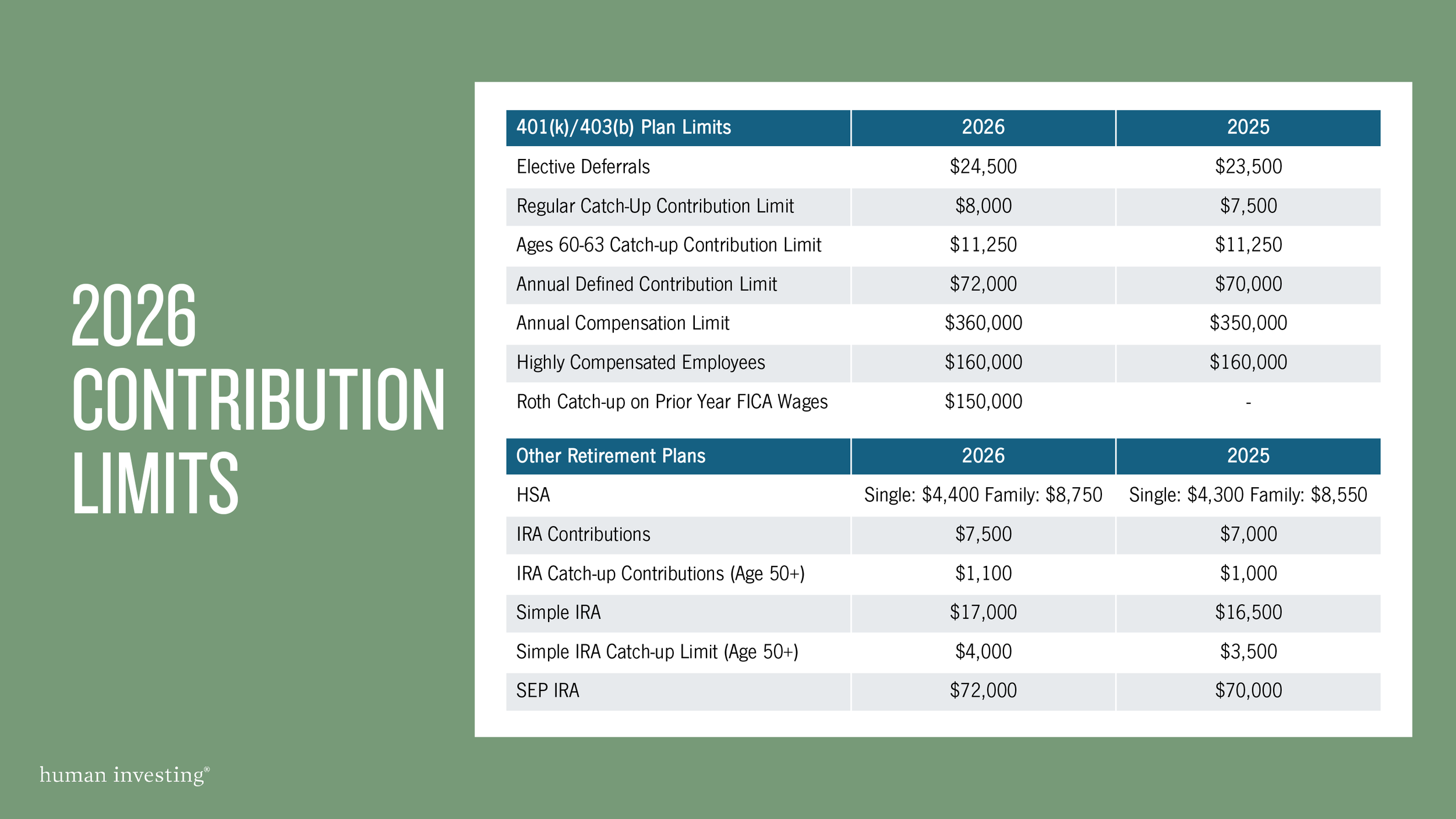
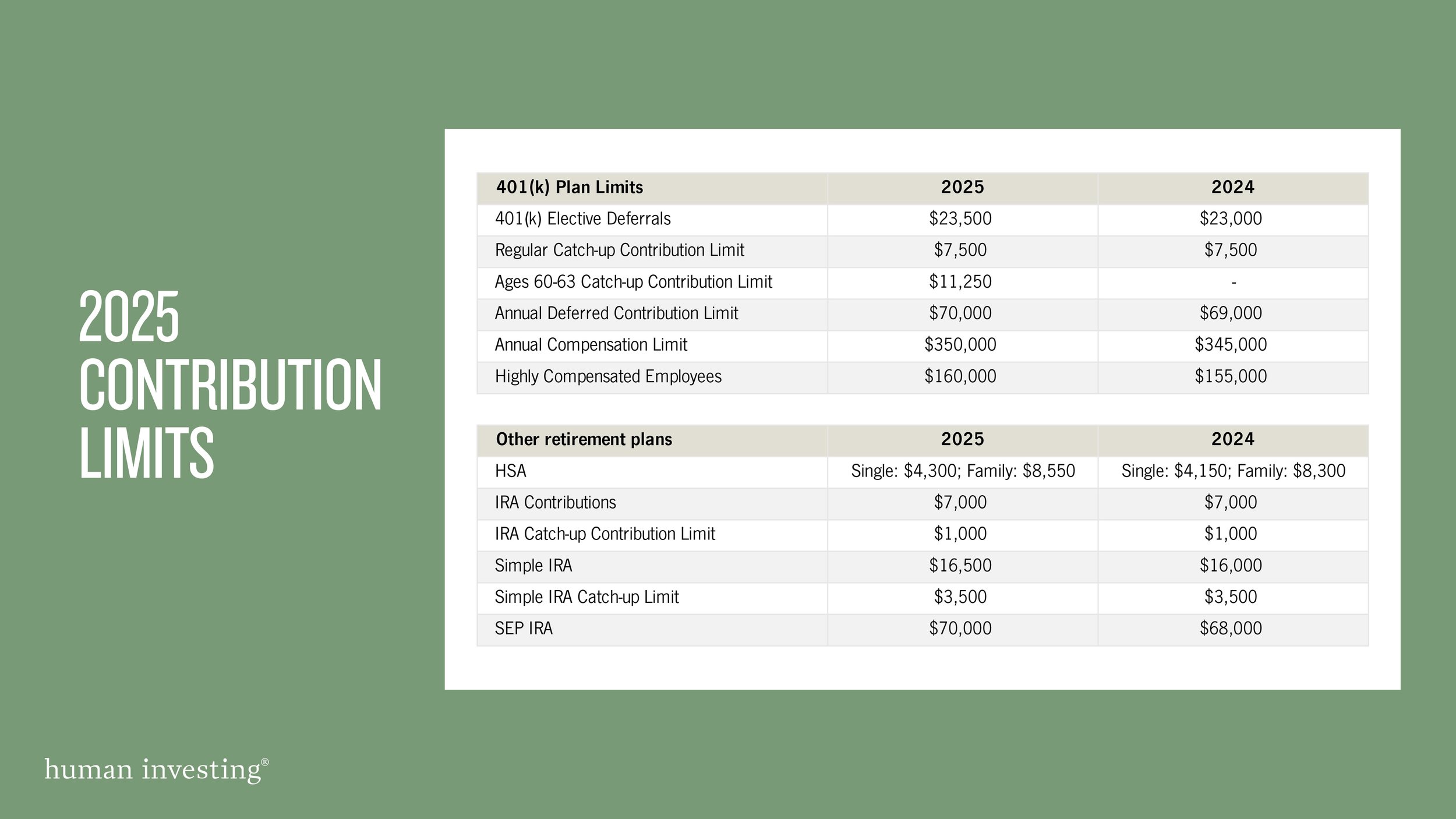
The IRS has increased contribution limits for 2025, including a new catch-up opportunity for 60-63 year olds
 

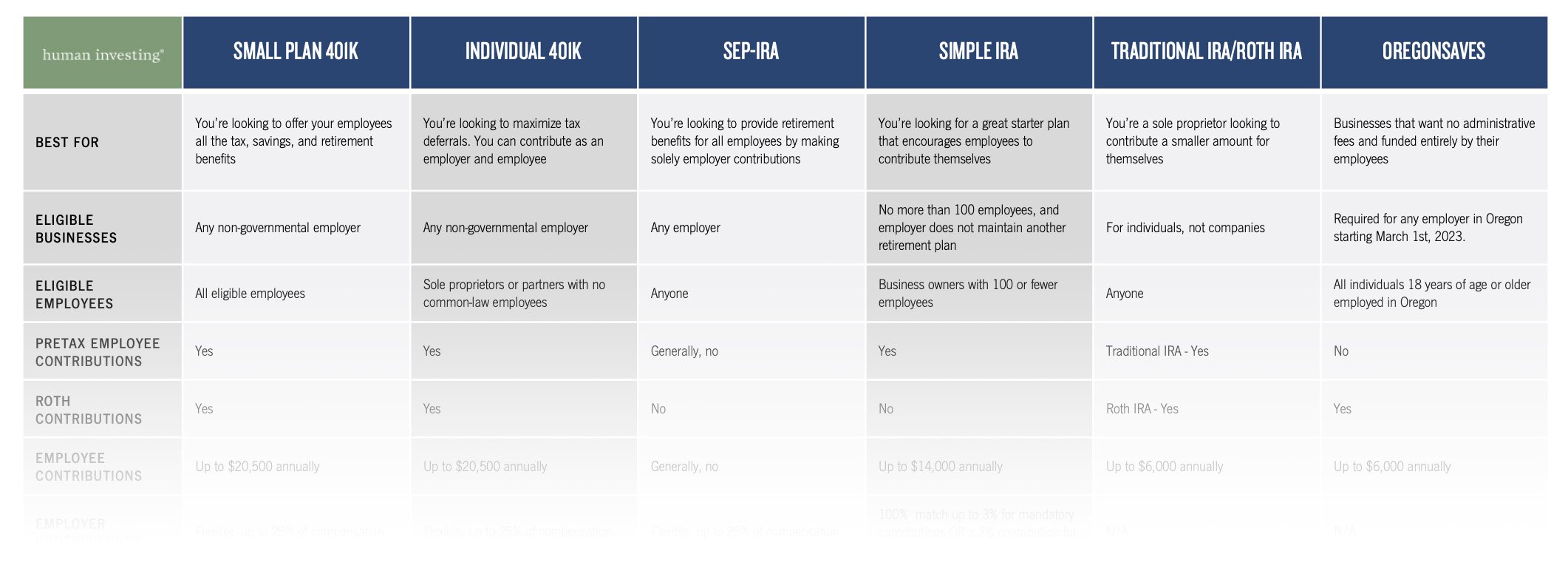
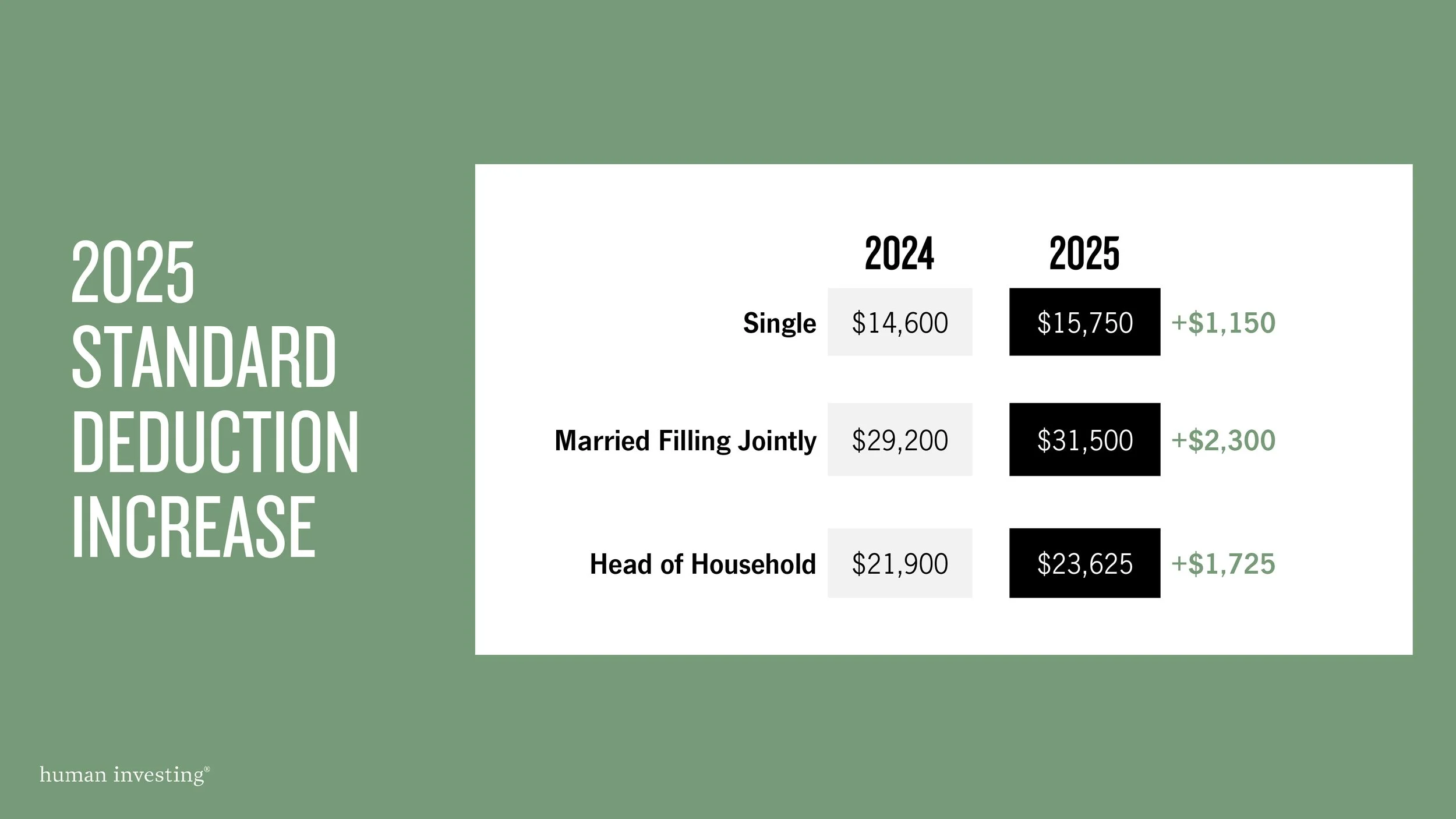
There is good news for retirement accounts! The IRS has increased the contribution limits for the upcoming year. As you can see below, there are many notable changes that will allow investors to save more money.

One important update for 2025 is that under a change made in SECURE 2.0, a higher catch-up contribution limit applies for employees aged 60, 61, 62 and 63 who participate in eligible retirement plans.

How do these changes impact your savings in the upcoming year? Are there any changes you should be making? Use this link to schedule a time to meet one-on-one with our team. We look forward to working with you in 2025!


Related Articles

FinCen BOI Reporting: What you need to know


If you’re a business owner, own a rental property, or receive self-employment income and are registered with a Secretary of State, you may be subject to Beneficial Ownership Information (BOI) reporting. To provide ownership security to U.S. licensed companies, the U.S. Treasury Financial Crimes Enforcement Network (FinCEN), is requiring initial BOI reports as of January 1, 2024 from domestic and foreign companies who file with a Secretary of State or similar offices in the United States.

Know when to file a report now to avoid headaches later

Whether you are involved in a partnership, LLC, or corporation, the importance of reporting to FinCEN is not just for security purposes. If not filed on time, BOI reporting can become a personal financial burden. There is no fee associated with BOI reporting, however those who fail to report or willfully violate the BOI requirements may be subject to civil penalties of up to $500 for each day the violation continues. Below are deadlines that will help individuals determine when they will need to file a BOI report:

  • Entities created or registered on or after 1/1/2024: 90 calendar days after receiving notice of the company’s creation or registration to file its initial BOI report.

  • Entities created or registered before 1/1/2024: Must report an initial BOI before 1/1/2025.

  • Entities created or registered after 1/1/2025: 30 calendar days from actual or public notice that the company’s creation or registration is effective to file their initial BOI reports with FinCEN.

This is a one-time filing, but keep tabs on your future business changes

If changes occur with required information about your company or its beneficial owners, your company must file an updated report no later than 30 days after the date of the change.

Please note, company applicants cannot be removed from a BOI report even if that individual no longer has a relationship with the company.

Any individual associated with the reporting company is eligible to file the report on behalf of that group, but to mitigate any mistakes, seeking out a trusted legal professional such as an attorney, is recommended. Please visit the FinCEN BOI E-filing website and their thorough Q&A section for further information on BOI reporting.


Related Articles

How Business Models Created The Culture of Financial Advisory Firms
 
financial-planning-compensation.jpg

Why not just make the necessary changes to correct what’s broken? 

At this point in our blog series, you might be asking yourself the question, “If things are so bad with the current state of financial planning, why not just make the necessary changes to correct what’s broken?” That is a logical conclusion, but while the problems are obvious, the solutions are challenging (possibly a little like some of the political debate topics you will be hearing for the next few months!). 

There are two real challenges here

One that we have already mentioned: nothing big is wrong. It is a host of smaller pieces that are broken, and those small pieces accumulate into a perception of confusion and mistrust and suboptimal financial planning outcomes.

A second challenge is that the core problems are so deeply rooted in the culture and systems that make up the industry that even obvious needed changes are difficult to address. It is the proverbial turning of the Titanic, if you will. So, a better place to begin might be defining the culture through the lens of how we arrived at where we are currently and identifying some of the elements of the culture that make it so sticky and unwieldy. 

As forecasted last time, there are many weighty systemic issues woven into the culture of financial services that make this move to a better model extremely difficult. These are true anchors working against a migration to something better. In this piece, we are going to start at the top and take a look at the business model of most financial planning firms and set the stage for why things are as they are. 

How financial services make money

As we have discussed, the financial planning profession has its roots in investment services and the insurance industry. Firms make money largely be selling either investment products (stocks, bonds, mutual funds, real estate trusts, options, etc.) or insurance products (whole life, variable life, annuities, etc.). 

Each of these products are sold with a commission and the firm makes money with each product sold. It is quite possible that a firm gets paid $10,000, $15,000 or even $20,000 or more for selling one variable annuity product. So, as you can imagine, this system is full of agency problems or conflicts of interest and has brought about many pieces of regulation to try to control these built-in conflicts. Selling products often comes at the expense of offering services. 

It is for this reason that we ended our last post talking about “fiduciary.” Fiduciary is a legal requirement imposed to make sure that planners/advisors are acting in a way that is in the client’s best interest. And, as we asked last time, who else’s interest would they be serving when they offer advice?

The very fact that a fiduciary standard is required reveals the problematic state of the industry 

This problem and others have led to a slow migration to other business models. Improvement. The commission-only paradigm began to change into a business model that is comprised of both fees for service and commission on products. This has further extended into a model where revenue comes exclusively from fees, with no commissioned products being sold. In fact, the CFP Board recognizes three different categories of compensation for planners:

  • Commission only

  • Commission and fee

  • Fee only

In order to be considered a fee-only advisor (or firm), no commissioned products can be sold. The CFP Board has defined the term “fee only” in the following way: “A certificant may describe his or her practice as “fee-only” if, and only if, all of the certificant’s compensation from all of his or her client work comes exclusively from the clients in the form of fixed, flat, hourly, percentage or performance-based fees.” 

While the definition might seem to align with what you would expect of a fee-for-service relationship, the dominate model looks much different. Instead of being paid to produce a financial plan or paid on an hourly basis, the vast majority of financial planning firms generate most of their revenue through what is called an “assets under management” (AUM) model.

WHAT THE ASSETS-UNDER-MANAGEMENT model MISSES

There are planners who do hourly work or charge by the plan, but that is the extreme minority of revenue dollars produced. The assets under management model assigns a percentage fee to the client assets that are managed by the firm. The more assets managed, the more money made. It is typical for the amount charged to be on a sliding scale so that the percentage applied to assets goes down if you hit certain targets. For example, if a firm charges 1.25% of AUM for assets under $1 million and 1.00% of AUM for assets over $1 million, a client with $500,000 invested would pay $6,250 for the year. A similar fee structure would be used to calculate annual fees during each future year. If the client had $3,000,000 invested, that client would pay $30,000 annually. 

There is nothing inherently wrong with this model, but it does explain why most financial planning firms look like investment service firm silos, or what we have termed “product-focused financial planning.” Other services can be offered and truly comprehensive financial planning can be conducted, but it is most often done without direct compensation. In other words, you are not paid for it. This is the largest and heaviest anchor working against a change from a culture of product-focused financial planning to truly comprehensive financial planning. 

The incentives are stacked too heavily towards products and wealth management. In order to change the incentive, the entire business model would need to change. And as you can imagine, that is a big ask. The more hidden cost is one of being stuck—of knowing what would and could be better, but experiencing the seemingly impossible task of getting there. In life, the one thing more frustrating than not knowing or being able to figure something out is the ability to observe, understand and know what needs to happen but not being able to do anything about it.

Associated costs are a continued and mired state of public distrust, a ridiculous amount of regulation and required disclosure, an opaque world in which terms like “advisor” and “planner” are almost impossible to decipher, and ultimately failing to offer the community the entirety of what they need… truly comprehensive financial planning. 

Check out the rest of the series with Ryan and Marc:

  1. Financial Planning: A New Mindset

  2. Bracing Ourselves For Rough Seas Ahead

  3. Isn’t Financial Planning a Dying Profession?

  4. What Financial Planning Should Look Like

  5. How Product Sales Is Ruining Financial Planning



Want to talk about your financial plan?
Want to learn more?
Come talk to us or e-mail Jill at jill@humaninvesting.com.

Ryan Halley, Ph.D., CFP® is Director of Planning Practices and Research at Human Investing. He holds a doctorate in Personal Financial Planning from Texas Tech University and an MBA with a concentration in Finance from The Ohio State University. Ryan has his CERTIFIED FINANCIAL PLANNER™ certification. Dr. Halley is also a Professor of Finance and Financial Planning at George Fox University, where he directs a CFP® Registered Program located near Portland, Oregon. He has co-authored a book and has numerous peer-reviewed journal articles. Additionally, he has been an invited professor and lecturer at various universities in the United States, Canada and China. 
 

Related Articles

Strategies for Employer Plan Participants that hold Employer Stock
 

Do you participate in an employer’s retirement plan in which you own your employer’s stock? Before selling shares or rolling your account over to an IRA, you should consider a special election that could save you significant tax dollars. For taxpayers with employer stock held inside a qualified employer plan, the IRS allows a special election to distribute those shares at their cost basis and recognize the appreciated gain at preferential capital gain tax rates (avoiding “ordinary” income tax rates). This strategy is known as “Net Unrealized Appreciation” and is outlined in IRS code section 402(e)(4). The net unrealized appreciation is referring to the excess fair market value (FMV) of your employer shares over their cost basis. The election creates an immediate income tax liability on the cost basis of the distributed shares, but allows for continued deferral and favorable tax rates on the embedded and future gain.

There are three requirements to qualifying for and executing an “NUA” election strategy. First, the stock must be distributed out of your employer plan “in kind.” Transferring stock “in kind” means you take distribution of the stock itself, not its liquidated cash value. Second, the NUA election must be made as part of a lump sum distribution in a single tax year. You can make the NUA election on all or a portion of your employer stock and make a tax-free rollover with the rest of your account. The rules only stipulate that the entire account must be distributed/rolled over in a single tax year. Lastly, the lump sum distribution must transpire from one of four situations: death, attaining age 59 ½, leaving the company, or disability.

Below is a chart that outlines the tax treatment of employer stock distributed in an NUA election (www.kitces.com)

Graph-1-for-Todd-Strategies-for-retirement-plans.png

For example, let’s say you were a Nike employee and inside your 401(k) you hold 150k of Nike stock. Those shares have been purchased inside your 401(k) over a 20-year career and have an average cost basis of 50k. You retired last month and are looking to roll over your 401(k) assets into an Individual Retirement Account (IRA). Before making the rollover, you decide to make the NUA election on all your Nike stock. The distribution of those shares at their cost basis is immediately taxable at your ordinary income tax rates (i.e. 33% * 50k = $16,500). Those assets are now outside a qualified plan and all embedded and future appreciation can be realized at capital gain rates. Let’s say you then held those Nike shares until they were worth 200k. That 150k gain (200k FMV – 50k basis) would be taxable at 15%, or $22,500. So, in total with an NUA election, you paid $39,000 in Federal income tax. In contrast, by not making the NUA election, and rolling the entire 401(k) into your IRA there is no immediate income tax bill on the rollover, but all embedded and future gains are taxed at ordinary income tax rates. So, using the $200,000 fair market value assumption, and a lower 25% Fed tax rate, your tax bill would be $50,000 when drawn out of the rollover IRA account. The NUA election would have saved $11,000 in Federal income taxes.
Because there is a tradeoff between recognizing income immediately on an “in kind” stock distribution (NUA election) and a full retirement plan rollover, the cost basis in those employer shares is a significant consideration. The lower the cost basis in the shares, the better. Studies have shown unless your cost basis is 50% or less of the stock’s FMV at the date of distribution it is hard to make a case for the NUA election, and a full rollover to an IRA likely makes the most sense (www. kitces.com).

That said, everyone’s situation is different and there are varying factors that may lead to one recommendation over another. Even your desire for charitable giving may weigh in on the decision. For example, let’s say you were to make the NUA election and receive 100 shares with a cost basis of $40 and a FMV of $100; this would create 40k of gross income in the year of distribution. But, if you were to donate 40 of those 100 shares to a charitable organization or donor advised fund, you could create an offsetting 40k charitable contribution deduction. This offsetting deduction could mute the immediate income tax impact and leave you with 60 shares (60k value) that can appreciate at preferential tax rates outside of a retirement account.

There are a multitude of taxpayer specific situations and profiles that may or may not support making the NUA election. So, if you hold employer stock in a qualifying retirement plan and are getting close to retirement, looking to rebalance the account, or sell out of any of those employer shares, please reach out to us and see if an NUA election strategy makes sense for you.

If you would like to talk with one of our advisors please call Jill Novak at 503-905-3100.


Related Articles