Posts in Investment Strategy
Should I sell my Nike stock now or wait?


Earnings season is coming

Nike’s stock price has been struggling, for several years now. You have to go back to the early 2000s to find a time when it took Nike longer to hit a new all time high. With that, many Nike employees are wondering what to do with their stock. Whether it is to diversify into another investment or to fund expenses like vacation, remodels, or tuition for their kids, the current price has made those decisions more difficult. A common question we hear is “Should I sell my NKE now or wait?”

NKE has recently experienced declines. From Jan 2025 to Apr 2026, NKE fell -41.60% while the S&P 500 has risen 22.57%. Nike had a great run of outperforming the S&P 500 for 10 out of 12 years prior to 2021 but has been on a losing streak since.

Is Nike poised to make a comeback? Predicting the future of any stock, or the market overall, is a difficult task. Nike is the industry leader in athletic apparel, particularly in footwear. If Nike can maintain their brand and industry leadership, they are poised to be successful. Achieving outperformance relative to the S&P 500 is not guaranteed.

Let’s look at a few different ways to approach valuing a stock to get a sense of if NKE appears over or undervalued.

🍰 Price / Earnings (P/E) ratio - how much are you paying for each dollar of earnings:

  • Pros: Earnings are the profits of the company, and those profits are ultimately what is available for shareholders as dividends

  • Cons: Easily manipulated or adjusted by many line items on the income statement, can vary greatly year to year

  • Current P/E: 29.04

  • 3 year median P/E: 29.78

  • Implied Valuation based on $2.16 Earnings Per Share = $64.42

  • Verdict: Based on this metric, NKE appears below its historical median valuation.

💰 Price / Sales (P/S) ratio – how much are you paying for each dollar of revenue:

  • Pros: Less subject to manipulation or fluctuation

  • Cons: Doesn’t consider efficiency (i.e. costs necessary to generate the revenues)

  • Current P/S: 1.40

  • 3 year median P/S: 2.40

  • Implied Value based on $31.45 revenue per share = $75.51

  • Verdict: Based on this metric, NKE appears below its historical median valuation.

🔄 Price / Free Cash Flow (P/FCF) ratio - How much are you paying for each dollar of operating cash:

  • Pros: Shows cash actually available to investors for dividends or stock buybacks, ignores non-cash expenses (i.e. depreciation)

  • Cons: Still subject to manipulation based on accounting practices, can vary greatly year to year

  • Currentl P/FCF: 62.34

  • 3 year median P/FCF: 28.52

  • Implied value based on $2.20 free cash flow per share = $62.66

  • Verdict: Based on this metric, NKE appears below its historical median valuation.

🥣 Average of all ratios:

  • Take the average of the implied values for P/E, P/S, and P/FCF

  • Implied Value = $67.53

  • Verdict: Based on this metric, NKE appears below its historical median valuation.

🚀 Price / Earnings Growth (PEG) ratio = P/E ratio / Earning Growth – measure P/E in context of company’s growth rate

  • PEG < 1 implies undervalued, PEG > 1 implies overvalued.

  • Currently: 29.04 / -30.88 = -0.94

  • Decrease in EPS results in negative value, and less than 1 means the earnings are shrinking faster than the P/E ratio; bad all around

  • Forward 1 year: 2.53

  • Verdict: NKE is poised to be successful.

Based on historical averages, NKE currently appears undervalued

That is typical for a stock that has been declining in earnings and price over time.You can also take different time periods for the median of these valuations, to see what Nike’s valuation has been like over a longer period of time.
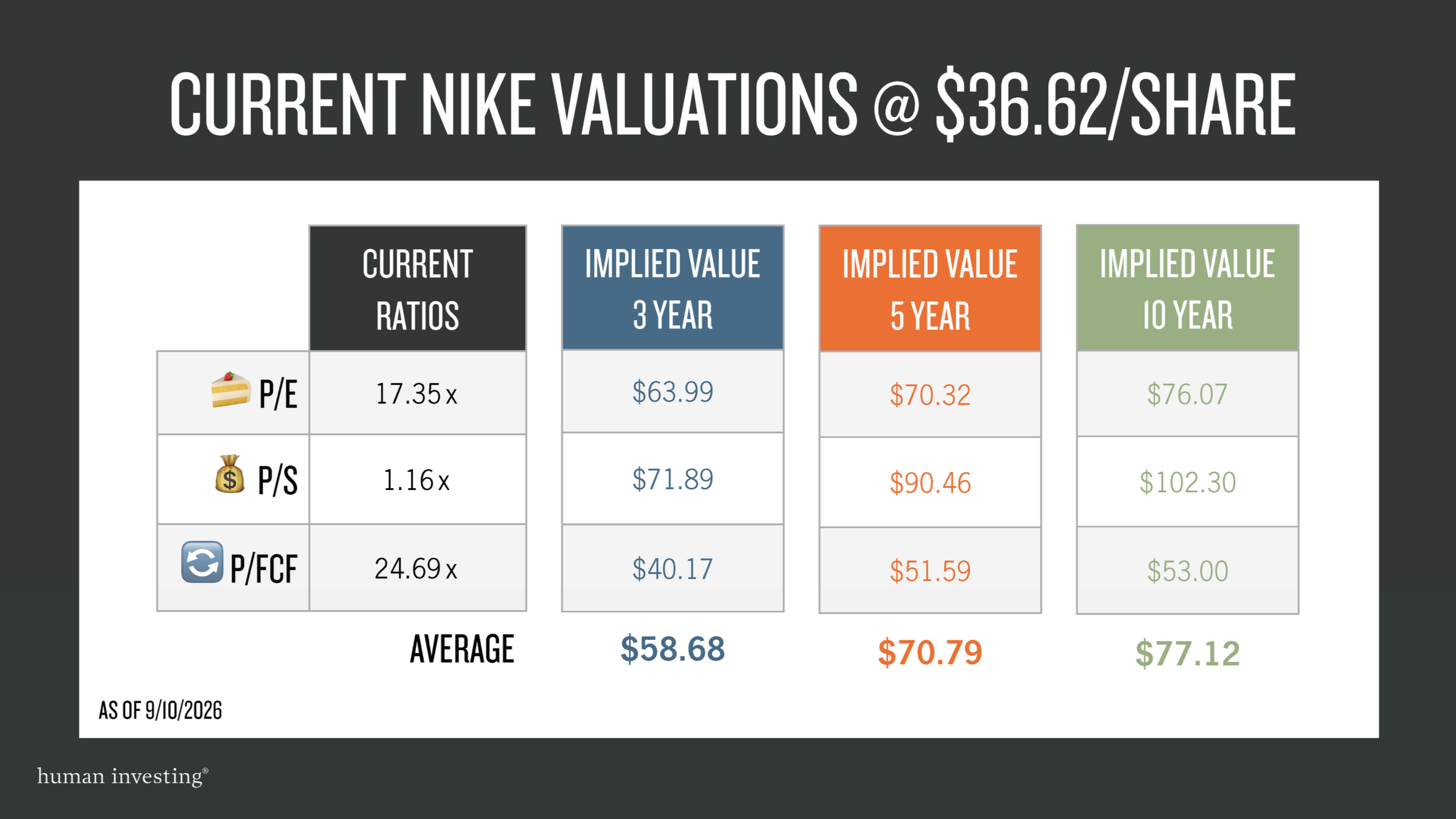
Note: All data courtesy of YCharts as of:  5/7/2026

While Nike may appear undervalued on a 3-year basis, the difference is greater over 5-year and 10-year medians. If you’re thinking about selling, these valuations may give you some guideline thresholds to re-evaluate at.

Based on historical averages for NKE, the stock currently appears undervalued. The decline in NKE’s price in recent years is a big reason for that. Whether the decline will continue, or NKE will return to its historical valuation norms nobody knows. Looking at the basic fundamentals, NKE has some clear struggles. 2025 fiscal year saw declines from 2024, which is unusual and not a healthy sign. On the other end, the basics of continuing on as a business seem strong for NKE:  

  • NKE has consistently sold its products above the cost of those goods.

  • NKE can cover both its current and longer-term debt needs based on existing cash and future expected earnings.

  • NKE has not missed a dividend in the past 10 years.

These metrics are by no means the only way to approach whether now is a good time to sell your NKE stock. Other factors to consider:

  • The amount of time you think you will work at Nike.

  • How much of your Net Worth is tied to NKE?

  • When do your Stock Options expire (if applicable)?

  • Your comfort level with the ups and downs over time.

  • Do you have any major expenses coming up? i.e. house purchase, funding college, etc.

We’re here to help

Beyond these factors and metrics, it is important to integrate your Nike stock decisions within the context of a comprehensive financial plan. If you have questions or would like to discuss whether to hold or sell your NKE stock, please reach out to us at nike@humaninvesting.com.



Disclosure: This material is for informational and educational purposes only and should not be considered personalized tax, legal, or investment advice. You should consult your own qualified tax, legal, and financial professionals before making any decisions based on this information. Tax laws and regulations, including those related to bonuses and supplemental income, are subject to change and may vary depending on individual circumstances. The examples provided are hypothetical and intended to illustrate general tax concepts; they should not be relied upon to determine your actual tax liability. Investing and financial planning involve risk, including the possible loss of principal. Past performance does not guarantee future results. Advisory services are offered through Human Investing, LLC, an SEC-registered investment adviser.

 

Related Articles

ESG Investing: Aligning Your Money With Your Values


Investing isn’t just about numbers. For many, it’s about making choices that reflect personal values while still aiming for long-term investment growth.

One of the more common questions we hear from both clients and prospective clients is, “How can my portfolio better reflect what I care about?” Often, that means avoiding certain industries or intentionally supporting companies with similar values, essentially “voting with your dollars” through your investments. Enter ESG investing: a way to invest while considering Environmental, Social, and Governance (ESG) factors.

Because ESG investing is relatively new and can look differently depending on the investor’s approach, let’s break down what ESG is, how it works (including common misconceptions), and whether it might make sense for you.

What ESG Investments are (and are not)

ESG investing considers how companies operate beyond profits. ESG is a metric that measures impact in the following areas:

  • Environmental: How a company navigates environmental issues like climate impact and sustainability practices

  • Social: How a company supports and interacts with the people and communities it impacts, from its workforce to suppliers to local communities

  • Governance: How it’s run through board diversity, executive pay, and transparency

Although ESG is designed to align investments with values, ESG is not charity. These portfolios still aim for returns and ESG ratings vary widely, so it should not be assumed every “ESG” fund is equal.

How did ESG Investing begin?

Although popular ESG index funds (such as ESGV and VFTAX) were launched just in the last 10 years, the intention of aligning money with values has been present for centuries.

As early as the 1700s, religious groups such as the Quakers practiced forms of values based investing by avoiding businesses involved in activities they believed caused harm, including weapons, slavery, and exploitative labor. These early decisions reflected a belief that how money is earned matters.

Socially Responsible Investing (SRI) gained traction in the 1960s and 1970s with the anti-war movement, as investors sought to divest from companies connected to the Vietnam War and apartheid in South Africa.

The early 2000s were marked by a desire from investors to have more structured ways to evaluate non-financial risks that could impact long-term performance.

In 2004, the United Nations published the report Who Cares Wins, formally introducing the term ESG to describe factors such as environmental impact, labor practices, and corporate oversight.

Today, ESG is widely used by both individual and institutional investors. However, because ESG developed across multiple frameworks over time, its ratings and methodologies are not standardized.

How does ESG Investing work?

ESG investing can take several forms:

  • Screening: Excluding companies that don’t meet certain standards (e.g., defense contracts, tobacco, weapons, fossil fuels, alcohol, gambling).

  • Positive selection: Choosing companies that actively perform well on ESG metrics such as greenhouse gas emissions, workforce diversity and inclusion, and human rights protections.

  • Shareholder advocacy: Investors upholding companies to improve their ESG practices.

What are the benefits of ESG Investing?

  • Values alignment: You invest in companies that reflect what matters to you.

  • Long-term risk management: Companies with strong ESG practices may be better prepared for future regulations or reputational risks.

  • Growing demand: ESG investing is becoming more mainstream, with more selections and better data.

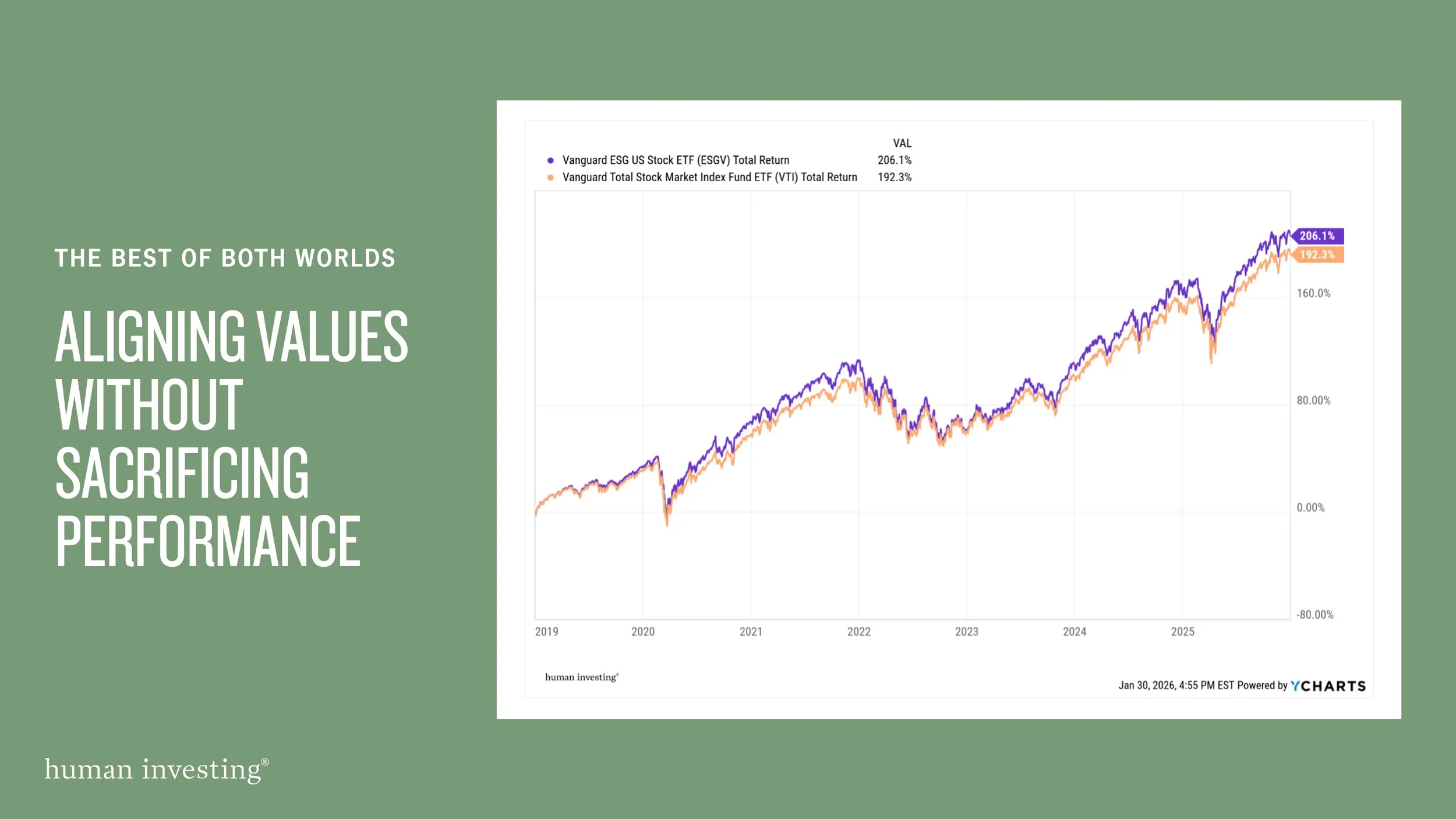
  • Competitive returns: Although long-term data is still developing, several established ESG funds have delivered returns comparable to traditional index funds over the past 5–9 years.

Data courtesy of YCharts. From 1/1/2019 to 12/31/2025, Vanguard ESG US Stock ETF (ESGV) delivered similar returns to Vanguard’s Total Stock Market Index Fund ETF (VTI), while also experiencing higher volatility due to a heavier tech concentration. Past performance is not indicative of future results.

Navigating the trade-offs in ESG investing

While ESG investments can improve alignment with your values, it is not a comprehensive or perfect solution. Some companies you think should be screened may not.

For example, Walmart may still be an investment despite their firearms and tobacco sales, as they derive the majority of their profit from groceries and home goods.

Additionally, Tesla may also be included as an investment in an ESG portfolio due to its sustainable energy focus, despite the controversy around some senior leadership of the company.

Here are some other considerations and common misconceptions with ESG investments:

  • Inconsistent ratings: ESG scores aren’t standardized, so one company might be rated differently by different agencies.

  • Limited diversification: ESG funds may exclude certain sectors, which can make the resultant investment less diverse.

  • Greenwashing: Some companies may appear ESG-friendly without meaningful action.

  • Higher fees: ESG funds can sometimes carry slightly higher expense ratios.

Five essentials for your ESG strategy

  1. Define your values: What issues matter most to you – climate change, human rights, corporate ethics, etc.?

  2. Explore ESG funds: Look for mutual funds or ETFs with ESG or SRI (Socially Responsible Investing) labels.

  3. Check your current investments: You may already be invested in funds with ESG screens.

  4. Talk to an advisor: A financial advisor can help you align your portfolio with your values.

  5. Start small: You don’t have to overhaul everything. Try allocating a portion of your portfolio to ESG choices.

Final thoughts

Although ESG portfolios offer a way of value-driven investing, every portfolio has its limitations. With the right approach, you can align your money with your values, while still aiming for financial success.

Want help exploring ESG investments in your portfolio? Let’s talk!


Disclosure:This content is for informational and educational purposes only and is not intended as investment, legal, or tax advice. The strategies and steps outlined—such as building an emergency fund, contributing to employer-sponsored plans, paying down debt, or using HSAs, IRAs, and taxable accounts—are general in nature and may not be appropriate for every individual. You should consult a qualified financial or tax professional before making decisions based on your personal circumstances. There is no guarantee that following any financial strategy will achieve your goals or protect against loss. References to interest rates, contribution limits, or tax rules reflect information available at the time of publication and may change. Past performance is not indicative of future results. Advisory services are offered through Human Investing, an SEC-registered investment adviser.


Related Articles

"If You Fail to Plan, You Are Planning to Fail"
 

Benjamin Franklin’s quote applies to many choices we make, including personal finances. If we don’t take his message to heart, then a lack of planning can be costly.

There are traditionally two paths one will take when preparing for a large expense. They will either build a plan ahead of time to achieve a financial goal, or the more common path, wait until the expense arises and deal with it then. It’s important to consider the hidden cost of financing a large future purchase instead of planning for it in advance.

NOT PLANNING AHEAD MAY COST YOU MORE THAN YOU THINK

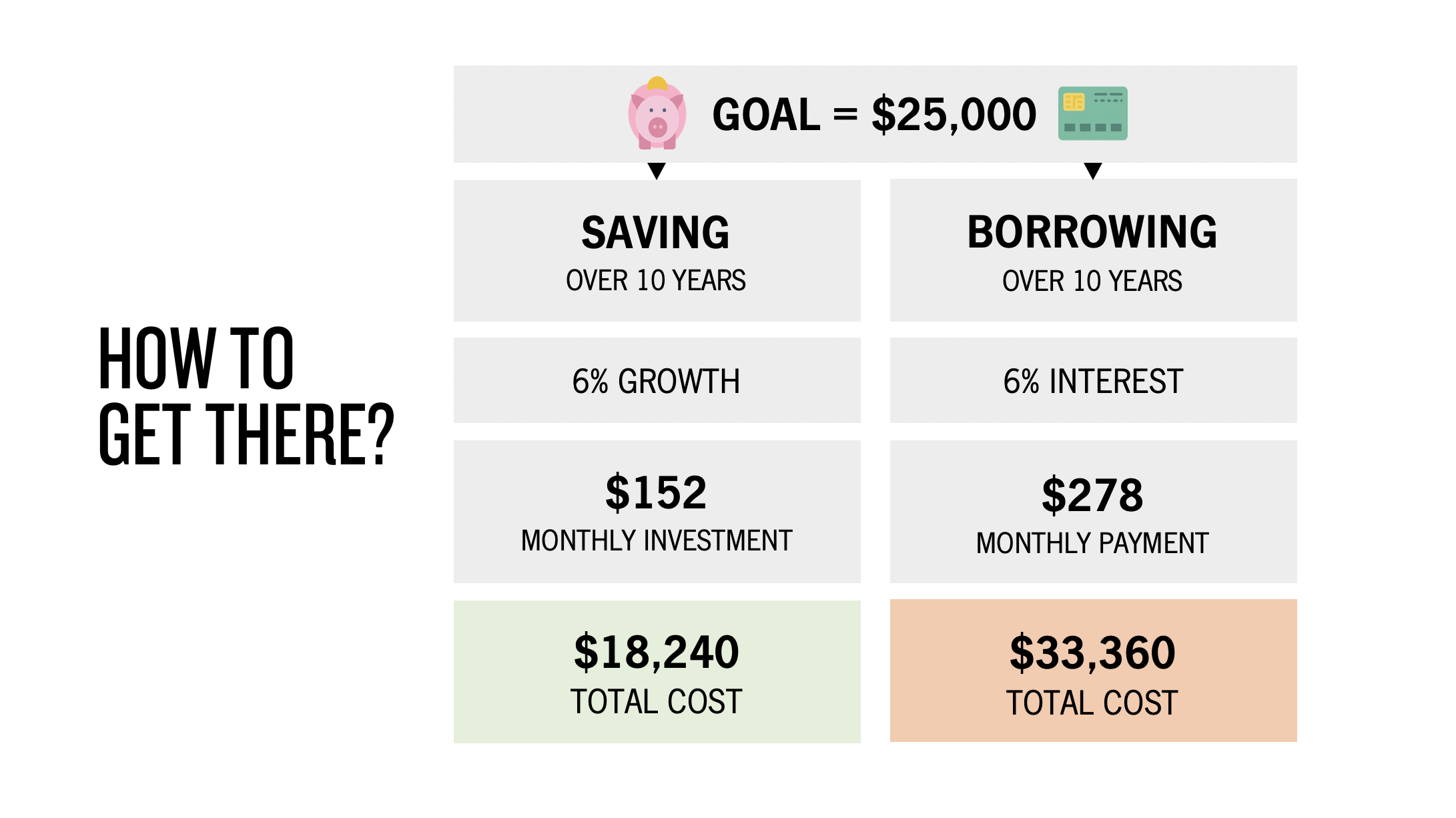
Let’s take the example of a future expense of $25,000 for any situation:

Fill in the blank: year of college for a child, down payment for a home, wedding, car purchase, or a dream vacation.

How do you pay for the $25,000 future expense?

(A) Make a monthly investment over the next 10 years, or
(B) Borrow the $25,000 and make monthly payments to pay off the debt over the next 10 years.

Note: This is for illustrative purposes only. Investment returns, interest rates, and loan periods will vary.

Note: This is for illustrative purposes only. Investment returns, interest rates, and loan periods will vary.

SO WHAT ARE YOU PLANNING FOR TOMORROW?

Building a savings plan and starting early provides around 27% in savings over 10 years, with a total out-of-pocket cost of approximately $18,240 (assuming a 6% annual investment return).

Conversely, the cost of convenience by borrowing adds more than 33% to the overall cost, raising the total to about $33,360 (assuming a 6% interest rate).

Unfortunately, much consumer debt is financed on credit cards, where the average APR in 2025 is over 21% according to the Federal Reserve. At that rate, the total cost of financing a one-time $25,000 purchase could more than double over 10 years, pushing the total cost well past $50,000.

This illustration provides a two-sided lesson. As shown above, building a financial plan can save thousands of dollars over time. On the other hand, procrastinating and choosing to borrow rather than plan can just as easily cost thousands.

Either way, the takeaway is clear: it’s important to understand the real cost of any financial decision in order to make a well-informed choice for your future.

Our team at Human Investing is available if you have questions or would like help building a financial plan that fits your goals.


Disclosure: This material is for informational and educational purposes only and should not be considered personalized tax, legal, or investment advice. You should consult your own qualified tax, legal, and financial professionals before making any decisions based on this information. The examples provided are hypothetical and are intended to illustrate general financial concepts such as saving versus borrowing; they do not represent any specific investment performance or loan terms. Interest rates, returns, and inflation assumptions are subject to change and may vary based on individual circumstances. Investing involves risk, including the possible loss of principal. Past performance does not guarantee future results. Advisory services are offered through Human Investing, LLC, an SEC-registered investment adviser.


Related Articles

Tax-Smart Philanthropy: How OBBBA Could Shape Giving in 2026


New Tax Breaks and Rules for Charitable Donations

People give because they care. That’s the heart of generosity. Yet the rhythm of giving is often set by the tax code. It can make giving feel natural and rewarding, or it can add friction that makes it harder.

When the One Big Beautiful Bill Act was signed on July 4, 2025, the headlines focused on spending and tax rates. Less noticed were the provisions that quietly change how Americans give.

Starting in 2026, millions of households, high-income donors, and businesses will face new incentives and new hurdles when they decide how much to give.

The details are technical, but the story is simple: with the right strategy, you can give more, save more, and make sure your money tells the story you want it to.

A Universal Deduction for a Majority of Taxpayers

For years, most families gave to charity without any tax benefit. Unless you itemized, your generosity was invisible to the IRS. You gave because it mattered, not because it saved you money.

That changes in 2026. Under the new law, taxpayers who claim the standard deduction will also be able to deduct charitable contributions. This is no longer a benefit limited to those who itemize. According to the Tax Foundation, a nonpartisan research group, roughly 85% of taxpayers take the standard deduction, making this one of the broadest incentives for charitable giving.

Here is how it works: taxpayers who claim the standard deduction can now also deduct up to $1,000 in cash contributions each year, or $2,000 for married couples. The gifts must be made in cash, not appreciated assets, and they must go directly to eligible charities.

Why it matters: After 2025, everyday giving like your monthly tithe, your holiday donation, or your support of a local nonprofit will show up on your tax return. The small checks you were already writing now carry extra weight.

What this means for you: For illustrative purposes, take a family who does not itemize and donate $100 each month to charity. That is $1,200 over the year. Beginning in 2026, that full amount can be deducted from their taxable income, up to the $2,000 limit for married couples, $1,000 single filers. A family in the 22% bracket giving $1,200 saves about $264 in taxes.

Note: The figures here represent Federal tax savings. For Oregonians, there may be an extra layer of benefit. If the state aligns with the new Federal rules, that same $1,200 donation could also reduce state taxes by up to 10%, or $120. States are currently evaluating whether to adopt these provisions, so this piece is still unfolding.

The catch is that families used to the standard deduction often don’t track their giving. It never mattered before. Starting in 2026, it will. The habit of generosity now comes with a second habit: record keeping.

‘Bunching’ and a New Hurdle for Itemizers

Beginning in 2026, all itemizers will also face a new rule. Charitable contributions will only be deductible above 0.5% of your adjusted gross income (AGI).

Here is how it works: Suppose your AGI is $200,000 and you itemize deductions. If you give $10,000 to charity, the first $1,000 ($200,000 x 0.5% = $1,000) does not count. Only $9,000 reduces your taxable income. Any 0.5% disallowed amount will be suspended and carried forward for up to 5 years, to hopefully be deducted in a future year when eligible.

Why it matters: On paper, half a percent sounds small. But in practice, this will likely shift how people give. Smaller, steady donations may no longer deliver the same benefit, nudging families to think more strategically about timing and structure.

What this means for you: It is not the size of your gift that changes, but the rhythm. Two larger checks can sometimes be more effective than four smaller ones. Instead of giving the same amount every year, consider making larger gifts less often, a strategy often called “bunching.”

For example, donating $20,000 every two years rather than $10,000 annually. In the larger year, your gift clears the new floor and provides a stronger deduction. In the smaller year, you take the standard deduction and still come out ahead. A $20,000 gift, above the 0.5% AGI floor, in the bunching year may yield roughly $6,400 in tax savings (assuming 32% bracket).

The increased State & Local Tax (SALT) deduction in 2026 can make this even more attractive. Take a household with $25,000 in SALT deductions and $20,000 in charitable giving every other year. That totals $45,000 of deductions, easily clearing the standard deduction and ensuring the charitable contribution counts well above the 0.5% threshold. In the off years, they simply return to the standard deduction.

Donor-advised funds (DAFs) make this easier. You can contribute a larger amount in one year, capture the deduction, and then spread your giving out over time so your favorite causes don’t feel the gap. Many DAFs even allow you to invest the balance, which means your dollars can grow before they’re granted. In that sense, a DAF turns one act of generosity today into even more generosity tomorrow. 

A 37% Deduction, Now 35%

If you itemize deductions and are in the top tax bracket, another change arrives in 2026. The maximum tax benefit you can receive from charitable deductions is limited to the equivalent of a 35% tax rate.

Here is how it works: Charitable gifts must first clear the new 0.5% of AGI floor. On top of that, the benefit of any eligible gifts above that floor will be limited to 35% rather than today’s 37%.

For example, with an AGI of $1,000,000 and a gift of $100,000, the first $5,000 provides no tax benefit today because of the 0.5% floor. The remaining $95,000 is deductible, producing a maximum tax savings of $33,250 in 2026. Under the current rates, a $95,000 gift would save $35,150.

The 0.5% floor can carry forward, but the difference between the 35% and 37% deduction rates does not.

Why it matters: For wealthy donors, the change is modest in dollars but meaningful in psychology. Even small shifts in after-tax cost can alter behavior at the margins, which is why thinking ahead about timing and tools matters more than ever.

What this means for you: For wealthy donors, every dollar still counts, but in 2026, each one counts a little less. It may make sense to accelerate some giving into 2025 before the new rules take effect.

C-Corp Business Owners and the New 1% Floor

Starting in 2026, C Corporations (C-Corp) will also face a new threshold. Charitable giving will only be deductible once it exceeds 1% of taxable income.

Here is how it works: If your company is a C-Corp and earns $1,000,000 and donates $8,000 (0.8% of income), you’ll no longer get a tax deduction for that gift. But if you give $15,000, you’ve crossed the 1% threshold, and the portion above $10,000 (the first 1%) is deductible.

The long-standing 10% cap on corporate deductions still stands, along with the five-year carryforward. The key difference is that smaller contributions that once carried a tax benefit may no longer qualify.

Why it matters: This rule discourages token giving and pushes companies toward more intentional generosity. Businesses that want their contributions to count, for both taxes and impact, will need to plan gifts as part of a larger strategy rather than as one-off gestures.

What this means for you: For C-Corp business owners, this change means smaller charitable gifts may no longer have a tax benefit. To maximize impact, you may choose to either increase your giving to clear the 1% threshold or bunch donations in certain years to secure the deduction.

A Special Planning Window in 2025

Before the new rules take effect, 2025 offers a unique chance to be more strategic with your generosity. The changes do not begin until 2026, which means as an itemizer you can still give under today’s more favorable framework: there is no 0.5% AGI floor for individuals, no 1% floor for corporations, and top-bracket donors can still receive up to a 37% deduction.

Why it matters: 2025 is one of the most favorable years in recent memory for charitable giving for itemizers. Acting before the rules change can mean more tax savings and more dollars flowing to the causes you care about.

What this means for you:

  • A family giving $20,000 in 2025 can deduct the full amount. In 2026, with a $200,000 AGI, only $19,000 would count toward a deduction.

  • A high-income donor with an AGI of $1,000,000 giving $100,000 in 2025 could reduce their taxable income by up to $37,000. The same gift in 2026 would shrink to $33,250 in savings, raising the after-tax cost of generosity.

  • C Corporations who typically make smaller annual gifts may want to accelerate donations into 2025 before the 1% corporate threshold applies.

For those who want to keep supporting their favorite charities steadily, donor-advised funds can be especially effective. By contributing a larger amount in 2025, your secure today’s tax benefits while giving yourself flexibility to distribute grants to nonprofits over time.

Bringing It All Together

The new law will change how taxpayers experience charitable giving. Some will gain new opportunities, while others will need to be more intentional to keep their giving tax efficient.

  1. Individuals & Families who do not itemize will now enjoy a tax break for giving.

  2. Itemizers will need to plan gifts to rise above the new floor.

  3. High-income donors will face a slightly smaller size tax benefit.

  4. C Corporations will need to give more intentionally to secure deductions.

  5. 2025 offers a last-chance window to maximize giving before the new rules take hold.

Why it matters: These rules will shape how generosity shows up, but not why we give. With planning, your giving can still tell the story of what matters most to you. The new law will not change the reasons we give, but it will change the timing, structure, and strategy that make generosity as efficient as possible.

At Human Investing, we see our job as more than managing investments. We help align your values with your financial life so that every dollar reflects what matters most. That way, your giving becomes not only a tax-smart decision, but a lasting legacy.


Tax Foundation. (2025). FAQ: The One Big Beautiful Bill Act tax changes. Retrieved from https://taxfoundation.org/research/all/federal/one-big-beautiful-bill-act-tax-changes/ Tax Foundation

Government Publishing Office. (2025). Public Law 119-21: One Big Beautiful Bill Act. Retrieved from https://www.congress.gov/119/plaws/publ21/PLAW-119publ21.pdf

Kitces, M. (2025, July). Breaking down the “One Big Beautiful Bill Act” (OBBBA): Tax planning, SALT cap, senior deduction, QBI deduction, Tax Cuts and Jobs Act (TCJA), AMT, “Trump Accounts”. Nerd’s Eye View. Retrieved from https://www.kitces.com/blog/obbba-one-big-beautiful-bill-act-tax-planning-salt-cap-senior-deduction-qbi-deduction-tax-cut-and-jobs-act-tcja-amt-trump-accounts/

Disclosure: This material is provided for informational and educational purposes only and should not be construed as tax, legal, or investment advice. Examples are hypothetical and for illustration purposes only; actual results will vary. Tax laws are subject to change, and their application may vary depending on individual circumstances. Clients should consult their own tax and legal advisors before making any charitable giving decisions. Advisory services offered through Human Investing, LLC, an SEC registered investment adviser.


Related Articles

Rebalancing – What is it, and Why Does it Matter?


Rebalancing is the idea that you are bringing your investment portfolio back to its targets. For example, if you invest your account as 60% stocks and 40% bonds (60/40) and never trade, in ten years your account will not be 60% stocks. Because stocks have historically tended to perform better than bonds over most ten-year periods, you will likely have a higher weight of stocks than bonds after ten years. If you don’t rebalance, your portfolio may not align with your intended allocation, which could change the risk and return characteristics.

WHY is it NECESSARY

Deciding how much to invest in various asset classes is a critical determinant of long-term performance[1]. Since asset allocation matters, maintaining it through rebalancing matters. As we’ve written previously, over time stocks typically outperform bonds[2]. There are also certainly times bonds outperform stocks, usually in recessions. The logic of rebalancing boosting returns is simple: You are selling what has relatively outperformed and buying what has underperformed (buy low, sell high). Especially in today’s world, where most ETFs are commission free, making the transaction costs of rebalancing minimal. Taxable investors should consider the tax implications of rebalancing, and also consider the change in risk and return of not rebalancing.

TWO APPROACHES

In financial theory, there are two main approaches to rebalancing: calendar-based and tolerance-based.

Calendar-based rebalancing ensures the long-term risk-return profile of your portfolio is consistent. This gets implemented on a set frequency (monthly, quarterly, annually) and ensures a consistent cadence.

Tolerance-based rebalancing takes advantage of buy low, sell high opportunities as they arise. This assumes you rebalance only if you hit certain thresholds of one asset class over or under performing. For example, say your target is 60/40, and you set a 3% absolute tolerance; if the equities drift to 64%, that prompts a rebalance back to 60/40. The alternative is relative tolerances, the same percentage of the target for each piece of the model. So, if a 60/40 portfolio had a 20% relative tolerance, the equities would be rebalanced if off by a relative 20% (20% of 60% target = 12% tolerance) and the bonds would have a 4% tolerance for rebalancing. There has been research suggesting tolerance-based rebalancing is more beneficial for long-term performance[3].

OUR PROCESS

At Human Investing, we combine both calendar-based and tolerance-based rebalancing to give our clients the best of both worlds. Tolerance rebalancing allows us to take advantage of market dips and rallies as they happen, while our annual reviews ensure no portfolio drifts too far off course. This approach keeps every account aligned with the level of risk and return our clients expect and provides discipline, consistency, and confidence over the long run.

While rebalancing can sometimes feel counter intuitive, like selling bonds and buying stocks in March 2020, it is a helpful practice for any investor. It both keeps your portfolio consistent in the long run, and may improve risk-adjusted returns over time.


[1] Ibbotson, R. G., & Kaplan, P. D. (2000). Does Asset Allocation Policy Explain 40, 90, or 100 Percent of Performance? Financial Analysts Journal56(1), 26–33. https://doi.org/10.2469/faj.v56.n1.2327

[2] https://www.humaninvesting.com/450-journal/equity-risk-premium

[3] Daryanani, Gobind (2008). Opportunistic Rebalancing: A New Paradigm for Wealth Managers. FPA Journal. January 2008.

Disclosure: This material is provided for informational and educational purposes only. It should not be construed as investment, legal, or tax advice, nor does it constitute a recommendation or solicitation to buy or sell any security. Investors should consult with a qualified financial professional before making any investment decisions. Rebalancing and asset allocation strategies do not ensure a profit or protect against loss in declining markets. There is no guarantee that any investment strategy will achieve its objectives. Any references to historical performance, academic studies, or research are based on past data and should not be considered indicative of future results. Past performance is not a guarantee of future outcomes. Advisory services offered through Human Investing, an SEC-registered investment adviser.
 

Related Articles

Making the Most of Your Nike Stock Choice: 3 Strategies for 3 Situations


The Nike stock choice window is just around the corner. While this may seem like a straightforward decision, it’s an important time to consider all aspects of your financial plan to make an informed decision that will best suit your needs. Through reflection and thoughtful planning, we often collaborate with Nike clients to walk them through this choice which serves their life goals best.

As we have worked with individuals in various life stages, we have seen a variety of needs and preferences emerge. Different people are trying to meet a diverse set of needs for themselves and their families.

We’d like to share a few stories of people in different life stages in hopes that one (or more) will resonate with you. We believe that each person has a unique story, and needs advice tailored to their specific situation. We like to know our clients by building a trusted and genuine human connection so we can serve them as a fiduciary.  

The personas profiled below are not reflective of any particular client or person. They are generalities based on years of experience working with Nike employees.

Meet John, 31, Director at Nike:

John, 31-years-old, was recently promoted to a Director role at Nike. He has been with the company for about two years and proudly considers himself a “lifer” at Nike. He believes in Nike’s long-term potential as a company and is excited about the opportunity to participate in its future growth. John likes to branch out in his investing by purchasing cryptocurrency and considers himself a risk-taker. He has a high-risk tolerance, not just in investing, but also in his love of extreme mountain biking. He is now entering his first year of participating in the annual stock choice, and is enthusiastic to partake in the future success of a company he truly believes in.

John is married with no kids, currently has little expenses and saves most of his paycheck. He is in a strong position and mindset to take more risk with his stock choices.

Our recommendation: By choosing stock options over restricted stock units (RSUs), John has the opportunity to benefit from Nike’s long-term growth. This choice provides him an approach that aligns with both his financial philosophy and comfort as well as his commitment to Nike’s future.

Meet Rachel, 42, Senior Director at Nike:

Married with young children in public school, Rachel, 42 years old, is focused on financial stability and meeting her family’s ongoing expenses. She has been at Nike for four years and currently excels in her role as a Senior Director. She has enjoyed her time at the company but is currently considering roles elsewhere. Rachel’s uncertainty about long-term tenure influences how she approaches financial decisions—particularly those tied to equity compensation.

Rachel is a conservative investor who doesn’t want to put all her eggs in one basket. Rachel tends to avoid risk and prefers stability over speculation.

Our recommendation: RSUs are a reliable source of income for Rachel. Her risk-averse mindset and need for cash have led her to select RSUs as her Nike stock choice decision in the past and sell them upon vesting. Continuing to choose RSUs allows Rachel to obtain a steady cash flow and participate in Nike’s equity program in a way that supports her personal and professional needs best.

Meet Matt, 53, VP at Nike:

Matt, a 53-year-old Vice President at Nike, has been with the company for a decade and is approaching a key transition point in his career. With plans to retire within the next one to two years, he has been closely reviewing his overall financial plan to adequately prepare for the future. Matt is uncertain about Nike in the long-term and doesn’t want to rely on his stock awards to fund all his personal goals and dreams.

Matt is nearing eligibility age for a special retirement vesting treatment. If Matt remains with Nike at age 55 this rule would extend his window to hold onto his unvested stock options (grants held for at least one year) beyond the typical 90 days.

However, with college-age children and education expenses creeping up, he also has immediate cash needs to consider.

Our recommendation: While RSUs offer a more reliable payout, options could become a strategic tool if the stock grows before the options expire. Ultimately, Matt must strike a balance of these two stock choices that fits his needs. His decision will likely be a mix of both options and RSUs to support his family and the opportunity for long-term growth.

How the Stock Choice Can Serve You

As these examples illustrate, there's no single approach that works for everyone. These stories are here to serve as a starting point for discussion around your personalized plan.

The Nike stock choice window is more than just an annual selection. It’s an opportunity to reflect on your broader financial goals and personal values. Whether you're early in your career like John, balancing family needs like Rachel, or preparing for retirement like Matt, your decision should align with where you are now and where you want to go.

Each individual’s situation is unique, and should factor in timing, risk tolerance, behavioral, and quantitative analysis. We’re here to help you think through those variables with clarity and confidence.

If you have questions or want to dive into an analysis of your own situation, take our survey below.

TAKE OUR ANNUAL STOCK CHOICE SURVEY

Get a customized score to help you make your stock choice this year.


Disclosures: The information provided in this communication is for informational and educational purposes only and should not be construed as investment advice, a recommendation, or an offer to buy or sell any securities. Market conditions can change at any time, and there is no assurance that any investment strategy will be successful. Investing involves risk, including the potential loss of principal. Past performance is not indicative of future results.

Diversification does not guarantee a profit or protect against a loss in declining markets. Asset allocation and portfolio strategies do not ensure a profit or guarantee against loss.

Scenarios discussed are hypothetical and for illustrative purposes only. They do not represent actual clients or outcomes and should not be interpreted as guarantees of future results.

The opinions expressed in this communication reflect our best judgment at the time of publication and are subject to change without notice. Any references to specific securities, asset classes, or financial strategies are for illustrative purposes only and should not be considered individualized recommendations.

Human Investing is a SEC Registered Investment Adviser. Registration as an investment adviser does not imply any level of skill or training and does not constitute an endorsement by the Commission. Please consult with your financial advisor to determine the appropriateness of any investment strategy based on your individual circumstances.


Related Articles

When Everything Feels Risky, are U.S. Treasuries Still the Answer?


Every few years, a familiar worry resurfaces: Can we still trust U.S. Treasuries?

It’s a fair one. Fiscal deficits are rising. Government debt dominates the headlines. Political theatrics are hard to ignore. These concerns are understandable.

But this piece is not a dismissal of those worries. It aims to weigh them against the steady role Treasuries continue to play in global markets and in investors’ portfolios.

Because the key, as always, is to separate signal from noise. And noise is never in short supply.

U.S. Treasuries are often described as “risk-free.” Of course, no investment truly is, but no other assets have earned that reputation as convincingly. Their strength is structural: deep markets, global demand, and the dollar’s central role in international finance. These aren’t passing features. They’re foundational pillars of a system that continues to hold.

WE’VE BEEN HERE BEFORE

Concerns about the national debt are nothing new. In the mid-1980s, Congress passed the Gramm-Rudman-Hollings Act in response to growing fears of a looming fiscal cliff.¹

That was nearly 40 years ago.

Since then, warnings have echoed: interest rates would skyrocket, the dollar would collapse, foreign buyers would flee. But none of those predictions played out in a sustained way. Interest rates stayed low for decades. The dollar remained strong. Treasuries continued to anchor global portfolios.

THE OTHER SIDE OF THE LEDGER

Most debt conversations focus on the total amount owed, but it would be wise to consider both sides of the ledger. An equally important story is the government’s ability to repay what it owes.

The United States has a broad and resilient tax base, drawing revenue from some of the world’s most profitable corporations and wealthiest individuals. In 2024, over 94 percent of federal revenue came from income, payroll, and corporate taxes.²

That revenue base gives the government something that matters more than the size of its debt: flexibility. The capacity to raise more if needed. This is a critical ingredient in maintaining trust and stability in U.S. Treasuries.

That doesn’t make debt a non-issue. But it puts the conversation in better context.

THERE IS NO SUBSTITUTE

Some point to shifting foreign ownership of Treasuries as a sign of trouble. But the truth is, global capital needs a home that is safe, liquid, and capable of absorbing trillions in flows. There are few alternatives.

That’s why central banks, sovereign wealth funds, and even the U.S. tri-party repo market continue to rely on Treasuries. ³,⁴ It is not because of short-term politics. It is because no other asset plays the role as effectively or as consistently.

Foreign holdings may ebb and flow with trade dynamics or currency shifts. But the long-term, strategic demand? It’s still there.

HIGH DEBT DOES NOT GUARANTEE CRISIS

Japan offers an interesting counterpoint. With a debt-to-GDP ratio over 250%, more than double that of the United States.⁵,⁶ And yet, its financial system remains stable, and interest rates are close to zero.

This is not to suggest that debt is irrelevant, but it serves as a useful reminder that high debt levels, on their own, do not lead to crisis. The surrounding structure, including credibility, strong institutions, and consistent demand, matters just as much, if not more.

Could Treasuries someday lose their special status? In theory, yes. Anything is possible. But if that day ever comes, it will likely coincide with a much broader breakdown in global order. In that kind of environment, the safety of any asset would be in doubt.

That’s not a prediction. It’s simply an observation about the scale of disruption required to unseat the U.S. Treasury market.

A WARNING FROM ‘THE BOND KING’

Not everyone views Treasuries as the unshakable anchor they once were. Even some of the most seasoned investors are questioning the long-term role of U.S. Treasuries.

Jeffrey Gundlach, CEO of DoubleLine Capital and one of the most influential fixed income investors of the past two decades, has voiced serious concerns. In a June 2025 interview, he offered this warning:

“There is an awareness that the long-term Treasury bond is not a legitimate flight-to-quality asset.”⁷

He points to shifting dynamics: the dollar falling during selloffs, long bond yields rising after rate cuts, and growing concern over rising interest costs. As low-yield bonds mature, they are being replaced by debt with much higher yields. According to Gundlach:

“The interest expense for the United States is untenable if we continue running this budget deficit and continue to have sticky interest rates.”

Gundlach raises legitimate questions. But even he stops short of calling Treasuries broken. His concern is about strain, not collapse. The system is being tested, not undone.

While the pressures are real, rising interest rates and persistent deficits, they are not set in stone. Policy can change. Priorities can shift. The system still has tools it can use.

And this is where perspective matters.

Markets are noisy. Bad news sells. Loud warnings travel further than quiet resilience. But alarm does not erase the quiet strength of systems that continue to function.

Even Gundlach points to stress, not failure.

Which brings us back to what still works.

STILL DOING THEIR JOB

Treasuries aren’t immune to worry, however they continue to serve their purpose. They provide liquidity, offer stability, and act as a counterbalance in times of uncertainty.

We’re seeing that play out again in real time. Renewed tensions with Iran have reminded investors what uncertainty feels like. Once more, yields have dropped and the dollar has strengthened. These are clear signs of a flight to safety.

Even amid rising deficits and political noise, Treasuries continue doing what they’ve always done: deliver reliability in a world that often falls short.

References:

  1. U.S. Congress. Balanced Budget and Emergency Deficit Control Act of 1985 (Gramm-Rudman-Hollings Act). Public Law 99–177, 99th Congress, December 12, 1985.

  2. U.S. Department of the Treasury. “Government Revenue.” Fiscal Data – America’s Finance Guide.Accessed June 20, 2025.

  3. Board of Governors of the Federal Reserve System (U.S.). “Rest of the World; Treasury Securities Held by Foreign Official Institutions; Asset, Level [BOGZ1FL263061130Q].” FRED, Federal Reserve Bank of St. Louis. Accessed June 20, 2025.

  4. Federal Reserve Bank of New York. “Tri-Party Repo Data Visualization.” Federal Reserve Bank of New York. Accessed June 20, 2025.

  5. U.S. Department of the Treasury. “National Debt and Debt-to-GDP Ratio.” Fiscal Data – America’s Finance Guide. Accessed June 20, 2025.

  6. World Economics. “Debt-to-GDP Ratio: Japan.” World Economics. Accessed June 20, 2025.

  7. Jeffrey Gundlach, interview with Bloomberg, “Gundlach on Treasuries, Gold, Fed, AI, Private Credit, Trump,” June 11, 2025.


Disclosure: Advisory services offered through Human Investing, an SEC registered investment adviser. This material is for informational and educational purposes only and is not intended as investment advice, an offer, or a solicitation to buy or sell any securities. Past performance is not indicative of future results. All investments involve risk, including the potential loss of principal. Any third-party opinions or sources cited are believed to be reliable but are not guaranteed for accuracy or completeness. Please consult your financial professional before making any investment decisions.

 

Related Articles

Managing Your Finances With the Three Bucket Approach


We live in a world where money feels more complicated than ever. There are more choices, more opinions, and more pressure to get it right. And because money is personal and often emotional, and it can be hard to know where to begin.

After working with hundreds of families, one thing stands out: the people who feel most confident about their finances aren’t the ones with the highest returns. They’re the ones with a system. A simple, repeatable process for managing cash flow, expenses, and uncertainty.

And for most people, that system starts with how you hold cash. The key is giving it structure.

That’s why I use a three-bucket approach:

  1. One bucket for the everyday—bills, groceries, and life’s basics.

  2. One for the unexpected—emergencies, repairs, and surprises.

  3. And one for the future—a place for your cash to grow and outpace inflation.

It’s not flashy. But it works. And in a world full of noise, systems that work quietly are often the ones that matter most.

Bucket One: Daily Life

This is your foundation. The money that pays for groceries, gas, the electric bill, subscriptions and everything else that keeps your life moving. It’s not meant to grow. It is meant to flow—steady, predictable, and low stress.

Purpose: Keep life steady. Pay your bills without stress.
Where to keep it: A checking account you trust.
What to keep in mind:

  • Aim to match your monthly spending – money in and money out, with a small buffer.

  • Enough to avoid dipping into savings or taking on credit card debt for the basics.

  • Not so much that you’re leaving money idle for no reason.

Too much in this account means money is sitting still and losing ground to inflation. Too little, and small surprises can throw everything off.

Cash in this bucket is like oxygen: you don’t think about it when it’s there, but when it’s not, nothing else works.

Bucket Two: The Buffer

No one plans for a broken transmission. Or a surprise tax bill. Or a layoff. But those things happen. That’s why this bucket exists not to help you get ahead, but to keep you from losing ground when life doesn’t go to plan.

It also covers the bigger, less frequent expenses you can anticipate. Things like replacing your car, covering a major home repair, or helping a child with college or a wedding. If it’s a larger expense and you expect it within the next five years, it belongs here. Planning for these ahead of time keeps them from becoming financial emergencies when they arrive.

Purpose: Provide breathing room when the unexpected shows up.
Where to keep it: High-yield savings, money market funds, or short-term Treasuries. These are safe places where your money is still accessible and earning more than a checking account.
What to keep in mind:

  • Cover 3 to 6 months of essential expenses.

  • Add extra for planned one-time costs like a new roof, tuition, or a car.

  • Focus on after-tax interest. Earning a bit more here helps these dollars avoid quietly shrinking under the pressure of inflation.

This is the bucket where it makes sense to look for a little more yield. That might come with a small sacrifice in liquidity. Your money may take an extra step or a day or two to access. But that added friction can be useful. It creates a natural pause that gives you a moment to think before reacting. Sometimes, having to slow down is exactly what protects you from making a decision you might regret.

This bucket may not make headlines, but it builds resilience. It helps turn unpredictable moments into manageable ones and keeps you moving forward with confidence.

Calculating the right amount is important. But holding too much here can also create risks. Cash that sits for years without a purpose slowly loses value. That is where the third bucket comes in.

Bucket Three: The Future

If Bucket One is about staying afloat and Bucket Two is about staying safe, Bucket Three is about moving forward. This is where your cash begins working toward the future, whether that is your own retirement, future generations, or a lasting legacy. It is not for today, and probably not for next year. It is for the life you are building over the long run.

Purpose: Grow your money in a way that keeps up with, and ideally outpaces, inflation.
Where to keep it: A diversified investment portfolio aligned with your goals and timeline, whether growth, income, or a mix of both.
What to keep in mind:

  • Time in the market is more powerful than trying to time the market.

  • There can be periods where the market goes down, but in the end the market is undefeated. 

  • Emotional decisions often cause more harm than poor performance ever will.

This is also a place where working with a fiduciary financial advisor can be especially helpful. An advisor can help you figure out how much to invest, how often to do it, and which types of accounts are the best fit for your goals. They provide structure, help you stay focused, especially when the market makes it tempting to second-guess your plan.

Final Thought: The Real Goal

Getting your financial life in order starts with building a system that makes the rest of your decisions easier. A system that keeps you steady when things get noisy. A system that gives every dollar a job.

The three-bucket approach is simple by design. One bucket to keep life running. One to absorb the unexpected. One to grow for the future.

As author James Clear puts it, “You do not rise to the level of your goals. You fall to the level of your systems.” The families who feel most confident about money aren’t the ones with the biggest portfolios. They’re the ones with a clear, repeatable system they trust, especially when things get hard.

This isn’t about wringing the highest return out of every dollar. It’s about creating margin, building structure, and letting consistency do the heavy lifting. In personal finance, small steady steps beat frantic leaps.

Start with where you are. Build a system that fits your life. And trust that simple, well-built plans often lead to the strongest outcome.


Disclosure: Investment advisory services offered through Human Investing, an SEC registered investment adviser. Investments involve risk, including the potential loss of principal. Diversification does not ensure a profit or guarantee against loss. Past performance is no guarantee of future results. This material is for informational purposes only and is not intended as individualized investment advice. Any references to market trends or economic conditions are for illustrative purposes and may not reflect future developments. Consult with a qualified fiduciary advisor before making financial decisions.

 

Related Articles

How to Approach Your RSUs, ESPPs & Stock Options in a Volatile Market


Given the recent stock market volatility, it is important to re-evaluate your plan for your Stock Benefits (RSUs, ESPP, Stock Options) to take advantage of opportunities that may arise in this environment. 

A well-crafted strategy for your stock benefits should focus on:

  1. Personal needs and situation

  2. Maximizing the benefit

  3. Minimizing taxes

  4. Diversifying strategically

  5. Incorporating the investing principle of “Buy Low + Sell High” (when available)

The Investing Principle of Buy Low + Sell High

A fundamental investing strategy is to buy stocks when they are undervalued and sell them once they’ve appreciated, allowing you to benefit from the price increase. While timing restrictions from stock benefits may limit this approach, it’s important to integrate it whenever possible.

Strategies for your stock benefits based on your timelines

How do you incorporate your personal situation and needs with an effective strategy during the current market volatility? We will dive into several strategies that address the needs for different time periods, since timelines are an even more important factor during volatile markets.

For short-term needs (2 years or less)

Stock compensation can provide funds for expenses beyond salary and bonus, such as tuition, home repairs, vacations, or tax bills.

  1. First, consider selling recently purchased ESPP shares. Since you're buying these shares at a discount while the stock price is low, selling them for a gain doesn’t violate the “buy low, sell high” principle.

  2. Next, consider selling recently granted and vested RSUs. Like the ESPP strategy, these RSUs can help meet short-term cash needs. The main difference is that RSUs are often granted at a higher price—before a market downturn—so their current value may be lower than when they were granted. However, if the RSUs were granted recently, the price difference might be minimal, making them a more attractive option to sell.

For intermediate term needs (3-7 years) 

The intermediate term timeframe can be more challenging, since the answer isn’t clear and should depend on your risk tolerance.

  • The more conservative approach: Sell existing RSU grants that will vest in the next 12 months. This strategy reduces your exposure to stock volatility but doesn’t fully align with the “buy low, sell high” principle, since RSUs may be worth less than their original grant price. However, future annual grants—typically part of your compensation—can help offset this by being issued at lower prices during a market downturn.

  • A higher-risk approach: Hold all existing RSUs until the funds are needed, with the hope that the stock price recovers before then. This could allow you to better capitalize on the “buy low, sell high” strategy. The risk, however, is that the stock may not recover in time—or at all—leaving you potentially forced to sell at a loss when cash is needed.

  • The balanced approach: To hedge your bets, consider combining both strategies: sell some RSUs now while holding others for potential future gains. This hybrid approach can offer peace of mind, helping you avoid second-guessing your decision if the market doesn’t move in your favor.

For long-term needs (8+ years)

Planning for long-term goals like retirement tends to be more straightforward.

  • For vested RSUs and ESPP: Consider a strategy called Tax Loss Diversification, a variation of traditional tax loss harvesting. Tax loss harvesting involves strategically selling investments in non-retirement accounts to realize a loss, which can reduce your tax bill. You then reinvest that money into similar investments to stay in the market and benefit from potential recovery. With Tax Loss Diversification, the added benefit is that you're also shifting from concentrated stock (like your company shares) into a more diversified investment—such as an index fund with exposure to hundreds or thousands of companies. When the market is rising, diversifying can be painful due to the capital gains taxes involved, so it's wise to take advantage of a downturn as a window of opportunity.

  • Stock Options, RSUs, and ESPP: Stock Options offer the greatest potential upside but also carry the highest risk, especially when they’re “underwater” (i.e., the stock price is below the option’s strike price, making them currently worthless). In these cases, the best move is often to wait and give the stock time to recover, maximizing the chance to capture that upside. For RSUs and ESPP shares that you intend to hold for long-term growth, the best approach is often patience—holding through downturns and waiting for both the stock price and the broader market to recover.

The Exception: Expiring Stock Options

Expiring stock options require timely decision-making due to looming deadlines. Your strategy should reflect your risk tolerance, the number of options involved, and how critical they are to your overall financial goals.

  • Conservative approach: Sell all options now to avoid the risk of further price declines. This minimizes downside but also limits any potential future upside.

  • Moderate approach: Sell portions of your options at predetermined dates over time, balancing risk reduction with the opportunity for gains.

  • Moderately aggressive approach: Sell portions based on specific price targets. If those targets aren’t reached, you may need to sell the remaining options closer to expiration to avoid losing them entirely.

  • Aggressive approach: Hold all options until close to expiration in hopes of a stock price rebound or significant upswing. This offers the most potential upside, but also the highest risk of loss if the stock doesn’t recover in time.

Market volatility may feel uncertain and carry risks, but it also creates rare opportunities to make the most of your stock benefits. If you haven’t revisited your strategy recently, now is a great time to reassess and align your plan with the current market landscape.

Remember, there’s no one-size-fits-all approach. The right strategy depends on your company’s stock performance, your personal financial goals, risk tolerance, and overall circumstances. Use this moment to take control, make informed decisions, and turn today’s challenges into tomorrow’s opportunities.

For questions or more information about managing stock benefits during current conditions, please call (503) 905-3100 or contact us.


Disclosures: The information provided in this communication is for informational and educational purposes only and should not be construed as investment advice, a recommendation, or an offer to buy or sell any securities. Market conditions can change at any time, and there is no assurance that any investment strategy will be successful. Investing involves risk, including the potential loss of principal. Past performance is not indicative of future results.

Diversification does not guarantee a profit or protect against a loss in declining markets. Asset allocation and portfolio strategies do not ensure a profit or guarantee against loss.

This material is not intended to provide, and should not be relied upon for, tax advice. Please consult your tax advisor regarding your specific situation.

The opinions expressed in this communication reflect our best judgment at the time of publication and are subject to change without notice. Any references to specific securities, asset classes, or financial strategies are for illustrative purposes only and should not be considered individualized recommendations.

Human Investing is a SEC Registered Investment Adviser. Registration as an investment adviser does not imply any level of skill or training and does not constitute an endorsement by the Commission. Please consult with your financial advisor to determine the appropriateness of any investment strategy based on your individual circumstances.

 

Related Articles

Is Owning Nike Stock in Your Nike 401(k) a Good Idea?
 
nike-benefits-401k

Understanding the Rules, Risks and Special Tax Incentives

As a Nike employee, it is common to have a desire to participate in the success of the company.  For many, this opportunity exists within the Nike 401(k) by investing retirement funds in Nike stock.  Even though it is available, is it a good idea and if so, how much is appropriate?  We will explore the rules, risks, and special tax incentives that exist within the plan.

The Nike Plan Rules and Limitations

  1. Future Investments in the Nike Stock Fund are limited to a maximum of 10%, which includes Employee Contributions, Nike Matching, and Rollovers.

  2. Existing Investments in the Nike Stock Fund:

    1. You can fully diversify out of Nike stock at any time by moving the dollars to a different available investment fund(s).

    2. If you want to increase your amount in the Nike Stock Fund from other existing investment funds, Nike will only allow it if the Nike Stock will be 20% or less of your overall account balance.

    3. Even though Nike places the 20% limit on transfers, there is no limit on the total amount of stock you can accumulate in the Nike Stock Fund. If you accumulate more than 20%, you can still contribute up to 10% to the Stock Fund.

Why the limitations on Nike Stock Fund within the RSP 401(k)?

You can see by the rules and limitations that Nike wants to encourage participation in the stock but in a responsible manner. It allows you to regularly contribute small amounts over time but with a cap of 10% at that time. It wants to discourage employees from making quick short-term decisions to move a large portion of their retirement savings into the Stock Fund by limiting that to 20%. To balance all of this out, it leaves an unlimited upside for the stock to grow in the 401(k) by having no overall limit in the value. Nike created guardrails to limit the risk and make sure that investment in Nike Stock is a long-term decision.

Understanding the Risks

Risk #1: Concentrated Stock Risk

Any stock or portfolio of stocks is subject to one type of risk known as Market Risk, which affects the entire stock market. Examples of factors that can create Market Risk are changes in interest rates, government regulations, taxes, and wars.

There is an additional risk that can affect you when you hold a large amount in a single stock. This risk is known as Company Risk, and it is related to the financial viability of that specific company. The emergence of new trends, technology, or even a scandal can decimate or take down an entire company. Examples of companies that have experienced this type of risk are Enron, Sears, Blockbuster, and AOL. This type of risk can be mitigated by diversifying and owning multiple stocks or investing in a diversified stock mutual fund or exchange-traded fund (ETF).

Risk #2: Employment Risk

If a company ever begins to struggle financially, the ramifications can likely be seen in the elimination of jobs and lower bonus’ for employees since they are tied to company performance. At the same time, the stock price of the company will typically drop, impacting the personal savings of anyone owning that stock. The effect of a stock price drop in your personal savings can become magnified if it happens simultaneously with losing your job or the elimination of your bonus.

How much Nike stock is too much?

The first step is to assess your overall exposure to Nike stock. Depending on the level at Nike, employees have access to different forms of Nike stock as part of the benefits package. It is common for Nike employees to accumulate a significant amount of Nike stock through benefits in the form of ESPP, Stock Options or Restricted Stock Units (RSUs). If you incorporate any Nike stock owned in your 401(k) and compare that to any other investments (retirement accounts, cash, real estate), what percentage of your assets are in Nike stock? So once you know the percentage, what is the right percentage for you?

Diversification and the “Rule of Thumb”

In the financial services industry, there is a rule of thumb that states that you should not own more than 5% or 10% of your overall investment portfolio in one single stock since it can create a significant amount of risk related to that Company Risk described earlier in this article. There definitely is prudence to this rule of thumb, but it can be challenging for employees to follow this “rule of thumb” strictly because of the stock benefits provided by Nike.

When It Can Make Sense to Exceed the Rule of Thumb

Part of maximizing your time at Nike is to take advantage of the benefits that are provided. Nike stock benefits all include a special incentive when compared to normal Nike stock. Whenever you consider risk, it should be evaluated in relation to the potential reward, so the higher the risk, the higher the reward should be for it to be a worthwhile investment. These incentives from the Nike benefits increase the reward so it can justify taking the additional risk of owning a concentrated amount of one stock.

The GAME-CHANGING Incentive for Owning Nike Stock in Your 401(K)

Net Unrealized Appreciation (NUA)

There is a unique tax strategy that exists within the Nike 401(k) that can make owning Nike stock more advantageous. The strategy is known as “Net Unrealized Appreciation” or “NUA” and applies to qualified retirement plans where you own company stock within the plan.

Net Unrealized Appreciation is the difference between what you have contributed (average cost basis) to the Nike Stock Fund and what it is worth today. Essentially, it is the growth above your contributions to the Nike Stock Fund.

The IRS has a provision that allows you to potentially receive a preferential tax rate on the NUA amount when you distribute Nike Stock from your 401(k) if you follow very specific rules. This preferential tax rate can save you between 13-37% in income taxes on the NUA amount depending on your specific situation.

When you make pre-tax contributions to your 401(k), future distributions will be taxed as Income when you take withdrawals from that account. If you follow the NUA Strategy steps, you would distribute all or part of the Stock Nike Fund as Nike Stock, pay taxes as Income on the contribution (Average Cost Basis) portion only. All growth of the Nike Stock (NUA) would be subject to a lower preferential tax rate of Capital Gains, which you can delay until you want to sell the Nike stock.

How to take advantage of the NUA strategy:

  1. Nike stock must be transferred out of the 401(k) in-kind and cannot be sold before transfer.

  2. The entire Nike 401(k) balance must be distributed in a single tax year. This could mean that the Non-Nike stock portion could be rolled into an IRA.

  3. The distribution of the entire account can only be made after a “triggering event,” which are Death, Disability, Separation from Service, or Reaching age 59 ½.

As a future tax planning strategy, you could wait to sell the NUA Nike stock until you were in a low enough tax bracket and potentially have No Federal Capital Gains tax on the NUA amount.  The most common timeframe for this opportunity is after retirement and before age 73, when Social Security income and required minimum distributions from your IRAs can force you into a higher tax bracket.

The final and most important consideration is how your Nike stock exposure fits into your overall financial plan.  If you have a financial plan to show you how dependent your financial future is on Nike stock, this can help you make the most well-informed decision on your overall Nike stock exposure.

If you want to know more about incorporating Nike stock within your 401(k), please get in touch.

You can schedule time with me on Calendly, e-mail me at marc@humanvesting.com, or call or text me at (503) 608-2968.


Related Articles

Nike Stock Choice: The 11 Questions to Answer Before Making Your Decision


The window is open from August 5-27, 2024

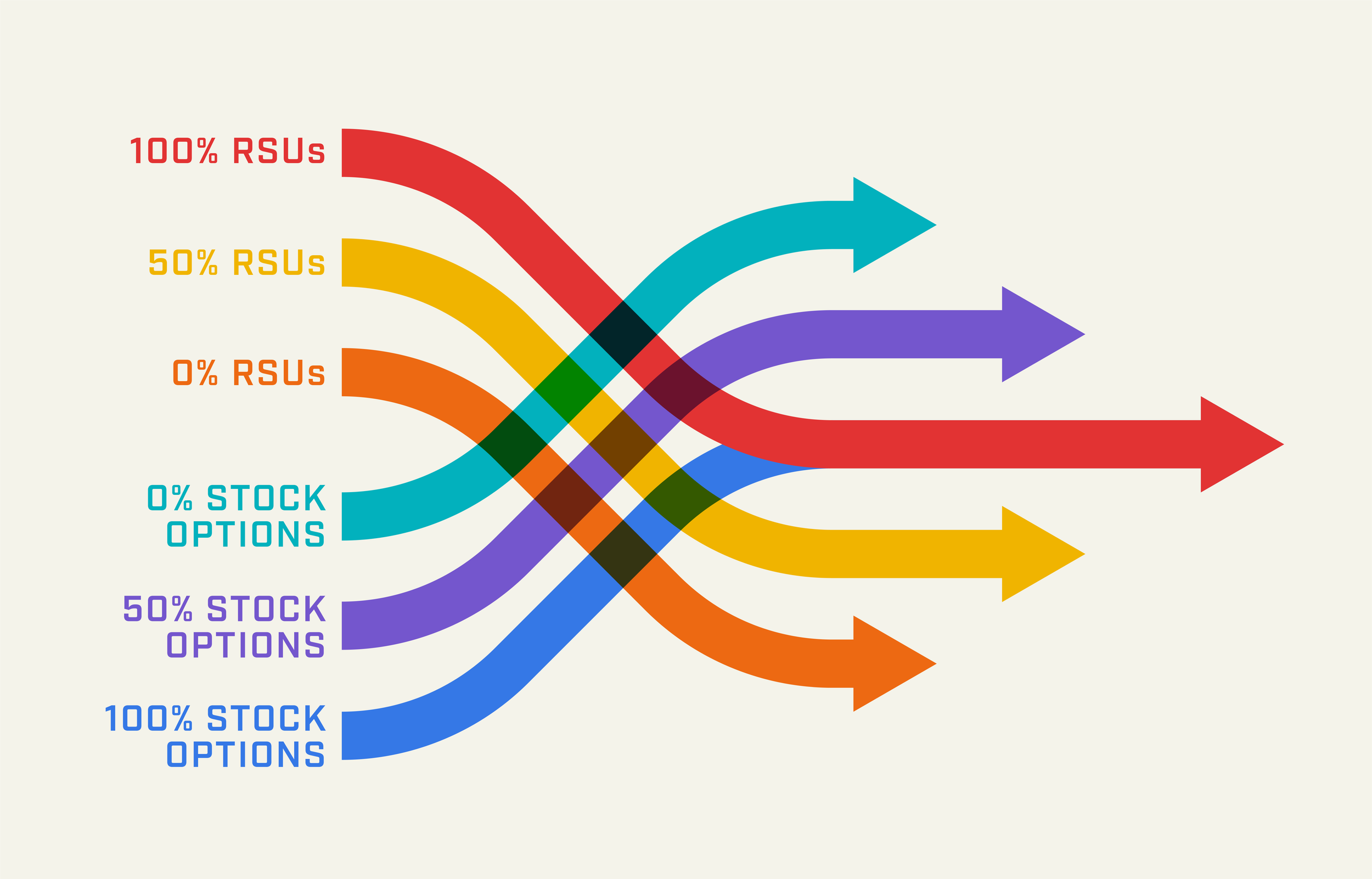
It’s that time of year again where Nike leaders will need to make their annual Nike Stock Choice and select between 100% Stock Options, 100% RSUs or 50/50. 

When comparing Nike Stock Options and Nike RSUs, RSUs are the safer optionRSUs offer a more secure value and a more moderate level of upside and downside.  Stock Options are more volatile but can also provide significantly more upside over time.

At first glance the decision can feel simple since there are only 3 roads to take, and when in doubt picking the middle road of 50/50 is the easy compromise.  While this can be the right selection for many individuals, it is not always the optimal choice.   While working alongside Nike leaders over many years, we have found that there are 11 crucial questions to answer and consider so that you arrive at that optimal selection for you.

Timing questions: Is it a sprint or a marathon?

Understanding your timeline is one of the most important factors in your choice.  Stock Options do not have any value until the stock price increases, but they do grow at a faster pace than RSUs.  So given enough time, Stock Options can surpass RSUs in value.  This is why timing considerations can be crucial to your decision and you should consider questions like:    

1. What is the purpose of Nike stock for you and your family? 

Does it contribute to longer-term goals like retirement, building wealth, and creating a legacy? Stock Options are more appropriate here. Or is it for shorter-term needs like a second home, more vacations, or education for your kids?  RSUs typically make more sense for these scenarios.

2. How much longer do you think you will work at Nike?

To the best of your ability, you should consider how long you think you will remain at Nike.  Your timeline could be short if you are seriously considering offers from recruiters or think your position could be eliminatedIn those types of considerations, RSUs could make more sense.  Conversely, if you plan to stay at Nike long-term and feel like your position is secure, you have a better chance to participate in the long-term growth of Nike stock.  In this case, Stock Options may be a better fit.   

3. How often do you typically sell Nike Stock to fund purchasing needs?

If you frequently sell your Nike stock grants to fund lifestyle needs, you likely need a more consistent funding source like RSUs since there is not adequate time for the stock to grow and realize the value.  

Behavioral questions: It goes beyond the numbers

As human beings, behavioral and emotional factors often affect our financial decisions.  These types of questions include:

4. What did you select last year, and do you feel like that was a good decision? 

Do you have buyer’s remorse, or do you feel good about that decision regardless of which selection is better at this point-in-time?  It is important to remember that the Stock Choice selection is a long-term decision that should not be overly influenced by recent, short-term results.

5. How much regret would you have if your peers made a more financially successful choice? 

If your peers are all celebrating the success of their selection and yours is different, how much would this affect you?  Everyone has a different level of response in these situations and setting yourself up well to be at peace with your decisions is important to your well-being.

6. How do you currently feel about the long-term growth potential of Nike stock?

Your long-term feelings toward Nike stock potential should be considered since it will better match your expectations and satisfaction regardless of what actually happens with stock performance.    

Risk questions: How much turbulence are you okay with?

7. If stock price dropped by 20%, how would you feel?

It is normal for any stock, including Nike, to experience ups and downs and a 20% drop at some point should be expected.  During these moments, would you be concerned to the point of wanting to sell immediately, not concerned at all, or a little concerned?  If this type of drop would be too difficult to stomach, you may want to lean towards RSUs.  If it is not a concern at all, you may be well-suited for Stock Options.

8. How do you feel about your total exposure to Nike stock?

Does having the bulk of your financial assets tied up in Nike already cause you concern and anxiety, or are you hoping to build up more Nike holdings?  If you are already concerned about your exposure, you will likely be diversifying out of Nike stock.  In this case, it could make more sense to lean towards RSUs.

Quantitative questions: The numbers do matter

9. How is the price of Nike stock valued currently based on its earnings and other factors? 

Is it overvalued or undervalued?  You may want to examine the metrics to see how it currently stacks compared to its historical valuation.  If it is undervalued that could make you lean more towards Stock Options, or if it is overvalued it could make sense to lean more RSUs.

10. What is this year’s Stock Option Ratio?

Each year there is a calculation of how many Stock Options you will receive if you make that choice.  It is a ratio based on the value of the RSU choice.  For the first 4 years, it was a 5:1 ratio (5 stock options for 1 RSU).  Starting in 2022, it shifted to a 4:1 ratio.  We cannot say for sure the reason for this shift, but it would be reasonable to assume it was affected by interest rate changes and stock market volatility as those factors can change the valuation of a stock option.

The 4:1 ratio for Stock Options means that you would receive less Stocks Options and Nike stock price would require additional growth to become more valuable than RSUs.  A lower ratio could mean that you need more time for Stock Options to grow to have a chance to exceed the value of RSUs. 

The overriding ‘special’ question

11. Do you qualify for the Stock Option Special Retirement Vesting?

If you are age 55+ and have worked for Nike for at least 5 years, you qualify for the Special Retirement Vesting of any Stock Options. This is the most important factor in the entire equation to consider. 

When you terminate from employment at Nike, you will lose any unvested RSUs and Stock Options.  Additionally, any unvested Stock Options must be exercised within 90 days unless you qualify for the Special Retirement Vesting.  This Special vesting will allow you to keep your unvested Stock Options (held for at least one year).  These will continue to vest over the next 4 years or vest immediately if you are Age 60+.  You will also have more time to exercise your Stock Options instead of being forced to do so within 90 days after termination.    

Since this special vesting is so valuable, anyone that qualifies or will be qualifying for this vesting soon, should strongly consider Stock Options as part of their decision. 

Do you want help putting it all together?

As you can gather from the 11 questions above, there are many different factors that should be considered.  Determining which ones are the most important can be challenging. 

Based on your answers to these questions, you may already feel confident and comfortable with one of the three options.

For those who are still unsure or want to obtain detailed information while deliberating, our team at Human Investing created our own, proprietary scoring tool.  The scoring tool takes the answers to these questions, assigns different weights depending on the importance of each question, and generates a unique score report.    

GET YOUR OWN COMPLEMENTARY SCORE

If you or anyone you know is interested in receiving their own Stock Choice score sign up below. 

Lastly, we believe it is important to consider how your Nike stock compensation fits within your overall financial situation.  The questions above and the scoring tool can be helpful, but this Stock Choice decision is best done in coordination with a personalized financial plan.

If you have questions or want to learn more about the Stock Choice, Stock Options or RSUs, please feel free to contact us at nike@humaninvesting.com


Related Articles

Consider your timeline for Nike stock


Since the recent Nike quarterly earnings report, the stock price dropped 20% in one day (June 28, 2024) and continues to hover around $72 - $75 per share. This has raised concern for employees as they rely on Nike stock to fund a significant portion of their investment strategy and lifestyle needs.

Below are 4 thoughts on the recent price drop and action items you can implement to move forward during this downtime.

Give yourself time to recover

 It’s easy to lose sight of this when the stock price is rising. The focus goes towards remaining invested for as long as possible so you don’t miss additional investment gains and forget that volatility can disrupt your strategy.

In our blog post from August 1, 2022, we analyzed the recovery period for Nike stock price when there is a 20% downturn. We can’t predict how long this recovery period will take, but history tells us that on average, it takes 339 days.

Action Items:

  • Stock options: The most common approach is to exercise and sell your Stock Options by converting it to cash before the expiration deadline. You may want to consider the less common option to exercise and hold the stock. This gives you an indefinite timeline to hold the stock and strategically wait until the right time to sell. For the exercise and hold strategy, you need to have cash to purchase the stock. For example, to exercise and hold 100 shares at $75 per share, you need $7,500 cash to purchase, so plan accordingly.

  • Strategically diversify: Diversify new ESPP and RSU purchases. Selling new shares at the time of purchase does a couple of things: (1) Avoids the risk of loss in value, (2) allows you to diversify into a balanced investment portfolio, and (3) gives time for your older Nike stock purchases to recover.   

Strategically raise funds when needed to minimize taxes

Rather than focusing on “how much cash do I need”, look at each of your Nike investment buckets and determine how you can get the cash you need in a tax-advantaged way.

Action Item:

  • Tax analysis: For RSUs and ESPP, look at each Lot to determine which holdings would sell at a capital gain and which would sell at a loss. Review critical factors such as (1) how much cash do I need, (2) how much investment will remain, (3) what is the net tax impact of what I’m selling, and (4) how long until I need to raise more funds.  

Re-evaluate your financial plan

When the stock price is down, it’s an opportunity to evaluate whether changes to your financial plan are required to stay on track with achieving your long-term goals.

Action Items:

  • Maximize benefits: Specifically ESPP stock while the price is low. At the next ESPP enrollment, consider increasing your deferral percentage to the maximum of 10%. 

  • Adjust investment strategy: Evaluate your overall concentration of Nike stock. If Nike stock is a large portion of your overall investment portfolio, consider ways you can maximize your savings going forward into a diversified portfolio to reduce your overall exposure.

  • Stock choice: Think about your upcoming Nike stock choice. If you’ve taken 100% RSUs in the past, does it make sense to change your strategy to 50/50 stock options or 100% stock options?

  • Prioritize your expenses: Determine which expenses are most important to you. Consider reducing or delaying expenditures that do not align with your highest priorities. This approach can feel difficult at first, but the more you buckle down during this season, the greater impact it will have on your financial plan.

Re-visit your college savings plan

Many Nike employees rely on their stock options to fund their kid’s college expenses. If this was your strategy, your options are underwater unless you have grants from 2014 (which expire soon) – 2017.

Action Items:

  • Evaluate other funding sources: Do you have other investment levers that can be used to fund college expenses?

  • Cash flow: How much cash flow do you have within your annual budget to fund college expenses? Will this be sufficient to cover part or all of the expected cost?  

  • Deferrals: If you reduce your retirement deferrals, will this increase your cash flow enough to fund annual college expenses?

  • Prepayments: If you are pre-paying any loans (ie: paying extra on your monthly mortgage), consider paying the minimum to free up cash flow for college expenses.   

  • Grants and scholarships: Are there opportunities to explore this further?

  • Adjusting expectations: Does this prompt a discussion with your kids around sharing the cost of college expenses?  

Consider your timeline. When Nike stock is increasing, it’s easy to lose sight of your timeline because the focus is not missing out on the appreciation. The recent volatility is a reminder that time is the most valuable asset when investing. The action items above are the starting point to navigate through the volatility. Please reach out to us so we can continue the discussion and help implement these strategies to remain on track with your long-term financial goals.


Related Articles