Posts tagged strategy2
When Everything Feels Risky, are U.S. Treasuries Still the Answer?


Every few years, a familiar worry resurfaces: Can we still trust U.S. Treasuries?

It’s a fair one. Fiscal deficits are rising. Government debt dominates the headlines. Political theatrics are hard to ignore. These concerns are understandable.

But this piece is not a dismissal of those worries. It aims to weigh them against the steady role Treasuries continue to play in global markets and in investors’ portfolios.

Because the key, as always, is to separate signal from noise. And noise is never in short supply.

U.S. Treasuries are often described as “risk-free.” Of course, no investment truly is, but no other assets have earned that reputation as convincingly. Their strength is structural: deep markets, global demand, and the dollar’s central role in international finance. These aren’t passing features. They’re foundational pillars of a system that continues to hold.

WE’VE BEEN HERE BEFORE

Concerns about the national debt are nothing new. In the mid-1980s, Congress passed the Gramm-Rudman-Hollings Act in response to growing fears of a looming fiscal cliff.¹

That was nearly 40 years ago.

Since then, warnings have echoed: interest rates would skyrocket, the dollar would collapse, foreign buyers would flee. But none of those predictions played out in a sustained way. Interest rates stayed low for decades. The dollar remained strong. Treasuries continued to anchor global portfolios.

THE OTHER SIDE OF THE LEDGER

Most debt conversations focus on the total amount owed, but it would be wise to consider both sides of the ledger. An equally important story is the government’s ability to repay what it owes.

The United States has a broad and resilient tax base, drawing revenue from some of the world’s most profitable corporations and wealthiest individuals. In 2024, over 94 percent of federal revenue came from income, payroll, and corporate taxes.²

That revenue base gives the government something that matters more than the size of its debt: flexibility. The capacity to raise more if needed. This is a critical ingredient in maintaining trust and stability in U.S. Treasuries.

That doesn’t make debt a non-issue. But it puts the conversation in better context.

THERE IS NO SUBSTITUTE

Some point to shifting foreign ownership of Treasuries as a sign of trouble. But the truth is, global capital needs a home that is safe, liquid, and capable of absorbing trillions in flows. There are few alternatives.

That’s why central banks, sovereign wealth funds, and even the U.S. tri-party repo market continue to rely on Treasuries. ³,⁴ It is not because of short-term politics. It is because no other asset plays the role as effectively or as consistently.

Foreign holdings may ebb and flow with trade dynamics or currency shifts. But the long-term, strategic demand? It’s still there.

HIGH DEBT DOES NOT GUARANTEE CRISIS

Japan offers an interesting counterpoint. With a debt-to-GDP ratio over 250%, more than double that of the United States.⁵,⁶ And yet, its financial system remains stable, and interest rates are close to zero.

This is not to suggest that debt is irrelevant, but it serves as a useful reminder that high debt levels, on their own, do not lead to crisis. The surrounding structure, including credibility, strong institutions, and consistent demand, matters just as much, if not more.

Could Treasuries someday lose their special status? In theory, yes. Anything is possible. But if that day ever comes, it will likely coincide with a much broader breakdown in global order. In that kind of environment, the safety of any asset would be in doubt.

That’s not a prediction. It’s simply an observation about the scale of disruption required to unseat the U.S. Treasury market.

A WARNING FROM ‘THE BOND KING’

Not everyone views Treasuries as the unshakable anchor they once were. Even some of the most seasoned investors are questioning the long-term role of U.S. Treasuries.

Jeffrey Gundlach, CEO of DoubleLine Capital and one of the most influential fixed income investors of the past two decades, has voiced serious concerns. In a June 2025 interview, he offered this warning:

“There is an awareness that the long-term Treasury bond is not a legitimate flight-to-quality asset.”⁷

He points to shifting dynamics: the dollar falling during selloffs, long bond yields rising after rate cuts, and growing concern over rising interest costs. As low-yield bonds mature, they are being replaced by debt with much higher yields. According to Gundlach:

“The interest expense for the United States is untenable if we continue running this budget deficit and continue to have sticky interest rates.”

Gundlach raises legitimate questions. But even he stops short of calling Treasuries broken. His concern is about strain, not collapse. The system is being tested, not undone.

While the pressures are real, rising interest rates and persistent deficits, they are not set in stone. Policy can change. Priorities can shift. The system still has tools it can use.

And this is where perspective matters.

Markets are noisy. Bad news sells. Loud warnings travel further than quiet resilience. But alarm does not erase the quiet strength of systems that continue to function.

Even Gundlach points to stress, not failure.

Which brings us back to what still works.

STILL DOING THEIR JOB

Treasuries aren’t immune to worry, however they continue to serve their purpose. They provide liquidity, offer stability, and act as a counterbalance in times of uncertainty.

We’re seeing that play out again in real time. Renewed tensions with Iran have reminded investors what uncertainty feels like. Once more, yields have dropped and the dollar has strengthened. These are clear signs of a flight to safety.

Even amid rising deficits and political noise, Treasuries continue doing what they’ve always done: deliver reliability in a world that often falls short.

References:

  1. U.S. Congress. Balanced Budget and Emergency Deficit Control Act of 1985 (Gramm-Rudman-Hollings Act). Public Law 99–177, 99th Congress, December 12, 1985.

  2. U.S. Department of the Treasury. “Government Revenue.” Fiscal Data – America’s Finance Guide.Accessed June 20, 2025.

  3. Board of Governors of the Federal Reserve System (U.S.). “Rest of the World; Treasury Securities Held by Foreign Official Institutions; Asset, Level [BOGZ1FL263061130Q].” FRED, Federal Reserve Bank of St. Louis. Accessed June 20, 2025.

  4. Federal Reserve Bank of New York. “Tri-Party Repo Data Visualization.” Federal Reserve Bank of New York. Accessed June 20, 2025.

  5. U.S. Department of the Treasury. “National Debt and Debt-to-GDP Ratio.” Fiscal Data – America’s Finance Guide. Accessed June 20, 2025.

  6. World Economics. “Debt-to-GDP Ratio: Japan.” World Economics. Accessed June 20, 2025.

  7. Jeffrey Gundlach, interview with Bloomberg, “Gundlach on Treasuries, Gold, Fed, AI, Private Credit, Trump,” June 11, 2025.



Disclosure: Advisory services offered through Human Investing, an SEC registered investment adviser. This material is for informational and educational purposes only and is not intended as investment advice, an offer, or a solicitation to buy or sell any securities. Past performance is not indicative of future results. All investments involve risk, including the potential loss of principal. Any third-party opinions or sources cited are believed to be reliable but are not guaranteed for accuracy or completeness. Please consult your financial professional before making any investment decisions.


 

Related Articles

Should I Invest in US Treasuries or CDs From My Bank or Credit Union? What are the differences?


Two ways to approach low-risk investments

When considering safe investment options, two popular choices that often come to mind are FDIC-insured CDs (Certificates of Deposit) and US Treasuries. While both offer relatively low-risk investment opportunities, there are some critical differences between the two that investors should be aware of.

FDIC-insured CDs are certificates issued by banks and credit unions that offer a guaranteed rate of return for a specified period. The Federal Deposit Insurance Corporation (FDIC) insures CDs up to $250,000 per depositor per bank, protecting against bank failure. In contrast, US Treasuries are debt securities issued by the US government to finance its operations. They are generally considered one of the safest investments available because the full faith and credit of the US government back them.

One key difference between the two is their liquidity. CDs have fixed terms ranging from a few months to several years, and if you need to withdraw funds before the maturity date, you may be subject to penalties. On the other hand, US Treasuries can be bought and sold in the secondary market and can be liquidated easily, making them a more flexible option.

Another difference is the level of risk. While both investments are considered safe, FDIC-insured CDs carry some risk due to the possibility of bank failure. While the FDIC provides insurance protection, there is always a small chance that a bank may fail, and investors may not receive their full investment amount. On the other hand, US Treasuries are backed by the US government and are considered virtually risk-free.

When it comes to returns, FDIC-insured CDs offer fixed interest rates that are lower than the returns available through US Treasuries. US Treasuries offer a range of maturities and yields determined by market demand, with longer-term securities offering higher yields.

In terms of taxes, both FDIC-insured CDs and US Treasuries are subject to federal income tax, but US Treasuries are exempt from state and local taxes. Additionally, you may be subject to capital gains tax if you sell US Treasuries for more than their purchase price.

Risks of Return on Investment: CDs

It's important to note that the FDIC receives no funding from taxpayers. Instead, it is funded by insurance premiums paid by banks and thrift institutions participating in the program. These premiums are based on the number of insured deposits each institution holds and the risk they pose to the insurance fund. In case of bank failure, the FDIC uses these funds to reimburse depositors for their insured deposits up to the $250,000 limit. This funding system helps ensure the banking system's stability and integrity while protecting depositors from loss.

While the FDIC insurance pool can become insolvent, it is highly unlikely. The FDIC has many safeguards to prevent insolvency, and its record of accomplishment in managing bank failures has been quite successful.

Firstly, as mentioned earlier, the FDIC collects insurance premiums from participating banks and thrift institutions. These premiums are based on the number of insured deposits each institution holds and the risk they pose to the insurance fund. The FDIC also has the authority to increase premiums to maintain the insurance fund's solvency.

Secondly, the FDIC has the ability to sell the assets and liabilities of a failed bank to another institution, thereby minimizing the cost of the failure of the insurance fund. This process, known as a purchase and assumption transaction, allows the acquiring institution to take over the failed bank’s deposits and assume its liabilities. At the same time, the FDIC pays out the insured deposits.

Finally, if the insurance fund were to become insolvent, the FDIC would have access to a line of credit with the US Treasury to cover any losses. The FDIC can also assess additional premiums on insured institutions to replenish the insurance fund.

It is worth noting that while the FDIC has never become insolvent since its creation in 1933, it has come close to doing so during times of economic stress, such as the savings and loan crisis in the 1980s. However, the FDIC's ability to manage these crises effectively and prevent widespread bank failures has helped to maintain public confidence in the banking system and the FDIC insurance program.

Risk of Return on Investment: Treasuries

If the United States were to become insolvent, it could have profound implications for US Treasuries, as the full faith and credit of the US government backs them. The creditworthiness of the US government is a key factor in determining the value of US Treasuries. Default or insolvency could significantly decrease demand for US Treasuries, resulting in a sharp rise in interest rates.

In addition, if the US were to become insolvent, it could lead to a global financial crisis, as domestic and foreign investors widely hold US Treasuries. A default could lead to a loss of confidence in the US government's ability to manage its finances, which could cause investors to sell off their US Treasury holdings, leading to a domino effect throughout the financial system.

However, it is important to note that the likelihood of the US becoming insolvent is extremely low because the US dollar is the world's reserve currency, and the US government can print its currency. This gives the government greater flexibility to manage its debt than other countries.

Furthermore, the US has a long history of managing its debt and has never defaulted on its sovereign debt. Even during times of economic stress, such as the Great Recession of 2008, the US government has been able to maintain its creditworthiness and continue to issue debt.

Overall, while there are risks associated with US Treasuries in the event of a US government insolvency, the likelihood of this scenario occurring is considered low. US Treasuries are still widely regarded as one of the safest investments in the world.

Implications of Printing Currency: A Double-edged Sword

The implications of the US printing more currency are complex and depend on a range of factors, including the current state of the economy, inflation rates, and global economic conditions.

On the one hand, increasing the money supply can help stimulate economic growth by making more money available for borrowing and spending. This can lead to increased investment and consumption, driving economic activity and creating jobs.

However, printing too much money can also lead to inflation, as the increased money supply can cause prices to rise. Inflation can erode the currency’s purchasing power and decrease consumer confidence and economic stability.

Furthermore, printing more currency can also lead to a depreciation of the currency's value relative to other currencies. This can negatively affect international trade, as a weaker currency can make imports more expensive and exports cheaper, potentially leading to a trade deficit.

Overall, the decision to print more currency should be carefully considered, considering a range of economic factors. While increasing the money supply can help stimulate economic growth, it is essential to strike a balance between promoting growth and maintaining economic stability and confidence in the currency.

What’s Your Timetable?

In conclusion, both FDIC-insured CDs and US Treasuries offer low-risk investment opportunities, but there are some key differences between the two that investors should consider. While CDs offer fixed returns and are insured by the FDIC, they are less liquid and carry some risk due to the possibility of bank failure. US Treasuries, on the other hand, offer higher returns, are virtually risk-free, and are more liquid. Ultimately, the choice between the two will depend on an investor's financial goals, risk tolerance, and investment horizon.

Authors Note: This article was written using prompts in ChatGPT. (2023, May 8). The author has independently verified the accuracy of the responses. The author edited and formatted responses from the prompts for clarity.


Related Articles

Why Dollar-Cost Averaging is a Great Investment Strategy
 

A recent theme in our client conversations has been around the timing of investing. On a regular basis we hear the question, “when is the right time to invest?” especially when times are uncertain. It’s a great question, one that is worth considering, but before answering this question let me state: We at Human Investing are long-term investors. Don’t mistake that for “buy and hold,” but rather “buy and assess.” Additionally, we believe financial planning is the key to investment success. While planning does not guarantee success, it does improve the odds of a successful outcome. In our advisory practice, the financial plan informs the investment decision.

Once the plan is in place and we’ve made the decision to invest, the timing of investing may not always mean we push a button to invest one hundred percent of someone’s capital in that moment. What it does mean is that we have a thoughtful discussion on the different strategies we might utilize to put the money to work, choosing the right option based on the client’s plan and their input.

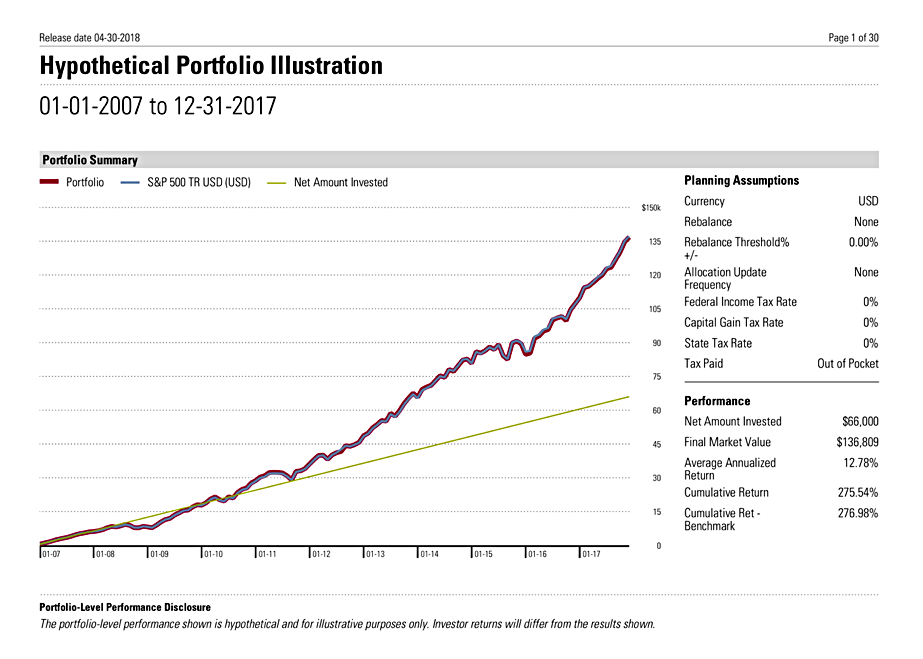
Let’s walk through an example. The chart below is a hypothetical client who invests $500 per month ($6k/year) over an eleven year period starting January 2007 and ending December 2017. For this exercise we simulated investing the $500/month into a simple total stock market index exchange-traded fund with the symbol ITOT. The total invested capital in 2007 was $66,000 with net proceeds of $136,809 on the last day of 2017. Pretty incredible results considering the eleven year time frame included small gain and loss years of 2007, 2011, and 2015 and a large loss of 39.42% in 2008.

Picture1.png

This is a great example of a strategy called dollar-cost averaging. Dollar-cost averaging is an investment strategy with the goal of reducing the impact of volatility on large purchases by adding small amounts of the intended purchase into the market over a specified period of time. Technically speaking, taking a lump sum and immediately investing the funds for an extended period of time is the best option. The challenge with the lump sum method is that many investors struggle to invest 100% of their money right away due to factors like willpower and emotion. With the dollar-cost averaging approach the investor puts his money to work bit-by-bit, which for many, feels good emotionally and prevents money ear-marked for investing from staying in cash too long. For these reasons and others, the methodical dollar-cost averaging approach has become the most successful way to invest capital for the long-run.

My intent is not to vilify a cash investment as bad. For many investors cash has a place and a purpose within their overall portfolio. I’m looking to highlight an effective approach/strategy for when a client’s financial plan requires a greater return than 1%.  

If you’ve asked the question, “What is this money for?” and the timeline is long-term, consider the total sum you are looking to invest, divide that sum into a reasonable time period and make a commitment to dollar-cost average those funds into the market. In doing so you won’t find that you’ve kept the funds in cash for any longer than is necessary, and you will be well on your way to your stated long-term savings and investment goal.


Related Articles