Posts tagged nikepop
Should I sell my Nike stock now or wait?


Earnings season is coming

Nike’s stock price has been struggling, for several years now. You have to go back to the early 2000s to find a time when it took Nike longer to hit a new all time high. With that, many Nike employees are wondering what to do with their stock. Whether it is to diversify into another investment or to fund expenses like vacation, remodels, or tuition for their kids, the current price has made those decisions more difficult. A common question we hear is “Should I sell my NKE now or wait?”

NKE has recently experienced declines. From Jan 2025 to Apr 2026, NKE fell -41.60% while the S&P 500 has risen 22.57%. Nike had a great run of outperforming the S&P 500 for 10 out of 12 years prior to 2021 but has been on a losing streak since.

Is Nike poised to make a comeback? Predicting the future of any stock, or the market overall, is a difficult task. Nike is the industry leader in athletic apparel, particularly in footwear. If Nike can maintain their brand and industry leadership, they are poised to be successful. Achieving outperformance relative to the S&P 500 is not guaranteed.

Let’s look at a few different ways to approach valuing a stock to get a sense of if NKE appears over or undervalued.

🍰 Price / Earnings (P/E) ratio - how much are you paying for each dollar of earnings:

  • Pros: Earnings are the profits of the company, and those profits are ultimately what is available for shareholders as dividends

  • Cons: Easily manipulated or adjusted by many line items on the income statement, can vary greatly year to year

  • Current P/E: 29.04

  • 3 year median P/E: 29.78

  • Implied Valuation based on $2.16 Earnings Per Share = $64.42

  • Verdict: Based on this metric, NKE appears below its historical median valuation.

💰 Price / Sales (P/S) ratio – how much are you paying for each dollar of revenue:

  • Pros: Less subject to manipulation or fluctuation

  • Cons: Doesn’t consider efficiency (i.e. costs necessary to generate the revenues)

  • Current P/S: 1.40

  • 3 year median P/S: 2.40

  • Implied Value based on $31.45 revenue per share = $75.51

  • Verdict: Based on this metric, NKE appears below its historical median valuation.

🔄 Price / Free Cash Flow (P/FCF) ratio - How much are you paying for each dollar of operating cash:

  • Pros: Shows cash actually available to investors for dividends or stock buybacks, ignores non-cash expenses (i.e. depreciation)

  • Cons: Still subject to manipulation based on accounting practices, can vary greatly year to year

  • Currentl P/FCF: 62.34

  • 3 year median P/FCF: 28.52

  • Implied value based on $2.20 free cash flow per share = $62.66

  • Verdict: Based on this metric, NKE appears below its historical median valuation.

🥣 Average of all ratios:

  • Take the average of the implied values for P/E, P/S, and P/FCF

  • Implied Value = $67.53

  • Verdict: Based on this metric, NKE appears below its historical median valuation.

🚀 Price / Earnings Growth (PEG) ratio = P/E ratio / Earning Growth – measure P/E in context of company’s growth rate

  • PEG < 1 implies undervalued, PEG > 1 implies overvalued.

  • Currently: 29.04 / -30.88 = -0.94

  • Decrease in EPS results in negative value, and less than 1 means the earnings are shrinking faster than the P/E ratio; bad all around

  • Forward 1 year: 2.53

  • Verdict: NKE is poised to be successful.

Based on historical averages, NKE currently appears undervalued

That is typical for a stock that has been declining in earnings and price over time.You can also take different time periods for the median of these valuations, to see what Nike’s valuation has been like over a longer period of time.
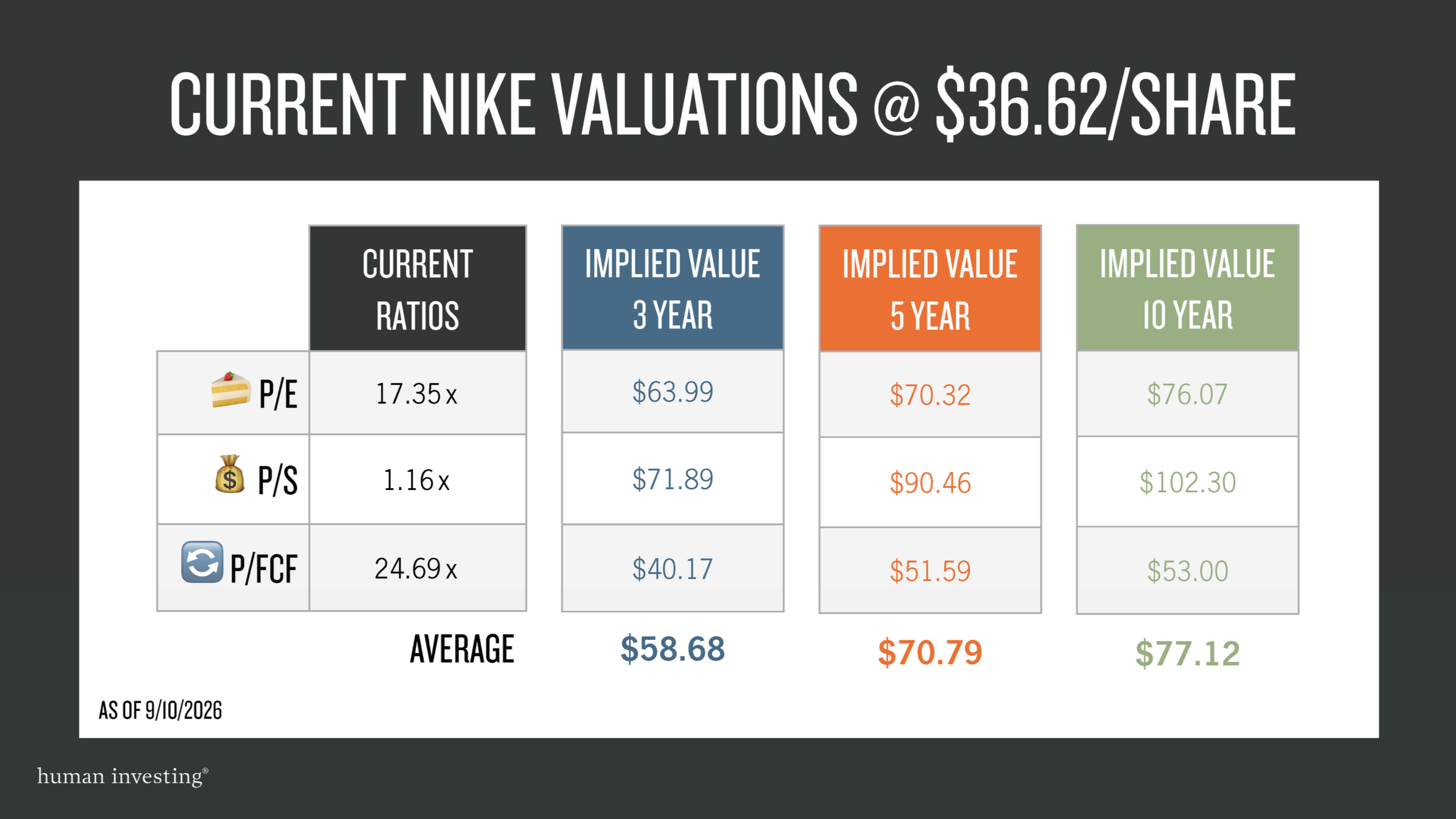
Note: All data courtesy of YCharts as of:  5/7/2026

While Nike may appear undervalued on a 3-year basis, the difference is greater over 5-year and 10-year medians. If you’re thinking about selling, these valuations may give you some guideline thresholds to re-evaluate at.

Based on historical averages for NKE, the stock currently appears undervalued. The decline in NKE’s price in recent years is a big reason for that. Whether the decline will continue, or NKE will return to its historical valuation norms nobody knows. Looking at the basic fundamentals, NKE has some clear struggles. 2025 fiscal year saw declines from 2024, which is unusual and not a healthy sign. On the other end, the basics of continuing on as a business seem strong for NKE:  

  • NKE has consistently sold its products above the cost of those goods.

  • NKE can cover both its current and longer-term debt needs based on existing cash and future expected earnings.

  • NKE has not missed a dividend in the past 10 years.

These metrics are by no means the only way to approach whether now is a good time to sell your NKE stock. Other factors to consider:

  • The amount of time you think you will work at Nike.

  • How much of your Net Worth is tied to NKE?

  • When do your Stock Options expire (if applicable)?

  • Your comfort level with the ups and downs over time.

  • Do you have any major expenses coming up? i.e. house purchase, funding college, etc.

We’re here to help

Beyond these factors and metrics, it is important to integrate your Nike stock decisions within the context of a comprehensive financial plan. If you have questions or would like to discuss whether to hold or sell your NKE stock, please reach out to us at nike@humaninvesting.com.



Disclosure: This material is for informational and educational purposes only and should not be considered personalized tax, legal, or investment advice. You should consult your own qualified tax, legal, and financial professionals before making any decisions based on this information. Tax laws and regulations, including those related to bonuses and supplemental income, are subject to change and may vary depending on individual circumstances. The examples provided are hypothetical and intended to illustrate general tax concepts; they should not be relied upon to determine your actual tax liability. Investing and financial planning involve risk, including the possible loss of principal. Past performance does not guarantee future results. Advisory services are offered through Human Investing, LLC, an SEC-registered investment adviser.

 

Related Articles

Nike Layoff Survival Guide: Essential Considerations for Financial Wellbeing


It’s no secret that Nike has been going through a tough time with the recent rounds of layoffs. This can create concern and uneasiness around a Nike employee’s livelihood and how it may affect their financial picture. As we have been actively guiding our Nike clients through this season, we wanted to share things to consider if you were or will be impacted by these layoffs.

Understand Your Severance Package

Nike has a standard severance agreement and package that includes a one-time payout of cash based on your level and tenure at Nike. This can range from 4 weeks to 48 weeks of salary.

In addition, there is often a continuation of health insurance through COBRA that includes a subsidy of the cost for around 6 months. This provides some time to transition to a different health insurance plan if that is right for you.

If you have any accrued PTO that you haven’t used, this will be paid out to you in cash after officially leaving Nike. This is often extra cash that people are not expecting and can help create some comfort during an uncomfortable time.

Lastly, you may still be eligible for the PSP bonus paid out in August as long as you are still employed anytime in May (the last month of the Fiscal Year).

Create a Strategy for Deferred Comp Distributions

If you contributed to the Nike Deferred Compensation Plan, leaving Nike will typically trigger distributions according to the schedule you designated when enrolling. This can range from a one-time lump sum or installments over 5, 10, or 15 years. For some, this can be a way to supplement income. However, for others who don’t need the funds, these distributions can create a tax issue to strategize around. These payments are sent out quarterly, so if this is needed for cash flow you should plan accordingly.

Plan for your Stock Options and RSUs

Any vested but unexercised stock options typically need to be exercised within 90 days of leaving Nike, unless you qualify for the special retirement benefits at age 55 or age 60 (you keep unvested options and can sell for lesser of expiration or 4 years). At this time, you typically will lose any unvested options or RSUs.

During larger layoffs, there can be enhanced vesting of options and RSUs, where upcoming vests within a year will accelerate and vest. In addition, Nike can also provide you with more time to exercise your stock options like up to 1 year instead of 90 days. When Nike stock price is struggling like it is now, it makes your exercise decisions in a small window difficult. We would recommend working with your financial advisor to determine a defined strategy to maximize the benefit and minimize taxes.

Keep track of your PSUs and ESPP

Normally, you need to be employed at Nike at the vest date to receive your PSUs. In a situation of Reduction in workforce (larger layoffs), you can still receive any PSUs if the vesting date is within one year of termination.

Any ESPP that has been contributed but not purchased yet will be refunded to you. In addition, you have more control over your ESPP shares that you have purchased previously as these can be held as long as you want. This provides an opportunity to be patient and strategic on any sale of this stock.

Prepare to mitigate tax liability

All the benefits outlined above come with tax implications that are not always easy to see. These items can quickly add up to large amounts of taxable income, which can push your income into high tax brackets. In addition, the tax is often under-withheld (22% Federal and 8% State), which can lead to a significant tax bill in April if not accounted for properly.

Know your 401K options

This recommendation depends on each person’s situation. Nike has a strong investment fund lineup, and you should compare that to any other place that would replace it. However, leaving your 401(k) at Nike requires more activity and maintenance since it does not have an auto-rebalancing feature, which would periodically sell funds that drift from their target allocation. For example, if the large company stock fund was targeted at 60% and grew to 64%, you should periodically bring that back to the 60% target to maintain the proper risk/return mix. Another factor to consider is the desire to make Backdoor Roth IRA contributions if you have extra funds for retirement savings.

Support when transitioning into the next job

The cash you receive from benefits like severance, PTO payout, and stock sales can help provide some comfort to your situation. While you are in transition with your job, we recommend creating a system to feel like you are receiving a paycheck replacement with your cash to reduce anxiety and bring normalcy to your day-to-day financial life. An example of this system would be taking your net benefits payout and depositing it in a savings account, then setting up bi-weekly transfers to your checking account to simulate your paychecks.

All these considerations are tied to a person’s long-term financial plan. Through financial planning projections and scenario planning, you can help determine what the next job needs to look like to achieve your goals for retirement, kids’ education, and lifestyle. It can provide you with the information to know if you need a comparable compensation package to Nike or if you could take a job with lesser pay that could be more fun or less stressful.

Being laid off from any job often creates much uncertainty, stress, and concern. With the right preparation, planning, and advice, it can be a smoother transition, and you may end up in an even better place than where you started.

If you have questions about preparing for or navigating a current layoff at Nike, please feel free to contact us at nike@humaninvesting.com or schedule time with us below.  


Related Articles

The Nike Guide to Building Sustainable Wealth


Elite performance isn’t about doing everything at once; it’s about prioritizing the right moves at the right time. Your finances deserve that same level of intentionality. You probably have many competing goals and need to find the best way to prioritize spending, debt pay down, and saving for the future, among other things.

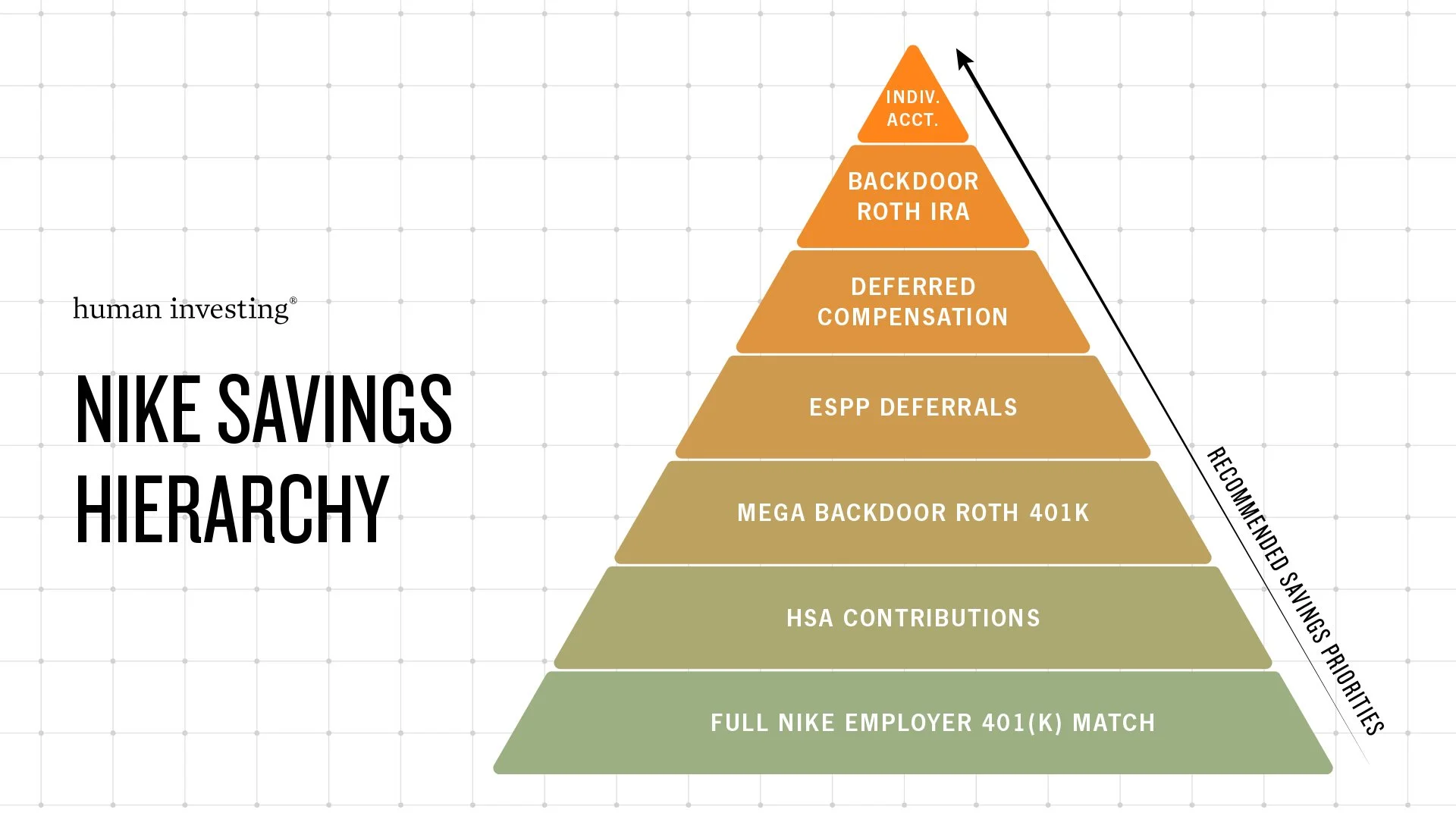
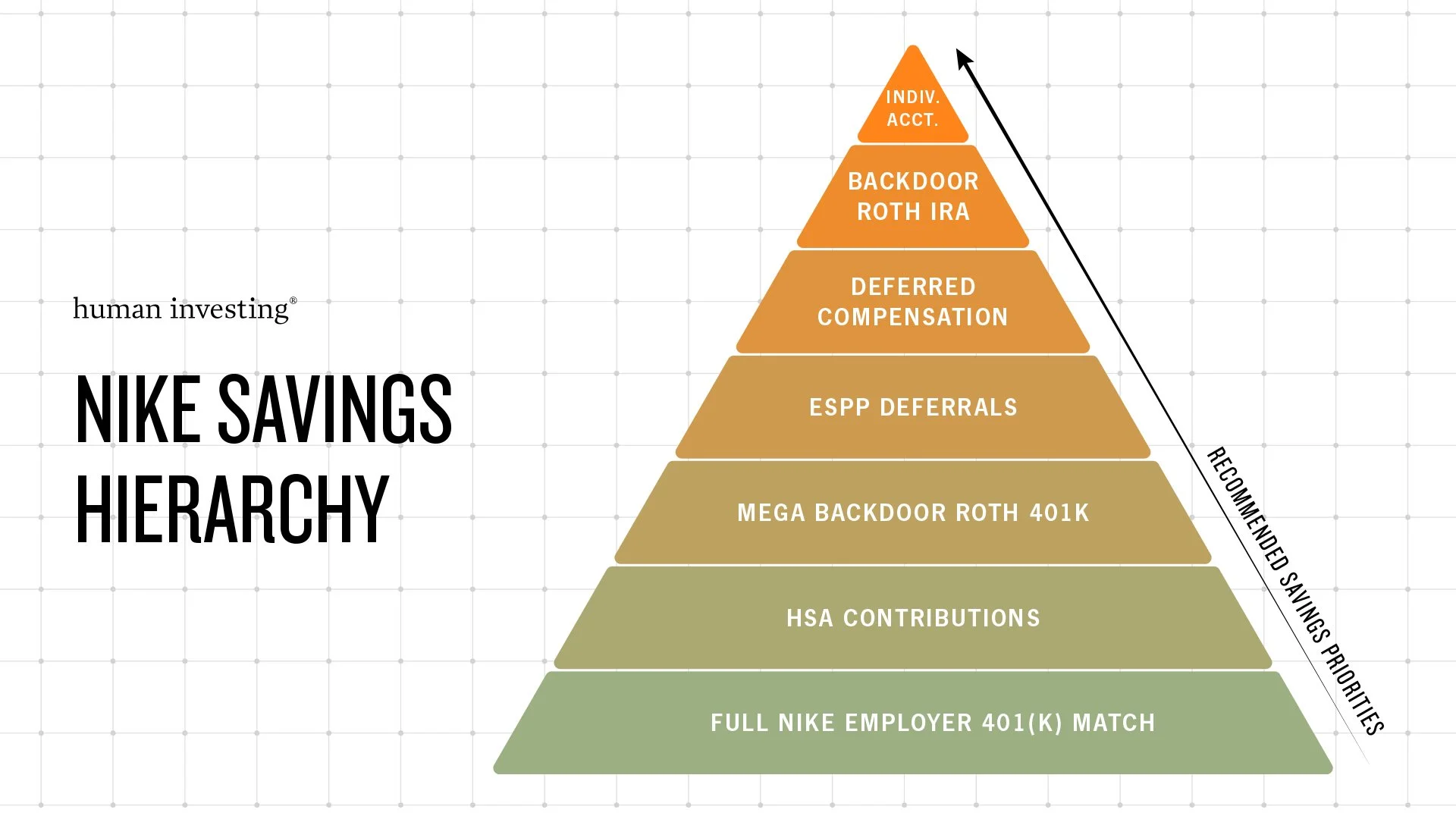
Selecting the optimal avenue for your dollars can be challenging when you have access to Nike’s unique savings avenues. It is important to fill the most beneficial buckets first. The order we have detailed below is not a “one size fits all” approach. Building your financial plan around your goals and unique circumstances will help determine the savings opportunities that will be the most impactful for you.

1. Contribute enough to get your Nike employer match on your 401k

Deferring 5% of your income to your Nike 401k is a strategic way to maximize free dollars. This helps grow your retirement savings and amplifies the long-term benefits of your investment. Additionally, you have the option to save pre-tax dollars or Roth dollars, allowing you to choose when you pay tax on your contributions. Whether to contribute via Roth or pre-tax is best determined by your unique financial plan.

2. Enroll and maximize your HSA contributions

One benefit of participating in Nike’s healthcare coverage is the opportunity to utilize the Health Savings Account (HSA). Those covered by the high-deductible healthcare plan (HDHP) can take advantage of tax-deductible contributions along with tax free earnings and withdrawals when used for qualified medical expenses.

Being covered under the high-deductible health care plan (HDHP) is not for everyone. It depends on your health needs and financial flexibility. Each person is unique and should consult a professional for their specific circumstances. 

3. Save extra into your 401k via Mega Backdoor Roth contributions

If you have filled all the prior buckets and still have additional cash flow, consider putting extra money into your 401k through Mega Backdoor Roth contributions. This savings vehicle allows you to go above and beyond traditional 401k contribution limits. You pay taxes on these dollars now and withdraw them tax-free in retirement. Contributions can be made up to 3% of your compensation, limited to a maximum of $360,000 of eligible compensation. This is a great savings opportunity to contribute extra funds, up to $10,800 on top of the standard $24,500 standard deferral limit, to your Nike 401k account.

4. Maximize ESPP Deferrals

Saving into the ESPP bucket is a way to purchase Nike shares at a 15% discount. You can contribute up to $21,250 through salary deferrals. If you have a steady cash flow, saving into your ESPP can feel like instant growth on Nike stock if you sell the shares right after they’re purchased. This strategy to immediately sell allows you to capture the discount and supplement cash flow when the shares are purchased every six months. There are no taxes until the shares are sold, but the taxes on the discount and any gains can be complicated and should be reviewed by a tax or financial professional. 

5. Utilize Deferred Compensation savings

If you are eligible for Nike’s deferred compensation plan, utilizing this plan can help reduce your current taxable income while setting aside and investing funds for your retirement. Contributing to the Deferred Compensation plan defers Federal and state taxes and can help keep your taxable income below thresholds for local taxes. This plan requires precision to set up and maintain and will help optimize your retirement savings in your financial plan.

6. Execute a Backdoor Roth IRA Contribution

In 2026, you can contribute up to $7,500 to a traditional IRA, with an additional $1,100 catch-up contribution available for those over age 50. Making a tax-deductible contribution is subject to income phaseouts. If you don’t have an existing IRA balance, you could make a backdoor Roth IRA contribution even if your income is above these phaseout levels or above the income phaseouts for Roth IRA contributions. This is done by contributing after-tax dollars to a traditional IRA and converting those funds into a Roth IRA.

7. Open a taxable brokerage account

If you still have cash flow to save after filling all the previous buckets, using a taxable brokerage account to make additional investments can help fund your future financial goals. Saving into a taxable brokerage account can be especially helpful if funds will be used soon, such as if you are considering a new home purchase or paying for college. These accounts allow you to withdraw funds at tax-advantaged capital gains rates at any time. In particular, the flexibility of this account can be advantageous for those considering retiring early since there is no penalty for withdrawing funds before age 59½.

Want to see this in action?

Building a strong roadmap to reach your goals includes thoughtfully utilizing Nike’s employee benefits and prioritizing ways to save through ways that are the most beneficial for your unique needs. The various options you have available at Nike each have their own unique contribution limits, tax advantages, and benefits. Having a coordinated strategy allows you to create a game plan that suits your unique needs and supports your needs for today and ambitions for tomorrow.

The most effective savings hierarchy is one that is thoughtfully aligned with your broader financial picture. A comprehensive financial plan can help bring clarity to competing priorities and ensure your savings decisions are aligned with your short-term needs and long-term goals. Working with a financial advisor can help you sift through these buckets and determine the best way to optimize each dollar saved to secure a successful financial future.


Disclosure: This content is for informational and educational purposes only and is not intended as investment, legal, or tax advice. The strategies and steps outlined—such as building an emergency fund, contributing to employer-sponsored plans, paying down debt, or using HSAs, IRAs, and taxable accounts—are general in nature and may not be appropriate for every individual. You should consult a qualified financial or tax professional before making decisions based on your personal circumstances. There is no guarantee that following any financial strategy will achieve your goals or protect against loss. References to interest rates, contribution limits, or tax rules reflect information available at the time of publication and may change. Past performance is not indicative of future results. Advisory services are offered through Human Investing, an SEC-registered investment adviser.


Related Articles

Nike Stock Choice: The 11 Questions to Answer Before Making Your Decision


The window is open from August 5-27, 2024

It’s that time of year again where Nike leaders will need to make their annual Nike Stock Choice and select between 100% Stock Options, 100% RSUs or 50/50. 

When comparing Nike Stock Options and Nike RSUs, RSUs are the safer optionRSUs offer a more secure value and a more moderate level of upside and downside.  Stock Options are more volatile but can also provide significantly more upside over time.

At first glance the decision can feel simple since there are only 3 roads to take, and when in doubt picking the middle road of 50/50 is the easy compromise.  While this can be the right selection for many individuals, it is not always the optimal choice.   While working alongside Nike leaders over many years, we have found that there are 11 crucial questions to answer and consider so that you arrive at that optimal selection for you.

Timing questions: Is it a sprint or a marathon?

Understanding your timeline is one of the most important factors in your choice.  Stock Options do not have any value until the stock price increases, but they do grow at a faster pace than RSUs.  So given enough time, Stock Options can surpass RSUs in value.  This is why timing considerations can be crucial to your decision and you should consider questions like:    

1. What is the purpose of Nike stock for you and your family? 

Does it contribute to longer-term goals like retirement, building wealth, and creating a legacy? Stock Options are more appropriate here. Or is it for shorter-term needs like a second home, more vacations, or education for your kids?  RSUs typically make more sense for these scenarios.

2. How much longer do you think you will work at Nike?

To the best of your ability, you should consider how long you think you will remain at Nike.  Your timeline could be short if you are seriously considering offers from recruiters or think your position could be eliminatedIn those types of considerations, RSUs could make more sense.  Conversely, if you plan to stay at Nike long-term and feel like your position is secure, you have a better chance to participate in the long-term growth of Nike stock.  In this case, Stock Options may be a better fit.   

3. How often do you typically sell Nike Stock to fund purchasing needs?

If you frequently sell your Nike stock grants to fund lifestyle needs, you likely need a more consistent funding source like RSUs since there is not adequate time for the stock to grow and realize the value.  

Behavioral questions: It goes beyond the numbers

As human beings, behavioral and emotional factors often affect our financial decisions.  These types of questions include:

4. What did you select last year, and do you feel like that was a good decision? 

Do you have buyer’s remorse, or do you feel good about that decision regardless of which selection is better at this point-in-time?  It is important to remember that the Stock Choice selection is a long-term decision that should not be overly influenced by recent, short-term results.

5. How much regret would you have if your peers made a more financially successful choice? 

If your peers are all celebrating the success of their selection and yours is different, how much would this affect you?  Everyone has a different level of response in these situations and setting yourself up well to be at peace with your decisions is important to your well-being.

6. How do you currently feel about the long-term growth potential of Nike stock?

Your long-term feelings toward Nike stock potential should be considered since it will better match your expectations and satisfaction regardless of what actually happens with stock performance.    

Risk questions: How much turbulence are you okay with?

7. If stock price dropped by 20%, how would you feel?

It is normal for any stock, including Nike, to experience ups and downs and a 20% drop at some point should be expected.  During these moments, would you be concerned to the point of wanting to sell immediately, not concerned at all, or a little concerned?  If this type of drop would be too difficult to stomach, you may want to lean towards RSUs.  If it is not a concern at all, you may be well-suited for Stock Options.

8. How do you feel about your total exposure to Nike stock?

Does having the bulk of your financial assets tied up in Nike already cause you concern and anxiety, or are you hoping to build up more Nike holdings?  If you are already concerned about your exposure, you will likely be diversifying out of Nike stock.  In this case, it could make more sense to lean towards RSUs.

Quantitative questions: The numbers do matter

9. How is the price of Nike stock valued currently based on its earnings and other factors? 

Is it overvalued or undervalued?  You may want to examine the metrics to see how it currently stacks compared to its historical valuation.  If it is undervalued that could make you lean more towards Stock Options, or if it is overvalued it could make sense to lean more RSUs.

10. What is this year’s Stock Option Ratio?

Each year there is a calculation of how many Stock Options you will receive if you make that choice.  It is a ratio based on the value of the RSU choice.  For the first 4 years, it was a 5:1 ratio (5 stock options for 1 RSU).  Starting in 2022, it shifted to a 4:1 ratio.  We cannot say for sure the reason for this shift, but it would be reasonable to assume it was affected by interest rate changes and stock market volatility as those factors can change the valuation of a stock option.

The 4:1 ratio for Stock Options means that you would receive less Stocks Options and Nike stock price would require additional growth to become more valuable than RSUs.  A lower ratio could mean that you need more time for Stock Options to grow to have a chance to exceed the value of RSUs. 

The overriding ‘special’ question

11. Do you qualify for the Stock Option Special Retirement Vesting?

If you are age 55+ and have worked for Nike for at least 5 years, you qualify for the Special Retirement Vesting of any Stock Options. This is the most important factor in the entire equation to consider. 

When you terminate from employment at Nike, you will lose any unvested RSUs and Stock Options.  Additionally, any unvested Stock Options must be exercised within 90 days unless you qualify for the Special Retirement Vesting.  This Special vesting will allow you to keep your unvested Stock Options (held for at least one year).  These will continue to vest over the next 4 years or vest immediately if you are Age 60+.  You will also have more time to exercise your Stock Options instead of being forced to do so within 90 days after termination.    

Since this special vesting is so valuable, anyone that qualifies or will be qualifying for this vesting soon, should strongly consider Stock Options as part of their decision. 

Do you want help putting it all together?

As you can gather from the 11 questions above, there are many different factors that should be considered.  Determining which ones are the most important can be challenging. 

Based on your answers to these questions, you may already feel confident and comfortable with one of the three options.

For those who are still unsure or want to obtain detailed information while deliberating, our team at Human Investing created our own, proprietary scoring tool.  The scoring tool takes the answers to these questions, assigns different weights depending on the importance of each question, and generates a unique score report.    

GET YOUR OWN COMPLEMENTARY SCORE

If you or anyone you know is interested in receiving their own Stock Choice score sign up below. 

Lastly, we believe it is important to consider how your Nike stock compensation fits within your overall financial situation.  The questions above and the scoring tool can be helpful, but this Stock Choice decision is best done in coordination with a personalized financial plan.

If you have questions or want to learn more about the Stock Choice, Stock Options or RSUs, please feel free to contact us at nike@humaninvesting.com


Related Articles

The Ultimate Guide to Navigating and Lowering Taxes for Nike Execs and Leaders


A growing complexity

As a Nike leader, you are provided a comprehensive range of benefits that help achieve financial and retirement goals. The downside is that these benefits often create confusing tax implications. Multiple measures over the last few years have passed to increase taxes on high-income earners, including the Metro and Multnomah County taxes. These tax measures in addition to regular Federal and Oregon taxes are becoming an increasing burden for Nike executives. 

A clear understanding of the tax implications with these benefits is crucial. Employing appropriate strategies can both reduce your tax burden and also prevent any surprises during tax season in April.

Let’s examine the three biggest reasons you could get hit with a tax bill and review a recommended solution.

The 3 leading causes to tax surprises

1. Wrong tax withholding on supplemental pay

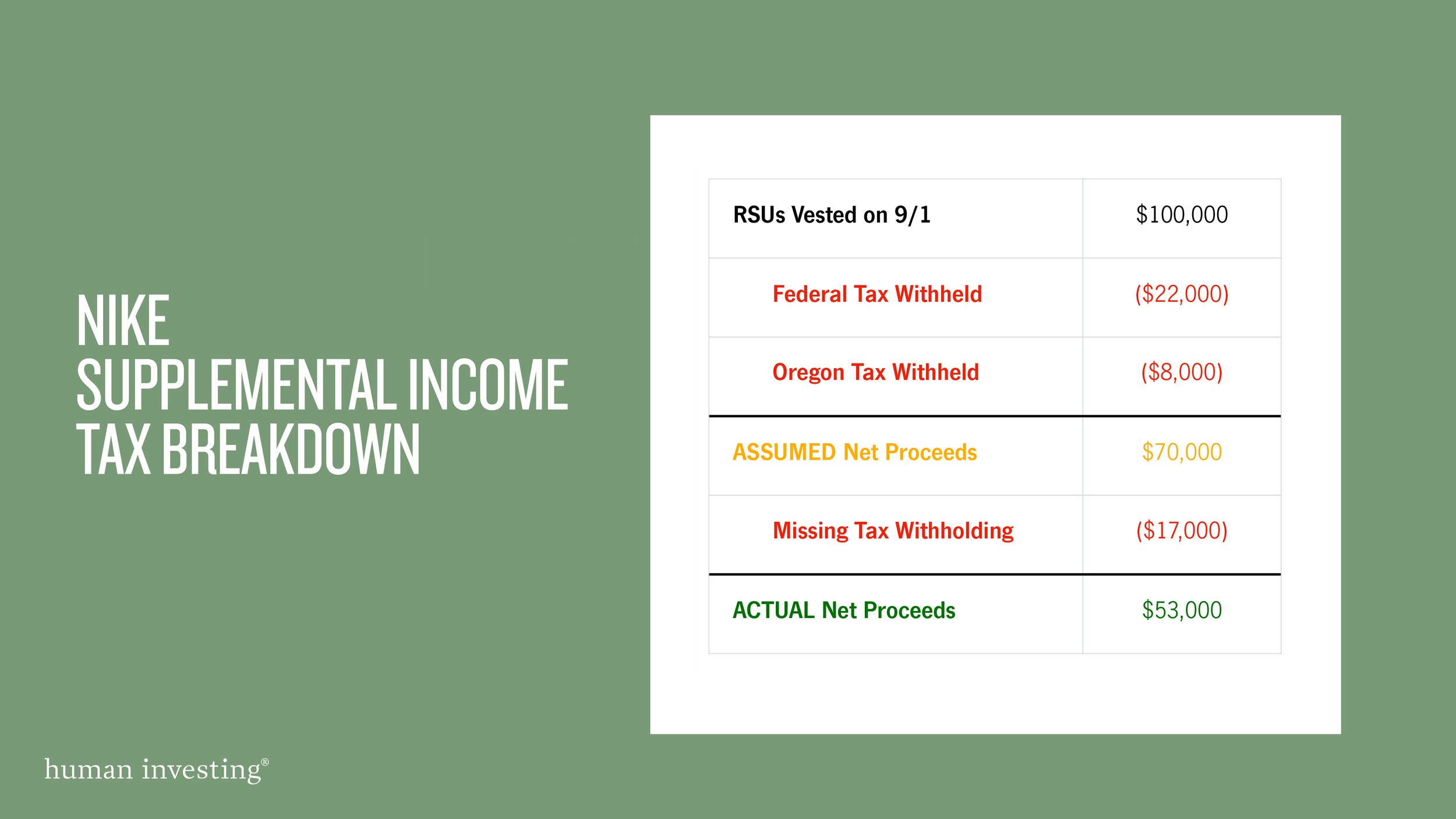
Many compensation sources at Nike beyond salary (such as PSP, LTIP/PSU vests, RSU vests, and stock option exercises) are taxed as “supplemental pay,” which come with a set percentage of tax withholding (22% Federal + 8% Oregon) regardless of your tax bracket or tax withholding elections on your salary. The reality is most Nike executives are in a much higher income tax bracket, sometimes as much as 17% higher than the amount withheld. This discrepancy leaves a significant gap in the amount taxes that should have been withheld versus the actual amount.

For example, Kate Executive has $100K of RSUs that vested on September 1st. With all her income sources (salary, PSP, LTIP/PSU, RSUs) her taxable income is $700K. The taxes automatically withheld on the $100K RSU vests would be about $30K (22% Federal + 8% State).  However, based on her tax bracket, Kate will owe another $17,000 on that RSU vest.

2. No tax withholding for Multnomah County’s “Preschool for All” tax

For those who live in Multnomah County, you are likely subject to the “Preschool for All” tax that started in 2021. Unfortunately, Nike does not withhold taxes from payroll to cover this tax, so you will be responsible to fully cover this on your own. Multnomah County expects these payments to be received quarterly to avoid interest and penalties.

The Preschool for All tax is 1.5% on taxable income over $125,000 for individuals and $200,000 for joint filers, with an additional 1.5% on taxable income over $250,000 for individuals and $400,000 for joint filers. The rate will increase by 0.8% in 2026.

3. No coordination of Portland Metro tax payments for 2 working spouses

Since Nike headquarters is located within the Portland Metro, they do withhold taxes for the Metro Supportive Housing tax (a.k.a. Homeless tax) that also started in 2021. The Metro Supportive Housing Tax is a 1% tax that is applied on income over $125,000 single filer or $200,000 joint filer. 

A common issue arises when you have two working spouses at different companies, since the income threshold for this tax is based on household income and the two different employers obviously do not communicate with each other.   

For example, once a Nike executive’s income reaches $200K, Nike will start to withhold the Metro tax on any income above that amount. However, the other spouse’s employer does not know about the income at Nike and assumes that the spouse’s income is the household income. So, if that spouse earns $90K, no Metro tax is withheld on that amount even though all of it is subject to the Metro tax.

The 3 tax payment issues identified above often lead to a frustrating situation, where you either end up with a significant tax bill in April or you have been paying in the wrong quarterly estimated tax payment amounts given to you by your CPA.

Our recommended solution: The pay as you receive strategy

For many Nike executives, setting aside additional tax payments into your monthly household cash flow can become stressful, since the amounts can be so inconsistent.   

The “Pay as You Receive” strategy is calculating the estimated amount of taxes due from each type of “Bonus Compensation” as you receive it and making those tax payments at that time, while you have the funds to do it. This will leave your monthly cash flow separate and unaffected.

If this sounds like a lot of work, you can make it simpler by applying this method during 2 key time periods. 

  • Time Period #1: August – PSP, LTIP/PSU bonus’

  • Time Period #2: Early September: September 1st RSU vests

A more thorough approach is the also include any February retention RSU vests and stock option exercises as they occur.

These supplemental estimated tax payments, when combined with the withholding, should be equal to your anticipated tax bracket for the calendar year. This approach helps ensure that your total payment to the IRS, Oregon, Multnomah County, and Metro aligns with your tax obligations.

Additional strategies for minimizing your tax liabilities

If you’re looking for more tax savings or want to use your stock benefits to take care of tax payments, we highly recommend proactive tax planning. This involves looking beyond the past year and anticipating opportunities to reduce taxes in the future.

Proactive tax planning common solutions include:

1. Maxing out your Nike 401(k) with pre-tax contributions

This is a simple strategy, yet it is often missed.  With the maximum contribution amount increasing periodically with inflation and with opportunities for additional catch-up contributions at age 50, forgetting to review your contribution percentage each year is common.  We recommend reviewing your 401k contribution amount after your PSP bonus is paid, since it is a variable amount that is part of the equation.

2. Selling the right type of Nike stock

If you ever need funds from Nike stock, find the most optimal type of Nike stock to sell to minimize your taxes. Typically, RSUs are preferred over ESPP from a tax standpoint, but this can depend on when it was purchased/vested, how long it has been held, and what the stock price is at the time.

3. Utilizing the Nike deferred compensation plan to defer your taxable income to a later date 

Nike’s deferred compensation plan is generally the most powerful tax savings tool available for Nike leaders.  There are specific IRS rules and many important considerations to plan around when using this strategy.  To learn more click here.

4. Charitable giving

Most people assume that all donations to charities are tax-deductible.  They can be tax-deductible but are not always, depending on your individual tax situation. To receive a charitable deduction, you need to exceed a certain threshold each year, and it may make sense to “bunch” donations (make multiple years-worth of contributions in a year) to cross that threshold and capture tax benefits. Coordinating your charitable strategy with the Nike charitable match can be an effective way to lower your taxes and benefit your desired charities at the same time. To find out more click here.

5. Residence planning

If you currently live in Multnomah County, you might consider moving to another county, such as Clackamas or Washington Counties, to avoid the Preschool for All tax. This solution should consider the estimated tax savings compared to the cost of selling your home, the tax implications of selling your home, the purchase price of a new home, and the difference in a new mortgage payment (especially because mortgage rates have increased significantly).

6. Planning around the Oregon state kicker

Oregon law has a provision known as the “kicker” credit. This is a surplus credit that is returned to you on your tax return when tax revenue is larger than predicted.  By accounting for this, you can strategically recognize more income in “kicker” qualifying years so that your potential kicker credit is increased.  The last kicker payment was 17.34% of the Oregon taxes you paid in 2020 and the next one is estimated to be even larger

Bring in experienced experts

By implementing a proactive forward-looking tax strategy and payment plan, Nike leaders have a significant opportunity to improve their financial situation and relieve stress related to taxes. It is important to note that any tax payment and mitigation strategies should be part of a comprehensive financial plan that is tailored to your specific financial situation.

If you have questions about how to set up a proactive forward-looking tax strategy, please contact our team to learn more.


Related Articles