Posts in Nike Stock
Making the Most of Your Nike Stock Choice: 3 Strategies for 3 Situations


The Nike stock choice window is just around the corner. While this may seem like a straightforward decision, it’s an important time to consider all aspects of your financial plan to make an informed decision that will best suit your needs. Through reflection and thoughtful planning, we often collaborate with Nike clients to walk them through this choice which serves their life goals best.

As we have worked with individuals in various life stages, we have seen a variety of needs and preferences emerge. Different people are trying to meet a diverse set of needs for themselves and their families.

We’d like to share a few stories of people in different life stages in hopes that one (or more) will resonate with you. We believe that each person has a unique story, and needs advice tailored to their specific situation. We like to know our clients by building a trusted and genuine human connection so we can serve them as a fiduciary.  

The personas profiled below are not reflective of any particular client or person. They are generalities based on years of experience working with Nike employees.

Meet John, 31, Director at Nike:

John, 31-years-old, was recently promoted to a Director role at Nike. He has been with the company for about two years and proudly considers himself a “lifer” at Nike. He believes in Nike’s long-term potential as a company and is excited about the opportunity to participate in its future growth. John likes to branch out in his investing by purchasing cryptocurrency and considers himself a risk-taker. He has a high-risk tolerance, not just in investing, but also in his love of extreme mountain biking. He is now entering his first year of participating in the annual stock choice, and is enthusiastic to partake in the future success of a company he truly believes in.

John is married with no kids, currently has little expenses and saves most of his paycheck. He is in a strong position and mindset to take more risk with his stock choices.

Our recommendation: By choosing stock options over restricted stock units (RSUs), John has the opportunity to benefit from Nike’s long-term growth. This choice provides him an approach that aligns with both his financial philosophy and comfort as well as his commitment to Nike’s future.

Meet Rachel, 42, Senior Director at Nike:

Married with young children in public school, Rachel, 42 years old, is focused on financial stability and meeting her family’s ongoing expenses. She has been at Nike for four years and currently excels in her role as a Senior Director. She has enjoyed her time at the company but is currently considering roles elsewhere. Rachel’s uncertainty about long-term tenure influences how she approaches financial decisions—particularly those tied to equity compensation.

Rachel is a conservative investor who doesn’t want to put all her eggs in one basket. Rachel tends to avoid risk and prefers stability over speculation.

Our recommendation: RSUs are a reliable source of income for Rachel. Her risk-averse mindset and need for cash have led her to select RSUs as her Nike stock choice decision in the past and sell them upon vesting. Continuing to choose RSUs allows Rachel to obtain a steady cash flow and participate in Nike’s equity program in a way that supports her personal and professional needs best.

Meet Matt, 53, VP at Nike:

Matt, a 53-year-old Vice President at Nike, has been with the company for a decade and is approaching a key transition point in his career. With plans to retire within the next one to two years, he has been closely reviewing his overall financial plan to adequately prepare for the future. Matt is uncertain about Nike in the long-term and doesn’t want to rely on his stock awards to fund all his personal goals and dreams.

Matt is nearing eligibility age for a special retirement vesting treatment. If Matt remains with Nike at age 55 this rule would extend his window to hold onto his unvested stock options (grants held for at least one year) beyond the typical 90 days.

However, with college-age children and education expenses creeping up, he also has immediate cash needs to consider.

Our recommendation: While RSUs offer a more reliable payout, options could become a strategic tool if the stock grows before the options expire. Ultimately, Matt must strike a balance of these two stock choices that fits his needs. His decision will likely be a mix of both options and RSUs to support his family and the opportunity for long-term growth.

How the Stock Choice Can Serve You

As these examples illustrate, there's no single approach that works for everyone. These stories are here to serve as a starting point for discussion around your personalized plan.

The Nike stock choice window is more than just an annual selection. It’s an opportunity to reflect on your broader financial goals and personal values. Whether you're early in your career like John, balancing family needs like Rachel, or preparing for retirement like Matt, your decision should align with where you are now and where you want to go.

Each individual’s situation is unique, and should factor in timing, risk tolerance, behavioral, and quantitative analysis. We’re here to help you think through those variables with clarity and confidence.

If you have questions or want to dive into an analysis of your own situation, take our survey below.

TAKE OUR ANNUAL STOCK CHOICE SURVEY

Get a customized score to help you make your stock choice this year.


Disclosures: The information provided in this communication is for informational and educational purposes only and should not be construed as investment advice, a recommendation, or an offer to buy or sell any securities. Market conditions can change at any time, and there is no assurance that any investment strategy will be successful. Investing involves risk, including the potential loss of principal. Past performance is not indicative of future results.

Diversification does not guarantee a profit or protect against a loss in declining markets. Asset allocation and portfolio strategies do not ensure a profit or guarantee against loss.

Scenarios discussed are hypothetical and for illustrative purposes only. They do not represent actual clients or outcomes and should not be interpreted as guarantees of future results.

The opinions expressed in this communication reflect our best judgment at the time of publication and are subject to change without notice. Any references to specific securities, asset classes, or financial strategies are for illustrative purposes only and should not be considered individualized recommendations.

Human Investing is a SEC Registered Investment Adviser. Registration as an investment adviser does not imply any level of skill or training and does not constitute an endorsement by the Commission. Please consult with your financial advisor to determine the appropriateness of any investment strategy based on your individual circumstances.


 

Related Articles

Nike Stock Choice: The 11 Questions to Answer Before Making Your Decision


The window is open from August 5-27, 2024

It’s that time of year again where Nike leaders will need to make their annual Nike Stock Choice and select between 100% Stock Options, 100% RSUs or 50/50. 

When comparing Nike Stock Options and Nike RSUs, RSUs are the safer optionRSUs offer a more secure value and a more moderate level of upside and downside.  Stock Options are more volatile but can also provide significantly more upside over time.

At first glance the decision can feel simple since there are only 3 roads to take, and when in doubt picking the middle road of 50/50 is the easy compromise.  While this can be the right selection for many individuals, it is not always the optimal choice.   While working alongside Nike leaders over many years, we have found that there are 11 crucial questions to answer and consider so that you arrive at that optimal selection for you.

Timing questions: Is it a sprint or a marathon?

Understanding your timeline is one of the most important factors in your choice.  Stock Options do not have any value until the stock price increases, but they do grow at a faster pace than RSUs.  So given enough time, Stock Options can surpass RSUs in value.  This is why timing considerations can be crucial to your decision and you should consider questions like:    

1. What is the purpose of Nike stock for you and your family? 

Does it contribute to longer-term goals like retirement, building wealth, and creating a legacy? Stock Options are more appropriate here. Or is it for shorter-term needs like a second home, more vacations, or education for your kids?  RSUs typically make more sense for these scenarios.

2. How much longer do you think you will work at Nike?

To the best of your ability, you should consider how long you think you will remain at Nike.  Your timeline could be short if you are seriously considering offers from recruiters or think your position could be eliminatedIn those types of considerations, RSUs could make more sense.  Conversely, if you plan to stay at Nike long-term and feel like your position is secure, you have a better chance to participate in the long-term growth of Nike stock.  In this case, Stock Options may be a better fit.   

3. How often do you typically sell Nike Stock to fund purchasing needs?

If you frequently sell your Nike stock grants to fund lifestyle needs, you likely need a more consistent funding source like RSUs since there is not adequate time for the stock to grow and realize the value.  

Behavioral questions: It goes beyond the numbers

As human beings, behavioral and emotional factors often affect our financial decisions.  These types of questions include:

4. What did you select last year, and do you feel like that was a good decision? 

Do you have buyer’s remorse, or do you feel good about that decision regardless of which selection is better at this point-in-time?  It is important to remember that the Stock Choice selection is a long-term decision that should not be overly influenced by recent, short-term results.

5. How much regret would you have if your peers made a more financially successful choice? 

If your peers are all celebrating the success of their selection and yours is different, how much would this affect you?  Everyone has a different level of response in these situations and setting yourself up well to be at peace with your decisions is important to your well-being.

6. How do you currently feel about the long-term growth potential of Nike stock?

Your long-term feelings toward Nike stock potential should be considered since it will better match your expectations and satisfaction regardless of what actually happens with stock performance.    

Risk questions: How much turbulence are you okay with?

7. If stock price dropped by 20%, how would you feel?

It is normal for any stock, including Nike, to experience ups and downs and a 20% drop at some point should be expected.  During these moments, would you be concerned to the point of wanting to sell immediately, not concerned at all, or a little concerned?  If this type of drop would be too difficult to stomach, you may want to lean towards RSUs.  If it is not a concern at all, you may be well-suited for Stock Options.

8. How do you feel about your total exposure to Nike stock?

Does having the bulk of your financial assets tied up in Nike already cause you concern and anxiety, or are you hoping to build up more Nike holdings?  If you are already concerned about your exposure, you will likely be diversifying out of Nike stock.  In this case, it could make more sense to lean towards RSUs.

Quantitative questions: The numbers do matter

9. How is the price of Nike stock valued currently based on its earnings and other factors? 

Is it overvalued or undervalued?  You may want to examine the metrics to see how it currently stacks compared to its historical valuation.  If it is undervalued that could make you lean more towards Stock Options, or if it is overvalued it could make sense to lean more RSUs.

10. What is this year’s Stock Option Ratio?

Each year there is a calculation of how many Stock Options you will receive if you make that choice.  It is a ratio based on the value of the RSU choice.  For the first 4 years, it was a 5:1 ratio (5 stock options for 1 RSU).  Starting in 2022, it shifted to a 4:1 ratio.  We cannot say for sure the reason for this shift, but it would be reasonable to assume it was affected by interest rate changes and stock market volatility as those factors can change the valuation of a stock option.

The 4:1 ratio for Stock Options means that you would receive less Stocks Options and Nike stock price would require additional growth to become more valuable than RSUs.  A lower ratio could mean that you need more time for Stock Options to grow to have a chance to exceed the value of RSUs. 

The overriding ‘special’ question

11. Do you qualify for the Stock Option Special Retirement Vesting?

If you are age 55+ and have worked for Nike for at least 5 years, you qualify for the Special Retirement Vesting of any Stock Options. This is the most important factor in the entire equation to consider. 

When you terminate from employment at Nike, you will lose any unvested RSUs and Stock Options.  Additionally, any unvested Stock Options must be exercised within 90 days unless you qualify for the Special Retirement Vesting.  This Special vesting will allow you to keep your unvested Stock Options (held for at least one year).  These will continue to vest over the next 4 years or vest immediately if you are Age 60+.  You will also have more time to exercise your Stock Options instead of being forced to do so within 90 days after termination.    

Since this special vesting is so valuable, anyone that qualifies or will be qualifying for this vesting soon, should strongly consider Stock Options as part of their decision. 

Do you want help putting it all together?

As you can gather from the 11 questions above, there are many different factors that should be considered.  Determining which ones are the most important can be challenging. 

Based on your answers to these questions, you may already feel confident and comfortable with one of the three options.

For those who are still unsure or want to obtain detailed information while deliberating, our team at Human Investing created our own, proprietary scoring tool.  The scoring tool takes the answers to these questions, assigns different weights depending on the importance of each question, and generates a unique score report.    

GET YOUR OWN COMPLEMENTARY SCORE

If you or anyone you know is interested in receiving their own Stock Choice score sign up below. 

Lastly, we believe it is important to consider how your Nike stock compensation fits within your overall financial situation.  The questions above and the scoring tool can be helpful, but this Stock Choice decision is best done in coordination with a personalized financial plan.

If you have questions or want to learn more about the Stock Choice, Stock Options or RSUs, please feel free to contact us at nike@humaninvesting.com


Related Articles

Consider your timeline for Nike stock


Since the recent Nike quarterly earnings report, the stock price dropped 20% in one day (June 28, 2024) and continues to hover around $72 - $75 per share. This has raised concern for employees as they rely on Nike stock to fund a significant portion of their investment strategy and lifestyle needs.

Below are 4 thoughts on the recent price drop and action items you can implement to move forward during this downtime.

Give yourself time to recover

 It’s easy to lose sight of this when the stock price is rising. The focus goes towards remaining invested for as long as possible so you don’t miss additional investment gains and forget that volatility can disrupt your strategy.

In our blog post from August 1, 2022, we analyzed the recovery period for Nike stock price when there is a 20% downturn. We can’t predict how long this recovery period will take, but history tells us that on average, it takes 339 days.

Action Items:

  • Stock options: The most common approach is to exercise and sell your Stock Options by converting it to cash before the expiration deadline. You may want to consider the less common option to exercise and hold the stock. This gives you an indefinite timeline to hold the stock and strategically wait until the right time to sell. For the exercise and hold strategy, you need to have cash to purchase the stock. For example, to exercise and hold 100 shares at $75 per share, you need $7,500 cash to purchase, so plan accordingly.

  • Strategically diversify: Diversify new ESPP and RSU purchases. Selling new shares at the time of purchase does a couple of things: (1) Avoids the risk of loss in value, (2) allows you to diversify into a balanced investment portfolio, and (3) gives time for your older Nike stock purchases to recover.   

Strategically raise funds when needed to minimize taxes

Rather than focusing on “how much cash do I need”, look at each of your Nike investment buckets and determine how you can get the cash you need in a tax-advantaged way.

Action Item:

  • Tax analysis: For RSUs and ESPP, look at each Lot to determine which holdings would sell at a capital gain and which would sell at a loss. Review critical factors such as (1) how much cash do I need, (2) how much investment will remain, (3) what is the net tax impact of what I’m selling, and (4) how long until I need to raise more funds.  

Re-evaluate your financial plan

When the stock price is down, it’s an opportunity to evaluate whether changes to your financial plan are required to stay on track with achieving your long-term goals.

Action Items:

  • Maximize benefits: Specifically ESPP stock while the price is low. At the next ESPP enrollment, consider increasing your deferral percentage to the maximum of 10%. 

  • Adjust investment strategy: Evaluate your overall concentration of Nike stock. If Nike stock is a large portion of your overall investment portfolio, consider ways you can maximize your savings going forward into a diversified portfolio to reduce your overall exposure.

  • Stock choice: Think about your upcoming Nike stock choice. If you’ve taken 100% RSUs in the past, does it make sense to change your strategy to 50/50 stock options or 100% stock options?

  • Prioritize your expenses: Determine which expenses are most important to you. Consider reducing or delaying expenditures that do not align with your highest priorities. This approach can feel difficult at first, but the more you buckle down during this season, the greater impact it will have on your financial plan.

Re-visit your college savings plan

Many Nike employees rely on their stock options to fund their kid’s college expenses. If this was your strategy, your options are underwater unless you have grants from 2014 (which expire soon) – 2017.

Action Items:

  • Evaluate other funding sources: Do you have other investment levers that can be used to fund college expenses?

  • Cash flow: How much cash flow do you have within your annual budget to fund college expenses? Will this be sufficient to cover part or all of the expected cost?  

  • Deferrals: If you reduce your retirement deferrals, will this increase your cash flow enough to fund annual college expenses?

  • Prepayments: If you are pre-paying any loans (ie: paying extra on your monthly mortgage), consider paying the minimum to free up cash flow for college expenses.   

  • Grants and scholarships: Are there opportunities to explore this further?

  • Adjusting expectations: Does this prompt a discussion with your kids around sharing the cost of college expenses?  

Consider your timeline. When Nike stock is increasing, it’s easy to lose sight of your timeline because the focus is not missing out on the appreciation. The recent volatility is a reminder that time is the most valuable asset when investing. The action items above are the starting point to navigate through the volatility. Please reach out to us so we can continue the discussion and help implement these strategies to remain on track with your long-term financial goals.


Related Articles

How Long Does it Take for Nike Stock Downturns to Recover?
 

On November 5th of 2021, Nike stock closed at its most recent all-time high of $177.51. Much has changed since that time, with the stock price dropping over 38% to $109.12 as of 7/22/22. This has made financial decisions much more challenging for Nike leaders that hold and receive significant amounts of Nike stock as part of their compensation and benefits. Many rely on their stock for their financial goals and life plans like retiring, paying for college, paying off debt, contributing to charitable causes, and purchasing a vacation home or a new car.

Uncertainty and concern

Those decisions are now met with uncertainty and concern over the significant decrease in their Nike shares compared to just seven months ago. So, the understandable questions are starting to arise:

“Should I sell some or all of my stock now?”

“Should I delay my financial goals and life plans?”

“Is there another way to fund those goals without selling my stock?”

“How long do you think it will take to recover?”

Each individual has a unique financial situation, and the right decision is not the same for everyone.

To help Nike clients through these discussions, we thought providing information and context to the question of how long it will take for the stock to recover would be helpful.

While we cannot predict the future, we can look to past situations to get a sense of general time frames, which can help the decision-making process.

How Long Will this Down Period Last?

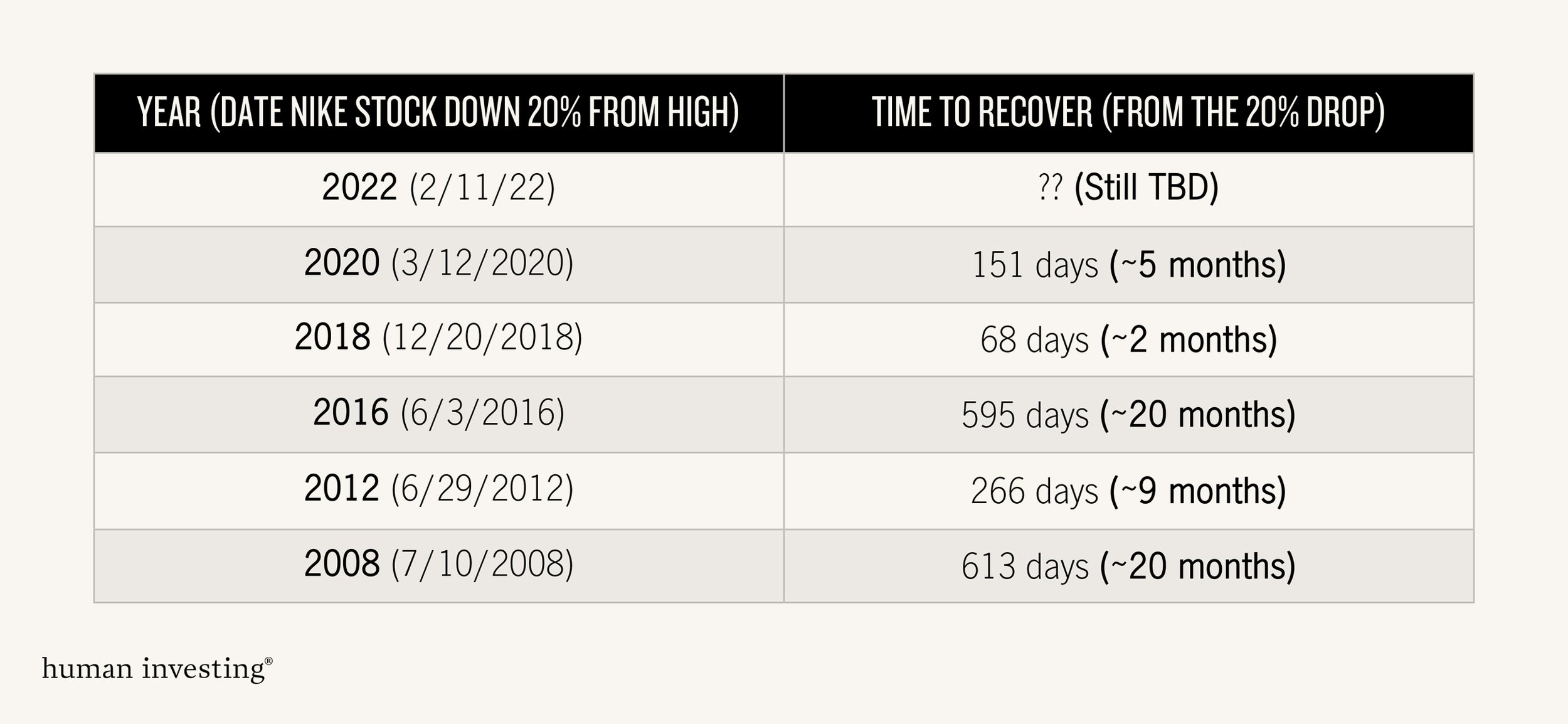
In examining the last five times Nike stock dropped by at least 20% from its high, we noted the periods to recover to their all-time high.


The average time for recovery has been just under one year at 339 days. You will notice from the table above that the recovery time varies widely from as quick as two months to as long as 20 months. Another interesting observation is that over the past 15 years, there has been a 20%+ drop in Nike stock every 2-4 years.

This most recent -20% downturn in Nike happened on February 11, 2022, about five months ago. So how much longer will this down period continue? No one truly knows, but if we go off of the history of the past 15 years, you should be prepared for up to another 15 months.

So, what should Nike leaders consider and assess now? Below are some tips.

TIP #1: Assess and Understand your Time Frame

Having enough time to be patient and wait for a potential recovery is one of the keys to the current environment. Take time to assess if you can hold tight or if you have very specific timelines or deadlines like a Stock Option expiration.

TIP #2: Take Note of your Risk Appetite

Even if you have the time to wait for a potential recovery, it may not be worth it if it is causing an undue amount of stress and anxiety. In this case, we find that developing a well-thought-out selling plan, where you sell part of your stock at different prices and time periods, can relieve some of the concern.

TIP #3: Develop a Contingency Plan

If the stock takes longer to recover than expected, identify other places where you can access cash in the short-term to meet those financial goals.  Examples can include: using existing cash in the bank, the conservative part of a taxable investment account, a home equity line of credit, or a portfolio loan.

TIP #4: Pick the Most Optimal Shares for any Sales

When the time is right to sell, are you picking ESPP, RSUs, or Stock Options?  We recommend carefully selecting the right type and exact shares to minimize taxes, maintain your long-term upside, and fit your time frame.

By looking into the past, we can see that downturns and recoveries in Nike stock are pretty standard and have happened regularly. We recognize that this historical data doesn’t mean it will be the same this time, but it does give you a sense of what it could look like.

“History never repeats itself, but it does often rhyme.”

-Mark Twain

If you need help assessing your current Nike stock and how it fits into your personal goals and situation, you can reach Marc at marc@humaninvesting.com.


Related Articles

Hoping for a Nike Stock Split? Why a Stock Split should not change your investment strategy.
 

The recent success of Nike stock has begun to fuel questions and curiosity about a future stock split.   When a company like Nike announces a stock split, does it lead to an immediate increase in value?  For many investors, stock splits tend to generate enthusiasm and an expectation that the stock will experience significant growth but is that always the case?  We will review what a stock split is and why companies have them.  Applying it specifically to Nike, we will explore the history of Nike stock splits and how the stock performed after those splits occurred.  

What is a Stock Split? 

A stock split happens when a company divides its outstanding shares into multiple shares, increasing the overall number of shares.  Since the underlying value of the company does not change, this results in a lower price per share.  For example, if you own 50 shares of Nike and the stock price was $100/share, your total value would be $5,000.  If Nike completed a 2-for-1 stock split, you would then own 100 shares with a stock price of $50/share, resulting in the same $5,000 total value.   

Why Do Companies do Stock Splits? could it increase the value of the stock?  

Companies have historically performed stock splits to make the stock more liquid and accessible to owners.  Stock splits typically occur after a company has experienced significant growth and the higher price may become a barrier to the average investor.  In the example above, you would need $100 to purchase one share of Nike before the stock split.  After the 2-for-1 stock split, you would only need $50 to purchase a share of Nike.

In theory, a stock split should not change your total dollar value in the stock.  However, the announcement of a stock split can create renewed interest and availability in the stock, which can result in a temporary price increase.  How has the announcement of a stock split affected Nike stock historically?   

History of Nike Stock Splits

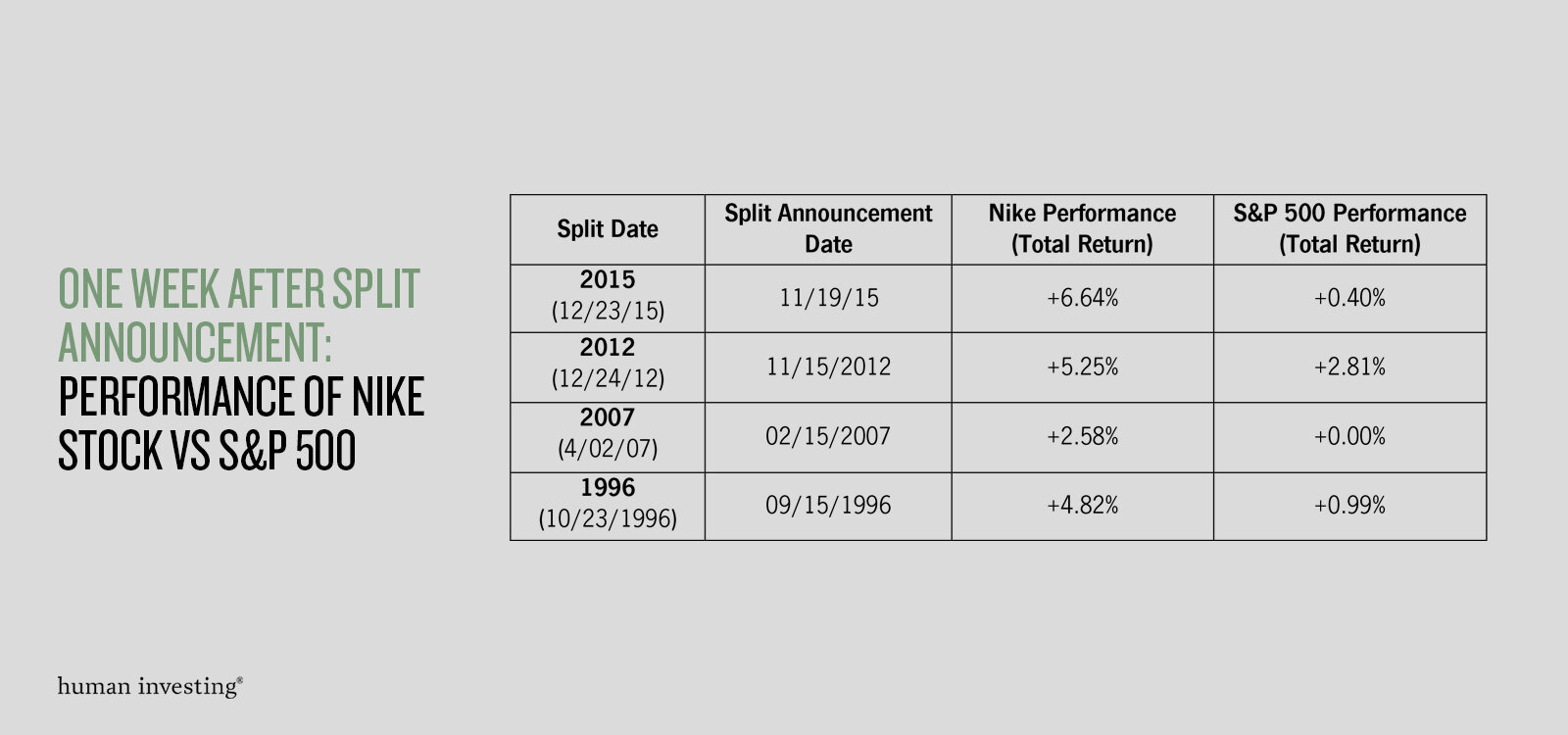
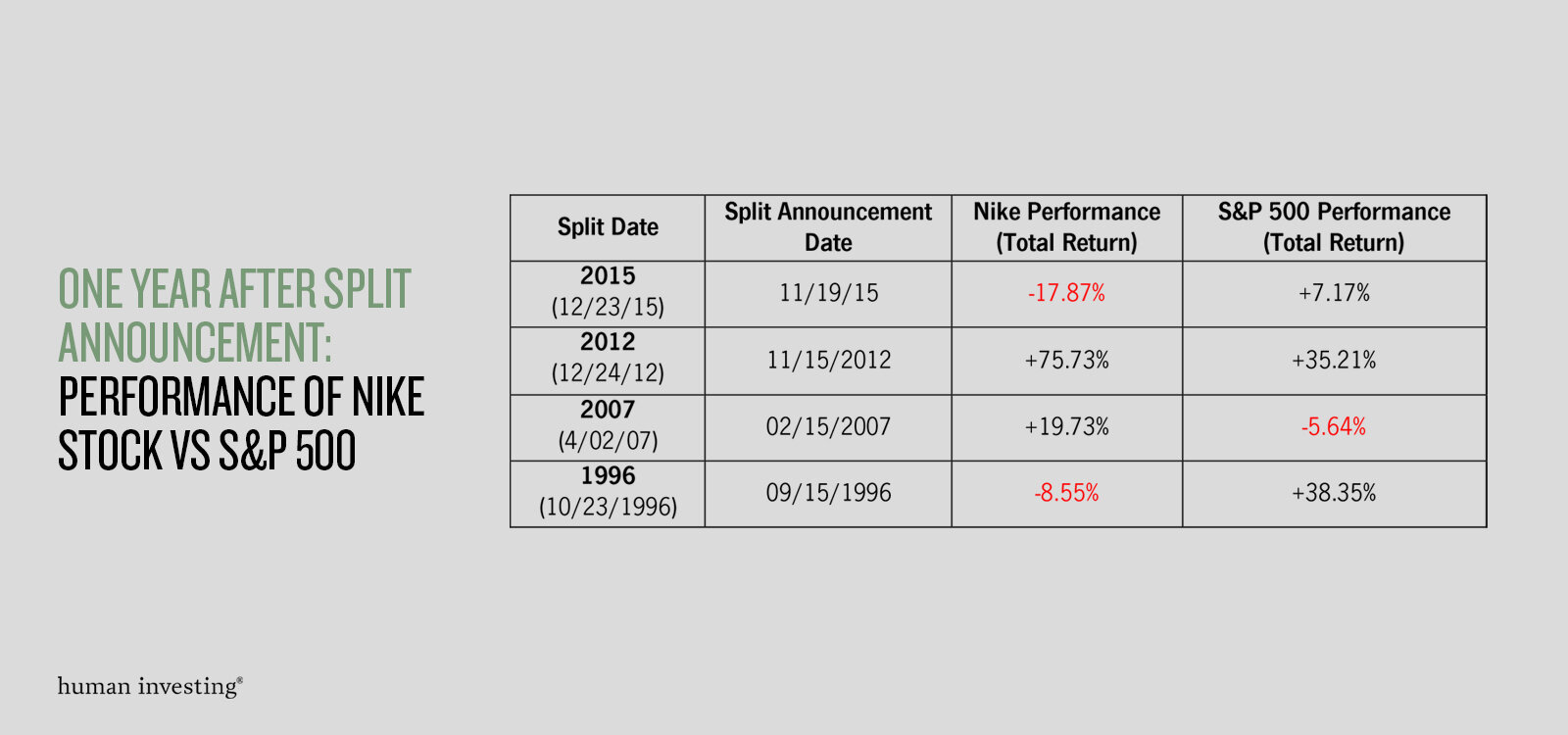
Nike has performed a 2-FOR-1 stock split seven times in its history, with the first one occurring in 1983 and the most recent one occurring in 2015.  We examined the performance of Nike stock compared to the S&P 500 Index (benchmark for US Large Cap Stock Market) both 1 week and 1 year after the announcement of the last four stock splits in 1996, 2007, 2012 and 2015.

nike-split-01.jpg
nike-split-02.jpg

Observations of Last Four Nike Stock Splits

When observing the outcomes of the last four Nike stock splits, several points stand out.

  1. Initial Price Bump for Nike – In all four cases, there was a solid price increase over a 1-week period after the announcement ranging from 2.5%-6.64%.  This price bump was much higher compared to the S&P 500 performance over that same period.  This is not surprising as a stock split announcement tends to garner interest and is considered favorable for the company.

  2. Lack of Consistency – When you look at the 1-Year return numbers for Nike, there is much more variability in the outcomes.  Although one might assume that there would be positive 1-year performance each time, the stock price was in fact negative in 2 of the 4 years. 

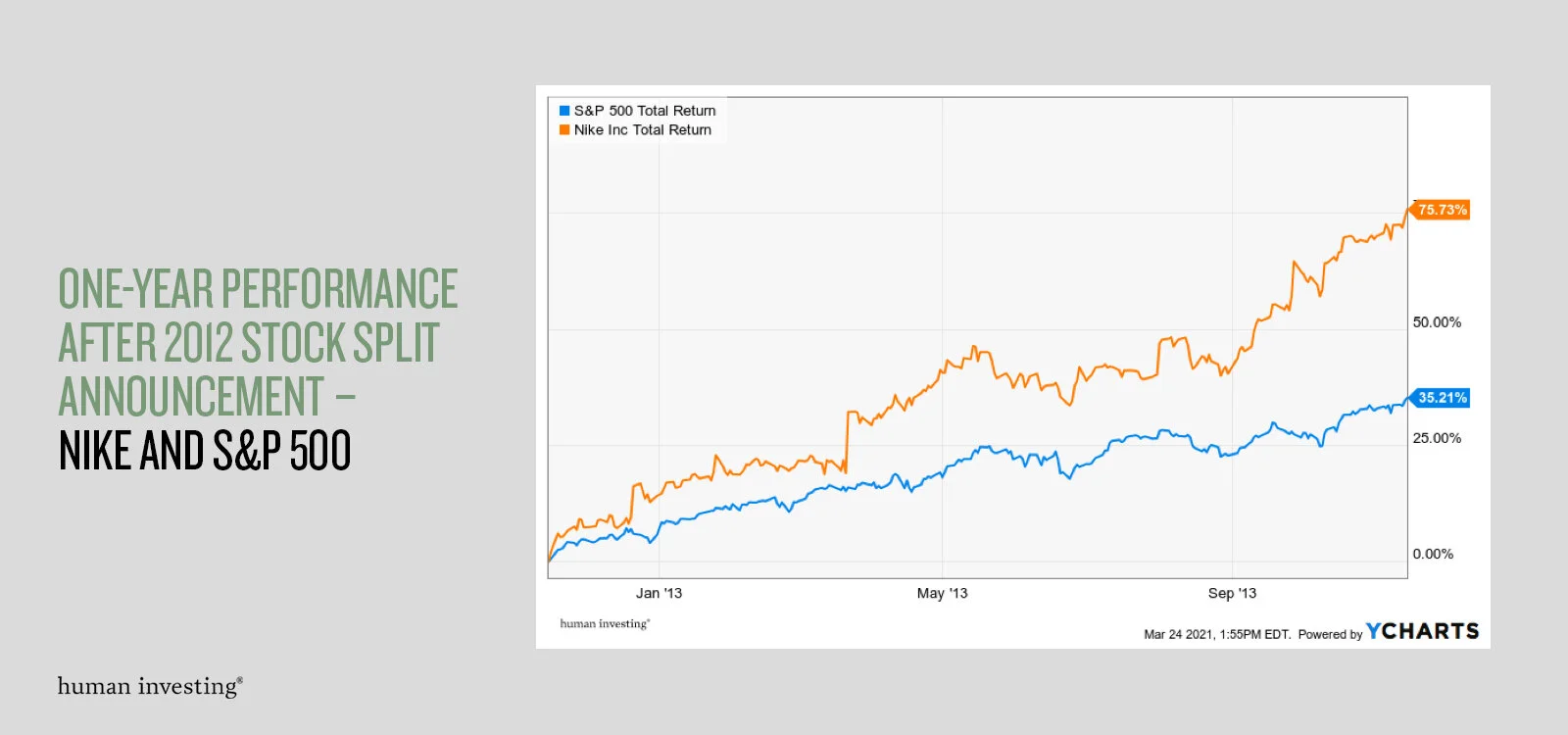
  3. Nike and the S&P 500 were Not on the Same Page – When comparing the 1-year performance between Nike and the S&P 500, in all four instances, the variation in returns was significant and had an average return difference of 34.46%.  For example, in 2012, Nike was up +75.73% versus S&P 500 at +35.21% (40.52% difference) and in 1996 Nike was down -8.55% and S&P 500 was up +35.35% (46.90% difference).

nike-split-03.jpg
nike-split-04.jpg

our recommendation for nike employees

During any short period of time, stock prices can move unpredictably and an event like a stock split does not necessarily result in substantial growth.  Stock splits do not fundamentally create any additional value and as you can see by the last four Nike splits, the results are inconsistent. The historical performance shows that any initial price increases from the split tend to be temporary.  We recommend that owners of Nike stock view their investment as long-term (10+ years), which will provide the best opportunity for success regardless of whether the stock undergoes a split or not.

If you have questions about your Nike stock and how it applies to your situation, please get in touch.

You can schedule time with me on Calendly, e-mail me at marc@humanvesting.com, or call or text me at (503) 608-2968.   


Related Articles