
Posts tagged strategy1
ESG Investing: Aligning Your Money With Your Values


Investing isn’t just about numbers. For many, it’s about making choices that reflect personal values while still aiming for long-term investment growth.

One of the more common questions we hear from both clients and prospective clients is, “How can my portfolio better reflect what I care about?” Often, that means avoiding certain industries or intentionally supporting companies with similar values, essentially “voting with your dollars” through your investments. Enter ESG investing: a way to invest while considering Environmental, Social, and Governance (ESG) factors.

Because ESG investing is relatively new and can look differently depending on the investor’s approach, let’s break down what ESG is, how it works (including common misconceptions), and whether it might make sense for you.

What ESG Investments are (and are not)

ESG investing considers how companies operate beyond profits. ESG is a metric that measures impact in the following areas:

  • Environmental: How a company navigates environmental issues like climate impact and sustainability practices

  • Social: How a company supports and interacts with the people and communities it impacts, from its workforce to suppliers to local communities

  • Governance: How it’s run through board diversity, executive pay, and transparency

Although ESG is designed to align investments with values, ESG is not charity. These portfolios still aim for returns and ESG ratings vary widely, so it should not be assumed every “ESG” fund is equal.

How did ESG Investing begin?

Although popular ESG index funds (such as ESGV and VFTAX) were launched just in the last 10 years, the intention of aligning money with values has been present for centuries.

As early as the 1700s, religious groups such as the Quakers practiced forms of values based investing by avoiding businesses involved in activities they believed caused harm, including weapons, slavery, and exploitative labor. These early decisions reflected a belief that how money is earned matters.

Socially Responsible Investing (SRI) gained traction in the 1960s and 1970s with the anti-war movement, as investors sought to divest from companies connected to the Vietnam War and apartheid in South Africa.

The early 2000s were marked by a desire from investors to have more structured ways to evaluate non-financial risks that could impact long-term performance.

In 2004, the United Nations published the report Who Cares Wins, formally introducing the term ESG to describe factors such as environmental impact, labor practices, and corporate oversight.

Today, ESG is widely used by both individual and institutional investors. However, because ESG developed across multiple frameworks over time, its ratings and methodologies are not standardized.

How does ESG Investing work?

ESG investing can take several forms:

  • Screening: Excluding companies that don’t meet certain standards (e.g., defense contracts, tobacco, weapons, fossil fuels, alcohol, gambling).

  • Positive selection: Choosing companies that actively perform well on ESG metrics such as greenhouse gas emissions, workforce diversity and inclusion, and human rights protections.

  • Shareholder advocacy: Investors upholding companies to improve their ESG practices.

What are the benefits of ESG Investing?

  • Values alignment: You invest in companies that reflect what matters to you.

  • Long-term risk management: Companies with strong ESG practices may be better prepared for future regulations or reputational risks.

  • Growing demand: ESG investing is becoming more mainstream, with more selections and better data.

  • Competitive returns: Although long-term data is still developing, several established ESG funds have delivered returns comparable to traditional index funds over the past 5–9 years.
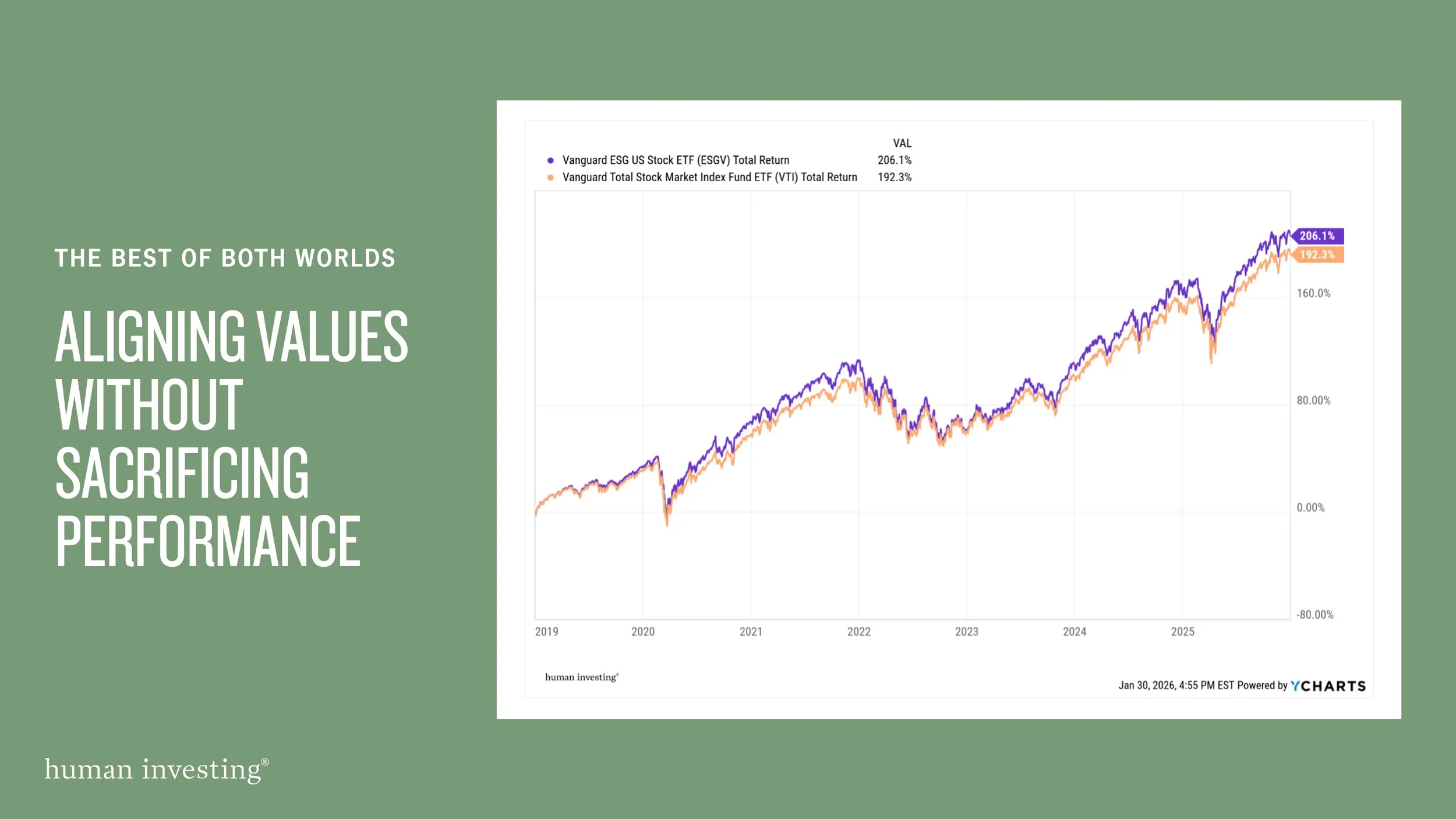
Data courtesy of YCharts. From 1/1/2019 to 12/31/2025, Vanguard ESG US Stock ETF (ESGV) delivered similar returns to Vanguard’s Total Stock Market Index Fund ETF (VTI), while also experiencing higher volatility due to a heavier tech concentration. Past performance is not indicative of future results.

Navigating the trade-offs in ESG investing

While ESG investments can improve alignment with your values, it is not a comprehensive or perfect solution. Some companies you think should be screened may not.

For example, Walmart may still be an investment despite their firearms and tobacco sales, as they derive the majority of their profit from groceries and home goods.

Additionally, Tesla may also be included as an investment in an ESG portfolio due to its sustainable energy focus, despite the controversy around some senior leadership of the company.

Here are some other considerations and common misconceptions with ESG investments:

  • Inconsistent ratings: ESG scores aren’t standardized, so one company might be rated differently by different agencies.

  • Limited diversification: ESG funds may exclude certain sectors, which can make the resultant investment less diverse.

  • Greenwashing: Some companies may appear ESG-friendly without meaningful action.

  • Higher fees: ESG funds can sometimes carry slightly higher expense ratios.

Five essentials for your ESG strategy

  1. Define your values: What issues matter most to you – climate change, human rights, corporate ethics, etc.?

  2. Explore ESG funds: Look for mutual funds or ETFs with ESG or SRI (Socially Responsible Investing) labels.

  3. Check your current investments: You may already be invested in funds with ESG screens.

  4. Talk to an advisor: A financial advisor can help you align your portfolio with your values.

  5. Start small: You don’t have to overhaul everything. Try allocating a portion of your portfolio to ESG choices.

Final thoughts

Although ESG portfolios offer a way of value-driven investing, every portfolio has its limitations. With the right approach, you can align your money with your values, while still aiming for financial success.

Want help exploring ESG investments in your portfolio? Let’s talk!


Disclosure:This content is for informational and educational purposes only and is not intended as investment, legal, or tax advice. The strategies and steps outlined—such as building an emergency fund, contributing to employer-sponsored plans, paying down debt, or using HSAs, IRAs, and taxable accounts—are general in nature and may not be appropriate for every individual. You should consult a qualified financial or tax professional before making decisions based on your personal circumstances. There is no guarantee that following any financial strategy will achieve your goals or protect against loss. References to interest rates, contribution limits, or tax rules reflect information available at the time of publication and may change. Past performance is not indicative of future results. Advisory services are offered through Human Investing, an SEC-registered investment adviser.


 

Related Articles

Rebalancing – What is it, and Why Does it Matter?


Rebalancing is the idea that you are bringing your investment portfolio back to its targets. For example, if you invest your account as 60% stocks and 40% bonds (60/40) and never trade, in ten years your account will not be 60% stocks. Because stocks have historically tended to perform better than bonds over most ten-year periods, you will likely have a higher weight of stocks than bonds after ten years. If you don’t rebalance, your portfolio may not align with your intended allocation, which could change the risk and return characteristics.

WHY is it NECESSARY

Deciding how much to invest in various asset classes is a critical determinant of long-term performance[1]. Since asset allocation matters, maintaining it through rebalancing matters. As we’ve written previously, over time stocks typically outperform bonds[2]. There are also certainly times bonds outperform stocks, usually in recessions. The logic of rebalancing boosting returns is simple: You are selling what has relatively outperformed and buying what has underperformed (buy low, sell high). Especially in today’s world, where most ETFs are commission free, making the transaction costs of rebalancing minimal. Taxable investors should consider the tax implications of rebalancing, and also consider the change in risk and return of not rebalancing.

TWO APPROACHES

In financial theory, there are two main approaches to rebalancing: calendar-based and tolerance-based.

Calendar-based rebalancing ensures the long-term risk-return profile of your portfolio is consistent. This gets implemented on a set frequency (monthly, quarterly, annually) and ensures a consistent cadence.

Tolerance-based rebalancing takes advantage of buy low, sell high opportunities as they arise. This assumes you rebalance only if you hit certain thresholds of one asset class over or under performing. For example, say your target is 60/40, and you set a 3% absolute tolerance; if the equities drift to 64%, that prompts a rebalance back to 60/40. The alternative is relative tolerances, the same percentage of the target for each piece of the model. So, if a 60/40 portfolio had a 20% relative tolerance, the equities would be rebalanced if off by a relative 20% (20% of 60% target = 12% tolerance) and the bonds would have a 4% tolerance for rebalancing. There has been research suggesting tolerance-based rebalancing is more beneficial for long-term performance[3].

OUR PROCESS

At Human Investing, we combine both calendar-based and tolerance-based rebalancing to give our clients the best of both worlds. Tolerance rebalancing allows us to take advantage of market dips and rallies as they happen, while our annual reviews ensure no portfolio drifts too far off course. This approach keeps every account aligned with the level of risk and return our clients expect and provides discipline, consistency, and confidence over the long run.

While rebalancing can sometimes feel counter intuitive, like selling bonds and buying stocks in March 2020, it is a helpful practice for any investor. It both keeps your portfolio consistent in the long run, and may improve risk-adjusted returns over time.


[1] Ibbotson, R. G., & Kaplan, P. D. (2000). Does Asset Allocation Policy Explain 40, 90, or 100 Percent of Performance? Financial Analysts Journal56(1), 26–33. https://doi.org/10.2469/faj.v56.n1.2327

[2] https://www.humaninvesting.com/450-journal/equity-risk-premium

[3] Daryanani, Gobind (2008). Opportunistic Rebalancing: A New Paradigm for Wealth Managers. FPA Journal. January 2008.

Disclosure: This material is provided for informational and educational purposes only. It should not be construed as investment, legal, or tax advice, nor does it constitute a recommendation or solicitation to buy or sell any security. Investors should consult with a qualified financial professional before making any investment decisions. Rebalancing and asset allocation strategies do not ensure a profit or protect against loss in declining markets. There is no guarantee that any investment strategy will achieve its objectives. Any references to historical performance, academic studies, or research are based on past data and should not be considered indicative of future results. Past performance is not a guarantee of future outcomes. Advisory services offered through Human Investing, an SEC-registered investment adviser.

 

Related Articles

How to Approach Your RSUs, ESPPs & Stock Options in a Volatile Market


Given the recent stock market volatility, it is important to re-evaluate your plan for your Stock Benefits (RSUs, ESPP, Stock Options) to take advantage of opportunities that may arise in this environment. 

A well-crafted strategy for your stock benefits should focus on:

  1. Personal needs and situation

  2. Maximizing the benefit

  3. Minimizing taxes

  4. Diversifying strategically

  5. Incorporating the investing principle of “Buy Low + Sell High” (when available)

The Investing Principle of Buy Low + Sell High

A fundamental investing strategy is to buy stocks when they are undervalued and sell them once they’ve appreciated, allowing you to benefit from the price increase. While timing restrictions from stock benefits may limit this approach, it’s important to integrate it whenever possible.

Strategies for your stock benefits based on your timelines

How do you incorporate your personal situation and needs with an effective strategy during the current market volatility? We will dive into several strategies that address the needs for different time periods, since timelines are an even more important factor during volatile markets.

For short-term needs (2 years or less)

Stock compensation can provide funds for expenses beyond salary and bonus, such as tuition, home repairs, vacations, or tax bills.

  1. First, consider selling recently purchased ESPP shares. Since you're buying these shares at a discount while the stock price is low, selling them for a gain doesn’t violate the “buy low, sell high” principle.

  2. Next, consider selling recently granted and vested RSUs. Like the ESPP strategy, these RSUs can help meet short-term cash needs. The main difference is that RSUs are often granted at a higher price—before a market downturn—so their current value may be lower than when they were granted. However, if the RSUs were granted recently, the price difference might be minimal, making them a more attractive option to sell.

For intermediate term needs (3-7 years) 

The intermediate term timeframe can be more challenging, since the answer isn’t clear and should depend on your risk tolerance.

  • The more conservative approach: Sell existing RSU grants that will vest in the next 12 months. This strategy reduces your exposure to stock volatility but doesn’t fully align with the “buy low, sell high” principle, since RSUs may be worth less than their original grant price. However, future annual grants—typically part of your compensation—can help offset this by being issued at lower prices during a market downturn.

  • A higher-risk approach: Hold all existing RSUs until the funds are needed, with the hope that the stock price recovers before then. This could allow you to better capitalize on the “buy low, sell high” strategy. The risk, however, is that the stock may not recover in time—or at all—leaving you potentially forced to sell at a loss when cash is needed.

  • The balanced approach: To hedge your bets, consider combining both strategies: sell some RSUs now while holding others for potential future gains. This hybrid approach can offer peace of mind, helping you avoid second-guessing your decision if the market doesn’t move in your favor.

For long-term needs (8+ years)

Planning for long-term goals like retirement tends to be more straightforward.

  • For vested RSUs and ESPP: Consider a strategy called Tax Loss Diversification, a variation of traditional tax loss harvesting. Tax loss harvesting involves strategically selling investments in non-retirement accounts to realize a loss, which can reduce your tax bill. You then reinvest that money into similar investments to stay in the market and benefit from potential recovery. With Tax Loss Diversification, the added benefit is that you're also shifting from concentrated stock (like your company shares) into a more diversified investment—such as an index fund with exposure to hundreds or thousands of companies. When the market is rising, diversifying can be painful due to the capital gains taxes involved, so it's wise to take advantage of a downturn as a window of opportunity.

  • Stock Options, RSUs, and ESPP: Stock Options offer the greatest potential upside but also carry the highest risk, especially when they’re “underwater” (i.e., the stock price is below the option’s strike price, making them currently worthless). In these cases, the best move is often to wait and give the stock time to recover, maximizing the chance to capture that upside. For RSUs and ESPP shares that you intend to hold for long-term growth, the best approach is often patience—holding through downturns and waiting for both the stock price and the broader market to recover.

The Exception: Expiring Stock Options

Expiring stock options require timely decision-making due to looming deadlines. Your strategy should reflect your risk tolerance, the number of options involved, and how critical they are to your overall financial goals.

  • Conservative approach: Sell all options now to avoid the risk of further price declines. This minimizes downside but also limits any potential future upside.

  • Moderate approach: Sell portions of your options at predetermined dates over time, balancing risk reduction with the opportunity for gains.

  • Moderately aggressive approach: Sell portions based on specific price targets. If those targets aren’t reached, you may need to sell the remaining options closer to expiration to avoid losing them entirely.

  • Aggressive approach: Hold all options until close to expiration in hopes of a stock price rebound or significant upswing. This offers the most potential upside, but also the highest risk of loss if the stock doesn’t recover in time.

Market volatility may feel uncertain and carry risks, but it also creates rare opportunities to make the most of your stock benefits. If you haven’t revisited your strategy recently, now is a great time to reassess and align your plan with the current market landscape.

Remember, there’s no one-size-fits-all approach. The right strategy depends on your company’s stock performance, your personal financial goals, risk tolerance, and overall circumstances. Use this moment to take control, make informed decisions, and turn today’s challenges into tomorrow’s opportunities.

For questions or more information about managing stock benefits during current conditions, please call (503) 905-3100 or contact us.


Disclosures: The information provided in this communication is for informational and educational purposes only and should not be construed as investment advice, a recommendation, or an offer to buy or sell any securities. Market conditions can change at any time, and there is no assurance that any investment strategy will be successful. Investing involves risk, including the potential loss of principal. Past performance is not indicative of future results.

Diversification does not guarantee a profit or protect against a loss in declining markets. Asset allocation and portfolio strategies do not ensure a profit or guarantee against loss.

This material is not intended to provide, and should not be relied upon for, tax advice. Please consult your tax advisor regarding your specific situation.

The opinions expressed in this communication reflect our best judgment at the time of publication and are subject to change without notice. Any references to specific securities, asset classes, or financial strategies are for illustrative purposes only and should not be considered individualized recommendations.

Human Investing is a SEC Registered Investment Adviser. Registration as an investment adviser does not imply any level of skill or training and does not constitute an endorsement by the Commission. Please consult with your financial advisor to determine the appropriateness of any investment strategy based on your individual circumstances.


Related Articles