
Posts in Pre-Retirement
What The New IRS Rule Means For Plan Sponsors & Workers Over 50


If you’re 50 or older and use catch-up contributions to bulk up your retirement savings, or you help run a plan that offers them, there’s a rule change that should be on your radar.

In mid-September, the IRS and Treasury finalized how a piece of the SECURE 2.0 Act will work. The short version: starting in 2026, certain higher-earning workers will only be able to make their catch-up contributions as Roth (after-tax) dollars.

Getting ahead of the change now will make 2026 a lot less painful.

First, What Are Catch-Up Contributions and Why Do THey Matter?

Once you hit age 50, you can put extra money into your 401(k), 403(b), or similar plan, above the standard IRS limit. That’s been true for years.

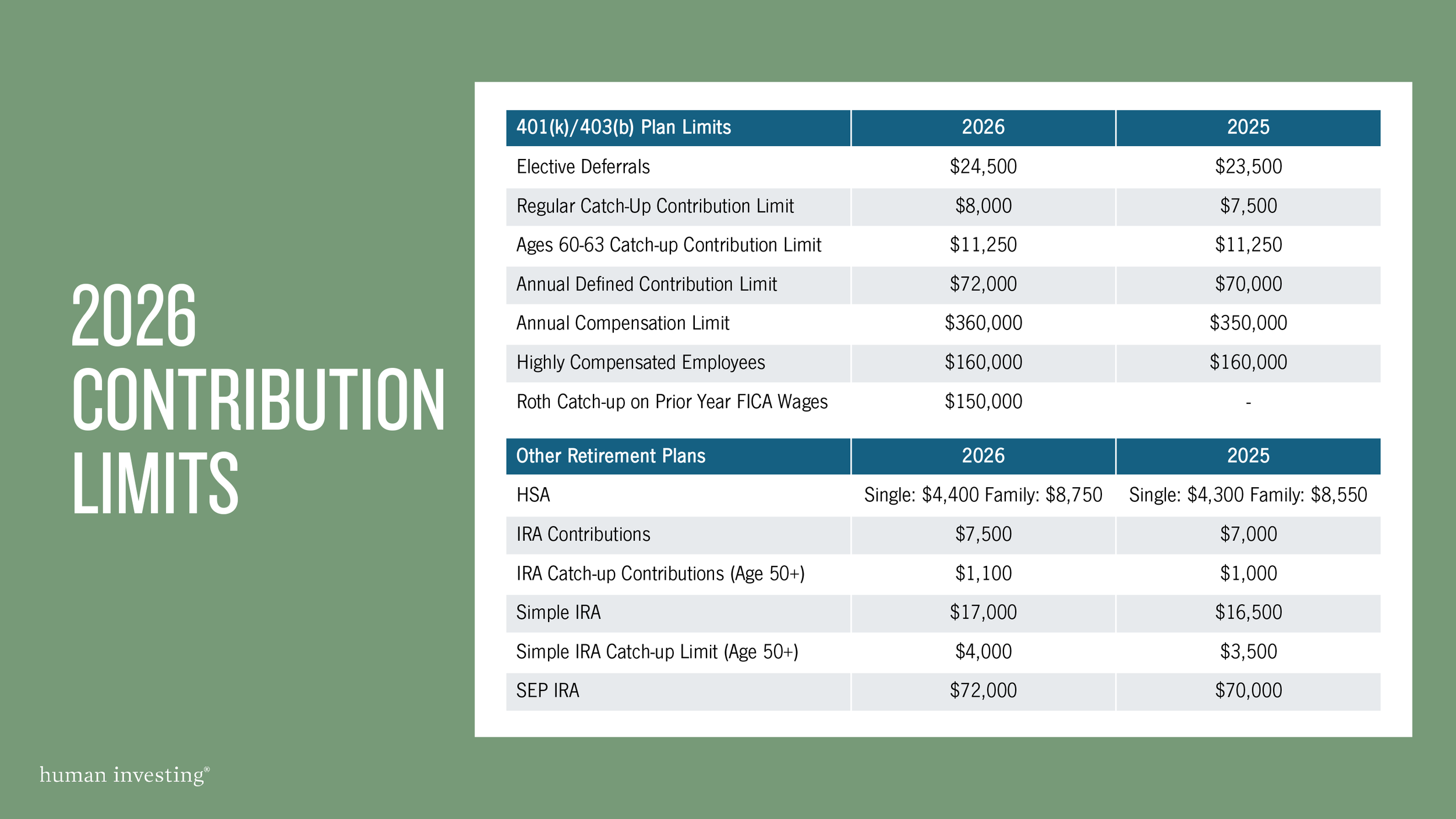
Here is the breakdown for 2026:

  • Under age 50: $24,500

  • Ages 50–59 and 64+: $32,500 (includes a $8,000 catch-up)

  • Ages 60–63: $35,750 (includes an $11,250 “super” catch-up)

SECURE 2.0 added another layer on top: starting in 2025, workers ages 60–63 get access to “super” catch-up contributions, up to 150% of the regular catch-up limit (or 110% for SIMPLE plans).

It is possible that catch-up contribution may be required to be made as a Roth contribution, especially if your income exceeds certain thresholds.

For employees, the downside is giving up the upfront tax break on catch-up contributions. The upside? Tax-free withdrawals later.

For employers, the stakes are higher: if the plan isn’t set up to handle Roth catch-ups, some employees could lose access to them entirely.

Diving Into the New Rule: Roth Required for Some

Here’s the key change:

If you make more than $150,000 in FICA wages in 2026 (adjusted annually), all your catch-up dollars will have to go in as Roth contributions, after tax dollars, starting January 1, 2026.

This means if you fall into the higher-income category, your Roth catch-up will be automatically applied to your eligible contributions once you hit age 50.

A few quick clarifications:

  • This does not apply to SIMPLE IRAs or SEP plans.

  • Wages are measured using Box 3 on your W-2.

  • If your plan does not include a Roth deferral option, catch-up contributions won’t be permitted in your plan regardless of income.

Congress delayed this rule once (from 2024 to 2026) to give employers time to adjust. That grace period is ending soon.

Two Types of Catch-Up Contributions

Depending on your age and plan setup, catch-ups may fall into these buckets:

  1. Standard age-50 catch-ups
    These are the usual “extra” contributions, and the ones subject to the Roth rule if you’re over the wage limit.

  2. “Super” catch-ups at ages 60–63
    Optional, but attractive for late-career savers (and yes, Roth rule applies to these as well).

If You Sponsor a Plan, Start Here

A survey from the Plan Sponsor Council of America says only 5% of plan sponsors feel fully ready.

Payroll providers will bear the heavy lifting here. Plan sponsors should lean on their payroll providers and ensure that there is clarity on how catch-up contributions are being made.

To facilitate administration of this new rule and employee experience, we suggest permitting “Deemed” Roth contributions. This means that there is an assumption that catch-up contributions will be considered Roth, even if an employee has elected pre-tax deferrals for their base contribution. Deemed Roth feature is typically setup as a function of payroll and must be included in your governing plan documents.

To avoid last-minute scrambling, here’s what employers should be doing in 2025 and into 2026:

  • Check whether your plan even offer Roth - this is a great deferral option for all employees, regardless of income.

  • Talk to payroll and your recordkeeper about tracking who’s subject to the rule.

  • Permit “Deemed” Roth contributions and amend plan document(s).  

  • Review catch-up provisions for ages 60–63 and for 403(b) service-based rules.

  • Create employee communications, especially for those over the wage limit.

  • Work with your Recordkeeper or TPA on plan amendments.

What’s the Timeline?

Here’s how the rollout shakes out:

  • Now — Setup a call with payroll and recordkeeper.

  • December 31, 2025 — New catch-up limits kick in.

  • January 1, 2026 — Roth requirement becomes real.

  • Late 2026 — Formal plan amendments are due.

We’re here to help

For the workers affected, the downside is giving up the upfront tax break on catch-up contributions. The upside? Tax-free withdrawals later.

For employers, the stakes are higher: if the plan isn’t set up to handle Roth catch-ups, some employees could lose access to them entirely.

Bottom line: Roth is about to move from optional to unavoidable for a lot of savers. Getting ahead of the change now will make 2026 less stressful. If you or someone you know may need assistance, let’s meet!


Disclosure: This material is for informational and educational purposes only and should not be considered personalized tax, legal, or investment advice. You should consult your own qualified tax, legal, and financial professionals before making any decisions based on this information. Tax laws and regulations, including those discussed here, may change and can vary based on individual circumstances. The examples and explanations provided are for general understanding and should not be relied upon to predict or guarantee outcomes. Investing and retirement planning involve risk, including possible loss of principal. Past performance does not guarantee future results. Advisory services are offered through Human Investing, LLC, an SEC-registered investment adviser.


 

Related Articles

How to take care of your spouse financially if something happens to you


As the person who manages most of the financial decisions in your household, it's natural to want to ensure your spouse is financially secure if you're no longer around. The financial burden on a widow can be overwhelming, especially with the lesser-known tax implications that often follow the death of a spouse. By planning ahead, you can safeguard your spouse from unnecessary financial stress.

Taking a few proactive steps now can help shield your spouse from these challenges and give them peace of mind. This guide will walk you through the financial implications of losing a spouse and what you can do today to ensure you preserve your assets for their well-being.

There are two common tax shocks you want to get ahead of:

Tax shock #1: The “survivor's penalty”

After a spouse dies, the widow is often left facing what’s called the "survivor’s penalty," which refers to higher taxes that result from a change in filing status. While you may currently file taxes jointly as a married couple, your spouse would be required to file as a single taxpayer after your death. This change can increase their tax bill substantially.

Here’s why this matters:

  • Higher Marginal Tax Brackets: After your passing, your spouse’s income could fall into a higher tax bracket due to the narrower brackets for single filers compared to married couples.

  • Reduced Standard Deduction: In 2024, the standard deduction for married couples filing jointly will be $29,200, but for single filers, it will be just $14,600. This reduction will increase the amount of income subject to taxes.

Looking ahead, it’s important to note that individual tax brackets are set to revert to pre-2018 levels in 2026, further increasing the tax burden on your spouse if you’re no longer here.

Tax shock #2: Hefty taxes on IRA distributions

If your spouse inherits your retirement accounts, such as an IRA, they’ll also face higher taxes due to Required Minimum Distributions (RMDs). These distributions are considered ordinary income, and combined with their new single filing status, could push them into an even higher tax bracket! The larger your IRA, the bigger this tax burden becomes.

What may seem like a well-planned nest egg now could become a source of financial strain later on due to taxes. By understanding this, you can take steps now to lessen the impact on your spouse’s financial future.

Firsthand example from a retired couple

When Spouse #1 and Spouse #2 file jointly, both receive Social Security and must take Required Minimum Distributions (RMDs) from their retirement accounts. Let’s look at their income and tax bill while filing as Married Filing Jointly (MFJ):

Now, if Spouse #1 passes, Spouse #2 becomes the sole taxpayer, facing a shift to the Single filing status. Spouse #2 is still required to take the same RMD amount as the beneficiary of the retirement accounts and claims Spouse #1’s higher Social Security benefit under the survivor benefit rules. However, Spouse #2 cannot receive both Social Security payments, so Spouse 2’s income is reduced. Here’s what their tax situation would look like:

Despite an almost 16% drop in income, Spouse #2's tax bill increases by over 30%, showing the impact of the survivor’s penalty on income and tax liability.

This example highlights why it’s essential to plan ahead to help lessen the financial burden on surviving spouses.

Four strategies to protect your spouse from a heavy tax burden

Fortunately, there are several strategies you can use to reduce the tax burden on your spouse in the future:

  1. Complete Tax Projections: To best plan for the future and make calculated decisions, it’s necessary to understand your expected lifetime tax bill. A comprehensive tax projection will identify your current and future tax rates, potential gaps, and overall lifetime tax obligations. This helps you make informed decisions today.

  2. Partial Roth IRA Conversions: Converting part of your traditional IRA into a Roth IRA over time can help reduce the tax impact on your spouse later. While you’ll pay taxes on the conversion now, the Roth IRA’s future growth will be tax-free, meaning less taxable income for your spouse when they inherit it.

  3. Take Advantage of the Step-Up in Basis: For non-retirement investments, your spouse can benefit from a "step-up in basis." This allows the cost basis of assets to reset to their value at the time of your death, potentially eliminating capital gains taxes if they were to sell those assets. Understanding this advantage can save your spouse from an unexpected tax bill down the road.

  4. Naming Non-Spouse Beneficiaries: Another option to reduce taxes is to name non-spouse beneficiaries for some of your retirement accounts, such as your children and grandchildren. While this can lessen the tax burden for your spouse, it’s essential that these non-spouse beneficiaries understand the new withdrawal rules set by the SECURE Act. This law requires that non-spouse beneficiaries fully distribute inherited IRA funds within 10 years, which could trigger substantial tax liabilities for them if not carefully planned. Additionally, consider adding a qualified charity as a beneficiary to your IRA for a tax-free transfer gift.

You can start planning ahead with your spouse now

Planning for your spouse's financial future can be an impactful gift. While it may be uncomfortable to think about what happens if you're no longer here, taking proactive steps now will ease your spouse’s transition during a difficult time. Here are a few key actions to consider:

Have Regular Financial Discussions: Make sure your spouse understands your financial plan, knows how to manage accounts, and is familiar with where to find important documents.

Work with a Fiduciary Financial Advisor: A financial advisor can help you develop a plan tailored to your family’s situation. By understanding your overall financial situation, an advisor can provide guidance now and assist your spouse when you're no longer there. They can also help with tax projections, Roth conversions, beneficiary updates, and staying ahead of tax law changes.

Create a Clear, Organized Estate Plan: Ensure your estate plan is up to date, including wills, trusts, health care directives, power of attorney, and beneficiary designations. This will help prevent unnecessary complications for your spouse during an already challenging time.

Be Proactive About Taxes: By planning for your spouse’s future tax obligations, you can reduce the “survivor’s penalty” and give your spouse more financial security.

You’ve worked hard to provide for your family, and planning for your spouse’s financial future if something happens to you is a vital part of that legacy. While it may seem difficult to know the "right" time to prepare, we can't predict the future. Whether you're already in retirement or facing a serious diagnosis, projecting out scenarios can make all the difference for your spouse’s security.

Don’t wait until it’s too late—start planning now to protect your loved one from unnecessary financial strain.


Related Articles

Retirement Income Planning: Tax Bracket Optimization
 

We help our clients organize and implement tax bracket optimization. In your early years of retirement, even if you do not have earned income, there are important tax considerations. I will illustrate two recurring tax planning strategies: Roth Conversions and Capital Gain Realization.

Consider a retired married couple (both age 65) living in Oregon this year.

In this example, this couple has $36,700 of taxable income. This places them in the 12% federal tax bracket and provides $52,750 more room inside the 12% bracket before moving into the 22% bracket.

Considering the wiggle room before the increased tax rate, this client could decide between the following options:

OPTION 1: Realize Capital Gains

Realize (sell and reinvest) up to $52,750 of long-term (held longer than 12 months) capital gains to take advantage of the 0% Federal Capital Gains rate within the 12% bracket. This couple living in Oregon would still pay 9% State. Ideally, they pay less taxes today to avoid realizing those gains at 15% Federal and 9% State later, likely during the required distribution timeframe starting at age 73. They would keep 15% more of the growth on their investments.

Option 2: Conduct Roth Conversions

If a client does not have any taxable accounts or unrealized capital gains, they could use the room in the 12% bracket to conduct Roth conversions. This would consist of transferring funds from a traditional IRA, paying the taxes now (12% Federal and 9% State), and putting the net amount into the Roth IRA to grow tax-free overtime. This strategy is helpful to maximize the 12% bracket, since the 12% bracket will revert to the 15% bracket in 2026, when the Tax Cuts and Jobs Act (TCJA) ends. Additionally, when a client turns 73 and is required to take distributions from IRAs, this required distribution amount cannot be converted to a Roth IRA but must be distributed.

Required distributions could also push income from IRAs into the 22% bracket. Another benefit of Roth conversion is that Roth IRAs are not subject to required distribution rules and therefore can continue to grow tax-free for the life of the married couple.

Option 3: Combination of realizing Capital Gains and Roth Conversions

This requires year-by-year income and deductions tracking from all sources to ensure the right amount of money is being realized or converted.

Tax bracket optimization is not an after-thought, but a pivotal component of holistic financial planning offered at Human Investing. If this kind of planning would be helpful to you, please schedule a time to review your situation.


Retire Early With the Rule of 55
 

Taking a distribution from a tax-qualified retirement plan, like a 401(k) before age 59.5, is generally subject to a 10% penalty for early withdrawal. The exceptions to paying this 10% penalty are:

Are you familiar with how the Rule of 55 works? If you want to retire early, this blog post is significant for you.

What is the Rule of 55?

The Rule of 55 is an IRS provision that allows employees who leave their job on or after age 55 to take penalty-free distributions from their retirement accounts. It’s a life hack! Typically, individuals would face a 10% early-withdrawal penalty if they access their retirement account before age 59.5. The 10% penalty and account accessibility are two of the reasons why people plan to work until at least age 59.5. 

If you are someone who is thinking about retiring early, the following Rule of 55 requirements are necessary:

  1. You leave your job (voluntarily or involuntarily) in or after the year you turn 55 years old.

  2. Your plan must allow for withdrawals before age 59.5.

  3. Your dollars must be kept in your employer’s retirement plan. If you roll them over to an IRA, you lose the Rule of 55 protection.

  4. You will likely want your plan to allow partial distributions when you are terminated.

Access to your retirement account at age 55 is available for all employees with an employer-sponsored retirement account. However, if you are considering retiring after age 55 and using funds from this retirement account, you must check whether your plan allows partial distributions. This feature is an opt-in feature for employers to select. We recommend that you work closely with your recordkeeper to ensure you can take advantage of the Rule of 55 in a way that benefits you.

3 Examples of the Rule of 55

Look at a few examples of employees with partial distributions compared to employees without partial distributions allowed in their plan.

Example 1: Partial Distributions Allowed

Danielle can take any amount from her PDX 401(k) account. For example, in October 2022, she can request $30,000. She doesn’t have to take anything out in 2023. She could take another $65,000 out in January 2024.

EXAMPLE 2: Partial Distributions Disallowed

Martin’s employer-sponsored retirement plan does not permit partial distributions. If he wants to access his retirement account at age 57 without incurring a 10% early-withdrawal penalty, he would have to withdraw the entire $450,000. This would result in reporting $450,000 of taxable income for the year of his distribution. Given the tax bracket optimization strategies that exist during retirement years, this may not be Martin’s best solution for accessing dollars before age 59.5.

A couple of alternative solutions for Martin are:

  1. Ideally, Martin would have a cash-flow plan to support his expenses until he reaches age 59.5.

  2. Initiate a direct rollover of his $450,000 retirement account into a IRA account. Then take distributions as needed but expect to pay a 10% penalty on these dollars. Before paying a 10% penalty on an early-distribution from a IRA, we would recommend that Martin review other cashflow options he may have.

Example 3: Partial Distributions Disallowed

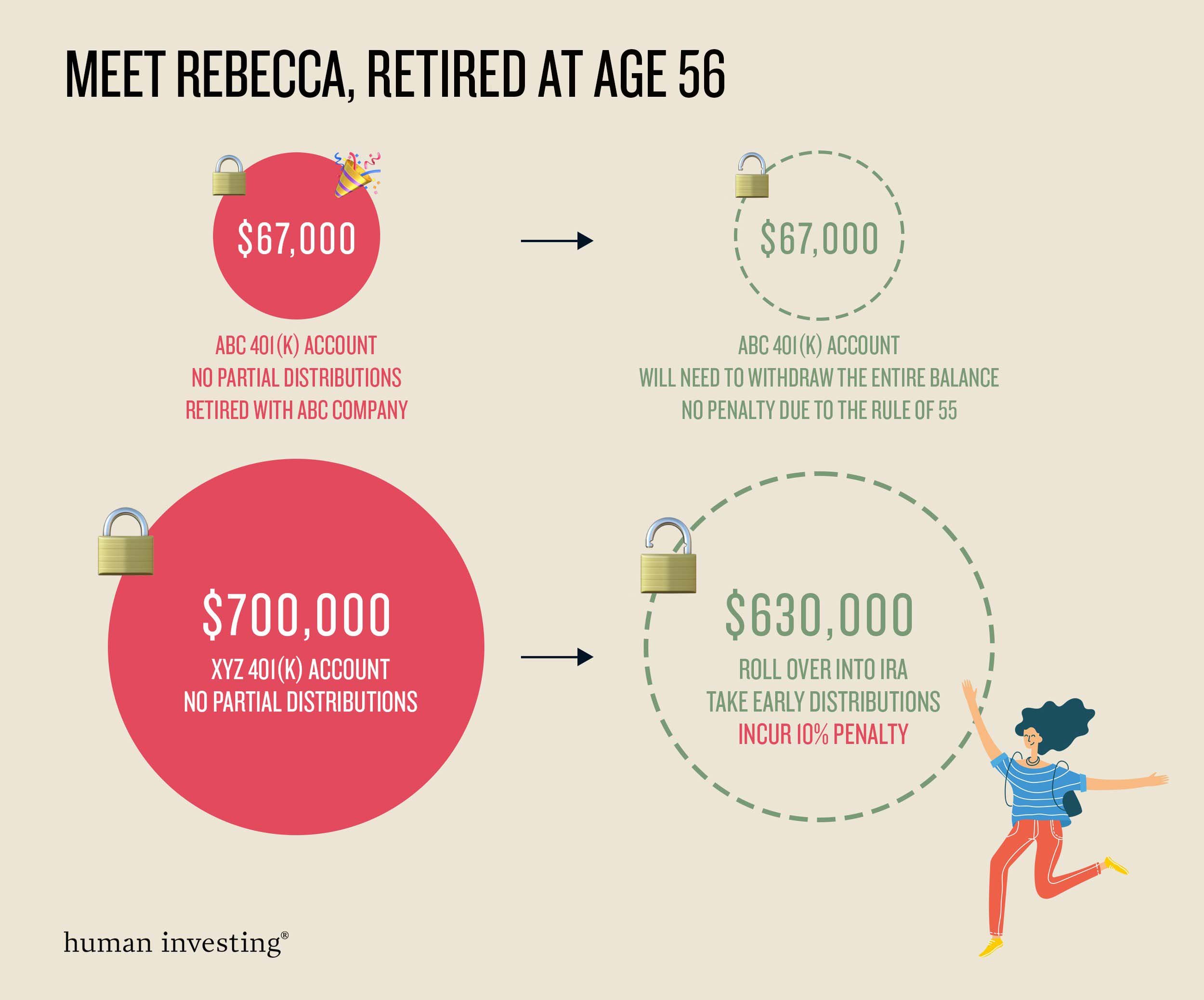
Rebecca, age 56, has $67,000 saved in her most recent 401(k) account with ABC Company. She also has $700,000 saved in her previous 401(k) account with XYZ Company. Neither of these retirement plans allow for partial distributions.

Rebecca retired at age 56 from ABC Company, so she can take the entire $67,000 balance out in one lump sum distribution. She will not owe a 10% penalty on these dollars due to the Rule of 55.

If she were to access any of her $700,000 saved in her previous 401(k) account with XYZ Company before age 59.5, then she would incur a 10% penalty. Not to mention the $700,000 is sitting in a plan that disallows partial distributions so that would be significant taxable income to report in the same tax year. Similar to the example above, Rebecca may consider initiating a direct rollover of her $700,000 into a IRA account for more flexible distribution choices.

What About Other 401(k) Accounts from Previous Jobs?

To qualify for the Rule of 55, you must be terminated as an employee on or after age 55. Therefore, if you have multiple retirement accounts, the only ones that will qualify for a penalty-free distribution between ages 55 and 59.5 are accounts with your termination date reflecting that age range.

One consideration is to roll over a previous retirement account into your current account before you retire. We recommend speaking with your recordkeeper to confirm that your retirement plan features are designed so rollover sources can be accessible by partial distributions.

For example, if Danielle from above had another 401(k) account, she could have rolled that into her PDX 401(k) account before retiring. All the dollars in the account would be eligible for Rule of 55 distributions.

What if I Decide to go Back to Work but have Taken Distributions Already?

Going back to work after you have taken a Rule of 55 distribution should not result in a 10% penalty. If you go back to work for the same company, then you may lose the ability to access funds as an active employee. However, your distributions will not be impacted if you go back to work at another organization.

How are Rule of 55 Distributions Tracked for Tax Reasons?

Custodians and recordkeepers are responsible for providing a Form 1099-R. This tax form reports any distributions from a retirement account. If you take a distribution under the Rule of 55, you would expect to see code 2 in box 7 of your 1099-R form. Code 2 specifies the following:

2 - Early distribution, exception applies (under age 59.5)

If your 1099-R form includes Code 2 in box 7, you will not owe a 10% penalty. Before you initiate a withdrawal between ages 55-59.5, we recommend confirming your record keeper will issue the 1099 in this format.

What Other Resources do you Have?

Retirement is a transition that only happens once in life. You probably haven’t retired before, and you likely won’t retire again. Retirement transitions involve several financial planning considerations and we wanted to conclude this article with additional resources that may be helpful to you:

Your Pre-Retirement Checklist

The 3 Questions to Ask to Build a Solid Retirement Income Plan

Why an IRA Makes More Sense in Retirement than your 401(k)

While the articles are supplemental information, we believe the best way to prepare for your upcoming retirement is to collaborate with our team at Human Investing. Please use this scheduling link to meet with our team to review your unique financial landscape before you start planning your retirement celebration(s): Schedule here.


Related Articles

Your Pre-Retirement Checklist
 

Transitioning into retirement can be an exciting time. For many it can also be a daunting reality. We hope the following Pre-Retirement Checklist is a helpful tool as you intentionally prepare for your retirement years.

5-10 years out 

  • Create a plan to pay down debt.   

  • Maintain Emergency Fund – Emergencies still happen in retirement.  

  • Familiarize yourself with Social Security, Pension, and/or Defined Benefit options.  

  • Consider Long Term Care (LTC) options – LTC Insurance vs Self-insuring using other assets.  

  • Maximize all tax-advantaged savings accounts – 2021 Contribution Limits.  

  • Review your investment strategy to make sure your retirement accounts are in line with your risk tolerance and timeline.   

  • Strategize how to divest from company stock.  

2-4 years out 

  • Devise a retirement spending plan:   

  • Begin developing a plan for a fulfilling retirement (goals, purpose, health).  

  • Practice being retired – take a long vacation in the location you plan to retire and live within your retirement budget. 

  • Retirement Living Plan:  

    • Evaluate downsizing a home or relocation and the associated tax implications.  

    • If a mortgage is required, relocate while you still have the income to qualify for the mortgage preapproval process. 

  • Formulate a plan to exercise your stock options

  • Review insurance needs – potentially to cancel or lower life/disability insurance.  

< 1 Year out 

  • Formulate a health care plan:   

    • Investigate Medicare, Medigap, and Medicare Advantage plans.  

    • Compare Individual Insurance policy or COBRA if you are younger than age 65.  

    • Enroll in Medicare 3 months before age 65.  

  • Apply for Social Security benefits 3-4 months before you want benefits to start.  

  • Determine how much monthly income you need from your portfolio to cover your expenses.   

  • Analyze your retirement income plan.

  • Consider a HELOC while you still have the income to qualify.  

  • Update estate plan documents with retirement changes.  

  • Take advantage of employer medical plans.   

Download this as a printable one-sheeter.

Planning for retirement should be exciting. Please reach out if our team of credentialed experts can help you navigate the road to retirement.


Related Articles

Biden's New Tax Proposals and What They Mean For You
 

With each presidential election comes a slew of new tax proposals and changes that are sometimes difficult to decode. News outlets mix proposed and enacted laws, furthering the stress that comes with determining how they will affect your taxes.

The biggest takeaway from Biden's new tax law proposals is that those who earn under $400,000 of income per year should not expect to face an increase in taxes. In fact, they are likely to see more tax credits that will help reduce their tax liability. However, those who make above $400,000 could be significantly affected by several of the proposed tax law changes.

Below is an outline of the administration’s current proposals that may become laws in the coming tax seasons based on your yearly income.

for THOSE WHO MAKE BELOW $400,000

What’s been enacted: The Dependent Care Tax Credit.

Eligible childcare expenses increased from $3,000 to $8,000 ($6,000 to $16,000 for multiple dependents) and the maximum reimbursement rate has increased from 35% to 50% for a maximum credit of $8,000. It is refundable for the 2021 tax year. If you pay for childcare services in 2021 for children 12 and under, you can claim those expenses in tax credits up to $16,000.

blog pic 1.png

The Child Tax Credit has temporarily increased from $2,000 to $3,000 per child ages 6-17, and $3,600 per child aged 0-5 for the 2021 tax year. There will also be monthly payments made from July to December 2021. Half the total credit amount will be paid in advance with the monthly payments, while the other half will be claimed on the tax return that you will file next year. For example, if a single filer with an AGI of $60,000 had one 13-year-old child, they would receive $250 per month from July to December and $1,500 as a credit on their 2021 tax return.

blog pic 2.png

The increase (i.e., the extra $1,000 or $1,600) is gradually phased-out for joint filers with an AGI of $150,000 or more, head-of-household filers with an AGI of $112,500 or more, and all other taxpayers with an AGI of $75,000 or more. At $440,000, couples will phase out of the tax credit entirely.

What’s been proposed: First-Time Homebuyer’s Tax Credit reinstated for up to $15,000 in refundable credits.

You may not have owned a home within the last 3 years to qualify for this credit. You must make no more than 160% of the area median income, and the home’s purchase price must be no more than 110% of the area median purchase price. You could claim this credit for primary residences purchased after Dec. 31, 2020.

for Those Who Make Above $400,000

What’s been proposed: Increased income tax

Currently, the top individual income tax rate is set at 37% on earnings above $622,050 ($518,400 for those filing single). The new proposed rate is 39.6% for earnings above $400,000.

blog pic 3.png

What’s been proposed: The 6.2% Social Security payroll tax on income above $400,000.

For 2021, the maximum limit on earnings for withholding of Social Security tax is $142,800. This proposed tax law would result in the 6.2% tax continuing on earned income over $400,000 in addition to the 6.2% tax on earned income up to $142,800. The income between $142,800 and $400,000 would not be subject to this tax. For example, if $450,000 is earned, $50,000 will be taxed at 6.2% resulting in $3,100 paid in SS tax on top of original cap of $8,853.60.

blog pic 4.png

What’s been proposed: Long-term capital gains and qualified dividends be taxed at a rate of 43.4% on income above $1,000,000.

Long-term capital gains above $501,600 ($445,850 for those filing single) is currently taxed at 20%. In addition, they are proposing the elimination of the step-up in basis for transferred assets.

What’s been proposed: Restoration of the limitation on itemized deductions (ie. mortgage interest, charitable contributions, property taxes, etc.) for taxable income above $400,000.

This means your itemized deduction amount would be reduced by the lesser of 3% of AGI in excess of $400,000 or 80% of your itemized deductions. The state and local tax deduction limit of $10,000 could also be removed, allowing for additional deductions in state and local taxes paid above $10k. For example, a person has $750,000 of taxable income, and their itemized deductions total $75,000. 3% of their taxable income above $400,000 = $10,500, 80% of itemized deductions = 60,000. Since the 3% calculation is the lesser of the two, their itemized deduction amount of $75,000 is then reduced/lowered by $10,500, resulting in $64,500 of itemized deductions.

blog pic 5.png

What’s been proposed: Pass-through deductions removed for taxpayers earning more than $400,000.

For business owners of a Sole Proprietorship, Partnership, S-Corporation, and certain trusts and estates, the Section 199A pass-through deduction for qualified businesses could be up to 20%. The maximum deduction is the lesser of 20% of an owner’s QBI, or 20% of taxable income, excluding any net capital gains. If it were to pass, this deduction would no longer be available if the taxpayers net income were above $400k.

What’s been proposed: Estate and Gift Tax exemption rates for assets may be brought back to 2009 rates.

For 2021, the unified federal gift and estate tax exemption is $11.7 million per individual. The tax rate on cumulative lifetime gifts in excess of the exemption is a flat 40% (applicable to taxable amounts above $1 million made while still alive). The estate tax exemption for Married Filing Jointly (2009): $7,000,000. For those filing Single (2009): $3,500,000. The maximum gift tax rate (2009): 45%

BUSINESS AND CORPORATE TAXATION

What’s been proposed: Increased corporate income tax from 21% to 25-28%.

While this may not directly affect your taxes, it may affect any assets you have in company stocks or potential dividends depending on how the corporation decides to deal with the increase in tax.

What’s been proposed: Minimum tax on corporations with $100 million or more in book income.

Corporations would be taxed on the greater of their regular corporate income tax rate or have a 15% minimum tax imposed on them.

It is important to remember that all proposed tax law changes would need to be reviewed and enacted by Congress in order to become official tax law. All proposed law could potentially be revised or eliminated.


It might be time to Maximize your Intel SERPLUS Deferred Compensation Plan
 

Perhaps now more than ever, it makes sense to increase your deferral to the SERPLUS deferred compensation plan. The following chart compares current tax rates to the proposed tax rates by the new administration.

Web 1920 – 1.png

Though we are uncertain when the tax changes will be implemented, we do know that tax rates will increase. If taxes increase, your deferred compensation benefits may become even more important for your tax planning.

TAP INTO Significant Tax and Income Benefits

Deferred compensation plans provide an opportunity to receive less income today in order to pay less taxes on that income when received in the future. When making annual deferred compensation elections, you have the choice of a 5-year, 10-year, or lump sum payment at retirement (when employment with Intel ends). If you plan to retire at 62, you could elect to receive distributions for 10 years from your SERPLUS plan to stretch out your income and realize it in a lower tax bracket until age 72. With this plan, you have deferred compensation income providing for your first 10 years of retirement. In your early 70’s, social security and required IRA distributions will supplement your steady income stream, and eventually replace your deferred compensation income.  

Spreading deferred compensation income out over 10 years allows you to take it in a lower tax bracket, like 21% for Federal and State combined or 24% combined after 2025. This tax deferral would provide for a tax reduction between 23% and 35%. In a hypothetical scenario, $50,000 contributed per year over 15 years would total $750,000 (without earnings computed). The income deferral could provide $172,500 in tax savings in a conservative example and $262,500 in savings in a more generous example. That is real money in your pocket rather than in the Federal and State governments. 

In the peak earning years of your life, with your 401k maxed out and not providing enough tax deferral and future income, the SERPLUS deferred compensation plan is a great tool to help increase both.

Cash Flow Considerations AND SOLUTIONS

If you do participate in the plan, your current take-home pay will decrease.  If cash flow becomes tight, there are opportunities within your employee benefits that could help provide the needed funds. It may be advisable to sell some company stock (ESPP, RSUs) to supplement your monthly income so that you can participate in the plan and defer income. Keep in mind, your election made in 2020 on salary is for the 2021 income year, whereas the bonus election is for the bonus paid in 2022. A portion of the bonus could be especially important to defer in 2022 considering the proposed tax changes. 

Questions ABOUT YOUR INTEL BENEFITS?

If you have questions about making deferred compensation elections, please schedule a call.


What Type of Life Insurance is Right for you?
 
dylan-nolte-HNXi5znlb8U-unsplash.jpg

Life Happens. Be prepared and consider buying life insurance.

But what kind? How does one navigate through the many types and attributes of life insurance products? To make things more complicated, high commissions create an unavoidable conflict of interest for life insurance agents, which can muddy the waters and lead to further consumer uncertainty.

To provide clarity, we will explore what life insurance is and provide a broad overview of the different policies that can be purchased. Someone’s lack of understanding should not get in the way of life insurance being a part of their financial plan.

WHAT IS LIFE INSURANCE?

Life insurance is an important tool to protect loved ones and/or business relationships. Most people should have some form of life insurance to provide cash flow in case of the inevitable.

A life insurance policy is a contract between a policyholder and an insurance company. In exchange for payment of premiums, the insurance company will pay a death benefit upon the death of the insured. The death benefit is a tax-free* sum of money paid to the beneficiaries of the policy, which are often family members.

If you have someone who relies on you for financial support, and you cannot self-insure, you need life insurance.

TYPES OF LIFE INSURANCE?

There are numerous different types of life insurance policies. Policies will vary in coverage, premium cost, cash value, investment risk, and flexibility. Of these differences, policies can be divided into two key groups: Term life and Permanent life.

insurance-decisions.jpg

Term — Term life insurance allows the policy owner to pay for coverage for a predetermined number of years, typically 5, 10, 20, or 30 years. For most, a term policy is the least expensive way to purchase a death benefit. The death benefit can be level or decreasing. Some will purchase a decreasing death benefit to match their decreasing mortgage debt.

Life Insurance - Term and Permanent_Page_2.jpg

Permanent — Permanent life insurance is just as it sounds. The policy owner may decide to have their life insurance policy last a lifetime (up to age 120), often requiring a lifetime of premiums payments. There are several types of permanent policies. Popular policies include Whole, Variable (VL), Universal (UL), Variable Universal (VUL), and Indexed Universal Life (IUL).

Key differences between a term policy and a permeant policy include price, length of policy, and a component called cash value. Permanent policies are traditionally more expensive. The higher premiums cover the cost of the death benefit (including administrative fees), and the remainder is added to a cash value.

Life Insurance - Term and Permanent_Page_1.jpg

Traditionally, the death benefit is used at death while the cash value can be used during the policyholder’s life. The cash value of a permanent life policy can be a tax-advantaged savings vehicle for the policy owner. Permanent policies are typically most advantageous once other tax-advantaged savings vehicles like your 401(k), Roth IRA, etc. have been exhausted. The cash value may be available to the policy owner to withdraw or borrow against. The cash value can accumulate in a variety of ways and is often distinguished by the type of permanent policy. See below for differences between common permanent policies and their cash value accumulation.

Whole Life — The insurance company takes on the responsibility to pay out a dividend which is based on the performance of an investment portfolio managed by the insurance company and their ability to keep their business expenses low.

Variable policies (VL & VUL) — The policyholder may invest the cash value in a selection of mutual fund-like sub-accounts. Variable policies provide a “variable” growth (& potential loss) of cash value as sub-accounts are connected to underlying investments.

Index Universal Life (IUL) — The policyholder may earn interest based on the performance of an equity index, think the S&P 500. While there is no actual money invested in the index, interest is credited to the cash value based on the performance of the selected index. IUL’s provide variable growth with a cap on maximum returns (cap rate). There’s also a guaranteed minimum annual return (floor rate often never less than 0). For example, an IUL has a cap rate of 8% and a floor rate of 0%. If the selected index grows by 20%, the cash value is credited a growth of 8% (cap rate), if the index loses value by -5% the cash value does not decrease due to the index (floor rate).

insurance-chart.jpg

WHAT TYPE LIFE INSURANCE IS RIGHT FOR YOU?

This is our opinion, some life insurance agents and brokers with a conflict of interest may disagree.

You are young — Do you have plans for a family? This may be a great opportunity to purchase a term life policy. The younger you are, the less expensive premium payments will be.

You are the breadwinner — Term life insurance can replace lost income during working years. Life insurance prevents your surviving spouse (and children) to forgo their standard of living and helps meet the family’s financial obligations.

You are a stay-at-home parent — While there is no income number attached to a stay-at-home parent, there is a value associated with the services they provide a family. Term life insurance covering the years when kids are young can help cover the cost of child-care, housekeeping, and other responsibilities taken on by a stay-at-home parent. 

You own a home — For many Americans, a home is one of their largest assets and debts. Purchasing a term life insurance policy with coverage lasting the length of a mortgage can cover the remaining mortgage balance.  

You are a business owner — A life insurance policy is a multifaced tool for a business owner. A policy can help pay off business debts, pay estate taxes, and fund a succession plan like a buy-sell agreement. There are many variables to consider when choosing between term and permanent policies.

You have maxed out your retirement accounts — If you have maxed out tax-deferred retirement savings vehicles, a permanent life insurance policy can provide another avenue of retirement savings. Permanent policies build a cash value that can be accessed tax-free**. We do not typically recommend this to our clients because permanent policies are often very costly. The larger price tag can include investment costs (we commonly see 1-1.5%), administrative fees, as well as surrender penalties.

You want to leave an inheritance — Do you plan to spend all your retirement dollars, yet you would like to leave heirs with an inheritance? A permanent life insurance policy will provide a lump-sum benefit to your beneficiaries no matter when you pass away (can be up to 120 years).

You have a high net-worth — Permanent life insurance is best for those who are concerned about estate taxes. A lump-sum benefit at death is distributed to heirs to pay estate taxes, rather than selling-off inheritance.

Life is complex. As such, your situation may require multiple life insurance policies for you and your family.

WE ARE HERE IF YOU HAVE QUESTIONS

There are many options for life insurance. While Human Investing does not sell life insurance policies, we do help clients find the best policy within their financial plan. Having someone to help you navigate life insurance without incentive to sell you a product has immense value. If you have questions about what type of life insurance may be best for you, or how it fits into your financial plan, please contact us at Human Investing.


*Death benefit will be tax-free if it does not violate the “transfer-for-value” rule.

**Tax-Free-withdrawals up to basis then gain taken as loan.  Also, is not a modified endowment contract.


Related Articles

My Target-Date Fund reached the target year.. now what?
 

Target-date funds do not stop when they reach the target year. For example, Vanguard Target Date 2015 (VTXVX) still exists today even though it is 2020. Your dollars will not disappear!

Instead, target-date funds are designed to continue to serve the assumed age demographic of a specific retirement year. To provide a deeper understanding, we have outlined what will happen to 2020 target-date funds.

Target-date funds are designed one of two ways:

  1. “Through” target-date funds: Continue to shift their asset mix (less stocks, more bonds) over a predetermined number of years. The dollars invested in a target-date fund will remain inside the fund.

  2. “To” target-date funds: Reach the designated target year and merge with a retirement fund that maintains a specified asset allocation over time.

Either way – “through” or “to” target-date funds continue to be invested, and there is no required action-item for investors once the target year is reached.

2020 Target-Date Fund ExampleS

Since 2020 is a target year; let us look at what will happen to popular target-date funds.


Vanguard Target Retirement 2020 (VTWNX)

Vanguard’s glide path continues through for seven years (in this case 2027) until the asset allocation is 30% stocks and 70% bonds. After the seventh year, dollars merge into Vanguard Target Retirement Income (VTINX).

Fidelity Freedom 2020 Fund (FFFDX)

Fidelity Freedom’s glide path continues through for nearly twenty years (in this case 2040) until the asset allocation is 24% stocks and 76% bonds. After that, dollars merge into Fidelity Freedom Income (FFFAX).

T.Rowe Retirement 2020 Fund )TRRBX)

T.Rowe’s glide path continues through for thirty years (in this case 2050) until the asset allocation is 20% stocks and 80% bonds. These dollars do not merge with another fund, but instead maintain this asset allocation until the investor withdraws all dollars from the account.

AGAIN, YOUR DOLLARS WILL CONTINUE TO BE INVESTED OVER TIME.

The use and protection of retirement dollars (beyond a target year) is embedded in a fund’s lifecycle. Regardless of whether a target-date fund operates ‘through’ or ‘to’ the target year, your dollars will continue to be invested over time.


Related Articles

Female Baby Boomers and Retirement: A Status Update
 

Although the front end of the baby boom generation is well into retirement, we are still 10-15 years away from the final boomers to hit retirement age.  With this in mind, we wanted to take a look at this cohort and highlight the research specifically aimed at women.  You may be surprised by the uphill battles they’ve faced over the last few decades.

Limited Career Choices and Gender Bias in Retirement Policies

Although Baby Boomer women were far more likely to go to college and get a job than the previous generation, the concept of “acceptable” careers for women often pointed them toward work with lower compensation.  As a result of these lower paying careers, women had less money to defer into retirement accounts than their male counterparts—if they chose to defer funds at all.

Also, due to part-time work and lower wages these women are looking at significantly smaller Social Security payments in retirement.  This may leave many women either dependent upon a spouse or relying on Social Security and personal savings.  This, coupled with less time in the workforce due to pregnancy and child rearing, has left many female Baby Boomers at a great disadvantage.

Individual Responsibility and the Psychology of Saving

Another challenge facing female Baby Boomers is the fear of risk and the perception that money is something that should be left to men.  The latter mindset may have led some women to leave retirement planning and budgeting up to their spouses.  Couple this with a lack of individual responsibility on the parts of both men and women in this generation, and we are left with a big problem. 

According to several studies conducted in the mid-nineties (O’Neill, 1991; Twentieth Century Services, 1994). Hayes and Parker (1993), Kadlec (1994), and Pope (1994), the Baby Boomer generation was shaped by a more affluent lifestyle than their parents.  They enjoyed a higher median gross income and higher free spending limits.  Additionally, since Boomers are a generation detached from the Great Depression’s influence on the importance of saving, many have more reliance on Social Security for retirement and simply have not saved enough.

Risk Averse and Under Educated

Research dating back to 1994 and prior (NCWRR) found that women tend to be conservative, low-risk investors.  At the time of these studies, 72% of the women who saved chose investments that provided only marginal returns.   In order to keep up, women now need to be willing to take more risk in their investments.  This is counter intuitive to how many women of this generation were raised and educated.  To compound this difficulty, many financial advisors and brokers assume women want less risk and therefore fail to do the planning and education needed to help their clients see the risk-reward return and to understand a pace of investing that keeps up with inflation. 

How We Can Help

In our work over the years with married, divorced or never married women, the answer always seems to be the same: Advisors need to understand their client’s biases, feelings, and fears about money and retirement.  We need to make a concerted effort toward financial literacy and, most importantly, to provide a solid, comprehensive financial plan.  Education and planning enable our clients to see the impact of their spending, savings, and the aggressive/conservative balance of their investments. 

At Human Investing we accomplish this through our process called hiPlan.  The hiPlan goal is to give our clients the peace that comes from the stability of a plan that enables them to live out the retirement they have worked hard and dreamed about.


3 Ways to Plan for Healthcare in Retirement
 

At Human Investing our advisors talk a lot about retirement, but more and more so, health care is becoming a larger component of how we need to plan. Below are 3 ways you can prepare for the medical needs that come with retirement years as well as an illustration from my life of what happens when you take your health for granted. This past weekend I competed with a team of coworkers and friends in the Wild Canyon Games, a weekend long multi event adventure race that takes pride in pushing its competitors to “find their limits.”

wildcanyongames.png


My most anticipated event was geocaching. My teammate/coworker Andrew Nelson and I spent 4 hours running 17 miles in the rugged terrain near Antelope, OR hunting for and finding hidden objects (caches) by means of GPS. Leading up to this event we knew preparation was key so we diligently used google maps and GPS software to plot our course to find the most valuable caches. We printed off maps and purchased the necessary gear to compete in this event.

  • GPS

  • The Right Equipment

  • A Winning Strategy

  • Slight Insanity

  • A Below Average Sense of Direction

We were as prepared as a team could be, or so I thought… Now fast-forward to the event. It was mile 13 of 17 total miles and the end was in sight. Andrew and I were running to the finish line, and this is when things started going south for me. My vision blurred, my hamstrings balled up, my mental determination faded and each step was more difficult than the previous one. I didn’t “find my limit,” my limit found me and hit me square in the jaw. I wanted to crawl into a hole and hide. My body was shutting down. In all my preparation, I didn’t take into account my physical health. I didn’t train enough, eat enough or drink enough I didn’t prepare accordingly.

 
beautifulcanyon.png
 

When running the race of life, many make a similar mistake. We become so busy thinking about everything else that we forget to take care of ourselves. Our busyness may hinder our health, especially as we look to the future and see the reality of our situation. The reality: health care in the United States is becoming more expensive: • Premiums, deductibles and other out-of-pocket expenses could cost a 65-year-old couple retiring today a jaw-dropping $220,000 – and that’s in addition to Medicare premiums.” (AARP.org)

• “The cost of health care is rising faster than inflation” (Forbes)

• According to the World Bank the average life expectancy in the US is 79 years, meaning retirement is lasting longer than ever before.

As we look down the trail towards retirement we can expect the same trend of rising health care needs and health care costs. The more you know and plan for you and your family’s health care, the better off you will be in the long run. Here are 3 thoughts to help you make sure your golden years of retirement stay golden:

1. Take advantage of your HSA: Many companies today are going the way of a High Deductible Health Plan (HDHP), frequently paired up with a Health Savings Account (HSA). An HSA has a triple tax advantage when used to save for inevitable health care costs:

1) Contributions (money put into the account) are pretax. 2) Through interest, dividends or capital gains your account can grow tax free. 3) Any withdrawals for qualified medical expenses are tax free.

Some HSA’s also have an option to invest these dollars with the goal of growth for a later date, similar to a retirement plan. If you have access to an HSA don’t miss out on this great opportunity to save for future health care expenses.

2. Save accordingly: Control what you can control. • Start saving, keep saving and stick to your goals. • Take advantage of your company’s 401(k)! Sign up and contribute as much as you can. • Ask questions: call the 401(k) Advisors at Human Investing with questions regarding saving for retirement - 503.905.3100

3. Invest in yourself: Whether you plan to travel the world, spend time with family, or give back to the community you will need good health to achieve your goals and dreams. You can begin making healthy choices today by sticking to those New Year’s Resolutions, eating right and exercising. Invest in yourself - keep your mind and body active and healthy for years to come.

Just like geocaching, it’s necessary to make adequate preparation for your future, but unless you invest in yourself well it becomes difficult to finish strong in the race of life.


Related Articles