
Posts tagged tax2
A Big Tax Break for Retirees: How To Put the New $6,000 Deduction To Work Before It’s Gone


On July 4, the One Big Beautiful Bill Act (OBBBA) became law, as a broad tax and spending package aimed at easing inflation and delivering financial relief to Americans. One of the most notable provisions for retirees is a new $6,000 “senior bonus deduction” for individuals age 65 and older.

The $6,000 bonus deduction is available to all eligible seniors, whether they take the standard deduction or choose to itemize. This is different from the age-based standard deduction, which is only allowed if you take the standard deduction.

Unlike the age-based standard deduction, this new bonus stacks on top of your existing deductions, making it one of the most generous tax breaks retirees have seen in years.

Here’s what’s changing and how to take advantage of it in your retirement plan.

How the stacked tax deduction will work

Starting for tax year 2025, taxpayers age 65 and older will be able to combine:

  • A standard deduction of $15,750 (single) or $31,500 (married filing jointly), with

  • An age-based addition of $2,000 (single) or $1,600 per spouse if married, and

  • A new $6,000 senior bonus deduction under the OBBBA.

That means a single filer over 65 could deduct up to $23,750(previously $16,550). A married couple where both spouses are 65 or older could deduct $46,700 (previously $32,300).

The catch?

Eligibility is income-based. The full deduction is available to those with modified adjusted gross income (MAGI) up to $75,000 for single filers or $150,000 for joint filers. The deduction begins to phase out once above those thresholds and is fully phased out at $175,000 for single filers and $250,000 for joint filers.

It’s also worth noting that this senior bonus deduction is temporary. As of now, it only applies for the 2025 through 2028 tax years. It’s possible Congress could extend it further, but we likely know until 2028.

Why It Matters: Five Planning Opportunities Worth Exploring

This deduction will reduce taxes for many retirees. But its real value lies in the doors it opens for proactive planning. Here are several strategies we’re helping clients explore:

1. Rethinking Roth Conversions

Roth conversions allow you to shift money from traditional IRAs to Roth IRAs, paying tax now to enjoy tax-free withdrawals later. The bonus deduction gives retirees more room to convert IRA dollars at lower effective tax rates.

By combining the standard deduction, the age-based addition, and this new $6,000 bonus, some retirees may be able to convert dollars each year with minimal tax impact. This can lower future required minimum distributions (RMDs), reduce lifetime taxes, and create more income flexibility down the road.

There’s a sweet spot between retirement and RMDs where this approach can have the most impact.

2. Smoothing Income Over Multiple Years

Retirees often experience uneven income from asset sales, business wind-downs, or large IRA distributions. With this senior bonus deduction in place for four years, now is the time to think about spreading income more evenly across tax years, so you can qualify for this deduction while it’s available.

To make the most of the deduction each year from 2025–2028, consider ways to spread income more evenly across those years:

  • Delaying large sales or distributions to avoid spiking above the income threshold in a single year.

  • Accelerating income from future high-tax years into lower-income years.

  • Using multi-year tax projections to identify the optimal path.

This smoothing strategy can help avoid unnecessary spikes in tax liability while making full use of the available deduction each year.

Same Income, Different Results - This chart compares two retirees, each with an average annual income of $160,000 over four years.

  • Uneven Income: Income spikes in 2026 and 2028 push this retiree above the $175,000 phaseout limit, causing them to miss out on the $6,000 deduction in two years. Total lost deductions: $12,000

  • Smoothed Income: By spreading income more evenly across all four years, this retiree stays under the threshold and qualifies for the full $6,000 deduction every year.  Total deductions preserved: $24,000

Strategic income timing can preserve valuable deductions, even when total income stays the same.

3. Funding the Cashflow Gap Before Claiming Social Security

Delaying Social Security often results in higher lifetime benefits. The challenge is funding those interim years. The senior bonus deduction provides a helpful cushion, allowing retirees to generate income from taxable or IRA accounts without incurring as much tax.

This deduction could help bridge the gap, making it easier to delay Social Security while keeping tax costs under control.

4. Revisiting Withdrawal Order

The traditional guidance suggests pulling from taxable accounts first, then IRAs, and Roth accounts last. But with this expanded deduction, it may be worth adjusting that sequence.

You might instead:

  • Draw more from IRAs early, taking advantage of low tax rates and the temporary senior deduction. You’re essentially using the government’s tax break to convert IRA assets into spending money at a low cost. This can also reduce future IRA balances (and future taxable RMDs).

  • Reserve taxable accounts for later, especially after the senior bonus deduction expires.

  • Preserve Roth assets for high-income years or future tax flexibility.

Coordinating withdrawals across all account types with the new deduction in mind can improve long-term tax efficiency.

5. Aligning With Charitable Giving

If you’re charitably inclined, this is a good time to revisit your giving strategy.

Qualified Charitable Distributions (QCDs) from IRAs remain a powerful tool to give directly to charity without increasing taxable income. This also keeps your MAGI lower, which may help you stay under the $250k Joint/$175k Single threshold to qualify for the senior bonus deduction.

For others, donor-advised funds can be used to bunch gifts in one year to claim a high itemized deduction, then take advantage of the standard deduction in the next. In both cases, retirees can still benefit from the new $6,000 bonus deduction each year they qualify.

This new deduction adds flexibility, helping you give with greater intention and less tax friction.

Bottom Line

If you’re 65 or older, the next few years offer a unique window of opportunity. From 2025 through 2028, this new deduction can help lower your tax bill today and create long-term planning advantages that stretch well into the future.

It’s a reminder that good tax laws are only as valuable as the plans they inspire. Used thoughtfully, this expanded deduction can help you reduce lifetime taxes, generate tax-efficient income, and leave a stronger legacy.

The next four years offer a rare opportunity to rethink how you generate income in retirement. Whether you're considering a Roth conversion, adjusting withdrawal strategies, or supporting causes you care about, we’re here to help you build a plan that puts this deduction to work.



Disclosure: This material is for informational and educational purposes only and is not intended as personalized tax, legal, or investment advice. You should consult your own tax, legal, and financial professionals before making any decisions based on the information provided. Tax laws and regulations are subject to change, and their application can vary based on your individual circumstances. While the strategies discussed may be appropriate for some individuals, there is no guarantee that any specific tax outcome or investment result will be achieved. Any examples, scenarios, or case studies are hypothetical and for illustrative purposes only. They do not represent actual client situations and should not be relied upon to predict or project results. Investing involves risk, including the potential loss of principal. Past performance does not guarantee future results. All investments and tax strategies carry certain risks and may not be suitable for all investors. Advisory services offered through Human Investing, LLC, an SEC registered investment adviser.


 

Related Articles

Really? My Bonus is Taxed the Same as my Paycheck?
 

Your bonus is not taxed more than regular income.

Have you ever noticed the discrepancy between the bonus payment that was communicated to you and the actual bonus payout? As an example, let’s say your employer announced that you will get a $5,000 bonus, but the upcoming paycheck is only $3,500. What happened?! The common and incorrect narrative is something along the lines of “Bonuses are taxed more than regular income!”

This is not true. Bonuses are taxed at the same rate as your regular income. Please keep reading if you would like to see an example.

Why do we think that bonuses are taxed more than regular income?

Probably because bonus payments are treated by the IRS as ‘supplemental income’, whereas your regular income is treated as ‘ordinary income’ by the IRS.

Supplement and ordinary income are taxed at the same rate. However, supplemental income (like bonuses, overtime pay, severance, and tips) require employers to withhold more taxes. Due to the tax withholding, it feels like bonuses are taxed more than regular pay. And yes, they do have more taxes withheld up front so it does impact your cash-flow.

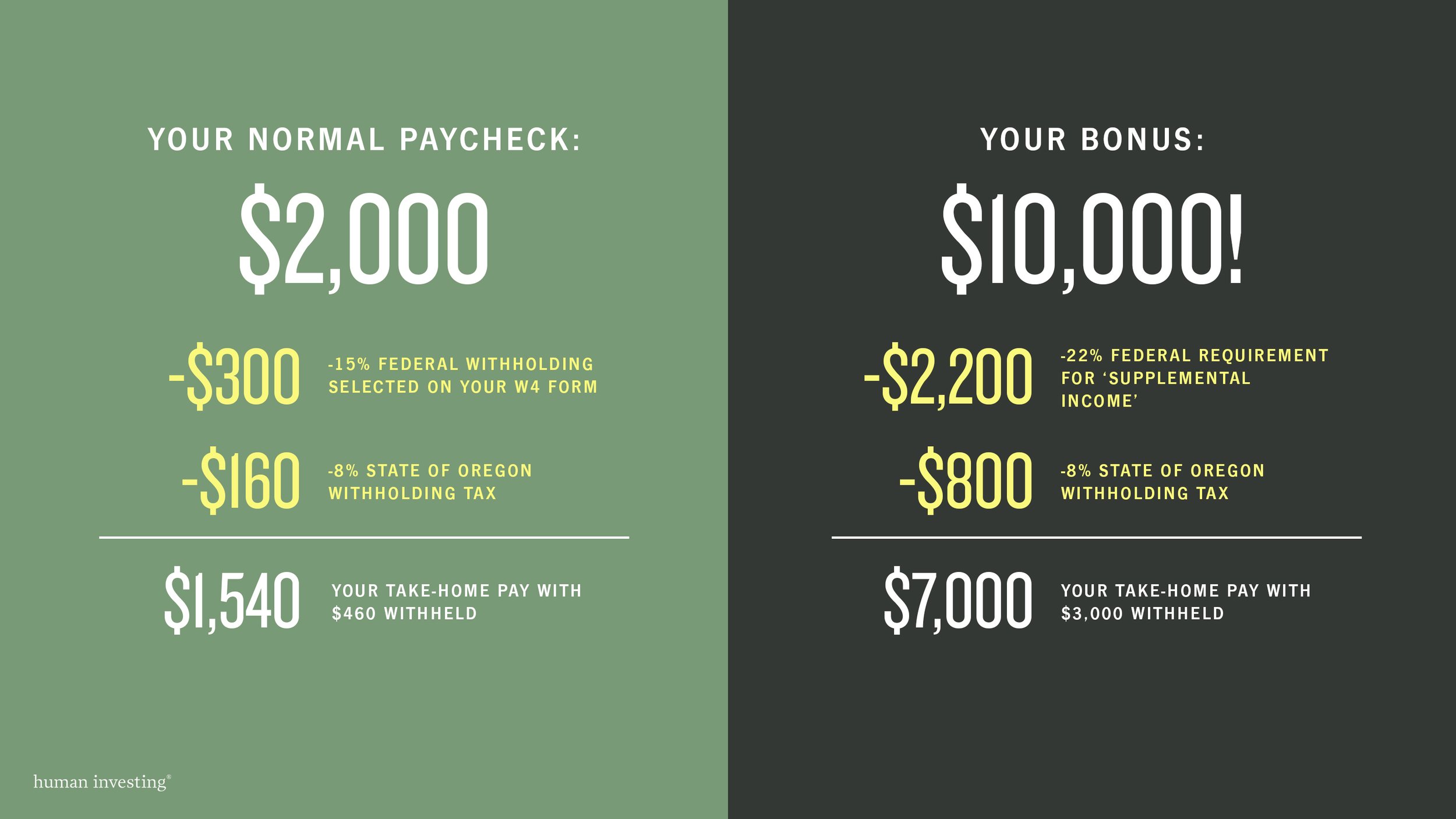
Because we love round numbers, let’s look at an example of for someone that normally receives a $2,000 paycheck and a one-time $10,000 bonus.

$10,000 Example

January 5, 2025: Your employer informs you that you will receive a $10,000 bonus.

January 10, 2025: You receive your paycheck that includes your typical income and the bonus payment.


Your regular income of $2,000 was subject to the following tax withholdings:

15% - federal withholding selected on your W4 Form

8% - state of Oregon withholding tax

23% - total withholding (federal + Oregon)

Your take-home pay is $1,540.


Your bonus paycheck was subject to the following tax withholdings:

22% - federal requirement for ‘supplemental income’

8% - state of Oregon withholding tax

30% - total withholding (federal + Oregon)

Your take-home bonus payment is $7,000. As you can see in this example, the total tax withholding for the bonus payment is greater than the tax withholdings for typical paychecks.


Your tax withholdings are not the same thing as your tax payments.

As shown in the example above, $3,000 was withheld from the bonus payment. This is an upfront payment to the IRS, but it doesn’t mean that this person will actually pay $3,000 in taxes for this bonus At the time of filing their tax return, they may receive some of that money back (a tax refund) or they could end up owing more taxes if they have significant income during the year.

As illustrated above, supplemental income has a 22% tax withholding rate. However, most taxpayers have a lower effective tax rate than that which means they will receive money back from the IRS once they have filed their taxes. We have included an example below to help clarify this concept.

The taxes paid on bonuses are the same as taxes paid on ordinary income.

While tax withholdings are different for regular income and bonus payments, the actual tax rate you pay is the same. Once you file your tax return the actual taxes paid are trued up.

Here is an example of a single tax-payer making a salary of $48,000 a year and a $10,000 bonus. They would see $58,000 appear in box 1 of their W2 Form issued by their employer. The total combined income of $58,000 is then subject to income tax brackets.

The key point is their entire income of $58,000 is subject to the same income tax brackets and end up with the same tax treatment. The difference is only the amount withheld when the bonus is paid out. We know that the $10,000 bonus had 22% in federal tax withholdings, but we can also infer that this person’s effective tax rate is probably lower based on the progressive tax brackets shown in this image.


To be clear, the first $11,925 gets taxed at 10%. The next $36,550 (range is dollars above $11,926 and below $48,475) get taxed at 12%. The remaining $9,525 is taxed at 22%. We encourage you to read the blog post titled 2025 Tax Updates and A Refresh On How Tax Brackets Work if you want a detailed explanation of our progressive tax brackets.

Whether or not this person will receive a tax refund or owes more taxes at the time of filing their tax return depends on the rest of their financial landscape. We can save that information for another blog post.

Disclosure: This material is for informational and educational purposes only and should not be considered personalized tax, legal, or investment advice. You should consult your own qualified tax, legal, and financial professionals before making any decisions based on this information. Tax laws and regulations, including those related to bonuses and supplemental income, are subject to change and may vary depending on individual circumstances. The examples provided are hypothetical and intended to illustrate general tax concepts; they should not be relied upon to determine your actual tax liability. Investing and financial planning involve risk, including the possible loss of principal. Past performance does not guarantee future results. Advisory services are offered through Human Investing, LLC, an SEC-registered investment adviser.



Related Articles

How to Turn Your Investment Loss Into a Tax Gain


Seeing losses in your portfolio during market volatility may be disheartening. Utilizing those losses through a process called tax loss harvesting affords the opportunity to have your taxes benefit from those losses. Rather than selling stock due to inferior performance and shifting the allocations in your portfolio, you can lock in those losses while keeping your portfolio performance the same.

What is tax loss harvesting? Why should I utilize it?

Tax loss harvesting is when you realize, or “lock in,” the losses of your investments by selling the investment. Say you bought stock A at $150 per share, and that investment is now valued at $120 per share (or a $30 per share unrealized loss). You may lock in the loss of an investment by selling some or all of your shares. This is known as “realizing” your losses.

You can then use these losses to lower your tax bill in three ways:

  1. Offsetting your realized gains from other investments sold

  2. Offsetting capital gains generated from other activities such as a home sale, business sale, or collectibles

  3. Offsetting up to $3,000 of your ordinary income

Tax loss harvesting is typically recommended for clients whose tax liabilities require year-round attention. We implement tax loss when positions we manage to hit a certain loss percentage. Toward the end of the year, we perform "tax-gain harvesting" where we look to sell positions with very high gains to ensure we are not generating a net gain for clients.

The “Wash Sale” Rule that minimizes loopholes

Unfortunately, you are not allowed to sell a stock and immediately repurchase it to recognize the losses. If you decide to sell an investment position at a loss, you may not purchase that same investment or a “substantially identical” investment 30 days before or after the sale at a loss. This is to avoid a “wash sale” rule violation. This rule applies to all investment accounts associated with your household and on your tax returns. If a wash sale rule violation happens, the IRS will not allow you to use the loss to offset your gains. The cost basis of your investment will also change as the disallowed loss is added to the cost basis of the new, "substantially identical" investment you purchased. Click here for more information on the wash sale rule.

Will I miss out on my investment returns by doing this?

While there is no guarantee that the original investment sold to harvest losses will stay valued at or lower than the price you sold it for, you can buy similar positions to maintain the allocation and expected rate of return in your investment portfolio.

For example, you sell your Apple stock (AAPL) and are looking for a replacement, so you decide to use a large-cap growth index fund. Large-cap growth index funds are funds that invest in various stocks/companies that are classified as "large-cap," meaning they are valued at a market capitalization of $10+ billion. The growth piece implies that the fund managers see that the companies offer strong earnings growth and are undervalued in the stock market. Using a large-cap growth index fund gives your portfolio continued exposure to the large-cap growth sector of the market during the time period you are not allowed to buy AAPL stock.

See tax loss harvesting in action.

Say you bought some AAPL stock at $10,000, and the stock is now valued at $7,500. If you were to decide to sell it, you would then realize a loss of $2,500. Then, you have another stock, MSFT, that you bought for $5,000 and is now valued at $9,000. You sell that stock and realize a gain of $4,000. Since you can use the losses generated to offset your gains, you would have a net $1,500 of capital gains to pay taxes on, rather than the original $4,000!

Human Investing is here to help.

Tax loss harvesting is done as part of our portfolio management services. We also offer tax planning as a part of our services, helping to ensure you receive comprehensive financial planning where you need it most. If you are interested, please reach out to us at 503-905-3100 or hi@humaninvesting.com.


Related Articles