Posts in Behavioral Finance
How to Avoid the Investing Cycle of Emotions
 
alice-donovan-rouse-UweNcthlmDc-unsplash.jpg

Do not let your emotions get in the way of making smart investment decisions.

It is difficult to separate emotions from reality. We often view the world through the lens of whatever emotion we are experiencing, and unchecked emotions can give rise to suboptimal financial decisions.

My role as a financial advisor allows me to have many conversations focused around money. Through these conversations over the last 12 months, I have witnessed the gambit of the emotional response to the stock market and its volatility. What I discovered is that an individual’s emotional response tends to be heightened by three things:

  1. The more zeros at the end of their account balance.

  2. The amount of negative news consumed.

  3. The greatest of which, whether they have taken the time to build a financial plan.

In his book The Behavioral Investor, psychologist and behavioral finance expert, Dr. Daniel Crosby reminds us that our emotions can’t be trusted when it comes to making investment decisions.

“The fact that your brain becomes more risk-seeking in bull markets and more conservative in bear markets means that you are neurologically predisposed to violate the first rule of investing, “buy low and sell high.” Our flawed brain leads us to subjectively experience low levels of risk when risk is actually quite high, a concept that Howard Marks refers to as the “perversity of risk.” – Dr. Daniel Crosby

Like the stock market, our emotions are cyclical. This cycle of emotions experienced as an investor can range from pure euphoria to utter despondency (lack of hope).

Source: Russell Investments

Source: Russell Investments

This emotion is often not dictated by the investor, rather it is the investor’s response to the market. The wild thing is, we have seemingly experienced all of these emotions over the last 12-month period. Compare the cycle of emotion to the S&P 500 over the last year.

S&P 500 1 Year as of 8.19.2020

Is it a coincidence that these two images almost mirror each other? I don’t think so.

It is completely normal to have an emotional reaction to your finances. Your account balances are often in direct relationship to your future financial freedom and well-being. However, it is only when an investor acts on these emotions do they get themselves in trouble.

Investor’s making short term emotional changes to their investments hurt their chances at long-term returns. A study conducted by DALBAR, Inc. discovered that over the last 30 years, the average mutual fund investor underperformed the market by almost 6%! Their finding is that investor’s change investment strategies too often to realize the inherent market rates of return.

Here are some action steps for avoiding emotional investment decisions:

  • Look inward — Take an introspective look to acknowledge your emotional response over the last 12-month market cycle. Will you emotionally make it through another market drop? Right now is the time to build self-awareness, because the reality of the market is not IF it will have another correction, but rather WHEN.

  • Look outward — Do you have someone to help you make wise financial decisions throughout life’s many emotions and seasons? Someone, to stand between your emotions and your finances? This is one of the many ways a financial advisor can add value to your comprehensive financial well-being.

  • Look forward — Does your risk profile align with your financial plan? Are you taking on too much risk (or, too little)? Take some time today to review your holistic investment strategy and consider making any changes while the market has rebounded since its market low on March 23rd.

Our team at Human Investing realizes your family’s financial well-being is just as much “human” as it is “investing”. Let us know how we can help, contact us at Human Investing or call at 503.905.3100.



Related Articles

Raising the Bar With B Corp
bcorpxhi.jpg

As one of currently sixty-four B Corp investment advisory firms in the United States, we get asked why Human Investing decided to pursue the B Corp certification. In the spirit of B Corp’s “Together We Are A Force for Good,” I thought I would share a few insights along with highlights from our most-recent recertification.

Why B Corp?

Like training for any number of professions, mastering a skill, or even raising children, becoming a B Corp involves many considerations. These considerations range from how a company is structured to how it operates, the impact its products and services have within the marketplace, and the company’s desire to support new initiatives towards growth. Additionally, assessing the ability to measure and track progress is key, as well as the ability to support the financial commitment. A not-so-secret ingredient and common denominator among B Corps is a strong (even passionate) desire to provide a better workplace for all. Beyond the structural considerations, the reason(s) a company pursues this certification may stem from a grass-roots motivation, a desire to take part in a rigorous assessment of their business practices, or more formal ESG (environmental, social, and governance) goals. Whatever the reason may be, it is available to for-profit companies of all sizes and industries with at least one year of operations. In many states, while the B Corp is not within the tax code, it is acknowledged as a benefit corporation. The purpose of this is to focus on and highlight stakeholder benefits along with shareholder benefits. Stakeholders are clients/customers, employees, vendors, as well as the community and the environment we live and work in. Once certified, a company’s legal documents (i.e. operating agreement), are required to be revised to include this language.

We have often communicated our B Corp certification as: what LEED certification is to a building or Organic is to milk, B Corp is to Human Investing. Becoming a B Corp is about stepping into the rigors of a standard that expects more. Attaining the certification has allowed us to verify how we operate and highlight what sets us apart. When initially hearing about the B corporation, we felt that being a B Corp already existed in the DNA of Human Investing. Walking through the initial certification gave us the first look into whether that was true and where we needed to focus our improvements.

Entering the initial and ongoing B Corp re-certifications have and continue to be a mirror by which we reflect on who we say we are against actual company data. In today’s world, it is easy to espouse ‘to be’ something. It is quite a different story to invite the effort and rigors into that narrative which, in turn, give validation to the words. As we learned more about what the B Corp organization was trying to accomplish, with its Declaration of Interdependence stating: “That we must be the change we seek in the world. That all business ought to be conducted as if people and place mattered. That, through their products, practices, and profits, business should aspire to do no harm and benefit all. To do so requires that we act with the understanding that we are each dependent upon another and thus responsible for each other and future generations,” we saw how it might fit with our structure as a for-profit company, our desire to be a company with high ideals, and our mission to serve the financial pursuits of all people.

The Certification Process 

Our initial certification process in 2014 included questions from 5 different areas: governance, workers, community, environment, and customers. It was like lifting the lid on a shiny car to find out what was really going on under the hood. Accompanying answers to the questions were our company financials along with various forms of data and information to corroborate our responses. Once our B-Corp submission was reviewed, accepted, and exceeded the 80-point minimum we were certified and ready to share the story.

We have recently completed our second re-certification and can confirm the process is becoming more stringent. Data has entered the certification (as with the rest of the business world) in a whole new way.  While the depth and breadth of the questions brought new challenges this time around, it also gave us the opportunity to give feedback to help shape future questions.

Keep Reaching Higher

Our story as a B Corporation continues to grow and evolve. We continue to communicate with clients and vendors not only what the certification is about but why it matters. More and more prospective clients are recognizing the logo on our website and expressing their desire to work with a registered investment advisory firm who is also a B Corp. We have encouraged some institutional clients to consider the certification as well. The challenges of our day are greater, but there is no time like the present to keep reaching higher, for the good of all!

If your firm is considering the B Corp certification and you have questions, please reach out to me at jill@humaninvesting.com, or check out the various resources from B Corp below. And remember that at the heart of it all, becoming a B Corp is a verb.

Additional Resources:

Assessment Info

Certification Requirements


Test Your Financial Literacy With These 5 Core Questions
 

The financial world can be a confusing place filled with jargon, technicalities, and little to no guarantees. Research suggests that those who are financially literate tend to have better financial outcomes. Financially literacy is typically measured by asking some core financial concept questions. Let’s walk through some financial literacy questions from the National Financial Capability Study, and explain the why behind the answer. Feel free to guess and score yourself at the end:


Question 1 - interest:

Suppose you had $100 in a savings account and the interest rate was 2% per year. After 5 years, how much do you think you would have in the account if you left the money to grow?

A. Less than $102
B. Exactly $102
C. More than $102


Answer: C, more than $102.

Explanation: The key part here is “After 5 years”. We are told the interest rate is 2% per year. That means every year, 2% gets added to our principal balance. To break it down year by year:


q1 copy.jpg

The interest earned increases each year. This is due to compound interest: the original principal ($100) grows, and the interest you earned previously (in year 2, $2) both earn interest. At the end of 5 years, we have $110.41 which is C More than $102.

Why this matters: Interest affects you when you save money to grow it, or borrow money to pay it back later. Knowing how interest can work for or against you is critical for financial success.

Question 2 - inflation:

Imagine the interest rate on your savings account was 1% per year and inflation was 2% per year. After 1 year, how much would you be able to buy with the money in this account?

A. Less than today
B. Exactly the same
C. More than today


Answer: A, Less Than today.

Explanation: They key here is the inflation rate is higher than the savings rate. Inflation is growing at 2%, meaning the price of goods (rent, utilities, food, cars, etc.) is going up by 2% each year. The cost of $100 of goods today will be $102 in 1 year. Your interest on savings is growing at 1% a year. That means in 1 year you will have $101 to spend on goods. In 1 year, you will have $101 to buy $102 worth of goods. Your ability to buy is A less than today.

Why this matters: Even if you keep your money “safe” in the bank or under the mattress, inflation is going to make that money less and less valuable. Thus why investing is so important. Investing can be scary due to downturns in the market, but ultimately the odds are in your favor to grow your money over time. Unless you can save significant portions of your income, growing your savings faster than inflation is critical for being able to retire.

q2 copy.jpg

Question 3 - Risk Diversification:

Buying a single company’s stock usually provides a safer return than a stock mutual fund.

A. True
B. False


Answer: B, False.

Explanation: To answer this question correctly, it is important to understand both risk and that a mutual fund owns a variety of companies. They keyword here is safer. Financial markets have two types of risk: market risk and company-specific risk (aka systematic risk and nonsystematic risk respectively).

Market risk refers to risk all companies face. Examples of market risk include a change to the US tax code, a global pandemic, or shifts in consumer tastes like a shift from fast food to organic freshly prepared food. You will always face market risk because every company is exposed to these risks. Company-specific risk refers to risks unique to one company. Examples of company-specific risk include sudden changes in management, a press release about product defects, mass recalls, or a superior/cheaper product released by a rival company. Because you own a variety of companies in a stock mutual fund, you diversify away (i.e. reduce your risk) if any single, specific company has a terrible event.

Why this matters: Don’t invest all your money in one company. Especially if you work for that company, and your compensation is based on the company doing well. By spreading out your investments, you reduce your risk of catastrophic returns, and smooth out the ride so you can sleep at night.

Question 4 - interest of the life of a loan:

A 15-year mortgage typically requires higher monthly payments than a 30-year mortgage, but the interest paid over the life of the loan will be less

A. True
B. False


Answer: A, True.

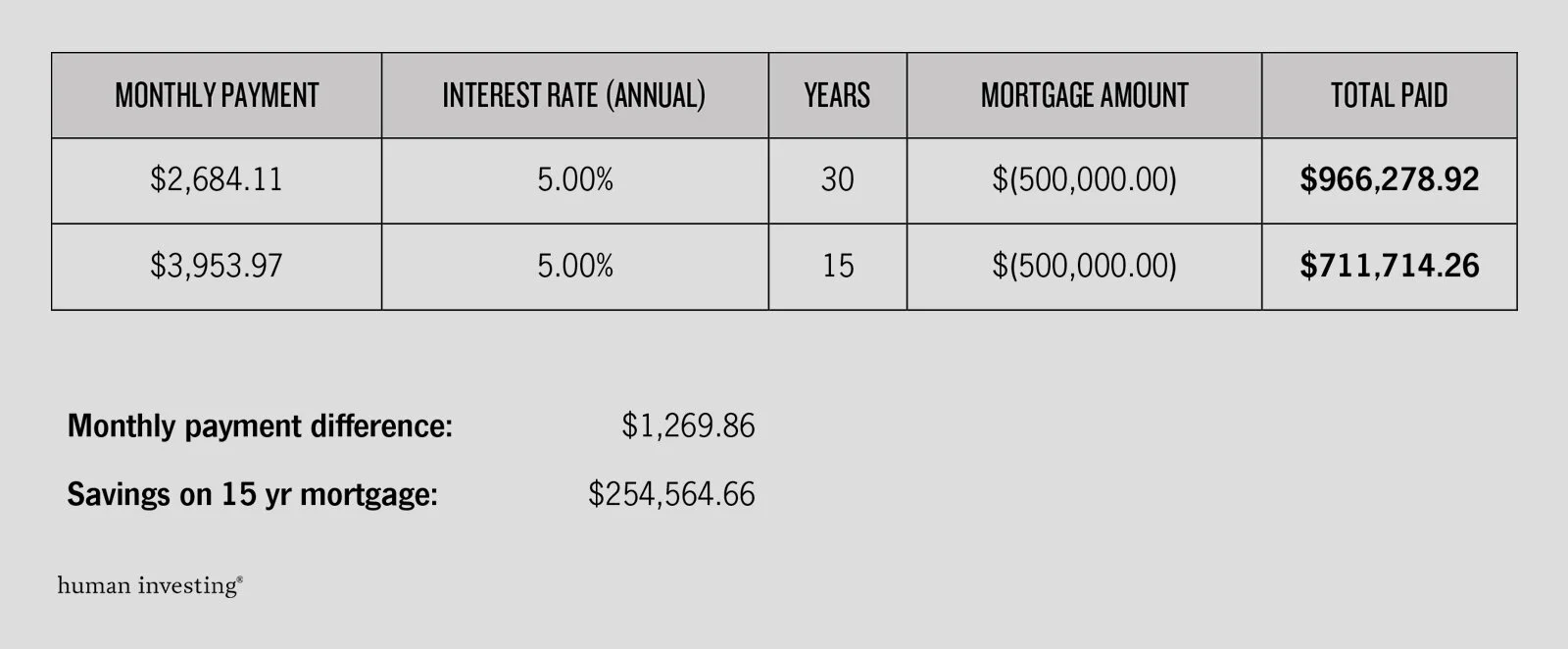
Explanation: Because of the shorter life of the mortgage loan, you pay less interest. Remember in question 1, interest compounds every year. When you borrow money, that compounding works against you. Therefore, the faster you are paying off debt, the less time for interest to compound and grow the total amount you have to payoff. The monthly payments are typically larger, but the overall interest paid is less.

To illustrate with numbers, let’s look at the difference between a 15 year & 30 year mortgage, assuming a 5% interest rate for both:

q3 copy.jpg

Why this matters: You can see from the example how much money is saved by opting for a 15 year mortgage. Can you afford that extra monthly payment? That’s worth investigating, but you’ll never explore your choices if you don’t know what they are. You can also usually get a lower interest rate for shorter term debts, which saves you even more money. Anytime you borrow any amount of money, the faster you can pay it off, the less you will pay total. Even if you don’t get a lower rate on the debt, if you pay off the principal sooner, that means there’s less interest compounding against you. When looking to borrow money, evaluate what term (length of time) works best for you and your budget. You want to minimize your cost of borrowing, but you also want to give yourself enough flexibility that you’re confident you will make all those payments on time, regardless of what life brings.

Question 5 - Bond prices and interest:

If interest rates rise, what will typically happen to bond prices?

A. They will fall
B. They will stay the same
C. They will rise


Answer: A, they will fall.

Explanation: This is the question most people get wrong. A bond is government or corporate debt. The government or company pays you coupons (interest payments) based on the issued interest rate. At the end of the bond’s life, it matures, and you get the principal back.

Imagine Disney issues bonds paying 5% interest, the current market rate. You purchase a bond for $1,000, and you get a $50 coupon payment from Mickey Mouse every year until the bond matures. If interest rates rise next year (say to 8%), and Disney issues new bonds, they will issue them at the new interest rate. Your neighbor Laura decides to buy $1,000, and she gets an $80 coupon from Mickey Mouse every year. Because interest rates rose, the value of your bond paying $50/month goes down in value, less than $1,000, because the $1,000 could buy Laura’s bond paying $80/month. The reverse if also true. If rates had fallen to 3%, Laura’s bond would only pay her $30, and your $50/month bond would be worth more than $1,000.

Why this matters: Interest rates change over time. This causes bond prices to change. Bonds will still be less volatile than equities, but they do also fluctuate in value. Don’t panic when you see interest rates rise, and your bond prices going down in value. This is both normal and expected. Rising interest rates are also usually a healthy sign for the economy, and so your equities will generally be rising in value to help offset the loss in value of your bonds. The reverse is also true here. Falling interest rates tend to indicate a less healthy economy (think about when rates have dropped significantly & quickly; the 07-08 financial crisis and COVID-19) which means falling stock prices. Because they don’t tend to move together (uncorrelated), bonds and stocks are an excellent pair for smoothing out your investment returns.

How did you do?

If you got some questions wrong, I hope you understand the why behind the answers and how to utilize this knowledge to better your financial life. If you have questions about financial vocabulary or systems you’d like me to blog about, please email me at andrewg@humaninvesting.com. If want to talk to an advisor, please email us at hi@humaninvesting.com.


Related Articles