Posts tagged Nikebenefit2
The most underrated Nike benefit: The Health Savings Account


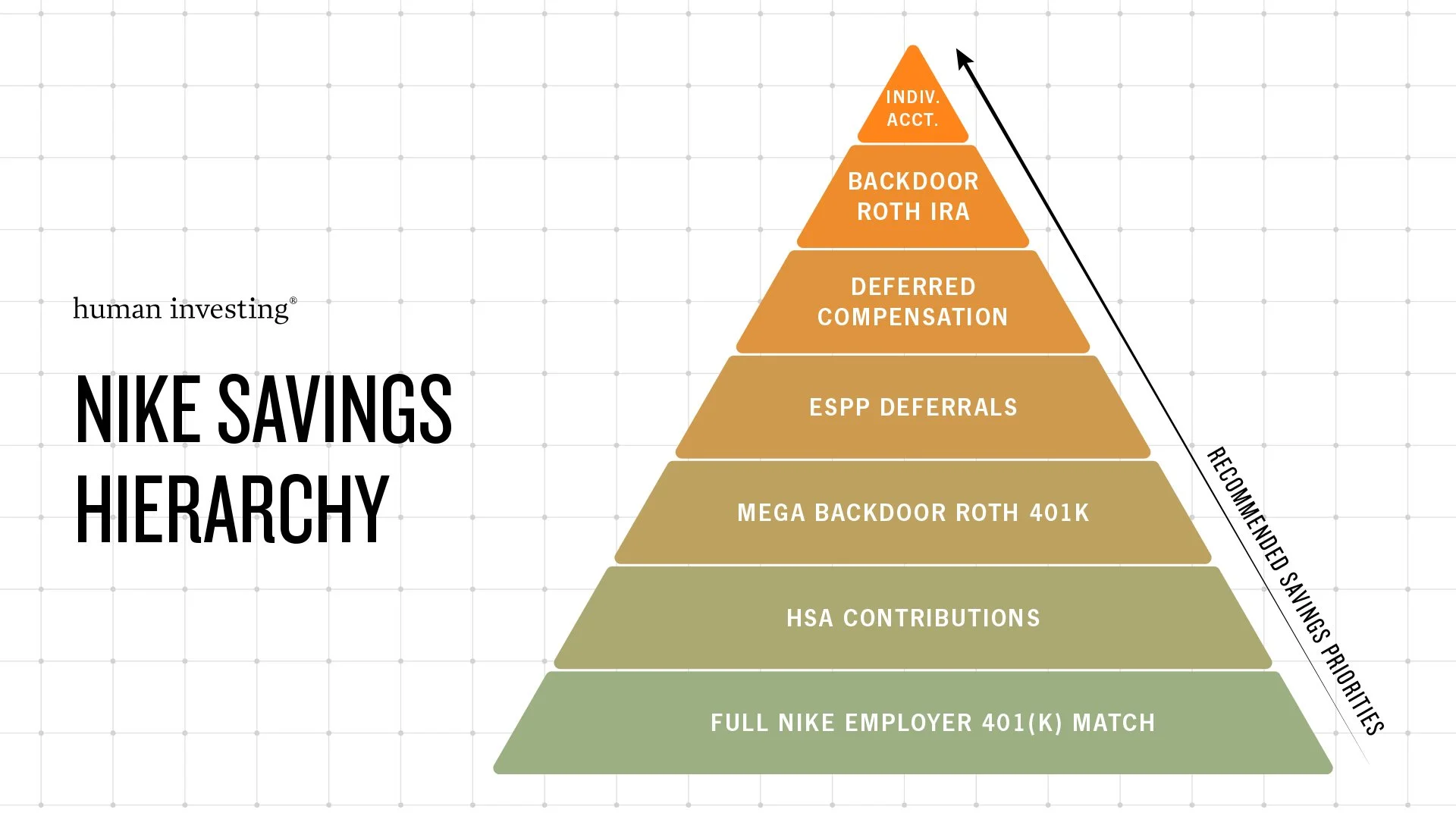
As a Nike Director or VP, there are many incentives for savings and investing through the Nike benefit programs. After making big decisions on your Deferred Comp, 401k deferral, and ESPP contributions, you may be left with decision fatigue when it comes to open enrollment for your health benefits.

Don’t let decision fatigue hinder you from taking advantage of the most underrated Nike benefit: the Health Savings Account (HSA).

Here are three reasons why you should consider implementing an HSA strategy for 2025.

1. HSA’s are the only account that is Triple Tax Advantaged

What does this mean?

  • Your contributions are tax-deductible.

  • Investment growth is tax-free.

  • Distributions are tax-free when used for qualified medical expenses.

That means that you never pay taxes at any point on these dollars. Think about all other Nike benefits and retirement accounts like your 401(k) and Deferred Comp plan, you only get two of these tax advantages and the IRS is getting their money at somewhere along the way. Using this strategy, you get to eliminate the IRS from the picture.

2. The Tax-Free Growth Opportunity

The goal of this HSA strategy is to save, grow and preserve these triple tax-advantaged dollars to be used for medical expense in retirement.

To do this correctly, you should contribute the maximum amount each year without taking distributions for medical expenses.

Prioritize using cash outside of your HSA account when medical expenses are incurred.

Next, do not leave the entire account balance in cash, but utilize the investment fund options so that you can capture the tax-free growth over the long-term.

Imagine a scenario where you were on the family HSA plan and contributed $8,550 per year for 5 years. You invested these funds and let them grow for 20 years until retirement, earning an average return of 8% per year. In 20 years, your HSA balance would be about $171,500 and you only contributed $42,750 to the account in the first 5 years. With rising health care costs, these funds can be used in retirement to pay for medical expenses, including Medicare premiums at age 65.

3. You own and control the account

Unlike Flexible Spending Accounts (FSAs) which are “use it or lose it” each year that you make contributions, the HSA is different because it’s an account that you own for your lifetime. You can keep the account if you change plans, retire, or leave Nike.

The contribution limits for 2025 are $4,300 for self-only coverage and $8,550 for family coverage. Those 55 and older can contribute an additional $1,000 as a catch-up contribution if not enrolled in Medicare. The contribution limits typically receive an inflation increase each year, so make sure you review this and stay up-to-date on the current amount.

Taxes can be one of the largest monthly expenses for many households. As a Nike Director or VP, you could be paying up to 51% in income taxes so it’s important to maximize every opportunity for tax savings.

To get the most benefit from your HSA, you need to be strategic, just as you would be when planning your Deferred Comp, 401k, and ESPP contributions. HSA’s are high deductible plans and if you anticipate substantial medical expenses, the HSA could cost you more than the lower deductible health plan options in 2025. This highlights why it’s important to evaluate the HSA as part of your comprehensive financial plan.

If you have questions about whether switching to the HSA is the right choice for you, please contact our team at nike@humaninvesting.com.


Related Articles

Nike Restricted Stock: Understanding RSUs and RSAs
 
Nike Restricted Stock.png

Until recently, the availability of Nike Restricted Stock was limited to a select group of Nike Executives.  In 2018, Nike shifted its Stock Award program to include Restricted Stock Units (RSUs) to pair with the traditional Stock Options benefit.  This brought the concept of restricted stock to a wider base of Nike Executives, including more VPs and Directors.  With this broader availability, more questions have arisen about what Restricted Stock Units (RSUs) are, how to maximize this benefit, and what strategies should be considered.

RSU (Restricted stock units)

What exactly are RSUs?  An RSU is a form of stock-based compensation where the company grants the employee a specific number of shares of Nike stock that are restricted and will not be issued until they vest.  The shares are released and issued each year according to the vesting schedule, which is typically in equal installments over 3-4 years.  Each Nike executive has an individual account at Fidelity that is tied to the stock plan and receives and holds RSU shares as they vest.    

RSA (Restricted stock awards)

RSAs appear almost identical to RSUs and many executives may not notice the difference between them.  The main difference between the two is that with RSAs, shares are issued at the time of grant and you own them even before they vest.  With RSUs, the shares are not issued and owned until the shares vest and subsequently become available.  In either case, you cannot sell the shares until they vest.  RSAs at Nike are marginally better for one reason: they pay out dividends to the Executive even before the shares vest.  With RSUs, you only receive dividends after the shares vest.  

Taxes

As RSUs and RSAs vest, they are taxed as compensation and are subject to the same federal and state tax rates as your salary/bonus.  A portion of shares that vest is immediately sold to withhold taxes and are paid directly to the IRS and Oregon.  A common challenge that we see with tax planning is that the amount withheld for taxes is often much lower than what is needed for the high-income tax brackets that Nike Executives fall in to.  We typically see a tax withholding shortfall of up to 17%.  This can contribute to a frustrating experience during tax filing in April, where painful checks need to be written to the IRS and Oregon.  With proper tax planning and coordination with a CPA, this can be mitigated by calculating the tax shortfall and setting aside the cash necessary to cover that shortfall.

Once the shares vest and become available, they are identical to Nike stock shares that anyone could purchase on their own in an individual, joint, or trust account funded with money you have already paid taxes on, like a checking account.  The growth or decline of the stock from the day it vests is now subject to capital gain/loss tax rules, which is triggered when it is sold.  If the stock grows and you sell it in 12 months or less, it is subject to short-term capital gains rates, which is the same as your regular income.  If you hold the stock for more than 12 months, it would be subject to long-term capital gains, a rate that can be up to 20% lower than short-term capital gains.

Risk/Return

When compared to Nike stock options, Nike restricted stock is a more conservative form of stock compensation.  RSUs/RSAs will follow the exact movement, up or down, of Nike stock while stock option values move significantly higher or lower than the actual stock price.  Put simply, stock options have a much higher upside and downside than RSU/RSAs.  This difference is a significant factor in the decision that many Nike executives must make each year between RSUs, stock options, or a combination of the two. 

Planning Strategies

What planning strategies and opportunities exist for RSUs and RSAs?

  1. Cash Needs – If you have needs for cash, whether for college expenses or a vacation and need to sell some of your Nike stock, RSUs/RSAs are typically your best option.  The tax impact is typically lower than Stock Options and ESPP shares.  Additionally, you are not sacrificing the significant growth opportunity that exists with stock options.

  2. Tax Loss Diversification - Most Nike executives own a significant amount of Nike stock that makes up most of their overall net worth.  This may represent such a large portion within your overall investment portfolio that it poses a significant amount of risk.  Many want to diversify out of Nike stock into other investments, but the tax bill that would be generated by doing so is so painful that no action is taken.  Tax-Loss Diversifying is a way to diversify out of Nike by identifying and selling very specific stock shares that are at a loss during a market downturn. 

    We do not believe that you should sell an investment at the bottom of a market drop and leave it in cash, so it is important to execute the next step, which is reinvesting the proceeds. Proceeds should be reinvested by diversifying into many different stocks that have also dropped in value during the downturn.  This can come in the form of low-cost, diversified funds, that hold thousands of stocks in large, mid, small, and international stock companies.  In addition to diversifying, the tax loss that is created can lower your current or future taxes by offsetting capital gains or deducting up to $3,000/year from your ordinary income, like your salary.

  3. Charitable Giving - Instead of using cash, make your charitable contributions from your RSUs/RSAs.  If you transfer this stock directly to the charity organization, you can still get the tax deduction for the value of the stock, and the charity can sell the stock to completely avoid any capital gains tax that would normally be due if you sold the stock on your own.  Please note that only stock that has been held for over 12 months is eligible for this preferential tax treatment.  For more details on utilizing Nike stock for charitable purposes see this article.

Nike RSUs and RSAs are an effective tool for Executives to both participate in the success of the company and to meet their personal financial goals.  They are a great compliment to Nike Stock Options and provide many planning opportunities to minimize the tax burden due to their flexibility.

If you want to know more about how to maximize your RSUs and RSAs, please get in touch.

You can schedule time with me on Calendly (click here to schedule an appointment), e-mail me at marc@humanvesting.com, or call or text me at (503) 608-2968.


Related Articles


Is the Nike Life Insurance Benefit a Good Deal? Uncovering the Hidden Costs
 
Nike-Life-Insurance.png

We wanted to explore a common question that we hear from our Nike clients: “Is the life insurance benefit offered through Nike a good deal?”  We will explore the hidden costs that exist within this benefit and compare it to alternatives to evaluate whether or not it is a good deal.

The Benefit

Nike provides a basic life insurance death benefit of half your annual salary up to a maximum of $500,000, paid by the company. 

Nike also provides employees with the opportunity to purchase additional supplemental life insurance in an amount up to 5½ of your salary up to a maximum of $3.5 million. 

If you combine basic life insurance and supplemental life insurance, the maximum amount you will receive is 6 six times your salary up to a maximum of $4 million of death benefit.

Nike does provide employees with a benefit credit to purchase up to 1½ times your salary of supplemental life insurance.  The benefit credit is, however, subject to income taxes.

On the surface, the Nike supplemental life insurance sounds like a good deal, right?  Before we can make that determination, we need to look at hidden costs as part of this equation.

Hidden Cost #1 - Imputed Income

Life insurance through your employer with a death benefit above $50,000 is considered a taxable fringe benefit.  The IRS puts a dollar value on this benefit called “imputed income," and the Imputed Income is taxed as wages, making it subject to federal, state, Social Security, and Medicare taxes in the same way that your salary is taxed. 

If you look at your Nike paystub, this item will show up under the category of “Add’l Taxable Other Compensation.” Within that category, you will see a line item called “Imputed Income -Life.

The taxes that are created from the imputed income create an additional cost to the life insurance coverage that is typically missed and not considered.  The higher your income tax bracket, the more punitive the imputed income becomes.  

Hidden Cost #2 - Premium Age Bands

It is also essential to understand that the premium you are currently paying for your supplemental life insurance will not stay the same and will likely increase over time.  The primary reason for the increase is that premiums are subject to “age bands.”  Age bands provide a set cost for anyone within a 5-year age increment.  For example, there is an age band for ages 30-34, another for ages 35-39, another for 40-44, and continues up to age 70+.  The older you are, the higher the cost in that age band.  The premium cost that you thought was good may quickly become expensive as you reach new age bands. 

The back-up plan

Given the “Hidden Costs” that we shared, how do you know when the supplemental life insurance is a good deal or not?  To determine that, we need to compare it to the possible alternatives.  At Human Investing, we believe that the only appropriate option is inexpensive individual term life insurance. 

Individual term life insurance is typically purchased for a set number of years (10, 15, 20, 30 years), and the premium during that time is locked in and guaranteed not to change.  Before you are approved for the policy and the premium cost is determined, you will typically be required to go through a medical underwriting process, including a 20-minute medical exam, blood and urine samples, and possibly medical records from your doctor.

When the Nike Supplemental Life Insurance Benefit is a Favorable Deal

  1. Simplicity and Time Savings are More Important than Lower Cost - The supplemental life insurance is easier to obtain than individual term life insurance.  During open enrollment, you can elect up to $500,000 of death benefit just by clicking “yes.”  An amount above $500,000 requires you to fill out a health statement, but that is still much easier than going through the medical underwriting needed for individual term life insurance.

  2. Current Medical Issues - If you have any pre-existing medical issues that would either cause you to be declined from individual term life insurance or create cost-prohibitive rates, the supplemental plan may be the best way for you to obtain affordable life insurance coverage since you can avoid the medical underwriting.

  3. Coverage Only Needed for a Short Time (Less than 5 Years) – If you think you only need life insurance coverage for a short time, supplemental life insurance can be the right choice since the cost is low for the short-term.  In our analysis, coverage becomes expensive in the intermediate to long-term due to the ongoing drag from hidden fees we discussed.  So how long do you need life insurance coverage?  Generally, income earners need life insurance to replace future income for their family for as long as they were planning to work.  The one exception is if they have saved enough funds to replace that future income for their family adequately.  The best way to determine this is to examine this within personalized financial planning projections.

When the Supplemental Life Insurance Benefit is an Unfavorable Deal

  1. You Have Average Health or Better – With individual term life insurance, one benefit of medical underwriting is that you can reap the benefits of being healthy.  The better your health), the lower your cost may be.  Company-sponsored group plans, like the Nike supplemental benefit, base their rate on a broad group that is averaged together, which includes people from excellent health to poor health.

  2.  You Need Life Insurance Coverage Over an Intermediate to Long Period of Time (7+ Years) – As we mentioned earlier, our analysis has shown that the cost of individual term life insurance is often much lower than supplemental life insurance by a significant amount.  This shows most prominently when coverage is needed for about seven years or longer.

  3.  You Want to Maintain Coverage When You Leave Nike – If you leave Nike, it is challenging to maintain the existing coverage, and portability options are limited.  With individual term life insurance, you can keep the policy with you wherever you go.  Additionally, you will lock in a price based on your health and age when you purchase it. Waiting later to buy it will cost you more since you will be older, and any health issues that might arise during that time may cause the cost to increase further.

It’s Not Too Late to Change

Let’s say that you just completed open enrollment, and you are having second thoughts about the supplemental life insurance coverage you just enrolled in.It’s not too late to change your mind. You can purchase individual coverage and can cancel the Nike coverage mid-year under one of the available exceptions.Simply contact Nike HR and tell them that you have a "Family Status Change," and the status change is "Employee/Spouse/Child/Other Gains Other Coverage."Please keep in mind that we always recommend waiting to cancel any coverage until the new coverage replacing it is fully in place.

Where to Get Individual Term Life Insurance

There are many conflicts of interest in firms that offer life insurance. Therefore, we would recommend that you proceed carefully.  Many firms do not shop the market for the best company that fits you. Since many are affiliated with one specific insurance company, they are motivated by commission payouts and sales targets to funnel you to their affiliates.   We would also recommend staying away from more expensive cash value life insurance products like whole life and universal life insurance.

At Human Investing, we decided to stop selling commissioned life insurance since we felt strongly that it was a conflict of interest. This decision allows us to act as a Fiduciary 100% of the time.  To continue to serve clients well, we instead decided to partner with insurance firms that specialize in the specific type of insurance we believe in and will not try to upsell you on more expensive coverage.  If you would like a reference to one of those firms, just let us know, and we would be happy to share that information with you.

We’re here if you have questions

There is nothing fundamentally wrong or bad about Nike’s supplemental life insurance offer.  In fact, the Nike benefit is a more generous plan than we have seen at other companies.  The real issue is that life insurance offered through employers has hidden costs that can make the coverage expensive. If you have questions or want to better understand how to take advantage of the Nike Life Insurance Plan, you can schedule time with me on Calendly below, e-mail me at marc@humanvesting.com, or call or text me at (503) 608-2968.



Related Articles