Posts in Behavioral Finance
When it Comes to Market Volatility, Don't Rely on Your Emotions, Rely on Your Financial Plan
 
adrian-FrSEEdYr418-unsplash.jpg

Recently I received a note from a longtime Human Investing client. He was following up on a discussion we had back in March, where he, like others, was concerned about where the market was headed. Here is a mostly intact version of what he said:

I just wanted to thank you and acknowledge your sound advice eight months ago when everything was running off the edge. Since then, we are up more than $250K (17%) and above where we were then. The reality is that had I pulled out, I would not have gotten back in before missing most of the bounce back. Hindsight can be wonderful when you do not make the wrong decision!  My friend, who sold out in March, is still hanging onto the belief that we are headed down again. Who knows the future.

A Discussion Goes a Long Way

The purpose of this note is not to take a victory lap for the advice we dispensed. Instead, it highlights how a discussion can help put investing in perspective in a tense market moment. This client has 50% of their portfolio in safe investments, like high-credit quality bonds and cash. The remaining portion is in broadly diversified equities. Despite having enough cash and bonds on hand to live a decade without having to touch their equities, they had a concern. The discussion with this client revolved around whether they needed more than ten years of cash and bonds to live and focused less on market timing. In the end, it was the client who decided to hold tight, not me. I was the one who removed myself from the emotion of the situation and was there to ask the right questions. 

Throughout my career, my role in the client’s life has evolved. In the mid-90s, we were providing stock recommendations and picking money managers. Today, we rely on trading algorithms from Morningstar and low-cost index funds from Vanguard and Barclay’s. The quantitative work has shifted from money management to financial planning and tax planning/compliance. This work is done by my colleagues at Human Investing: Andrew Gladhill, CFA, Marc Kadomatsu, CFP, Amber Jones, CPA, and Luke Schultz, CPA. On the flip side of the quantitative work is qualitative research, which involves non-numerical data. Qualitative research comes from our interaction with clients and hearing about their feelings, emotions, and opinions. These qualitative insights are paramount to a successful retirement plan. Some might argue that emotion and opinion can derail the best of financial plans. This is at the heart of the above quote. Quantitatively, the client was in great shape, but their “in the moment emotions” almost derailed a great retirement plan. 

Dalbar Inc. provides performance information on the “average investor”. Figure 1 is a chart I have tracked for years. One of the many reasons why the “average investor” does so poorly versus the returns of various asset classes and stock/bond mixes is due to their emotions. Having someone to talk to about these thoughts and feelings can be helpful.  If the plan permits and valid concerns arise from the discussion, then changes can be made.  However, if the change is not rooted in probability and the financial plan, there is the potential that the decision being made can be harmful.

Figure 1

Investing over the long run

It is interesting to see the S&P 500, dating back to the year I started in the financial services profession. Figure 2 depicts much relevant information. Most notably is the long term upward trending line during my career. If we went back to the early 1900s, the chart would look similar—lots of ups and downs with a trend line that moves up over time. 

Figure 2

Sometimes, the drops in the market happen gradually—as do their recoveries (as was the case in 2000). Other times, market volatility stems from “counterparty risk,” which was the case in 2007 when the housing market and credit created uncertainty. In the most recent case, the severe volatility was brought upon by fear from a pandemic and an uncertain future. Regardless of the reason, volatility is a natural part of investing in the stock market. My observation is that volatility is permanent. Surprises (both up and down) are common. The financial plan, which is a quantitative document developed by credentialed experts, can be worth its weight in gold. It can act as a financial roadmap when you feel lost—and provide an advisor like me the data-points to dispense proper advice during anxious moments.


The Difference Between Speculating and Planning
 

A week ago, I came across a chart that does a nice job representing the call volume we have been experiencing at Human Investing in 2020. While the amount of calls we receive does not equal the amount of times people search for CNBC, the two data points are certainly correlated.

google-searches-stocks-cnbc-hartford.jpg

The image is titled, “When Markets Fall, We Search”, and ultimately shows that individuals have been more likely to seek out CNBC (market related news) any time the market has fallen over the last 15 years.

I’d argue that you could replace ‘search’ with ‘speculate’ and both the phrase and the chart would remain true, “when markets fall, we speculate”. Given the state of current affairs and the upcoming presidential election, individuals are worrying about their retirement accounts. A growing number of conversations our team has with individuals inside of retirement plans sound something like this:

Caller: “I’m fearful of (X) candidate winning the election because I’m affiliated with (Y) political party (both sides are saying this). Additionally, there is uncertainty around COVID, and I don’t feel comfortable staying invested during these unpredictable times. I’d like you (Human Investing) to help provide me with a more conservative investment recommendation.”

Before I respond with market research, I want to reiterate that you aren’t alone with your concerns and fear. We hear you. At the same time, before making any decisions related to your portfolio, take the time to think through all the angles of your decision. The rest of this post will hopefully provide some anecdotes in your process. Here are few thoughts about what it looks like to plan for the end of 2020 and into 2021. Remember, it is better to plan than to speculate.

The correlation between your Politics and Your Portfolio

Generally speaking, there is low correlation between political parties and the stock market. However, that statement is easy to say and difficult to live out in practice. Tread lightly when reading articles that try to align which stock/sectors to own with the political party that takes office. This article from 2016 couldn’t have been more wrong prognosticating that energy companies (specifically Exxon Mobile) would be top performers for the proceeding four years. It goes without saying this was a massive miss.

stock-and-sector-returns-since-2016.jpg

The bigger influence: Are you a speculator or planner?

If you think like a speculator, you will make rash decisions around your investment accounts and have no plan for re-entering the market if you move your dollars to cash or to a conservative investment.  

If you think like a planner, you will use both quantitative and qualitative measurements to evaluate your decision. For example:

  • If you have a long-term horizon (greater than 15-20 years), political changes should not impact your investment decisions.

  • Irrespective of the political environment, review if your account is too aggressive or too conservative for your financial landscape.

  • Have a clear understanding of both candidate’s tax policies. Changes to the federal tax code should be a factor in your financial planning for the remainder of 2020 and into the future. If you are working with a CPA and/or Financial Advisor, make sure they are staying abreast with any impactful tax code changes.

annualized-asset-class-returns-presidents.jpg

Ditching The Market

Trying to time the market when negative news arises (or the anticipation of negative news) is a dangerous game to play. Luckily, we have a recent case study of how dangerous it can be. From January 1st to March 23rd, the stock market fell 30%. Since then, the market has recovered all losses and then some. If you were thinking like a spectator, it would have been easy to create a narrative around mid-March to pull your money out of the market and wait for greener pastures. If an investor did so, most likely that investor is still waiting for the market to dip and has missed out on the recent recovery as indicated by the second chart.

sp-500-returns-2020.jpg

If you think like a planner when the market is more volatile, sometimes taking some form of action itches a behavioral scratch. Here are some ways to take action while not compromising your account:

  • Raise your contribution in your retirement account to take advantage of a decreasing market (buying more shares at discounted prices).

  • Open a small “fun money” account to track if your predictions are correct.

  • If the market does significantly drop, look at converting pre-tax dollars to ROTH.

The concept of thinking like a speculator vs. thinking like a planner represents the cultural moment we are living in right now.

Speculating = headlines, fast moving social media, and the potential for instant gratification.

Planning = well thought out strategies that take time and often require no action.

As we head into this season of elections and COVID uncertainty, I hope this post provides some perspective on how to approach your portfolio. As always feel free to reach out to our team to talk through your thought process. We are happy to help!


Related Articles

Providing Sound Advice in a World of Robinhood Investing
 
scott-graham-5fNmWej4tAA-unsplash.jpg

One of the interesting subplots in the finance industry during COVID-19 has been the rise of the day trader. Robinhood, an online brokerage and trading platform, acts as a proxy for many investors who are rapidly opening accounts at other brokerage firms including Charles Schwab, E*T, TD Ameritrade, Fidelity, etc.

Our firm works with thousands of employees via their company-sponsored retirement plans and has had many conversations end with a question/comment along the lines of, “What do you think of this Robinhood thing? Is it worth putting some money in there? Seems like (fill in the blank tech company) is making money! Should I buy some?”. So, I felt compelled to address the question(s) and provide some context around where a speculative trading account fits into a greater financial plan.

THE MAJOR PLAYERS

Source: Piper Sandler

Source: Piper Sandler

E*TRADE: more users opened accounts in the month of March than any full year on record.

Charles Schwab: 1 million new accounts so far in 2020.

Robinhood: 3 million users opened accounts in Q1 2020. For perspective, there have been 13 million accounts opened at Robinhood since its founding in 2013.

The GROWING appeal OF DAY TRADING

The barrier of entry has never been lower to open an account and buy shares of publicly traded companies. Because many individuals are at home, trading is as cheap and accessible as ever, and some firms have incentive offerings (like a free share of stock when you open an account). Pair that with the stock market reaching its low point for the year on March 23rd and having one of its fastest recoveries ever (in other words the last 5 months have been a winning proposition for many investors), and you get to the point where we are today.

YCharts1.png

Today could be a euphoric place for an investor owning stocks since March. To me, euphoria looked like TMZ coming out with a trading subscription service… yikes. Stocks have only gone up, and popular tech companies have led the way. Kudos to those who might have doubled their money on a company like TESLA, but the last 5 months do not paint a realistic picture of what investing looks like over the long haul.

the emotional rollercoaster of Owning single stocks

When talking about owning a single company, I like this example. Owning a company like Amazon over the last 10 years seems like a no brainer (today). If you had invested $10,000 10 years ago, it is worth over $268,000 today. However, when you see that over the last 10 years, an investor would have had to hold through down periods of -25% over 5 times to get to where the stock is today. In other words, the stock was down 25% of its high over 5 times. Holding a company through those periods can be difficult, emotional, and in my opinion, is an objective way of capturing what owning a stock (even one that has performed as well as Amazon) is like.

AMZN_chart (2).png
AMZN_chart (3).png

Investing advice for smarter day trading

Whether you are someone who has already played around, are thinking of dipping your toe in the water, or your ego is already as big as ever because you’ve been a successful trader for the last 5 months, here is some advice on what it looks like to invest in your long-term plan vs. speculating.

Boundaries, Boundaries, Boundaries: If you are going to buy a stock on your own, don’t have it impact your overall investment strategy and long-term plans. What does that mean? Invest a dollar amount that you would feel comfortable taking a 100% loss on.

A positive outcome can mean… many things: Recently the Winklevoss twins (yes those Winklevoss twins) were quoted saying that Elon Musk is going to mine gold on asteroids orbiting the Earth, thus decreasing the value of gold and increasing the value of bitcoin (I promise this isn’t fake). One scenario is that their theory is wrong but in the next 5 years, owning bitcoin could be a profitable trade. In the same light, if you have owned a technology company or a fund that tracks technology companies since March, you have probably made money. Does this make you the next great market predictor? Most likely not. At Human Investing, we have a saying "process over results". So, in these situations, whether or not your account is checking up on your process is equally or more important.

Trading Journal: If you are seriously interested in the market and having a brokerage account, a trading journal is imperative. If you have a prediction, write it down, track it, and review your track record. It’s not a bad idea to do this for a few weeks to test the waters before you open an account.

Small Losses Can Lead to Long-Term Positive Outcomes: Here’s a hypothetical, stay with me. You read this post, you open an E*TRADE account, and deposit $200. You end up buying a few stocks and start following the market. You are following investing influencers on social media, listening to podcasts, and even watching CNBC in the morning. Then life happens. You get a little bored, lose track of your password, reset your password, and lose track again (this version of you doesn’t have LastPass 😊). Six months go by, and you see that your $200 is now $50. As a byproduct of this experience, you realize that you are better off opening up a ROTH IRA at Vanguard contributing $100 a month into an age-based target-date fund because you now care more about retiring comfortably. Your $150 loss on your account made you realize:

  1. You are not interested in picking stocks and it isn’t easy.

  2. You educated yourself about the market, the benefits of a ROTH IRA, and moved the needle on helping yourself retire.

Time will tell if this Robinhood movement is a fad or a long-term trend. Either way, if you have questions, want to grab coffee via zoom and talk markets, or talk longer-term planning, our team is here to be a resource.

Other Articles You Might Enjoy On This Subject

* Inside Story On Robinhood

* WSJ video on Robinhood


Related Articles

How to Avoid the Investing Cycle of Emotions
 
alice-donovan-rouse-UweNcthlmDc-unsplash.jpg

Do not let your emotions get in the way of making smart investment decisions.

It is difficult to separate emotions from reality. We often view the world through the lens of whatever emotion we are experiencing, and unchecked emotions can give rise to suboptimal financial decisions.

My role as a financial advisor allows me to have many conversations focused around money. Through these conversations over the last 12 months, I have witnessed the gambit of the emotional response to the stock market and its volatility. What I discovered is that an individual’s emotional response tends to be heightened by three things:

  1. The more zeros at the end of their account balance.

  2. The amount of negative news consumed.

  3. The greatest of which, whether they have taken the time to build a financial plan.

In his book The Behavioral Investor, psychologist and behavioral finance expert, Dr. Daniel Crosby reminds us that our emotions can’t be trusted when it comes to making investment decisions.

“The fact that your brain becomes more risk-seeking in bull markets and more conservative in bear markets means that you are neurologically predisposed to violate the first rule of investing, “buy low and sell high.” Our flawed brain leads us to subjectively experience low levels of risk when risk is actually quite high, a concept that Howard Marks refers to as the “perversity of risk.” – Dr. Daniel Crosby

Like the stock market, our emotions are cyclical. This cycle of emotions experienced as an investor can range from pure euphoria to utter despondency (lack of hope).

Source: Russell Investments

Source: Russell Investments

This emotion is often not dictated by the investor, rather it is the investor’s response to the market. The wild thing is, we have seemingly experienced all of these emotions over the last 12-month period. Compare the cycle of emotion to the S&P 500 over the last year.

S&P 500 1 Year as of 8.19.2020

Is it a coincidence that these two images almost mirror each other? I don’t think so.

It is completely normal to have an emotional reaction to your finances. Your account balances are often in direct relationship to your future financial freedom and well-being. However, it is only when an investor acts on these emotions do they get themselves in trouble.

Investor’s making short term emotional changes to their investments hurt their chances at long-term returns. A study conducted by DALBAR, Inc. discovered that over the last 30 years, the average mutual fund investor underperformed the market by almost 6%! Their finding is that investor’s change investment strategies too often to realize the inherent market rates of return.

Here are some action steps for avoiding emotional investment decisions:

  • Look inward — Take an introspective look to acknowledge your emotional response over the last 12-month market cycle. Will you emotionally make it through another market drop? Right now is the time to build self-awareness, because the reality of the market is not IF it will have another correction, but rather WHEN.

  • Look outward — Do you have someone to help you make wise financial decisions throughout life’s many emotions and seasons? Someone, to stand between your emotions and your finances? This is one of the many ways a financial advisor can add value to your comprehensive financial well-being.

  • Look forward — Does your risk profile align with your financial plan? Are you taking on too much risk (or, too little)? Take some time today to review your holistic investment strategy and consider making any changes while the market has rebounded since its market low on March 23rd.

Our team at Human Investing realizes your family’s financial well-being is just as much “human” as it is “investing”. Let us know how we can help, contact us at Human Investing or call at 503.905.3100.


Related Articles

Raising the Bar With B Corp
bcorpxhi.jpg

As one of currently sixty-four B Corp investment advisory firms in the United States, we get asked why Human Investing decided to pursue the B Corp certification. In the spirit of B Corp’s “Together We Are A Force for Good,” I thought I would share a few insights along with highlights from our most-recent recertification.

Why B Corp?

Like training for any number of professions, mastering a skill, or even raising children, becoming a B Corp involves many considerations. These considerations range from how a company is structured to how it operates, the impact its products and services have within the marketplace, and the company’s desire to support new initiatives towards growth. Additionally, assessing the ability to measure and track progress is key, as well as the ability to support the financial commitment. A not-so-secret ingredient and common denominator among B Corps is a strong (even passionate) desire to provide a better workplace for all. Beyond the structural considerations, the reason(s) a company pursues this certification may stem from a grass-roots motivation, a desire to take part in a rigorous assessment of their business practices, or more formal ESG (environmental, social, and governance) goals. Whatever the reason may be, it is available to for-profit companies of all sizes and industries with at least one year of operations. In many states, while the B Corp is not within the tax code, it is acknowledged as a benefit corporation. The purpose of this is to focus on and highlight stakeholder benefits along with shareholder benefits. Stakeholders are clients/customers, employees, vendors, as well as the community and the environment we live and work in. Once certified, a company’s legal documents (i.e. operating agreement), are required to be revised to include this language.

We have often communicated our B Corp certification as: what LEED certification is to a building or Organic is to milk, B Corp is to Human Investing. Becoming a B Corp is about stepping into the rigors of a standard that expects more. Attaining the certification has allowed us to verify how we operate and highlight what sets us apart. When initially hearing about the B corporation, we felt that being a B Corp already existed in the DNA of Human Investing. Walking through the initial certification gave us the first look into whether that was true and where we needed to focus our improvements.

Entering the initial and ongoing B Corp re-certifications have and continue to be a mirror by which we reflect on who we say we are against actual company data. In today’s world, it is easy to espouse ‘to be’ something. It is quite a different story to invite the effort and rigors into that narrative which, in turn, give validation to the words. As we learned more about what the B Corp organization was trying to accomplish, with its Declaration of Interdependence stating: “That we must be the change we seek in the world. That all business ought to be conducted as if people and place mattered. That, through their products, practices, and profits, business should aspire to do no harm and benefit all. To do so requires that we act with the understanding that we are each dependent upon another and thus responsible for each other and future generations,” we saw how it might fit with our structure as a for-profit company, our desire to be a company with high ideals, and our mission to serve the financial pursuits of all people.

The Certification Process 

Our initial certification process in 2014 included questions from 5 different areas: governance, workers, community, environment, and customers. It was like lifting the lid on a shiny car to find out what was really going on under the hood. Accompanying answers to the questions were our company financials along with various forms of data and information to corroborate our responses. Once our B-Corp submission was reviewed, accepted, and exceeded the 80-point minimum we were certified and ready to share the story.

We have recently completed our second re-certification and can confirm the process is becoming more stringent. Data has entered the certification (as with the rest of the business world) in a whole new way.  While the depth and breadth of the questions brought new challenges this time around, it also gave us the opportunity to give feedback to help shape future questions.

Keep Reaching Higher

Our story as a B Corporation continues to grow and evolve. We continue to communicate with clients and vendors not only what the certification is about but why it matters. More and more prospective clients are recognizing the logo on our website and expressing their desire to work with a registered investment advisory firm who is also a B Corp. We have encouraged some institutional clients to consider the certification as well. The challenges of our day are greater, but there is no time like the present to keep reaching higher, for the good of all!

If your firm is considering the B Corp certification and you have questions, please reach out to me at jill@humaninvesting.com, or check out the various resources from B Corp below. And remember that at the heart of it all, becoming a B Corp is a verb.

Additional Resources:

Assessment Info

Certification Requirements


Test Your Financial Literacy With These 5 Core Questions
 

The financial world can be a confusing place filled with jargon, technicalities, and little to no guarantees. Research suggests that those who are financially literate tend to have better financial outcomes. Financially literacy is typically measured by asking some core financial concept questions. Let’s walk through some financial literacy questions from the National Financial Capability Study, and explain the why behind the answer. Feel free to guess and score yourself at the end:


Question 1 - interest:

Suppose you had $100 in a savings account and the interest rate was 2% per year. After 5 years, how much do you think you would have in the account if you left the money to grow?

A. Less than $102
B. Exactly $102
C. More than $102


Answer: C, more than $102.

Explanation: The key part here is “After 5 years”. We are told the interest rate is 2% per year. That means every year, 2% gets added to our principal balance. To break it down year by year:


q1 copy.jpg

The interest earned increases each year. This is due to compound interest: the original principal ($100) grows, and the interest you earned previously (in year 2, $2) both earn interest. At the end of 5 years, we have $110.41 which is C More than $102.

Why this matters: Interest affects you when you save money to grow it, or borrow money to pay it back later. Knowing how interest can work for or against you is critical for financial success.

Question 2 - inflation:

Imagine the interest rate on your savings account was 1% per year and inflation was 2% per year. After 1 year, how much would you be able to buy with the money in this account?

A. Less than today
B. Exactly the same
C. More than today


Answer: A, Less Than today.

Explanation: They key here is the inflation rate is higher than the savings rate. Inflation is growing at 2%, meaning the price of goods (rent, utilities, food, cars, etc.) is going up by 2% each year. The cost of $100 of goods today will be $102 in 1 year. Your interest on savings is growing at 1% a year. That means in 1 year you will have $101 to spend on goods. In 1 year, you will have $101 to buy $102 worth of goods. Your ability to buy is A less than today.

Why this matters: Even if you keep your money “safe” in the bank or under the mattress, inflation is going to make that money less and less valuable. Thus why investing is so important. Investing can be scary due to downturns in the market, but ultimately the odds are in your favor to grow your money over time. Unless you can save significant portions of your income, growing your savings faster than inflation is critical for being able to retire.

q2 copy.jpg

Question 3 - Risk Diversification:

Buying a single company’s stock usually provides a safer return than a stock mutual fund.

A. True
B. False


Answer: B, False.

Explanation: To answer this question correctly, it is important to understand both risk and that a mutual fund owns a variety of companies. They keyword here is safer. Financial markets have two types of risk: market risk and company-specific risk (aka systematic risk and nonsystematic risk respectively).

Market risk refers to risk all companies face. Examples of market risk include a change to the US tax code, a global pandemic, or shifts in consumer tastes like a shift from fast food to organic freshly prepared food. You will always face market risk because every company is exposed to these risks. Company-specific risk refers to risks unique to one company. Examples of company-specific risk include sudden changes in management, a press release about product defects, mass recalls, or a superior/cheaper product released by a rival company. Because you own a variety of companies in a stock mutual fund, you diversify away (i.e. reduce your risk) if any single, specific company has a terrible event.

Why this matters: Don’t invest all your money in one company. Especially if you work for that company, and your compensation is based on the company doing well. By spreading out your investments, you reduce your risk of catastrophic returns, and smooth out the ride so you can sleep at night.

Question 4 - interest of the life of a loan:

A 15-year mortgage typically requires higher monthly payments than a 30-year mortgage, but the interest paid over the life of the loan will be less

A. True
B. False


Answer: A, True.

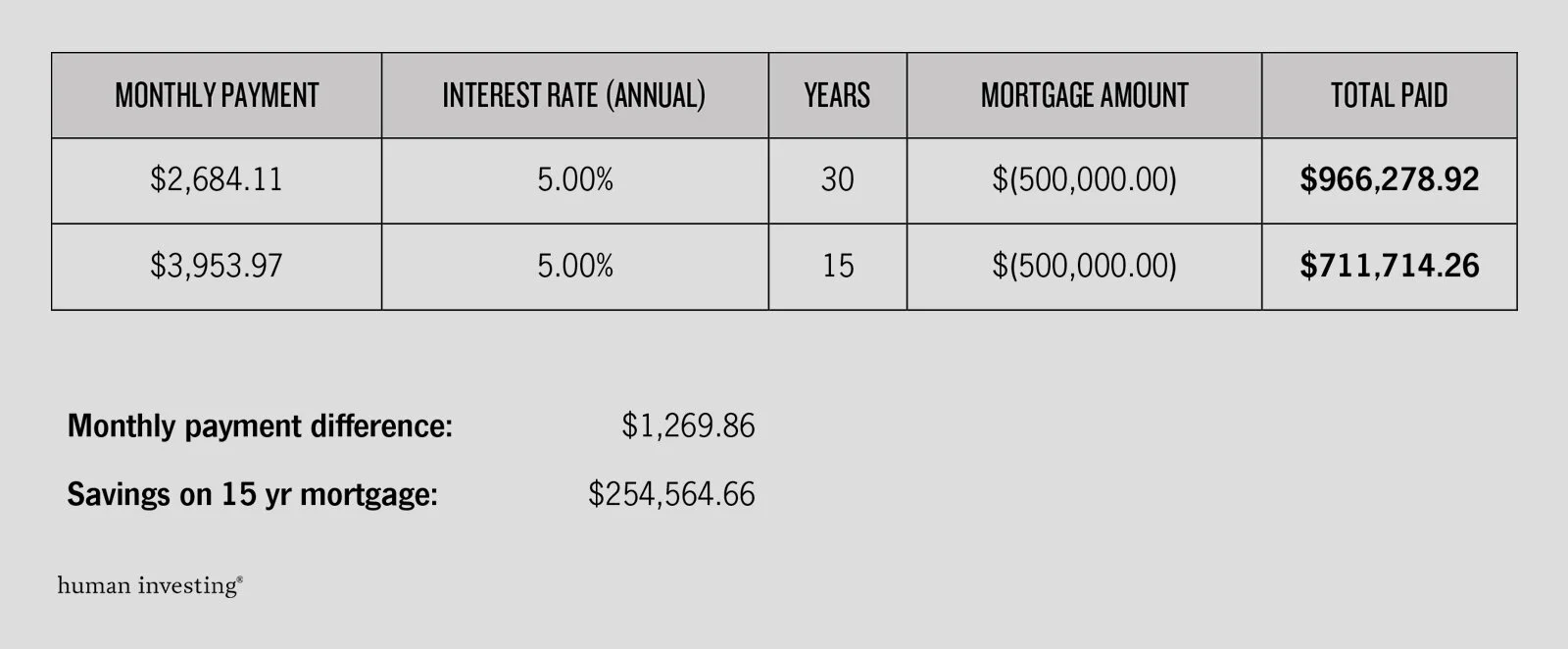
Explanation: Because of the shorter life of the mortgage loan, you pay less interest. Remember in question 1, interest compounds every year. When you borrow money, that compounding works against you. Therefore, the faster you are paying off debt, the less time for interest to compound and grow the total amount you have to payoff. The monthly payments are typically larger, but the overall interest paid is less.

To illustrate with numbers, let’s look at the difference between a 15 year & 30 year mortgage, assuming a 5% interest rate for both:

q3 copy.jpg

Why this matters: You can see from the example how much money is saved by opting for a 15 year mortgage. Can you afford that extra monthly payment? That’s worth investigating, but you’ll never explore your choices if you don’t know what they are. You can also usually get a lower interest rate for shorter term debts, which saves you even more money. Anytime you borrow any amount of money, the faster you can pay it off, the less you will pay total. Even if you don’t get a lower rate on the debt, if you pay off the principal sooner, that means there’s less interest compounding against you. When looking to borrow money, evaluate what term (length of time) works best for you and your budget. You want to minimize your cost of borrowing, but you also want to give yourself enough flexibility that you’re confident you will make all those payments on time, regardless of what life brings.

Question 5 - Bond prices and interest:

If interest rates rise, what will typically happen to bond prices?

A. They will fall
B. They will stay the same
C. They will rise


Answer: A, they will fall.

Explanation: This is the question most people get wrong. A bond is government or corporate debt. The government or company pays you coupons (interest payments) based on the issued interest rate. At the end of the bond’s life, it matures, and you get the principal back.

Imagine Disney issues bonds paying 5% interest, the current market rate. You purchase a bond for $1,000, and you get a $50 coupon payment from Mickey Mouse every year until the bond matures. If interest rates rise next year (say to 8%), and Disney issues new bonds, they will issue them at the new interest rate. Your neighbor Laura decides to buy $1,000, and she gets an $80 coupon from Mickey Mouse every year. Because interest rates rose, the value of your bond paying $50/month goes down in value, less than $1,000, because the $1,000 could buy Laura’s bond paying $80/month. The reverse if also true. If rates had fallen to 3%, Laura’s bond would only pay her $30, and your $50/month bond would be worth more than $1,000.

Why this matters: Interest rates change over time. This causes bond prices to change. Bonds will still be less volatile than equities, but they do also fluctuate in value. Don’t panic when you see interest rates rise, and your bond prices going down in value. This is both normal and expected. Rising interest rates are also usually a healthy sign for the economy, and so your equities will generally be rising in value to help offset the loss in value of your bonds. The reverse is also true here. Falling interest rates tend to indicate a less healthy economy (think about when rates have dropped significantly & quickly; the 07-08 financial crisis and COVID-19) which means falling stock prices. Because they don’t tend to move together (uncorrelated), bonds and stocks are an excellent pair for smoothing out your investment returns.

How did you do?

If you got some questions wrong, I hope you understand the why behind the answers and how to utilize this knowledge to better your financial life. If you have questions about financial vocabulary or systems you’d like me to blog about, please email me at andrewg@humaninvesting.com. If want to talk to an advisor, please email us at hi@humaninvesting.com.


Related Articles