Posts in Financial Planning
Charitable Gifting at Nike - Maximizing the Nike Donation Match & Lowering Taxes
 
photo-1544639044-4f142ceb6a2b.jpeg

As we approach the end of 2019, a common topic for discussion with our Nike clients is around planning for charitable contributions.  Nike employees have many factors to consider if they are hoping to maximize both the Nike Donation Match program and the tax benefits of charitable contributions.

MAXIMIZING THE NIKE DONATION MATCH PROGRAM

In order to maximize the impact to your chosen charity, the first step is to find out if it is qualified for a match.  To check the qualified donation match list, simply log into the Nike Give Your Best website: https://nike.benevity.org/user/login.

Next, consider the matching rules and limitations outlined below.

Nike Donation Match Details:

  • Dollar-for-dollar match for charities on the qualifying list

  • Double match for donations to charities aimed at youth sports 

  • Maximum donation match of $10,000 per calendar year

  • Grant of $10/hour for volunteer hours up to a maximum of $1,000/year

Additionally, Nike has participated in Giving Tuesday, which was Tuesday, December 3rd this year.  If you make donations on Giving Tuesday, Nike will make a double match on all qualifying charities.  Thus, planning to make your donations on Giving Tuesday could be a great way to maximize the benefit to your charity.

Once you determine that your charity qualifies for the donation match and the amount you want to give, the next step is to decide how to fund the donation.

WAYS TO FUND THE DONATION

The most common method of funding a donation to charity is by contributing cash.  However, a frequently overlooked opportunity is to make contributions from appreciated investments.  For Nike employees this is typically some form of Nike stock.

There is an additional tax benefit to using appreciated investments for your donation.  All appreciated investments would normally be subject to taxes upon selling the investment, but this can be avoided/minimized if it is first transferred to and then sold by the charity.   The charity receives the investment, sells it immediately and the cash proceeds are used for the charitable cause without tax consequences. 

Since Nike employees and executives typically own many different types of stock, we will explore the advantages and disadvantages of each type in addition to outside options.

  1. Nike Stock - This is Nike stock purchased individually, outside a Nike employee benefit.  This can be a good option depending on how long you have held the stock.   The entire market value of the stock can be tax-deductible if considered long term gains (i.e. held for longer than one year).  If the stock is held less than one year you only receive a tax deduction on the “cost basis,” which is the original amount you invested.  If this stock has the most growth (largest gain) of all your investments, then it could be one of the most tax-advantageous options for a donation.

  2. Nike ESPP – Nike stock purchased through ESPP has a different set of tax implications and considerations.  Nike allows you to purchase the stock at a 15% discount and that discount is taxed as income whenever you sell the stock.  The discount is also taxable upon donating the shares to charity.  Additionally, the holding period to get the best tax treatment and receive a full deduction for the full market value is longer than normal Nike stock as described in the first scenario.  ESPP shares need to be held for at least 2 years from the grant date and at least 1 year from the purchase date to receive the optimal tax benefits.  Depending on the amount of growth in this stock, it may not be the best stock to utilize since the 15% discount will still be taxable upon the sale and the holding period rules may be challenging to track.

  3. Nike Vested Restricted Stock Units (RSUs) and Restricted Stock Awards (RSAs) – RSUs and RSAs generally vest over a 3 or 4-year period.  Once this stock is vested, the stock becomes just like normal Nike stock (see option #1) and therefore should be held for longer than one year before donating it to a charity.  Since the vested shares become the same as option #1, the benefit in donating these shares depends on how much it has grown.  As with other stock, the larger the gain the better as you will avoid higher taxes if used as a donation.  Unvested RSUs and RSAs are not available for donation to charity.     

  4. Nike Stock Options – Stock Options are non-transferable and not available to donate to charities.  You may, however, exercise the option and either transfer the exercised stock or cash proceeds to the charity.  This method does not offer a significant tax benefit since income tax is paid on the option exercise.  If you exercised stock options and held them as stock for a long period of time with significant growth, then it could become a beneficial method.

  5. Stock in a Different Company (i.e. Amazon, Google, etc.) – Nike employees that have worked for a publicly-traded company in the past typically own sizable amount of stock from their previous employer.  This can be a good way to divest of that stock and diversify without having to pay additional taxes when sold.

  6. Other Stock/Mutual Funds/ETFs – If you have other outside investments those can be also be an effective gifting option. These follow the same holding period rules as option #1.  Again, comparing the amount of gain in these investments versus other types of Nike stock is important in evaluating the optimal gifting and tax benefit option.

Once you have made the donation with one of the options above, make sure that you receive a receipt and submit it through the Give Your Best platform within 90 days of the donation.

Other Considerations

  • Be mindful of the Nike Blackout period.  If you are an executive that is subject to this restriction, when selling Nike stock during certain times of the year you will want to make sure that you do not donate Nike stock during the Blackout Period.

  • Tax Deductibility of Charitable Contributions: Charitable tax deductions changed significantly in 2018 with the recent tax law change from the Tax Cut and Jobs Act of 2017.  Be sure to check with your CPA or Financial Planner to see if your charitable contributions are tax-deductible for this year.  If they are not currently tax-deductible, you still may be able to take advantage of the tax deduction using a strategy known as “bunching.”  See the Human Investing blog post for details on the “bunching” strategy HERE.

  • In addition, based on your total income, there may be limitations to the amount of your deductions in any given year.  Limitations are determined by your Adjusted Gross Income on your tax return. If you cannot take the full tax deductions now due to this limit, those deductions can be carried forward for up to 5 years in the future.

As we have outlined above, there are many options for Nike employees to consider when marking charitable gifts to the organizations that are important to them while at the same time maximizing the tax benefits.  These strategies can also be an effective way to diversify your exposure to one stock without having to pay a significant tax bill in the process. 

If you have questions or want to know more about how to plan your charitable giving as a Nike employee, you can schedule time with me on Calendly below, e-mail me at marc@humanvesting.com, or call or text me at (503) 608-2968.


Related Articles

Is the Nike Life Insurance Benefit a Good Deal? Uncovering the Hidden Costs
 
Nike-Life-Insurance.png

We wanted to explore a common question that we hear from our Nike clients: “Is the life insurance benefit offered through Nike a good deal?”  We will explore the hidden costs that exist within this benefit and compare it to alternatives to evaluate whether or not it is a good deal.

The Benefit

Nike provides a basic life insurance death benefit of half your annual salary up to a maximum of $500,000, paid by the company. 

Nike also provides employees with the opportunity to purchase additional supplemental life insurance in an amount up to 5½ of your salary up to a maximum of $3.5 million. 

If you combine basic life insurance and supplemental life insurance, the maximum amount you will receive is 6 six times your salary up to a maximum of $4 million of death benefit.

Nike does provide employees with a benefit credit to purchase up to 1½ times your salary of supplemental life insurance.  The benefit credit is, however, subject to income taxes.

On the surface, the Nike supplemental life insurance sounds like a good deal, right?  Before we can make that determination, we need to look at hidden costs as part of this equation.

Hidden Cost #1 - Imputed Income

Life insurance through your employer with a death benefit above $50,000 is considered a taxable fringe benefit.  The IRS puts a dollar value on this benefit called “imputed income," and the Imputed Income is taxed as wages, making it subject to federal, state, Social Security, and Medicare taxes in the same way that your salary is taxed. 

If you look at your Nike paystub, this item will show up under the category of “Add’l Taxable Other Compensation.” Within that category, you will see a line item called “Imputed Income -Life.

The taxes that are created from the imputed income create an additional cost to the life insurance coverage that is typically missed and not considered.  The higher your income tax bracket, the more punitive the imputed income becomes.  

Hidden Cost #2 - Premium Age Bands

It is also essential to understand that the premium you are currently paying for your supplemental life insurance will not stay the same and will likely increase over time.  The primary reason for the increase is that premiums are subject to “age bands.”  Age bands provide a set cost for anyone within a 5-year age increment.  For example, there is an age band for ages 30-34, another for ages 35-39, another for 40-44, and continues up to age 70+.  The older you are, the higher the cost in that age band.  The premium cost that you thought was good may quickly become expensive as you reach new age bands. 

The back-up plan

Given the “Hidden Costs” that we shared, how do you know when the supplemental life insurance is a good deal or not?  To determine that, we need to compare it to the possible alternatives.  At Human Investing, we believe that the only appropriate option is inexpensive individual term life insurance. 

Individual term life insurance is typically purchased for a set number of years (10, 15, 20, 30 years), and the premium during that time is locked in and guaranteed not to change.  Before you are approved for the policy and the premium cost is determined, you will typically be required to go through a medical underwriting process, including a 20-minute medical exam, blood and urine samples, and possibly medical records from your doctor.

When the Nike Supplemental Life Insurance Benefit is a Favorable Deal

  1. Simplicity and Time Savings are More Important than Lower Cost - The supplemental life insurance is easier to obtain than individual term life insurance.  During open enrollment, you can elect up to $500,000 of death benefit just by clicking “yes.”  An amount above $500,000 requires you to fill out a health statement, but that is still much easier than going through the medical underwriting needed for individual term life insurance.

  2. Current Medical Issues - If you have any pre-existing medical issues that would either cause you to be declined from individual term life insurance or create cost-prohibitive rates, the supplemental plan may be the best way for you to obtain affordable life insurance coverage since you can avoid the medical underwriting.

  3. Coverage Only Needed for a Short Time (Less than 5 Years) – If you think you only need life insurance coverage for a short time, supplemental life insurance can be the right choice since the cost is low for the short-term.  In our analysis, coverage becomes expensive in the intermediate to long-term due to the ongoing drag from hidden fees we discussed.  So how long do you need life insurance coverage?  Generally, income earners need life insurance to replace future income for their family for as long as they were planning to work.  The one exception is if they have saved enough funds to replace that future income for their family adequately.  The best way to determine this is to examine this within personalized financial planning projections.

When the Supplemental Life Insurance Benefit is an Unfavorable Deal

  1. You Have Average Health or Better – With individual term life insurance, one benefit of medical underwriting is that you can reap the benefits of being healthy.  The better your health), the lower your cost may be.  Company-sponsored group plans, like the Nike supplemental benefit, base their rate on a broad group that is averaged together, which includes people from excellent health to poor health.

  2.  You Need Life Insurance Coverage Over an Intermediate to Long Period of Time (7+ Years) – As we mentioned earlier, our analysis has shown that the cost of individual term life insurance is often much lower than supplemental life insurance by a significant amount.  This shows most prominently when coverage is needed for about seven years or longer.

  3.  You Want to Maintain Coverage When You Leave Nike – If you leave Nike, it is challenging to maintain the existing coverage, and portability options are limited.  With individual term life insurance, you can keep the policy with you wherever you go.  Additionally, you will lock in a price based on your health and age when you purchase it. Waiting later to buy it will cost you more since you will be older, and any health issues that might arise during that time may cause the cost to increase further.

It’s Not Too Late to Change

Let’s say that you just completed open enrollment, and you are having second thoughts about the supplemental life insurance coverage you just enrolled in.It’s not too late to change your mind. You can purchase individual coverage and can cancel the Nike coverage mid-year under one of the available exceptions.Simply contact Nike HR and tell them that you have a "Family Status Change," and the status change is "Employee/Spouse/Child/Other Gains Other Coverage."Please keep in mind that we always recommend waiting to cancel any coverage until the new coverage replacing it is fully in place.

Where to Get Individual Term Life Insurance

There are many conflicts of interest in firms that offer life insurance. Therefore, we would recommend that you proceed carefully.  Many firms do not shop the market for the best company that fits you. Since many are affiliated with one specific insurance company, they are motivated by commission payouts and sales targets to funnel you to their affiliates.   We would also recommend staying away from more expensive cash value life insurance products like whole life and universal life insurance.

At Human Investing, we decided to stop selling commissioned life insurance since we felt strongly that it was a conflict of interest. This decision allows us to act as a Fiduciary 100% of the time.  To continue to serve clients well, we instead decided to partner with insurance firms that specialize in the specific type of insurance we believe in and will not try to upsell you on more expensive coverage.  If you would like a reference to one of those firms, just let us know, and we would be happy to share that information with you.

We’re here if you have questions

There is nothing fundamentally wrong or bad about Nike’s supplemental life insurance offer.  In fact, the Nike benefit is a more generous plan than we have seen at other companies.  The real issue is that life insurance offered through employers has hidden costs that can make the coverage expensive. If you have questions or want to better understand how to take advantage of the Nike Life Insurance Plan, you can schedule time with me on Calendly below, e-mail me at marc@humanvesting.com, or call or text me at (503) 608-2968.



Related Articles

Isn’t Financial Planning a Dying Profession?
 
demystify.jpg

Let’s return to an observation that we shared in last month’s introductory post. Do you remember the administrator who asked the peculiar question, “Isn’t financial planning a dying profession?” This question caught us a bit flatfooted at first as we wondered how anyone could work in a business context for the past two decades and think that financial planning is a dying profession. 

It’s a growing career field.

There are many ways to measure where an industry might be in its lifecycle, but since we were planning a program whose goal is to place students in jobs after graduation, the closest statistic we could measure this statement against was the projected job growth within the industry. According to the Bureau of Labor Statistics Occupational Outlook Handbook (OOH), employment of financial planners is expected to increase by 7% from 2018 to 2028. This is moderately higher than the average for all occupations, which is just 5%. Most professions that are dying do not have a projected job growth rate that is 40% higher than the overall growth rate. 

So why was such an odd question posed? 

It is evident that we were not talking about the same profession. But how could that be? If the respective profession were changed to nursing, it would not be confused with pharmacology. Architecture wouldn’t be confused with lumber production. Those professions (and most all others) are rather clearly defined by name and distinguished from other professionals. Why such confusion involving the work of financial planners? 

In last month’s blog, we proposed a long list of systemic factors that have impaired financial planning outcomes and distorted the way in which financial planning is done. Near the bottom of that list was a perilous factor whose proximity near the end of the list was not indicative of diminished importance. In fact, it’s the focus of this month’s post and one that will provide the foundation on which subsequent pieces will be built. It is an overarching paradigm that has played a significant role in creating the current culture and systems of financial planning—a culture that we believe has weakened the full potential of financial planning outcomes and circumvented most clients’ primary needs. 

Here’s the factor:

Investment services silo while human-centered financial planning is comprehensive in nature. 

In other words, using the term financial planning to represent what is instead solely the investment services function. Historically, most all financial services have been addressed in silos. An individual would have a bank for all savings and cash management functions, go to a stockbroker for non-retirement investing, use a Human Resource office to establish and fund a retirement investment plan, use an insurance agent for all insurance needs, have a Certified Public Accountant for tax preparation, contact a realtor and mortgage banker for housing and property purchases and funding, and hire a lawyer to address any legal matters. Most of these professions still exist and serve valuable market functions.

Comprehensive financial planning uses aspects of most all of these job functions in the implementation steps found within a financial plan, with the critical element being the integration and interaction of all areas of financial management. No financial area stands on its own. 

More misconceptions.

However, the investment services silo structure remains different from all of the others — it has experienced radical transformation, leading us to agree with this questioning administrator if he had in mind a stockbroker when we said “financial planning.” Indeed, the historic profession of being a stockbroker is largely dead. Consider the progression of tax-advantaged investment accounts (primarily for retirement and college funding), the evolution of mutual funds and exchange-traded funds, the broad access to information, the speed of technology, and the automation and machine learning tools surrounding asset allocation. The world of investment management has morphed from being one of stock picking and asset selection to one of managing diversified investments across asset classes in tax efficient ways in order to fund future goals with optimal risk/return profile portfolios.

The confusion surrounding this topic also led to this administrator’s next question, which was, “Don’t robots already do financial planning?” (It should be noted that this is not one person’s perception and inquisition—we are asked a variation of this question all the time). See, the misunderstanding here is based on the same paradigm. If financial planning is defined as asset allocation and building an efficient investment portfolio that considers a client’s risk profile, then, indeed, robots (algorithms and machine learning) have replaced humans to a considerable extent. 

This is good, right?

Well, that’s not really the critical question. It is far less about the industry being right than it is about the involuntary need to stay relevant by keeping up with the break-neck pace of change. In other words, the speed of change has altered the industry right in front of our eyes without much deliberate architecture. The system changed. Go back with us to last month’s post about the state of the industry. In that article, we stated a purpose for the blog series as defining what we see as wrong with the industry. 

A major part of the complexity is that it is not any one thing. Nothing big is wrong. It is smaller pieces that are broken, and those small pieces accumulate into a perception of confusion and mistrust and suboptimal financial planning outcomes. The practice of investment management and investment managers all around the world have provided valuable services to clients as they work towards growing financial assets to meet future financial goals. This is good. But it has created a world where it is now virtually impossible for the marketplace to distinguish between a “financial advisor” and a “financial planner.” No matter what term the industry uses, the profession is filled with financial planners who almost exclusively do investment services work.

This is a long way from comprehensive financial planning.

Investment planning is only one piece of financial planning, and ignoring the other components leads to suboptimal outcomes. Again, it is not about semantics (what we call ourselves), but it is instead about substance and structure. 

In our next post, we will begin to build a picture of how we view the most comprehensive and purest form of human-centered financial planning. Here’s a teaser…if you like puzzles, you’re in for a treat! 

Ryan Halley, Ph.D., CFP® is Director of Planning Practices and Research at Human Investing. He holds a doctorate in Personal Financial Planning from Texas Tech University and an MBA with a concentration in Finance from The Ohio State University. Ryan has his CERTIFIED FINANCIAL PLANNER™ certification. Dr. Halley is also a Professor of Finance and Financial Planning at George Fox University, where he directs a CFP® Registered Program located near Portland, Oregon. He has co-authored a book and has numerous peer-reviewed journal articles. Additionally, he has been an invited professor and lecturer at various universities in the United States, Canada and China. 


Related Articles


Bracing Ourselves for Rough Seas Ahead
 
caution-ahead.jpg

In our introductory post to this series last month, we mentioned that we intend to identify and call out a long list of systemic factors that have impaired financial planning outcomes and have distorted how financial planning is done. We will share what we believe are solutions to these obstacles and ways we think the industry needs to address these challenges to offer clients the most comprehensive and purest form of human-centered financial planning.

Times of disruption create the most significant opportunities for progress.

These moments do not come easily and virtually never come without a cost. But the advancement is the cause that makes it worth it. The world’s greatest transformations and progressions have followed similar patterns. In our effort to push forward, we will most likely step on some toes and create some uncomfortable conversations. It is inevitable, but hopefully it can be done in respectful ways that lead to eventual breakthroughs. Our purpose is not to undermine, isolate, or hurt anyone. We intend to create dialogue, with our ultimate goal of influencing and improving the financial planning process.

The best outcomes will arise from collaboration.

In our effort to ascertain and convey these systematic factors and challenges, we probably have some of it wrong. There are likely better (and undoubtedly) alternative solutions to those we have conceptualized. We also appreciate that there are many perspectives on the same situation. We have asked a bunch of questions of ourselves, and more questions develop as proposed solutions are created. Technology is changing everything. The world changes at a pace that makes it challenging to keep up and stay intentional about everything we do. Even as we process the current state of our industry and share a small list of insights pertaining to what we believe are progressions in our service to clients, we are actively looking to continue to change as things evolve. We do not pretend to have it perfectly illuminated and have the one best operational model in place. What we do know and are driven by is that clients’ needs and interests must be at the center of everything we do, and there is room for improvement in this initiative. The industry can get closer to this ambition, and any step in that direction is a step worth taking (and perhaps a feather worth ruffling). Thank you for taking a seat at this table.

Ryan Halley, Ph.D., CFP® is Director of Planning Practices and Research at Human Investing. He holds a doctorate in Personal Financial Planning from Texas Tech University and an MBA with a concentration in Finance from The Ohio State University. Ryan has his CERTIFIED FINANCIAL PLANNER™ certification. Dr. Halley is also a Professor of Finance and Financial Planning at George Fox University, where he directs a CFP® Registered Program located near Portland, Oregon. He has co-authored a book and has numerous peer-reviewed journal articles. Additionally, he has been an invited professor and lecturer at various universities in the United States, Canada and China.


Related Articles


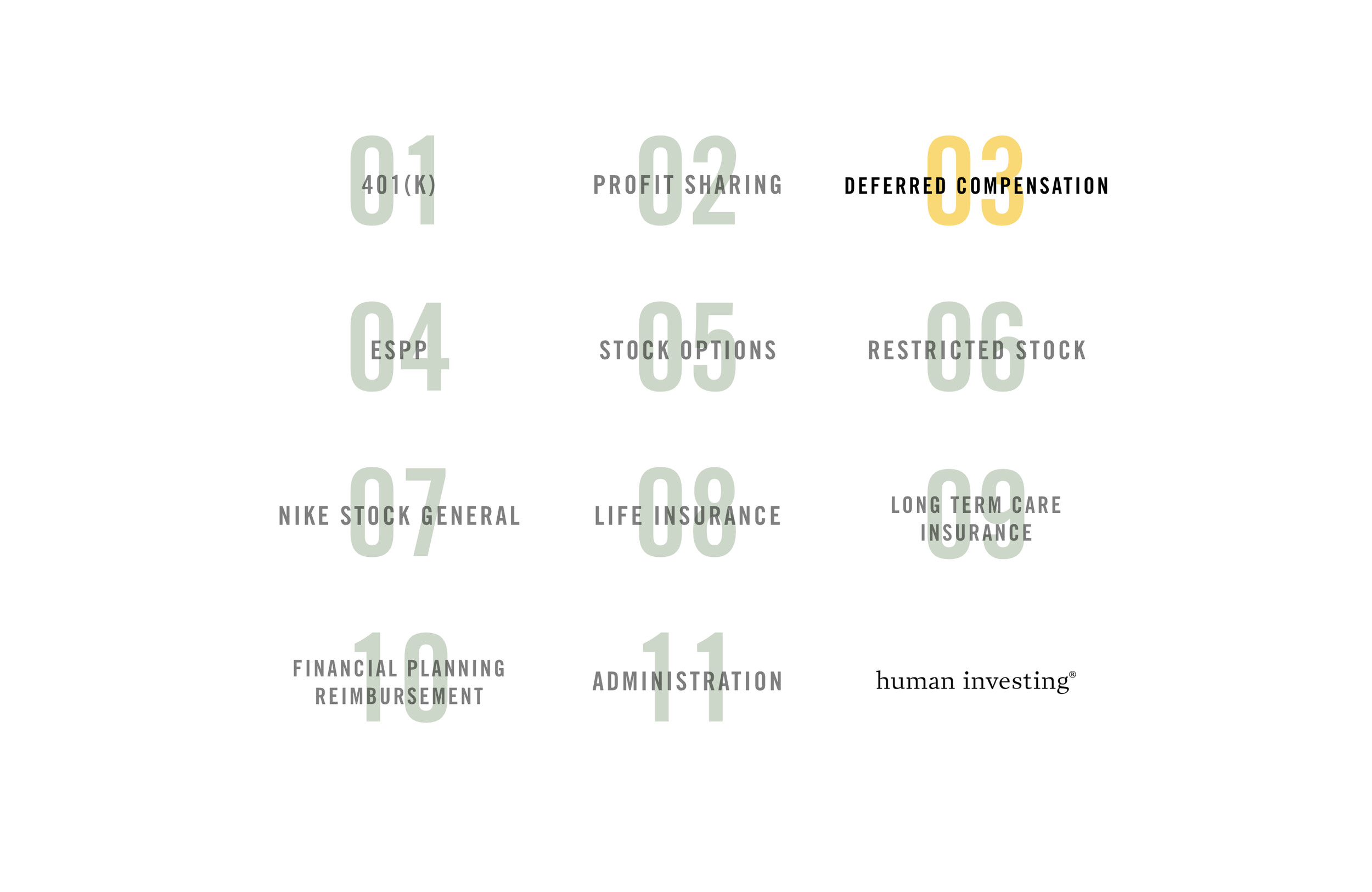
Nike Deferred Compensation Plan: 5 Common Mistakes to Avoid
 
starting11-deferredcomp.png

The Nike Deferred Compensation Plan can be a powerful way to lower your income taxes and save additional pre-tax funds above and beyond any 401(k) contributions.

With open enrollment approaching, we wanted to share the 5 most common mistakes we see with Nike Executives.

1. Ignoring Profit Sharing Contributions from Nike

If you earn over $280K (2019) in combined Salary & PSP, then Nike makes profit sharing contributions on your behalf directly into the Deferred Compensation plan even if you do not contribute to the plan.  These contributions are often viewed as insignificant, but they can quickly accumulate to a sizable amount.  We commonly see these contributions ignored and left invested in the default, which is cash, and thus miss out on multiple years of potential growth.

2. Forgetting about Evergreen Provisions

Evergreen provisions mean that any elections you make in the previous year will continue to roll forward each year if you do not participate in open enrollment. For example, if you decided to defer 10% of your salary last year and do not participate in open enrollment, you will automatically be re-enrolled at 10%. Deferred Compensation plans are more rigid than 401(k) plans and you cannot change your salary deferral to the Deferred Comp Plan mid-year. The takeaway is that if you want to make any changes to deferral percentages, sources or distribution options it is important to participate in open enrollment.

3. Not Having a Strategic Plan for Distribution Option Selection

In the Nike plan you have the option to select a distribution schedule in which the funds are paid out after leaving Nike. The options range from Single Lump Sum or Installments over 5, 10 or 15 years. It is important to remember that distributions are initiated soon after you leave Nike regardless whether it is voluntary, such as retirement/job change, or involuntary, such as being laid off/fired. The distributions are subject to ordinary income tax so if you receive a large distribution in a short period of time it may push you into a high tax bracket and create an unnecessarily large tax bill.

This is where detailed financial planning and tax projections can help minimize the tax impact. Planning out year by year the combined amount of these distributions with other anticipated income sources is crucial to managing your tax bracket and maximizing this benefit. Once you have elected a distribution option you can change it, but there are very specific rules outlined by the IRS that you need to follow. All changes need to be made at least 12 months in advance of leaving Nike, so it is important to do any planning ahead of time.

4. Misunderstanding the Investment Time Horizon

Determining an appropriate mix of investments is impacted significantly by the time frame for when distributions are needed.  Investments in stocks can be volatile in the short-term but can provide a greater return than safer short-term investments like cash or bonds over a long period of time (10+ years).  Funds in a deferred compensation plan are often mis-categorized and lumped together with more aggressively invested retirement funds like 401(k)s and IRAs. 

The time horizon for Deferred Compensation Plans are very different than IRAs and 401(k)s.  For IRAs and 401(k)s, you are not required to take distributions until the year you reach age 70 ½, and those distributions can be spread out over the rest of your life.  On the other hand, Deferred Compensation plans have a much shorter time frame since they are initiated after leaving Nike and have a set distribution schedule of between 1 and 15 years.  Due to the shorter time horizon with a Deferred Compensation plan, we believe it is prudent to have a more conservative investment mix than other retirement accounts and to incorporate it into your financial planning projections to determine the best mix. 

5. Missing Out on the State Income Tax Strategy

An often-missed state income tax strategy exists with Deferred Compensation plans. If you select the lump sum or 5-year distribution option, the state of Oregon will still tax your Deferred Compensation distributions regardless of what state you live in at that time of distribution.  If you move out of Oregon to a state with no/low income tax rates (i.e. Washington), it is advantageous to select a 10 or 15-year distribution option to avoid Oregon state income taxation.  If there is a possibility that you will move out of Oregon after leaving Nike, make sure to evaluate the local taxation compared to Oregon and plan accordingly.

We’re here for you if you have questions

In summary, the Nike Deferred Compensation Plan can be a very advantageous benefit from a savings and tax perspective but due to its unique rules and IRS requirements it is most effective when incorporated within a customized financial plan.  If you have questions or want to better understand how to take advantage of the Nike Deferred Compensation Plan, you can schedule time with me on Calendly below, e-mail me at marc@humanvesting.com, or call or text me at (503) 608-2968.


Related Articles

Financial Planning: A New Mindset
 
show-me-the-incentive.jpg

“Isn’t financial planning a dying profession?”

A first-year undergraduate student majoring in Financial Planning approached me after class one day and asked what he thought was a very simple question – “What’s the difference between a financial planner and a financial advisor?” Simple answer? Not really. 

As I was working to establish a CFP Board Registered Program at a university, an administrator asked me the following few questions as part of his vetting process: “Isn’t financial planning a dying profession?” “Don’t robots already do financial planning?” “Who is going to hire a 23- year-old financial planner to help them with their finances?” These came from a smart individual who had a strong record of professional success. What was he talking about? 

I was speaking with a long-distance friend the other day who told me, “I’m sure glad that my financial planner doesn’t charge me a fee each time we meet but, instead, she only takes a very small percentage from returns on the investments I have with her.” Did this financial planner appropriately disclose compensation methods? I am sure she did. Did this friend understand the true cost of what he was paying for financial planning services? Obviously not. 

“We don’t trust you.”

Several years ago, I was at an annual conference for a large financial planning organization. The conference organizers planned an innovative and unique keynote session where they invited a panel of strangers gathered randomly and spontaneously from off the streets outside of the meeting venue. This group of individuals was diverse and clearly represented many demographic and socioeconomic classes. They were asked a variety of questions about their need for financial advice and desire for help with the money management tasks of life. It was evident that this group was readily willing to admit their lack of financial knowledge and self-efficacy when it came to money-related topics and behaviors.

Then came the curve ball. The panel was told that the room of people (nearly one thousand) who were in front of them were all financial professionals. They were asked another simple question – “Would you hire any of these individuals to help you with your personal finances?” Every one of the panelists said “no!” When asked why, they all said in their own words a message that sounded like “we don’t trust you.” Did these individuals need help managing their financial decisions? You bet. Were they looking to the financial planning industry to fill that role? No. Before you dismiss this as a case of non-target-audience identity for financial planning services, let me introduce you to another conversation. 

“I can’t get objective advice anywhere!”

Recently, I found myself in a conversation with the leader of a local company. He had come to our financial planning firm as a prospective client for planning services. Given the fact that he had been affluent for a significant number of years and was nearing the latter part of his working years, I inquired about his experiences with financial planning in the past and what brought him to our company. His answer was firm and without deliberation – “I can’t get objective advice anywhere!” Was this individual the ideal financial planning client? Pretty much. Why is it so hard to get objective advice? 

So, what is the difference between a financial planner and a financial advisor?

Do you know? Could you explain it to this young and eager student? Is there a difference? We would argue that it does not matter. The core issue is about substance and structure – not semantics. People are looking for a service and not a job or profession title. Why do we continually encounter situations like the ones we have described? Why all the confusion around the discipline of financial planning and why the lack of trust and objectivity? Why is this not a prevailing theme of most other professions (think doctors, lawyers, architects, teachers, pharmacists, engineers, etc.)? It does not take much more than a quick look at the culture and system of the industry to find the dilemma. 

There is a long list of systemic factors that have impaired financial planning outcomes and distorted the way in which financial planning is done. Here are a few: 

  • Products over services 

  • Business models of financial planning firms and compensation structure for planners 

  • Career status and prestige based solely on sales achievements 

  • Role of incentives (Charlie Munger was right when he said “Show me the incentive and I’ll show you the outcome”) 

  • Conflicts of interest that are not transparent 

  • The need for and confusion surrounding “fiduciary” 

  • Measures of success and effectiveness tied to a book of business 

  • Academic preparation/credentialing/pathway to profession 

  • Focus on money content and education while overlooking behavior 

  • Technology/Machine learning and the loss of the human 

  • Investment services silo instead of comprehensive financial planning 

  • Individual planner model instead of team approach 

Restoring confidence in all of us

We are going to be publishing a series of blog posts that highlight and elaborate on these dynamics that have contributed to the rationale for the questions that are mentioned above and the current state of the financial planning profession. In other words, we are going to define what we see as wrong. See, it is not any one thing. Nothing big is wrong. Big things tend to be addressed with swift action through market response or regulation. It is smaller pieces that are broken and those small pieces accumulate into a perception of confusion and mistrust and suboptimal financial planning outcomes. 

We will not stop at identifying problems but, instead, will share what we believe are solutions to these obstacles. We will elaborate on how we do financial planning and define its effectiveness by addressing these challenges to offer our clients the most comprehensive and purest form of human-centered financial planning. It is exactly why our core purpose is to faithfully serve the financial pursuits of all people. That is a big ambition, but it is precisely what individuals and families need, and it is our highest ideal for financial planning. We believe it is a mission worth pursuing.

Ryan Halley, Ph.D., CFP® is Director of Planning Practices and Research at Human Investing. He holds a doctorate in Personal Financial Planning from Texas Tech University and an MBA with a concentration in Finance from The Ohio State University. Ryan has his CERTIFIED FINANCIAL PLANNER™ certification. Dr. Halley is also a Professor of Finance and Financial Planning at George Fox University, where he directs a CFP® Registered Program located near Portland, Oregon. He has co-authored a book and has numerous peer-reviewed journal articles. Additionally, he has been an invited professor and lecturer at various universities in the United States, Canada and China. 


Related Articles


Your Nike Benefits – What You Need to Know
 
nike stock options.png

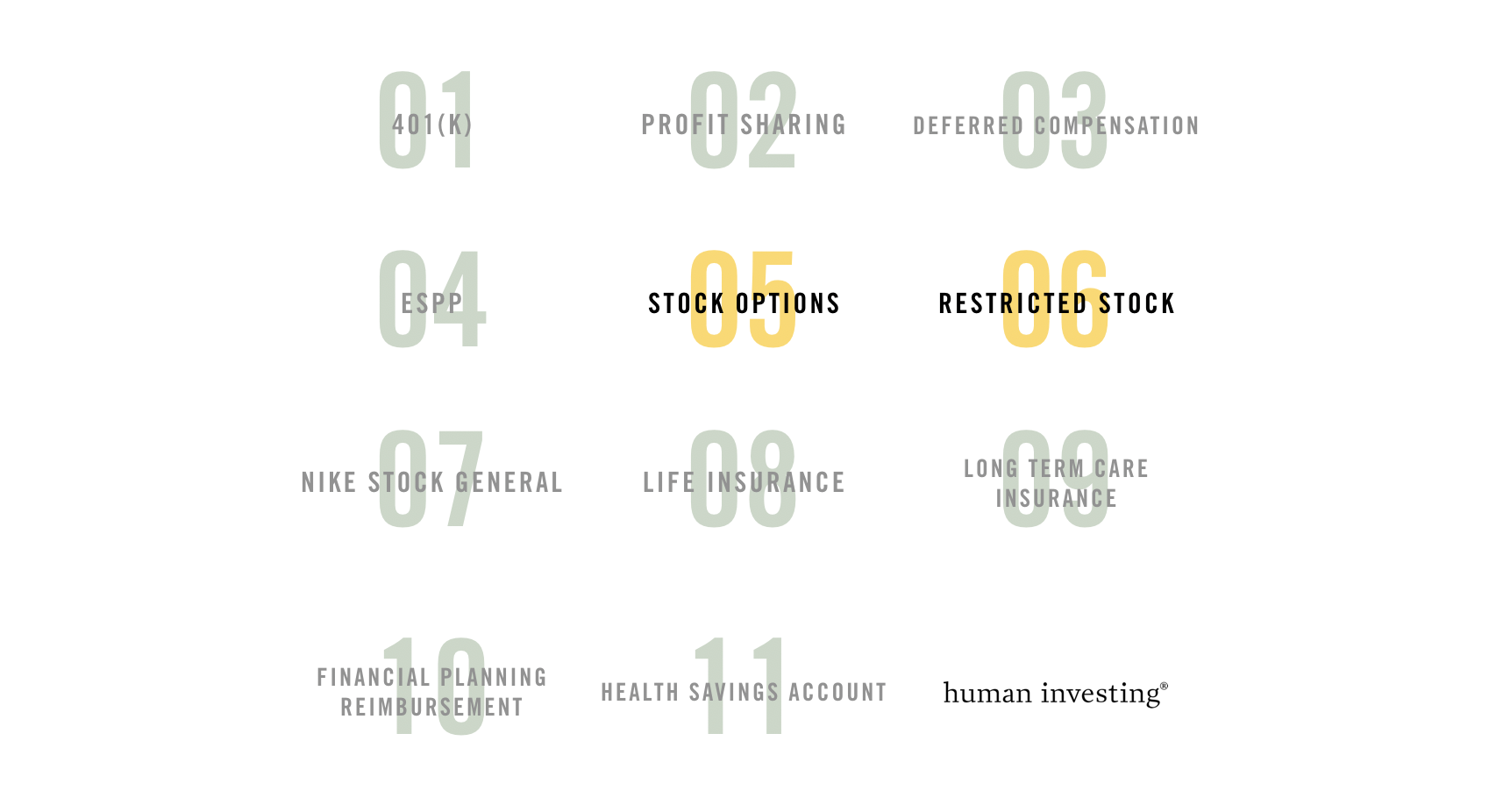
In 2018 Nike opened Restricted Stock Units to their already generous benefit line up.  Now employees have the option of choosing either Stock Options, RSUs or, a combination of the two. 

The following content provides guidance—and highlights the benefits and drawbacks of each option choice.

RSUs (Restricted Stock Units)

An RSU is a grant of stock units that, after a specified vesting period, provides an employee with a pre-determined amount of company shares.  The vesting schedule for RSUs varies by company.  At Nike, the vesting schedule is typically 3-4 years.  You do not receive the stock until you are vested, but once vested the stock is yours and will always have value unless the stock price goes to $0.  

Many consider RSUs to be a less-risky investment. However, it is essential to remember that the realized value of your vested grant may increase or decrease depending on the movement of the stock price.  Once the stock vests, you may choose to either sell the stock immediately or hold it.  RSUs are taxed as ordinary income equal to the market value of the stock at the time of vesting.  One crucial planning consideration is that the actual tax due on the RSU is often higher than the amount of tax withheld at vesting.  This leaves many RSU option owners with an unpleasant surprise at tax time. 

At Human Investing, we help our clients plan for the additional they will need to set aside for taxes, thereby avoiding end-of-year tax surprises. Tax planning and anticipating future tax liabilities are important for both RSUs and Stock Options.

Nonqualified Stock Options

Nonqualified stock options differ from RSUs as they are an option to buy Nike stock at a specified price, called the grant price.  Nonqualified stock options can provide a considerable upside if the stock grants are held during a time of substantial growth in the underlying stock.   

The downside is that if the stock price does not rise above the grant price, the options will be worth $0 at vesting.  Another piece to monitor is that stock options expire if they are not exercised within ten years, leaving the owner without benefit.  When a stock option is exercised, it is taxed on the grant price as ordinary income.  If held for a qualifying period, there will also be a tax on long-term capital gains on the difference between the grant price and market price at the time of sale.

Making Your Choice

Ultimately, considering the following questions has the potential to improve your outcome.  Questions like:  How high is your risk tolerance?  What is your confidence in how the stock will perform in 3, 5, and 10 years?  Is your portfolio diversified or highly concentrated in company stock? Are you looking to retire or leave the company? 

While RSUs can provide more predictable income and tax planning, if you separate from the company, you will lose any RSUs that are not vested.   

Stock Options must be vested upon separation and are generally required to be exercised within 90 days of separation from employment.  This is a risk depending on the stock price at the time of departure.  There is one exception to this rule when you turn 55, but additional criteria apply.

Both Stock Options and RSUs are great benefits and a great way to build wealth. At Human Investing we walk our clients through these choices with a close look at their situation.  We help our clients to determine the best course of action with all their benefits with a comprehensive financial plan we call hiPlan

Want Us To HELP? Let’S TALK.

031-open.png

You can schedule time with me on Calendly below, e-mail me at marc@humanvesting.com, or call or text me at (503) 608-2968 to take your next steps.


Related Articles

Financial Planning: A Solution for Market Volatility and Loss Aversion Bias
 

In order to achieve retirement readiness, financial planning should be the focus of most individuals and families. Indeed, knowing how much a household needs to save and invest in producing a suitable level of income at retirement makes much sense.  At the same time, given the recent uptick in market volatility, I have noticed additional benefits.  Clients who have gone through the financial planning process appear to be at greater peace with the stock market gyrations.  Further, when focused on executing their plan and not mentally tethered to the markets, clients are less prone to letting their behavior negatively impact their long-term performance.

Much of the time, financial planning does a great job of identifying how much an individual or family should own in both "safe" and "risk" investments to meet short-term cash and safety needs, as well as long-term growth objectives.  In the absence of a financial plan, investors are left to wonder if they have the right mix of investments.  Moreover, when market volatility increases, they are often the first to let their emotions get the best of them.  Absent a financial plan; the focus is on the stock market.  If the focus is on the stock market, and the market is temporarily going down, the pain of the volatility or what psychologists call "loss aversion bias" is too much to handle.  As a result, at exactly the wrong time and for the wrong reason, we get a call to "sell everything" locking in those temporary losses—only to see the market recover as the investor sits on the sideline wondering when to get back in.  Selling into a market that is going down is a significant reason investor returns and market returns are so different.

Picture1.png

Dalbar, Inc. tracks investor return versus market returns, and the results are eye-opening. Our observation is that much of the gap between the long-term investor return and the long-term market returns are due to poor behavior and investors lacking a financial plan.  In our view, having a financial plan is paramount as it gives a leg up to investors in two ways: 1) it helps center the discussion about money around goals and 2) it allows investors to minimize their dependence on monthly, quarterly, and annual stock market swings while redirecting the discussion back to goals-based planning.  Goals-based planning is just a discussion on how many dollars will be needed and in what timeframe—this process alone will help determine the amount of safe versus risky investments.  

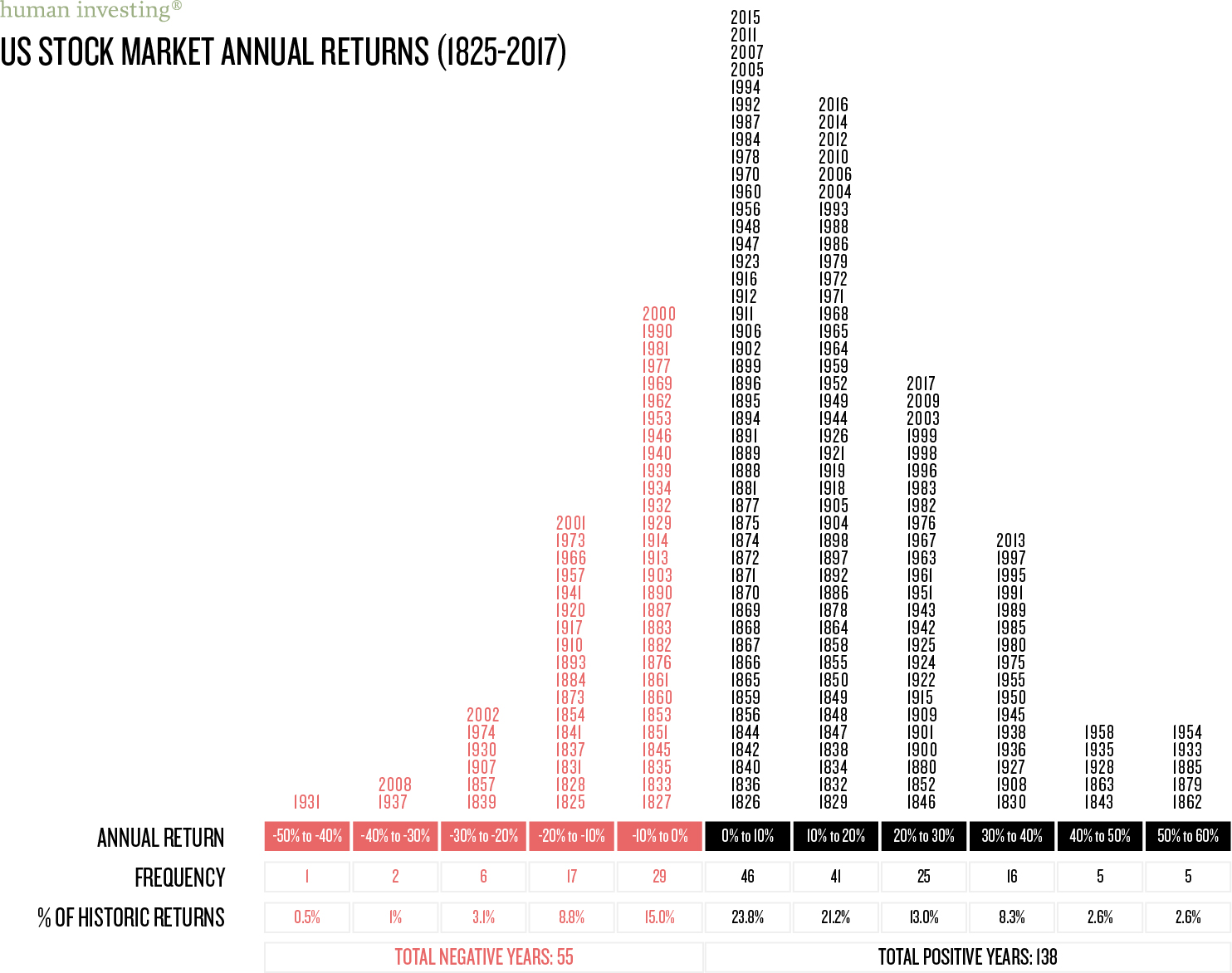
Finally, comprehending the odds of success or failure in the market may be a massive help in keeping nerves at bay and focused on the things that matter most.  Although the legal language would point us towards a statement about past performance being no indication of future success, we can look at the distribution of returns in the stock market going back to 1825 and feel very good about the chance of a positive outcome.  It all adds up to 71.5% of the time the stock market has been favorable, in spite of many ups and downs in between.


historic returns.jpg


Related Articles

Stop winging it. Why you should start your financial plan now
 

As our friends at Charles Schwab post their 2018 Modern Wealth Index data[1], their research findings are eye-opening:   

  1. Sixty percent of Americans live paycheck to paycheck

  2. Only twenty-five percent have a written financial plan.

Ultimately, the Schwab findings point to a challenging financial future for most American.  About one-half of all American households with residents age 55 and older have no savings such as a 401(k) plan or IRA.  The latest GAO report findings make sense given the number of workers living paycheck to paycheck.

pete-blog.jpg

Money isn’t something a whole lot of people enjoy talking about, but at some point, the tone should change so that we can put these glaring facts on the table and work towards a flexible solution.  It seems the findings are explicit (at least with the 2018 Modern Wealth Index): if you have a written plan, you’ll be in the top decile of financial performers.  In other words, you’ll put yourself in an optimal position to have both financial peace and wellness.

[1] www.aboutschwab.come/modern-wealth-index-2018


Related Articles

Setting Your Mind Toward Savings
 
Highway 212 by Matt Duncan

Highway 212 by Matt Duncan

While working with employees at retirement plans over the years, one thing I’ve realized is that being disciplined to save for retirement is challenging and there are many obstacles to doing it successfully. For those living the northwest, saving for retirement can be particularly hard due to the average wage vs. the cost of housing.

Income vs cost of living

When thinking about specific clients that truly save well, regardless of income, a theme that I see is all of these people have a specific mindset towards saving and understand how to achieve short term and long term goals. Over the past month I’ve had a few things cross my life about perspective and goal setting that I wanted to pass along:

First order vs. Second order consequences

A book that I’m in the middle of listening to is by a famous investor Ray Dalio who is the founder of Bridgewater Investments, the largest hedge fund in the world at 160 billion. Dalio, is one of the most successful investors of our time and has some truly unique ways of managing his team and thinking through problems. One passage that really stuck out to me is:

“I’ve come to see that people who overweight the first order consequence of their decisions and ignore the effects of second-and-subsequent-order consequences rarely reach their goals. This is because first-order consequences often have opposite desirability’s from second order consequences resulting in big mistakes in decision making. For example, the first order consequence from an exercise plan (pain and time spent) are commonly considered undesirable, while the second-order consequences (better health and more attractive appearance) are desirable.”

This principle holds true for investing towards retirement as well. By saving a $100/month for their future, a person is giving up something today (coffee, vacation, entertainment) in order to have a more desirable retirement. In other words, this is a first-order consequence and second order consequence type of decision. While this concept is not a unique one, I’d never heard it explained this way and it resonated with how I view decision making.

What’s your “This” in order to get “That”

A friend of mine made the comment a few weeks back “Has your company done the whole let’s set goals for 2018 and never check back in on them again movement?” Unfortunately, corporate goal setting has that stereotype. Often, because it’s true. Luckily our company has Jill, a mother of four and a low tolerance for time wasting activities. She recently implemented a quarterly system for goal setting and tracking. Our team has high hopes for this new system and we’ll ultimately see how it goes. My big takeaway from our time talking about goals was the video she presented by Dr. Henry Cloud called “Start Small”. In this video he speaks to how we all want to get to the big goal but have a hard time setting and sticking to smaller goals.

For some of the guys in our office this meant going on the TB12 diet plan to prepare for our upcoming middle aged athletic endeavors (for me my city league basketball team starting in late January. Wish me luck!).

For you, similar to the Dalio piece, maybe this means looking at what your long term goals is (i.e. having X amount of money at retirement) and shrinking that down to what do I need to do this month/this week in order to get a little closer to that goal.

At the end of the day, the phrases “mindset” and “goal setting” can sound really cheesy, and when done poorly can lead to nothing. However, when we look at our collective social circles and see people who have reached their goals (whether those be physical, business or relationships) often times they are using mindsets like the ones Dalio and Cloud are talking about. Hopefully these can be somewhat inspirational when it comes to putting away additional funds towards your savings goal.

If you have questions or would like to have a conversation about your retirement plan, please don’t hesitate to email or call our team!


Related Articles


Strategies for Employer Plan Participants that hold Employer Stock
 

Do you participate in an employer’s retirement plan in which you own your employer’s stock? Before selling shares or rolling your account over to an IRA, you should consider a special election that could save you significant tax dollars. For taxpayers with employer stock held inside a qualified employer plan, the IRS allows a special election to distribute those shares at their cost basis and recognize the appreciated gain at preferential capital gain tax rates (avoiding “ordinary” income tax rates). This strategy is known as “Net Unrealized Appreciation” and is outlined in IRS code section 402(e)(4). The net unrealized appreciation is referring to the excess fair market value (FMV) of your employer shares over their cost basis. The election creates an immediate income tax liability on the cost basis of the distributed shares, but allows for continued deferral and favorable tax rates on the embedded and future gain.

There are three requirements to qualifying for and executing an “NUA” election strategy. First, the stock must be distributed out of your employer plan “in kind.” Transferring stock “in kind” means you take distribution of the stock itself, not its liquidated cash value. Second, the NUA election must be made as part of a lump sum distribution in a single tax year. You can make the NUA election on all or a portion of your employer stock and make a tax-free rollover with the rest of your account. The rules only stipulate that the entire account must be distributed/rolled over in a single tax year. Lastly, the lump sum distribution must transpire from one of four situations: death, attaining age 59 ½, leaving the company, or disability.

Below is a chart that outlines the tax treatment of employer stock distributed in an NUA election (www.kitces.com)

Graph-1-for-Todd-Strategies-for-retirement-plans.png

For example, let’s say you were a Nike employee and inside your 401(k) you hold 150k of Nike stock. Those shares have been purchased inside your 401(k) over a 20-year career and have an average cost basis of 50k. You retired last month and are looking to roll over your 401(k) assets into an Individual Retirement Account (IRA). Before making the rollover, you decide to make the NUA election on all your Nike stock. The distribution of those shares at their cost basis is immediately taxable at your ordinary income tax rates (i.e. 33% * 50k = $16,500). Those assets are now outside a qualified plan and all embedded and future appreciation can be realized at capital gain rates. Let’s say you then held those Nike shares until they were worth 200k. That 150k gain (200k FMV – 50k basis) would be taxable at 15%, or $22,500. So, in total with an NUA election, you paid $39,000 in Federal income tax. In contrast, by not making the NUA election, and rolling the entire 401(k) into your IRA there is no immediate income tax bill on the rollover, but all embedded and future gains are taxed at ordinary income tax rates. So, using the $200,000 fair market value assumption, and a lower 25% Fed tax rate, your tax bill would be $50,000 when drawn out of the rollover IRA account. The NUA election would have saved $11,000 in Federal income taxes.

Because there is a tradeoff between recognizing income immediately on an “in kind” stock distribution (NUA election) and a full retirement plan rollover, the cost basis in those employer shares is a significant consideration. The lower the cost basis in the shares, the better. Studies have shown unless your cost basis is 50% or less of the stock’s FMV at the date of distribution it is hard to make a case for the NUA election, and a full rollover to an IRA likely makes the most sense (www. kitces.com).

That said, everyone’s situation is different and there are varying factors that may lead to one recommendation over another. Even your desire for charitable giving may weigh in on the decision. For example, let’s say you were to make the NUA election and receive 100 shares with a cost basis of $40 and a FMV of $100; this would create 40k of gross income in the year of distribution. But, if you were to donate 40 of those 100 shares to a charitable organization or donor advised fund, you could create an offsetting 40k charitable contribution deduction. This offsetting deduction could mute the immediate income tax impact and leave you with 60 shares (60k value) that can appreciate at preferential tax rates outside of a retirement account.

There are a multitude of taxpayer specific situations and profiles that may or may not support making the NUA election. So, if you hold employer stock in a qualifying retirement plan and are getting close to retirement, looking to rebalance the account, or sell out of any of those employer shares, please reach out to us and see if an NUA election strategy makes sense for you.

If you would like to talk with one of our advisors please call Jill Novak at 503-905-3100.


Related Articles

Investing in Future Generations
 
element5-digital-OyCl7Y4y0Bk-unsplash.jpg

Exciting news from the Human Investing office:  In the year 2017 alone five babies will be born into the families of Human Investing (2 girls and 2 boys already, with 1 boy on his way)! For myself and the other new parents in our office, 2017 has already been a year of much joy, little sleep, ‘dad jokes’, cliché parenting sayings and a bunch of finance nerds trying to figure out how to care for their little ones and save for their college education. Here’s what we came up with. First the cost –

In recent years, the average rate of inflation in college costs has been about 5%.Source: National average cost data © 2017 The College Board, “Trends in College Pricing 2016.”

In recent years, the average rate of inflation in college costs has been about 5%.

Source: National average cost data © 2017 The College Board, “Trends in College Pricing 2016.”

Parents like my wife and I and others in the office may have different goals and philosophies on how much we would like to cover for our child’s education expenses - whether a dollar amount, like $50k, or a percent of the education expense. Whatever the philosophy, we understand the need to save. But what is the best vehicle to do so? Here are a few of the most common options and some important considerations to take into account when saving or choosing an account type:

  • 529 Savings Plan: 529 accounts allow you to set aside after-tax contributions that grow tax free. The balance can be used for qualified higher education expenses, such as tuition, room and board, and books. States may offer 529 plans to residents, often with tax breaks or additional incentives - check your state here.

  • Coverdell Education Savings Account (ESA): ESAs allow you to set aside after-tax contributions that grow tax free. Account value can be used for expenses not exclusive to college. Unlike 529 plans, there is flexibility to use ESAs for qualified education expenses from Kindergarten through Graduate School.

  • Roth IRA: The Roth IRA can be used as a combination retirement account and educational savings vehicle. Your after-tax (Roth) contributions can be invested for retirement purposes and college expenses can be withdrawn with exemption to early withdrawal penalties. Additionally, the value of your Roth IRA will not hurt chances for financial aid eligibility as it is not considered assets on the Free Application for Federal Student Aid (FAFSA).

  • Uniform Gifts to Minors Act and Uniform Transfer to Minors Act (UGMA/UTMA): The original college savings account, UGMA/UTMA assets are transferred to the child’s account and are invested on their behalf until he or she reaches age 18 – 21 (defined by state). At this time, the beneficiary can use dollars for whatever they wish. With a UGMA /UTMA you can realize $1,050 of gains tax-free per year. Note: UGMA/UTMA is in the child’s ownership for FAFSA purposes.

college savings.png

* This data is provided by www.savingforcollege.com and is subject to change. The numbers provided reflect 2017 regulation and will fluctuate with time. Please contact a trusted tax professional to understand exact tax implications.

The consensus: If you are looking to maximize saving for college and want to make it a family affair (any one can contribute) then the 529 is the best option. If you are not sure about college for your child but would still like to save for their future, then other great options like a UGMA/UTMA may be beneficial. Want to talk about what type of account is best for you or share baby stories? Let’s talk, Human Investing is here to help.


Related Articles