Posts in Saving and Spending
The Market, Economy, and Implications from Our CEO


One of my favorite market commentators is Dr. David Kelly, an economist whose research focuses on the investment implications of an evolving economic environment. His insights are rooted in theory and application, which help make the work he publishes comprehensive and practical. In his most recent article, he notes the following:

As America emerges from the pandemic, there are still serious health concerns, a yawning political divide, rising autocracy around the world, a brutal war in Europe and the highest inflation in 40 years. Moreover, anxiety triggered by these genuine problems is being amplified by cable channels and social media which ever more efficiently gather their audience by appealing to fear and outrage.[1]
— DR. DAVID KELLY

With this backdrop, I will try to share my thoughts on the market, economy, and implications for investors.  

Market declines: We’ve been here before.

Whether looking at the stock market, bond market, or commercial and residential real estate markets (to name a few), all are down for the year. With widespread asset price declines, renewed volatility is unnerving for many of us. These are challenging times to have capital deployed into the market. However, volatility and risk are the primary reasons investors in the market have achieved meaningfully better returns than cash over most market cycles.

The narrative surrounding this market cycle continues to evolve—the reasons "why" we are experiencing market gyrations and asset declines today differ from past times. However, I have great hope and confidence markets will normalize and begin their next run higher—in the same way they have done following each of the last downturns dating back to 1825. [2] In my 25+ years advising clients, I have experienced managing assets through significant market declines, with the most recent being Q1 2020, and most memorable 2007-2009, and 2000-2002. The cause for these markets was different, but the result was the same for those who managed their emotions through turbulence.

How is the economy responding to the current market?

Economic activity is beginning to slow. The most notable remark came from Fed-Ex, which reported a slowdown in shipments—a real-time data point highlighting growing constraints from corporations and consumers alike. Although the Fed-Ex announcement is one observation, it is congruent with analysis conducted by Dr. Kelly and others, highlighting a slowing economy domestically and abroad.

The Federal Reserve (the Fed) job is exceedingly tricky, given that inflation affects everyone and the primary defense for rising prices is interest rate hikes. At the same time, if interest rate increases are applied excessively, they stand to constrain the economy, which in turn could inflict pain on households through job loss and a decline in asset prices. Concern over Federal Reserve policy mistakes has begun to capture the headlines, with notable economists Mohamed El-Erian and Jeremy Siegel blasting the Fed for raising interest rates too aggressively.

The tension between the actions of the Fed and prominent economists may cause the Fed to exercise more constraints when deciding on interest rate policy in the future. Ultimately, we hope Fed Chairman Powell and his colleagues around the country can orchestrate a soft landing for the economy—which involves moderating rate hikes and extinguishing inflation while maintaining reasonable economic growth.

Our financial plans factor in these conditions.

Financial planning is essential to helping to create positive customer outcomes and providing wise counsel in all market and economic conditions. Recently, a retired client and friend called concerned about the market. They asked if they should reduce their overall risk and sell a portion of their equities. After a review of their financial plan, it was determined that despite the market decline, they were on target to maintain their spending goals; therefore, no immediate action was needed.

Our recommendation for this client included a study on their financial plan's probability of success. The probability analysis simulates their plan's likely outcomes based on good and bad markets. When coupling their planning inputs with their probability analysis and considering their cash and bond holdings, it is easier to look past the market and focus on their plan, including simulations for markets like we are in now.

Please know we understand how unnerving it is to see account balances drop and to feel that the world is unraveling. However, it is imperative that we remain objective and focused on our disciplined approach to both planning and investing. When speaking with your advisor, their answer may be "stay the course." This is our way of saying we have looked at your plan and are prepared for times such as these. Attempting to control the market or predict capital market outcomes sets us up for failure. However, focusing on what we can control, utilizing industry-leading technology, and leveraging a team of experienced credentialed experts are the best approaches with the highest probability of success for our clients and their plans. [3]

As has been the case since hiring Marc Kadomatsu, CFP to Human Investing, financial advice dispensed through the lens of financial planning has been the cornerstone of our service offering at Human Investing. Marc previously served as the head of the Financial Planning Association for Oregon and SW Washington. We have added to his team the recent promotion of Will Kellar, CFP, to Partner. Will has tremendous experience in advising clients through a planning lens. Moreover, Will is responsible for training the next generation of financial planners as he currently serves on the faculty of Oregon's only accredited financial planning program at George Fox University. 

Diversification may be the key to your peace of mind.

Emotion management is complicated—particularly for those whose primary source of income is their investment portfolio. To help manage the anxiousness that may accompany turbulent markets, please consider the concept of diversification. The term "diversification" means we don't put all your eggs in one basket. Although you have one account statement from your primary brokerage affiliation (Schwab, Fidelity, Betterment, etc.), you have various investments. Each investment serves a purpose in helping you achieve your goals. Some investments like cash and short-term bonds are what we tap into to provide necessary liquidity without having to sell at a significant loss. At the same time, equities are for longer-term appreciation to help your portfolio generate returns that outpace inflation and taxes.

Although your portfolio performance and holdings are aggregated into a single statement, we ensure that customers are adequately diversified into many different holdings. That way, when it's time to take a necessary withdrawal, we have many options for where we can go for the cash. There is no easy way to manage emotions in volatile markets. However, knowing ample investments can be accessed to provide the needed financial resources is something to consider when looking at the portfolio as a whole.

Markets of all kinds experience ups and downs—which has been my experience since 1996. The current downturn has several major markets down in excess of twenty percent year-to-date. Countries and regions go through economic cycles for various reasons and durations. The economy is showing signs of a slowdown, which could negatively impact consumers and businesses alike. With both the market and the economy on edge, we believe it is paramount for investors to stay disciplined, avoid acting on emotion and lean on their financial plan and advisor to help them make informed financial decisions.


[1] Kelly, D. (2022, September 19). Why the Fed should worry less about sticky inflation (but probably won't). Notes on the Week Ahead, JP Morgan Asset Management.

[2] Gladhill, A. (2019, September 12). Return histogram: Stock market annual returns 1825-2017. Investment Committee Q32019, Human Investing.

[3] Bennyhoff, D. G., & Kinniry Jr, F. M. (2016). Vanguard Advisor's Alpha®. Vanguard, June, http://bit. ly/2gXMDCs.


Related Articles

How to Make the Most of Your Windfalls


Many people dream of one day receiving a considerable sum of money, whether through a large inheritance, winning the lottery, or selling their business or home. Whether the windfall is expected or not, without a plan, coming into a lump sum of money can be overwhelming at first and emotionally draining once the dust settles.

We’ve all read or heard stories of lottery winners who went from rags to riches to rags again, ending in bankruptcy. [1] While most of us may not win the lottery, we may receive money from an inheritance or a gift we weren’t expecting. This news will undoubtedly stir up thoughts of grandeur on how to spend it or for those more practical, how to best protect it. Not to mention, there are also taxes to consider. It can be exciting and scary at the same time.

For these reasons and more, building a financial plan may help you avoid the pitfalls of emotional or poor decision-making by creating a roadmap. This roadmap will act as your guide, helping you stay on track and get the most out of your new-found wealth. By creating a plan, you will cover many topics that matter most to you, such as:

Assessing your short-term goals.

Has there been anything on your to-do list that you would like to check off within the next few years? Buy a more reliable car, take care of house projects, or bolster your emergency savings fund? It’s vital to assess these needs before you consider investing, as the funds necessary to cover the costs of these goals may need to remain in cash.

Paying off high-interest debt.

Do you have any debt? Our team defines high-interest debt as any loan with an interest rate of 6-8%. This is typically found in credit card debt, some student loan debt, and personal loans. It is important to aggressively pay down high-interest debt, and receiving a lump sum just might provide you with the opportunity to do so!

Building an investment plan.

Analysis paralysis can sometimes lead someone to leave their windfall as cash. Building a personalized investment plan that aligns with your goals and timeline is essential to avoid the permanent risk of holding cash. This step is one where an advisor is especially valuable to provide expertise and advice.

Treating yourself.

Receiving a windfall should not feel like a chore. As your financial plan is being built, it’s okay to add room for things like gift and travel. Not only will it make you feel good that it’s in the budget, but it will give you something to look forward to. Considering even small treats is good to do as it will help you plan to budget for bigger things like travel. According to a survey by the Harvard Business Review, 80% of people derive a greater level of happiness when spending money on experiences rather than buying material things.

You can certainly create a basic goals-based plan on your own, or you could look to hire an expert to help you with comprehensive planning. Here are three ways an advisor can help you:

1. Discuss what may be the highest and best use of your dollars.

An advisor will help you prioritize your needs and wants. While it may seem like you are set for life, without proper planning, the money can disappear fast.

2. Help decipher what is important to you.

For many, coming into a lump sum of money can be partnered with heartbreak from losing a loved one or the pain from a legal settlement. Having a discussion measuring both objective and subjective factors is essential.

3. Partner with you to help keep you accountable for your goals.

Many come into money with great intentions but fail in the execution due to a lack of responsibility, intentional or not.

See The Value of Hiring Human Investing for additional information about the advantages of having an advisor.

As always, our team is here to help. We believe receiving a lump sum requires deep consideration and understanding as it relates to your overall financial well-being. If you would like to connect with a dedicated team member to go over your options, please use this link.

[1] The Ticket to Easy Street? The Financial Consequences of Winning the Lottery


Related Articles

Ready to Invest? Start With These Four Foundational Steps
 

Starting From Square One (Or $20 in my bank account)

Picture this: You’ve just graduated college and received your first '“big-kid” job. You have about $20 in your name. Although it is a new concept, with a new job comes new responsibility, and you decide you should probably be more mindful about your spending (and saving) habits. But how do you start?

I had the unique privilege of beginning my career at Human Investing shortly after I graduated. As you can imagine, working at a financial advisory firm meant that before I started contributing to the company’s 401(k) plan, I was given a beginner’s course in investing.

AN ENDLESS MAZE OF DECISIONS

Like many people who join corporate America, I opted into its retirement plan because it was a free benefit I received. I knew saving for retirement was important, and the investment options available to me would benefit my long-term financial plan.

When I received my first paycheck, I learned the importance of contributing to my 401(k), but in a way that was compatible with my cash flow.

A common rule of thumb is to contribute 10-15% of your gross salary to your retirement account if you can (this includes the employer contribution/match). After learning this, I was eager to invest 15% into my 401(k). However, I did not consider other key factors that made up a healthy and holistic financial plan, like funding an emergency savings account or considering other short-term goals (ex: continuing education or buying a home). Although I was so eager to contribute as much as I could to my retirement plan, I ended up contributing much less than expected after assessing my current financial situation.

Unpacking where to start

I share this story because, like most people new to the financial scene, I wanted to manage my money well, and I figured investing all of my excess income would equate to successful money management. What I didn’t do was take a step back and assess my entire financial landscape. Thankfully, Human Investing was there to provide some guidance. That’s why we made this visual. We call it “The Pyramid to Financial Wellness.” Use the visual as a map; start at the foundation and then work your way up. Before continuing, please know that we all have unique financial situations, and not every block may apply to your situation.

LEVEL 1: Build a Foundation

Build a Budget to understand your monthly cash flow: If you’re looking to invest dollars from your paycheck, you need to know how much bandwidth you have at the end of each month. If you don’t currently have any excess dollars, try to get creative. Look at your current spending habits and see if you need to minimize spending in a certain area. Don’t be afraid to rely on savings apps for help. We generally recommend Mint or Digit.

Pay off High-Interest Debt: Focus on higher interest, non-deductible loans first, such as credit card loans. Consider refinancing your loans or reconsolidating your debt to make payments more manageable.

Contribute to your Company-Sponsored Retirement Account: If applicable, contribute enough to receive the employer match. For example, if your employer matches up to 6% of your contribution, try to meet the 6% savings rate.

Build an emergency fund: If something unpredictable happens, make sure you’re prepared. Click here to learn how to build an emergency savings fund.

Level 2: Plant Long-term Seeds

Open a Retirement Account for future savings: Based on your age and tax bracket, start contributing to either an IRA or a Roth IRA. Click here to see if a Roth IRA account is the right account for you.

Continue paying down student loans: If student loan payments are on your horizon, don’t delay! Try to pay off what you can now. Consider refinancing your loans in order to make regular payments more manageable.

Save for a Home: If this is a goal of yours, start saving. Depending on your timeline, try to save in either a High Yield Savings Account (Short-term goal) or a Roth IRA (Longer-term goal).

Level 3: Hone your Monthly Budget

Open up a 529 account for a child or grandchild: If you are hoping or planning to fund your child’s college education, utilizing a 529 account can protect your purchasing power. The same rules that apply when flying apply here too. Put your mask on before taking care of others.

Pay down your mortgage: Target additional mortgage payments if you are able. Consider refinancing your mortgage to possibly find greater savings with lower interest rates.

Save for Short-term and Mid-term goals: Short-term goals include immediate expenses, paying down debt, having an emergency savings fund, etc. Mid-term goals are big purchases that you plan to make before you retire. This includes saving for a house or a car. Avoid borrowing and start planning to save. If you’ve exhausted other savings vehicles (like your 401K and Roth IRA), consider opening a brokerage account.

If you have any questions about how investing can fit into your financial plan, contact us! We are here for you and are excited to cheer you on as you learn to manage your money well.


Related Articles

Student Loan Forgiveness: What's Next?


On Wednesday, August 24th, President Biden announced his administration’s Student Loan Debt Plan. This news may bring up questions for you, and we are here to answer them.

Here are the Details you Need:

Who qualifies for loan forgiveness?

  • Federal student loan borrowers who earn less than $125,000 per year or married couples who make less than $250,000 per year on their 2020 or 2021 tax return.

  • Private and Federal loans taken after June 30th, 2022, are not eligible.

How much will be forgiven?

  • $10,000 of student loan debt is canceled for all federal student loan borrowers. 

  • An additional $10,000 ($20,000 total) of student loan debt is canceled for those who received Pell grants

How can you ensure you receive forgiveness if you qualify?

Borrowers who are already on income-driven repayment plans will automatically receive forgiveness. The Department of Education will make an application available during the month of October. Due to high-volume traffic, the application and income verification process will likely take time.

Borrowers can sign up for updates from the US Department of Education to be notified when the application becomes available by clicking here.  

Other key dates to remember:

  • November 15th The deadline to apply to receive debt cancellation by the time the payment pause expires at the end of the year. Your application must be submitted by November 15th.

  • January 1, 2023: If you didn’t receive total forgiveness, payments will start back up and interest will begin accruing on the balance on January 1, 2023.

  • December 31, 2023: The final deadline to apply for student loan forgiveness.

Forbearance extension

Biden also extended the pandemic student loan forbearance that was set to expire on August 31st to the end of the year. This will benefit those who won’t qualify for forgiveness and those who will still have a balance remaining after forgiveness.

Proposed change of repayment based on income: Those with undergraduate loans who are on income-driven payment plans, may be able to cap repayment at 5% of their monthly income. This is half of the current rate most borrowers pay now.

How does this affect Your current financial situation? 

This news will likely create further questions regarding your specific financial landscape. Here are a few examples of how this change is applied to everyday people:  

MARIA, AGE 25

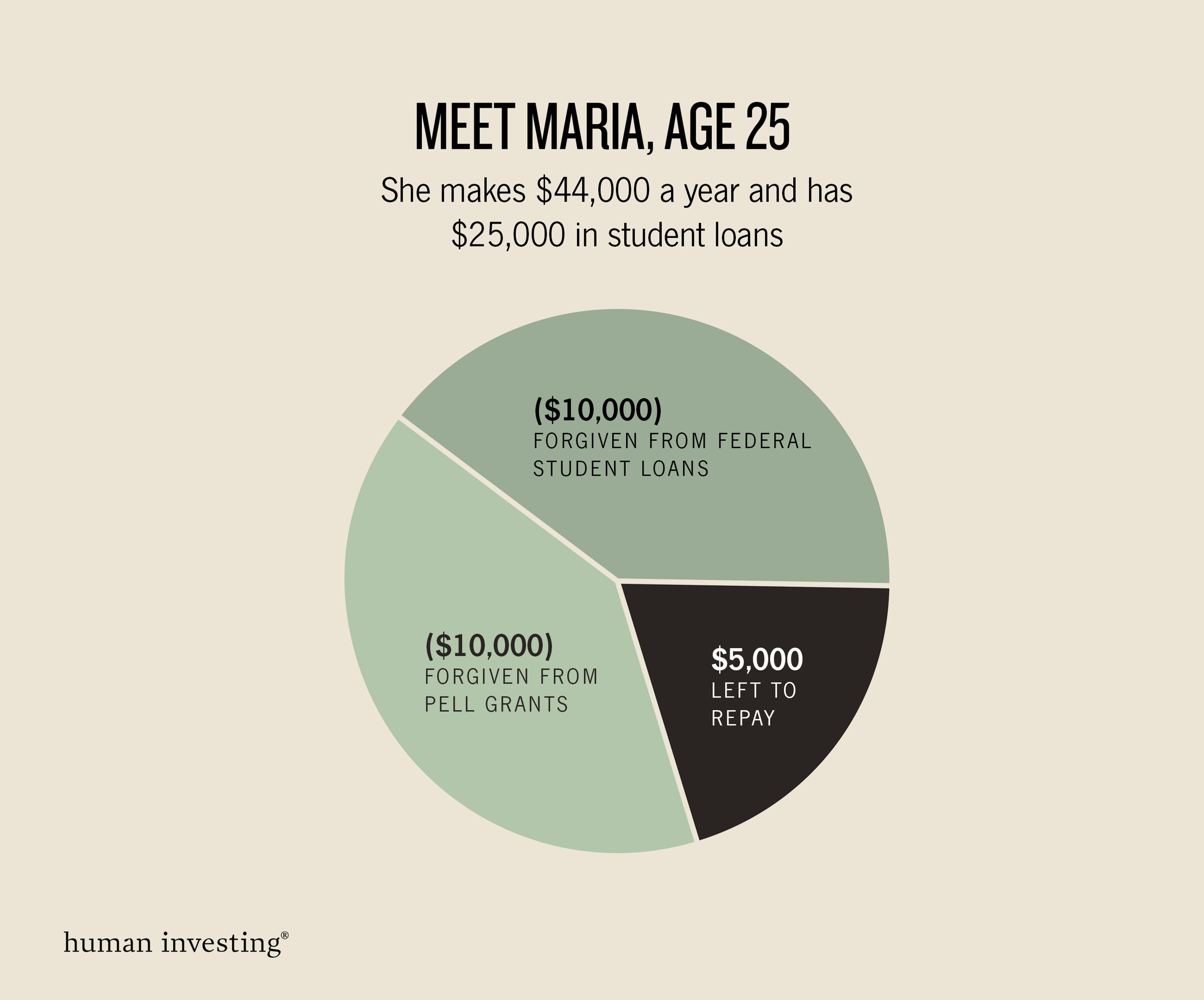
Maria graduated in 2019 with $25,000 in student loan debt and currently makes $44,000 per year. One of the loans she received was a Pell Grant. According to Biden’s plan, Maria will only have $5,000 left to repay starting in January 2023.

ANDREW & MONICA, AGE 43

Andrew and Monica are a married couple. Together, they carry $40,000 in student loan debt and make a combined income of $260,000 per year. Due to their income, they are ineligible to receive student loan debt forgiveness and will need to resume their repayments starting in January 2023.  

SEAN, AGE 35

Sean graduated in 2017 with $8,000 in student loan debt and currently makes $75,000 per year. All of Sean’s student loans are canceled, with no repayments resuming in January 2023.

How Should You Adjust Your Financial Plan?

However you are receiving this news, you should use this opportunity to assess your finances and take action to get closer to your long-term goals. Here are a few tips:  

If your student loan debt has been altogether canceled:  

  • Take some time to reassess your spending and saving habits – create a budget.  

  • Bolster your emergency savings fund: Make sure you have 3-6 months of expenses saved.

  • Use the extra cash to pay off any consumer debt.

  • If you have no consumer debt and have extra cash, consider redirecting those repayments to funding a Roth IRA. (Up to $6,000, or $7,000 if you are aged 50+).

  • Reconsider short-term and long-term goals.

If your student loan debt repayments are resuming in January 2023:

  • Edit your budget to include these payments.

  • Consider restarting your monthly payment schedule. This will save you money in accrued interest by paying down the principal during the payment pause.

As always, our team at Human Investing is here to help should you have any further questions. If you would like to talk with an advisor, call 503-905-3100.


Related Articles

In the Market for a New Electric Vehicle? Get One Today if you Want the Most EV Credits
 

Due to the newly proposed legislation (Inflation Reduction Act), if you are in the market for a new electric vehicle, you may want to rush to the dealership today (August 11th)!  In the proposed legislation, Congress extended the electric vehicle credit but has added new restrictions which will make qualifying for the credit more difficult.

Here is a list of the new limitations proposed for Electric Vehicles delivered in 2023:

  1. 40% of the Battery must have been made in a country in which the US has a free trade agreement.

  2. MSRP must be under $55,000 for sedans and $80,000 for vans and SUV’s.

  3. Modified Adjusted Gross Income must be less than $300,000 for married joint returns and $150,000 for others.

  4. On a positive note, the $200,000 sales limitation that has kept Tesla and a few other manufacturers from qualifying for electric vehicle credit will be removed. So if you are thinking about getting one of these models, you may want to wait until next year to see if these manufacturers can meet the above qualifications.

To use the old credit, you must take delivery of the car in 2022 or have a binding contract to purchase before the bill is signed into law. The bill has already been approved by the Senate and will head to the House for a vote on Friday, August 12. 

Which cars are still eligible for the old credit?

If you want to act quickly, this link contains a list of cars that are still eligible for the old credit.  Please note that Tesla and some other dealers are not eligible for the old credit, but may be eligible for the new credit given they comply with the limitations above. 

As always, we are here to help. Please reach out to your advisor team or email luke@humaninvesting.com if you have any questions.


Related Articles

Are your Kids Starting Summer Jobs? Start Investing in their Financial Independence
 

Summertime in full swing often means summer jobs for many young people, especially high school and college-age students. Earned income can provide a terrific opportunity for young people to save, think about their future, and begin practicing financial independence.

High school and college students motivated to save and invest can utilize Roth IRA accounts to get the most out of their dollars. Compound interest in action is a pretty magical thing to behold, and the earlier you can earn compound interest working for you, the better! Compound interest, tax benefits, and learning lifelong financial lessons can make for an incredible summer job experience.

Here is why opening a Roth IRA account is an excellent option for those spending their summer working as a high school or college student. 


Tax-Free Benefits

We are big fans of Roth IRAs here at Human Investing. Because the money used to contribute is after-tax dollars, it grows tax free and is not taxed down the road when you take it out…..We love this!

The younger your child starts a Roth IRA account, the more time their tax-free dollar amount in the account has to grow.

Compound Interest Growth

Youth isn’t wasted on the young. In Beth Kobliner’s book Make Your Kid a Money Genius (Even If You're Not): A Parents' Guide for Kids 3 to 23, she uses the following example:  

“Let's say [your teen] puts $1,000 of his summer earnings into a Roth IRA for each of the four years from age 15 to age 18. If he stops and never puts in another penny, but lets the money grow, by age 65 he'll have about $107,000, if the money earns 7% a year. 

But if your kid waits until age 25 and then puts away $1,000 for each of the four years until age 28 and stops, that account will only be worth a little over $50,000 by age 65.”

By taking advantage of a Roth IRA early on (in this example, ages 15-18), you can double your money compared to starting in your twenties. 

Roth IRA Specifics

In 2022, the maximum annual Roth IRA contribution is $6,000 a person for those under 50 years old who are single and making under $129,000 a year.

For those under 18 years old:

For children under the age of 18, they would need to open a Minor or Custodial Roth IRA account. 

Money put in this account must be earned, not gifted (this includes birthday and graduation gifts), and the adult who opens this account for the minor controls the assets until the minor reaches the age of majority (which is 18). 

Adults can also contribute. If your teen earns $3,000 at their summer job, you could either contribute the full amount they earned and let them spend their money, or you could contribute a percentage of your teen’s earnings (like 50%). 

It’s important to note that parents can contribute the money to a teen’s Roth IRA if their teen earned at least that amount. For example, if your teen made $2000, the most that could be contributed to the Roth IRA is $2000 total.

More info here: https://www.schwab.com/ira/custodial-ira 

For those over 18 years old:

For children 18 years or older, their Roth IRA account is now no different than the Roth IRA their parents might have. This account has the same requirements and restrictions as any other non-minor Roth IRA.

Building habits for the long-term

Here are a few ideas from parents on our team about approaching this opportunity with your child who has a summer job. 

As tempting as it is to spend those paychecks on something more tangible (a car, clothes, trips with friends), our children will need to understand the importance of financial independence, hard work, and investing for the future. Old habits die hard, so the earlier they learn these lessons, the better off they will be in the long run! 

You can incentivize your child’s savings by matching their Roth IRA contribution (up to their contribution limit). You can also lead by example. Share with your child why you save and what your financial “why” is. Share your hopes and dreams for their financial future and how their Roth IRA can be a means to this end. 

If you want to read more about Roth IRAs, check out our other blog post by fellow HI team member Nicole: Is a Roth IRA the Right Account for you?

Feel free to reach out to our Human Investing team if you would like more information about Roth IRA accounts. 


Related Articles

Section 121 Exclusion: Is it the Right Time to Sell Your Home?
 

Home prices and home equity have increased substantially over the last few years, which may leave you wondering if you should sell your home. Wouldn’t selling your home be even more tempting if buying another home wasn’t so difficult?

If you are thinking about selling a home, then you are probably focused on market timing, payments, moving and lifestyle changes. One thing you may have overlooked are the tax considerations of selling a home.

You may be thinking, “wait, isn’t the sale of my main home tax free?”  

It depends.

Primary homes are considered capital assets, like investments such as stocks and bonds. Capital assets are normally subject to capital gains taxes when they are sold. However, primary homes may qualify for a favorable capital gains treatment called the Section 121 exclusion.

For most homeowners, the Section 121 exclusion is one of the greatest benefits of the current tax code. Are you aware of how this exclusion works and how to ensure you qualify?

Start With your Capital Gains

Before making the decision to sell your home, start by calculating your capital gains. A gain on the sale of a primary residence is calculated as such:

Sale price - (Purchase price + Improvements) = Capital Gain

Breaking Down the Section 121 Capital Gain Exclusion and its Qualifications

The 2-out-of-5 year capital gain exemption is crucial for homeowners to understand.

The IRS allows homeowners to exclude part of your home sale from capital gain taxes if you’ve owned your home and lived in it as your primary residence for two of the past five years. The 24 months do not have to be consecutive months, but rather a total of 24 months within a 5-year period. If you qualify for the 2-out-of-5 year rule, then you have the following gain exclusion when selling your home:

The profit mentioned above does not include outstanding mortgage. If there is an outstanding mortgage on the home, this will not impact the Section 121 capital gain exclusion amount. Please read example #1 below to see how mortgages do not impact the overall capital gain.

Partial Gain Exclusions and Benefit Timing

Even if you haven’t lived in your home two out of five of the years prior to selling the home, there may be a way to qualify for a partial gain exclusion. For example, you could be eligible for a partial gain exclusion if you had to move due to work-related reasons, health-related reasons, or for unforeseen circumstances such as divorce or giving birth to two or more children from the same pregnancy.

Homeowners can benefit from this Section 121 capital gain exclusion once every two years. For example, if you have two homes and lived in both for at least two of the past 5 years, both homes are not eligible for the capital gains exclusion at the same time.

Four Examples of the Section 121 exclusion


EXAMPLE #1: SINGLE-FILING TAXPAYER

Jordan purchased a home in 2016 for $350,000 and sold it in 2022 for $560,000.

Jordan lived in her home for these 6 consecutive years. When she listed her home for sale, Jordan still had an outstanding mortgage of $75,000 on her home. As mentioned above, mortgages are not part of calculating the total Section 121 gain exclusion. Jordan has a total gain of $210,000 ($560,000 sale price - $350,000 purchase price). For a single taxpayer, none of this gain is subject to taxes because it is less than the exclusion amount of $250,000. Time for Jordan to enjoy her celebration of choice.

EXAMPLE #2: COUPLE FILING TAXES JOINTLY

Marta and Paul purchased a home in 1999 for $350,000 and sold it in 2022 for $1,000,000.

Marta and Paul raised their children in this home for the past 23 years, except for in 2006 when they rented their home for a sabbatical year. The total gain on the sale of the home is $650,000. They will only pay capital gains on $150,000, since $500,000 is subject to the Section 121 gain exclusion.

EXAMPLE #3: VACATION HOME TURNED TO A PRIMARY RESIDENCE

Samuel and Taylor bought a vacation home on the coast in 2010 for $300,000. They used the home as a vacation home for the first 10 years, and then converted it to their primary residence in 2020. Samuel and Taylor would like to sell their home at some point in 2022 for $500,000.

The first 10 years of ownership are considered non-qualified use. Non-qualified use is any period after 2008 when the home was not used as a primary residence. Examples of non-qualified use are vacation homes, rental properties, investment properties, or homes used in a trade of business. Homeowners cannot take the full tax-free exclusion under Section 121 if a property was held and used for non-qualified use prior to it being held as a primary residence (qualified use).

In this example, 2/12ths of the total $200,000 of capital gain can be excluded from taxable income ($33,333) as qualified under Section 121 and 10/12ths ($167,666) of the total capital gain must be included in taxable income as non-qualified use under Section 121.

*There are some exceptions to non-qualified use. They are listed under the Business or Rental Use of Home section.

EXAMPLE #4: HOMEOWNERS TURNED TO LANDLORDS

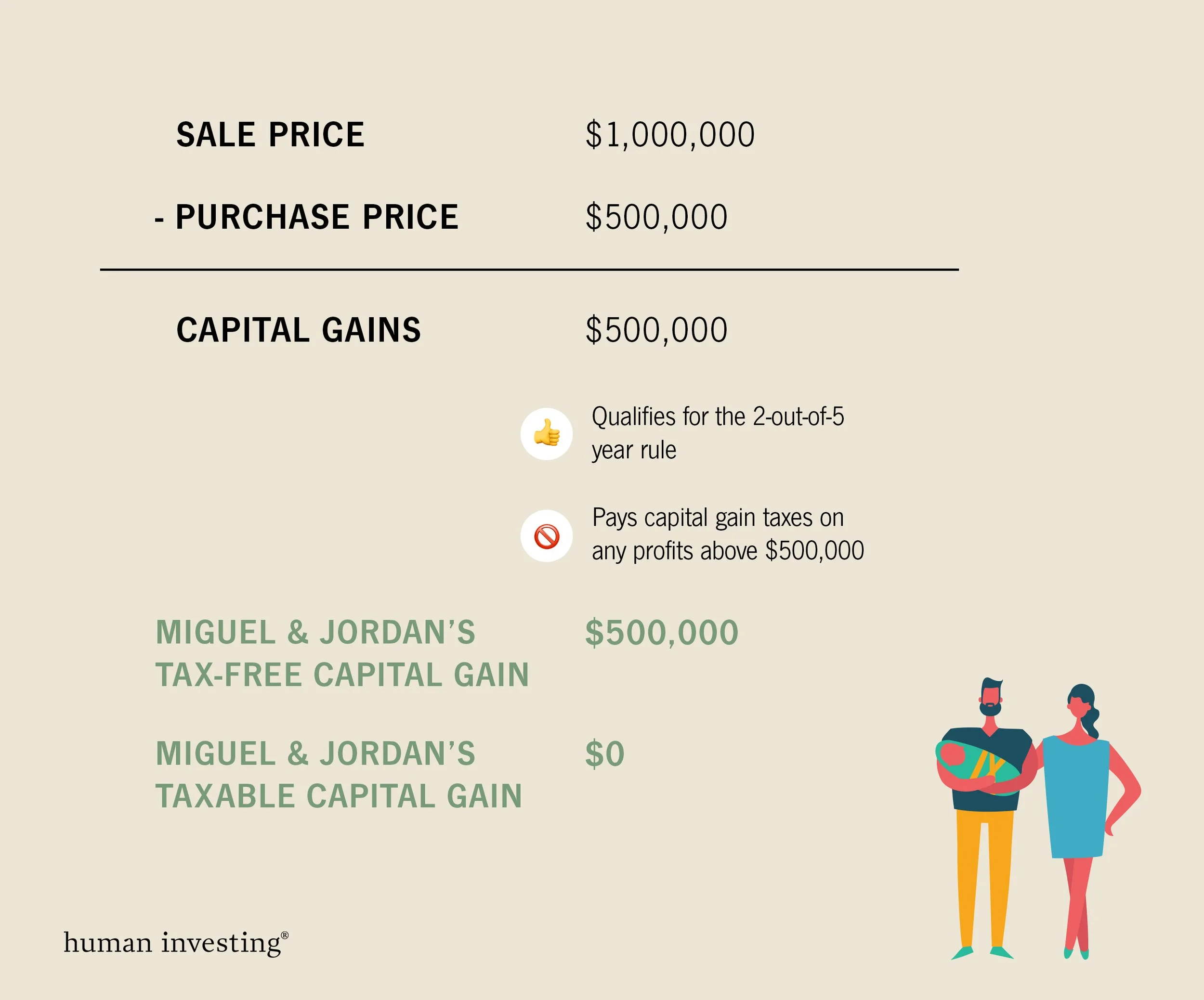
Miguel and Jasmine purchased their primary home in 2012 for $500,000. They moved out of the home and started renting it in 2020. They sold their home for $1,000,000 in 2022.

Since they wanted to utilize the Section 121 gain exclusion, they had to sell the home in 2022. To articulate the importance this sale timing, here is a detailed timeline:

2018 – home used as their primary home

2019 – home used as their primary home

2020 – home used as a rental home

2021 – home used as a rental home

2022 – home used as a rental home for most of the year and sold for $1,000,000 on May 15, 2022

Since they sold this home during 2022, which meets the 2-out-of-5 year exclusion rule, they can utilize the full tax-free exclusion on the $500,000 gain. ** They may owe tax on the depreciation recapture.

However, if they waited to sell their home until 2023, Miguel and Jasmine would pay capital gains tax on the entire $500,000 gain since they wouldn’t have qualified for the 2-out-of-5 year exclusion rule in this case. As this example illustrates, being mindful of your timeline for selling a home is critical.

Tax Planning for your Home(s) IS CRUCIAL IN MAXIMIZING WHAT YOU CAN POCKET

As you may have gathered from this blog post, buying and selling homes may involve complicated tax planning. Given the prolonged seller’s market, our team has worked on several tax planning scenarios and strategies for different clients. If you would like to speak to us about your own unique scenario, please reach out to us at hi@humaninvesting.com or 503-905-3100.


Related Articles

2022 Tax Updates and a Refresh on how Tax Brackets Work
 

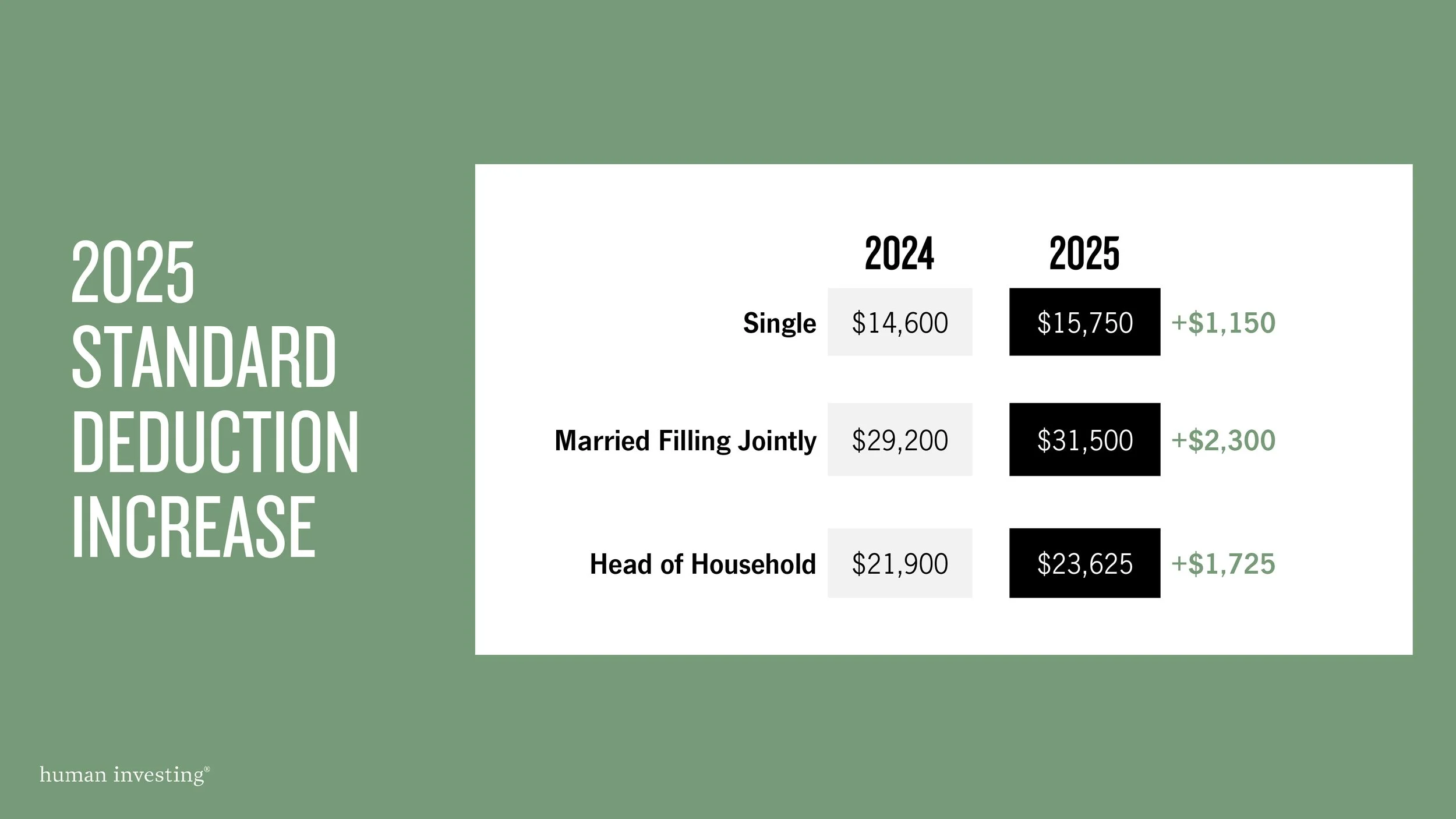
The IRS recently announced increases to both the standard deduction and tax brackets for taxpayers in 2022. Are you aware of how an increase to the standard deduction and an increase to tax brackets will impact you?

As you know, there are many headlines leading up to anticipated tax code changes, a litany of speculations throughout the process, and a cacophony of opinions once official tax code changes are announced. To be succinct, these two 2022 tax changes will have a small but favorable impact on most households. Everyone’s tax situation differs, but we wrote this blog to break down the complexities of the latest tax code changes.

What has changed?

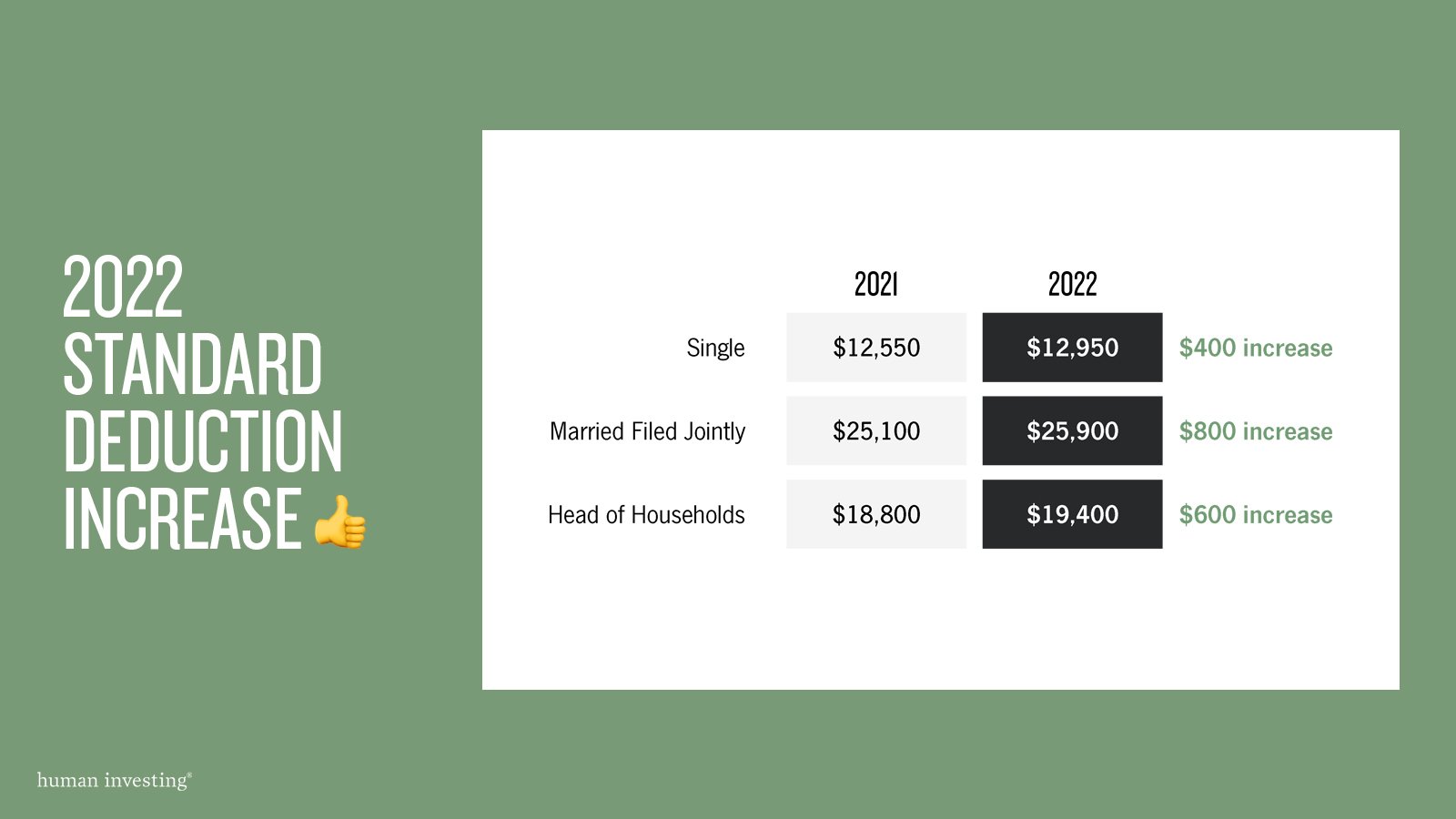
1. The standard deduction will increase for the 2022 tax year. See below for a summary of the increases:

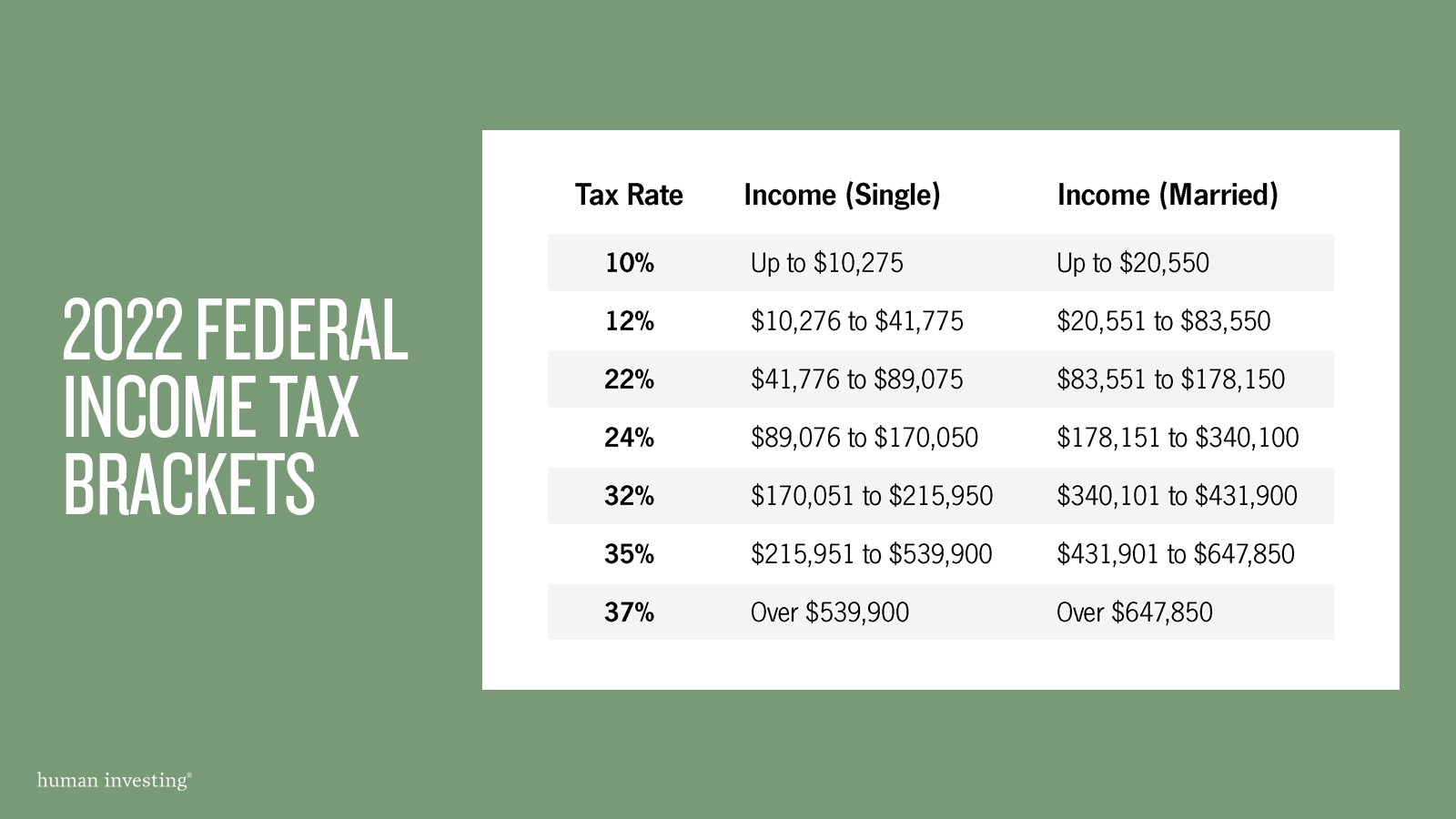
2. Federal income tax brackets will increase 3% for the 2022 tax year compared to 2021. Including a visual of the 2021 federal tax brackets is TMI for this post, but below are the new 2022 tax brackets:

what does this mean for me? it may not be much.

The practical answer is that these 2022 updates are not expected to have a significant impact on your taxes, cash flow, or budget. Both increases are good news for most households, but not life changing. To show how the changes are applied, we included a fictitious example and illustration below.

The academic or technical answer is that the increase in standard deduction means households will have less income subject to taxes, and the income that is subject to taxes will be subject to better tax brackets.

To provide an example of the impact of the 2022 increased standard deduction and 2022 increased tax brackets, read on.

Meet MARTIN & ANGELA

Below is a breakdown of their taxable income and taxes due in 2021 compared to 2022.

As you can see, they reported $100,000 of combined income which is reduced by their pre-tax 401(k) contributions and the standard deduction. Specifically, the standard deduction for married filed jointly is changing from $25,100 to $25,900 in 2022 so their taxable income is less than it was in 2021. Less taxable income puts Martin and Angela on track to pay less federal tax in 2022 than in 2021.

PORTIONS OF YOUR INCOME GET TAXED AT DIFFERENT RATES

Tax brackets calculate the tax rate you will pay on each portion of income. Tax brackets are part of our progressive tax system, which means the tax rate increases as someone’s income grows. As shown on the second image of this blog, there are 7 different federal tax brackets in 2022.

Looking at the image above, you can see that you can split your taxable income to take advantage of the lowest tax bracket. Isn’t it true that Martin and Angela would prefer to have a portion of their income taxed at the 10% rate before moving into the 12% tax bracket? In 2021, the maximum income allowed at the lowest tax bracket of 10% was $19,900. In 2022, the maximum income allowed will be $20,550.

DRUMROLL, PLEASE…

After this exercise is completed for all their taxable income, you can see that their total taxes owed in 2021 is $7,990 compared to $7,881 in 2022. As illustrated above, Martin and Angela will pay $109 less federal taxes in 2022 than they did in 2021. This will be welcomed news, but not a life-changing update when compared to the amount of buzz these two tax changes will generate in the media.

If you have questions about your unique tax situation, please schedule a time to connect with our team. As always, we would love to hear from you!

Disclaimer: this post is for educational purposes and not predictive of your 2022 tax situation. The fictitious example is not a full presentation of a tax filing.


Related Articles

The Importance of a College Education
 
nathan-dumlao-ewGMqs2tmJI-unsplash.jpg

On a recent financial planning call with colleague Amber Jones and a new client of our firm, we had a chance to discuss college savings for their daughter. It is always interesting to hear how families view college for their children and grandchildren. Some consider college a necessary expense, while others view college as an investment. Regardless of your college position, I thought it would be helpful to look at unemployment levels by education and income, based on the type of education an individual achieves. The numbers paint an incredible picture. Figure 1 underscores the importance of going to college. Not only are those with college degrees employed more consistently, but their annual earnings are nearly double those with a high school degree.

  Figure 1. Employment and income by education attainment

  Figure 1. Employment and income by education attainment

In short, Figure 1 makes a good case for encouraging your children (and grandchildren) to go to college. Yes, there are dozens of college alternatives, including starting a business or going to trade school. We all know successful individuals who never stepped foot in college or tried a university and decided it was not for them. I hope this article is taken in the way it was intended—that is, if college is an option, it is an excellent investment worth the sacrifice. 

Maybe you are a grandparent trying to think of a gift for your granddaughter—fund a college savings account. Maybe you are a parent wondering if college is a good investment—the answer is yes, fund a college savings account. Or possibly you are a teenager considering going to college—do what you can to make it happen. College is a sacrifice for families and for the one that is bold enough to attend.  Nevertheless, the payoff can be significant. As far as an investment goes, I can think of no better. 

If you have questions about college, funding a college savings account, or if you just want to have a thinking partner on the topic, call us; we would love to hear from you. College comes in many shapes and sizes. For example, a four-year degree, split between community college and Portland State University, averages less than $8,000 per year. Even if loans are required to meet tuition demands, the potential return on investment is immediate and over a lifetime, sizeable.


Related Articles

Consistency is Key When Fighting the Dad Bod and Growing Your Investments
 
cyril-saulnier-TsVN31Dzyv4-unsplash.jpg

On September 1st, my beautiful wife and I welcomed our new son into the world. His arrival has brought our family much joy during this season. Like all newborns, he has also brought sleepless nights, an abundance of comfort food, and disruption to our schedules and disciplines. As a result, I am here to tell you from personal experience the “dad bod” is real (find out if you have a dad bod here).

As I begin the journey to get back in shape, exercise and clean eating seem more difficult than ever before. Had I maintained my regimented sleep, diet, and exercise schedule throughout the entire pregnancy, returning to my baseline wouldn’t be as challenging. In physics, we call this inertia. In finance, we call this the compounding effect.  

Like most things in life, there is a compounding effect on our actions. 

  • Consistency in showing up to work → proficiency at your job. 

  • Consistency in showing up in the lives of loved ones → richer relationships. 

  • Consistency with a sustainable diet and exercise plan → greater physical health. 

  • Consistency in following a prudent investment strategy → increased net worth. 

Consistency is integral to the compounding effect

The inverse is also true. Disruption is a detriment to the compounding effect, a truth for our fitness as well as our investment accounts. To quote Charlie Munger, Warren Buffet's partner at Berkshire Hathaway —“The first rule of compounding is to never interrupt it unnecessarily”.

I would argue that someone’s consistency often has a greater impact than their effort and resources. Take the following example of two investors: 

  • Investor A - saves $2K/year from age 26-65.  

  • Investor B - saves $2K/year from age 19-26 and stops there.  

  • Both achieve a 10% annual return.*  

At age 65, who ends up with more money?  

  • Investor A: $883,185  

  • Investor B: $941,054 

By saving and investing $2,000 at the beginning of each year from age 26 to 65 (39 total years), Investor A can expect to have a final balance of $883,185. Investor B only saves for 8 years but starts to save earlier in life than Investor A. Investor B benefits by taking advantage of 46 years of compounding growth, finishing with a balance of $941,054.

What Investor B lacks in consistency of contributions, they make up for in consistency of not interrupting the compounding effect on their investment account. I know you are probably curious, what would happen if Investor B did not stop contributing at age 26? Investor B’s account balance would be $1,902,309. Once again consistency wins out.

Start now and stick with it

  • There are no shortcuts to saving for retirement and fighting the "dad bod". Starting can be difficult and sometimes painfully slow, however, the long-term results can be powerful. 

  • The easiest advice to give is “never get off track.” However, like your sleep schedule with a newborn, there are some things you cannot control. It is important to know how to reassess and get back to work.  

  • Building anything valuable and defensible takes time, effort, and energy. Build a plan today.  

If you want to compare notes on raising a newborn, see baby photos, or discuss the impact of consistency when building a prudent financial plan, please reach out. We are here for you.

*This is for illustrative and discussion purposes only. Investment results will vary.


Related Articles

Health Savings Accounts - The Total Trifecta
 
pexels-karolina-grabowska-4386464.jpg

Health Savings Accounts (HSA) made the roster of tax-deferred accounts. For this reason, these accounts can be a favorable component in a financial plan both today and in the future (65+ years old). HSA accounts were first introduced in 2003, and since then, their utilization among employees and employers has grown meaningfully. In order to be eligible to participate in an HSA – an employee must be covered by a High-Deductible Health Plan (HDHP) and not be enrolled in Medicare or other health coverage. Like an employer-sponsored retirement plan, a Health Savings Account offers benefits for both employees and employers. As such, their increased popularity is hardly surprising.

While there are many benefits of HSA accounts, we must also recognize that switching from a PPO plan to an HSA often results in more out-of-pocket medical expenses during the year. Yes, we agree that sounds unappealing. However, there is always more to the story.  

Benefits of HSA accounts to Employees

  • The account is portable. Contributions to HSA need not be used in the tax year they are made. Additionally, if an employee changes jobs, the account is still accessible.  

  • Health Savings Accounts do not impose income limitations. Unlike IRAs, highly compensated individuals are still eligible to participate in these tax-deferred accounts.

  • Health Savings Accounts provide a trifecta of tax savings:

    • Employee contributions are federal-tax deductible.

    • Federal tax on investment earnings is deferred until withdrawal.

    • All withdrawals (including earnings) used to pay for qualified healthcare costs are free from federal taxes regardless of when they are made.

  • Dollars contributed to an HSA are both literally and psychologically compartmentalized for medical expenses.

Benefits of HSA accounts to Employers

  • The time and money employees spend on healthcare is often more efficient with an HSA. This seems intuitive because unlike an FSA, employees have ‘skin in the game’.

  • Employer contributions to their employees’ HSA accounts are exempt from FICA taxes. In 2020, the combined FICA rate is 7.65% which is not insignificant.

  • Offering an HSA plan further diversifies the benefit offerings for their employees.

Hierarchy of Retirement Savings

For those with an employer-sponsored retirement plan and an HSA account, there is a hierarchy for where to best save one’s dollars. This hierarchy assumes the employee does not have significant debt and has also created an emergency savings fund.

  • First Priority: Take full advantage of the 401k employer match. Free money!

  • Second Priority: Maximize your HSA contributes and invest your dollars for the future.

  • Final Priority: If you have extra earnings, contribute the maximum to a 401k plan or a Roth IRA.

Here is an example scenario of the three-step hierarchy above:

  • Sophia’s employer matches 50% up to 6%. Melissa should contribute 6% to her 401k plan, and her employer will contribute 3%. Free money – check.

  • Next, Sophia should maximize her annual HSA contribution. Trifecta of tax savings – check!

  • Finally, Sophia can contribute additional funds to her 401k plan to maximize her annual contribution and/or contribute to a Roth IRA.

Withdrawal Rules

There are early withdrawal restrictions for Health Savings Accounts to ensure individuals are using their account for the intended purpose: paying for medical expenses. Specifically, HSA’s incur a 20% penalty and income tax on any amount withdrawn before age 65 that is not used for medical expenses. That said, an HSA account should be opened with the pure objective of saving and paying for inevitable health expenses throughout one’s life.

When you have your inevitable health care expenses, you can also pay out-of-pocket and keep the receipts for tracking your deductible. From a long-term growth and tax perspective, this may be advantageous if you have extra savings in your bank account.  

Investment Strategy

Most HSA accounts have a minimum cash balance required. Once you have saved the minimum cash balance, the additional dollars can be invested. The investment strategy within your HSA account will vary depending on your financial landscape, but often the investment strategy is aligned with your other retirement accounts – like a 401k or an IRA.

Prioritize your health

It is absolutely imperative to acknowledge that HSA dollars should be spent on health and wellbeing as needed. As exciting and opportunistic it is to imagine a future tax-deferred balance, health today must be prioritized. We do not work in the health sector, but at Human Investing we have a team of financial advisors who are committed to ensuring your medical costs are accounted for in a strategic manner.  


Related Articles

How to be a Responsible Credit Card Holder and why it Matters
Credit Score Header.png

A credit score can be a helpful tool for your overall financial wellness. Unfortunately, rules and regulations surrounding credit scores can be complex and unclear. Read on to learn the importance of a good credit score, its components, and how to use a credit score to impact your financial health.

WHAT IS THE PURPOSE OF A CREDIT SCORE?

Put simply, a credit score is your financial report card. It allows lenders to assess your trustworthiness as a borrower. A good credit score not only grants you easier access to lower interest rates on loans, but it can also help you rent an apartment, finance a car, or pay down a mortgage. In short, your credit score helps you navigate the lending side of the financial world, and even gain greater financial success.

WHAT ARE THE COMPONENTS THAT MAKE UP A CREDIT SCORE?

Your payment history: Do you have a record of paying your bills, in full and on time? Doing so will boost your credit score. Paying bills on an inconsistent basis (or ignoring them completely) will lower your score. FYI, paying the minimum monthly payment is not paying your bills in full. Paying only the monthly minimum will negatively impact your credit score. Don’t be tricked by that sneaky number. Live within your means and pay your bills on time. Pro tip: Utilize due dates in your calendar, or use the reminders app on your phone, to remind you to pay your bills.

The amount you owe: Do you approach or reach your credit limit each month? The ratio of the amount you spend and the limit on your credit card is called credit utilization. It is best to keep this ratio high (i.e. 1:10 not 1:1). Leaving room between the amount you spend in any given month and the limit on your credit card will boost your credit score, while closely approaching your credit limit each month (or reaching it) will lower your credit score.

The length of your credit history: How long have you had a credit score? The longer the better! If you do not currently have a credit card, make sure you are responsible enough to own one before rushing to get one. Remember, it is better to be a responsible borrower for a shorter period of time than an irresponsible borrower for a longer period of time.

Your credit mix and new accounts: How many accounts do you have? Utilizing a variety of different borrowing options (i.e. a combination of a mortgage, an auto loan, and student loans) isn’t bad if necessary. In fact, it can actually be helpful! Try to keep open accounts to a minimum, even if you only use some accounts sparingly. Opening multiple accounts can cause lenders to be more suspicious, which in turn can lower your score. So, yes, you heard me. You might need to cancel that Hawaiian Airlines card, even if you save $150 every 2 years for your biannual Hawaii trip.

Aside from these factors, lenders may also look at your salary, occupation and job title, and employment history. These additional factors will not actually change your credit score, but they can be used in addition to your credit score to assess your trustworthiness.

WHAT IS A GOOD CREDIT SCORE?

By assessing each of these components, a three digit credit score is generated, ranging from 300-850. Any score over 700 is considered a good score.

credit-scores.jpg

SO, WHAT DOES IT LOOK LIKE TO BE A RESPONSIBLE CREDIT CARD HOLDER?

Sure, this information can be helpful, but how can it be applied to everyday life? Let’s look at an example.

CC Sophia 1 - cropped.png

Sophia is a recent college graduate.

She just received her first full-time job and is looking to build her credit score. She applies for a credit card that has a low credit limit and only uses it for her regular monthly payments: gas, Netflix, and her gym membership. She lives within her means, knowing she has other payments to consider, such as her student loans and auto loan.

 
CC Sophia 2 - cropped.png
 

Sophia gets used to living off of a budget.

Every month, Sophia remembers to pay her credit card bill, and pay it in full. As a young lender, it is important for her to stay on top of her monthly payments.

 
CC Sophia 3 - cropped.png

As Sophia ages, she solidifies her good spending habits.

She opens another credit card account that has a larger spending limit, and uses it conveniently for groceries, bills, and other expenses—still living within her means and paying her bills on time.

 
CC Sophia 4 - cropped.png
 

Related Articles

All her daily money habits pay off.

Her credit score has deemed her a trust-worthy lender, and she is able to lock-in favorable rates for the mortgage of her first home!