Posts in Investment Strategy
$5 Today is Worth More than $5 Tomorrow
 

Saving your hard-earned dollars is a better game plan than frivolously spending money. However, keeping your savings in cash (not investing the dollars) is also risky. This risk is called inflation. To substantiate inflation, we found the increase in price of Stumptown Coffee Roasters lattes since 2014.  

**This article is not about Stumptown increasing the costs of their lattes. Suppliers, just like buyers, pay more for the goods they buy when inflation is rising. Stumptown consistently ranks among the best coffee shops in Portland!**

Flashback! It’s 2014…

You have $5.00 to go spend at Stumptown Roasters. That will buy you a delicious medium latte for $3.75 and a shortbread cookie for $1.25. Treat yourself!

2014.jpg

Let’s say, instead of spending that $5.00 in 2014, you put it under your mattress for safe keeping. You find the $5.00 a few years later and still frequent Stumptown. We are going to run through a few scenarios of the purchasing power of that same $5.00 bill.

Two years have passed, and it is now 2016.

Your beloved medium latte now costs $4.00, and the shortbread cookie costs $1.35. You find $.35 in your pocket (does finding coins ever happen anymore?!), so you make the purchase possible.

2016.jpg

Four years have passed, and it is now 2018.

That same tasty medium latte now costs $4.50, and the shortbread cookie costs $1.50. You might be going home hungry.

2018.jpg

Fast forward six years to 2020…

Your medium latte now costs $4.75, and the shortbread cookie costs $1.60. Assuming you would leave the barista a tip, your $5.00 bill cannot even buy you a coffee. You might be going home thirsty and hungry.

2020.jpg

Magnifying inflation’s effects on bigger life decisions

In this example, the cost of a coffee and a cookie only changed by $1.33 over six years. While that may not seem significant (the increase is less than $2!), the cost of goods did increase by 26%. If you apply that percent increase to a larger purchase like a home, a car, or education savings, you may not be able to afford what you intended.

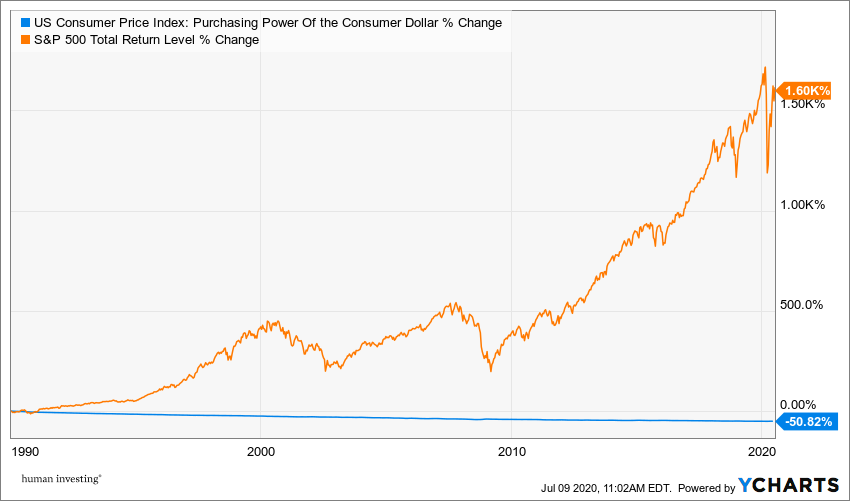
One way to maintain purchasing power is to invest the $5.00 into the stock market. If you bought the S&P 500 in 2014, then that same $5.00 would be worth around $9.40 today in 2020, which is enough to pay for a coffee and cookie from Stumptown. For simplicity purposes, we only looked at the rising cost of coffee and S&P 500 return since 2014. To further substantiate the decrease of purchasing power over time, we included a chart that compares the S&P 500 total return to the purchasing power of a dollar since 1990. 

Coffee Chart.png

If you have questions or need help preparing an investment strategy for your savings, please contact our team at Human Investing. We drink good coffee.  


Related Articles

Nike Restricted Stock: Understanding RSUs and RSAs
 
Nike Restricted Stock.png

Until recently, the availability of Nike Restricted Stock was limited to a select group of Nike Executives.  In 2018, Nike shifted its Stock Award program to include Restricted Stock Units (RSUs) to pair with the traditional Stock Options benefit.  This brought the concept of restricted stock to a wider base of Nike Executives, including more VPs and Directors.  With this broader availability, more questions have arisen about what Restricted Stock Units (RSUs) are, how to maximize this benefit, and what strategies should be considered.

RSU (Restricted stock units)

What exactly are RSUs?  An RSU is a form of stock-based compensation where the company grants the employee a specific number of shares of Nike stock that are restricted and will not be issued until they vest.  The shares are released and issued each year according to the vesting schedule, which is typically in equal installments over 3-4 years.  Each Nike executive has an individual account at Fidelity that is tied to the stock plan and receives and holds RSU shares as they vest.    

RSA (Restricted stock awards)

RSAs appear almost identical to RSUs and many executives may not notice the difference between them.  The main difference between the two is that with RSAs, shares are issued at the time of grant and you own them even before they vest.  With RSUs, the shares are not issued and owned until the shares vest and subsequently become available.  In either case, you cannot sell the shares until they vest.  RSAs at Nike are marginally better for one reason: they pay out dividends to the Executive even before the shares vest.  With RSUs, you only receive dividends after the shares vest.  

Taxes

As RSUs and RSAs vest, they are taxed as compensation and are subject to the same federal and state tax rates as your salary/bonus.  A portion of shares that vest is immediately sold to withhold taxes and are paid directly to the IRS and Oregon.  A common challenge that we see with tax planning is that the amount withheld for taxes is often much lower than what is needed for the high-income tax brackets that Nike Executives fall in to.  We typically see a tax withholding shortfall of up to 17%.  This can contribute to a frustrating experience during tax filing in April, where painful checks need to be written to the IRS and Oregon.  With proper tax planning and coordination with a CPA, this can be mitigated by calculating the tax shortfall and setting aside the cash necessary to cover that shortfall.

Once the shares vest and become available, they are identical to Nike stock shares that anyone could purchase on their own in an individual, joint, or trust account funded with money you have already paid taxes on, like a checking account.  The growth or decline of the stock from the day it vests is now subject to capital gain/loss tax rules, which is triggered when it is sold.  If the stock grows and you sell it in 12 months or less, it is subject to short-term capital gains rates, which is the same as your regular income.  If you hold the stock for more than 12 months, it would be subject to long-term capital gains, a rate that can be up to 20% lower than short-term capital gains.

Risk/Return

When compared to Nike stock options, Nike restricted stock is a more conservative form of stock compensation.  RSUs/RSAs will follow the exact movement, up or down, of Nike stock while stock option values move significantly higher or lower than the actual stock price.  Put simply, stock options have a much higher upside and downside than RSU/RSAs.  This difference is a significant factor in the decision that many Nike executives must make each year between RSUs, stock options, or a combination of the two. 

Planning Strategies

What planning strategies and opportunities exist for RSUs and RSAs?

  1. Cash Needs – If you have needs for cash, whether for college expenses or a vacation and need to sell some of your Nike stock, RSUs/RSAs are typically your best option.  The tax impact is typically lower than Stock Options and ESPP shares.  Additionally, you are not sacrificing the significant growth opportunity that exists with stock options.

  2. Tax Loss Diversification - Most Nike executives own a significant amount of Nike stock that makes up most of their overall net worth.  This may represent such a large portion within your overall investment portfolio that it poses a significant amount of risk.  Many want to diversify out of Nike stock into other investments, but the tax bill that would be generated by doing so is so painful that no action is taken.  Tax-Loss Diversifying is a way to diversify out of Nike by identifying and selling very specific stock shares that are at a loss during a market downturn. 

    We do not believe that you should sell an investment at the bottom of a market drop and leave it in cash, so it is important to execute the next step, which is reinvesting the proceeds. Proceeds should be reinvested by diversifying into many different stocks that have also dropped in value during the downturn.  This can come in the form of low-cost, diversified funds, that hold thousands of stocks in large, mid, small, and international stock companies.  In addition to diversifying, the tax loss that is created can lower your current or future taxes by offsetting capital gains or deducting up to $3,000/year from your ordinary income, like your salary.

  3. Charitable Giving - Instead of using cash, make your charitable contributions from your RSUs/RSAs.  If you transfer this stock directly to the charity organization, you can still get the tax deduction for the value of the stock, and the charity can sell the stock to completely avoid any capital gains tax that would normally be due if you sold the stock on your own.  Please note that only stock that has been held for over 12 months is eligible for this preferential tax treatment.  For more details on utilizing Nike stock for charitable purposes see this article.

Nike RSUs and RSAs are an effective tool for Executives to both participate in the success of the company and to meet their personal financial goals.  They are a great compliment to Nike Stock Options and provide many planning opportunities to minimize the tax burden due to their flexibility.

If you want to know more about how to maximize your RSUs and RSAs, please get in touch.

You can schedule time with me on Calendly (click here to schedule an appointment), e-mail me at marc@humanvesting.com, or call or text me at (503) 608-2968.


Related Articles


How Business Models Created The Culture of Financial Advisory Firms
 
financial-planning-compensation.jpg

Why not just make the necessary changes to correct what’s broken? 

At this point in our blog series, you might be asking yourself the question, “If things are so bad with the current state of financial planning, why not just make the necessary changes to correct what’s broken?” That is a logical conclusion, but while the problems are obvious, the solutions are challenging (possibly a little like some of the political debate topics you will be hearing for the next few months!). 

There are two real challenges here

One that we have already mentioned: nothing big is wrong. It is a host of smaller pieces that are broken, and those small pieces accumulate into a perception of confusion and mistrust and suboptimal financial planning outcomes.

A second challenge is that the core problems are so deeply rooted in the culture and systems that make up the industry that even obvious needed changes are difficult to address. It is the proverbial turning of the Titanic, if you will. So, a better place to begin might be defining the culture through the lens of how we arrived at where we are currently and identifying some of the elements of the culture that make it so sticky and unwieldy. 

As forecasted last time, there are many weighty systemic issues woven into the culture of financial services that make this move to a better model extremely difficult. These are true anchors working against a migration to something better. In this piece, we are going to start at the top and take a look at the business model of most financial planning firms and set the stage for why things are as they are. 

How financial services make money

As we have discussed, the financial planning profession has its roots in investment services and the insurance industry. Firms make money largely be selling either investment products (stocks, bonds, mutual funds, real estate trusts, options, etc.) or insurance products (whole life, variable life, annuities, etc.). 

Each of these products are sold with a commission and the firm makes money with each product sold. It is quite possible that a firm gets paid $10,000, $15,000 or even $20,000 or more for selling one variable annuity product. So, as you can imagine, this system is full of agency problems or conflicts of interest and has brought about many pieces of regulation to try to control these built-in conflicts. Selling products often comes at the expense of offering services. 

It is for this reason that we ended our last post talking about “fiduciary.” Fiduciary is a legal requirement imposed to make sure that planners/advisors are acting in a way that is in the client’s best interest. And, as we asked last time, who else’s interest would they be serving when they offer advice?

The very fact that a fiduciary standard is required reveals the problematic state of the industry 

This problem and others have led to a slow migration to other business models. Improvement. The commission-only paradigm began to change into a business model that is comprised of both fees for service and commission on products. This has further extended into a model where revenue comes exclusively from fees, with no commissioned products being sold. In fact, the CFP Board recognizes three different categories of compensation for planners:

  • Commission only

  • Commission and fee

  • Fee only

In order to be considered a fee-only advisor (or firm), no commissioned products can be sold. The CFP Board has defined the term “fee only” in the following way: “A certificant may describe his or her practice as “fee-only” if, and only if, all of the certificant’s compensation from all of his or her client work comes exclusively from the clients in the form of fixed, flat, hourly, percentage or performance-based fees.” 

While the definition might seem to align with what you would expect of a fee-for-service relationship, the dominate model looks much different. Instead of being paid to produce a financial plan or paid on an hourly basis, the vast majority of financial planning firms generate most of their revenue through what is called an “assets under management” (AUM) model.

WHAT THE ASSETS-UNDER-MANAGEMENT model MISSES

There are planners who do hourly work or charge by the plan, but that is the extreme minority of revenue dollars produced. The assets under management model assigns a percentage fee to the client assets that are managed by the firm. The more assets managed, the more money made. It is typical for the amount charged to be on a sliding scale so that the percentage applied to assets goes down if you hit certain targets. For example, if a firm charges 1.25% of AUM for assets under $1 million and 1.00% of AUM for assets over $1 million, a client with $500,000 invested would pay $6,250 for the year. A similar fee structure would be used to calculate annual fees during each future year. If the client had $3,000,000 invested, that client would pay $30,000 annually. 

There is nothing inherently wrong with this model, but it does explain why most financial planning firms look like investment service firm silos, or what we have termed “product-focused financial planning.” Other services can be offered and truly comprehensive financial planning can be conducted, but it is most often done without direct compensation. In other words, you are not paid for it. This is the largest and heaviest anchor working against a change from a culture of product-focused financial planning to truly comprehensive financial planning. 

The incentives are stacked too heavily towards products and wealth management. In order to change the incentive, the entire business model would need to change. And as you can imagine, that is a big ask. The more hidden cost is one of being stuck—of knowing what would and could be better, but experiencing the seemingly impossible task of getting there. In life, the one thing more frustrating than not knowing or being able to figure something out is the ability to observe, understand and know what needs to happen but not being able to do anything about it.

Associated costs are a continued and mired state of public distrust, a ridiculous amount of regulation and required disclosure, an opaque world in which terms like “advisor” and “planner” are almost impossible to decipher, and ultimately failing to offer the community the entirety of what they need… truly comprehensive financial planning. 

Check out the rest of the series with Ryan and Marc:

  1. Financial Planning: A New Mindset

  2. Bracing Ourselves For Rough Seas Ahead

  3. Isn’t Financial Planning a Dying Profession?

  4. What Financial Planning Should Look Like

  5. How Product Sales Is Ruining Financial Planning



Want to talk about your financial plan?
Want to learn more?
Come talk to us or e-mail Jill at jill@humaninvesting.com.

Ryan Halley, Ph.D., CFP® is Director of Planning Practices and Research at Human Investing. He holds a doctorate in Personal Financial Planning from Texas Tech University and an MBA with a concentration in Finance from The Ohio State University. Ryan has his CERTIFIED FINANCIAL PLANNER™ certification. Dr. Halley is also a Professor of Finance and Financial Planning at George Fox University, where he directs a CFP® Registered Program located near Portland, Oregon. He has co-authored a book and has numerous peer-reviewed journal articles. Additionally, he has been an invited professor and lecturer at various universities in the United States, Canada and China. 


Related Articles

Nike Deferred Compensation Plan: 5 Common Mistakes to Avoid
 
starting11-deferredcomp.png

The Nike Deferred Compensation Plan can be a powerful way to lower your income taxes and save additional pre-tax funds above and beyond any 401(k) contributions.

With open enrollment approaching, we wanted to share the 5 most common mistakes we see with Nike Executives.

1. Ignoring Profit Sharing Contributions from Nike

If you earn over $280K (2019) in combined Salary & PSP, then Nike makes profit sharing contributions on your behalf directly into the Deferred Compensation plan even if you do not contribute to the plan.  These contributions are often viewed as insignificant, but they can quickly accumulate to a sizable amount.  We commonly see these contributions ignored and left invested in the default, which is cash, and thus miss out on multiple years of potential growth.

2. Forgetting about Evergreen Provisions

Evergreen provisions mean that any elections you make in the previous year will continue to roll forward each year if you do not participate in open enrollment. For example, if you decided to defer 10% of your salary last year and do not participate in open enrollment, you will automatically be re-enrolled at 10%. Deferred Compensation plans are more rigid than 401(k) plans and you cannot change your salary deferral to the Deferred Comp Plan mid-year. The takeaway is that if you want to make any changes to deferral percentages, sources or distribution options it is important to participate in open enrollment.

3. Not Having a Strategic Plan for Distribution Option Selection

In the Nike plan you have the option to select a distribution schedule in which the funds are paid out after leaving Nike. The options range from Single Lump Sum or Installments over 5, 10 or 15 years. It is important to remember that distributions are initiated soon after you leave Nike regardless whether it is voluntary, such as retirement/job change, or involuntary, such as being laid off/fired. The distributions are subject to ordinary income tax so if you receive a large distribution in a short period of time it may push you into a high tax bracket and create an unnecessarily large tax bill.

This is where detailed financial planning and tax projections can help minimize the tax impact. Planning out year by year the combined amount of these distributions with other anticipated income sources is crucial to managing your tax bracket and maximizing this benefit. Once you have elected a distribution option you can change it, but there are very specific rules outlined by the IRS that you need to follow. All changes need to be made at least 12 months in advance of leaving Nike, so it is important to do any planning ahead of time.

4. Misunderstanding the Investment Time Horizon

Determining an appropriate mix of investments is impacted significantly by the time frame for when distributions are needed.  Investments in stocks can be volatile in the short-term but can provide a greater return than safer short-term investments like cash or bonds over a long period of time (10+ years).  Funds in a deferred compensation plan are often mis-categorized and lumped together with more aggressively invested retirement funds like 401(k)s and IRAs. 

The time horizon for Deferred Compensation Plans are very different than IRAs and 401(k)s.  For IRAs and 401(k)s, you are not required to take distributions until the year you reach age 70 ½, and those distributions can be spread out over the rest of your life.  On the other hand, Deferred Compensation plans have a much shorter time frame since they are initiated after leaving Nike and have a set distribution schedule of between 1 and 15 years.  Due to the shorter time horizon with a Deferred Compensation plan, we believe it is prudent to have a more conservative investment mix than other retirement accounts and to incorporate it into your financial planning projections to determine the best mix. 

5. Missing Out on the State Income Tax Strategy

An often-missed state income tax strategy exists with Deferred Compensation plans. If you select the lump sum or 5-year distribution option, the state of Oregon will still tax your Deferred Compensation distributions regardless of what state you live in at that time of distribution.  If you move out of Oregon to a state with no/low income tax rates (i.e. Washington), it is advantageous to select a 10 or 15-year distribution option to avoid Oregon state income taxation.  If there is a possibility that you will move out of Oregon after leaving Nike, make sure to evaluate the local taxation compared to Oregon and plan accordingly.

We’re here for you if you have questions

In summary, the Nike Deferred Compensation Plan can be a very advantageous benefit from a savings and tax perspective but due to its unique rules and IRS requirements it is most effective when incorporated within a customized financial plan.  If you have questions or want to better understand how to take advantage of the Nike Deferred Compensation Plan, you can schedule time with me on Calendly below, e-mail me at marc@humanvesting.com, or call or text me at (503) 608-2968.


Related Articles

Financial Planning: A New Mindset
 
show-me-the-incentive.jpg

“Isn’t financial planning a dying profession?”

A first-year undergraduate student majoring in Financial Planning approached me after class one day and asked what he thought was a very simple question – “What’s the difference between a financial planner and a financial advisor?” Simple answer? Not really. 

As I was working to establish a CFP Board Registered Program at a university, an administrator asked me the following few questions as part of his vetting process: “Isn’t financial planning a dying profession?” “Don’t robots already do financial planning?” “Who is going to hire a 23- year-old financial planner to help them with their finances?” These came from a smart individual who had a strong record of professional success. What was he talking about? 

I was speaking with a long-distance friend the other day who told me, “I’m sure glad that my financial planner doesn’t charge me a fee each time we meet but, instead, she only takes a very small percentage from returns on the investments I have with her.” Did this financial planner appropriately disclose compensation methods? I am sure she did. Did this friend understand the true cost of what he was paying for financial planning services? Obviously not. 

“We don’t trust you.”

Several years ago, I was at an annual conference for a large financial planning organization. The conference organizers planned an innovative and unique keynote session where they invited a panel of strangers gathered randomly and spontaneously from off the streets outside of the meeting venue. This group of individuals was diverse and clearly represented many demographic and socioeconomic classes. They were asked a variety of questions about their need for financial advice and desire for help with the money management tasks of life. It was evident that this group was readily willing to admit their lack of financial knowledge and self-efficacy when it came to money-related topics and behaviors.

Then came the curve ball. The panel was told that the room of people (nearly one thousand) who were in front of them were all financial professionals. They were asked another simple question – “Would you hire any of these individuals to help you with your personal finances?” Every one of the panelists said “no!” When asked why, they all said in their own words a message that sounded like “we don’t trust you.” Did these individuals need help managing their financial decisions? You bet. Were they looking to the financial planning industry to fill that role? No. Before you dismiss this as a case of non-target-audience identity for financial planning services, let me introduce you to another conversation. 

“I can’t get objective advice anywhere!”

Recently, I found myself in a conversation with the leader of a local company. He had come to our financial planning firm as a prospective client for planning services. Given the fact that he had been affluent for a significant number of years and was nearing the latter part of his working years, I inquired about his experiences with financial planning in the past and what brought him to our company. His answer was firm and without deliberation – “I can’t get objective advice anywhere!” Was this individual the ideal financial planning client? Pretty much. Why is it so hard to get objective advice? 

So, what is the difference between a financial planner and a financial advisor?

Do you know? Could you explain it to this young and eager student? Is there a difference? We would argue that it does not matter. The core issue is about substance and structure – not semantics. People are looking for a service and not a job or profession title. Why do we continually encounter situations like the ones we have described? Why all the confusion around the discipline of financial planning and why the lack of trust and objectivity? Why is this not a prevailing theme of most other professions (think doctors, lawyers, architects, teachers, pharmacists, engineers, etc.)? It does not take much more than a quick look at the culture and system of the industry to find the dilemma. 

There is a long list of systemic factors that have impaired financial planning outcomes and distorted the way in which financial planning is done. Here are a few: 

  • Products over services 

  • Business models of financial planning firms and compensation structure for planners 

  • Career status and prestige based solely on sales achievements 

  • Role of incentives (Charlie Munger was right when he said “Show me the incentive and I’ll show you the outcome”) 

  • Conflicts of interest that are not transparent 

  • The need for and confusion surrounding “fiduciary” 

  • Measures of success and effectiveness tied to a book of business 

  • Academic preparation/credentialing/pathway to profession 

  • Focus on money content and education while overlooking behavior 

  • Technology/Machine learning and the loss of the human 

  • Investment services silo instead of comprehensive financial planning 

  • Individual planner model instead of team approach 

Restoring confidence in all of us

We are going to be publishing a series of blog posts that highlight and elaborate on these dynamics that have contributed to the rationale for the questions that are mentioned above and the current state of the financial planning profession. In other words, we are going to define what we see as wrong. See, it is not any one thing. Nothing big is wrong. Big things tend to be addressed with swift action through market response or regulation. It is smaller pieces that are broken and those small pieces accumulate into a perception of confusion and mistrust and suboptimal financial planning outcomes. 

We will not stop at identifying problems but, instead, will share what we believe are solutions to these obstacles. We will elaborate on how we do financial planning and define its effectiveness by addressing these challenges to offer our clients the most comprehensive and purest form of human-centered financial planning. It is exactly why our core purpose is to faithfully serve the financial pursuits of all people. That is a big ambition, but it is precisely what individuals and families need, and it is our highest ideal for financial planning. We believe it is a mission worth pursuing.

Ryan Halley, Ph.D., CFP® is Director of Planning Practices and Research at Human Investing. He holds a doctorate in Personal Financial Planning from Texas Tech University and an MBA with a concentration in Finance from The Ohio State University. Ryan has his CERTIFIED FINANCIAL PLANNER™ certification. Dr. Halley is also a Professor of Finance and Financial Planning at George Fox University, where he directs a CFP® Registered Program located near Portland, Oregon. He has co-authored a book and has numerous peer-reviewed journal articles. Additionally, he has been an invited professor and lecturer at various universities in the United States, Canada and China. 


Related Articles


Your Nike Benefits – What You Need to Know
 
nike stock options.png

In 2018 Nike opened Restricted Stock Units to their already generous benefit line up.  Now employees have the option of choosing either Stock Options, RSUs or, a combination of the two. 

The following content provides guidance—and highlights the benefits and drawbacks of each option choice.

RSUs (Restricted Stock Units)

An RSU is a grant of stock units that, after a specified vesting period, provides an employee with a pre-determined amount of company shares.  The vesting schedule for RSUs varies by company.  At Nike, the vesting schedule is typically 3-4 years.  You do not receive the stock until you are vested, but once vested the stock is yours and will always have value unless the stock price goes to $0.  

Many consider RSUs to be a less-risky investment. However, it is essential to remember that the realized value of your vested grant may increase or decrease depending on the movement of the stock price.  Once the stock vests, you may choose to either sell the stock immediately or hold it.  RSUs are taxed as ordinary income equal to the market value of the stock at the time of vesting.  One crucial planning consideration is that the actual tax due on the RSU is often higher than the amount of tax withheld at vesting.  This leaves many RSU option owners with an unpleasant surprise at tax time. 

At Human Investing, we help our clients plan for the additional they will need to set aside for taxes, thereby avoiding end-of-year tax surprises. Tax planning and anticipating future tax liabilities are important for both RSUs and Stock Options.

Nonqualified Stock Options

Nonqualified stock options differ from RSUs as they are an option to buy Nike stock at a specified price, called the grant price.  Nonqualified stock options can provide a considerable upside if the stock grants are held during a time of substantial growth in the underlying stock.   

The downside is that if the stock price does not rise above the grant price, the options will be worth $0 at vesting.  Another piece to monitor is that stock options expire if they are not exercised within ten years, leaving the owner without benefit.  When a stock option is exercised, it is taxed on the grant price as ordinary income.  If held for a qualifying period, there will also be a tax on long-term capital gains on the difference between the grant price and market price at the time of sale.

Making Your Choice

Ultimately, considering the following questions has the potential to improve your outcome.  Questions like:  How high is your risk tolerance?  What is your confidence in how the stock will perform in 3, 5, and 10 years?  Is your portfolio diversified or highly concentrated in company stock? Are you looking to retire or leave the company? 

While RSUs can provide more predictable income and tax planning, if you separate from the company, you will lose any RSUs that are not vested.   

Stock Options must be vested upon separation and are generally required to be exercised within 90 days of separation from employment.  This is a risk depending on the stock price at the time of departure.  There is one exception to this rule when you turn 55, but additional criteria apply.

Both Stock Options and RSUs are great benefits and a great way to build wealth. At Human Investing we walk our clients through these choices with a close look at their situation.  We help our clients to determine the best course of action with all their benefits with a comprehensive financial plan we call hiPlan

Want Us To HELP? Let’S TALK.

031-open.png

You can schedule time with me on Calendly below, e-mail me at marc@humanvesting.com, or call or text me at (503) 608-2968 to take your next steps.


Related Articles

Strategies for Employer Plan Participants that hold Employer Stock
 

Do you participate in an employer’s retirement plan in which you own your employer’s stock? Before selling shares or rolling your account over to an IRA, you should consider a special election that could save you significant tax dollars. For taxpayers with employer stock held inside a qualified employer plan, the IRS allows a special election to distribute those shares at their cost basis and recognize the appreciated gain at preferential capital gain tax rates (avoiding “ordinary” income tax rates). This strategy is known as “Net Unrealized Appreciation” and is outlined in IRS code section 402(e)(4). The net unrealized appreciation is referring to the excess fair market value (FMV) of your employer shares over their cost basis. The election creates an immediate income tax liability on the cost basis of the distributed shares, but allows for continued deferral and favorable tax rates on the embedded and future gain.

There are three requirements to qualifying for and executing an “NUA” election strategy. First, the stock must be distributed out of your employer plan “in kind.” Transferring stock “in kind” means you take distribution of the stock itself, not its liquidated cash value. Second, the NUA election must be made as part of a lump sum distribution in a single tax year. You can make the NUA election on all or a portion of your employer stock and make a tax-free rollover with the rest of your account. The rules only stipulate that the entire account must be distributed/rolled over in a single tax year. Lastly, the lump sum distribution must transpire from one of four situations: death, attaining age 59 ½, leaving the company, or disability.

Below is a chart that outlines the tax treatment of employer stock distributed in an NUA election (www.kitces.com)

Graph-1-for-Todd-Strategies-for-retirement-plans.png

For example, let’s say you were a Nike employee and inside your 401(k) you hold 150k of Nike stock. Those shares have been purchased inside your 401(k) over a 20-year career and have an average cost basis of 50k. You retired last month and are looking to roll over your 401(k) assets into an Individual Retirement Account (IRA). Before making the rollover, you decide to make the NUA election on all your Nike stock. The distribution of those shares at their cost basis is immediately taxable at your ordinary income tax rates (i.e. 33% * 50k = $16,500). Those assets are now outside a qualified plan and all embedded and future appreciation can be realized at capital gain rates. Let’s say you then held those Nike shares until they were worth 200k. That 150k gain (200k FMV – 50k basis) would be taxable at 15%, or $22,500. So, in total with an NUA election, you paid $39,000 in Federal income tax. In contrast, by not making the NUA election, and rolling the entire 401(k) into your IRA there is no immediate income tax bill on the rollover, but all embedded and future gains are taxed at ordinary income tax rates. So, using the $200,000 fair market value assumption, and a lower 25% Fed tax rate, your tax bill would be $50,000 when drawn out of the rollover IRA account. The NUA election would have saved $11,000 in Federal income taxes.

Because there is a tradeoff between recognizing income immediately on an “in kind” stock distribution (NUA election) and a full retirement plan rollover, the cost basis in those employer shares is a significant consideration. The lower the cost basis in the shares, the better. Studies have shown unless your cost basis is 50% or less of the stock’s FMV at the date of distribution it is hard to make a case for the NUA election, and a full rollover to an IRA likely makes the most sense (www. kitces.com).

That said, everyone’s situation is different and there are varying factors that may lead to one recommendation over another. Even your desire for charitable giving may weigh in on the decision. For example, let’s say you were to make the NUA election and receive 100 shares with a cost basis of $40 and a FMV of $100; this would create 40k of gross income in the year of distribution. But, if you were to donate 40 of those 100 shares to a charitable organization or donor advised fund, you could create an offsetting 40k charitable contribution deduction. This offsetting deduction could mute the immediate income tax impact and leave you with 60 shares (60k value) that can appreciate at preferential tax rates outside of a retirement account.

There are a multitude of taxpayer specific situations and profiles that may or may not support making the NUA election. So, if you hold employer stock in a qualifying retirement plan and are getting close to retirement, looking to rebalance the account, or sell out of any of those employer shares, please reach out to us and see if an NUA election strategy makes sense for you.

If you would like to talk with one of our advisors please call Jill Novak at 503-905-3100.


Related Articles

How to Optimize Your Stock Options
 

Two Things to Consider When Managing Your Employee Stock Options.

Stock options are an interesting benefit. Instead of giving you actual shares of company stock, your employer gives you the “option” to buy a certain number of shares at a particular price. While options can be a tremendous benefit, they are frequently mismanaged causing you to either take too much risk or to miss out on most of the benefit. If you’ve been given employee stock options there are a couple of things to know.

First, there are a different types of stock options: Non-qualified Stock Options (NQs), Restricted Stock Units (RSUs), Incentive Stock Options (ISOs), etc. Second, the value of your stock options may differ from owning actual shares of stock. Understanding how options pricing works is key to getting the most from this potential benefit.

For this post, I’m going to focus on non-qualified stock options. Non-qualified stock options have a few moving parts that can have a major impact on your ending value - or whether there is any value at all.  When an employer, such as Nike or Intel, gives non-qualified stock options, they come with a particular grant price.  The grant price is the price at which you have the “option” to buy your shares of stock. Having an understanding of the stock price vs. the grant price will help you maximize the value and minimize your risk of loss.

The grant price is the key difference between owning actual shares of stock and a stock-option. Unlike owning actual shares of stock, your options value is based on the difference between the grant price and the actual stock price, not the value of the stock price itself. Therefore, if the actual stock price is greater than the grant price, your options have monetary value. If the stock price is below the value of the grant price, then your options have no value.  For example, if you have 1000 shares of Nike options with a grant price of $65 and the actual stock price is $58, then that particular grant would be worth $0.

Here are two common mistakes I see employees make:

Mistake #1 – Selling Too Soon

Until the stock price exceeds your grant price by a significant amount, you will have only a partial benefit. For example, let’s assume the following:

  • You were granted 1000 shares

  • The share price is $60

  • Your grant price is $57

Since the stock price is $3 more than your grant price, your options would have a value of $3000 ($3 of value per share x 1000 shares). While $3000 is a nice amount of money, it would only equate to 50 shares of actual stock ($3000/$60=50 shares). If you sell at this point in time you would effectively lock in a value of 50 shares instead of the full 1000 that you were given. As the stock price increases, your effective number of shares increases as well.

To show how this works, let’s assume the stock price increases to $80/share. How do your 1000 options look now? The new stock price of $80 gives you a value of $23/share ($80 - $57 = $23). Your new options value is $23,000 ($23 x 1000 shares). At this price, you’d have the equivalent of 287.5 shares ($23,000/$80=287.5).

In addition, you will notice that while the stock price went up from $60 to $80 in our example (an increase of 33%), your option value increased from $3000 to $23,000 (an increase of 667%). This is a phenomenon that is unique to stock options and one that can provide a lot of upside benefit. However, as you’ll see below, it can also expose you to more risk than you might think.

Mistake #2 – Holding on too long

For those of you who’ve seen some nice growth in your options over the years, you are possibly taking a lot more risk than you need to.  As you saw in our previous example, option value can rise significantly greater than the price of the stock itself. The flip side is that if the stock price declines, your options will go down in a greater percentage than the stock itself. Again, this is caused by the fact that you were not given 1000 actual shares of stock, but the “option” to buy 1000 shares at a price of $57/share.

To further demonstrate this, let’s use the reverse of the example above. If the stock price goes from $80 down to $60, a person who owns actual shares of that stock would lose 25% of their account value. However, since you have a grant price of $57 your options would go from $23,000 down to $3000.  That’s a loss of 87%!

Summary

Without a strategy for managing your stock options, you could be leaving a tremendous amount of money on the table and/or exposing yourself to a lot of unnecessary risk.

There’s no guarantee how any stock will perform in any given time-period, but with a proper strategy you can maximize your option value and minimize your risk, helping you stay on track with your financial goals.

If you would like help putting a strategy together to make sure you’re maximizing your options, give us a call at 503-905-3100.


Related Articles

Summary Block
This block has no content yet. Items you add to the page connected to this block will display here.
Paying Off Mortgage vs. Investing in Your 401k
 

During my time leading our participant education efforts for the retirement plans we manage, I’ve received all kinds of questions. Questions ranging from, “How do I start a 401k?” to “What’s the best way to consolidate my student loans?” However, a question I’ve gotten more frequently is:

“If I have the ability to save more, should I pay off my mortgage or should I put more towards retirement saving?”

I feel like this question has been on people’s minds as our economy has made a nice recovery since 2008. For people I’ve talked with, the question has come up due to a change in financial circumstances such as; an inheritance or some form of windfall, the sale of a home, or a recent bonus. Regardless of the circumstances, these individuals have been sitting on this money in low interest rate saving accounts and are looking for ways to have their money work harder for them. While there is no all-inclusive answer, I’ll do my best to outline some of the pros and cons of paying off your mortgage/making additional payments or saving more toward your retirement account.

Your home.

You will not change the value of your home by contributing more to the mortgage, or even paying it off. If your house is worth $350k, it’s always going to be worth $350k until the market determines otherwise. When you put more money into paying off your house, it’s not doing anything to change the value of the house…you’re basically putting money into an illiquid asset that you can only access when you sell the home or take a HELOC.

Additionally, your house is most likely financed at a low/tax-deductible interest rate. Your interest rate might be in the 4.5% ballpark. With your tax deduction, you’re most likely paying a real interest rate of 3% to 3.5%. That’s pretty cheap money. If interest rates were much higher (like in the 8% to 9% range), then it would be a different story and paying off your mortgage might make more sense.

Investing.

When putting money into a long-term retirement account and investing appropriately, you’re building an asset that can grow at 9% per year, using the S&P 500 as a benchmark, over a long period of time. By putting money in, you’re actually giving those dollars the ability to grow over the years. Unlike putting money into your mortgage, your deferrals will directly affect the type of return and the growth of that account over time. So, the more you put in, the more you will get out in the end.

Example: Keep in mind that nothing you do, except making updates to your home, will increase the value of it. Compare that with an investment/retirement account. Let’s assume there are two different people…one has been putting a fair amount of savings in their retirement account, the other has contributed a much smaller amount. For the sake of the example, let’s call them Kelly and Chip.

Kelly has a $110k account. Chip has a $10k account. It’s 2014 and they are both invested in the Vanguard Target Retirement 2040 fund. The return on that fund in 2014 was 7.15%.

So, to start 2015 and without additional savings, Kelly now has an account worth $117,865 and has gained $7,865 just on return alone. Chip now has an account worth $10,715 and has gained $715 on return alone. Both are good, but Kelly is setting herself up to have a suitable retirement account. By the way, if we assume that neither Kelly or Chip contribute another dollar to this account forever, in the year 2040 (assuming an average 7% rate of return per year) Kelly will have an account value of about $640k, while Chip will have an account worth about $58k. That’s a huge difference! Personally, I’ll take the investment accounts over paying off my mortgage a few years earlier.

Regardless of your views on this specific question, know that if you’re wrestling with anything retirement account related feel free to reach out by phone at 503.905.3100 or email 401k@humaninvesting.com anytime. We would love to connect with you!


Related Articles