Posts in Nike Strategy
Nike Layoff Survival Guide: Essential Considerations for Financial Wellbeing


It’s no secret that Nike has been going through a tough time with the recent rounds of layoffs. This can create concern and uneasiness around a Nike employee’s livelihood and how it may affect their financial picture. As we have been actively guiding our Nike clients through this season, we wanted to share things to consider if you were or will be impacted by these layoffs.

Understand Your Severance Package

Nike has a standard severance agreement and package that includes a one-time payout of cash based on your level and tenure at Nike. This can range from 4 weeks to 48 weeks of salary.

In addition, there is often a continuation of health insurance through COBRA that includes a subsidy of the cost for around 6 months. This provides some time to transition to a different health insurance plan if that is right for you.

If you have any accrued PTO that you haven’t used, this will be paid out to you in cash after officially leaving Nike. This is often extra cash that people are not expecting and can help create some comfort during an uncomfortable time.

Lastly, you may still be eligible for the PSP bonus paid out in August as long as you are still employed anytime in May (the last month of the Fiscal Year).

Create a Strategy for Deferred Comp Distributions

If you contributed to the Nike Deferred Compensation Plan, leaving Nike will typically trigger distributions according to the schedule you designated when enrolling. This can range from a one-time lump sum or installments over 5, 10, or 15 years. For some, this can be a way to supplement income. However, for others who don’t need the funds, these distributions can create a tax issue to strategize around. These payments are sent out quarterly, so if this is needed for cash flow you should plan accordingly.

Plan for your Stock Options and RSUs

Any vested but unexercised stock options typically need to be exercised within 90 days of leaving Nike, unless you qualify for the special retirement benefits at age 55 or age 60 (you keep unvested options and can sell for lesser of expiration or 4 years). At this time, you typically will lose any unvested options or RSUs.

During larger layoffs, there can be enhanced vesting of options and RSUs, where upcoming vests within a year will accelerate and vest. In addition, Nike can also provide you with more time to exercise your stock options like up to 1 year instead of 90 days. When Nike stock price is struggling like it is now, it makes your exercise decisions in a small window difficult. We would recommend working with your financial advisor to determine a defined strategy to maximize the benefit and minimize taxes.

Keep track of your PSUs and ESPP

Normally, you need to be employed at Nike at the vest date to receive your PSUs. In a situation of Reduction in workforce (larger layoffs), you can still receive any PSUs if the vesting date is within one year of termination.

Any ESPP that has been contributed but not purchased yet will be refunded to you. In addition, you have more control over your ESPP shares that you have purchased previously as these can be held as long as you want. This provides an opportunity to be patient and strategic on any sale of this stock.

Prepare to mitigate tax liability

All the benefits outlined above come with tax implications that are not always easy to see. These items can quickly add up to large amounts of taxable income, which can push your income into high tax brackets. In addition, the tax is often under-withheld (22% Federal and 8% State), which can lead to a significant tax bill in April if not accounted for properly.

Know your 401K options

This recommendation depends on each person’s situation. Nike has a strong investment fund lineup, and you should compare that to any other place that would replace it. However, leaving your 401(k) at Nike requires more activity and maintenance since it does not have an auto-rebalancing feature, which would periodically sell funds that drift from their target allocation. For example, if the large company stock fund was targeted at 60% and grew to 64%, you should periodically bring that back to the 60% target to maintain the proper risk/return mix. Another factor to consider is the desire to make Backdoor Roth IRA contributions if you have extra funds for retirement savings.

Support when transitioning into the next job

The cash you receive from benefits like severance, PTO payout, and stock sales can help provide some comfort to your situation. While you are in transition with your job, we recommend creating a system to feel like you are receiving a paycheck replacement with your cash to reduce anxiety and bring normalcy to your day-to-day financial life. An example of this system would be taking your net benefits payout and depositing it in a savings account, then setting up bi-weekly transfers to your checking account to simulate your paychecks.

All these considerations are tied to a person’s long-term financial plan. Through financial planning projections and scenario planning, you can help determine what the next job needs to look like to achieve your goals for retirement, kids’ education, and lifestyle. It can provide you with the information to know if you need a comparable compensation package to Nike or if you could take a job with lesser pay that could be more fun or less stressful.

Being laid off from any job often creates much uncertainty, stress, and concern. With the right preparation, planning, and advice, it can be a smoother transition, and you may end up in an even better place than where you started.

If you have questions about preparing for or navigating a current layoff at Nike, please feel free to contact us at nike@humaninvesting.com or schedule time with us below.  


Related Articles

The Nike Guide to Building Sustainable Wealth


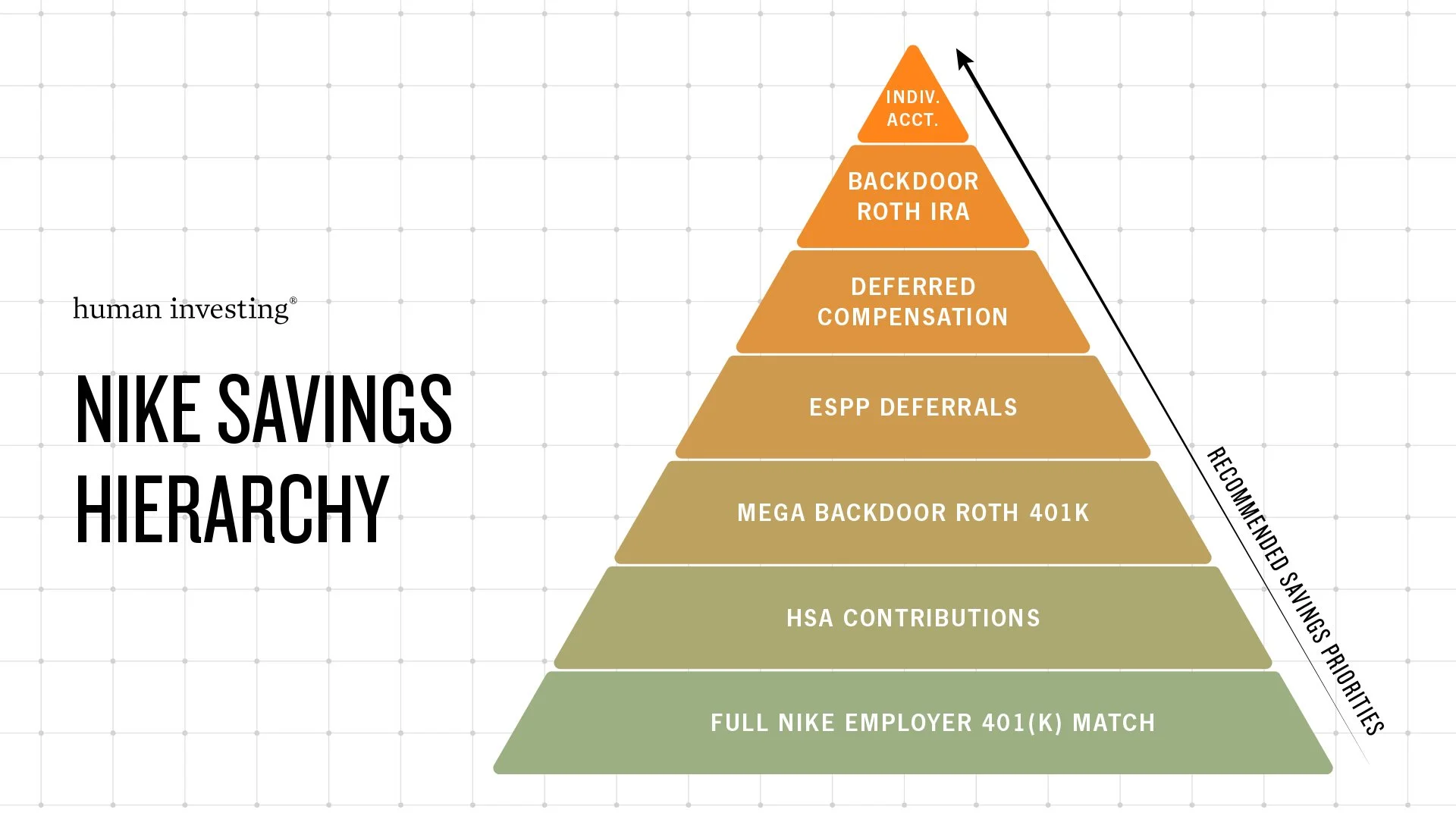
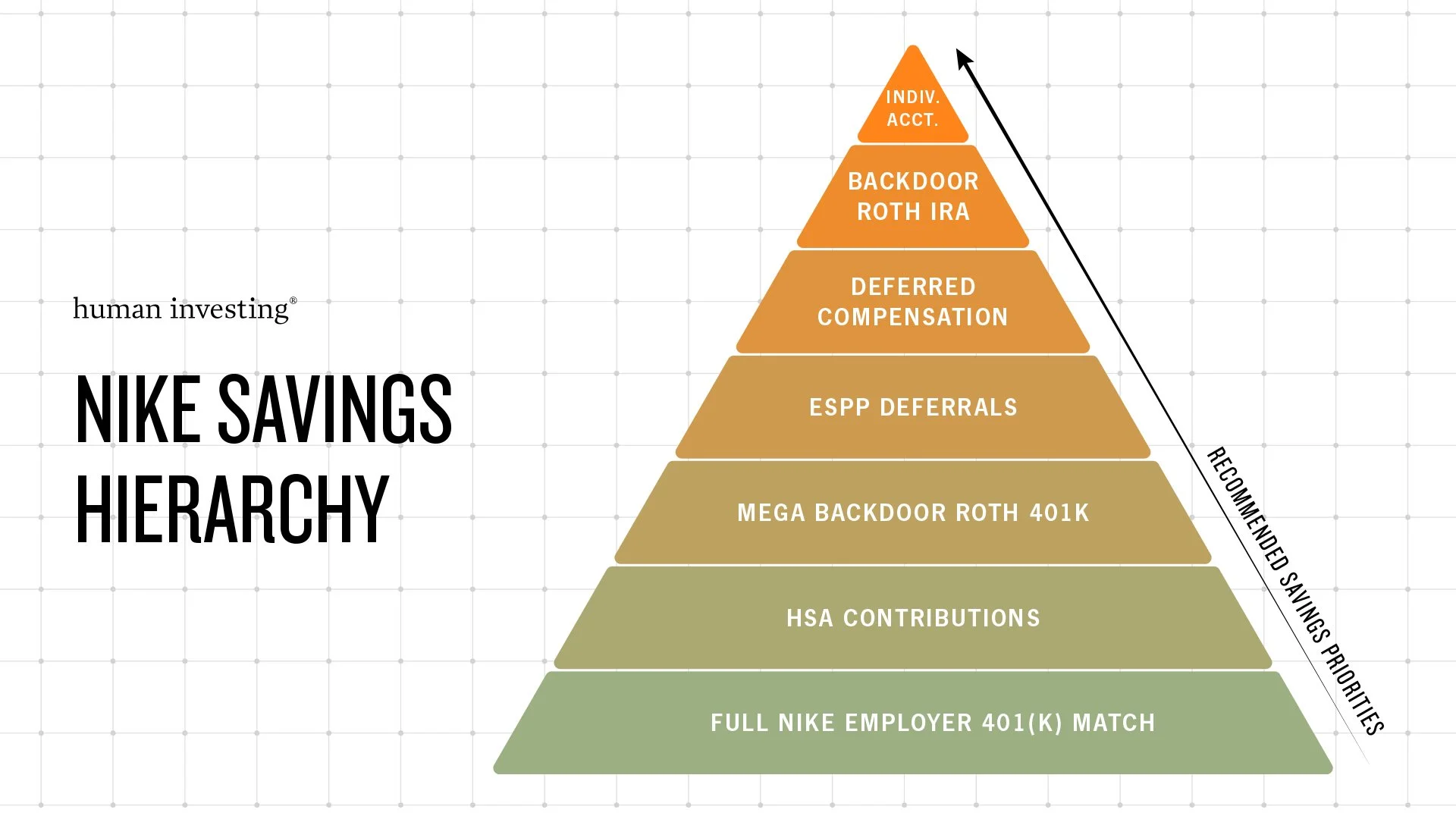
Elite performance isn’t about doing everything at once; it’s about prioritizing the right moves at the right time. Your finances deserve that same level of intentionality. You probably have many competing goals and need to find the best way to prioritize spending, debt pay down, and saving for the future, among other things.

Selecting the optimal avenue for your dollars can be challenging when you have access to Nike’s unique savings avenues. It is important to fill the most beneficial buckets first. The order we have detailed below is not a “one size fits all” approach. Building your financial plan around your goals and unique circumstances will help determine the savings opportunities that will be the most impactful for you.

1. Contribute enough to get your Nike employer match on your 401k

Deferring 5% of your income to your Nike 401k is a strategic way to maximize free dollars. This helps grow your retirement savings and amplifies the long-term benefits of your investment. Additionally, you have the option to save pre-tax dollars or Roth dollars, allowing you to choose when you pay tax on your contributions. Whether to contribute via Roth or pre-tax is best determined by your unique financial plan.

2. Enroll and maximize your HSA contributions

One benefit of participating in Nike’s healthcare coverage is the opportunity to utilize the Health Savings Account (HSA). Those covered by the high-deductible healthcare plan (HDHP) can take advantage of tax-deductible contributions along with tax free earnings and withdrawals when used for qualified medical expenses.

Being covered under the high-deductible health care plan (HDHP) is not for everyone. It depends on your health needs and financial flexibility. Each person is unique and should consult a professional for their specific circumstances. 

3. Save extra into your 401k via Mega Backdoor Roth contributions

If you have filled all the prior buckets and still have additional cash flow, consider putting extra money into your 401k through Mega Backdoor Roth contributions. This savings vehicle allows you to go above and beyond traditional 401k contribution limits. You pay taxes on these dollars now and withdraw them tax-free in retirement. Contributions can be made up to 3% of your compensation, limited to a maximum of $360,000 of eligible compensation. This is a great savings opportunity to contribute extra funds, up to $10,800 on top of the standard $24,500 standard deferral limit, to your Nike 401k account.

4. Maximize ESPP Deferrals

Saving into the ESPP bucket is a way to purchase Nike shares at a 15% discount. You can contribute up to $21,250 through salary deferrals. If you have a steady cash flow, saving into your ESPP can feel like instant growth on Nike stock if you sell the shares right after they’re purchased. This strategy to immediately sell allows you to capture the discount and supplement cash flow when the shares are purchased every six months. There are no taxes until the shares are sold, but the taxes on the discount and any gains can be complicated and should be reviewed by a tax or financial professional. 

5. Utilize Deferred Compensation savings

If you are eligible for Nike’s deferred compensation plan, utilizing this plan can help reduce your current taxable income while setting aside and investing funds for your retirement. Contributing to the Deferred Compensation plan defers Federal and state taxes and can help keep your taxable income below thresholds for local taxes. This plan requires precision to set up and maintain and will help optimize your retirement savings in your financial plan.

6. Execute a Backdoor Roth IRA Contribution

In 2026, you can contribute up to $7,500 to a traditional IRA, with an additional $1,100 catch-up contribution available for those over age 50. Making a tax-deductible contribution is subject to income phaseouts. If you don’t have an existing IRA balance, you could make a backdoor Roth IRA contribution even if your income is above these phaseout levels or above the income phaseouts for Roth IRA contributions. This is done by contributing after-tax dollars to a traditional IRA and converting those funds into a Roth IRA.

7. Open a taxable brokerage account

If you still have cash flow to save after filling all the previous buckets, using a taxable brokerage account to make additional investments can help fund your future financial goals. Saving into a taxable brokerage account can be especially helpful if funds will be used soon, such as if you are considering a new home purchase or paying for college. These accounts allow you to withdraw funds at tax-advantaged capital gains rates at any time. In particular, the flexibility of this account can be advantageous for those considering retiring early since there is no penalty for withdrawing funds before age 59½.

Want to see this in action?

Building a strong roadmap to reach your goals includes thoughtfully utilizing Nike’s employee benefits and prioritizing ways to save through ways that are the most beneficial for your unique needs. The various options you have available at Nike each have their own unique contribution limits, tax advantages, and benefits. Having a coordinated strategy allows you to create a game plan that suits your unique needs and supports your needs for today and ambitions for tomorrow.

The most effective savings hierarchy is one that is thoughtfully aligned with your broader financial picture. A comprehensive financial plan can help bring clarity to competing priorities and ensure your savings decisions are aligned with your short-term needs and long-term goals. Working with a financial advisor can help you sift through these buckets and determine the best way to optimize each dollar saved to secure a successful financial future.


Disclosure: This content is for informational and educational purposes only and is not intended as investment, legal, or tax advice. The strategies and steps outlined—such as building an emergency fund, contributing to employer-sponsored plans, paying down debt, or using HSAs, IRAs, and taxable accounts—are general in nature and may not be appropriate for every individual. You should consult a qualified financial or tax professional before making decisions based on your personal circumstances. There is no guarantee that following any financial strategy will achieve your goals or protect against loss. References to interest rates, contribution limits, or tax rules reflect information available at the time of publication and may change. Past performance is not indicative of future results. Advisory services are offered through Human Investing, an SEC-registered investment adviser.


Related Articles

Your Money Needs a Financial Plan: Here's How to Build One That Works


A financial plan is a structured approach to managing one’s financial life. It is not merely a spreadsheet or a collection of investment products—it is a comprehensive framework that organizes income, expenses, savings, risk management, taxes, and long-term goals into a cohesive, actionable strategy. When constructed properly, a financial plan enhances decision-making, reduces uncertainty, and improves financial outcomes (Nissenbaum, Raasch, & Ratner, 2004).

Yet if financial planning is so powerful, why do so few follow through?

The answer often lies not in math, but in mindset. Research shows that even financially literate individuals struggle to plan for the future when they lack self-control, future orientation, or supportive social norms (Tomar, Baker, Kumar, & Hoffmann, 2021). A well-designed plan must account not just for assets and liabilities—but for human behavior. That’s why the best financial plans are often paired with an accredited fiduciary advisor, who offers a simple, visual, and tailored approach to help you make decisions.

At its core, a financial plan helps individuals clarify what matters most and align their resources accordingly. Whether navigating early adulthood, managing a growing family, or preparing for retirement, individuals benefit from a written plan that reflects financial priorities and personal values. In my work as a financial advisor and educator, I have seen that the most significant breakthroughs often come not from more money, but from more clarity.

the purpose of a financial plan

The purpose of a financial plan is twofold: to organize current financial resources and to make informed decisions about the future. This may sound straightforward, but the complexity of modern financial life often makes it difficult for individuals to answer even basic questions such as, "Can I afford this?" or "Am I on track?" A financial plan provides a framework to answer these questions thoughtfully and methodically.

More than a static document, a financial plan is a living tool. It should evolve alongside an individual's life stages, economic conditions, and shifting priorities. According to Nissenbaum, Raasch, and Ratner (2004), regularly reviewed and updated plans yield significantly better financial outcomes over time.

It starts with defining your goals

Goal-setting is the anchor of any financial plan. Without clear goals, even the most sophisticated strategies can lose direction. Goals give context to numbers and bring meaning to saving and investing. They can be short-term (saving for a vacation), mid-term (purchasing a home), or long-term (funding retirement or creating a legacy).

One of the most effective frameworks for goal setting is the SMART method—specific, Measurable, Achievable, Relevant, and Time-bound. Goals should inspire and direct behavior. In my experience, clients who articulate their goals clearly are far more likely to follow through on their plans.

components of a comprehensive plan

A thorough financial plan includes several interdependent elements, each of which contributes to the individual's or household's overall financial health. According to Ernst & Young’s Personal Financial Planning Guide (Nissenbaum et al., 2004), the five essential components are:

  1. Cash Flow and Budgeting
    Understanding income and expenses is the foundation of any financial plan. A clear cash flow picture allows individuals to make informed decisions about saving, spending, and giving. Budgeting is not about restriction; it is about intentionality. When individuals budget effectively, they begin to control their money rather than letting money control them.

  2. Risk Management and Insurance
    Life is unpredictable. A good financial plan includes appropriate insurance coverage to protect against major disruptions—including illness, disability, death, or property loss. While not exciting, insurance serves as a financial firewall. Emergency savings also fall into this category, with most professionals recommending a reserve of 3 to 6 months of essential expenses.

  3. Tax Planning
    Tax efficiency is a core pillar of financial planning. Smart planning reduces unnecessary tax burdens and aligns financial decisions with long-term goals. This includes strategic use of tax-advantaged accounts, such as IRAs and 401(k)s, as well as decisions around capital gains, charitable giving, and income timing.

  4. Investment Planning
    Investments must serve the plan—not the other way around. A financial plan defines the purpose, time horizon, and risk tolerance for each investment goal. This helps investors avoid emotional decisions and focus on long-term strategies. Diversification, asset allocation, and periodic rebalancing are all part of this disciplined approach.

  5. Retirement and Estate Planning
    A financial plan must consider the future. This includes projecting future income needs, optimizing Social Security benefits, managing required minimum distributions (RMDs), and crafting an estate plan that reflects one’s legacy goals. Planning ahead ensures that wealth is transferred intentionally and tax-efficiently.

Building a financial plan: a step-by-step process

While the components of a financial plan are well-established, the process of creating one can be deeply personal. Below is a common approach used by both individuals and professionals:

  1. Establish Goals and Priorities
    Start by asking what matters most. What do you want your money to do for you? What are your non-negotiables? Apply the SMART method in making them more attainable. Writing these goals down is a powerful first step.

  2. Gather Data
    Collect all relevant financial information, including income, expenses, debts, assets, insurance policies, and legal documents. The accuracy of your plan depends on the quality of your data.

  3. Analyze and Diagnose
    Identify gaps, inefficiencies, or risks. This includes assessing debt levels, reviewing savings rates, stress-testing for emergencies, and evaluating investment alignment.

  4. Develop Strategies
    Design strategies that address the specific needs uncovered in your analysis. This might include refinancing high-interest debt, increasing retirement contributions, or adjusting your investment allocation.

  5. Implement the Plan
    Execution is where many plans fall apart. Automate good behavior when possible—automated savings, investment contributions, and bill payments reduce reliance on willpower.

  6. Monitor and Review
    Plans should be reviewed at least annually, and anytime there is a significant life event (e.g., marriage, new job, birth of a child). Adjustments should be proactive, not reactive.

Behavioral considerations in financial planning

Financial planning is as much about psychology as it is about math. Behavioral finance has shown that individuals often act irrationally with money due to cognitive biases, emotional reactions, and social pressures. A written financial plan serves as a behavioral anchor—a tool that reduces the likelihood of impulsive decisions.

Recent research reinforces the role of psychology in retirement financial planning. Tomar, Baker, Kumar, and Hoffmann (2021) identify several psychological determinants that significantly impact whether individuals engage in effective planning. These include future time perspective (the ability to think long-term), self-control, planning attitudes, and financial knowledge. In other words, it is not enough to know what to do; one must also be inclined to do it. Social norms and perceived behavioral control also play an influential role, suggesting that a supportive environment enhances financial planning behavior.

Research has shown that investors with written plans are more likely to stay invested during market volatility, rebalance their portfolios regularly, and avoid the pitfalls of market timing. A plan brings structure, and structure supports discipline.

common mistakes and how to avoid them

Even well-intentioned individuals fall prey to common planning mistakes. These include:

  • Neglecting emergency savings

  • Underestimating expenses in retirement

  • Taking on too much investment risk

  • Failing to review insurance coverage

  • Overlooking tax implications of financial decisions

  • Not discussing financial goals with a spouse or partner

Avoiding these mistakes begins with awareness and regularly revisiting the plan. A good advisor doesn’t just build a plan—they help you adapt it.

the value of working with an advisor

While many individuals can build a basic plan on their own, the guidance of a fiduciary financial advisor can add significant value. Advisors provide objectivity, technical expertise, and behavioral coaching. At Human Investing, we believe our highest calling is to serve as guides—helping clients navigate complexity with wisdom and clarity.

Importantly, not all financial advisors are held to the same standard. A fiduciary advisor is legally obligated to act in your best interest. Yet even among those who use the fiduciary label, fewer than five percent operate without receiving any form of commission (Fisher, 2025). That’s why the true fiduciary standard—free from all commissions—should be the baseline, not the exception.

turn intention into action

A financial plan is not just a document—it’s a decision. It reflects your willingness to take control of your future instead of drifting into it. The most successful outcomes aren’t reserved for the wealthiest or the most analytical—they’re earned by those who start, stay consistent, and make adjustments along the way.

If you’ve made it this far, you already care about your financial future. The next step is simple, but powerful: act. Whether it’s writing down your goals, scheduling time to review your budget, or meeting with a fiduciary advisor, do one thing today that your future self will thank you for.

Your money needs a plan. And now, you have the framework to build one that works.

References
Fisher, P. (2025, February 14). Only 4.92% of advisors are true fiduciaries. Is yours? Human Investing. https://www.humaninvesting.com/450-journal/only-5-percent-of-advisors-are-true-fiduciaries

Nissenbaum, M., Raasch, B. J., & Ratner, C. L. (2004). Ernst & Young's personal financial planning guide. John Wiley & Sons.

Tomar, S., Baker, H. K., Kumar, S., & Hoffmann, A. O. (2021). Psychological determinants of retirement financial planning behavior. Journal of Business Research, 133, 432–449.



Disclosures: Human Investing is a registered investment adviser with the U.S. Securities and Exchange Commission (SEC). Registration with the SEC does not imply a certain level of skill or training. This article is provided for informational and educational purposes only and should not be construed as personalized investment advice. The information contained herein is believed to be accurate as of the publication date but is subject to change without notice. Past performance is not indicative of future results. Investing involves risk, including the potential loss of principal. Readers should consult with a qualified financial advisor to assess their individual circumstances before making any financial decisions.
 

Related Articles

How to Approach Your RSUs, ESPPs & Stock Options in a Volatile Market


Given the recent stock market volatility, it is important to re-evaluate your plan for your Stock Benefits (RSUs, ESPP, Stock Options) to take advantage of opportunities that may arise in this environment. 

A well-crafted strategy for your stock benefits should focus on:

  1. Personal needs and situation

  2. Maximizing the benefit

  3. Minimizing taxes

  4. Diversifying strategically

  5. Incorporating the investing principle of “Buy Low + Sell High” (when available)

The Investing Principle of Buy Low + Sell High

A fundamental investing strategy is to buy stocks when they are undervalued and sell them once they’ve appreciated, allowing you to benefit from the price increase. While timing restrictions from stock benefits may limit this approach, it’s important to integrate it whenever possible.

Strategies for your stock benefits based on your timelines

How do you incorporate your personal situation and needs with an effective strategy during the current market volatility? We will dive into several strategies that address the needs for different time periods, since timelines are an even more important factor during volatile markets.

For short-term needs (2 years or less)

Stock compensation can provide funds for expenses beyond salary and bonus, such as tuition, home repairs, vacations, or tax bills.

  1. First, consider selling recently purchased ESPP shares. Since you're buying these shares at a discount while the stock price is low, selling them for a gain doesn’t violate the “buy low, sell high” principle.

  2. Next, consider selling recently granted and vested RSUs. Like the ESPP strategy, these RSUs can help meet short-term cash needs. The main difference is that RSUs are often granted at a higher price—before a market downturn—so their current value may be lower than when they were granted. However, if the RSUs were granted recently, the price difference might be minimal, making them a more attractive option to sell.

For intermediate term needs (3-7 years) 

The intermediate term timeframe can be more challenging, since the answer isn’t clear and should depend on your risk tolerance.

  • The more conservative approach: Sell existing RSU grants that will vest in the next 12 months. This strategy reduces your exposure to stock volatility but doesn’t fully align with the “buy low, sell high” principle, since RSUs may be worth less than their original grant price. However, future annual grants—typically part of your compensation—can help offset this by being issued at lower prices during a market downturn.

  • A higher-risk approach: Hold all existing RSUs until the funds are needed, with the hope that the stock price recovers before then. This could allow you to better capitalize on the “buy low, sell high” strategy. The risk, however, is that the stock may not recover in time—or at all—leaving you potentially forced to sell at a loss when cash is needed.

  • The balanced approach: To hedge your bets, consider combining both strategies: sell some RSUs now while holding others for potential future gains. This hybrid approach can offer peace of mind, helping you avoid second-guessing your decision if the market doesn’t move in your favor.

For long-term needs (8+ years)

Planning for long-term goals like retirement tends to be more straightforward.

  • For vested RSUs and ESPP: Consider a strategy called Tax Loss Diversification, a variation of traditional tax loss harvesting. Tax loss harvesting involves strategically selling investments in non-retirement accounts to realize a loss, which can reduce your tax bill. You then reinvest that money into similar investments to stay in the market and benefit from potential recovery. With Tax Loss Diversification, the added benefit is that you're also shifting from concentrated stock (like your company shares) into a more diversified investment—such as an index fund with exposure to hundreds or thousands of companies. When the market is rising, diversifying can be painful due to the capital gains taxes involved, so it's wise to take advantage of a downturn as a window of opportunity.

  • Stock Options, RSUs, and ESPP: Stock Options offer the greatest potential upside but also carry the highest risk, especially when they’re “underwater” (i.e., the stock price is below the option’s strike price, making them currently worthless). In these cases, the best move is often to wait and give the stock time to recover, maximizing the chance to capture that upside. For RSUs and ESPP shares that you intend to hold for long-term growth, the best approach is often patience—holding through downturns and waiting for both the stock price and the broader market to recover.

The Exception: Expiring Stock Options

Expiring stock options require timely decision-making due to looming deadlines. Your strategy should reflect your risk tolerance, the number of options involved, and how critical they are to your overall financial goals.

  • Conservative approach: Sell all options now to avoid the risk of further price declines. This minimizes downside but also limits any potential future upside.

  • Moderate approach: Sell portions of your options at predetermined dates over time, balancing risk reduction with the opportunity for gains.

  • Moderately aggressive approach: Sell portions based on specific price targets. If those targets aren’t reached, you may need to sell the remaining options closer to expiration to avoid losing them entirely.

  • Aggressive approach: Hold all options until close to expiration in hopes of a stock price rebound or significant upswing. This offers the most potential upside, but also the highest risk of loss if the stock doesn’t recover in time.

Market volatility may feel uncertain and carry risks, but it also creates rare opportunities to make the most of your stock benefits. If you haven’t revisited your strategy recently, now is a great time to reassess and align your plan with the current market landscape.

Remember, there’s no one-size-fits-all approach. The right strategy depends on your company’s stock performance, your personal financial goals, risk tolerance, and overall circumstances. Use this moment to take control, make informed decisions, and turn today’s challenges into tomorrow’s opportunities.

For questions or more information about managing stock benefits during current conditions, please call (503) 905-3100 or contact us.


Disclosures: The information provided in this communication is for informational and educational purposes only and should not be construed as investment advice, a recommendation, or an offer to buy or sell any securities. Market conditions can change at any time, and there is no assurance that any investment strategy will be successful. Investing involves risk, including the potential loss of principal. Past performance is not indicative of future results.

Diversification does not guarantee a profit or protect against a loss in declining markets. Asset allocation and portfolio strategies do not ensure a profit or guarantee against loss.

This material is not intended to provide, and should not be relied upon for, tax advice. Please consult your tax advisor regarding your specific situation.

The opinions expressed in this communication reflect our best judgment at the time of publication and are subject to change without notice. Any references to specific securities, asset classes, or financial strategies are for illustrative purposes only and should not be considered individualized recommendations.

Human Investing is a SEC Registered Investment Adviser. Registration as an investment adviser does not imply any level of skill or training and does not constitute an endorsement by the Commission. Please consult with your financial advisor to determine the appropriateness of any investment strategy based on your individual circumstances.


Related Articles

The Ultimate Guide to Navigating and Lowering Taxes for Nike Execs and Leaders


A growing complexity

As a Nike leader, you are provided a comprehensive range of benefits that help achieve financial and retirement goals. The downside is that these benefits often create confusing tax implications. Multiple measures over the last few years have passed to increase taxes on high-income earners, including the Metro and Multnomah County taxes. These tax measures in addition to regular Federal and Oregon taxes are becoming an increasing burden for Nike executives. 

A clear understanding of the tax implications with these benefits is crucial. Employing appropriate strategies can both reduce your tax burden and also prevent any surprises during tax season in April.

Let’s examine the three biggest reasons you could get hit with a tax bill and review a recommended solution.

The 3 leading causes to tax surprises

1. Wrong tax withholding on supplemental pay

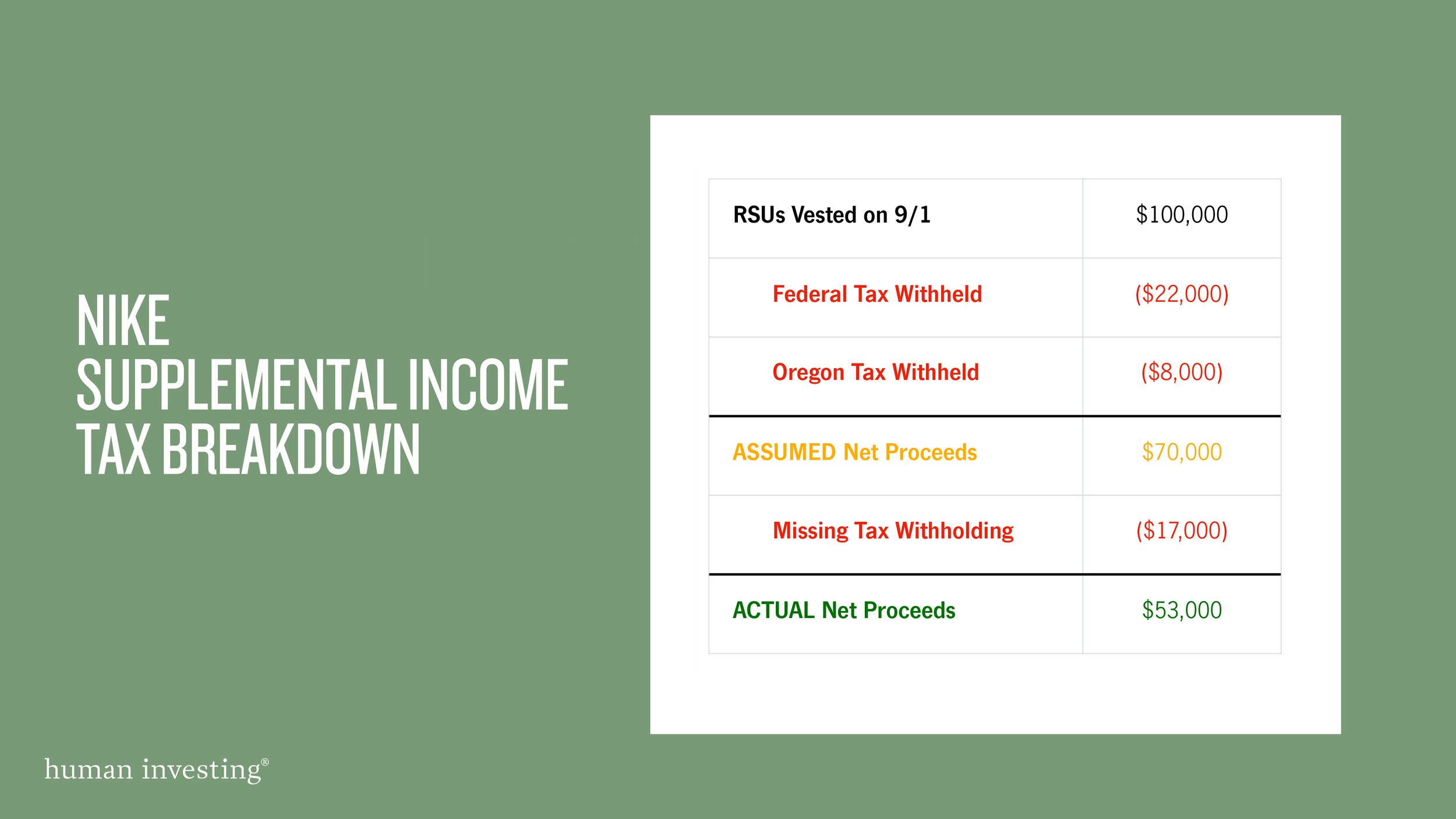
Many compensation sources at Nike beyond salary (such as PSP, LTIP/PSU vests, RSU vests, and stock option exercises) are taxed as “supplemental pay,” which come with a set percentage of tax withholding (22% Federal + 8% Oregon) regardless of your tax bracket or tax withholding elections on your salary. The reality is most Nike executives are in a much higher income tax bracket, sometimes as much as 17% higher than the amount withheld. This discrepancy leaves a significant gap in the amount taxes that should have been withheld versus the actual amount.

For example, Kate Executive has $100K of RSUs that vested on September 1st. With all her income sources (salary, PSP, LTIP/PSU, RSUs) her taxable income is $700K. The taxes automatically withheld on the $100K RSU vests would be about $30K (22% Federal + 8% State).  However, based on her tax bracket, Kate will owe another $17,000 on that RSU vest.

2. No tax withholding for Multnomah County’s “Preschool for All” tax

For those who live in Multnomah County, you are likely subject to the “Preschool for All” tax that started in 2021. Unfortunately, Nike does not withhold taxes from payroll to cover this tax, so you will be responsible to fully cover this on your own. Multnomah County expects these payments to be received quarterly to avoid interest and penalties.

The Preschool for All tax is 1.5% on taxable income over $125,000 for individuals and $200,000 for joint filers, with an additional 1.5% on taxable income over $250,000 for individuals and $400,000 for joint filers. The rate will increase by 0.8% in 2026.

3. No coordination of Portland Metro tax payments for 2 working spouses

Since Nike headquarters is located within the Portland Metro, they do withhold taxes for the Metro Supportive Housing tax (a.k.a. Homeless tax) that also started in 2021. The Metro Supportive Housing Tax is a 1% tax that is applied on income over $125,000 single filer or $200,000 joint filer. 

A common issue arises when you have two working spouses at different companies, since the income threshold for this tax is based on household income and the two different employers obviously do not communicate with each other.   

For example, once a Nike executive’s income reaches $200K, Nike will start to withhold the Metro tax on any income above that amount. However, the other spouse’s employer does not know about the income at Nike and assumes that the spouse’s income is the household income. So, if that spouse earns $90K, no Metro tax is withheld on that amount even though all of it is subject to the Metro tax.

The 3 tax payment issues identified above often lead to a frustrating situation, where you either end up with a significant tax bill in April or you have been paying in the wrong quarterly estimated tax payment amounts given to you by your CPA.

Our recommended solution: The pay as you receive strategy

For many Nike executives, setting aside additional tax payments into your monthly household cash flow can become stressful, since the amounts can be so inconsistent.   

The “Pay as You Receive” strategy is calculating the estimated amount of taxes due from each type of “Bonus Compensation” as you receive it and making those tax payments at that time, while you have the funds to do it. This will leave your monthly cash flow separate and unaffected.

If this sounds like a lot of work, you can make it simpler by applying this method during 2 key time periods. 

  • Time Period #1: August – PSP, LTIP/PSU bonus’

  • Time Period #2: Early September: September 1st RSU vests

A more thorough approach is the also include any February retention RSU vests and stock option exercises as they occur.

These supplemental estimated tax payments, when combined with the withholding, should be equal to your anticipated tax bracket for the calendar year. This approach helps ensure that your total payment to the IRS, Oregon, Multnomah County, and Metro aligns with your tax obligations.

Additional strategies for minimizing your tax liabilities

If you’re looking for more tax savings or want to use your stock benefits to take care of tax payments, we highly recommend proactive tax planning. This involves looking beyond the past year and anticipating opportunities to reduce taxes in the future.

Proactive tax planning common solutions include:

1. Maxing out your Nike 401(k) with pre-tax contributions

This is a simple strategy, yet it is often missed.  With the maximum contribution amount increasing periodically with inflation and with opportunities for additional catch-up contributions at age 50, forgetting to review your contribution percentage each year is common.  We recommend reviewing your 401k contribution amount after your PSP bonus is paid, since it is a variable amount that is part of the equation.

2. Selling the right type of Nike stock

If you ever need funds from Nike stock, find the most optimal type of Nike stock to sell to minimize your taxes. Typically, RSUs are preferred over ESPP from a tax standpoint, but this can depend on when it was purchased/vested, how long it has been held, and what the stock price is at the time.

3. Utilizing the Nike deferred compensation plan to defer your taxable income to a later date 

Nike’s deferred compensation plan is generally the most powerful tax savings tool available for Nike leaders.  There are specific IRS rules and many important considerations to plan around when using this strategy.  To learn more click here.

4. Charitable giving

Most people assume that all donations to charities are tax-deductible.  They can be tax-deductible but are not always, depending on your individual tax situation. To receive a charitable deduction, you need to exceed a certain threshold each year, and it may make sense to “bunch” donations (make multiple years-worth of contributions in a year) to cross that threshold and capture tax benefits. Coordinating your charitable strategy with the Nike charitable match can be an effective way to lower your taxes and benefit your desired charities at the same time. To find out more click here.

5. Residence planning

If you currently live in Multnomah County, you might consider moving to another county, such as Clackamas or Washington Counties, to avoid the Preschool for All tax. This solution should consider the estimated tax savings compared to the cost of selling your home, the tax implications of selling your home, the purchase price of a new home, and the difference in a new mortgage payment (especially because mortgage rates have increased significantly).

6. Planning around the Oregon state kicker

Oregon law has a provision known as the “kicker” credit. This is a surplus credit that is returned to you on your tax return when tax revenue is larger than predicted.  By accounting for this, you can strategically recognize more income in “kicker” qualifying years so that your potential kicker credit is increased.  The last kicker payment was 17.34% of the Oregon taxes you paid in 2020 and the next one is estimated to be even larger

Bring in experienced experts

By implementing a proactive forward-looking tax strategy and payment plan, Nike leaders have a significant opportunity to improve their financial situation and relieve stress related to taxes. It is important to note that any tax payment and mitigation strategies should be part of a comprehensive financial plan that is tailored to your specific financial situation.

If you have questions about how to set up a proactive forward-looking tax strategy, please contact our team to learn more.


Related Articles

How to Lower your Tax Burden with Nike Mega Backdoor Roth 401(k)
 
roth401k.jpg

A combination of recent tax cuts, swelling government debt and changing political winds have many concerned about increases in future tax rates.  This has created a growing interest in strategies that can lower and mitigate future income taxes. One such strategy is available and often missed by many Nike employees within their 401(k) plan, known as “Mega Backdoor Roth 401(k) contributions”. While the name often elicits laughter at first, it can in fact be a serious and tangible way to save on future income taxes. 

What is the Nike Mega Backdoor Roth 401(k)?

The Mega Backdoor Roth 401(k) provides the ability to make additional tax-advantaged contributions to the Nike 401(k) plan above and beyond the typical employee limits of $19,500, plus catch-up contributions of $6,500 for ages 50+ (2020).  The additional contributions are in the form of “after-tax” contributions of up to 3% of income.  This applies to base salary and any PSP bonus. The total contribution amount will have a cap based on annual IRS limitations: $8,550 for 2020 and $8,700 for 2021.  The after-tax contributions can then be converted to Roth dollars within the plan, which allow them to grow tax-free and be distributed tax-free* in the future. 

How to Execute the Strategy

The process starts by electing to make after-tax contributions within the Nike 401(k) plan of up to 3%.  Once the after-tax contributions have been made, it is important to then convert these contributions into tax-free Roth funds* by periodically electing to do an “In-Plan Roth Conversion”.  To complete the In-Plan Roth Conversion, the employee will need to call the Nike 401(k) phone line and make the request verbally.  Be prepared to spend 10-15 minutes on the phone for the conversion process to be completed.     

The In-Plan Roth Conversion is important because the growth of the after-tax contributions will become taxable as ordinary income upon distribution if the conversion is never completed. However, if you convert those funds into Roth dollars, then the future growth and distributions will be tax-free*. We recommend that the In-Plan Roth conversion be completed on a periodic basis to make sure that the funds are converted before any significant growth occurs.  Any growth of the after-tax contributions at the time of this conversion will be taxable income, but if completed regularly, the growth and subsequent tax is typically minimal.  Ideally the conversion would be completed after every payroll or monthly, but practically speaking, one to two times per year should be sufficient to effectively execute the strategy.

Is this Strategy Right for You?

Nike’s robust benefit options can leave many unsure of which savings plan is best for them.  Whether it is 401(k) contributions, ESPP, Deferred Comp or Mega Backdoor 401(k) contributions, there are only so many dollars available out of a paycheck.  The order of priority is different for each person based on their personal tax situation, time frame at Nike, and plans for the future.  We believe that the best way to determine the priority of one plan over another is through financial planning projections. Through the financial planning process, we take your financial considerations today and project them into the future. While this does not predict the future, it does allow you to measure the impact of each savings option and find the optimal course of action.

Solution to Cash-Flow Problem

A potential solution to the cash-flow challenge of participating in the Mega Backdoor Roth 401(k) contributions is to repurpose other funds.  Available options that we have identified include existing after-tax accounts like Individual, Joint or Trust investment accounts, extra cash in the bank, or cash that you have from selling and diversifying out of Nike RSUs, ESPP, or Stock Options.  You can use these accounts to supplement your cash flow while the Mega Backdoor Roth contributions are coming out of your paycheck. 

Lower Your Tax Burden

While this strategy may not make sense for every Nike employee, it is a unique opportunity to get significant dollars into a Roth account that might not otherwise be available.  Whether or not income taxes actually do increase in the future, the Nike Mega Backdoor Roth 401(k) is a very effective way to lower your long-term tax burden and should be considered as part of your financial plan.

If you want to know more about how to take advantage of the Nike Mega Backdoor 401(k), please get in touch.

You can schedule time with me on Calendly, e-mail me at marc@humanvesting.com, or call or text me at (503) 608-2968.

*Assumes first Roth contribution made at least 5 years before withdrawal and withdrawals occur after age 59½.


Related Articles