
Posts in Saving and Spending
Credit Unions: An Underutilized Financial Institution
 

Credit unions are member-owned and member-governed financial cooperatives. The first financial cooperatives were established in Europe in the mid-1800s and spread to North America at the beginning of the 20th century. In Canada, Alphonse Desjardins is recognized for launching the first credit union in Quebec. Desjardins was also instrumental in establishing the first U.S. credit union in Manchester, New Hampshire, in 1908. Twenty-six years after creating the first U.S. credit union, the U.S. Federal Credit Union Act was passed, which was instrumental in providing structure around the credit union movement.

As of the end of 2020, according to the National Credit Union Administration (NCUA), U.S. credit unions had 124.3 million members across 5,099 federally insured credit unions. Despite the total number of members with a credit union relationship, their deposits are negligible compared to their banking counterparts. For example, data released by the Federal Reserve shows JPMorgan Chase Bank holding domestic assets above $2.2 trillion as of September 2020. Conversely, as reported by NCUA, federally insured credit unions had a combined $1.85 trillion of assets.

Better Service & Better Borrowing Rates

Banks' overall prominence is surprising given that credit unions are generally regarded as providing better support for their members than banks do for their customers. In addition to having the upper hand on customer service, credit unions generally pay more on member deposits and charge less when members borrow than traditional banks. For example, quarterly data provided by the NCUA examines the national average rate of credit unions versus banks in 23 different product categories ranging from CDs to car loans. In over 90% of the categories, credit unions beat banks. Based on this simple comparison alone, it is surprising why consumers would choose a bank over a credit union.

One of the first financial accounts a consumer opens is a checking account. From there, it is common for an individual to put some of their excess in a savings account for an emergency fund or future purchase. For many Americans, a CD is a first "investment." Based on the data from NCUA, if you assume a five basis point delta between credit union deposits and banks, and you compare domestic deposits of the three largest U.S. banks against the deposits of all credit unions, a seemingly insignificant delta becomes meaningful. On average, the top three banks together keep an extra $3 billion per year that if on deposit with a credit union would go directly to a member.

A car purchase is another area where consumers interact with their financial institution. For many individuals, a car provides the necessary transportation to a first job, in addition to the ability to get out of town to explore another part of the city or state. Most individuals finance a car purchase through a bank or credit union. In this particular category, the benefits of credit unions are even more apparent, with an average rate difference of about 1.97%.

Members get stronger together

So how are credit unions able to offer such a rate advantage on both deposit and lending products? Part of the answer resides in the unique structure of credit unions. First, credit unions are owned by their members, not shareholders. Therefore, the interests of the owners (the members) are aligned with the interests of the members (the owners). Member owners do not want to charge themselves more than is necessary to cover the cost of the product and the operation of the institution. Another reason credit unions can offer products and services that are more beneficial than banks is they are tax-exempt entities. That's right, under IRS rules, federal credit unions are tax-exempt under section 501(c)(1), and state credit unions are exempt under section 501(c)(14)(A). This allows credit unions a lower cost structure than most banks and allows credit unions to recycle profits to lower rates on loans and higher rates on deposits.

Despite the large number of Americans with a credit union relationship, banks dominate the wallet of U.S. households. This is surprising given credit unions' upper hand in offering members better rates for deposits and loans. One of the many reasons credit unions can offer better rates on consumer deposits and lower fees when borrowing is that 1) members are also owners, and 2) credit unions are tax-exempt organizations. The choice between a bank or credit union is a significant one given the potential economic loss associated with one, versus the financial gain related to the other.

This article was originally published on Forbes on June 10, 2021.


Related Articles

How Much Money are you Saving by Living With Your Parents?
 

If you are a recent grad, you have likely fantasized about making career moves, moving to a new city, or maybe even getting your own pots and pans. Instead, you might be moving in with your parents. According to Forbes, 50% of Millennials and Gen Z plan to move back in with their parents after graduating college. Whatever steered you to decide to move back in with your parents, hopefully this post gives you some confidence about your decision.

Some of you may choose to live at home, but many of you have no other option. Do you find yourself hesitating about moving back home? Or maybe you are considering spending your savings just to get some space from your family? Regardless of the specifics, have you thought about the impact saving money on rent can have on your future?

This is an excellent opportunity to start saving like a millionaire.

For illustrative purposes, let’s consider Sophia, a fictitious 23-year-old. She had other plans for herself, but she is living at home for various reasons. She wakes up grateful for safety and shelter, but she is also human and feels a little nostalgia for what this year could have been. Let’s run some numbers on the potential financial benefit of living at home to make her day a little brighter.


Doodle credit: Rachelle Locey


LET THE SAVINGS BEGIN

If Sophia were not living at home, she would be spending $1,100 a month in housing expenses. After 12 months of living at home, she could save $13,200 that would have ‘normally’ been spent on her rent, wifi, utilities, and parking.


WHERE SHOULD SHE PUT THIS EXTRA CASH?

Sophia is comforted by these additional savings in her bank account today. She remembers her economics teacher explain inflation, the stock market, and compounding interest. Now what is a girl to do?


Here’s her 5 step game plan


One year of savings, Thirty years later


**This chart assumes a 7% annualized growth for her investment over time. The 7% is based on historical data of S&P500 returns. **


By living at home, Sophia has safety, shelter, and savings. She also has significant savings for not only today, but also for the future. If you are living at home, please be thankful for your dishwasher and applaud your future self because the financial trade-off is immense.


Related articles

 
How to Make the Most of Your Windfalls


Many people dream of one day receiving a considerable sum of money, whether through a large inheritance, winning the lottery, or selling their business or home. Whether the windfall is expected or not, without a plan, coming into a lump sum of money can be overwhelming at first and emotionally draining once the dust settles.

We’ve all read or heard stories of lottery winners who went from rags to riches to rags again, ending in bankruptcy. [1] While most of us may not win the lottery, we may receive money from an inheritance or a gift we weren’t expecting. This news will undoubtedly stir up thoughts of grandeur on how to spend it or for those more practical, how to best protect it. Not to mention, there are also taxes to consider. It can be exciting and scary at the same time.

For these reasons and more, building a financial plan may help you avoid the pitfalls of emotional or poor decision-making by creating a roadmap. This roadmap will act as your guide, helping you stay on track and get the most out of your new-found wealth. By creating a plan, you will cover many topics that matter most to you, such as:

Assessing your short-term goals.

Has there been anything on your to-do list that you would like to check off within the next few years? Buy a more reliable car, take care of house projects, or bolster your emergency savings fund? It’s vital to assess these needs before you consider investing, as the funds necessary to cover the costs of these goals may need to remain in cash.

Paying off high-interest debt.

Do you have any debt? Our team defines high-interest debt as any loan with an interest rate of 6-8%. This is typically found in credit card debt, some student loan debt, and personal loans. It is important to aggressively pay down high-interest debt, and receiving a lump sum just might provide you with the opportunity to do so!

Building an investment plan.

Analysis paralysis can sometimes lead someone to leave their windfall as cash. Building a personalized investment plan that aligns with your goals and timeline is essential to avoid the permanent risk of holding cash. This step is one where an advisor is especially valuable to provide expertise and advice.

Treating yourself.

Receiving a windfall should not feel like a chore. As your financial plan is being built, it’s okay to add room for things like gift and travel. Not only will it make you feel good that it’s in the budget, but it will give you something to look forward to. Considering even small treats is good to do as it will help you plan to budget for bigger things like travel. According to a survey by the Harvard Business Review, 80% of people derive a greater level of happiness when spending money on experiences rather than buying material things.

You can certainly create a basic goals-based plan on your own, or you could look to hire an expert to help you with comprehensive planning. Here are three ways an advisor can help you:

1. Discuss what may be the highest and best use of your dollars.

An advisor will help you prioritize your needs and wants. While it may seem like you are set for life, without proper planning, the money can disappear fast.

2. Help decipher what is important to you.

For many, coming into a lump sum of money can be partnered with heartbreak from losing a loved one or the pain from a legal settlement. Having a discussion measuring both objective and subjective factors is essential.

3. Partner with you to help keep you accountable for your goals.

Many come into money with great intentions but fail in the execution due to a lack of responsibility, intentional or not.

See The Value of Hiring Human Investing for additional information about the advantages of having an advisor.

As always, our team is here to help. We believe receiving a lump sum requires deep consideration and understanding as it relates to your overall financial well-being. If you would like to connect with a dedicated team member to go over your options, please use this link.

[1] The Ticket to Easy Street? The Financial Consequences of Winning the Lottery


Related Articles

Ready to Invest? Start With These Four Foundational Steps
 

Starting From Square One (Or $20 in my bank account)

Picture this: You’ve just graduated college and received your first '“big-kid” job. You have about $20 in your name. Although it is a new concept, with a new job comes new responsibility, and you decide you should probably be more mindful about your spending (and saving) habits. But how do you start?

I had the unique privilege of beginning my career at Human Investing shortly after I graduated. As you can imagine, working at a financial advisory firm meant that before I started contributing to the company’s 401(k) plan, I was given a beginner’s course in investing.

AN ENDLESS MAZE OF DECISIONS

Like many people who join corporate America, I opted into its retirement plan because it was a free benefit I received. I knew saving for retirement was important, and the investment options available to me would benefit my long-term financial plan.

When I received my first paycheck, I learned the importance of contributing to my 401(k), but in a way that was compatible with my cash flow.

A common rule of thumb is to contribute 10-15% of your gross salary to your retirement account if you can (this includes the employer contribution/match). After learning this, I was eager to invest 15% into my 401(k). However, I did not consider other key factors that made up a healthy and holistic financial plan, like funding an emergency savings account or considering other short-term goals (ex: continuing education or buying a home). Although I was so eager to contribute as much as I could to my retirement plan, I ended up contributing much less than expected after assessing my current financial situation.

Unpacking where to start

I share this story because, like most people new to the financial scene, I wanted to manage my money well, and I figured investing all of my excess income would equate to successful money management. What I didn’t do was take a step back and assess my entire financial landscape. Thankfully, Human Investing was there to provide some guidance. That’s why we made this visual. We call it “The Pyramid to Financial Wellness.” Use the visual as a map; start at the foundation and then work your way up. Before continuing, please know that we all have unique financial situations, and not every block may apply to your situation.

LEVEL 1: Build a Foundation

Build a Budget to understand your monthly cash flow: If you’re looking to invest dollars from your paycheck, you need to know how much bandwidth you have at the end of each month. If you don’t currently have any excess dollars, try to get creative. Look at your current spending habits and see if you need to minimize spending in a certain area. Don’t be afraid to rely on savings apps for help. We generally recommend Mint or Digit.

Pay off High-Interest Debt: Focus on higher interest, non-deductible loans first, such as credit card loans. Consider refinancing your loans or reconsolidating your debt to make payments more manageable.

Contribute to your Company-Sponsored Retirement Account: If applicable, contribute enough to receive the employer match. For example, if your employer matches up to 6% of your contribution, try to meet the 6% savings rate.

Build an emergency fund: If something unpredictable happens, make sure you’re prepared. Click here to learn how to build an emergency savings fund.

Level 2: Plant Long-term Seeds

Open a Retirement Account for future savings: Based on your age and tax bracket, start contributing to either an IRA or a Roth IRA. Click here to see if a Roth IRA account is the right account for you.

Continue paying down student loans: If student loan payments are on your horizon, don’t delay! Try to pay off what you can now. Consider refinancing your loans in order to make regular payments more manageable.

Save for a Home: If this is a goal of yours, start saving. Depending on your timeline, try to save in either a High Yield Savings Account (Short-term goal) or a Roth IRA (Longer-term goal).

Level 3: Hone your Monthly Budget

Open up a 529 account for a child or grandchild: If you are hoping or planning to fund your child’s college education, utilizing a 529 account can protect your purchasing power. The same rules that apply when flying apply here too. Put your mask on before taking care of others.

Pay down your mortgage: Target additional mortgage payments if you are able. Consider refinancing your mortgage to possibly find greater savings with lower interest rates.

Save for Short-term and Mid-term goals: Short-term goals include immediate expenses, paying down debt, having an emergency savings fund, etc. Mid-term goals are big purchases that you plan to make before you retire. This includes saving for a house or a car. Avoid borrowing and start planning to save. If you’ve exhausted other savings vehicles (like your 401K and Roth IRA), consider opening a brokerage account.

If you have any questions about how investing can fit into your financial plan, contact us! We are here for you and are excited to cheer you on as you learn to manage your money well.


Related Articles

Student Loan Forgiveness: What's Next?


On Wednesday, August 24th, President Biden announced his administration’s Student Loan Debt Plan. This news may bring up questions for you, and we are here to answer them.

Here are the Details you Need:

Who qualifies for loan forgiveness?

  • Federal student loan borrowers who earn less than $125,000 per year or married couples who make less than $250,000 per year on their 2020 or 2021 tax return.

  • Private and Federal loans taken after June 30th, 2022, are not eligible.

How much will be forgiven?

  • $10,000 of student loan debt is canceled for all federal student loan borrowers. 

  • An additional $10,000 ($20,000 total) of student loan debt is canceled for those who received Pell grants

How can you ensure you receive forgiveness if you qualify?

Borrowers who are already on income-driven repayment plans will automatically receive forgiveness. The Department of Education will make an application available during the month of October. Due to high-volume traffic, the application and income verification process will likely take time.

Borrowers can sign up for updates from the US Department of Education to be notified when the application becomes available by clicking here.  

Other key dates to remember:

  • November 15th The deadline to apply to receive debt cancellation by the time the payment pause expires at the end of the year. Your application must be submitted by November 15th.

  • January 1, 2023: If you didn’t receive total forgiveness, payments will start back up and interest will begin accruing on the balance on January 1, 2023.

  • December 31, 2023: The final deadline to apply for student loan forgiveness.

Forbearance extension

Biden also extended the pandemic student loan forbearance that was set to expire on August 31st to the end of the year. This will benefit those who won’t qualify for forgiveness and those who will still have a balance remaining after forgiveness.

Proposed change of repayment based on income: Those with undergraduate loans who are on income-driven payment plans, may be able to cap repayment at 5% of their monthly income. This is half of the current rate most borrowers pay now.

How does this affect Your current financial situation? 

This news will likely create further questions regarding your specific financial landscape. Here are a few examples of how this change is applied to everyday people:  

MARIA, AGE 25

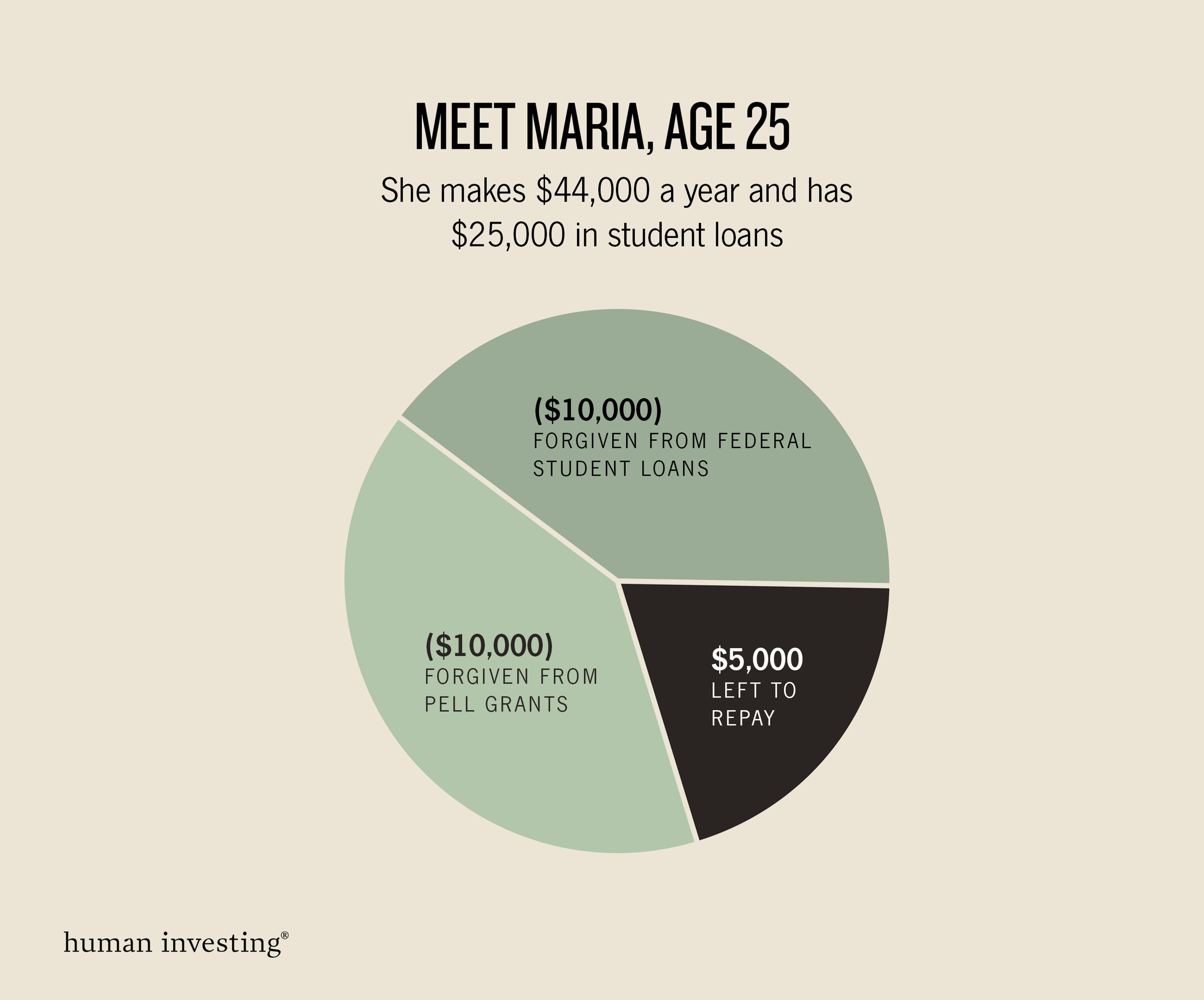
Maria graduated in 2019 with $25,000 in student loan debt and currently makes $44,000 per year. One of the loans she received was a Pell Grant. According to Biden’s plan, Maria will only have $5,000 left to repay starting in January 2023.

ANDREW & MONICA, AGE 43

Andrew and Monica are a married couple. Together, they carry $40,000 in student loan debt and make a combined income of $260,000 per year. Due to their income, they are ineligible to receive student loan debt forgiveness and will need to resume their repayments starting in January 2023.  

SEAN, AGE 35

Sean graduated in 2017 with $8,000 in student loan debt and currently makes $75,000 per year. All of Sean’s student loans are canceled, with no repayments resuming in January 2023.

How Should You Adjust Your Financial Plan?

However you are receiving this news, you should use this opportunity to assess your finances and take action to get closer to your long-term goals. Here are a few tips:  

If your student loan debt has been altogether canceled:  

  • Take some time to reassess your spending and saving habits – create a budget.  

  • Bolster your emergency savings fund: Make sure you have 3-6 months of expenses saved.

  • Use the extra cash to pay off any consumer debt.

  • If you have no consumer debt and have extra cash, consider redirecting those repayments to funding a Roth IRA. (Up to $6,000, or $7,000 if you are aged 50+).

  • Reconsider short-term and long-term goals.

If your student loan debt repayments are resuming in January 2023:

  • Edit your budget to include these payments.

  • Consider restarting your monthly payment schedule. This will save you money in accrued interest by paying down the principal during the payment pause.

As always, our team at Human Investing is here to help should you have any further questions. If you would like to talk with an advisor, call 503-905-3100.


Related Articles

Are your Kids Starting Summer Jobs? Start Investing in their Financial Independence
 

Summertime in full swing often means summer jobs for many young people, especially high school and college-age students. Earned income can provide a terrific opportunity for young people to save, think about their future, and begin practicing financial independence.

High school and college students motivated to save and invest can utilize Roth IRA accounts to get the most out of their dollars. Compound interest in action is a pretty magical thing to behold, and the earlier you can earn compound interest working for you, the better! Compound interest, tax benefits, and learning lifelong financial lessons can make for an incredible summer job experience.

Here is why opening a Roth IRA account is an excellent option for those spending their summer working as a high school or college student. 


Tax-Free Benefits

We are big fans of Roth IRAs here at Human Investing. Because the money used to contribute is after-tax dollars, it grows tax free and is not taxed down the road when you take it out…..We love this!

The younger your child starts a Roth IRA account, the more time their tax-free dollar amount in the account has to grow.

Compound Interest Growth

Youth isn’t wasted on the young. In Beth Kobliner’s book Make Your Kid a Money Genius (Even If You're Not): A Parents' Guide for Kids 3 to 23, she uses the following example:  

“Let's say [your teen] puts $1,000 of his summer earnings into a Roth IRA for each of the four years from age 15 to age 18. If he stops and never puts in another penny, but lets the money grow, by age 65 he'll have about $107,000, if the money earns 7% a year. 

But if your kid waits until age 25 and then puts away $1,000 for each of the four years until age 28 and stops, that account will only be worth a little over $50,000 by age 65.”

By taking advantage of a Roth IRA early on (in this example, ages 15-18), you can double your money compared to starting in your twenties. 

Roth IRA Specifics

In 2022, the maximum annual Roth IRA contribution is $6,000 a person for those under 50 years old who are single and making under $129,000 a year.

For those under 18 years old:

For children under the age of 18, they would need to open a Minor or Custodial Roth IRA account. 

Money put in this account must be earned, not gifted (this includes birthday and graduation gifts), and the adult who opens this account for the minor controls the assets until the minor reaches the age of majority (which is 18). 

Adults can also contribute. If your teen earns $3,000 at their summer job, you could either contribute the full amount they earned and let them spend their money, or you could contribute a percentage of your teen’s earnings (like 50%). 

It’s important to note that parents can contribute the money to a teen’s Roth IRA if their teen earned at least that amount. For example, if your teen made $2000, the most that could be contributed to the Roth IRA is $2000 total.

More info here: https://www.schwab.com/ira/custodial-ira 

For those over 18 years old:

For children 18 years or older, their Roth IRA account is now no different than the Roth IRA their parents might have. This account has the same requirements and restrictions as any other non-minor Roth IRA.

Building habits for the long-term

Here are a few ideas from parents on our team about approaching this opportunity with your child who has a summer job. 

As tempting as it is to spend those paychecks on something more tangible (a car, clothes, trips with friends), our children will need to understand the importance of financial independence, hard work, and investing for the future. Old habits die hard, so the earlier they learn these lessons, the better off they will be in the long run! 

You can incentivize your child’s savings by matching their Roth IRA contribution (up to their contribution limit). You can also lead by example. Share with your child why you save and what your financial “why” is. Share your hopes and dreams for their financial future and how their Roth IRA can be a means to this end. 

If you want to read more about Roth IRAs, check out our other blog post by fellow HI team member Nicole: Is a Roth IRA the Right Account for you?

Feel free to reach out to our Human Investing team if you would like more information about Roth IRA accounts. 


Related Articles

Section 121 Exclusion: Is it the Right Time to Sell Your Home?
 

Home prices and home equity have increased substantially over the last few years, which may leave you wondering if you should sell your home. Wouldn’t selling your home be even more tempting if buying another home wasn’t so difficult?

If you are thinking about selling a home, then you are probably focused on market timing, payments, moving and lifestyle changes. One thing you may have overlooked are the tax considerations of selling a home.

You may be thinking, “wait, isn’t the sale of my main home tax free?”  

It depends.

Primary homes are considered capital assets, like investments such as stocks and bonds. Capital assets are normally subject to capital gains taxes when they are sold. However, primary homes may qualify for a favorable capital gains treatment called the Section 121 exclusion.

For most homeowners, the Section 121 exclusion is one of the greatest benefits of the current tax code. Are you aware of how this exclusion works and how to ensure you qualify?

Start With your Capital Gains

Before making the decision to sell your home, start by calculating your capital gains. A gain on the sale of a primary residence is calculated as such:

Sale price - (Purchase price + Improvements) = Capital Gain

Breaking Down the Section 121 Capital Gain Exclusion and its Qualifications

The 2-out-of-5 year capital gain exemption is crucial for homeowners to understand.

The IRS allows homeowners to exclude part of your home sale from capital gain taxes if you’ve owned your home and lived in it as your primary residence for two of the past five years. The 24 months do not have to be consecutive months, but rather a total of 24 months within a 5-year period. If you qualify for the 2-out-of-5 year rule, then you have the following gain exclusion when selling your home:

The profit mentioned above does not include outstanding mortgage. If there is an outstanding mortgage on the home, this will not impact the Section 121 capital gain exclusion amount. Please read example #1 below to see how mortgages do not impact the overall capital gain.

Partial Gain Exclusions and Benefit Timing

Even if you haven’t lived in your home two out of five of the years prior to selling the home, there may be a way to qualify for a partial gain exclusion. For example, you could be eligible for a partial gain exclusion if you had to move due to work-related reasons, health-related reasons, or for unforeseen circumstances such as divorce or giving birth to two or more children from the same pregnancy.

Homeowners can benefit from this Section 121 capital gain exclusion once every two years. For example, if you have two homes and lived in both for at least two of the past 5 years, both homes are not eligible for the capital gains exclusion at the same time.

Four Examples of the Section 121 exclusion


EXAMPLE #1: SINGLE-FILING TAXPAYER

Jordan purchased a home in 2016 for $350,000 and sold it in 2022 for $560,000.

Jordan lived in her home for these 6 consecutive years. When she listed her home for sale, Jordan still had an outstanding mortgage of $75,000 on her home. As mentioned above, mortgages are not part of calculating the total Section 121 gain exclusion. Jordan has a total gain of $210,000 ($560,000 sale price - $350,000 purchase price). For a single taxpayer, none of this gain is subject to taxes because it is less than the exclusion amount of $250,000. Time for Jordan to enjoy her celebration of choice.

EXAMPLE #2: COUPLE FILING TAXES JOINTLY

Marta and Paul purchased a home in 1999 for $350,000 and sold it in 2022 for $1,000,000.

Marta and Paul raised their children in this home for the past 23 years, except for in 2006 when they rented their home for a sabbatical year. The total gain on the sale of the home is $650,000. They will only pay capital gains on $150,000, since $500,000 is subject to the Section 121 gain exclusion.

EXAMPLE #3: VACATION HOME TURNED TO A PRIMARY RESIDENCE

Samuel and Taylor bought a vacation home on the coast in 2010 for $300,000. They used the home as a vacation home for the first 10 years, and then converted it to their primary residence in 2020. Samuel and Taylor would like to sell their home at some point in 2022 for $500,000.

The first 10 years of ownership are considered non-qualified use. Non-qualified use is any period after 2008 when the home was not used as a primary residence. Examples of non-qualified use are vacation homes, rental properties, investment properties, or homes used in a trade of business. Homeowners cannot take the full tax-free exclusion under Section 121 if a property was held and used for non-qualified use prior to it being held as a primary residence (qualified use).

In this example, 2/12ths of the total $200,000 of capital gain can be excluded from taxable income ($33,333) as qualified under Section 121 and 10/12ths ($167,666) of the total capital gain must be included in taxable income as non-qualified use under Section 121.
*There are some exceptions to non-qualified use. They are listed under the Business or Rental Use of Home section.

EXAMPLE #4: HOMEOWNERS TURNED TO LANDLORDS

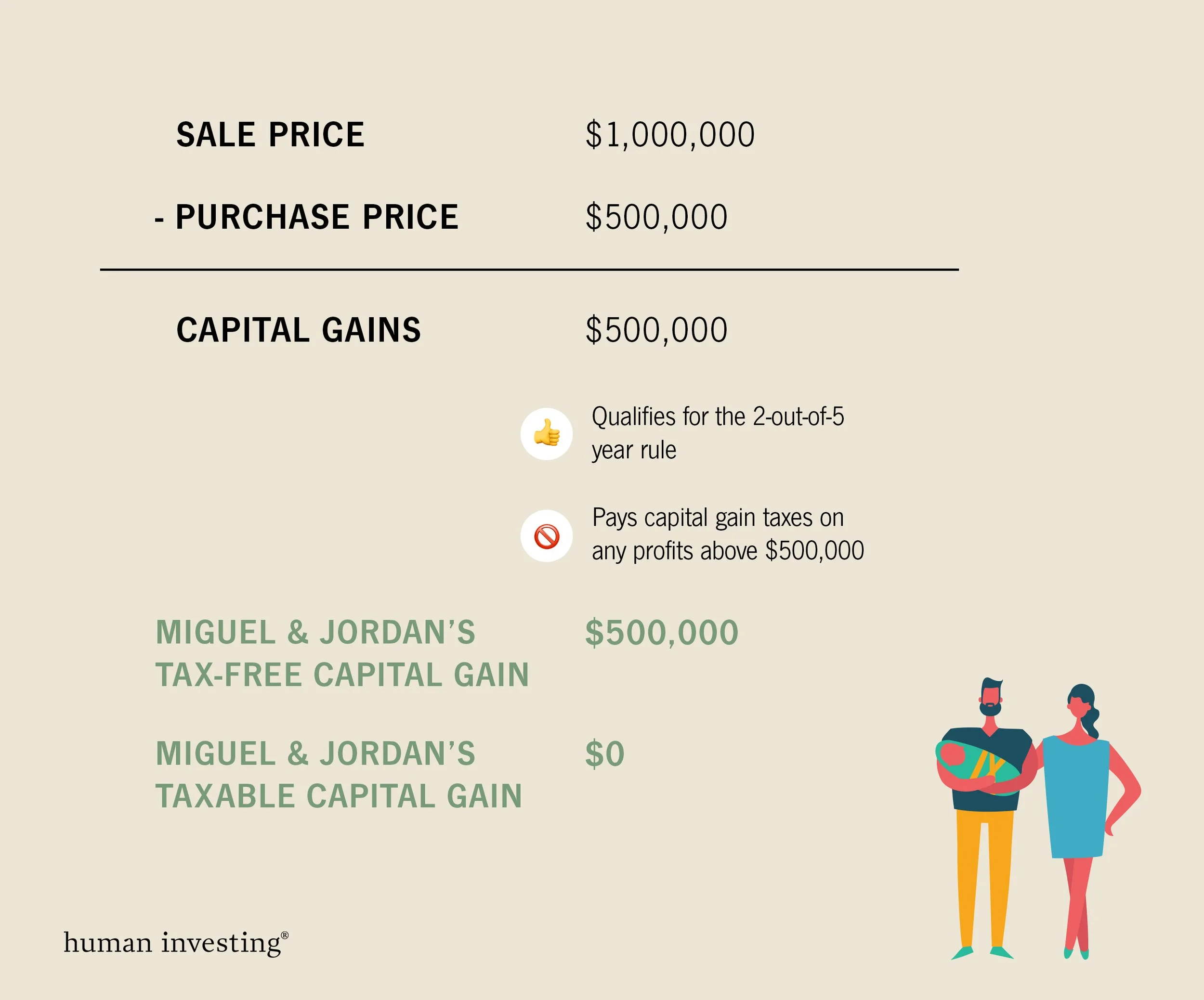
Miguel and Jasmine purchased their primary home in 2012 for $500,000. They moved out of the home and started renting it in 2020. They sold their home for $1,000,000 in 2022.

Since they wanted to utilize the Section 121 gain exclusion, they had to sell the home in 2022. To articulate the importance this sale timing, here is a detailed timeline:

2018 – home used as their primary home

2019 – home used as their primary home

2020 – home used as a rental home

2021 – home used as a rental home

2022 – home used as a rental home for most of the year and sold for $1,000,000 on May 15, 2022

Since they sold this home during 2022, which meets the 2-out-of-5 year exclusion rule, they can utilize the full tax-free exclusion on the $500,000 gain. ** They may owe tax on the depreciation recapture.

However, if they waited to sell their home until 2023, Miguel and Jasmine would pay capital gains tax on the entire $500,000 gain since they wouldn’t have qualified for the 2-out-of-5 year exclusion rule in this case. As this example illustrates, being mindful of your timeline for selling a home is critical.

Tax Planning for your Home(s) IS CRUCIAL IN MAXIMIZING WHAT YOU CAN POCKET

As you may have gathered from this blog post, buying and selling homes may involve complicated tax planning. Given the prolonged seller’s market, our team has worked on several tax planning scenarios and strategies for different clients. If you would like to speak to us about your own unique scenario, please reach out to us at hi@humaninvesting.com or 503-905-3100.


Related Articles

Consistency is Key When Fighting the Dad Bod and Growing Your Investments
 
cyril-saulnier-TsVN31Dzyv4-unsplash.jpg

On September 1st, my beautiful wife and I welcomed our new son into the world. His arrival has brought our family much joy during this season. Like all newborns, he has also brought sleepless nights, an abundance of comfort food, and disruption to our schedules and disciplines. As a result, I am here to tell you from personal experience the “dad bod” is real (find out if you have a dad bod here).

As I begin the journey to get back in shape, exercise and clean eating seem more difficult than ever before. Had I maintained my regimented sleep, diet, and exercise schedule throughout the entire pregnancy, returning to my baseline wouldn’t be as challenging. In physics, we call this inertia. In finance, we call this the compounding effect.  

Like most things in life, there is a compounding effect on our actions. 

  • Consistency in showing up to work → proficiency at your job. 

  • Consistency in showing up in the lives of loved ones → richer relationships. 

  • Consistency with a sustainable diet and exercise plan → greater physical health. 

  • Consistency in following a prudent investment strategy → increased net worth. 

Consistency is integral to the compounding effect

The inverse is also true. Disruption is a detriment to the compounding effect, a truth for our fitness as well as our investment accounts. To quote Charlie Munger, Warren Buffet's partner at Berkshire Hathaway —“The first rule of compounding is to never interrupt it unnecessarily”.

I would argue that someone’s consistency often has a greater impact than their effort and resources. Take the following example of two investors: 

  • Investor A - saves $2K/year from age 26-65.  

  • Investor B - saves $2K/year from age 19-26 and stops there.  

  • Both achieve a 10% annual return.*  

At age 65, who ends up with more money?  

  • Investor A: $883,185  

  • Investor B: $941,054 

By saving and investing $2,000 at the beginning of each year from age 26 to 65 (39 total years), Investor A can expect to have a final balance of $883,185. Investor B only saves for 8 years but starts to save earlier in life than Investor A. Investor B benefits by taking advantage of 46 years of compounding growth, finishing with a balance of $941,054.

What Investor B lacks in consistency of contributions, they make up for in consistency of not interrupting the compounding effect on their investment account. I know you are probably curious, what would happen if Investor B did not stop contributing at age 26? Investor B’s account balance would be $1,902,309. Once again consistency wins out.

Start now and stick with it

  • There are no shortcuts to saving for retirement and fighting the "dad bod". Starting can be difficult and sometimes painfully slow, however, the long-term results can be powerful. 

  • The easiest advice to give is “never get off track.” However, like your sleep schedule with a newborn, there are some things you cannot control. It is important to know how to reassess and get back to work.  

  • Building anything valuable and defensible takes time, effort, and energy. Build a plan today.  

If you want to compare notes on raising a newborn, see baby photos, or discuss the impact of consistency when building a prudent financial plan, please reach out. We are here for you.

*This is for illustrative and discussion purposes only. Investment results will vary.


Related Articles

How to be a Responsible Credit Card Holder and why it Matters
Credit Score Header.png

A credit score can be a helpful tool for your overall financial wellness. Unfortunately, rules and regulations surrounding credit scores can be complex and unclear. Read on to learn the importance of a good credit score, its components, and how to use a credit score to impact your financial health.

WHAT IS THE PURPOSE OF A CREDIT SCORE?

Put simply, a credit score is your financial report card. It allows lenders to assess your trustworthiness as a borrower. A good credit score not only grants you easier access to lower interest rates on loans, but it can also help you rent an apartment, finance a car, or pay down a mortgage. In short, your credit score helps you navigate the lending side of the financial world, and even gain greater financial success.

WHAT ARE THE COMPONENTS THAT MAKE UP A CREDIT SCORE?

Your payment history: Do you have a record of paying your bills, in full and on time? Doing so will boost your credit score. Paying bills on an inconsistent basis (or ignoring them completely) will lower your score. FYI, paying the minimum monthly payment is not paying your bills in full. Paying only the monthly minimum will negatively impact your credit score. Don’t be tricked by that sneaky number. Live within your means and pay your bills on time. Pro tip: Utilize due dates in your calendar, or use the reminders app on your phone, to remind you to pay your bills.

The amount you owe: Do you approach or reach your credit limit each month? The ratio of the amount you spend and the limit on your credit card is called credit utilization. It is best to keep this ratio high (i.e. 1:10 not 1:1). Leaving room between the amount you spend in any given month and the limit on your credit card will boost your credit score, while closely approaching your credit limit each month (or reaching it) will lower your credit score.

The length of your credit history: How long have you had a credit score? The longer the better! If you do not currently have a credit card, make sure you are responsible enough to own one before rushing to get one. Remember, it is better to be a responsible borrower for a shorter period of time than an irresponsible borrower for a longer period of time.

Your credit mix and new accounts: How many accounts do you have? Utilizing a variety of different borrowing options (i.e. a combination of a mortgage, an auto loan, and student loans) isn’t bad if necessary. In fact, it can actually be helpful! Try to keep open accounts to a minimum, even if you only use some accounts sparingly. Opening multiple accounts can cause lenders to be more suspicious, which in turn can lower your score. So, yes, you heard me. You might need to cancel that Hawaiian Airlines card, even if you save $150 every 2 years for your biannual Hawaii trip.

Aside from these factors, lenders may also look at your salary, occupation and job title, and employment history. These additional factors will not actually change your credit score, but they can be used in addition to your credit score to assess your trustworthiness.

WHAT IS A GOOD CREDIT SCORE?

By assessing each of these components, a three digit credit score is generated, ranging from 300-850. Any score over 700 is considered a good score.

credit-scores.jpg

SO, WHAT DOES IT LOOK LIKE TO BE A RESPONSIBLE CREDIT CARD HOLDER?

Sure, this information can be helpful, but how can it be applied to everyday life? Let’s look at an example.

CC Sophia 1 - cropped.png

Sophia is a recent college graduate.

She just received her first full-time job and is looking to build her credit score. She applies for a credit card that has a low credit limit and only uses it for her regular monthly payments: gas, Netflix, and her gym membership. She lives within her means, knowing she has other payments to consider, such as her student loans and auto loan.

 
CC Sophia 2 - cropped.png
 

Sophia gets used to living off of a budget.

Every month, Sophia remembers to pay her credit card bill, and pay it in full. As a young lender, it is important for her to stay on top of her monthly payments.

 
CC Sophia 3 - cropped.png

As Sophia ages, she solidifies her good spending habits.

She opens another credit card account that has a larger spending limit, and uses it conveniently for groceries, bills, and other expenses—still living within her means and paying her bills on time.

 
CC Sophia 4 - cropped.png
 

Related Articles

All her daily money habits pay off.

Her credit score has deemed her a trust-worthy lender, and she is able to lock-in favorable rates for the mortgage of her first home!


What Type of Life Insurance is Right for you?
 
dylan-nolte-HNXi5znlb8U-unsplash.jpg

Life Happens. Be prepared and consider buying life insurance.

But what kind? How does one navigate through the many types and attributes of life insurance products? To make things more complicated, high commissions create an unavoidable conflict of interest for life insurance agents, which can muddy the waters and lead to further consumer uncertainty.

To provide clarity, we will explore what life insurance is and provide a broad overview of the different policies that can be purchased. Someone’s lack of understanding should not get in the way of life insurance being a part of their financial plan.

WHAT IS LIFE INSURANCE?

Life insurance is an important tool to protect loved ones and/or business relationships. Most people should have some form of life insurance to provide cash flow in case of the inevitable.

A life insurance policy is a contract between a policyholder and an insurance company. In exchange for payment of premiums, the insurance company will pay a death benefit upon the death of the insured. The death benefit is a tax-free* sum of money paid to the beneficiaries of the policy, which are often family members.

If you have someone who relies on you for financial support, and you cannot self-insure, you need life insurance.

TYPES OF LIFE INSURANCE?

There are numerous different types of life insurance policies. Policies will vary in coverage, premium cost, cash value, investment risk, and flexibility. Of these differences, policies can be divided into two key groups: Term life and Permanent life.

insurance-decisions.jpg

Term — Term life insurance allows the policy owner to pay for coverage for a predetermined number of years, typically 5, 10, 20, or 30 years. For most, a term policy is the least expensive way to purchase a death benefit. The death benefit can be level or decreasing. Some will purchase a decreasing death benefit to match their decreasing mortgage debt.

Life Insurance - Term and Permanent_Page_2.jpg

Permanent — Permanent life insurance is just as it sounds. The policy owner may decide to have their life insurance policy last a lifetime (up to age 120), often requiring a lifetime of premiums payments. There are several types of permanent policies. Popular policies include Whole, Variable (VL), Universal (UL), Variable Universal (VUL), and Indexed Universal Life (IUL).

Key differences between a term policy and a permeant policy include price, length of policy, and a component called cash value. Permanent policies are traditionally more expensive. The higher premiums cover the cost of the death benefit (including administrative fees), and the remainder is added to a cash value.

Life Insurance - Term and Permanent_Page_1.jpg

Traditionally, the death benefit is used at death while the cash value can be used during the policyholder’s life. The cash value of a permanent life policy can be a tax-advantaged savings vehicle for the policy owner. Permanent policies are typically most advantageous once other tax-advantaged savings vehicles like your 401(k), Roth IRA, etc. have been exhausted. The cash value may be available to the policy owner to withdraw or borrow against. The cash value can accumulate in a variety of ways and is often distinguished by the type of permanent policy. See below for differences between common permanent policies and their cash value accumulation.

Whole Life — The insurance company takes on the responsibility to pay out a dividend which is based on the performance of an investment portfolio managed by the insurance company and their ability to keep their business expenses low.

Variable policies (VL & VUL) — The policyholder may invest the cash value in a selection of mutual fund-like sub-accounts. Variable policies provide a “variable” growth (& potential loss) of cash value as sub-accounts are connected to underlying investments.

Index Universal Life (IUL) — The policyholder may earn interest based on the performance of an equity index, think the S&P 500. While there is no actual money invested in the index, interest is credited to the cash value based on the performance of the selected index. IUL’s provide variable growth with a cap on maximum returns (cap rate). There’s also a guaranteed minimum annual return (floor rate often never less than 0). For example, an IUL has a cap rate of 8% and a floor rate of 0%. If the selected index grows by 20%, the cash value is credited a growth of 8% (cap rate), if the index loses value by -5% the cash value does not decrease due to the index (floor rate).

insurance-chart.jpg

WHAT TYPE LIFE INSURANCE IS RIGHT FOR YOU?

This is our opinion, some life insurance agents and brokers with a conflict of interest may disagree.

You are young — Do you have plans for a family? This may be a great opportunity to purchase a term life policy. The younger you are, the less expensive premium payments will be.

You are the breadwinner — Term life insurance can replace lost income during working years. Life insurance prevents your surviving spouse (and children) to forgo their standard of living and helps meet the family’s financial obligations.

You are a stay-at-home parent — While there is no income number attached to a stay-at-home parent, there is a value associated with the services they provide a family. Term life insurance covering the years when kids are young can help cover the cost of child-care, housekeeping, and other responsibilities taken on by a stay-at-home parent. 

You own a home — For many Americans, a home is one of their largest assets and debts. Purchasing a term life insurance policy with coverage lasting the length of a mortgage can cover the remaining mortgage balance.  

You are a business owner — A life insurance policy is a multifaced tool for a business owner. A policy can help pay off business debts, pay estate taxes, and fund a succession plan like a buy-sell agreement. There are many variables to consider when choosing between term and permanent policies.

You have maxed out your retirement accounts — If you have maxed out tax-deferred retirement savings vehicles, a permanent life insurance policy can provide another avenue of retirement savings. Permanent policies build a cash value that can be accessed tax-free**. We do not typically recommend this to our clients because permanent policies are often very costly. The larger price tag can include investment costs (we commonly see 1-1.5%), administrative fees, as well as surrender penalties.

You want to leave an inheritance — Do you plan to spend all your retirement dollars, yet you would like to leave heirs with an inheritance? A permanent life insurance policy will provide a lump-sum benefit to your beneficiaries no matter when you pass away (can be up to 120 years).

You have a high net-worth — Permanent life insurance is best for those who are concerned about estate taxes. A lump-sum benefit at death is distributed to heirs to pay estate taxes, rather than selling-off inheritance.

Life is complex. As such, your situation may require multiple life insurance policies for you and your family.

WE ARE HERE IF YOU HAVE QUESTIONS

There are many options for life insurance. While Human Investing does not sell life insurance policies, we do help clients find the best policy within their financial plan. Having someone to help you navigate life insurance without incentive to sell you a product has immense value. If you have questions about what type of life insurance may be best for you, or how it fits into your financial plan, please contact us at Human Investing.


*Death benefit will be tax-free if it does not violate the “transfer-for-value” rule.

**Tax-Free-withdrawals up to basis then gain taken as loan.  Also, is not a modified endowment contract.


Related Articles

Financial Literacy Starts Young: Knowledge that Pays
 

Demand for better financial literacy is going up

Financial Literacy is the understanding of financial concepts which guides good money decisions in everyday life.

The backdrop of personal finance is having a structure for how to act. We usually refer to this as a financial plan. A financial plan helps to allocate money, a limited resource (for most of us), to unlimited alternatives.

Financial literacy can help parents make a difference

The United States is the largest economy in the world however, Standard and Poor’s Global Financial Literacy Survey reveals that it is the 14th in the world in Financial Literacy at approximately 57%.

By age 7, most children begin to grasp that money can be exchanged for goods and represent value. For example, understanding that 5 pennies equals 1 nickel, as a University of Cambridge research on “Habit Formation and Learning in Young Children” discovered.  Starting at age 7 or 2nd grade, a child is ready for more instruction and guidance around money concepts. In the same way that children learn language from their parents, they can and do learn money habits from their parents but need exposure and  instructive conversations. Moreover, children need the opportunity to practice with money, or forms of money, that have different representations of value.

Financial literacy can lead to responsible decision making

Parents have the ultimate authority and responsibility to begin educating on financial concepts from a young age. Parents should be aware not to rely on the education system to teach the basics or complexities of personal finance, as it is not required to graduate in many states (ex: Oregon).

To help empower parents with the knowledge and tools to provide a great foundation for personal finance, let us refresh ourselves of the basics of what children can learn and apply early in their formation. Always remember to keep it simple.

Start with an approachable framework

The four basic functions for allocating money is to Spend, Save, Invest, or Give. A guideline to start with is a 30/70 rule: save, give and invest 30% while spending the remaining 70%. To create a basic guideline for our kids (and possibly even ourselves), let’s break each of these functions down.

The heart of giving

Let’s start with giving, since many of us have experienced that if it is not given up front, it may not be given at all. This is important in establishing an altruistic worldview (selfless concern for the wellbeing of others) but also in teaching an abundance mindset (always more to go around) as opposed to a scarcity mindset (only so much and never enough). Giving can immensely impact a child’s desire to be a force for good and help others, which is the foundation for business. When banking a dollar per week from allowance, even with this small amount, it can be a great place to start the heart-healthy habit. Ask your child what they care about and who they would like to help with their giving, it may surprise you.

The necessity of saving

A similar principle will prove necessary for saving. It is much easier to set aside some money prior to spending to ensure you will have something left over when needed. Having adequate savings can keep you from being subject to predatory lending or missing out on an opportunity. It is equally important to help kids understand that saving is not the same as investing. It is important to have money working for you, not just set aside and available to you.

The value of investing

The importance of investing is compounding interest and seeing your hard-earned dollars multiply for you in a way that seems effortless but requires patience and self-control.

Setting money aside to help a child invest in a company like Disney or Nike, something they can tangibly see and enjoy, is a great learning lesson. This could be done through your taxable investment account or in their own UTMA (child’s investing account).

If the former idea is too involved or the money is not available for buying actual shares of companies, consider offering your child a “matching program” when they invest in the “Parent Company”. In the same way, consider offering your child interest (growth) for leaving their savings with you. They may need a greater incentive to understand the concept and value of having their money grow. Based on the child’s age, show them a toy that costs $1 and a toy that costs $10. They could spend their $1 weekly allowance collecting numerous low cost and low value toys, or they could save and potentially even grow their dollars to achieve a valuable toy more quickly. This would help provide the incentive to invest those dollars rather than spend them or even save them.

Lastly, teach the rule of 72. An investment that grows 7% annually will double in just over 10 years (72/7=10.2). An investment that grows by 10% annually will double in just over 7 years (72/10=7.2).

The discipline of spending

A great place to start is needs and wants. How much should be allocated to needs and what is left for wants. A rule of thumb is 50% for needs and 20% for wants. Without a credit card line, this is much easier to do when working on a cash basis. Until kids are old enough to have expenses like cell phone, auto insurance, gas, it will be difficult to break out needs versus wants. Until then, spending will be all one category at 70%. Once the child is a high schooler, they will experience more reasoning between needs and wants. What is left over is available for “fun money”.

It will be important to discuss the topic of credit versus debit as credit cards are a form of debt and borrowing from an institution will have numerous negative effects on saving and investing.

Another concept to teach when considering spending is discounts and coupons. When paying less for a specific item, you have more left over for other items or for saving, investing, or giving. One of the best places to teach this is looking at a specific product at the grocery store (candy bars!) and comparing prices, those on sale and those that are not and the impact of spending less to keep more.

The compounding benefits of financial literacy

Financial literacy, like investing, has compounding benefits especially when starting young. It is invaluable to model and have conversations around money with your children. No need for perfection, but the goal is to make progress and provide opportunities to learn.

This article was inspired from a presentation by Mac Gardner, CFP®, author of “The Four Money Bears”.


Related Articles