
Posts in 401k & IRA
The IRS Has Increased Contribution Limits for 2024
 

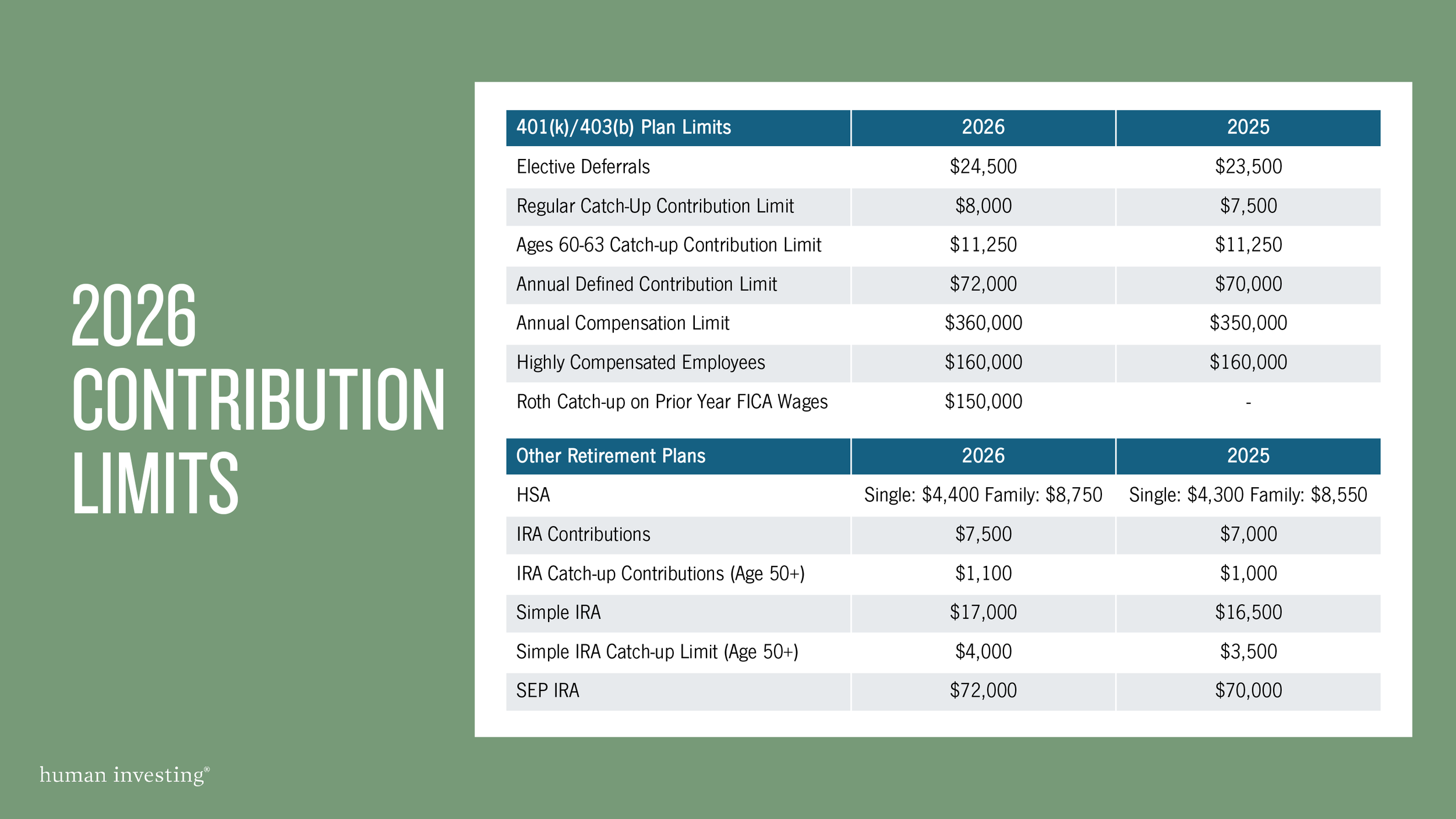
There is good news for retirement accounts! The IRS has increased the contribution limits for the upcoming year. As you can see below, there are many notable changes that will allow investors to save more money. One important update for 2024 is that 401(k) elective deferrals increased from $22,500 to $23,000. That’s not all! Please see below for the applicable updates for the coming year:

How do these changes impact your savings in the upcoming year? Are there any changes you should be making? Use this link to schedule a time to meet one-on-one with our team. We look forward to working with you in 2024!


Related Articles

Are Series I Bonds right for you to hedge against inflation?
 

There has been a lot of news on high inflation coming and its looming effects on everything from investment portfolios to the price of milk.

As people are searching for ways to combat high inflation and preserve how far their money can go, we’ve been receiving many questions on an investment option called I Bonds. Questions about what they are and why they haven’t heard of them before.

Our hope is to shed some light on Series I Savings Bonds (I Bonds), available here, and outline how the investment works before offering our recommendations.

How risky is an I Bond?

I Bonds are US treasury bonds, meaning they are backed by the full faith and credit of the US government, making them one of the safest, lowest risk investments possible.

What is the interest rate on an I Bond?

There are two parts to the interest rate on an I Bond.

  • A nominal (fixed) rate — currently 0% as of November 2, 2021.

  • An inflation (floating or adjustable) rate that changes every 6 months — currently 3.56% as of November 1, 2021.

These two rates are added together to determine the interest rate on an I Bond, so the current rate on the I Bonds for 6 months is 0% (nominal) + 3.56% (inflation) = 3.56% total (which is 7.12% annually). This interest rate cannot drop below 0% even if there is ever a negative inflation adjustment. See here for historical I Bond interest rates.

The floating rate on I Bonds will adjust as inflation adjusts. Today, inflation rates are high, but as the historical rates table in the link above shows, inflation rates can be lower.

When can I access my money?

An important factor to consider is that I Bonds only pay interest upon maturity, so you will not receive cash flows from the I Bond as you hold it.

I bonds have no secondary market, so you cannot resell your I Bond, you can only redeem it. I Bonds have no liquidity for the first year after purchase, so it’s important that you will not need to access the funds for at least one year. For years 1-5 after purchase, you may redeem your I Bond early by forfeiting the last 3 months of interest. After 5 years, you may redeem the bond early without penalty. I Bonds will mature 30 years after purchase.

How do the taxes work?

I Bonds only pay interest upon maturity. You can claim (pay) the taxes on the earned interest every year on your I Bonds, or you can pay taxes on all interest upon maturity of the I Bond. I Bond interest is not subject to state or local taxes. See here for more information.

How do I purchase I Bonds?

You have to purchase I Bonds directly through treasurydirect.gov, or with your federal income tax refund. See here for more information.

You are limited to $10,000 of I Bonds through electronic purchase, and $5,000 of I Bonds through paper purchase via your tax refund, for a total limit of $15,000 of I Bonds in a calendar year.

The pros and cons of waiting to get paid out

If you’re still wondering if these bonds are right for you and your financial plan, weigh the pros and cons below against your goals.

Pros:

  • The inflation adjustment makes I Bonds a great inflation hedge

Cons:

  • Interest is only paid out upon maturity, so don’t utilize I Bonds as a source of cash flows over time

  • Funds are locked up for 1 year, so don’t use I Bonds for any funds you might need before then

Other considerations:

  • I Bonds must be purchased on your own, so they’re for a more DIY inclined investor

  • The inflation adjustment rate will change adjust over time, so the precise amount of interest an I Bond will earn is uncertain

  • Consider the potential taxes of having all interest hitting upon maturity of the I Bond, or having to pay taxes each year on interest you have not yet received

  • You are limited on how much you can purchase in a year

I Bonds are typically best for medium term (i.e. around 5 year) savings goals.

The inflation adjustment reduces your risk of losing purchasing power due to inflation. The low nominal rates on I Bonds today means your funds will not grow faster than inflation.

For longer term savings goals (i.e. retirement in 10+ years), equities are a great long-term inflation hedge, because companies can adjust their prices (and therefore dividends & earnings) based on inflation. Treasury Inflation Protected Securities (TIPS) are another, lower risk than equities, investment that adjust for inflation.

If you have more questions about I Bonds, or would like to speak to a financial professional about other investments, please reach out to us at hi@humaninvesting.com or 503-905-3100.



Related Articles

The Real Risk of Owning Bonds: Too Much in Bonds May Hurt Your Purchasing Power
 

We talk to a lot of different people about investing. A common request is something along the lines of: “I don’t want to lose anything, and I want my money to grow.” This is a challenging, if not impossible mission. The investment world is full of opportunities to grow your money. However, there is an inherent risk when you put your money in any investment.

Finance has a lot of ways of measuring risk. Standard deviation is used to try to show a range of the possible returns. Max drawdown displays your worst-case scenario. Sharpe ratio provides a risk-adjusted measure of performance. However, very few investors ask about standard deviation, max drawdown, and Sharpe ratios. The people we talk to are most likely to ask “What are the odds of losing money” because they don’t want to see their current savings drop in value.

How strong is your purchasing power?

An important consideration when talking about losing money is purchasing power: the ability to buy goods with your money. Inflation has consistently pushed prices up over time, reducing the purchasing power of a single dollar. Wanting to avoid losing money is completely understandable. The danger of keeping your money under your mattress or sitting in cash is that inflation is constantly reducing your purchasing power.

When concerned with losing money, many investors are focused on nominal returns. Nominal returns are the raw return values, unadjusted for inflation, and are simple to calculate and digest. I would argue that most investors should be focused on real returns: returns adjusted for inflation. Real returns are a more accurate measure of your change in purchasing power. Ultimately, very few outside of Scrooge McDuck want a giant pile of money. Most people want to spend that money on goods, like food, travel, or a home, therefore purchasing power is likely what investors really care about.

Real return = (1+Nominal Return) ÷ (1+inflation rate)

Historically, stocks deliver positive returns, and those returns are in your favor. However, stocks are down (i.e. lose money) more frequently than bonds. The safety bonds offer also means they provide lower returns. What blend of stocks and bonds is most likely to protect your purchasing power (i.e. produce a positive real return)?

inflation is dwindling BOND power

To try and answer this question, I looked at the Stocks, Bonds, Bills, and Inflation (SBBI) data from the CFA Institute from 1926-2020. This data included monthly and annual returns; the annual data is for each calendar year. For stocks, I used the Ibbotson SBBI US Large-Cap Stocks total return.

For Bonds, I used the Ibbotson US intermediate-term (5 year) Government Bonds total return. I looked at several different portfolios which include a variety of stocks and bonds. Specifically, I blended the stocks and bonds in 10% increments, from 100% stocks, to 90% stocks 10% bonds, to 80% stocks 20% bonds, and so on to 0% stocks 100% bonds. I also assumed the portfolios were rebalanced at the start of each return period (i.e. the weights were reset at the start of each month for monthly data, and the start of each calendar year for annual data).

I took these different stock/bond portfolio mixes, and I calculated the nominal and real returns from 1926-2020 for both monthly and annual (calendar year) returns. I then calculated what percentage of returns were positive to measure the chance of losing money (nominal returns) or purchasing power (real returns). I’ve graphed the nominal vs real returns for monthly and annual returns below.

bonds-monthly-returns.jpg
bonds-annual-returns-v2.jpg

You’ll notice the nominal monthly returns paint a clear picture. If you want positive nominal returns more often, you want to own more bonds, hence the steady upward trend to the graph. If you look at the annual nominal returns and want to maximize your chances of a positive nominal return, you actually want a 10/90 portfolio (10% stocks, 90% bonds). As risky as stocks seem, having at least a sliver of stocks actually increases the chances of a positive nominal return

The real returns tell a slightly different story. For the monthly real returns, the stock/bond mix is almost irrelevant for producing a positive return, and hovers right around 60%. There is a drop off after 10/90 (10% stocks, 90% bonds), indicating owning even just 10% stocks in your portfolio helps increase your chances of positive real returns better than owning 100% bonds.

For the annual real returns, you can see that your odds of a positive real return are better with at least some bonds in the portfolio. Interestingly, the 70/30 portfolio and the 20/80 portfolios produce the highest chance of a positive real return. The all bond portfolio, 0/100, has the worst chance of maintaining your purchasing power (i.e. producing a positive real return).

Stocks can seem risky, and the loss of value can make many investors shy away. Even just a small amount of stocks can protect your purchasing power better than owning only bonds. There are still many considerations for how you should invest including your risk tolerance, time horizon, and holistic financial plan. If you’re interested in talking to an advisor, please reach out to us at hi@humaninvesting.com or 503-905-3100.


Related articles

How Some Millennials are More Resilient during Financial Shocks
 

According to most research, although millennials are considered the most highly educated generation, we are the least informed when it comes to our financial decisions. Not only do we lack financial literacy, but pre COVID-19, 63% of millennials felt anxious when thinking about their financial situation, and 55% felt stressed when discussing their financial situation. I imagine COVID-19 has negatively impacted those figures even further.
There are many factors that affect our personal financial stress levels, but historically, the financial industry has felt inaccessible to those who lack financial literacy and/or feel insecure about their financial situation. How are we supposed to learn if we lack access to knowledge?

SAVINGS APPS TO SAVE THE DAY

I love the concept of savings apps, because it improves accessibility of investing and saving for a large population. Basically, if you have a smart phone and a few extra dollars, you can be a saver. A study conducted in 2019 found that individuals who used savings apps kept better track of their finances and were more resilient when faced with a financial shock. However, accessibility without education can be hazardous. So, here are two recommended savings apps that provide learning and saving opportunities.

  • Mint is a free app powered by INTUIT (think Turbo Tax) that houses all of your financial information in one place. Mint uses a holistic view and budgeting tools to find extra savings for you. Not only do they provide you with custom savings tips, but they also have a hub of resources, ranging from building a grocery budget to investing advice, so you can learn along the way!

  • Digit has the same philosophy as Mint: find savings within your current financial situation. With this philosophy, Digit analyzes your current income and expenses and then lets you know what you can afford to save. They invest your dollars in FDIC insured account using a portfolio based on your risk level and comfortability. You are also able to attach these savings to a specific goal – emergency savings, honeymoon, a doggo—you name it. There is a monthly cost of $5, but you do receive 1% annual bonus savings every three months.

NOT FEELING IT? FOLLOW THEIR SAVING PHILOSOPHIES

It’s okay if you don’t vibe with the savings app world. But if you do want a better grip on your finances, follow the philosophy behind the savings apps:

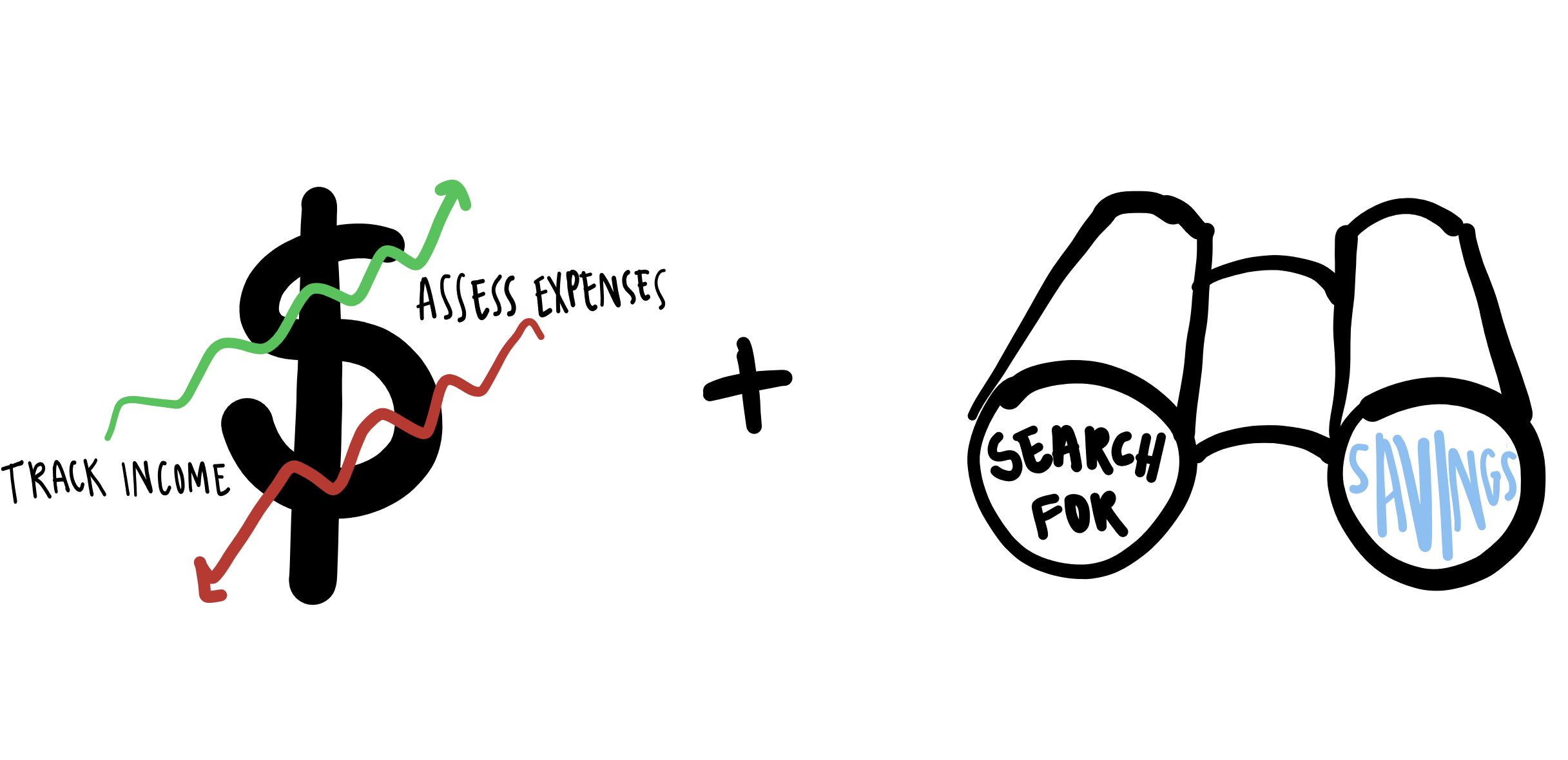
  1. Keep track of your income.

  2. Assess your spending habits.

  3. See where you can save.

savings blog doodle23.png

For me, that looks like walking past the gluten-free bakery every so often instead of into it (which is usually the case) and saving the extra $5. At the end of the month it can make a difference (Don’t believe me? See how much you can save by ditching your morning coffee here).

Finally, allow yourself to interact with financial resources without being too hard on yourself. The purpose of these apps is not to be a report card. The purpose is to empower you to make thoughtful decisions that will improve your financial health. If you have questions, check out our Financial Wellness Center or reach out! We are here for you.


Related Articles