Posts in Tax
Retirement Income Planning: Tax Bracket Optimization
 

We help our clients organize and implement tax bracket optimization. In your early years of retirement, even if you do not have earned income, there are important tax considerations. I will illustrate two recurring tax planning strategies: Roth Conversions and Capital Gain Realization.

Consider a retired married couple (both age 65) living in Oregon this year.

In this example, this couple has $36,700 of taxable income. This places them in the 12% federal tax bracket and provides $52,750 more room inside the 12% bracket before moving into the 22% bracket.

Considering the wiggle room before the increased tax rate, this client could decide between the following options:

OPTION 1: Realize Capital Gains

Realize (sell and reinvest) up to $52,750 of long-term (held longer than 12 months) capital gains to take advantage of the 0% Federal Capital Gains rate within the 12% bracket. This couple living in Oregon would still pay 9% State. Ideally, they pay less taxes today to avoid realizing those gains at 15% Federal and 9% State later, likely during the required distribution timeframe starting at age 73. They would keep 15% more of the growth on their investments.

Option 2: Conduct Roth Conversions

If a client does not have any taxable accounts or unrealized capital gains, they could use the room in the 12% bracket to conduct Roth conversions. This would consist of transferring funds from a traditional IRA, paying the taxes now (12% Federal and 9% State), and putting the net amount into the Roth IRA to grow tax-free overtime. This strategy is helpful to maximize the 12% bracket, since the 12% bracket will revert to the 15% bracket in 2026, when the Tax Cuts and Jobs Act (TCJA) ends. Additionally, when a client turns 73 and is required to take distributions from IRAs, this required distribution amount cannot be converted to a Roth IRA but must be distributed.

Required distributions could also push income from IRAs into the 22% bracket. Another benefit of Roth conversion is that Roth IRAs are not subject to required distribution rules and therefore can continue to grow tax-free for the life of the married couple.

Option 3: Combination of realizing Capital Gains and Roth Conversions

This requires year-by-year income and deductions tracking from all sources to ensure the right amount of money is being realized or converted.

Tax bracket optimization is not an after-thought, but a pivotal component of holistic financial planning offered at Human Investing. If this kind of planning would be helpful to you, please schedule a time to review your situation.


How to Turn Your Investment Loss Into a Tax Gain


Seeing losses in your portfolio during market volatility may be disheartening. Utilizing those losses through a process called tax loss harvesting affords the opportunity to have your taxes benefit from those losses. Rather than selling stock due to inferior performance and shifting the allocations in your portfolio, you can lock in those losses while keeping your portfolio performance the same.

What is tax loss harvesting? Why should I utilize it?

Tax loss harvesting is when you realize, or “lock in,” the losses of your investments by selling the investment. Say you bought stock A at $150 per share, and that investment is now valued at $120 per share (or a $30 per share unrealized loss). You may lock in the loss of an investment by selling some or all of your shares. This is known as “realizing” your losses.

You can then use these losses to lower your tax bill in three ways:

  1. Offsetting your realized gains from other investments sold

  2. Offsetting capital gains generated from other activities such as a home sale, business sale, or collectibles

  3. Offsetting up to $3,000 of your ordinary income

Tax loss harvesting is typically recommended for clients whose tax liabilities require year-round attention. We implement tax loss when positions we manage to hit a certain loss percentage. Toward the end of the year, we perform "tax-gain harvesting" where we look to sell positions with very high gains to ensure we are not generating a net gain for clients.

The “Wash Sale” Rule that minimizes loopholes

Unfortunately, you are not allowed to sell a stock and immediately repurchase it to recognize the losses. If you decide to sell an investment position at a loss, you may not purchase that same investment or a “substantially identical” investment 30 days before or after the sale at a loss. This is to avoid a “wash sale” rule violation. This rule applies to all investment accounts associated with your household and on your tax returns. If a wash sale rule violation happens, the IRS will not allow you to use the loss to offset your gains. The cost basis of your investment will also change as the disallowed loss is added to the cost basis of the new, "substantially identical" investment you purchased. Click here for more information on the wash sale rule.

Will I miss out on my investment returns by doing this?

While there is no guarantee that the original investment sold to harvest losses will stay valued at or lower than the price you sold it for, you can buy similar positions to maintain the allocation and expected rate of return in your investment portfolio.

For example, you sell your Apple stock (AAPL) and are looking for a replacement, so you decide to use a large-cap growth index fund. Large-cap growth index funds are funds that invest in various stocks/companies that are classified as "large-cap," meaning they are valued at a market capitalization of $10+ billion. The growth piece implies that the fund managers see that the companies offer strong earnings growth and are undervalued in the stock market. Using a large-cap growth index fund gives your portfolio continued exposure to the large-cap growth sector of the market during the time period you are not allowed to buy AAPL stock.

See tax loss harvesting in action.

Say you bought some AAPL stock at $10,000, and the stock is now valued at $7,500. If you were to decide to sell it, you would then realize a loss of $2,500. Then, you have another stock, MSFT, that you bought for $5,000 and is now valued at $9,000. You sell that stock and realize a gain of $4,000. Since you can use the losses generated to offset your gains, you would have a net $1,500 of capital gains to pay taxes on, rather than the original $4,000!

Human Investing is here to help.

Tax loss harvesting is done as part of our portfolio management services. We also offer tax planning as a part of our services, helping to ensure you receive comprehensive financial planning where you need it most. If you are interested, please reach out to us at 503-905-3100 or hi@humaninvesting.com.


Related Articles

In the Market for a New Electric Vehicle? Get One Today if you Want the Most EV Credits
 

Due to the newly proposed legislation (Inflation Reduction Act), if you are in the market for a new electric vehicle, you may want to rush to the dealership today (August 11th)!  In the proposed legislation, Congress extended the electric vehicle credit but has added new restrictions which will make qualifying for the credit more difficult.

Here is a list of the new limitations proposed for Electric Vehicles delivered in 2023:

  1. 40% of the Battery must have been made in a country in which the US has a free trade agreement.

  2. MSRP must be under $55,000 for sedans and $80,000 for vans and SUV’s.

  3. Modified Adjusted Gross Income must be less than $300,000 for married joint returns and $150,000 for others.

  4. On a positive note, the $200,000 sales limitation that has kept Tesla and a few other manufacturers from qualifying for electric vehicle credit will be removed. So if you are thinking about getting one of these models, you may want to wait until next year to see if these manufacturers can meet the above qualifications.

To use the old credit, you must take delivery of the car in 2022 or have a binding contract to purchase before the bill is signed into law. The bill has already been approved by the Senate and will head to the House for a vote on Friday, August 12. 

Which cars are still eligible for the old credit?

If you want to act quickly, this link contains a list of cars that are still eligible for the old credit.  Please note that Tesla and some other dealers are not eligible for the old credit, but may be eligible for the new credit given they comply with the limitations above. 

As always, we are here to help. Please reach out to your advisor team or email luke@humaninvesting.com if you have any questions.


Related Articles

High-income Portland/Metro area residents, have you paid your 2021 local taxes yet?


Did you Make Over $125,000 Individually or over $200,000 as a Married Couple?

There are two new local personal income taxes that became effective for the 2021 tax year. These two taxes, explained below, are specifically for single filers with Oregon taxable income above $125,000 and married jointly filers with Oregon taxable income above $200,000.

These two programs are local taxes, not state taxes. This means that the tax payments go directly to The City of Portland and require an additional filing. We expect high-income earners in the Portland-metro area to have at least three tax returns for 2021: US Individual Income Tax Return, Oregon Income Tax Return and City of Portland.

Like your federal and Oregon state tax return, these local tax returns are also due by Monday, April 18.

Local tax #1: Preschool for All (PFA) Personal Income Tax

In November 2020 Multnomah County voters passed The Preschool For All Program which will provide tuition-free preschool for children that meet the program criteria.

  • This local tax is funded by a 1.5% marginal personal income tax on taxable income above $125,000 for single filers and $200,000 for those married filing jointly.

  • This local tax is also funded by an additional 1.5% tax is imposed on taxable income over $250,000 for single filers and $400,000 for those married filing jointly

Local tax #2: Portland Metro Tax

In May 2020, Portland-area voters approved Measure 26-210 which will provide homelessness services like shelter, advocacy, and mental health resources.

  • This local tax is funded by a 1% marginal personal income tax on taxable income above $125,000 for individuals and $200,000 for those married filing jointly.

  • This local tax is also funded by a 1% business income tax on net income for businesses with gross receipts above $5 million.

  • The Portland Metro area includes residents of Multnomah County, Clackamas County, and Washington County. For a full reference guide of the Metro jurisdiction use this online tool.

How can I Find my 2021 Taxable Income?

Taxes are complicated. Remember that your income (like your salary) is not the same as your taxable income. For example, you could earn a salary of $140,000 a year but have less than $140,000 of taxable income because of pre-tax retirement account contributions and taking the standard deduction or itemized deductions.

The easiest way to confirm your 2021 Oregon taxable income is to complete an Oregon Income Tax Return. Your taxable income is included on line 19 of your Form Oregon 1040.

If you are a single filer and your Oregon taxable income (on Line 19 on your 2021 Form OR-40) is greater than $125,000 or if you are a married jointly filer and your Oregon taxable income is greater than $200,000 then you likely need to pay your taxes by April 18, 2021.


FINDING YOUR TAXABLE INCOME IN TURBOTAX

1. Login and find the Documents tab.

2. Download your tax PDF. Scroll to the bottom of the PDF for the Oregon return.  

3. Find your 2021 Form OR-40. Line 19 includes your total taxable income.


examples of Calculating your local taxes owed


Preschool For All Tax: $0 because her income is below the $125,000 threshold for individual taxpayers.

Portland Metro Tax: $0 because her income is below the $125,000 threshold for individual taxpayers.


Preschool For All Tax: $6,000.
Tier 1: $400,000 - $200,000 = $200,000 of taxable income. $200,000 x 1.5% = $3,000
Tier 2: Then, $500,000 - $400,000 = $100,000 of additional taxable income. $100,000 x 3% = $3,000

Portland Metro Tax: $3,000.
$500,000 - $200,000 = $300,000 of taxable income. $300,000 x 1% = $3,000


Preschool for All Tax: $0 because they are not a Multnomah County resident.

Portland Metro Tax: $350.
$160,000 - $125,000 = $35,000 of taxable income above the threshold. $35,000 x 1% = $350


How Can I Pay for this Tax?

If you hire a CPA to prepare your individual tax returns, we recommend confirming that they will also file your City of Portland taxes for you. 

If you use an online tax software like turbotax, you will have to visit the Pro.Portland.gov website to submit your tax payments in a separate return. If you are a Multnomah County resident, this process will feel similar to paying your $35 Arts Tax.

What if my Taxable Income is Below the Limits for the PFA and Metro Tax?

You do not need to file anything to the city of Portland if your taxable income is below the limits for both local taxes in 2021. However, if you are a Multnomah County resident then don’t forget to pay your Multnomah County Art Tax for 2021. You can pay for it here: Portland Arts Tax Online Payment.

If you have more questions about the new local taxes, or would like to speak to a financial professional please reach out to us at hi@humaninvesting.com or 503-905-3100.


Related Articles

2022 Tax Updates and a Refresh on how Tax Brackets Work
 

The IRS recently announced increases to both the standard deduction and tax brackets for taxpayers in 2022. Are you aware of how an increase to the standard deduction and an increase to tax brackets will impact you?

As you know, there are many headlines leading up to anticipated tax code changes, a litany of speculations throughout the process, and a cacophony of opinions once official tax code changes are announced. To be succinct, these two 2022 tax changes will have a small but favorable impact on most households. Everyone’s tax situation differs, but we wrote this blog to break down the complexities of the latest tax code changes.

What has changed?

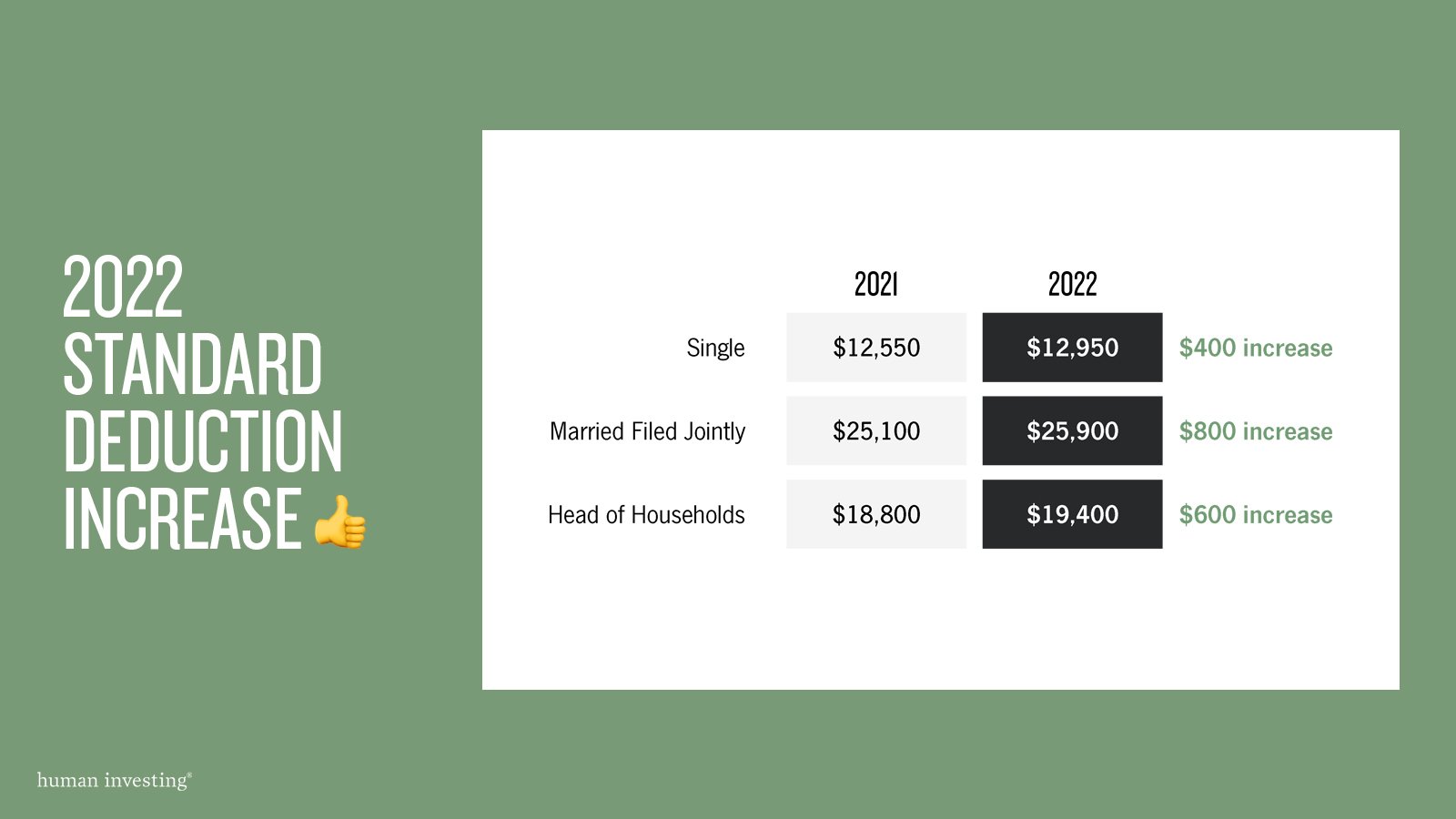
1. The standard deduction will increase for the 2022 tax year. See below for a summary of the increases:

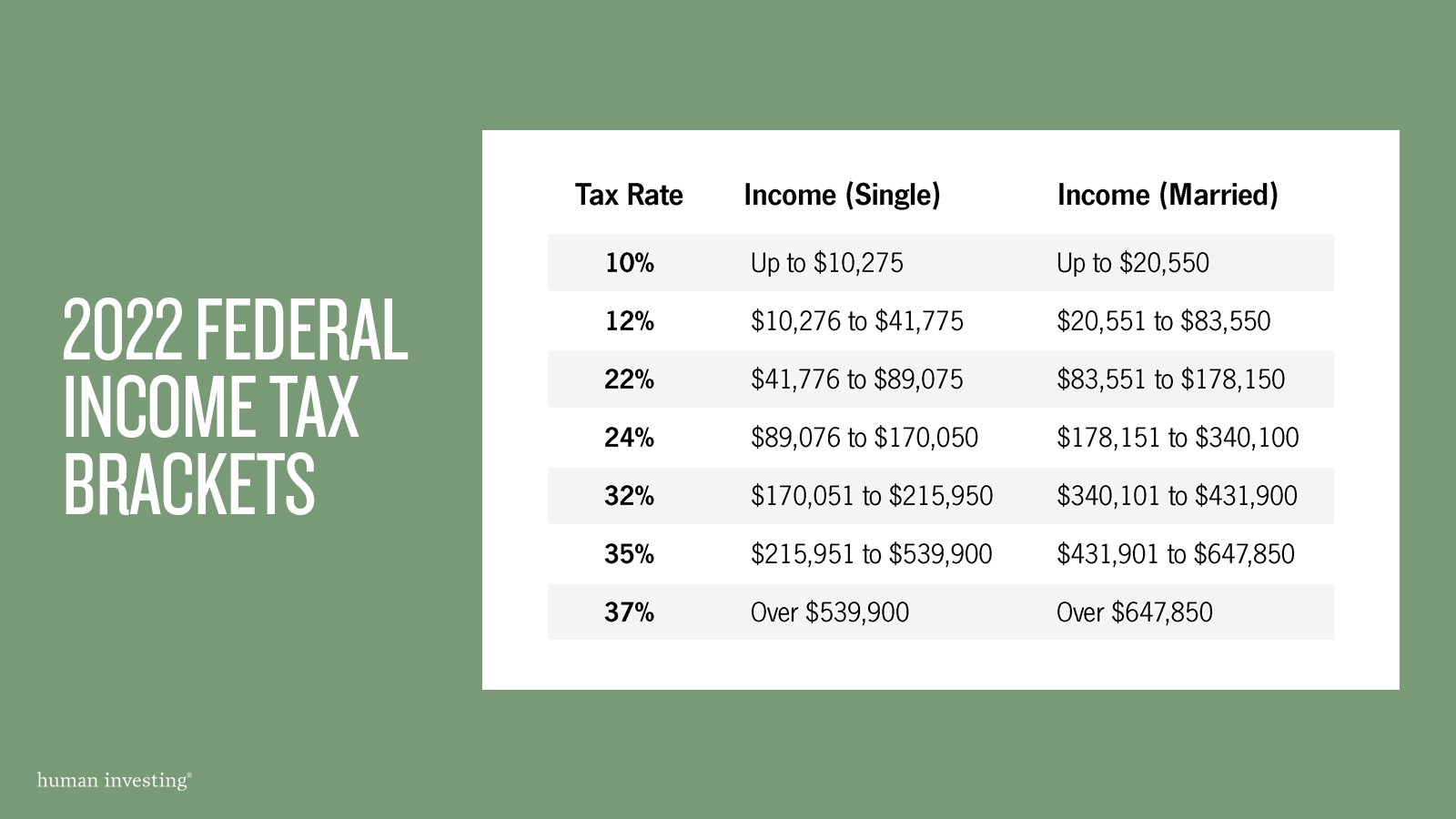
2. Federal income tax brackets will increase 3% for the 2022 tax year compared to 2021. Including a visual of the 2021 federal tax brackets is TMI for this post, but below are the new 2022 tax brackets:

what does this mean for me? it may not be much.

The practical answer is that these 2022 updates are not expected to have a significant impact on your taxes, cash flow, or budget. Both increases are good news for most households, but not life changing. To show how the changes are applied, we included a fictitious example and illustration below.

The academic or technical answer is that the increase in standard deduction means households will have less income subject to taxes, and the income that is subject to taxes will be subject to better tax brackets.

To provide an example of the impact of the 2022 increased standard deduction and 2022 increased tax brackets, read on.

Meet MARTIN & ANGELA

Below is a breakdown of their taxable income and taxes due in 2021 compared to 2022.

As you can see, they reported $100,000 of combined income which is reduced by their pre-tax 401(k) contributions and the standard deduction. Specifically, the standard deduction for married filed jointly is changing from $25,100 to $25,900 in 2022 so their taxable income is less than it was in 2021. Less taxable income puts Martin and Angela on track to pay less federal tax in 2022 than in 2021.

PORTIONS OF YOUR INCOME GET TAXED AT DIFFERENT RATES

Tax brackets calculate the tax rate you will pay on each portion of income. Tax brackets are part of our progressive tax system, which means the tax rate increases as someone’s income grows. As shown on the second image of this blog, there are 7 different federal tax brackets in 2022.

Looking at the image above, you can see that you can split your taxable income to take advantage of the lowest tax bracket. Isn’t it true that Martin and Angela would prefer to have a portion of their income taxed at the 10% rate before moving into the 12% tax bracket? In 2021, the maximum income allowed at the lowest tax bracket of 10% was $19,900. In 2022, the maximum income allowed will be $20,550.

DRUMROLL, PLEASE…

After this exercise is completed for all their taxable income, you can see that their total taxes owed in 2021 is $7,990 compared to $7,881 in 2022. As illustrated above, Martin and Angela will pay $109 less federal taxes in 2022 than they did in 2021. This will be welcomed news, but not a life-changing update when compared to the amount of buzz these two tax changes will generate in the media.

If you have questions about your unique tax situation, please schedule a time to connect with our team. As always, we would love to hear from you!

Disclaimer: this post is for educational purposes and not predictive of your 2022 tax situation. The fictitious example is not a full presentation of a tax filing.

 

Related Articles

S&P Stock Market Performance and Capital Gains Tax Increases
 
wall st.jpg

Many of our blog articles are inspired by conversations we have throughout the week. This article on the S&P 500 stock market performance and capital gains tax increases is no exception. The question we are being asked is, "what do you think is going to happen with the market if capital gains go up?" Our recent response has been, "let us do some research and circle back to you." Here is what we found:

  1. Federal capital gains tax rates are currently near 70-year lows

  2. The proposed bill (House Ways & Means Committee, September 13, 2021) increases the top capital gains rate from 20% to 25% on income above $400,000.

  3. The previously proposed rate was 39.6% but kicked in at $1,000,000 of income.

  4. Table 1 below provides a side-by-side of the recent proposal with current capital gains rates and income brackets.

capital-gains-01-table.jpg

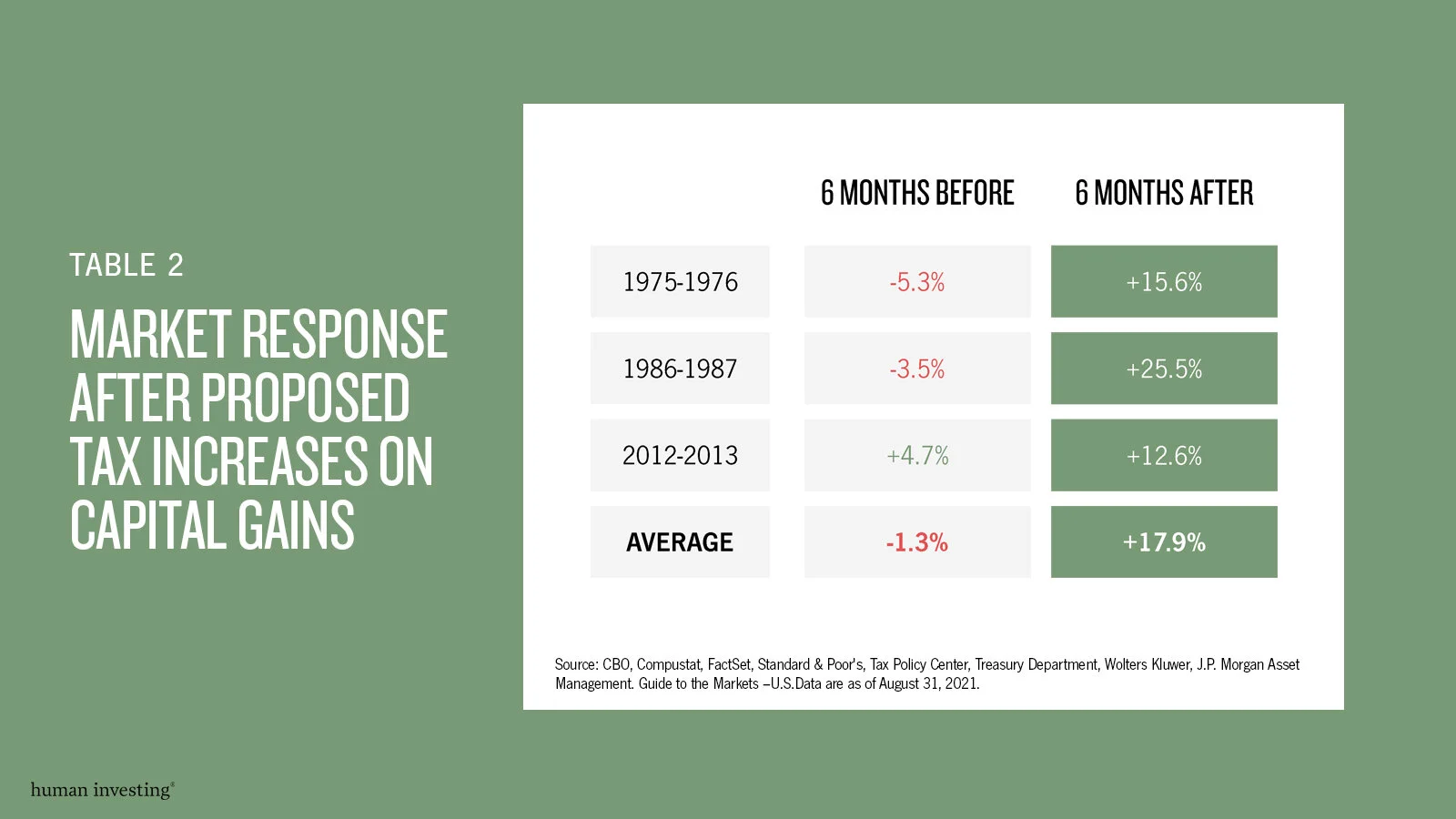
With this background on where rates have been and what is being proposed, we look to address the question, "so what happens to the market when capital gains rates go up?" Table 2 below tells an interesting story. Although there is market anxiety leading up to the proposed capital gain tax change, which results in a negative average return, the six months following the tax increase, the market is favorable. Wait, what? Excuse me for a minute while I reexamine Table 2. Ok, yes, the market is actually up after a proposed tax increase on capital gains.

capital-gains-02-table.jpg

As we have learned from our 25 years advising clients, anything is possible, and history does not always repeat itself. Another lesson learned from experience is that the market does not care about our charts, nor does it give a rip about our attempt to explain what might be. It is nice to know that cap gains tax hikes do not always mean turbulent markets are ahead. In fact, the market has performed above the historical average when a cap gain tax hike is put in place—at least, that is the case for the six months following the increase.


Related Articles

Summary Block
This block has no content yet. Items you add to the page connected to this block will display here.
How to Lower your Tax Burden with Nike Mega Backdoor Roth 401(k)
 
roth401k.jpg

A combination of recent tax cuts, swelling government debt and changing political winds have many concerned about increases in future tax rates.  This has created a growing interest in strategies that can lower and mitigate future income taxes. One such strategy is available and often missed by many Nike employees within their 401(k) plan, known as “Mega Backdoor Roth 401(k) contributions”. While the name often elicits laughter at first, it can in fact be a serious and tangible way to save on future income taxes. 

What is the Nike Mega Backdoor Roth 401(k)?

The Mega Backdoor Roth 401(k) provides the ability to make additional tax-advantaged contributions to the Nike 401(k) plan above and beyond the typical employee limits of $19,500, plus catch-up contributions of $6,500 for ages 50+ (2020).  The additional contributions are in the form of “after-tax” contributions of up to 3% of income.  This applies to base salary and any PSP bonus. The total contribution amount will have a cap based on annual IRS limitations: $8,550 for 2020 and $8,700 for 2021.  The after-tax contributions can then be converted to Roth dollars within the plan, which allow them to grow tax-free and be distributed tax-free* in the future. 

How to Execute the Strategy

The process starts by electing to make after-tax contributions within the Nike 401(k) plan of up to 3%.  Once the after-tax contributions have been made, it is important to then convert these contributions into tax-free Roth funds* by periodically electing to do an “In-Plan Roth Conversion”.  To complete the In-Plan Roth Conversion, the employee will need to call the Nike 401(k) phone line and make the request verbally.  Be prepared to spend 10-15 minutes on the phone for the conversion process to be completed.     

The In-Plan Roth Conversion is important because the growth of the after-tax contributions will become taxable as ordinary income upon distribution if the conversion is never completed. However, if you convert those funds into Roth dollars, then the future growth and distributions will be tax-free*. We recommend that the In-Plan Roth conversion be completed on a periodic basis to make sure that the funds are converted before any significant growth occurs.  Any growth of the after-tax contributions at the time of this conversion will be taxable income, but if completed regularly, the growth and subsequent tax is typically minimal.  Ideally the conversion would be completed after every payroll or monthly, but practically speaking, one to two times per year should be sufficient to effectively execute the strategy.

Is this Strategy Right for You?

Nike’s robust benefit options can leave many unsure of which savings plan is best for them.  Whether it is 401(k) contributions, ESPP, Deferred Comp or Mega Backdoor 401(k) contributions, there are only so many dollars available out of a paycheck.  The order of priority is different for each person based on their personal tax situation, time frame at Nike, and plans for the future.  We believe that the best way to determine the priority of one plan over another is through financial planning projections. Through the financial planning process, we take your financial considerations today and project them into the future. While this does not predict the future, it does allow you to measure the impact of each savings option and find the optimal course of action.

Solution to Cash-Flow Problem

A potential solution to the cash-flow challenge of participating in the Mega Backdoor Roth 401(k) contributions is to repurpose other funds.  Available options that we have identified include existing after-tax accounts like Individual, Joint or Trust investment accounts, extra cash in the bank, or cash that you have from selling and diversifying out of Nike RSUs, ESPP, or Stock Options.  You can use these accounts to supplement your cash flow while the Mega Backdoor Roth contributions are coming out of your paycheck. 

Lower Your Tax Burden

While this strategy may not make sense for every Nike employee, it is a unique opportunity to get significant dollars into a Roth account that might not otherwise be available.  Whether or not income taxes actually do increase in the future, the Nike Mega Backdoor Roth 401(k) is a very effective way to lower your long-term tax burden and should be considered as part of your financial plan.

If you want to know more about how to take advantage of the Nike Mega Backdoor 401(k), please get in touch.

You can schedule time with me on Calendly, e-mail me at marc@humanvesting.com, or call or text me at (503) 608-2968.

*Assumes first Roth contribution made at least 5 years before withdrawal and withdrawals occur after age 59½.


Related Articles

A Bird’s Eye View of Today’s Tax Rates

“In this world nothing can be said to be certain except death and taxes” – Benjamin Franklin.

HERE’S A SNAPSHOT OF HISTORICAL TAX RATES

Historical Highest Marginal Income Tax Rate.jpg

You can compare 2020’s highest marginal income tax rate to years dating back to 1913. Although this chart is not an all-inclusive story about someone’s individual tax situation, it does suggest that overall tax rates are lower today than they have been in the recent past.

How to Take Advantage

The current tax rates are locked until December 31, 2025, unless there is an update to the Tax Cuts and Jobs Act (TCJA). Without a crystal ball, we do not know where tax rates are heading. However, as this image illustrates, we do know tax rates can increase in the future. 

One way to take advantage of today’s low tax rates is to utilize accounts like a Roth IRA or saving Roth inside your 401k plan.

Do you have questions?

We know that interpreting the tax code is an unpleasant and complicated experience. We have a team of CPA’s at Human Investing who are ready to answer any questions you may have.


Related Articles

Charitable Gifting at Nike - Maximizing the Nike Donation Match & Lowering Taxes
 
photo-1544639044-4f142ceb6a2b.jpeg

As we approach the end of 2019, a common topic for discussion with our Nike clients is around planning for charitable contributions.  Nike employees have many factors to consider if they are hoping to maximize both the Nike Donation Match program and the tax benefits of charitable contributions.

MAXIMIZING THE NIKE DONATION MATCH PROGRAM

In order to maximize the impact to your chosen charity, the first step is to find out if it is qualified for a match.  To check the qualified donation match list, simply log into the Nike Give Your Best website: https://nike.benevity.org/user/login.

Next, consider the matching rules and limitations outlined below.

Nike Donation Match Details:

  • Dollar-for-dollar match for charities on the qualifying list

  • Double match for donations to charities aimed at youth sports 

  • Maximum donation match of $10,000 per calendar year

  • Grant of $10/hour for volunteer hours up to a maximum of $1,000/year

Additionally, Nike has participated in Giving Tuesday, which was Tuesday, December 3rd this year.  If you make donations on Giving Tuesday, Nike will make a double match on all qualifying charities.  Thus, planning to make your donations on Giving Tuesday could be a great way to maximize the benefit to your charity.

Once you determine that your charity qualifies for the donation match and the amount you want to give, the next step is to decide how to fund the donation.
WAYS TO FUND THE DONATION

The most common method of funding a donation to charity is by contributing cash.  However, a frequently overlooked opportunity is to make contributions from appreciated investments.  For Nike employees this is typically some form of Nike stock.

There is an additional tax benefit to using appreciated investments for your donation.  All appreciated investments would normally be subject to taxes upon selling the investment, but this can be avoided/minimized if it is first transferred to and then sold by the charity.   The charity receives the investment, sells it immediately and the cash proceeds are used for the charitable cause without tax consequences. 
Since Nike employees and executives typically own many different types of stock, we will explore the advantages and disadvantages of each type in addition to outside options.

  1. Nike Stock - This is Nike stock purchased individually, outside a Nike employee benefit.  This can be a good option depending on how long you have held the stock.   The entire market value of the stock can be tax-deductible if considered long term gains (i.e. held for longer than one year).  If the stock is held less than one year you only receive a tax deduction on the “cost basis,” which is the original amount you invested.  If this stock has the most growth (largest gain) of all your investments, then it could be one of the most tax-advantageous options for a donation.

  2. Nike ESPP – Nike stock purchased through ESPP has a different set of tax implications and considerations.  Nike allows you to purchase the stock at a 15% discount and that discount is taxed as income whenever you sell the stock.  The discount is also taxable upon donating the shares to charity.  Additionally, the holding period to get the best tax treatment and receive a full deduction for the full market value is longer than normal Nike stock as described in the first scenario.  ESPP shares need to be held for at least 2 years from the grant date and at least 1 year from the purchase date to receive the optimal tax benefits.  Depending on the amount of growth in this stock, it may not be the best stock to utilize since the 15% discount will still be taxable upon the sale and the holding period rules may be challenging to track.

  3. Nike Vested Restricted Stock Units (RSUs) and Restricted Stock Awards (RSAs) – RSUs and RSAs generally vest over a 3 or 4-year period.  Once this stock is vested, the stock becomes just like normal Nike stock (see option #1) and therefore should be held for longer than one year before donating it to a charity.  Since the vested shares become the same as option #1, the benefit in donating these shares depends on how much it has grown.  As with other stock, the larger the gain the better as you will avoid higher taxes if used as a donation.  Unvested RSUs and RSAs are not available for donation to charity.     

  4. Nike Stock Options – Stock Options are non-transferable and not available to donate to charities.  You may, however, exercise the option and either transfer the exercised stock or cash proceeds to the charity.  This method does not offer a significant tax benefit since income tax is paid on the option exercise.  If you exercised stock options and held them as stock for a long period of time with significant growth, then it could become a beneficial method.

  5. Stock in a Different Company (i.e. Amazon, Google, etc.) – Nike employees that have worked for a publicly-traded company in the past typically own sizable amount of stock from their previous employer.  This can be a good way to divest of that stock and diversify without having to pay additional taxes when sold.

  6. Other Stock/Mutual Funds/ETFs – If you have other outside investments those can be also be an effective gifting option. These follow the same holding period rules as option #1.  Again, comparing the amount of gain in these investments versus other types of Nike stock is important in evaluating the optimal gifting and tax benefit option.

Once you have made the donation with one of the options above, make sure that you receive a receipt and submit it through the Give Your Best platform within 90 days of the donation.

Other Considerations

  • Be mindful of the Nike Blackout period.  If you are an executive that is subject to this restriction, when selling Nike stock during certain times of the year you will want to make sure that you do not donate Nike stock during the Blackout Period.

  • Tax Deductibility of Charitable Contributions: Charitable tax deductions changed significantly in 2018 with the recent tax law change from the Tax Cut and Jobs Act of 2017.  Be sure to check with your CPA or Financial Planner to see if your charitable contributions are tax-deductible for this year.  If they are not currently tax-deductible, you still may be able to take advantage of the tax deduction using a strategy known as “bunching.”  See the Human Investing blog post for details on the “bunching” strategy HERE.

  • In addition, based on your total income, there may be limitations to the amount of your deductions in any given year.  Limitations are determined by your Adjusted Gross Income on your tax return. If you cannot take the full tax deductions now due to this limit, those deductions can be carried forward for up to 5 years in the future.

As we have outlined above, there are many options for Nike employees to consider when marking charitable gifts to the organizations that are important to them while at the same time maximizing the tax benefits.  These strategies can also be an effective way to diversify your exposure to one stock without having to pay a significant tax bill in the process. 

If you have questions or want to know more about how to plan your charitable giving as a Nike employee, you can schedule time with me on Calendly below, e-mail me at marc@humanvesting.com, or call or text me at (503) 608-2968.


Related Articles