Posts in Current Events
2024 Q3 Economic Update: Equity Risk Premiums


We’re all familiar with the risk-reward tradeoff: Do I risk injury to compete in a sport I love and feel fulfilled by? Do I risk leaving a stable job to pursue a career that excites me? It’s not surprising that this everyday phenomenon is also very present in our investment portfolios.

For example, there are three asset classes that an investor typically includes in their portfolio: cash, bonds, and stocks. Of the three, stocks can generate the greatest return but also merit the highest risk. On the other hand, a risk-free investment guarantees a future return with essentially no possibility of loss. An example of a risk-free investment is US Treasury bills, as they are backed by the full faith and credit of the US government. If investors are taking on more risk by investing in stocks, they want to know their efforts are worth it. Enter the equity risk premium.

Understanding the Equity Risk Premium

The equity risk premium measures how much more an investor may receive in returns when investing in stocks versus a risk-free investment like T-bills. Basically, it puts a number to the term, “the higher the risk, the higher the reward”.

As we’ve previously written, the fear of financial loss causes many investors to be overly cautious about their investments. ”Myopic loss aversion” is when focusing on avoiding short-term losses in equities leads to poor long-term allocation decisions.  Incorporating bonds into your investment portfolio can serve as  a stabilizer, reducing the payback period to see your portfolio recover from downturns. Many investors own some combination of stocks and bonds to ensure the risk-reward tradeoff is an acceptable range for them, either emotionally or financially (or both). Because of the fear of loss, many investors either avoid or under-weigh equities. How significant is the difference between owning stocks (highest risk), bonds (lower risk), or cash (no risk)?

Risks associated with investing in Stocks

So, why do those who invest in stocks generally receive a greater return? Because of the greater risk they take on by doing so, such as:

Unpredictability: Stocks do not offer fixed payments at specific intervals like bonds.

When an investor buys a bond, they are essentially lending money to a company or a government (see our Bonds 101 blog for a primer on bond basics). Like any loan, bonds have terms outlining specific payment amounts and dates. These payments, known as coupons or interest, are obligatory, with insolvency being the only reason for non-payment.

Conversely, stocks represent ownership in a company and entail greater uncertainty. Returns for stock investors can come in the form of dividends distributed by the company or by selling shares at a higher price in the future. Unlike bond payments, dividends are not mandatory and can be suspended unexpectedly, as seen during the onset of the COVID-19 pandemic. Additionally, the growth of dividends may not meet expectations, even for well-established companies commonly known as “blue chip” stocks (such as Coca-Cola, McDonalds, or Microsoft). Even large and stable companies face challenges that can cause fluctuations in their stock prices. Due to the unpredictability of stock payouts in terms of amount and timing, investing in stocks is inherently riskier and more volatile. As a result, investors demand higher returns from equities as compensation for bearing this additional risk.

Risk of Total Loss: Stockholders can see their investment go to zero more easily than bond investors.

Over the last thirty years, bondholders have frequently recouped 40% or more of their initial investment during bankruptcies, although exact recovery rates can vary[1]. In contrast, equity owners seldom receive any compensation in bankruptcy. The harsh reality is that most companies fail in the long term, and many of these companies made interest payments on bonds throughout their existence, while equity investors ultimately see their investments become worthless. Regardless of whether you’re investing in stocks or bonds, owning a broad index fund provides essential diversification. Owning a basket of companies ensures that even if one fails, the other companies that continue to grow offset your losses so you’re never experiencing a complete wipeout.

The Equity Premium at Play Can Sometimes be a Jackpot

First, a quick note: All return figures mentioned below are based on real returns, or returns after adjusting for inflation. Real returns are the most accurate comparison across different asset classes, reflecting changes in purchasing power over time. Although nominal returns are widely used in the financial world unless otherwise specified, they do not account for inflation and are therefore less accurate in this example. All returns are based on rolling 12-month periods, meaning this is the return if you held the investment for 12 months.

Table 1 - Real returns, rolling 12 month periods - (1926-2023, adjusted for inflation)[2]

When we look at the real returns for the last 97 years between cash, bonds, and equities, it’s clear stocks deliver the highest returns, albeit with the most downside risk. Cash is undeniably the safest asset class but struggles to outpace inflation. Bonds tend to be closer to cash than equities in terms of their risk-return profile.

The Long-Term Power of the Equity Premium for an Investor

While stocks undoubtedly offer the highest returns, it’s essential to grasp their long-term value to investors. To demonstrate this, let’s outline a hypothetical scenario:

  • Assume three investors each save $5K annually for 40 years for retirement for a total contribution of $200K per investor.

  • We’ll assume each investor owns only a single asset class (cash, bonds, or stocks) for all 40 years of saving.

  • We’ll use the real return averages from Table 1 for each asset class.

  • We’ll utilize the commonly cited 4% annual withdrawal rate[3] for retirees to determine how much income the portfolio provides in retirement annually.

Table 2 – Portfolio values assuming real returns

The difference in portfolio value, and resulting income possible in retirement, is significant. A pure equity investor ends up with nearly six times the spending power of a pure bond investor after 40 years.

While equity market volatility can be unsettling, exposure to equities can significantly reduce the amount of savings required to achieve your financial goals such as funding retirement. It’s critical to ensure your equity allocation is sufficient to facilitate asset growth yet small enough to prevent panic during market downturns. Striking this balance depends on your emotional risk tolerance and financial capacity for risk.

Determining the optimal equity and bond allocation requires careful consideration of factors such as taxes, time horizon, and liquidity needs. If you are seeking guidance in navigating this complex process, please reach out to us at 503-905-3100, or email hi@humaninvesting.com to start the conversation.

Sources

[1] https://www.spglobal.com/ratings/en/research/articles/231215-default-transition-and-recovery-u-s-recovery-study-loan-recoveries-persist-below-their-trend-12947167

[2] These returns are based on an index, do not represent actual investment results, and are not guarantees of future results.

Data based on rolling 12 month returns, with monthly return intervals.

Equity returns utilize the Ibbotson SBBI Large-Cap Stocks Total Return for Jan 1926 to Sep 1989 (data courtesy of CFA Institute), and S&P 500 TR for Oct 1989 to Dec 2023 (data courtesy of YCharts).

Bond returns utilize the Ibbotson SBBI US Intermediate Term Government Bonds Total Return for Jan 1926 to Apr 1996 (CFA Institute), and Bloomberg US Aggregate for May 1996 to Dec 2023 (YCharts).

Cash returns utilize the Ibbotson SBBI US (30-Day) Treasury Bills for Jan 1926 to May 1997 (CFA Institute), and Bloomberg US Treasury Bills 1-3 Month for Jun 1997 to Dec 2023 (YCharts).

Inflation rates for calculating real returns are based on the Ibbotson SBBI inflation for Jan 1926 to Jan 1947 (CFA Institute), and the Consumer Price Index (CPI) for Feb 1947 to Dec 2023 (YCharts).

[3] https://www.financialplanningassociation.org/sites/default/files/2021-04/MAR04%20Determining%20Withdrawal%20Rates%20Using%20Historical%20Data.pdf




Related Articles

Q2 2024 Market Note: Preparing for the Presidential Elections & Fed Policy


Between Fed Policy and the Presidential election, 2024 has all the makings to derail investors. While these factors introduce volatility and uncertainty, historical insights and a sound financial plan can guide those navigating the financial markets.

The year began promisingly, with the market reaching all-time highs in the first quarter of 2024. However, the start of the second quarter has highlighted the inherent unpredictability of the financial landscape. Beneath these surface-level fluctuations lies a geopolitical landscape marked by pivotal events that demand attention.

Fed policies will continue to impact market dynamics

The Federal Reserve's stance on interest rates emerges as a significant factor shaping market sentiment and performance in 2024. Speculation about potential adjustments in interest rates can significantly influence investor behavior and market dynamics. Lower interest rates can stimulate economic activity and boost equity valuations. However, uncertainties surrounding the timing and magnitude of such policy shifts add complexity to the investment landscape. At the beginning of the year, the Fed indicated it might cut rates at some point in 2024. But with inflation remaining higher than expected, it's now anticipated that there will be fewer rate cuts (if any) than initially predicted.

The "cost of admission": lessons from decades of market turbulence

Regardless of the headlines, it's fundamental to understand that the path to stock market growth is paved with bumps in the road. The following chart from JP Morgan nicely illustrates how volatile the stock market can be over short periods of time. In the chart, grey bars represent the returns for each calendar year, while red dots show the intra-year declines.

Looking back to 1980, the S&P 500 experienced an average sell-off of 14.2%, while ending positive in 33 of the 44 years measured. This inherent market fluctuation underscores the “cost of admission” for those seeking long-term gains through stock investments.


Insights from past elections: market performance amid political uncertainty

In most years, the stock market experiences growth, and this pattern holds true for presidential election years as well. However, investors should be prepared for increased volatility due to market uncertainty. Over the past four decades, election years have witnessed heightened market volatility fueled by the ambiguity surrounding political transitions. Despite this turbulence, historical data illustrates the market's resilience.

The S&P 500 has delivered a median total return of 11% over the past ten election cycles, inclusive of the 2008 Global Financial crisis. Though slightly lower than the median return of 15% across all years since 1984, this resilience showcases the market's ability to weather political flux.

Despite the uncertainty surrounding elections, historical data indicates that remaining invested through the election has proven advantageous. Once election results are announced, returns often speed up, usually boosting equity valuations and prices post-Election Day regardless of election outcome.

Leveraging a well-crafted plan for stability

During market turbulence driven by factors such as Federal Reserve policies and elections, a well-crafted financial plan acts as a stabilizing force. As we journey through 2024, it's essential to acknowledge that fluctuations are inherent in investing. Stress-testing your financial plan against various scenarios becomes vital, providing resilience in the face of uncertainty. While headlines may evoke strong emotions, maintaining a long-term perspective grounded in a robust plan aids in navigating choppy waters.

As 2024 unfolds, investors are reminded to stay committed to their financial plan's principles. By drawing on historical insights and adhering to a clearly defined strategy, investors can confidently maneuver through market volatility, knowing that their financial plan serves as their guiding star, directing them toward their long-term objectives.

Sources

  1. Human Investing. (2024). 2024 Q1 Economic Update: Politics and the Market. Human Investing Blog. Retrieved from https://www.humaninvesting.com/450-journal/q1-2024-economic-update

  2. Goldman Sachs. (2024, February 1). Global Macro Research. Retrieved from [https://www.goldmansachs.com/intelligence/pages/2024-the-year-of-elections-f/report.pdf]

  3. J.P. Morgan. (2024). Guide to the markets: March 31, 2024.


Related Articles

2024 Q1 Economic Update: Politics and the Market


Welcome to 2024

It’s an election year and America will vote in November for a new Congress and President. Regardless of the election outcome, some investors will be pleased, while others will be disappointed. This article will help investors understand how the markets have been influenced when different political parties take control of both Congress and the Presidency. Looking at data from 1926 through 2023, the main conclusion is straightforward:

Over time the markets tend to rise, regardless of which party controls the White House or Congress.[1]

What impact does the President have on the stock market?

Democratic presidents have overseen slightly higher stock returns compared to Republicans. However, this difference is minor and not considered statistically significant. The variance in stock returns under different political parties can be attributed to the random chance of who happened to be in power at a given time. The reality is the US economy is vast and intricate, making it challenging for any individual, even a powerful figure like the President, to completely control its direction.

A recent example is the presidential election of 2016. The general expectation was for Hillary Clinton to win. When Donald Trump unexpectedly secured victory, initial market reactions led to a decline. By the following day’s market close, markets had not only recovered from the dip but ended up positive on the day. It’s hard to know how the market will respond to unexpected information, and it’s equally difficult to predict what impact a President may have on the stock market.

What impact does Congress have on the stock market?

On the other end of the federal government, a Republican-controlled Congress has typically overseen the best stock market returns. The differences are minor enough that there’s no certainty which party controlling congress (or a split) is best for the stock market.

Congress can be the more impactful part of the federal government in the long run. Executive actions are easily overridden day one by a President from the opposing party taking office. Legislation tends to be more enduring due to the requirement for a larger number of people to be involved. It’s important to note that the effects of legislation may take years to become apparent. This time lag makes it extremely challenging to pinpoint and attribute specific policies to their respective impacts on the ever-evolving dynamics of the market.

What about the White House and Congress combined?

When you widen your lens to encompass both the White House and Congress, the narrative remains consistent. Markets tend to go up irrespective of political control.

Regardless of the federal government’s control scenario, markets go up more often than they go down

As the 2024 elections unfold, we urge investors to remember that investing is a marathon, not a sprint. Position your portfolio to be successful in the long run, enabling it to weather unexpected changes from any source. Both parties have experienced periods of positive and negative returns while in power. Despite the inevitable changes in government, companies exhibit resilience and innovation, consistently discovering avenues to yield returns for their investors. In the intricate dance of politics and markets, a steadfast and forward-looking investment approach proves to be the key to enduring success.

Sources:

[1] Equity returns are monthly returns for the Ibbotson SBBI US Large-Cap Stocks Total Return for Jan 1926 thru Oct 1989 (data courtesy of the CFA Institute & Morningstar Direct), and the S&P 500 Total return for Nov 1989 thru Dec 2023 (data courtesy of YCharts)

Data for which party controlled both houses of Congress and the presidency is from the history.house.gov website (https://history.house.gov/Institution/Presidents-Coinciding/Party-Government/)

Changes to Congress and the Presidency are assumed to occur Jan 1st of odd years. A split Congress indicates that each party controls either the House or Senate, but neither party controls both.

Appendix: Bonus Chart 📈


Related Articles

2023 Q4 Economic Update: Labor’s impact on the economy


In recent months, I’ve been pondering the US labor force and how it has changed in the last five years. Amid the ongoing conversations surrounding inflation and the Federal Reserve's (aka The Fed) recent decisions to raise interest rates to manage inflation, I don’t want to neglect the other part of The Fed’s dual mandate: the dynamics of unemployment and the labor force. Prior to COVID-19, unemployment was at 3.5%, the lowest rate in the last 50 years. Today unemployment is around 3.8%, and has been 4% or lower since December 2021, significantly below the median unemployment of approximately 5% the US has experienced over the last 25 years. Since March 2021, job openings have consistently surpassed the number of job seekers.

Unemployment is often considered an indicator of an economy’s health. Like inflation, you want some unemployment, but not too much. Too high unemployment indicates a weak economy. If unemployment is too low, high inflation becomes a concern. Businesses seeking to grow may be constrained because of a lack of workers, limiting overall economic growth.

Strong employment is a major reason why 2023 has not experienced the recession that many feared at the beginning of the year. I wanted to delve into the reasons behind the tight labor market, what can be done about it, and what this signifies for the overall economy.

Labor’s impact on the current economy

The fundamental assumption in most economic models is that production is constrained by two primary inputs: labor (i.e. workers) and capital (i.e. technology). While technology has yielded significant advances in productivity, the necessity for a workforce to drive economic growth remains. A shortage of labor would imply slower economic growth, potentially resulting in reduced stock market growth.

Concerns persist regarding automation displacing jobs. Some have even proposed the implementation of a universal basic income due to the scarcity of employment opportunities resulting from automation (as exemplified by former presidential candidate Andrew Yang, who made this a central theme of his campaign). A variation of this concern has been present for over a century.

The latest development in automation centers around AI potentially increasing productivity to the extent that we might encounter a surplus of labor. Numerous case studies illustrate that technological change does not always materialize as successfully or rapidly as initially projected. A decade ago, there was much buzz about how autonomous cars were poised to revolutionize the world. Substantial progress has been made, but the challenge of perfecting driverless cars has proven more intricate than many had anticipated. (An example is Moral Machine, where you weigh in on how a self-driving car should navigate situations where the car must choose who to protect in an unavoidable collision).

Another illustration can be found in the excessive optimism at the peak of the dot-com bubble. While the internet did transform the way we work and introduced new efficiencies, it took significantly longer than what people in 1999 had envisioned. Forecasting the timeline for technological change impacting worker productivity is challenging.

If I had to guess, I would anticipate that in the near term (i.e. the next 5 years), we will continue to experience a tight labor market that will be a headwind to growth, for the economy and the stock market.

Retiring baby boomers present a significant challenge

By 2030, the youngest Baby Boomers will turn 65. The average American retires at 64. These retiring Baby Boomers possess the most expertise and would ideally be succeeded by Gen X workers with slightly less experience. However, Gen X is too small of a generation to fully replace the baby boomers, and Millennials & Gen Z broadly lack the experience necessary to fully replace the skills of retiring baby boomers.

This is backed by recent projections by the Bureau of Labor Statistics (BLS), showing that total employment is expected to grow by only 0.3% annually for the next decade, with a significant constraint being the slower growth of the working age population. Slowing growth in labor likely means slowing growth in GDP and stock prices.

Furthermore, there has been a consistent decline in the labor force participation rate over time. This is a measure of everyone 16 and older who is not in the military or an institution (due to criminal activity, mental health, or aging). Part of this reflects the aging population. As the proportion of the population beyond retirement age increases, a smaller segment of the population remains in the workforce.


How can we increase labor?

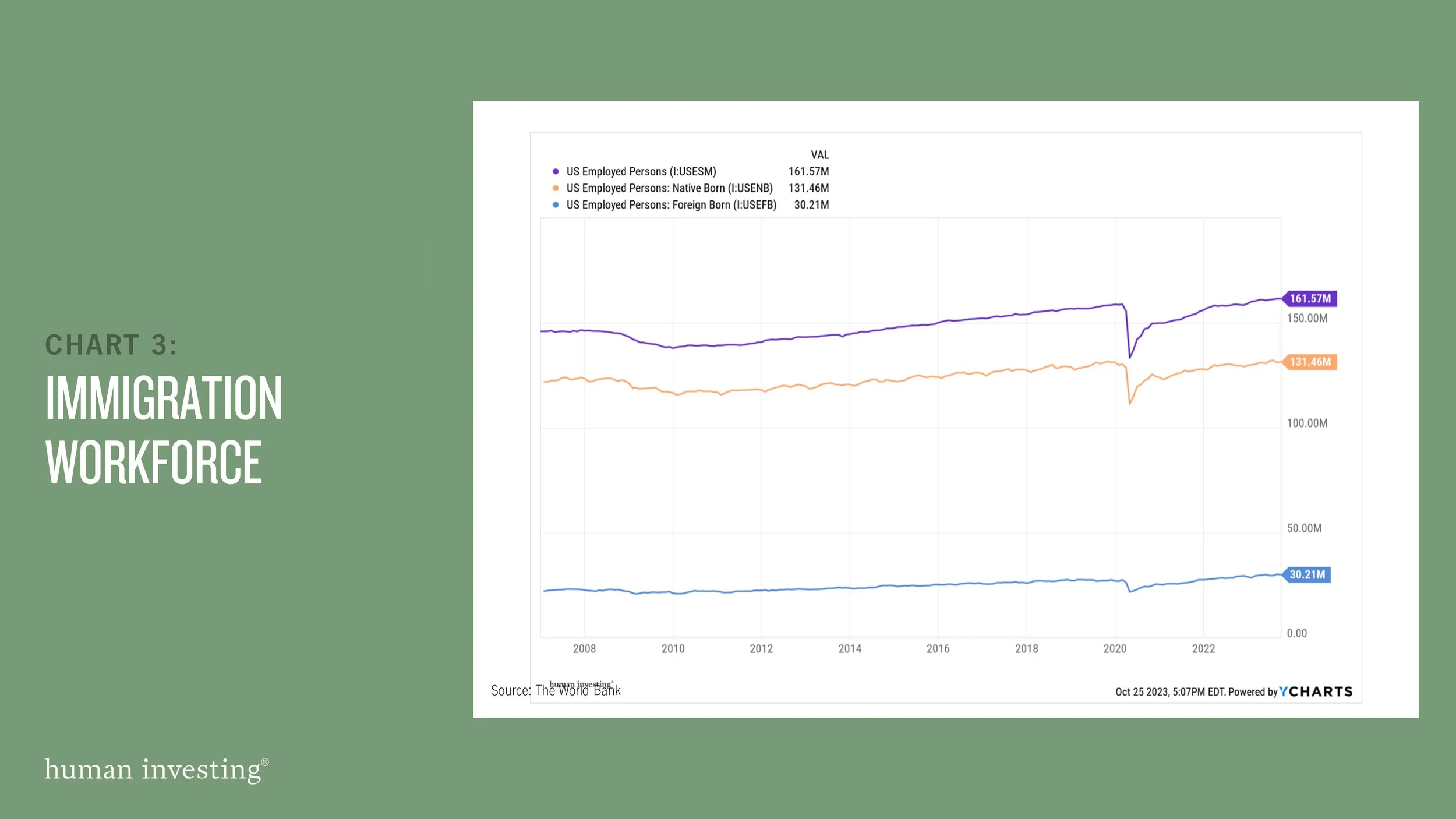
Gen Z is entering the workforce, but as a generation, they are too small to completely replace retiring baby boomers. Producing more working-age adults takes at least 16 years and 9 months, and the US birthrate has been below the stable replacement level of 2.1 for most of the last 50 years. If the US wants to sustain long-term population growth, and consequently, workforce expansion, it must either depend on immigration or find ways to boost the birth rate.

Implementing a policy permitting increased immigration could boost the size of the workforce in America. However, this is a politically contentious issue, and the legal framework around immigration is too uncertain to make reliable long-term predictions. Overly restrictive immigration policy could lead to a labor shortage, and too permissive immigration policy could cause a labor surplus. Foreign workers constitute approximately 20% of the US workforce.

A tighter labor market has some benefits for workers

The scarcity of labor translates into more choices when seeking employment and enhances the bargaining power of job seekers. Companies will have to consider their recruitment and retention policies to ensure they have the workers required for optimal performance. US wages and salaries are remaining above inflation, showing workers ability to demand higher compensation.

A tighter labor market plus higher wages could equal higher inflation rates

However, higher wages also entail increased costs for companies, and the allocation of these costs, whether to customers or shareholders, may result in higher inflation or reduced earnings. To counter inflation, the Federal Reserve has been increasing and maintaining higher interest rates. Many are apprehensive that the tight labor market (associated with demand-pull inflation) and ongoing post-COVID supply chain challenges (linked to cost-push inflation) could make achieving the long-term target of 2% inflation more challenging.

In Q3 2023 we observed inflation rates increasing from just below 3% in June to 3.7% in September. Many consider unemployment and inflation to have an inverse relationship. A tighter labor market may necessitate the Federal Reserve to persist with a more extended and aggressive tightening policy to manage inflation. If the Federal Reserve becomes overly aggressive in its tightening efforts, the concerns that led many to anticipate a 2023 recession could materialize.

All of this hinges on the tight labor market persisting. Technological advancements have the potential to enhance productivity to a level where a smaller workforce can achieve more and sustain economic growth. Modifications in immigration policy could either introduce a new source of workers or further reduce the size of the workforce.

In the long run, successful companies will adapt to the new environment and thrive. A diversified portfolio will continue to capture the growth of the companies that excel. We encourage investors to be prepared for a myriad of reasons to be nervous, and understand given time the market will figure things out and continue to grow.


Related Articles

2023 Q3 Economic Update: What’s behind the market rally


What recession?

As prognosticators assessed markets and the economy in the beginning of 2023, the expectation for many was a tumultuous year,  with a substantial likelihood of a recession. Now, nearly two-thirds of the way through the year, the S&P (Standard & Poor) 500 has surged by 18.73% through the end of August. Real GDP (Gross domestic product) has maintained steady growth, with quarterly increases of at least 2% since Q3 2022. Inflation, which began the year at a daunting 6.4%, has receded to 3.18%, still above The Fed's 2% long-term target but showing a marked improvement.

What changed given the gloomy expectations for 2023 at the start of the year? The biggest unknown was the impact of The Fed’s decision to continue raising interest rates. The expectation was that The Fed raising interest rates to cool inflation would cause an economic recession. We’ve even seen rising rates play a role in multiple banks failing earlier in 2023, but those events haven’t triggered any distress.

We’ll break down the top themes for why we’re seeing the markets and economy continue to power through.

Theme #1: Strong job market

Inflation has gone down, but GDP growth remains positive, and unemployment remains low. There are still 3 million more job openings than job seekers, and few were expecting The Fed to get this far on inflation without dipping the economy into a recession. Even experts have a difficult time accurately predicting where the markets and the economy are going.

Theme #2: ‘Soft landing’ of interest rate hikes

In contrast to the substantial interest rate hikes witnessed in 2022, the changes in 2023 have been modest. A significant contributor to the slowdown in interest rate hikes was the decline in inflation during the latter part of 2022, which has persisted into 2023. Consequently, The Fed didn’t need to enact as many rate increases, or do so as rapidly as they did in 2022.

Theme #3: Surprising growth from S&P 500 companies

The S&P 500’s rise has a couple of factors going for it. While 2022 saw a decline in earnings per share for S&P 500 companies, 2023 has witnessed earnings growth, with expectations that growth will continue. Analysts are feeling increasingly optimistic that companies will find a way to bolster earnings amidst a higher interest rate environment.

The other piece of the puzzle is the exceptional performance of the largest stocks within the S&P 500 this year. The S&P 500 is a market cap weighted index, meaning that each stock is weighted based on how large the company is. This means AAPL has a bigger weight than Home Depot, and AAPL being up 10% would increase the S&P 500 performance more than HD (Home Depot) being up 10%.

In 2023, returns have been concentrated in a few high-performing stocks. Put differently, only 28% of stocks in the S&P 500 have outperformed the index. This highlights the dominance of a handful of top performers in 2023. It’s worth noting 61% of stocks in the S&P 500 have achieved positive returns for the year, indicating favorable performance across the stock market.

Source: Data for this paragraph is based on using IVV (iShares Core S&P 500 ETF) holdings. Positions were all verified to be held 12/30/2022 and 8/24/2023 to ensure consistency of constituents. Average returns assumes equal weighting of the positions. Top 10 holdings are based on 8/24/2023 weighting: AAPL, MSFT, AMZN, NVDA, GOOGL, GOOG, META, BRK.B, TSLA, UNH. Jan-Aug performance data courtesy of YCharts as of 8/31/2023 market close.

Theme #4: Mid and small sized companies are not far behind

Many talk about the S&P 500 as though it represents the entire stock market. However the S&P 500 represents the largest companies in the US (typically $14.5 billion and greater), leaving out companies considered mid-sized and small.  The mid and small parts of the US markets have been lagging, still positive returns but not as high.

Source: All data courtesy of YCharts. Assumes S&P 500 for US Large, S&P 400 for Mid, S&P 600 for Small, and S&P 1500 for Total Market (blend for all). Uses Value & Growth versions of benchmarks respectively.

Predicting short-term MARKET outcomes continues to be difficult

Short-term value oriented investors may be frustrated to see their performance lagging the broad market. Alternatively, longer-term investors recall seeing a significant benefit in 2022 by experiencing less negative returns than the broad market or growth stocks. You are still positive from the start of 2022 to the end of August 2023. Growth and blend investors are still waiting to recover from the downturn. Trying to time when value or growth will outperform is not recommended. Find an investment style that suits your risk tolerance and financial plan, and be prepared to stick with it for the long haul despite periods of under or over performance.

The year 2023 so far serves as a compelling illustration of how stocks can still generate positive returns even in the face of grim expectations. It is also a great reminder of how difficult accurately predicting the economy or the markets is. The outlook for the equities market is rarely all sunshine and rainbows. Stock market volatility means that short-term corrections are always on the table. There are and always will be valid concerns that could lead to a downturn. If you are choosing a particular tilt in your investments, be prepared to stick with it over time. Long term, equities remain the best way to grow your savings. It is valuable to remember and reflect on the times when you anticipated poor returns but were pleasantly surprised by positive performance.


Related Articles

Economic Update From Human Investing: Yield Curves


What is the yield curve?

The yield curve refers to the current yields of US treasury bonds based upon time until maturity. It’s frequently depicted as a graph to help summarize the data. Typically, a yield curve is upward sloping. Short-term (ST) rates are lower, and long-term (LT) rates are higher.

Wall Street Journal, Bonds & Rates: Yield Curve, April 25, 2023

Reading the yield curve:

  • A “steeper” or “steepening” of the yield curve means short-term (ST) rates are lower, and long-term (LT) rates are higher, resulting in a steeper line when comparing

  • A “flatter” or “flattening” of the yield curve is when ST rates and LT rates are equivalent, or are getting closer to parity

  • An “inverted” yield curve is when ST rates are higher than LT rates, like the current line in the snapshot above.

What determines the yield curve?

All rates on the yield curve are determined by the market. The Fed only controls the federal funds rate, which is only the rate banks lend to each other overnight. Because the market determines the shape of the yield curve, many look to the yield curve as a summary of overall investor sentiment to draw conclusions about expectations for the future. Some important market factors that influence the yield curve include:

  • Liquidity (time horizon): The more time until a bond matures, the longer you have your money tied up. As a result, a longer time to maturity (and lower liquidity) bond tends to have a higher yield. This contributes to an upward sloping yield curve.

  • Growth expectations: If there are higher growth expectations, you tend to see a steeper yield curve. This is because higher growth tends to lead to higher inflation, and so rates must be higher to achieve positive real returns.

  • Demand: As more investors demand a bond, the price goes up. As bond prices go up, yields go down.

Why is the yield curve inverted, and why does that indicate a recession?

The yield curve is inverted because ST rates are higher than LT rates. This is largely due to The Fed raising interest rates to lower inflation. The Fed appears determined to reign in inflation, and has raised ST interest rates to slow down the economy enough to reduce inflation. This is putting upward pressure on ST rates. Many expect this approach to cause a recession, which would lower growth expectations, reducing LT interest rates. The result is the inverted yield curve we see today.

Why does this inversion indicate a recession?

In theory, the market is pricing treasuries so the returns over a given time period are the same, regardless of what you buy today. Let’s use an example to illustrate this.

Say you want to invest $10,000 in treasuries for 2 years, you can make two choices:

  1. Choice #1: Buy a single 2 year treasury

    • Currently a ~4.2% yield, so you earn roughly 4.2% for 2 years.

  2. Choice #2: Buy a 1 year treasury today, then a new 1 year treasury in 1 year:

    • Currently a ~4.7% yield, so you earn roughly 4.7% for 1 year.

    • After the first year, your treasury will mature, and you will have to purchase a new treasury at whatever the current rates are. The yield curve today is predicting 1 year rates will be at 3.7% in the following year.

    • Your overall return after averaging those rates for each year is 4.2% — the same as buying a 2 year treasury initially!

A lower rate in the future indicates lower growth expectations at that time. Growth expectations being lower (or negative) does not bode well for the health of the economy. The inverted yield curve also has a solid record of predicting recessions, but that doesn’t mean it’s perfect or guaranteed. The yield curve reflects the average sentiment of the markets, which indicates what expectations are. Sometimes expectations create a self-fulfilling prophecy situation, and sometimes expectations are flat out incorrect because of an unexpected shock, like the COVID-19 pandemic.

What does this mean for me and my portfolio?

Ultimately your portfolio should be allocated for the long term, and that should be positioned accordingly. While the inverted yield curve has been a strong predictor of recessions, the timing of that prediction and how significant it’s going to be are not consistent enough to provide an easy 5 step solution for everyone.

If you are positioned towards the more aggressive end of what you are comfortable with, consider reducing risk with some volatility expected on the horizon. Understand that regardless of the yield curve today, the long run expectation is growth and positive returns for the economy and equity markets.


Related Articles

Quarterly Economic Update from Human Investing
 

It’s a new year, and there are still plenty of old questions about the economy & markets. We thought diving into some questions about today’s economy would be helpful.

2023 Economic Outlook

Many different sources (See Table 1) forecast a recession for 2023. With The Fed combating inflation by raising interest rates, expectations are these moves will force the economy into a downturn. The extent of the recession may depend on The Fed’s actions. If inflation recedes quickly, and The Fed cuts rates or stops raising them, that could minimize a recession or possibly avoid a recession entirely—this is called a “soft landing.” If inflation persists, and The Fed is determined to lower inflation in the face of a declining economy, the recession could be worse. However, market forecasts expect The Fed to cut rates in 2023 in response to a recession. The Fed has yet to forecast those same rate cuts. Based on our observations, the odds are we will experience a mild recession in 2023.

2023 Investment Outlook

Despite the prospects of a recession, investments grow over the long run, and volatility is expected. As we’ve previously covered, it can take years for your portfolio to recover from a downturn. We have always seen markets recover to new all-time highs. With a looming recession, 10-year forecasts for US stocks remain positive.


Downturns present a buying opportunity for investors, particularly workers accumulating for retirement. Continuing to purchase when stocks decline is an excellent investment. Saving more when times are tough is challenging. Ensure you are in good financial shape: have 3-6 months of expenses saved in an emergency fund, pay off any high-interest debt, and consistently spend less than you make. Then consider increasing your savings. Increasing your contribution rate is a wonderful forced savings tool if you have a 401(k) or similar plan.
 
Markets and the Economy
You may have heard the market is forward-looking. We know the market is a flawed prognosticator because prices still adjust daily to reflect new information. Let’s examine how closely market bottoms coincide with recessions.
 
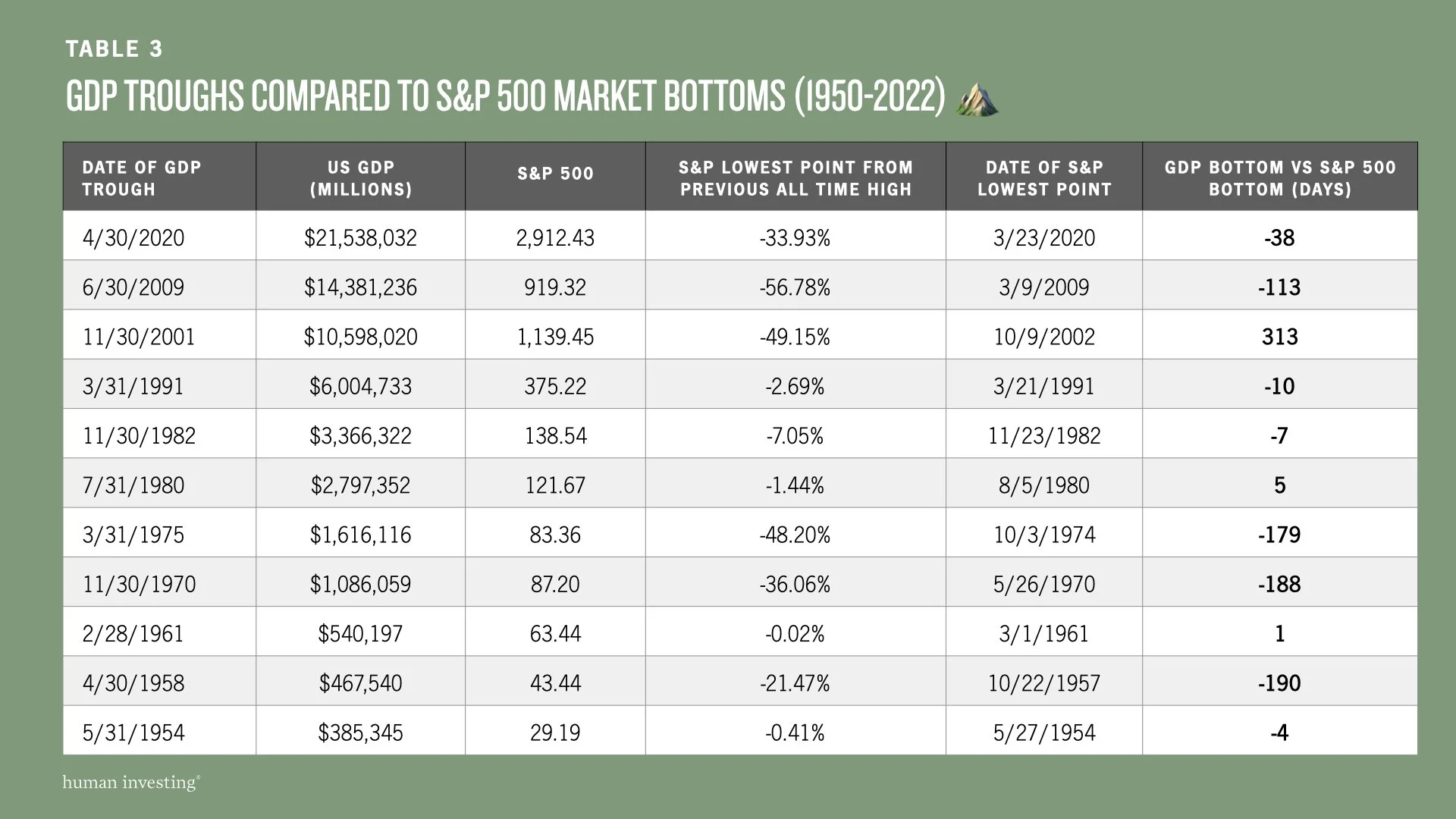
There have been 11 recessions since 1950, according to the National Bureau of Economic Research (NBER). Using the NBER’s trough dates (i.e., the end of a recession), we can compare GDP with the S&P to see when both hit their lowest point. Looking at Table 3, the S&P 500 tends to do one of two things:

  1. The market is at its worst about the same time as the economy.

  2. The market is at its worst approximately six months before the economy bottoms out.


There are some caveats. Market data is live, and markets are open every business day. GDP data comes out quarterly, advance estimates come out nearly a month after the fact, and aren’t fully revised until around 60 days after initial release. For both the market and economy, knowing when you’ve hit bottom is nearly impossible to determine in the moment. Because it’s difficult to know when the worst is over, we recommend staying invested amidst the potential short-term tumult.

Be prepared for some turbulence this year

Economists and market prognosticators are expecting there will be a recession in 2023. The severity of the recession will vary depending on The Fed. The Unemployment rate remains below historical averages at 3.5%. In November 2022, there were nearly 6 million more job openings than job seekers, suggesting the economy can handle some tightening. Trying to time the market or economy bottom remains a guessing game. Long term, the outlook for returns is still strong. Be prepared for some turbulence this year, knowing you are headed in the right direction long term.

Sources
1. Federal Reserve Bank of New York. The yield curve as a leading indicator. January 2023.
2. The Wall Street Journal. Economists in WSJ survey still see recession this year despite easing inflation. January 2023.
3. Bloomberg. Economists place 70% chance for US recession in 2023. December 2022.
4. Vanguard. Vanguard economic and market outlook for 2023: Beating back inflation. December 2022.
5. BlackRock. 2023 global outlook. January 2023.
6. Charles Schwab. 2023 market outlook: Cross currents. January 2023.
7. Fidelity. Global outlook 2023: New world disorder. January 2023.
8. Charles Schwab. Schwab's 2023 long-term capital market expectations. January 2023.
9. Vanguard. Market perspectives: December 2022. November 2022.
10. BlackRock. Asset return expectations and uncertainty: as of September 2022 November 2022..
11. Data courtesy of YCharts & NBER


Related Articles

Charts of the Year 2022
 

These are some of our favorite charts and graphs that told the biggest stories from 2022.

Stock Market Performance

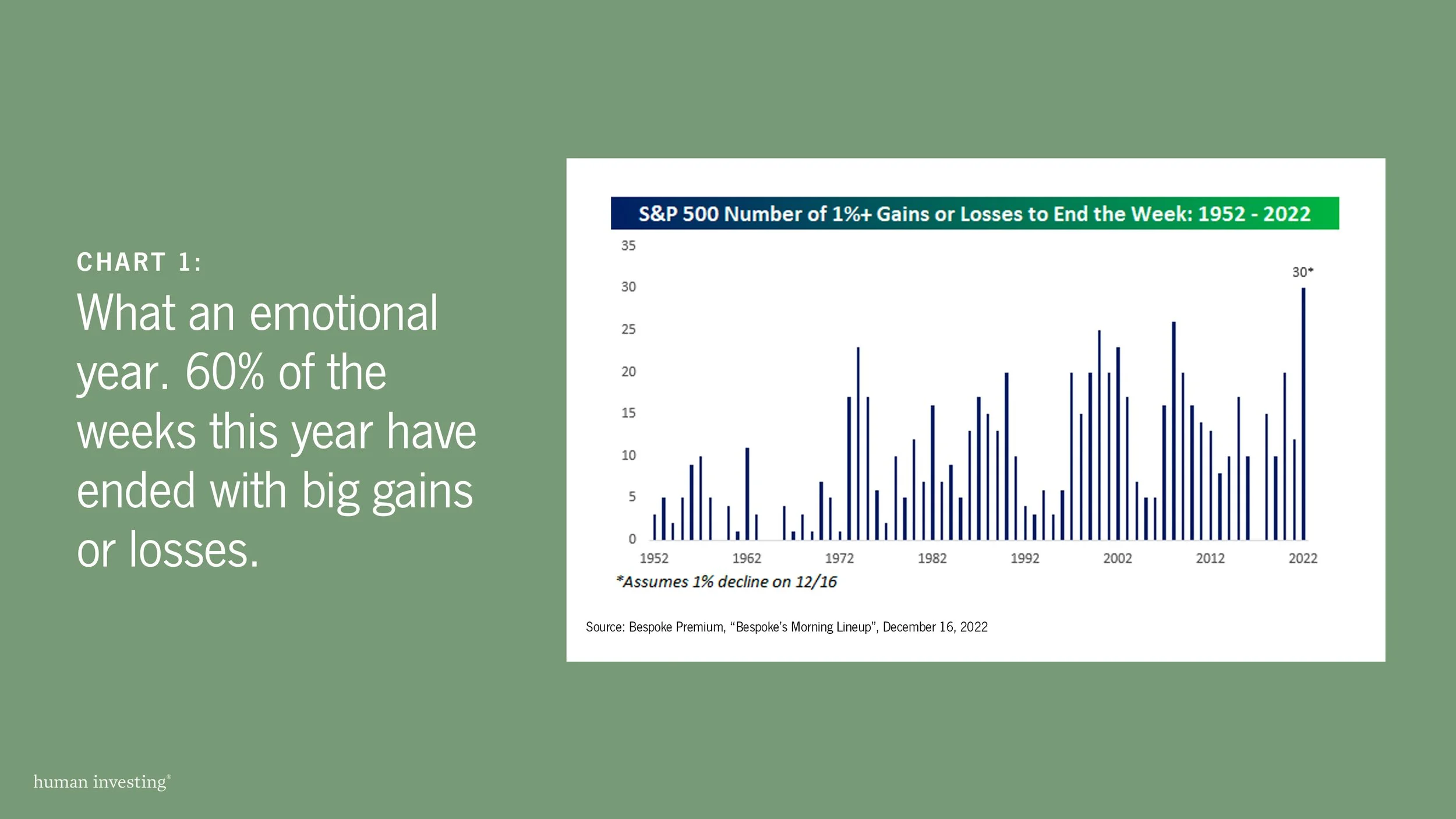
Each year, the stock market has its narrative around why it performed the way it did. With 2022 coming to a close and, as of 12/21, the stock market down 17.31%, one of the narratives for this year has been persistent volatility. As the chart above shows, 2022 marks the most days (30) that the market was either up or down 1%at the end of the week. 16 of the instances were down days, and 14 of the instances were positive.

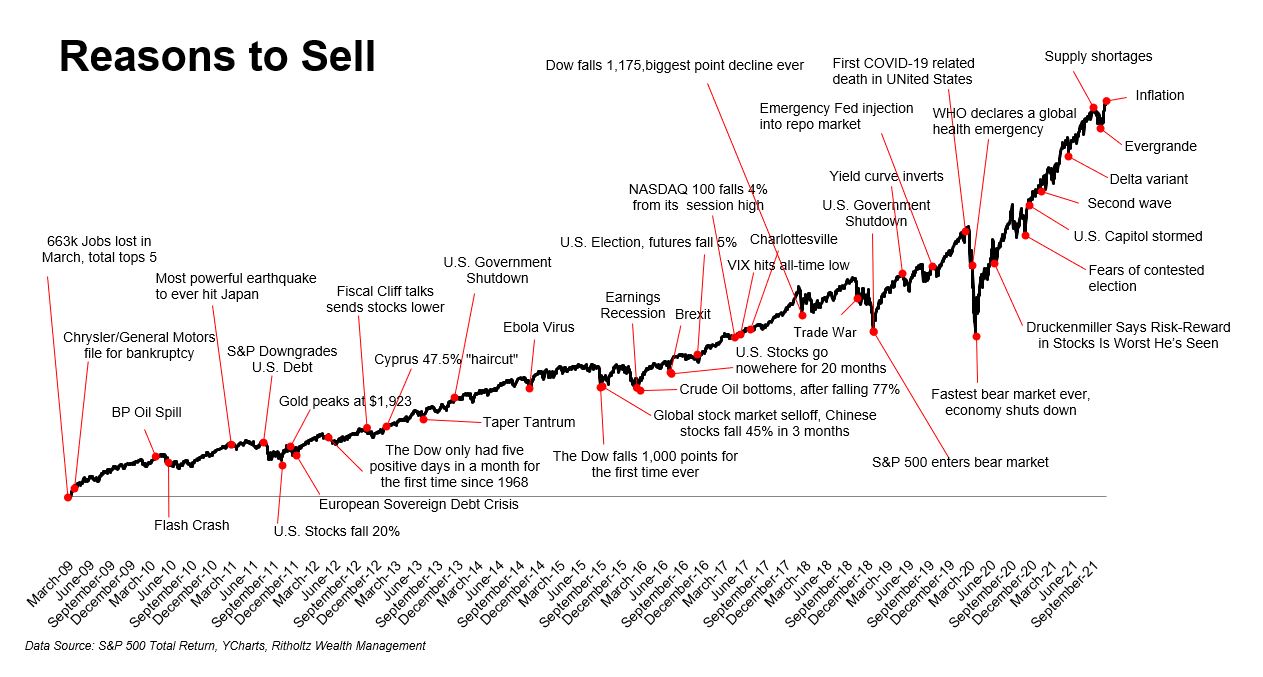
In terms of additional narratives for this year, our team has been referencing a year like 2022 as a “price of admission” year. In other words, to receive the benefit of long-term equity returns, negative years (like 2022) are part of the price of admission to achieve the benefits. We reference this chart when looking at the negative headlines the market has overcome over the years.

INFLATION AND SAVINGS

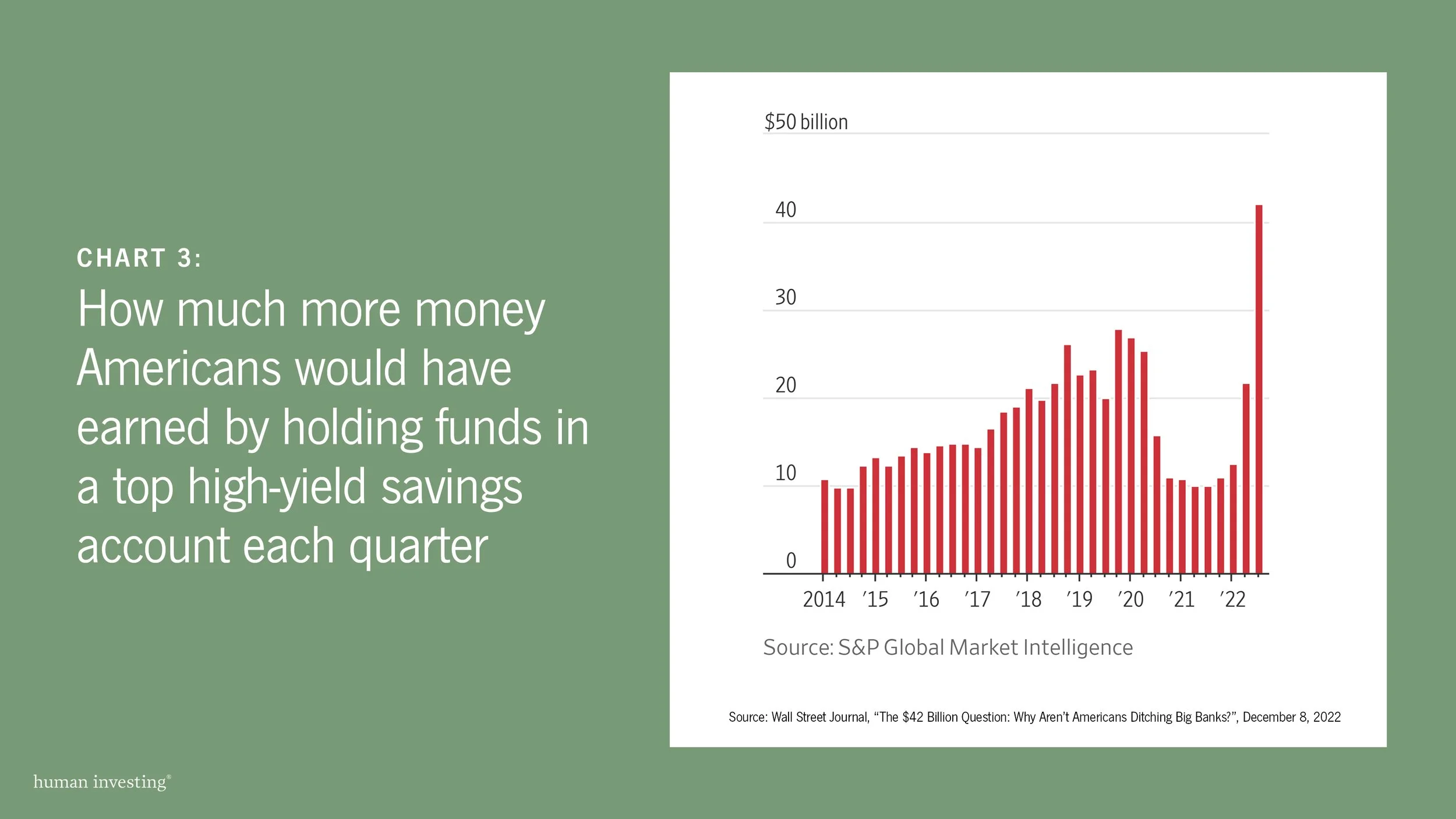
With interest rates increasing rapidly, there have been many moving parts in all areas of the economy. From real estate to food prices, most industries have been impacted. One area that consumers/investors should look to take advantage of is their saving and checking accounts. During the most recent period of low-interest rates, we have become accustomed to these accounts paying little to nothing in interest. However, as the chart above mentions, Americans are leaving dollars on the table by not searching out higher interest bank accounts. Our team recommends utilizing a local credit union which often has new member checking benefits, or aggregator sites like NerdWallet do a good job of providing high-paying savings accounts.

Market Volatility

With all the market downturns and volatility, we thought it would be interesting to see how long it takes to make your money back, depending on how you are invested. Ensuring your allocations are positioned so you can ride out any downturns is essential for any investor. 

Job Market

It's been a unique time in the jobs market. Job openings have exceeded people searching for jobs by nearly 5 million for 2022. The persistence of this even with all the uncertainty around the economy and inflation is surprising. As a result of the pandemic, more people are seeking remote work. LinkedIn revealed that remote jobs, which take up 15.9% of job listings, attract 52.9% of job applicants.

FTX

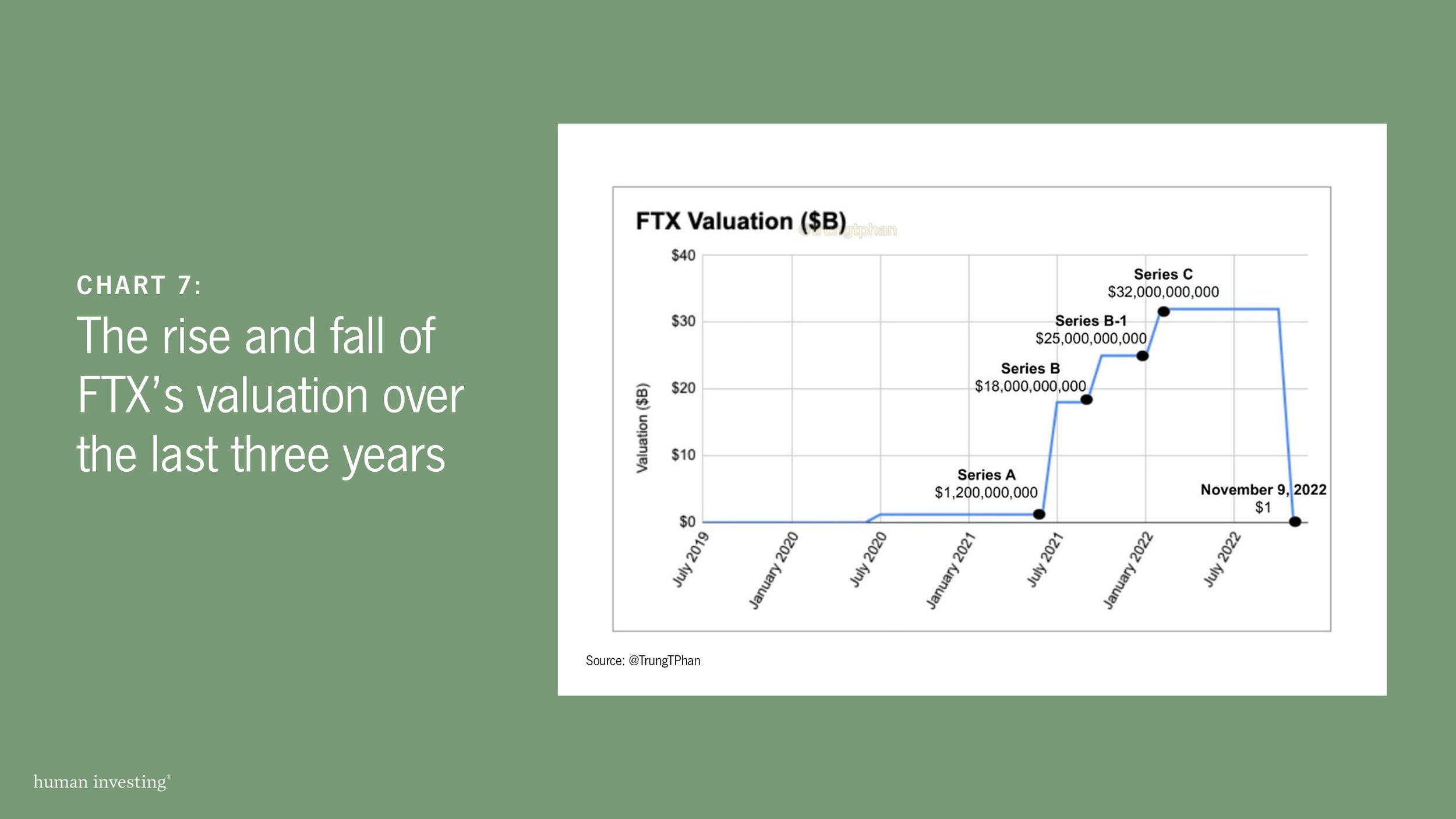
2022 charts of the year wouldn’t be complete without referencing the rise and fall of the cryptocurrency exchange FTX. Even as I write this, new information surrounding this saga continues to emerge, and it will be a high-profile news story to follow into 2023.

The above chart shows how the organization’s value got as high as $32B as recently as January 2022 during FTX’s most recent round of funding. There are many lessons to be learned from fraud scenarios, and like you, we will follow this story into the new year.


Related Articles

Economic Update from Human Investing
 

As a Charted Financial Analyst serving as the firm’s Director of Investments and Compliance, I oversee the construction and management of client portfolios. How we go about investing client capital involves evaluating a variety of factors that move the markets. Given the economic backdrop for 2022, I thought it would be helpful to address a few of the components impacting the economy and subsequent stock and bond market volatility.

Historical trends suggest the current high levels of inflation will not persist.

 Inflation is higher than it has been for decades, exceeding 7.5% in the March to October 2022 numbers, represented in the purple line below. The breakeven rate between a 5-year Treasury Inflation Protected Security (TIPS) and a standard Treasury is commonly used as a benchmark for what average inflation over the next five years is expected to be. The graph below shows this in orange below, hovering around 2.34%.

What is causing inflation?

There are broadly two types of inflation:

1. Demand-pull inflation occurs when there is too much demand for a limited supply of items (too much money chasing too few goods).


2. Cost-push inflation occurs when the costs of inputs for producers increase, and those costs are passed along to consumers (too few inputs to produce too many goods).

Both factors are helping push inflation higher. Government stimulus in response to COVID and global supply chains having to adjust in response to the pandemic have both had their part in increasing inflation, along with many other factors.

What brings inflation down?

Macroeconomic theory believes that inflation falls when an economy slows down. A slower economy usually means higher unemployment and less spending and investment. This means there isn’t too much demand-pull inflation occurring because higher unemployment means there are fewer wages chasing the goods produced. Higher unemployment also tends to lead to lower cost-push inflation because the cost of labor typically goes down when unemployment is high.

The Fed is still working on a soft landing.

Higher inflation is not healthy for an economy long term. Banks still want to make money even when inflation is high, so they lend at higher rates to ensure they still make a profit after accounting for inflation. Higher interest rates result in a higher cost of borrowing, making any investment (buying a house, going to college, launching a new business, building a new production facility, etc.) more expensive. Households and companies invest less, which means fewer productive and good investments happen, slowing down the overall economy.

Because high inflation is unhealthy for an economy, the Federal Reserve (aka “The Fed”, the US central bank) is raising interest rates. The Fed’s goal is to raise interest rates high enough to slow down the economy and bring down inflation. The concern is that The Fed will be too aggressive in raising interest rates and cause a sharp economic downturn. The hope is The Fed can execute a soft landing, slowing down the economy enough to reign in inflation but not slowing down so much to trigger a major recession.

The job market is still experiencing labor scarcity.

Currently, there are about 5 million more open jobs than people looking for a job. Unemployment is below 4%, near the historical lows we were experiencing pre-pandemic. Due to labor scarcity, employees are seeing their wages rise.


The overall economy is seeing consistent growth.

Gross Domestic Product (GDP) is the most used measure of the size of an economy. Real GDP (rGDP) accounts for inflation. The orange line is a “trendline” for real GDP, based on the average growth of rGDP from 2012 to 2017. As you can see, GDP is not far off from what would have been expected if the COVID downturn & recovery had never occurred. While the first half of 2022 had two-quarters of negative GDP growth (a common definition of a recession), Q3 2022 saw the economy grow.


Company earnings are still increasing despite downturns.

The following chart illustrates earnings growth compared to the S&P 500. The market tends is forward-looking, setting prices based on what is expected to happen. Current fears about inflation & The Fed triggering a downturn by raising interest rates too much too quickly are pushing the market down. Earnings reflect what companies earned in the previous three months. While there is a lot of anxiety about the state of the economy, companies are continuing to earn money and will continue to do so even in a downturn.


What does this mean for you and your portfolio?

In conclusion, there are contradictory messages. The economy quickly recovered from the global pandemic, and the workers are enjoying a solid labor market with wages rising. The positive economic news is contrasted with poor investor experience in the stock market. Concerns about high inflation and The Fed’s anticipated aggressive rate hikes to combat inflation have the market worrying about a recession. With all this happening, companies have continued to grow their earnings.

While there is conflicting information in the short term, we continue to anticipate long-term growth in the economy and stock market. Having a sound financial plan that accounts for downturns and uncertainties is crucial. Feel free to reach out if you have any questions about your plan or have had any changes in your financial situation.

All data courtesy of YCharts Nov 29, 2022.


Related Articles

The Market, Economy, and Implications from Our CEO


One of my favorite market commentators is Dr. David Kelly, an economist whose research focuses on the investment implications of an evolving economic environment. His insights are rooted in theory and application, which help make the work he publishes comprehensive and practical. In his most recent article, he notes the following:

As America emerges from the pandemic, there are still serious health concerns, a yawning political divide, rising autocracy around the world, a brutal war in Europe and the highest inflation in 40 years. Moreover, anxiety triggered by these genuine problems is being amplified by cable channels and social media which ever more efficiently gather their audience by appealing to fear and outrage.[1]
— DR. DAVID KELLY

With this backdrop, I will try to share my thoughts on the market, economy, and implications for investors.  

Market declines: We’ve been here before.

Whether looking at the stock market, bond market, or commercial and residential real estate markets (to name a few), all are down for the year. With widespread asset price declines, renewed volatility is unnerving for many of us. These are challenging times to have capital deployed into the market. However, volatility and risk are the primary reasons investors in the market have achieved meaningfully better returns than cash over most market cycles.

The narrative surrounding this market cycle continues to evolve—the reasons "why" we are experiencing market gyrations and asset declines today differ from past times. However, I have great hope and confidence markets will normalize and begin their next run higher—in the same way they have done following each of the last downturns dating back to 1825. [2] In my 25+ years advising clients, I have experienced managing assets through significant market declines, with the most recent being Q1 2020, and most memorable 2007-2009, and 2000-2002. The cause for these markets was different, but the result was the same for those who managed their emotions through turbulence.

How is the economy responding to the current market?

Economic activity is beginning to slow. The most notable remark came from Fed-Ex, which reported a slowdown in shipments—a real-time data point highlighting growing constraints from corporations and consumers alike. Although the Fed-Ex announcement is one observation, it is congruent with analysis conducted by Dr. Kelly and others, highlighting a slowing economy domestically and abroad.

The Federal Reserve (the Fed) job is exceedingly tricky, given that inflation affects everyone and the primary defense for rising prices is interest rate hikes. At the same time, if interest rate increases are applied excessively, they stand to constrain the economy, which in turn could inflict pain on households through job loss and a decline in asset prices. Concern over Federal Reserve policy mistakes has begun to capture the headlines, with notable economists Mohamed El-Erian and Jeremy Siegel blasting the Fed for raising interest rates too aggressively.

The tension between the actions of the Fed and prominent economists may cause the Fed to exercise more constraints when deciding on interest rate policy in the future. Ultimately, we hope Fed Chairman Powell and his colleagues around the country can orchestrate a soft landing for the economy—which involves moderating rate hikes and extinguishing inflation while maintaining reasonable economic growth.

Our financial plans factor in these conditions.

Financial planning is essential to helping to create positive customer outcomes and providing wise counsel in all market and economic conditions. Recently, a retired client and friend called concerned about the market. They asked if they should reduce their overall risk and sell a portion of their equities. After a review of their financial plan, it was determined that despite the market decline, they were on target to maintain their spending goals; therefore, no immediate action was needed.

Our recommendation for this client included a study on their financial plan's probability of success. The probability analysis simulates their plan's likely outcomes based on good and bad markets. When coupling their planning inputs with their probability analysis and considering their cash and bond holdings, it is easier to look past the market and focus on their plan, including simulations for markets like we are in now.

Please know we understand how unnerving it is to see account balances drop and to feel that the world is unraveling. However, it is imperative that we remain objective and focused on our disciplined approach to both planning and investing. When speaking with your advisor, their answer may be "stay the course." This is our way of saying we have looked at your plan and are prepared for times such as these. Attempting to control the market or predict capital market outcomes sets us up for failure. However, focusing on what we can control, utilizing industry-leading technology, and leveraging a team of experienced credentialed experts are the best approaches with the highest probability of success for our clients and their plans. [3]

As has been the case since hiring Marc Kadomatsu, CFP to Human Investing, financial advice dispensed through the lens of financial planning has been the cornerstone of our service offering at Human Investing. Marc previously served as the head of the Financial Planning Association for Oregon and SW Washington. We have added to his team the recent promotion of Will Kellar, CFP, to Partner. Will has tremendous experience in advising clients through a planning lens. Moreover, Will is responsible for training the next generation of financial planners as he currently serves on the faculty of Oregon's only accredited financial planning program at George Fox University. 

Diversification may be the key to your peace of mind.

Emotion management is complicated—particularly for those whose primary source of income is their investment portfolio. To help manage the anxiousness that may accompany turbulent markets, please consider the concept of diversification. The term "diversification" means we don't put all your eggs in one basket. Although you have one account statement from your primary brokerage affiliation (Schwab, Fidelity, Betterment, etc.), you have various investments. Each investment serves a purpose in helping you achieve your goals. Some investments like cash and short-term bonds are what we tap into to provide necessary liquidity without having to sell at a significant loss. At the same time, equities are for longer-term appreciation to help your portfolio generate returns that outpace inflation and taxes.

Although your portfolio performance and holdings are aggregated into a single statement, we ensure that customers are adequately diversified into many different holdings. That way, when it's time to take a necessary withdrawal, we have many options for where we can go for the cash. There is no easy way to manage emotions in volatile markets. However, knowing ample investments can be accessed to provide the needed financial resources is something to consider when looking at the portfolio as a whole.

Markets of all kinds experience ups and downs—which has been my experience since 1996. The current downturn has several major markets down in excess of twenty percent year-to-date. Countries and regions go through economic cycles for various reasons and durations. The economy is showing signs of a slowdown, which could negatively impact consumers and businesses alike. With both the market and the economy on edge, we believe it is paramount for investors to stay disciplined, avoid acting on emotion and lean on their financial plan and advisor to help them make informed financial decisions.


[1] Kelly, D. (2022, September 19). Why the Fed should worry less about sticky inflation (but probably won't). Notes on the Week Ahead, JP Morgan Asset Management.

[2] Gladhill, A. (2019, September 12). Return histogram: Stock market annual returns 1825-2017. Investment Committee Q32019, Human Investing.

[3] Bennyhoff, D. G., & Kinniry Jr, F. M. (2016). Vanguard Advisor's Alpha®. Vanguard, June, http://bit. ly/2gXMDCs.


Related Articles

Charts of Q2 2022
 

April, May, and June 2022 have been long, emotional months. The purpose of our charts of the quarter posts is to provide financial updates, and it may be no surprise that this post is focused on interest rates, housing prices, and market volatility.

1: Interest rates increased by HALF A PERCENT in May 2022

On May 4, 2022, the Federal Reserve raised interest rates by ½ a percent. While ½ of a percent may feel insignificant, this was the most significant interest hike in more than two decades.

What does an increased interest rate mean for you? It means that borrowing money from the bank is more expensive. It has also historically been good news for your saving and investment accounts.

Specifically, this chart summarizes investment returns since 1990 after the Federal Reserve raised interest rates by at least ½ a percent. As you can see, on average, stocks returned +20.5%, and bonds returned +13.8% one year after the interest rate hike. Only time will tell what happens, but it wouldn’t surprise us if returns got better in the coming months.

Source: Morningstar

2: How long does it take to get your money back?

During Q2 2022 – from April 1 – June 30, the S&P 500 returned -16%. Checking your account balance hasn’t been a pleasant experience in Q2 ’22.

Most people want to know the answer to the question, “how long is it going to take to get my money back?” Since this was a recurring question this quarter, Andrew Gladhill wrote a blog post called Payback Periods: How Long to Make Your Money Back. We encourage you to read the full article, but we selected one chart to share from this post.

This chart states that 95% of the time, it takes nine months for investors to, once again, reach another all-time high in their account. Said differently, most of the time, the market rewards investors who stay invested for at least nine months. What does this mean for you?

Remaining invested and, in the case of 401(k) accounts, continuing to invest your dollars is the easiest way to see your account balance recover. This can be an uncomfortable experience, and we recommend reaching out to our team if you feel uneasy or want to brainstorm ways to adjust your account strategies.

Source: CFA Institute

3: Are we heading into a recession?

Source: Google

Are we heading into a recession? Are you feeling worried, fearful, and frustrated? As this chart illustrates, the Google Trend for the search engine “recession” since the beginning of 2022 has quadrupled.

Everyone is looking for an answer that doesn’t exist. We cannot predict if there will be a recession or how long it will last. We know that recessions are a regular, unavoidable part of economic cycles.

Here are a few questions to ask yourself in preparation for a recession:

Do I have job security?
Does my spouse have job security?
What fixed expenses do I have? (Examples may include mortgage payments, car payments, daycare payments, and recurring health care payments)
Do I have emergency savings to pay for my fixed expenses?
Would a recession change my current investment strategy?
Does anyone really know if there is a recession coming?

We also know that compared to the recent past, US Households currently have more cash and cash equivalents in their bank accounts. This chart, dating back to 2015, shows the rise of cash on hand for US Households. We may be more prepared for a recessionary period than we think we are. As the previous recession preparation questions suggest, it is essential to have liquidity during a recessionary period to help pay for fixed costs, protect against a loss of income, and to avoid selling investments while the markets are volatile.

If you need help answering any of the questions above, please contact your team of advisors at Human Investing.

4: Mortgage rates doubled in Q2 2022

Mortgage rates, as you may have seen, surged in Q2’22. Average mortgage rates went from 3% to 6%, which is the most significant one-week increase in interest rates since 1987. At about 6%, 30-year mortgage rates are back to where they were in November 2008. 

We wanted to share this chart which illustrates the increase in mortgage payments since 2015. As you can see, monthly mortgage payments have increased over time, but 2022 has experienced a remarkable surge in average monthly mortgage payments.

Let’s see how the rest of summer unfolds. Suppose you are in the market to buy a home. In that case, we highly recommend understanding all the costs associated with purchasing a home, including closing costs, property taxes, monthly payments, and repairs.

Source: Redfin


For a more in-depth overview, read this Redfin article.

Our team is always here for you should you have any questions or concerns about your financial landscape.


Related Articles

Is Inflation Affecting your Investments?
 

Inflation can lay waste to portfolios and wages, which is one of many reasons why inflation is concerning for laborers and investors alike. Some speculate that the rise in inflation is from supply chain congestion, resulting from labor shortage due to the Coronavirus pandemic. Others hypothesize that a flood of liquidity into the global economy, which stems from quantitative easing dating back to the financial crisis in 2007-2009, is the cause of rising prices. Regardless of the reason, the concern is that gains in wages and market appreciation are muted, or worse, erased, by an escalation in prices for goods and services.


Inflation’s History

It has been three decades since we've seen inflation at current levels and even longer since inflation averaged double digits (several different times in the mid-70s to early 80s)[1]. Clients of our firm who remember the 1970s recall long gas lines, borrowing for a home purchase at 15%, and investing in treasury bonds at over 10%.

Consider this: in October of 1981, the 30-year mortgage rate was 18.45%[2]. As I type, that sort of rate seems almost unthinkable, yet it's true. To illustrate how it would impact the average homeowner or investor today, imagine a $500,000 home purchase with a 20% down payment. An individual would be financing $400,000 and be left with a $6,175 payment!


How Does Inflation Work?

Inflation works in a similar way with food, gas, and other products and services we use regularly. Inflation can be viewed as a tax that leaves consumers with less to spend at the end of each month. With consumers facing higher prices, the dollars they spend must go to the staples such as food, housing, and gas—while potentially having less to spend on discretionary items such as travel and entertainment.

To combat inflation, the Federal Reserve (the Fed) will typically increase short-term borrowing costs on member banks—which in turn, trickles down to the consumer. Managing inflation is a primary objective of the Federal Reserve. The inflation target for the Federal Reserve is 2%. With both headline and core inflation trending well above those targets, aggressive rate increases are warranted. Surely the invasion of the Ukraine by Russia has complicated the Fed’s rate decision. My previous article “War and the Market: What Does History Teach Us?” discusses this topic further. Despite the concern over the war in Ukraine, the question is not if the Fed will raise rates. Instead, it’s a matter of how fast the Fed will hike rates and when they will stop.


Our Recommendations

First, revisit your budget. See where you are seeing the biggest increases as some individuals are impacted far more than others. For example, my brother is a sports fisherman who is impacted much more by the price of fuel than I am with a five-mile commute to work. At the same time, a family of seven will feel food inflation much more than my parents, who have been empty nesters for almost 30 years. Secondly, once you have revised your budget, a conversation with your advisor can be warranted. For some who are living off a fixed income, the process will require pairing back or needing larger distributions from your portfolio. For others, it may prompt a change in your investment mix. While for many clients, the process may entail staying the course.

Investors whose investment horizon is long-term should continue to invest in a diversified, low-cost, equity-leaning portfolio. However, for investors who are either uneasy with market gyrations or have a more condensed investment timeline, multiple levers can be pulled to potentially position the portfolio to hold up well during inflationary times. Many experts agree that treasury bills and private real estate hold up well during inflation. [3],[4] It is also important to note that during inflation cycles, equities do well; however, volatility can increase, making maintaining a portfolio heavy on stocks problematic for investors whose emotions can get the best of them.


Guidance for Those who are Worried

If you are prone to worry about your investments, there are several actions to consider. First, consider looking at your investments less often. This does not mean a “head in the sand” approach. Instead, if you are looking at your portfolio a few times per day, consider a few times per week. Or, if it’s weekly, consider checking in on your accounts monthly. Second, look at history for context surrounding the volatility. What you will find is that the market, on average, experiences a 14% intra-year drops since 1980. This may not provide you all the peace you want , but having perspective on what is normal can be helpful in curbing emotions. To further combat mixing emotions with investments, read “How to Avoid the Investing Cycle of Emotions” by our own Will Kellar, CFP®. Finally, if the volatility is cause for sleepless nights, you may be someone that needs to take less risk, meaning a conversation with your advisor is warranted.

Because the course of this inflationary cycle is unknown, it is essential for all investors to track their spending to determine what impact inflation has had on budgets. For some, there is plenty of discretionary capital to absorb the increase prices; however, for others, it may be necessary to tighten the belt and prioritize essential spending, to minimize the impact of elevated costs.

[1] U.S. Inflation Calculator

[2] History of Mortgage Interest Rates

[3] Fama, E. F., & Schwert, G. W. (1977). Asset returns and inflation. Journal of financial economics, 5(2), 115-146.

[4] Crawford, G., Liew, J. K. S., & Marks, A. (2013). Investing Under Inflation Risk. The Journal of Portfolio Management, 39(3), 123-135.


If you have feedback for us, have questions, or would like to hear more on other topics we’ve not already covered, please email us directly at hi@humaninvesting.com. We cherish the emails and questions and look forward to connecting with you soon.


Related Articles