Posts in Current Events
Charts of the Year 2022
 

These are some of our favorite charts and graphs that told the biggest stories from 2022.

Stock Market Performance

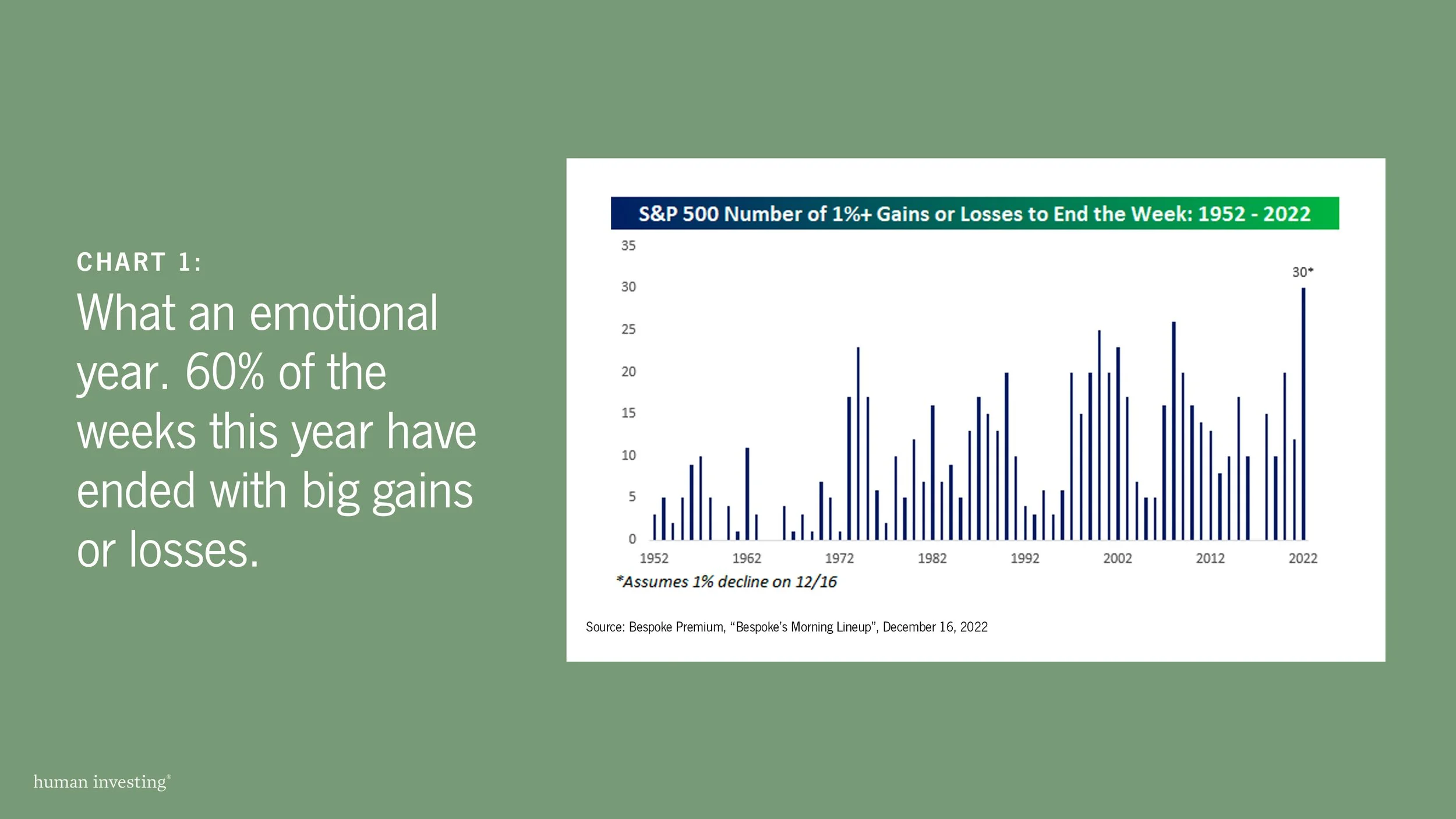
Each year, the stock market has its narrative around why it performed the way it did. With 2022 coming to a close and, as of 12/21, the stock market down 17.31%, one of the narratives for this year has been persistent volatility. As the chart above shows, 2022 marks the most days (30) that the market was either up or down 1%at the end of the week. 16 of the instances were down days, and 14 of the instances were positive.

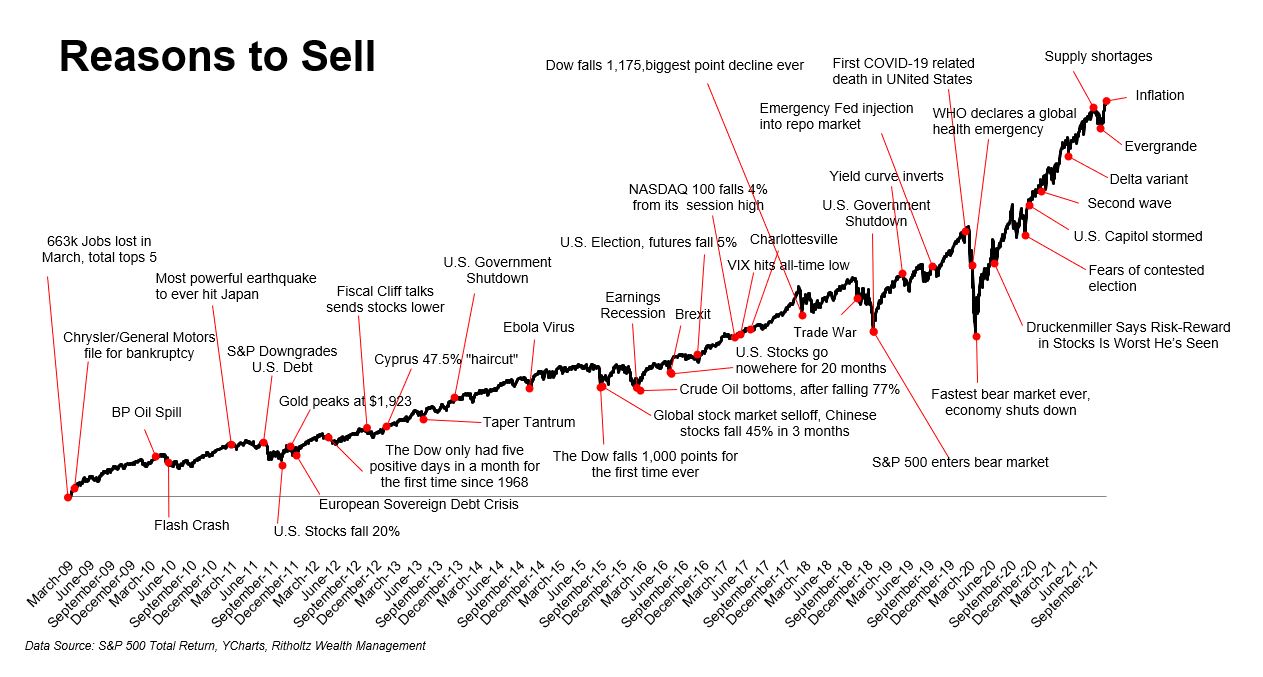
In terms of additional narratives for this year, our team has been referencing a year like 2022 as a “price of admission” year. In other words, to receive the benefit of long-term equity returns, negative years (like 2022) are part of the price of admission to achieve the benefits. We reference this chart when looking at the negative headlines the market has overcome over the years.

INFLATION AND SAVINGS

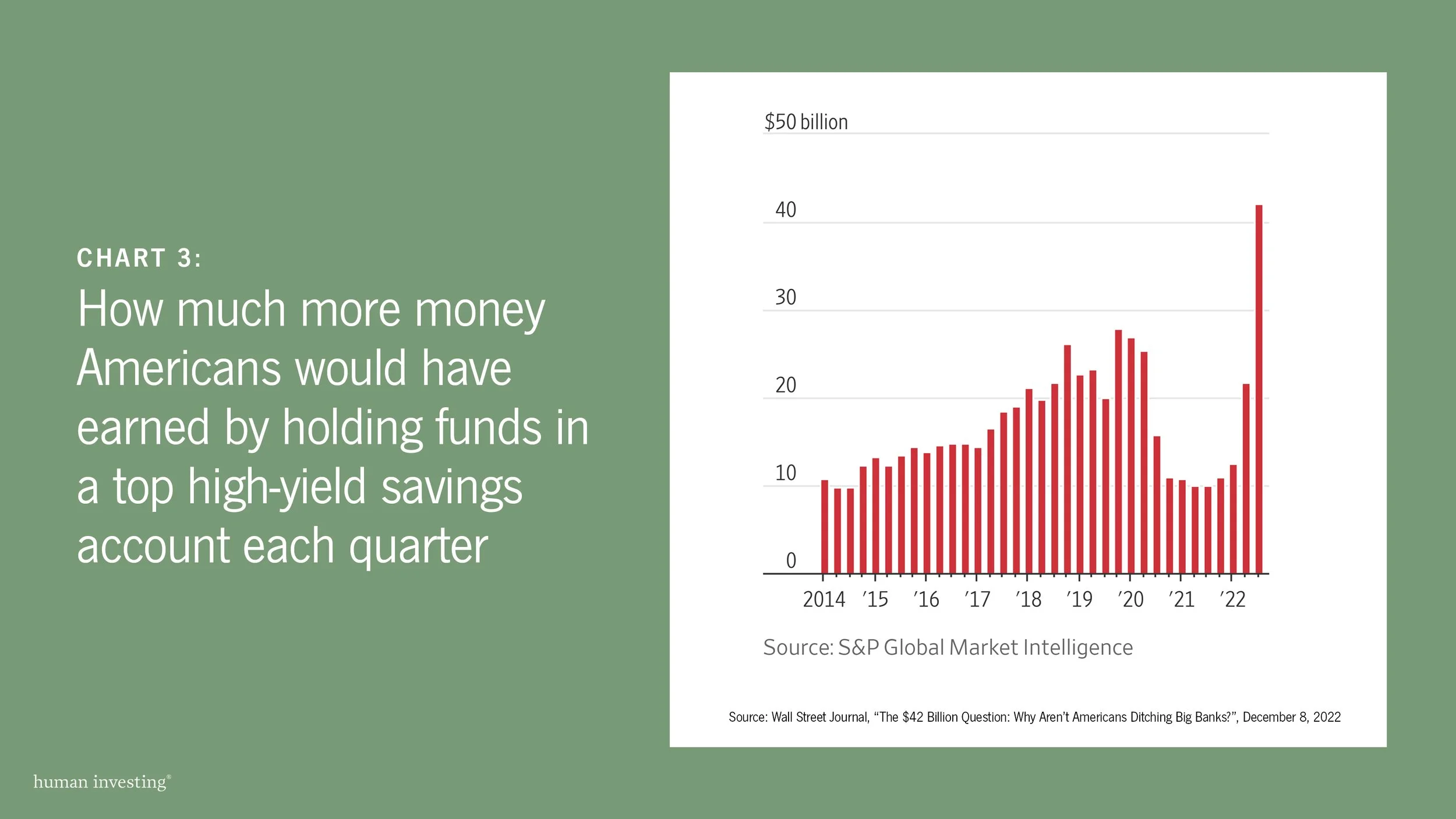
With interest rates increasing rapidly, there have been many moving parts in all areas of the economy. From real estate to food prices, most industries have been impacted. One area that consumers/investors should look to take advantage of is their saving and checking accounts. During the most recent period of low-interest rates, we have become accustomed to these accounts paying little to nothing in interest. However, as the chart above mentions, Americans are leaving dollars on the table by not searching out higher interest bank accounts. Our team recommends utilizing a local credit union which often has new member checking benefits, or aggregator sites like NerdWallet do a good job of providing high-paying savings accounts.

Market Volatility

With all the market downturns and volatility, we thought it would be interesting to see how long it takes to make your money back, depending on how you are invested. Ensuring your allocations are positioned so you can ride out any downturns is essential for any investor. 

Job Market

It's been a unique time in the jobs market. Job openings have exceeded people searching for jobs by nearly 5 million for 2022. The persistence of this even with all the uncertainty around the economy and inflation is surprising. As a result of the pandemic, more people are seeking remote work. LinkedIn revealed that remote jobs, which take up 15.9% of job listings, attract 52.9% of job applicants.

FTX

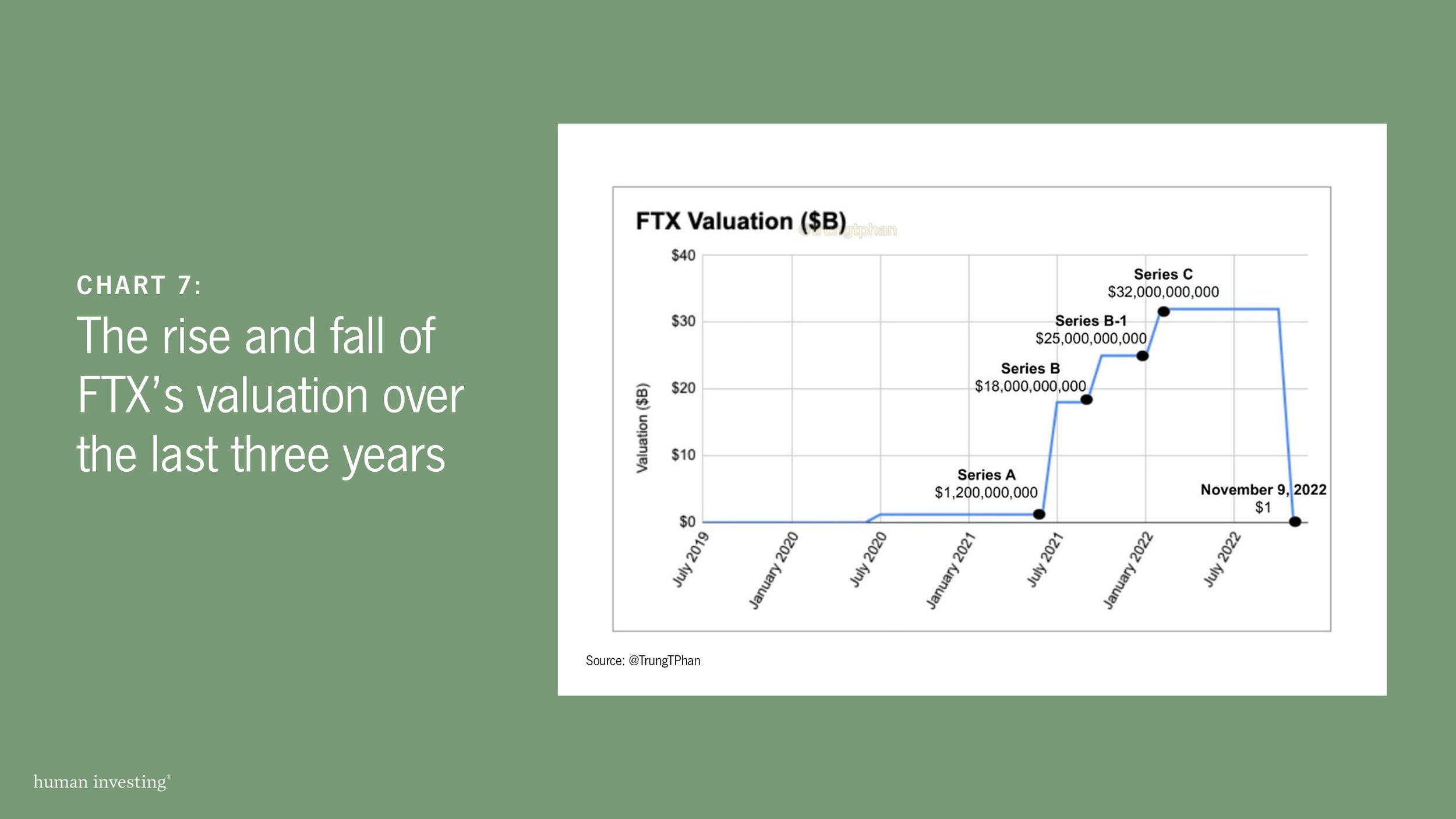
2022 charts of the year wouldn’t be complete without referencing the rise and fall of the cryptocurrency exchange FTX. Even as I write this, new information surrounding this saga continues to emerge, and it will be a high-profile news story to follow into 2023.

The above chart shows how the organization’s value got as high as $32B as recently as January 2022 during FTX’s most recent round of funding. There are many lessons to be learned from fraud scenarios, and like you, we will follow this story into the new year.


Related Articles

Economic Update from Human Investing
 

As a Charted Financial Analyst serving as the firm’s Director of Investments and Compliance, I oversee the construction and management of client portfolios. How we go about investing client capital involves evaluating a variety of factors that move the markets. Given the economic backdrop for 2022, I thought it would be helpful to address a few of the components impacting the economy and subsequent stock and bond market volatility.

Historical trends suggest the current high levels of inflation will not persist.

 Inflation is higher than it has been for decades, exceeding 7.5% in the March to October 2022 numbers, represented in the purple line below. The breakeven rate between a 5-year Treasury Inflation Protected Security (TIPS) and a standard Treasury is commonly used as a benchmark for what average inflation over the next five years is expected to be. The graph below shows this in orange below, hovering around 2.34%.

What is causing inflation?

There are broadly two types of inflation:

1. Demand-pull inflation occurs when there is too much demand for a limited supply of items (too much money chasing too few goods).


2. Cost-push inflation occurs when the costs of inputs for producers increase, and those costs are passed along to consumers (too few inputs to produce too many goods).

Both factors are helping push inflation higher. Government stimulus in response to COVID and global supply chains having to adjust in response to the pandemic have both had their part in increasing inflation, along with many other factors.

What brings inflation down?

Macroeconomic theory believes that inflation falls when an economy slows down. A slower economy usually means higher unemployment and less spending and investment. This means there isn’t too much demand-pull inflation occurring because higher unemployment means there are fewer wages chasing the goods produced. Higher unemployment also tends to lead to lower cost-push inflation because the cost of labor typically goes down when unemployment is high.

The Fed is still working on a soft landing.

Higher inflation is not healthy for an economy long term. Banks still want to make money even when inflation is high, so they lend at higher rates to ensure they still make a profit after accounting for inflation. Higher interest rates result in a higher cost of borrowing, making any investment (buying a house, going to college, launching a new business, building a new production facility, etc.) more expensive. Households and companies invest less, which means fewer productive and good investments happen, slowing down the overall economy.

Because high inflation is unhealthy for an economy, the Federal Reserve (aka “The Fed”, the US central bank) is raising interest rates. The Fed’s goal is to raise interest rates high enough to slow down the economy and bring down inflation. The concern is that The Fed will be too aggressive in raising interest rates and cause a sharp economic downturn. The hope is The Fed can execute a soft landing, slowing down the economy enough to reign in inflation but not slowing down so much to trigger a major recession.

The job market is still experiencing labor scarcity.

Currently, there are about 5 million more open jobs than people looking for a job. Unemployment is below 4%, near the historical lows we were experiencing pre-pandemic. Due to labor scarcity, employees are seeing their wages rise.


The overall economy is seeing consistent growth.

Gross Domestic Product (GDP) is the most used measure of the size of an economy. Real GDP (rGDP) accounts for inflation. The orange line is a “trendline” for real GDP, based on the average growth of rGDP from 2012 to 2017. As you can see, GDP is not far off from what would have been expected if the COVID downturn & recovery had never occurred. While the first half of 2022 had two-quarters of negative GDP growth (a common definition of a recession), Q3 2022 saw the economy grow.


Company earnings are still increasing despite downturns.

The following chart illustrates earnings growth compared to the S&P 500. The market tends is forward-looking, setting prices based on what is expected to happen. Current fears about inflation & The Fed triggering a downturn by raising interest rates too much too quickly are pushing the market down. Earnings reflect what companies earned in the previous three months. While there is a lot of anxiety about the state of the economy, companies are continuing to earn money and will continue to do so even in a downturn.


What does this mean for you and your portfolio?

In conclusion, there are contradictory messages. The economy quickly recovered from the global pandemic, and the workers are enjoying a solid labor market with wages rising. The positive economic news is contrasted with poor investor experience in the stock market. Concerns about high inflation and The Fed’s anticipated aggressive rate hikes to combat inflation have the market worrying about a recession. With all this happening, companies have continued to grow their earnings.

While there is conflicting information in the short term, we continue to anticipate long-term growth in the economy and stock market. Having a sound financial plan that accounts for downturns and uncertainties is crucial. Feel free to reach out if you have any questions about your plan or have had any changes in your financial situation.

All data courtesy of YCharts Nov 29, 2022.


Related Articles

The Market, Economy, and Implications from Our CEO


One of my favorite market commentators is Dr. David Kelly, an economist whose research focuses on the investment implications of an evolving economic environment. His insights are rooted in theory and application, which help make the work he publishes comprehensive and practical. In his most recent article, he notes the following:

As America emerges from the pandemic, there are still serious health concerns, a yawning political divide, rising autocracy around the world, a brutal war in Europe and the highest inflation in 40 years. Moreover, anxiety triggered by these genuine problems is being amplified by cable channels and social media which ever more efficiently gather their audience by appealing to fear and outrage.[1]
— DR. DAVID KELLY

With this backdrop, I will try to share my thoughts on the market, economy, and implications for investors.  

Market declines: We’ve been here before.

Whether looking at the stock market, bond market, or commercial and residential real estate markets (to name a few), all are down for the year. With widespread asset price declines, renewed volatility is unnerving for many of us. These are challenging times to have capital deployed into the market. However, volatility and risk are the primary reasons investors in the market have achieved meaningfully better returns than cash over most market cycles.

The narrative surrounding this market cycle continues to evolve—the reasons "why" we are experiencing market gyrations and asset declines today differ from past times. However, I have great hope and confidence markets will normalize and begin their next run higher—in the same way they have done following each of the last downturns dating back to 1825. [2] In my 25+ years advising clients, I have experienced managing assets through significant market declines, with the most recent being Q1 2020, and most memorable 2007-2009, and 2000-2002. The cause for these markets was different, but the result was the same for those who managed their emotions through turbulence.

How is the economy responding to the current market?

Economic activity is beginning to slow. The most notable remark came from Fed-Ex, which reported a slowdown in shipments—a real-time data point highlighting growing constraints from corporations and consumers alike. Although the Fed-Ex announcement is one observation, it is congruent with analysis conducted by Dr. Kelly and others, highlighting a slowing economy domestically and abroad.

The Federal Reserve (the Fed) job is exceedingly tricky, given that inflation affects everyone and the primary defense for rising prices is interest rate hikes. At the same time, if interest rate increases are applied excessively, they stand to constrain the economy, which in turn could inflict pain on households through job loss and a decline in asset prices. Concern over Federal Reserve policy mistakes has begun to capture the headlines, with notable economists Mohamed El-Erian and Jeremy Siegel blasting the Fed for raising interest rates too aggressively.

The tension between the actions of the Fed and prominent economists may cause the Fed to exercise more constraints when deciding on interest rate policy in the future. Ultimately, we hope Fed Chairman Powell and his colleagues around the country can orchestrate a soft landing for the economy—which involves moderating rate hikes and extinguishing inflation while maintaining reasonable economic growth.

Our financial plans factor in these conditions.

Financial planning is essential to helping to create positive customer outcomes and providing wise counsel in all market and economic conditions. Recently, a retired client and friend called concerned about the market. They asked if they should reduce their overall risk and sell a portion of their equities. After a review of their financial plan, it was determined that despite the market decline, they were on target to maintain their spending goals; therefore, no immediate action was needed.

Our recommendation for this client included a study on their financial plan's probability of success. The probability analysis simulates their plan's likely outcomes based on good and bad markets. When coupling their planning inputs with their probability analysis and considering their cash and bond holdings, it is easier to look past the market and focus on their plan, including simulations for markets like we are in now.

Please know we understand how unnerving it is to see account balances drop and to feel that the world is unraveling. However, it is imperative that we remain objective and focused on our disciplined approach to both planning and investing. When speaking with your advisor, their answer may be "stay the course." This is our way of saying we have looked at your plan and are prepared for times such as these. Attempting to control the market or predict capital market outcomes sets us up for failure. However, focusing on what we can control, utilizing industry-leading technology, and leveraging a team of experienced credentialed experts are the best approaches with the highest probability of success for our clients and their plans. [3]

As has been the case since hiring Marc Kadomatsu, CFP to Human Investing, financial advice dispensed through the lens of financial planning has been the cornerstone of our service offering at Human Investing. Marc previously served as the head of the Financial Planning Association for Oregon and SW Washington. We have added to his team the recent promotion of Will Kellar, CFP, to Partner. Will has tremendous experience in advising clients through a planning lens. Moreover, Will is responsible for training the next generation of financial planners as he currently serves on the faculty of Oregon's only accredited financial planning program at George Fox University. 

Diversification may be the key to your peace of mind.

Emotion management is complicated—particularly for those whose primary source of income is their investment portfolio. To help manage the anxiousness that may accompany turbulent markets, please consider the concept of diversification. The term "diversification" means we don't put all your eggs in one basket. Although you have one account statement from your primary brokerage affiliation (Schwab, Fidelity, Betterment, etc.), you have various investments. Each investment serves a purpose in helping you achieve your goals. Some investments like cash and short-term bonds are what we tap into to provide necessary liquidity without having to sell at a significant loss. At the same time, equities are for longer-term appreciation to help your portfolio generate returns that outpace inflation and taxes.

Although your portfolio performance and holdings are aggregated into a single statement, we ensure that customers are adequately diversified into many different holdings. That way, when it's time to take a necessary withdrawal, we have many options for where we can go for the cash. There is no easy way to manage emotions in volatile markets. However, knowing ample investments can be accessed to provide the needed financial resources is something to consider when looking at the portfolio as a whole.

Markets of all kinds experience ups and downs—which has been my experience since 1996. The current downturn has several major markets down in excess of twenty percent year-to-date. Countries and regions go through economic cycles for various reasons and durations. The economy is showing signs of a slowdown, which could negatively impact consumers and businesses alike. With both the market and the economy on edge, we believe it is paramount for investors to stay disciplined, avoid acting on emotion and lean on their financial plan and advisor to help them make informed financial decisions.


[1] Kelly, D. (2022, September 19). Why the Fed should worry less about sticky inflation (but probably won't). Notes on the Week Ahead, JP Morgan Asset Management.

[2] Gladhill, A. (2019, September 12). Return histogram: Stock market annual returns 1825-2017. Investment Committee Q32019, Human Investing.

[3] Bennyhoff, D. G., & Kinniry Jr, F. M. (2016). Vanguard Advisor's Alpha®. Vanguard, June, http://bit. ly/2gXMDCs.



Related Articles

Charts of Q2 2022
 

April, May, and June 2022 have been long, emotional months. The purpose of our charts of the quarter posts is to provide financial updates, and it may be no surprise that this post is focused on interest rates, housing prices, and market volatility.

1: Interest rates increased by HALF A PERCENT in May 2022

On May 4, 2022, the Federal Reserve raised interest rates by ½ a percent. While ½ of a percent may feel insignificant, this was the most significant interest hike in more than two decades.

What does an increased interest rate mean for you? It means that borrowing money from the bank is more expensive. It has also historically been good news for your saving and investment accounts.

Specifically, this chart summarizes investment returns since 1990 after the Federal Reserve raised interest rates by at least ½ a percent. As you can see, on average, stocks returned +20.5%, and bonds returned +13.8% one year after the interest rate hike. Only time will tell what happens, but it wouldn’t surprise us if returns got better in the coming months.

Source: Morningstar

2: How long does it take to get your money back?

During Q2 2022 – from April 1 – June 30, the S&P 500 returned -16%. Checking your account balance hasn’t been a pleasant experience in Q2 ’22.

Most people want to know the answer to the question, “how long is it going to take to get my money back?” Since this was a recurring question this quarter, Andrew Gladhill wrote a blog post called Payback Periods: How Long to Make Your Money Back. We encourage you to read the full article, but we selected one chart to share from this post.

This chart states that 95% of the time, it takes nine months for investors to, once again, reach another all-time high in their account. Said differently, most of the time, the market rewards investors who stay invested for at least nine months. What does this mean for you?

Remaining invested and, in the case of 401(k) accounts, continuing to invest your dollars is the easiest way to see your account balance recover. This can be an uncomfortable experience, and we recommend reaching out to our team if you feel uneasy or want to brainstorm ways to adjust your account strategies.

Source: CFA Institute

3: Are we heading into a recession?

Source: Google

Are we heading into a recession? Are you feeling worried, fearful, and frustrated? As this chart illustrates, the Google Trend for the search engine “recession” since the beginning of 2022 has quadrupled.

Everyone is looking for an answer that doesn’t exist. We cannot predict if there will be a recession or how long it will last. We know that recessions are a regular, unavoidable part of economic cycles.

Here are a few questions to ask yourself in preparation for a recession:

Do I have job security?
Does my spouse have job security?
What fixed expenses do I have? (Examples may include mortgage payments, car payments, daycare payments, and recurring health care payments)
Do I have emergency savings to pay for my fixed expenses?
Would a recession change my current investment strategy?
Does anyone really know if there is a recession coming?

We also know that compared to the recent past, US Households currently have more cash and cash equivalents in their bank accounts. This chart, dating back to 2015, shows the rise of cash on hand for US Households. We may be more prepared for a recessionary period than we think we are. As the previous recession preparation questions suggest, it is essential to have liquidity during a recessionary period to help pay for fixed costs, protect against a loss of income, and to avoid selling investments while the markets are volatile.

If you need help answering any of the questions above, please contact your team of advisors at Human Investing.

4: Mortgage rates doubled in Q2 2022

Mortgage rates, as you may have seen, surged in Q2’22. Average mortgage rates went from 3% to 6%, which is the most significant one-week increase in interest rates since 1987. At about 6%, 30-year mortgage rates are back to where they were in November 2008. 

We wanted to share this chart which illustrates the increase in mortgage payments since 2015. As you can see, monthly mortgage payments have increased over time, but 2022 has experienced a remarkable surge in average monthly mortgage payments.

Let’s see how the rest of summer unfolds. Suppose you are in the market to buy a home. In that case, we highly recommend understanding all the costs associated with purchasing a home, including closing costs, property taxes, monthly payments, and repairs.

Source: Redfin


For a more in-depth overview, read this Redfin article.

Our team is always here for you should you have any questions or concerns about your financial landscape.


Related Articles

Is Inflation Affecting your Investments?
 

Inflation can lay waste to portfolios and wages, which is one of many reasons why inflation is concerning for laborers and investors alike. Some speculate that the rise in inflation is from supply chain congestion, resulting from labor shortage due to the Coronavirus pandemic. Others hypothesize that a flood of liquidity into the global economy, which stems from quantitative easing dating back to the financial crisis in 2007-2009, is the cause of rising prices. Regardless of the reason, the concern is that gains in wages and market appreciation are muted, or worse, erased, by an escalation in prices for goods and services.


Inflation’s History

It has been three decades since we've seen inflation at current levels and even longer since inflation averaged double digits (several different times in the mid-70s to early 80s)[1]. Clients of our firm who remember the 1970s recall long gas lines, borrowing for a home purchase at 15%, and investing in treasury bonds at over 10%.

Consider this: in October of 1981, the 30-year mortgage rate was 18.45%[2]. As I type, that sort of rate seems almost unthinkable, yet it's true. To illustrate how it would impact the average homeowner or investor today, imagine a $500,000 home purchase with a 20% down payment. An individual would be financing $400,000 and be left with a $6,175 payment!


How Does Inflation Work?

Inflation works in a similar way with food, gas, and other products and services we use regularly. Inflation can be viewed as a tax that leaves consumers with less to spend at the end of each month. With consumers facing higher prices, the dollars they spend must go to the staples such as food, housing, and gas—while potentially having less to spend on discretionary items such as travel and entertainment.

To combat inflation, the Federal Reserve (the Fed) will typically increase short-term borrowing costs on member banks—which in turn, trickles down to the consumer. Managing inflation is a primary objective of the Federal Reserve. The inflation target for the Federal Reserve is 2%. With both headline and core inflation trending well above those targets, aggressive rate increases are warranted. Surely the invasion of the Ukraine by Russia has complicated the Fed’s rate decision. My previous article “War and the Market: What Does History Teach Us?” discusses this topic further. Despite the concern over the war in Ukraine, the question is not if the Fed will raise rates. Instead, it’s a matter of how fast the Fed will hike rates and when they will stop.


Our Recommendations

First, revisit your budget. See where you are seeing the biggest increases as some individuals are impacted far more than others. For example, my brother is a sports fisherman who is impacted much more by the price of fuel than I am with a five-mile commute to work. At the same time, a family of seven will feel food inflation much more than my parents, who have been empty nesters for almost 30 years. Secondly, once you have revised your budget, a conversation with your advisor can be warranted. For some who are living off a fixed income, the process will require pairing back or needing larger distributions from your portfolio. For others, it may prompt a change in your investment mix. While for many clients, the process may entail staying the course.

Investors whose investment horizon is long-term should continue to invest in a diversified, low-cost, equity-leaning portfolio. However, for investors who are either uneasy with market gyrations or have a more condensed investment timeline, multiple levers can be pulled to potentially position the portfolio to hold up well during inflationary times. Many experts agree that treasury bills and private real estate hold up well during inflation. [3],[4] It is also important to note that during inflation cycles, equities do well; however, volatility can increase, making maintaining a portfolio heavy on stocks problematic for investors whose emotions can get the best of them.


Guidance for Those who are Worried

If you are prone to worry about your investments, there are several actions to consider. First, consider looking at your investments less often. This does not mean a “head in the sand” approach. Instead, if you are looking at your portfolio a few times per day, consider a few times per week. Or, if it’s weekly, consider checking in on your accounts monthly. Second, look at history for context surrounding the volatility. What you will find is that the market, on average, experiences a 14% intra-year drops since 1980. This may not provide you all the peace you want , but having perspective on what is normal can be helpful in curbing emotions. To further combat mixing emotions with investments, read “How to Avoid the Investing Cycle of Emotions” by our own Will Kellar, CFP®. Finally, if the volatility is cause for sleepless nights, you may be someone that needs to take less risk, meaning a conversation with your advisor is warranted.

Because the course of this inflationary cycle is unknown, it is essential for all investors to track their spending to determine what impact inflation has had on budgets. For some, there is plenty of discretionary capital to absorb the increase prices; however, for others, it may be necessary to tighten the belt and prioritize essential spending, to minimize the impact of elevated costs.

[1] U.S. Inflation Calculator

[2] History of Mortgage Interest Rates

[3] Fama, E. F., & Schwert, G. W. (1977). Asset returns and inflation. Journal of financial economics, 5(2), 115-146.

[4] Crawford, G., Liew, J. K. S., & Marks, A. (2013). Investing Under Inflation Risk. The Journal of Portfolio Management, 39(3), 123-135.


If you have feedback for us, have questions, or would like to hear more on other topics we’ve not already covered, please email us directly at hi@humaninvesting.com. We cherish the emails and questions and look forward to connecting with you soon.


Related Articles

When Market Crashes are Like Rock Climbing Falls
 
brook-anderson-gTQbZXL417Q-unsplash.jpg

“Am I okay?” Fear ripe in my voice. 

We just heard what no climber ever wants to hear: one loud scream, three thuds, then nothing.

At that moment, I was sixty feet in the air doing the routine work of cleaning the anchor, removing all the gear that protected us as we climbed up the route and re-setting the rope to be lowered and move on to the next climb when we heard it.

That sound? It was someone falling. Hard. We didn’t know how far or how badly, but we knew that climb was higher than mine: about eighty feet top to earth.

“I got you!” He called back. “Take a deep breath. Tell me what you’re doing.”

I did. I called out every single step I was taking to clean the anchor and secure the rope back to my harness –triple checked for safety – and he held the rope. Eventually, my feet and wobbling legs arrived safely back on earth.

When you rock climb, there is obvious risk involved. Risk that you accept as the price of admission for moving higher than twenty feet – the height where, if you fall, you most likely will not be fatally injured. 

Confidence matters. Confidence in your gear, skill, weather, and your risk tolerance. Yet there is a confidence that is as important – if not more important – than all the confidence inside you: that is confidence in your belay partner.

Your partner is the one on the other end of the rope, your safety line, whose responsibility it is to pay attention, catch you when you fall, and lower you safely from sky to earth. A good belay partner must not only know the mechanics of climbing and safety but must also know you. They communicate clearly and are always paying attention – often mitigating the risks that are out of your control when you chose to leave the earth and head toward the open blue.

At no point after hearing those falling sounds did anything feel ok. My imagination was a wild hostage situation, forcing in front of my focus nightmares of gear failing and my body hurling through space.

But in reality, I was okay. I was safely anchored.  We had a plan and practice in place for climbing safely. My belay partner was paying attention, “I got you”. He heard the sounds too, but he did not take his focus off the rope and my safety.

Investing in the stock market can be a lot like rock climbing

There is risk involved in climbing your portfolio value higher than a modest, though acceptable, goal of beating inflation.

When the market takes a dive and the media heads are talking about total economic fall-out, it sure doesn’t feel okay. Do you have a good partner? A good advisor is a good partner. 

Are they paying attention? When you hear the rumble and scary sounds of the market moving and you call out, “Am I okay?”, how does your advisor respond?

At Human Investing, we are your partner on the other end of the rope

  • Our climbing anchor is the fiduciary standard. Every trade, conversation, and piece of back-office work is done to mitigate unnecessary risk as your portfolio climbs, and it is all done with YOUR best interest in mind.

  • Our figure-eight is clean and tight.  Your financial plan is like tying the climbing rope in to your harness – it is your safety line that serves to mitigate risk by informing how your dollars are invested to avoid and securely catch any falls. When the market crashes, we are on the other end of the line. 

  • Our GriGri is loaded and locked.  We have the highest standard in investment tools.  We know our tools and we use them well, monitoring the “weather patterns” of the market, watching your portfolio as it climbs and responding as appropriate.

  • “On Belay? Belay on! Climbing? Climb on!”  Before you climb you say to your partner:  Are you ready and paying attention?  We are paying attention and ready to serve you. There is more than one set of eyes on your accounts – you are more than dollars and stock holdings to us.  We will not be distracted by the noise around us.

  • “I got you!”  As with any good partner: We know you.  We will respond to fear or a fall.  Your time with us is invested in discussing your goals, your values, and your reactions when your portfolio climbs or lurches.  We answer when you call, and sometimes we call you first because we also hear the sounds of the news and peers, and it may be scary. But in the end, we “got you.” We will not allow a fall-fear to inflict avoidable loss.

If you would like to talk to an advisor about how to climb your portfolio the Human Investing way, give us a call or send us an email.  It would be our pleasure to partner with you.


Related Articles

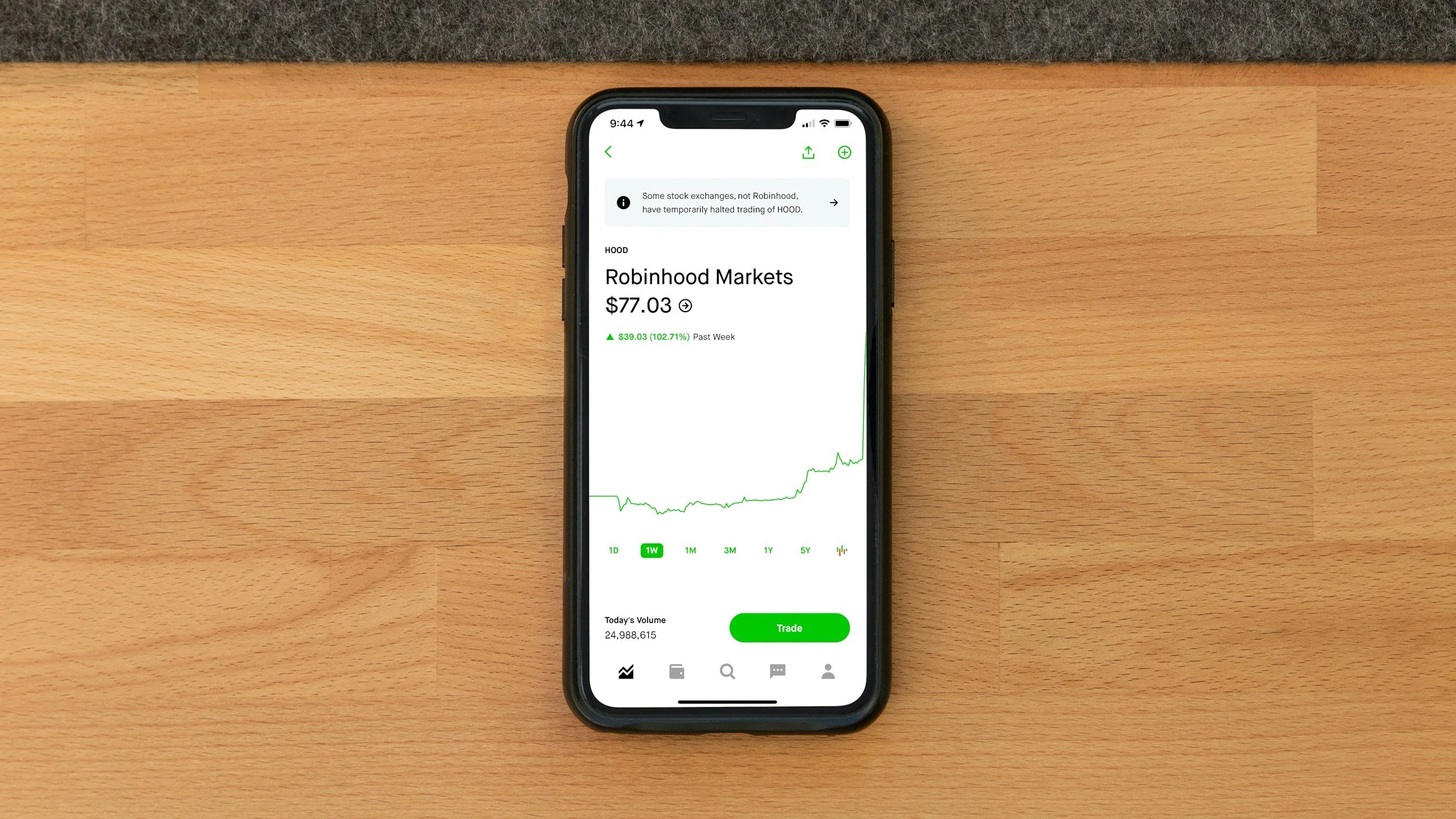
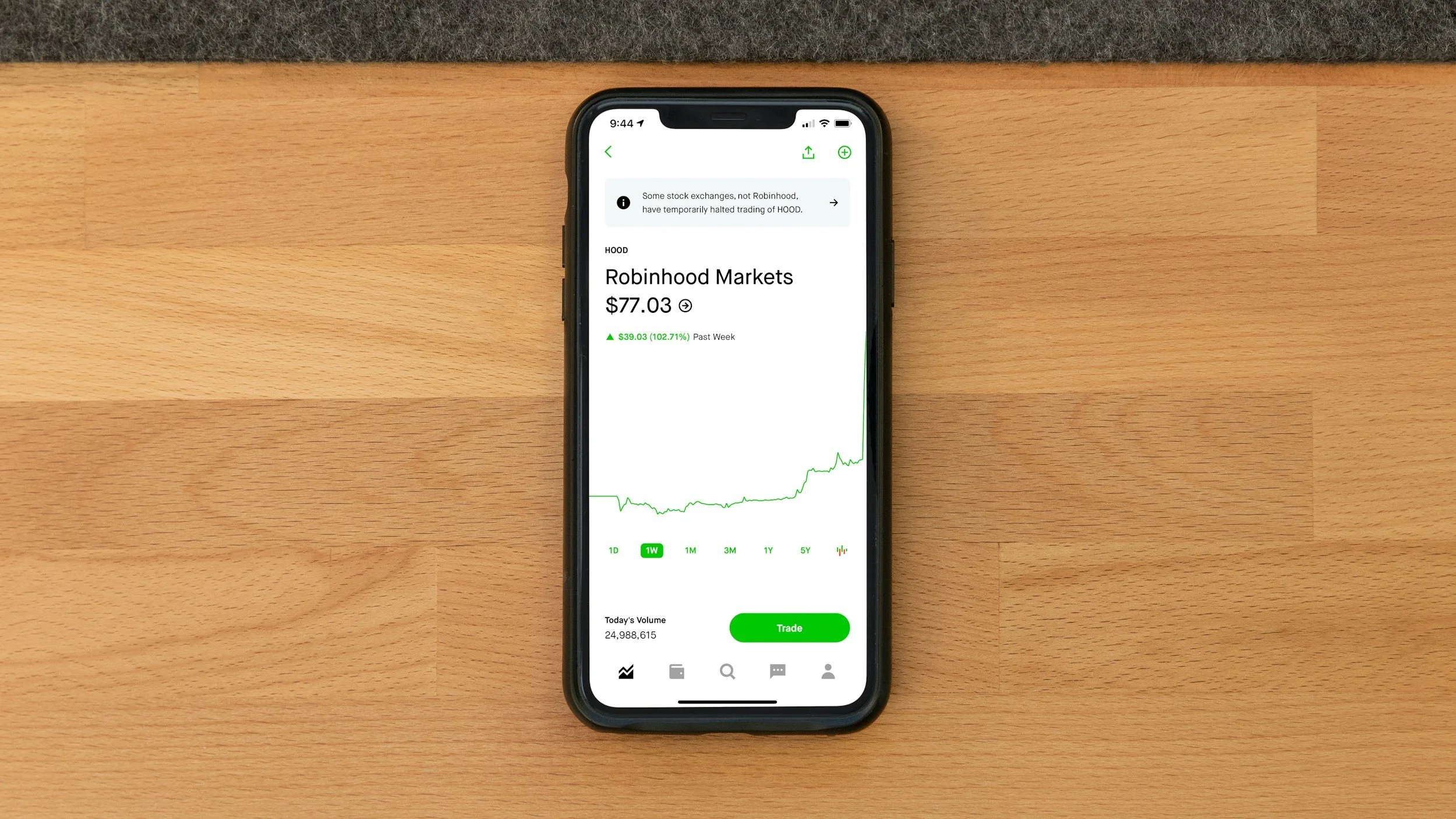
Providing Sound Advice in a World of Robinhood Investing
 

One of the interesting subplots in the finance industry during COVID-19 has been the rise of the day trader. Robinhood, an online brokerage and trading platform, acts as a proxy for many investors who are rapidly opening accounts at other brokerage firms including Charles Schwab, E*T, TD Ameritrade, Fidelity, etc.

Our firm works with thousands of employees via their company-sponsored retirement plans and has had many conversations end with a question/comment along the lines of, “What do you think of this Robinhood thing? Is it worth putting some money in there? Seems like (fill in the blank tech company) is making money! Should I buy some?”. So, I felt compelled to address the question(s) and provide some context around where a speculative trading account fits into a greater financial plan.

THE MAJOR PLAYERS

Source: Piper Sandler

Source: Piper Sandler

E*TRADE: more users opened accounts in the month of March than any full year on record.

Charles Schwab: 1 million new accounts so far in 2020.

Robinhood: 3 million users opened accounts in Q1 2020. For perspective, there have been 13 million accounts opened at Robinhood since its founding in 2013.

The GROWING appeal OF DAY TRADING

The barrier of entry has never been lower to open an account and buy shares of publicly traded companies. Because many individuals are at home, trading is as cheap and accessible as ever, and some firms have incentive offerings (like a free share of stock when you open an account). Pair that with the stock market reaching its low point for the year on March 23rd and having one of its fastest recoveries ever (in other words the last 5 months have been a winning proposition for many investors), and you get to the point where we are today.

YCharts1.png

Today could be a euphoric place for an investor owning stocks since March. To me, euphoria looked like TMZ coming out with a trading subscription service… yikes. Stocks have only gone up, and popular tech companies have led the way. Kudos to those who might have doubled their money on a company like TESLA, but the last 5 months do not paint a realistic picture of what investing looks like over the long haul.

the emotional rollercoaster of Owning single stocks

When talking about owning a single company, I like this example. Owning a company like Amazon over the last 10 years seems like a no brainer (today). If you had invested $10,000 10 years ago, it is worth over $268,000 today. However, when you see that over the last 10 years, an investor would have had to hold through down periods of -25% over 5 times to get to where the stock is today. In other words, the stock was down 25% of its high over 5 times. Holding a company through those periods can be difficult, emotional, and in my opinion, is an objective way of capturing what owning a stock (even one that has performed as well as Amazon) is like.

AMZN_chart (2).png
AMZN_chart (3).png

Investing advice for smarter day trading

Whether you are someone who has already played around, are thinking of dipping your toe in the water, or your ego is already as big as ever because you’ve been a successful trader for the last 5 months, here is some advice on what it looks like to invest in your long-term plan vs. speculating.

Boundaries, Boundaries, Boundaries: If you are going to buy a stock on your own, don’t have it impact your overall investment strategy and long-term plans. What does that mean? Invest a dollar amount that you would feel comfortable taking a 100% loss on.

A positive outcome can mean… many things: Recently the Winklevoss twins (yes those Winklevoss twins) were quoted saying that Elon Musk is going to mine gold on asteroids orbiting the Earth, thus decreasing the value of gold and increasing the value of bitcoin (I promise this isn’t fake). One scenario is that their theory is wrong but in the next 5 years, owning bitcoin could be a profitable trade. In the same light, if you have owned a technology company or a fund that tracks technology companies since March, you have probably made money. Does this make you the next great market predictor? Most likely not. At Human Investing, we have a saying "process over results". So, in these situations, whether or not your account is checking up on your process is equally or more important.

Trading Journal: If you are seriously interested in the market and having a brokerage account, a trading journal is imperative. If you have a prediction, write it down, track it, and review your track record. It’s not a bad idea to do this for a few weeks to test the waters before you open an account.

Small Losses Can Lead to Long-Term Positive Outcomes: Here’s a hypothetical, stay with me. You read this post, you open an E*TRADE account, and deposit $200. You end up buying a few stocks and start following the market. You are following investing influencers on social media, listening to podcasts, and even watching CNBC in the morning. Then life happens. You get a little bored, lose track of your password, reset your password, and lose track again (this version of you doesn’t have LastPass 😊). Six months go by, and you see that your $200 is now $50. As a byproduct of this experience, you realize that you are better off opening up a ROTH IRA at Vanguard contributing $100 a month into an age-based target-date fund because you now care more about retiring comfortably. Your $150 loss on your account made you realize:

  1. You are not interested in picking stocks and it isn’t easy.

  2. You educated yourself about the market, the benefits of a ROTH IRA, and moved the needle on helping yourself retire.

Time will tell if this Robinhood movement is a fad or a long-term trend. Either way, if you have questions, want to grab coffee via zoom and talk markets, or talk longer-term planning, our team is here to be a resource.

Other Articles You Might Enjoy On This Subject

* Inside Story On Robinhood

* WSJ video on Robinhood


Related Articles

There's Nothing She Can't Do
 
wfh-moms.jpg

Since Human Investing has shifted to remote work for 5 months, I wanted to peek into what daily life looks like for two of our fabulous and industrious moms. Shelly Chase and Eve Bell are candid, funny, and share some family tips!

JILL: Shelly, you are a seasoned Client Service Specialist, so how has it been working remote these past 4 months while managing your work and your family?

SHELLY: Multi-tasking is key! I’m never far from my computer while working from home, and when the “ding” comes in for an email or message (if I’m not right in front of it), it’s a sprint back to the computer so I don’t miss anything and reply in a timely manner. Of course, I sometimes trip over the dog….

JILL: That is a funny image! I’m sure all dogs—yours included—are wondering why we’re all home, and if it means they get more snacks. Eve, as our Workplace Advisory Administrator and young mom, you have also had a lot going on. What was your before- and after-work routine with your young daughter prior to COVID, and how has that changed?

EVE: Pre-COVID our nanny picked up our daughter every morning, and my husband and I took turns picking her up after work. We were in for a shock when we all went remote on March 15th. Having an active little toddler means my husband and I are re-evaluating routines every few weeks and upping our communication game. Our almost 2-year-old is home most days, so we have to communicate A LOT about our meeting and project schedules, work together to make adjustments, and have at least one parent watching out at all times, so that our toddler isn’t having a tea party with the dog’s food and water.

wfh-moms-eve.jpg

JILL: What a full plate, Eve! How long did you think you would be working remotely? I would love to hear your initial thoughts.

EVE: I thought it was only going to be for two or three weeks! I knew it was going to be a challenge, but I Pinterest-ed all the DIY toddler activities and bought a two-week supply of snacks (for both my baby and me).

SHELLY: I kept thinking how can I work from home and stay focused….kids’ noise, dog barking, FedEx knocking…how can I work from the dining room and keep my home life under control while serving our clients?

JILL: Let me say you each have done an incredible job and probably did not realize just how much strength you had within you to manage it all.Shelly, with summer in full swing and school on the horizon, how are you working through the options for schooling and what is top priority?

SHELLY: The top priority is what is best for my almost sophomore son. He did okay with ending the school year online, but it did take a lot of coaxing from mom to keep him on schedule and get his work done. It was recently announced that his school will be online until at least October 30th. I better brush up on my US History facts!

wfh-moms-shelly.jpg

JILL: I really admire you parents; whose kids are in grade school or high school. It’s not an easy feat to work and ensure your child learns new things and retain some of what they have already learned! You have seemed to weather this valiantly but being human, we all know we’ve had moments of struggle. What walls have either of you ‘hit’, what has been the biggest thing you have tackled, and how are you rising above it all?

EVE: The first wall I hit was trying to make a typical 8am to 4pm workday schedule work from the dining room table. Once I recognized that my workday would need to look and feel different, I began adjusting to new routines. As a result, both work and family life got a lot easier to navigate. And then prioritizing! I have had to dig deep, practice more patience, and become laser focused. It has been a funny balance of being super chill about some things (who needs an organized Tupperware drawer anyways) while also pushing myself to strategize and implement new ways to serve clients.

SHELLY: I have been really surprised so far. There has been no dead ends and no walls hit. I have tried to stay focused on doing my best to maintain the same work schedule at home as I did in the office. I am working a bit longer each day since I save time without a commute, but I also have more flexibility. I have grown more confident in my ability to be an earner, mom, maid, cook and as of recent, teacher. I remind myself all day long to take deep breaths and take a little time for myself by walking, listening to my favorite music, or making my homemade salsa.

JILL: Such great, practical advice and wise counsel coming from you both! Thanks for taking time out of your busy days to share your experiences with me. And Shelly, what about that homemade salsa recipe?

SHELLY: I am making it every day now and my family still loves it! It is simple and always delicious. I even think the title fits its appeal. I hope you all try it and add your own flair!

Click here for Shelly’s homemade salsa recipe!

Jill has spent over a decade at Human Investing honing her skills in the areas of service, administration, sales, operations and human resources. As a SHRM certified practitioner, Jill now puts all her past experience to work - ensuring that the Human Investing team is cared for and the operations run smoothly.

Eve helps clients navigate the nuanced and complex landscape of qualified retirement plans by providing plan design expertise and advocating for employers and their employees.

Shelly draws from her 20 years in financial services to uniquely care for clients while meeting the administrative needs of their accounts on a daily basis. She strives to always provide personalized, and honest, and up-to-date client service and plans to continue to love, care and serve our clients for the next 10+ years.


Related Articles

What Doesn't Add up With the Market Ups and Downs
 
Buckle up. Welcome to the rollercoaster ride of the year.

Buckle up. Welcome to the rollercoaster ride of the year.

Find me one person who predicted the magnitude and velocity of the recent stock market selloff and rebound, and I will buy us tickets to Vegas. In 74 trading days, the stock market lost a third of its value and subsequently rallied by more than 40%. (Another friendly reminder that short-term market prognosis is speculative.)

Through discussions of this market phenomenon with clients, friends, and family, I have discovered a disconnect in how investors interpret investment returns. Take the S&P 500 for an example:

From its high on February 19th, the S&P 500 slid by more than -33% over the next 24 market days 📉

Market+Low+3.23.2020+.jpg

Following its low on March 23rd, the market quickly gained in value by more than 40% 🤯

Market Rebound 3.23 to 6.03.2020.png

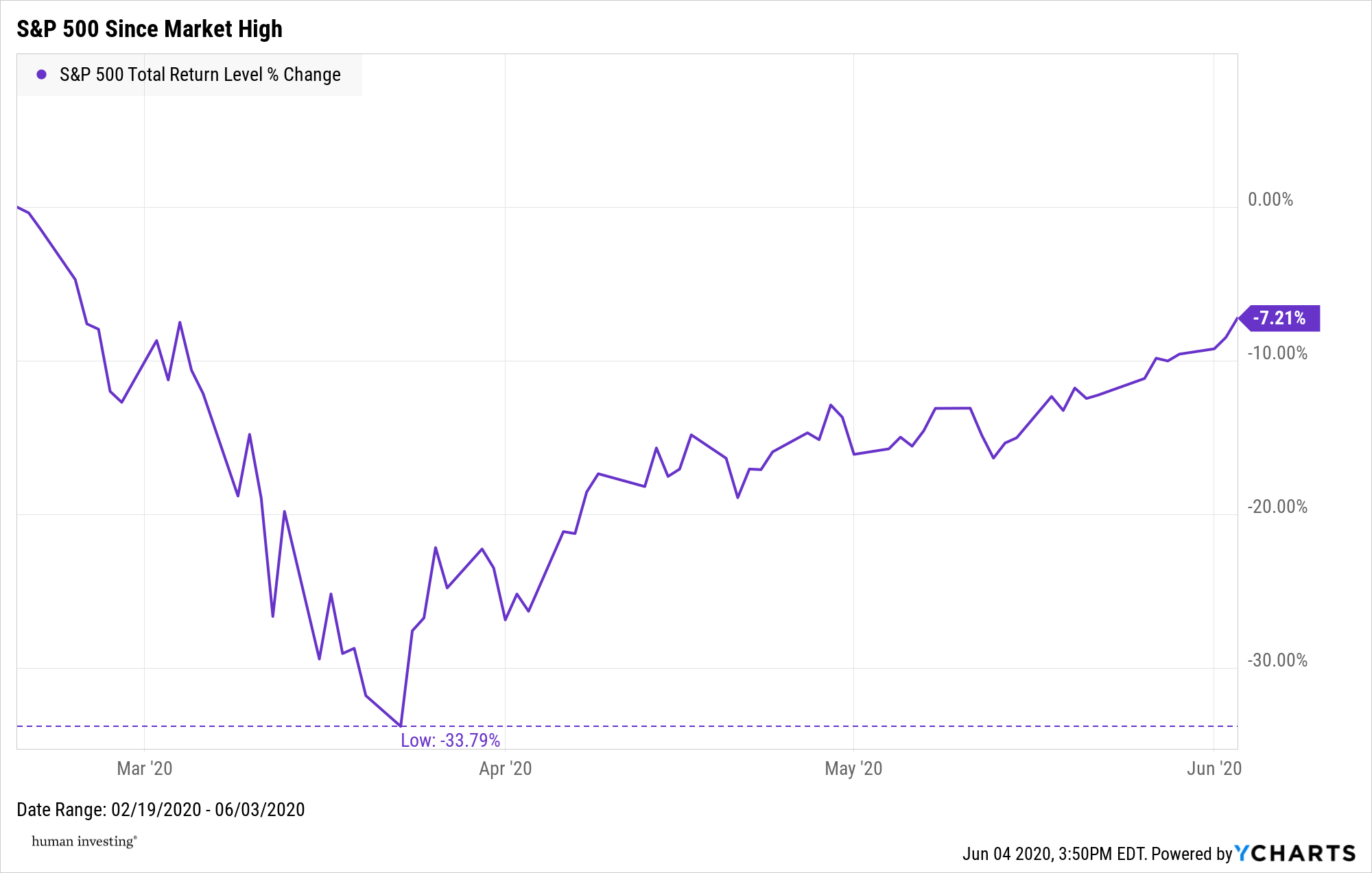
It would appear that as of June 3rd, the market would be up 6.35% for the year (-33.79% + 40.14% = 6.35%). However, this is not the case for our investment account statements.

The reality is that the S&P 500 was still down -7.21%.

Market 2.19 to 6.3.2020.png

Why? Market pullbacks will have a greater magnitude than the market rebound.

This is because the percentage loss experienced in the pullback is based on a larger value than the rebound percentage. Thus, not all percentages can be evaluated in the same way.

An easier way to understand this is through the following example:

Take an account valued at $100,000. Now cut the account value in half (-50%), and its value is at $50,000. What return is needed to bring it back up to $100,000? You would need to double your account (+100%).

So what percentage of growth is needed to make up for a portfolio or market loss?

  • A market loss of 1% requires a 1.01% return to get back to its beginning value.

  • A market loss of 5% requires a 5.26% return to get back to its beginning value.

  • A market loss of 10% requires an 11.11% return to get back to its beginning value.

As illustrated above, the greater the market loss, the greater are the market gains needed to recover.

In terms of the COVID-19 crash, a market drop of -33.79% requires +51.03% of market growth to make up for the loss incurred. 

*Note the exponential increase in the percentage gain needed to recover.

*Note the exponential increase in the percentage gain needed to recover.

In application, it is important to consider the downside risk of investments with regards to your financial planning needs. Investment downside risk can have a greater detriment depending on an investor’s timeline and cash needs. (See our article on sequence risk here.)

Both patience and an intelligently designed investment strategy are the remedies to market loss. In the history of the US stock market, no matter how great the loss, subsequent market returns have always lead to new market highs. This is a trend we expect will continue.


Related Articles


Managing Your Personal Finances Through a Crisis
 

Over the last 100+ days since the first US Covid-19 case, Americans have had to alter their normal way of life. For some, there has been little change, for others the change has been drastic.

The combined health and financial crisis can be confusing and difficult. Navigating personal finances during this time for many has been paralyzing. As an effort to help, here are some general considerations for you during this time:

Complete a proper assessment:

How is your job security? - Soberly assess your employment during this season where more than 30 million Americans have filed for unemployment since march. No one knows how long this economic disruption will last, so plan accordingly. Has your employment been displaced? See our guide to unemployment during Covid-19 here.

How is your emergency reserve? – For such a time as this we recommend that clients build and maintain an emergency reserve. A stockpile of liquid assets can be the best form of self-insurance. Most should plan to keep a minimum of 3-6 months of living expenses on hand.

How are your investment accounts? Should you make updates? Many states are recommending residence to "stay home." Stay home is not just wise counsel to help flatten the curve, but for many “stay put” should be their investment philosophy as well. A study conducted by DALBAR, Inc. found that investors change investment strategies too often to realize the inherent market rates of return. It is in volatile seasons like this where investors’ emotions run high and they make short term changes that will hurt their long-term returns.

Source: Dalbar. Past performance is no guarantee of future results.

Source: Dalbar. Past performance is no guarantee of future results.

“Have we already seen the bottom of the market?”

“Do you think the market will go down further?”

Consider the time horizon for your investment accounts. Make long-term investment strategies, not short-term speculations.

Know what resources are available to you:

Negotiate your bills – To reduce your expenses call your creditors and try to negotiate your bills. Lenders realize the financial stress many are under and are willing to work with you to create approved payment modifications. Learn how to negotiate your bills here.

Stimulus checks - 80 million Americans already received stimulus checks from the US Treasury Department via direct deposit earlier this month. If you are eligible but haven't received your stimulus dollars check on its status here.

Accessing retirement dollars - The recent CARES act has made it easier to access retirement account dollars through loans and distributions. Eve Bell shares how your 401(k) may be impacted here

Extended tax filing deadline - The due date to file your 2019 Federal and Oregon taxes has been extended. Luke Schultz, CPA answers questions on the stimulus bill and 2019 tax filing here.


What to do with excess:

If you are questioning what to do with extra cash, consider yourself lucky. Are you saving money without a commute, eating out, or childcare? Here are some considerations for what to do with extra cash:

Give - There are many people in need. Want ideas on how to give and to learn about the current tax benefits of doing so? See our post by Nicole Wilson, CPA here.

Build up your aforementioned emergency reserve.

Consider refinancing your mortgage - See our how to guide here.

Invest - As a part of your long-term investment strategy buy when the market is down. Global stocks are priced down to 2019 values. Will the market go down further? Maybe, or maybe not. Again, make long-term investment strategies, not short-term speculations.

VT_^MSACWITR_^MSWTR_chart.png

Both in a physical and in a financial crisis it is important to have a plan.

Be wise, panicked decisions can have long-term negative implications.

It is never too late to get your finances in order.


SOURCES:
https://www.dalbar.com/
https://www.irs.gov/


Related Articles


How to Give to Others During 2020
 
This photo was taken before flour and yeast disappeared from grocery shelves.

This photo was taken before flour and yeast disappeared from grocery shelves.

Love. Care. Serve.

Those were three words Pete Fisher repeated during my interview at Human Investing. So simple, yet so energizing. I left the interview hoping for an opportunity to join Human Investing, a Certified B Corp, but most importantly committed to finding a profession that would combine my analytical background with an opportunity to empower others. 

That is why I am here writing a blog about the ways we, as individuals, can give to others in 2020. If you are thinking of giving financial aid, there is good news for you. Specifically, in the last month, there have been updates to the tax code which expand charitable deductions for all taxpayers, including those who are taking the standard deduction and those who are itemizing deductions this year. In addition to humanitarian motivations for charitable giving, the changes to the tax code also provide financial incentives.

Give and lower your taxable income even more

This section is useful if you are interested in lowering your 2020 taxable income and donating some cash to help others. 

The CARES Act, which passed a few weeks ago, includes a $300 above-the-line tax deduction for cash donations to qualified charities in 2020. This above-the-line deduction is available for taxpayers who use the standard deduction, which is true for most taxpayers. See below for a visual on how this changes a single filer’s tax return:  

taxable-income-2020 copy.png

My advice for lowering your taxable income and donating cash to help others is the following: 

  1. Keep your receipts.

  2. Don’t forget to include the donation on your 2020 tax return!

Giving $300 might feel enormous to you, and de minimis for the community. Or it might feel de minimis to you, and impactful for the community. Just remember micro-actions lead to macro changes.  Your $300 will go a long way to help your community.

Good news for taxpayers using itemized deductions

The CARES Act also includes an incentive for those who itemize their deductions. In the year 2020, taxpayers can take 100% of adjusted gross income as a charitable deduction. Before this bill passed, itemized taxpayers could take up to 60%. Note: this rule only applies to cash gifts that go to a public charity. Cash gifts to private foundations are still subject to the 60% rule. 

Tax planning strategies

Our team of CFP’s and CPA’s is also thinking about more complex tax planning strategies these updates could have on your current tax returns. Individuals are limited to a $100,000 qualified charitable distribution (QCD) from their IRA account in 2020. However, the CARES Act includes financial incentives for taxpayers who itemize deductions that allows them to donate and deduct more than $100,000 from an IRA this year. For example, since Required Minimum Distributions are waived for 2020, individuals could still make a taxable withdrawal and give the cash to a qualified charity. This series of events completely offsets taxable income since there is a 100% charitable deduction this year. This scenario is specific for itemized taxpayers, but it exemplifies the cohesive planning strategies we can discuss to maximize benefits and minimize taxes.

Time is money

If you do not have extra dollars to make charitable contributions, please know there are other ways to give to others this year. For example, you can give your time. To quote my beloved mother, “children spell love T-I-M-E”. Whether it’s organized volunteer work or calling a distant relative, giving of your time is a generous way to donate to others this year. 

If you are feeling inspired, visit this article from the Washington Post listing numerous ways to help vulnerable populations throughout the nation. Let us know if you have questions about how to strategize 2020 gifts. We are here to love, care, and serve.


Related Articles

Panic is Not a Strategy
 
Nothing like having your morning coffee and talking to your cat about time and threshold rebalancing strategies

Nothing like having your morning coffee and talking to your cat about time and threshold rebalancing strategies

Last weekend, I was perusing the Wall Street Journal and stumbled across section B4 and B5 titled, “What Happens Next?”.  In it, the Journal interviewed five financial magnates about the market.  As many of those interviewed often do, they made bold statements and predictions for the future.  Knowing their collective predictive power is ZERO, many of us read along, believing these financial giants have a crystal ball.  This, my friends, is a terrible mistake.  It is a mistake for them to prognosticate, particularly now.  It is equally miscalculated for us to believe they know where the markets are headed, whether it be up or down.

A meaningful statement from the CEO of Charles Schwab

From my point of view, one meaningful statement came from the CEO of Charles Schwab, Walt Bettinger, who posits that “panic is not an investment strategy".  Mr. Bettinger, I so agree.  Think about times in your life where panic is useful in a crisis.  In reality, it rarely helps the situation get better and often makes matters worse.  So, what is the opposite of panic?  Words that come to mind are courage, calmness, peace, and composure.  When it comes to your financial situation, model the opposite of panic and chaos.  Be calm.  Get off your screen and evaluate your portfolio in the quiet of the early morning. Yes, with a cup of coffee or tea in hand.  Or, if you are a night owl (which I am certainly not), find some space once the kids are down to evaluate your plan and portfolio.  Be at peace and take a deep breath.  Be courageous, which may mean rebalancing your portfolio by selling quality bonds to buy quality stocks.  Yep, buy low, sell high.  Try being composed when thinking about money and ways in which a negative can be turned into a positive.  Call your local credit union or bank to see if they can refinance your car or house loan, as recently rates are at record lows.  Most importantly, collect yourself and find comfort knowing this too shall pass.

Over time, history has shown that global economies expand, and markets rebound.

However, nobody knows how long our current circumstances will last, nor do they see the direction the markets will head.  Take the extra time you now have to develop a game plan for getting your family through this crisis.  Getting through our current dilemma will require a measured approach to decision making. This includes the choices you make with your financial plan and money. In its aftermath, there will be plenty of opportunities to get back on track, as long as you keep yourself and your finances in one piece and do not panic.

Peter Fisher is the CEO of Human Investing, one of the largest and fastest-growing wealth management firms (Forbes) in the U.S.  He is the author of Becoming a 401(k) Millionaire and blogger at 450 publishing.  He received his B.A. in Economics from Linfield College, an M.B.A. from George Fox University, and is currently a 3rd-year Doctoral student researching financial literacy, and the concept of collaborative consumption.   


Related Articles