Posts in Retirement Planning
Is Your Debt Crippling Your Future Retirement?
 

We have all been told to save for retirement.  We need the “Magic Number” before we can retire.  What about having debt during retirement?  Most retirement planning calculators ignore debt and debt payments can limit the amount of future income and can wreak havoc on retirement.  A comprehensive financial plan considers debt in the retirement equation providing a tool and process to fully answer the retirement questions.

Studies Show Debt is Increasing for those Entering Retirement

More of us than ever before have debt going into retirement.  A study by Lusardi, Mitchell and Oggero entitled “Debt Close to Retirement and Its Implications for Retirement Well-being,” quotes numerous findings demonstrating that those nearing retirement have increased borrowing at all economic levels.  Based on a 2015 NFCS survey of persons from age 56 to 61, 37% had mortgages, 11% had home equity loans, 14.6% still had student loan debt, 29.6% carried auto loan debt and, 36.4% had credit card debt with a balance paying interest.  And more concerning, 23% had what they called, “expensive credit card behavior” meaning, “paying the minimum only, paying late or over-the-limit fees, or using credit cards for cash advances.”  

Debt Pre-Retirement.png

Debt is a Presumption of the Future

When we take out debt, we presume that we will have future income that will both cover living expenses and the additional payments we promise to make.  We effectively reduce our future income.  For the retiree with adequate income and assets, debt might be okay.  The retiree that has cash in an account to purchase a car that takes a no interest loan might come out ahead.  And at any time, they have the power to pay off that debt.  However, often debt is a decision that can cripple future living.

Debt in Retirement Limits Lifestyle

Of course, a debt payment means higher total expenses, but it doesn’t stop there.  Debt usually means more expense due to the added interest.  Additional debt and interest require higher retirement distributions.  Higher distributions from IRA accounts increase taxable income and can increase the likelihood Social Security income will also be taxed.  And for many, the result of the compounding expenses due to debt eventually lead to the need for a cut to lifestyle and live on less. To the 23% with “expensive” debt behavior in the study, even more expenses come due to late payments and higher interest costs which further the cycle of limits on lifestyle.

Financial Planning Answers the Questions

While some debt might be considered “okay”, most we know is not.  How do we know?  The answer comes in a financial plan.  It pulls together all the other pieces of the story and provides a structure to answer the question.  A financial plan provides possible options, strategies and answers.  It is a tool and process that fully answers the retirement equation.  Do I have enough for retirement, including debt?
Want to create your financial plan today?


Related Articles


Female Baby Boomers and Retirement: A Status Update
 

Although the front end of the baby boom generation is well into retirement, we are still 10-15 years away from the final boomers to hit retirement age.  With this in mind, we wanted to take a look at this cohort and highlight the research specifically aimed at women.  You may be surprised by the uphill battles they’ve faced over the last few decades.

Limited Career Choices and Gender Bias in Retirement Policies

Although Baby Boomer women were far more likely to go to college and get a job than the previous generation, the concept of “acceptable” careers for women often pointed them toward work with lower compensation.  As a result of these lower paying careers, women had less money to defer into retirement accounts than their male counterparts—if they chose to defer funds at all.

Also, due to part-time work and lower wages these women are looking at significantly smaller Social Security payments in retirement.  This may leave many women either dependent upon a spouse or relying on Social Security and personal savings.  This, coupled with less time in the workforce due to pregnancy and child rearing, has left many female Baby Boomers at a great disadvantage.

Individual Responsibility and the Psychology of Saving

Another challenge facing female Baby Boomers is the fear of risk and the perception that money is something that should be left to men.  The latter mindset may have led some women to leave retirement planning and budgeting up to their spouses.  Couple this with a lack of individual responsibility on the parts of both men and women in this generation, and we are left with a big problem. 

According to several studies conducted in the mid-nineties (O’Neill, 1991; Twentieth Century Services, 1994). Hayes and Parker (1993), Kadlec (1994), and Pope (1994), the Baby Boomer generation was shaped by a more affluent lifestyle than their parents.  They enjoyed a higher median gross income and higher free spending limits.  Additionally, since Boomers are a generation detached from the Great Depression’s influence on the importance of saving, many have more reliance on Social Security for retirement and simply have not saved enough.

Risk Averse and Under Educated

Research dating back to 1994 and prior (NCWRR) found that women tend to be conservative, low-risk investors.  At the time of these studies, 72% of the women who saved chose investments that provided only marginal returns.   In order to keep up, women now need to be willing to take more risk in their investments.  This is counter intuitive to how many women of this generation were raised and educated.  To compound this difficulty, many financial advisors and brokers assume women want less risk and therefore fail to do the planning and education needed to help their clients see the risk-reward return and to understand a pace of investing that keeps up with inflation. 

How We Can Help

In our work over the years with married, divorced or never married women, the answer always seems to be the same: Advisors need to understand their client’s biases, feelings, and fears about money and retirement.  We need to make a concerted effort toward financial literacy and, most importantly, to provide a solid, comprehensive financial plan.  Education and planning enable our clients to see the impact of their spending, savings, and the aggressive/conservative balance of their investments. 

At Human Investing we accomplish this through our process called hiPlan.  The hiPlan goal is to give our clients the peace that comes from the stability of a plan that enables them to live out the retirement they have worked hard and dreamed about.


Closing The Gap For The Retirement Haves And Have-Nots
 

This article was originally published on Forbes.

Shutterstock

Shutterstock

The Employee Retirement Income Security Act (ERISA) was established in 1974 to give employees retirement income security. Why, then, after 40-plus years, are Americans so underprepared for retirement?

According to a 2015 study from the Government Accountability Office, "About half of households age 55 and older have no retirement savings (such as in a 401(k) plan or an IRA)." Even those who have saved have saved poorly. Among those households of residents ages 55 to 64 with some retirement savings, the median amount saved is $104,000. For those 65 to 74, the amount is roughly $148,000 per household. And, with 70% of the civilian population having access to a retirement plan and 91% access for government employees, it’s a wonder there is such a lack of retirement readiness.

There is no shortage of financial and intellectual capital being spent on a solution for retirement readiness. But most solutions have fallen short of narrowing the gap between the retirement haves and have-nots. So, what is the solution? My thoughts follow:

Government Plus Employer Plus Employee

First, the government is already involved in the regulation of retirement plans, as well as allowing for employers to deduct the expenses of having a plan, so why not go all in? Why not tell employers, “If you are going to get the deduction, you need to meet certain requirements that are great for employees, great for your business and great for our country”?

Those requirements could include auto-enrollment (as this has been a home-run for participation), auto-increase (as individuals get raises, they add a little more to their retirement) and an eligible age-based default option (eligibility for a great default option would be low-cost and diversified as you get from the likes of popular mutual fund providers with their index retirement glide path funds).

In order to qualify for a business deduction or incentive from the government, an employer would be required to match a certain amount. I’d propose 5%, with the employee required to commit 5% to get that amount. Why these amounts? Because if someone has a job for 40 years and invests in a basket of mutual funds growing at or around 8%, with both the employee and employer contributing at 5% each, they end up a millionaire (assuming a $36,000 annual salary, or $300 per month contributions, compounded monthly for 40 years.)

The Industry

In a recent Society for Human Resource Management (SHRM) study, more than 70% of HR professionals surveyed emphasized the importance a retirement savings plan. So, at a minimum, employees are aware of the need to save and desire to do so. While there is definitely a need amongst employees to save for retirement, there are several barriers that impact participants interest and willingness to save. First, trust among advisors is low. Second, many plans have a dizzying array of options, which negatively impacts deferral rates. Finally, not all employers offer to match contributions, which minimizes the incentive for employees to contribute to the 401(k) versus less automated choices, like an IRA.

So, what can the industry do to partner with employers and their workforce? There are two things in my view:

1. Understand the heart of ERISA. Advisors and their firms are to put the interests of the employee and their income security at the center of everything they are doing. If, somehow, the advice we are giving in any way conflicts with the employee and their security, then we should reassess what we are doing and meet the stated purpose of ERISA -- it doesn’t need to be any more complex.

2. In order to minimize the potential for anything but the fiduciary standard, any firm operating in the retirement space should be required to be a fiduciary and have no ability to be dually registered or receive commissions, kickbacks, trips or any other super-secret benefit.

Join the small percentage of firms that are truly fee-only and have no way of receiving any form of compensation other than from the client. Disclosing away conflicts is not the answer for the clients, as few read the disclosures they are provided. If we are going to serve clients well, eliminating the ability for the conflict to exist is the only reasonable route to go.

In conclusion, the government is already involved in both rule-making and incentives for companies and their employees to offer and invest in retirement plans. A model for offering a retirement plan that meets certain criteria in order to fully receive the incentive should be outlined and adhered to by companies and their employees. In partnership with the government, employers and employees, the financial services community should be held to a higher standard to eliminate the conflicts that keep retirement plans for becoming all they could be, which is for employee retirement income security.


Related Articles

Setting Your Mind Toward Savings
 
Highway 212 by Matt Duncan

Highway 212 by Matt Duncan

While working with employees at retirement plans over the years, one thing I’ve realized is that being disciplined to save for retirement is challenging and there are many obstacles to doing it successfully. For those living the northwest, saving for retirement can be particularly hard due to the average wage vs. the cost of housing.

Income vs cost of living

When thinking about specific clients that truly save well, regardless of income, a theme that I see is all of these people have a specific mindset towards saving and understand how to achieve short term and long term goals. Over the past month I’ve had a few things cross my life about perspective and goal setting that I wanted to pass along:

First order vs. Second order consequences

A book that I’m in the middle of listening to is by a famous investor Ray Dalio who is the founder of Bridgewater Investments, the largest hedge fund in the world at 160 billion. Dalio, is one of the most successful investors of our time and has some truly unique ways of managing his team and thinking through problems. One passage that really stuck out to me is:

“I’ve come to see that people who overweight the first order consequence of their decisions and ignore the effects of second-and-subsequent-order consequences rarely reach their goals. This is because first-order consequences often have opposite desirability’s from second order consequences resulting in big mistakes in decision making. For example, the first order consequence from an exercise plan (pain and time spent) are commonly considered undesirable, while the second-order consequences (better health and more attractive appearance) are desirable.”

This principle holds true for investing towards retirement as well. By saving a $100/month for their future, a person is giving up something today (coffee, vacation, entertainment) in order to have a more desirable retirement. In other words, this is a first-order consequence and second order consequence type of decision. While this concept is not a unique one, I’d never heard it explained this way and it resonated with how I view decision making.

What’s your “This” in order to get “That”

A friend of mine made the comment a few weeks back “Has your company done the whole let’s set goals for 2018 and never check back in on them again movement?” Unfortunately, corporate goal setting has that stereotype. Often, because it’s true. Luckily our company has Jill, a mother of four and a low tolerance for time wasting activities. She recently implemented a quarterly system for goal setting and tracking. Our team has high hopes for this new system and we’ll ultimately see how it goes. My big takeaway from our time talking about goals was the video she presented by Dr. Henry Cloud called “Start Small”. In this video he speaks to how we all want to get to the big goal but have a hard time setting and sticking to smaller goals.

For some of the guys in our office this meant going on the TB12 diet plan to prepare for our upcoming middle aged athletic endeavors (for me my city league basketball team starting in late January. Wish me luck!).

For you, similar to the Dalio piece, maybe this means looking at what your long term goals is (i.e. having X amount of money at retirement) and shrinking that down to what do I need to do this month/this week in order to get a little closer to that goal.

At the end of the day, the phrases “mindset” and “goal setting” can sound really cheesy, and when done poorly can lead to nothing. However, when we look at our collective social circles and see people who have reached their goals (whether those be physical, business or relationships) often times they are using mindsets like the ones Dalio and Cloud are talking about. Hopefully these can be somewhat inspirational when it comes to putting away additional funds towards your savings goal.

If you have questions or would like to have a conversation about your retirement plan, please don’t hesitate to email or call our team!


Related Articles


4 Reasons for Delaying Social Security
 

Over 50% of us take Social Security before “Full Retirement Age”… and over 90% take Social Security by “Full Retirement Age”.

What age are we taking Social Security?

steve-blog.png

Munnell, A and Chen, A, “Trends in Social Security Claiming”, May 2015, Center for Retirement Research at Boston College, from http://crr.bc.edu/briefs/trends-in-social-security-claiming/

What is “Full Retirement Age” and are 90% of people right?

Full Retirement Age or FRA is the age an individual can take their full Social Security retirement benefit without a deduction.  Depending on your age this is between 65 and 67.

While the FRA to take Social Security is between 65 and 67, we can take Social Security as early as 62 with a reduction in benefits.  48% of women and 42% of men take their benefit at age 62.  Is this a good idea?  If your FRA is 67, by taking your benefit at 62 there is about a 30% reduction in your benefit for your lifetime.  If you were normally to receive $2,000 a month, by taking it at 62 you would receive about $1,400 a month for life not including cost of living increases.  Over time, this is significant.

Consider these 4 reasons for delaying Social Security:

Higher Income

If you wait until 70, your monthly benefit is significantly higher. If your FRA benefit at 66 is $2,000, then waiting until 70 will provide a benefit of $2,640.  You will receive an additional $640 each month for the rest of your life plus the cost of living increases.  If the $2,000 covers basic expenses, the additional $640 per month of discretionary income can be significant to an enjoyable retirement.

Survivor Benefit

If you are married, this applies to you.  When one spouse passes away the survivor gets the higher of the two benefits and loses the lower benefit. Having the spouse with the highest Social Security benefit wait until 70 can drastically improve the life of the surviving partner.  If you both take Social Security at FRA with one at $2,000 and the other at $1,200, when one passes the remaining spouse will lose $1,200 a month and be left with only the $2,000 benefit.  Waiting until 70 for the spouse with the higher benefit of $2,640 may significantly improve the life of the remaining spouse.

Less Taxes

Social Security is not subject to tax the same way as your earned income. How much tax is paid on Social Security dollars depends on total combined income and differs from an individual to a married couple filing jointly. Whichever your situation may be, Social Security benefits are taxed either up to 50% or up to 85%. In any case, it is never taxed at 100% of the benefit. And waiting to receive your benefits until 70 may benefit the overall tax you pay. Always check with a CPA to confirm your specific numbers.

More Money

Most people will receive more Social Security dollars by waiting until 70 (If they live beyond 83.) Or if married and one of you live beyond 83, you will likely have more total dollars by waiting until 70. Additionally, if you live a long life, you will receive significantly more total dollars in retirement. This is due to the significantly higher Social Security benefit amount received by waiting, coupled with potentially lower income taxes.

Personally-saved retirement income is the base for many people’s retirement budget.  If portfolio assets run out or are greatly reduced, a higher Social Security benefit can drastically impact later years of retirement to fill the gap.

Higher income, survivor benefit, lower taxes, and more money… 4 good reasons to consider waiting past full retirement age to take your Social Security benefit.

Each person, each couple is unique

There is no one size fits all in retirement planning and the ramifications of the decisions made here are significant.  The questions you ask as you invest and then begin to plan towards retirement may be some of the most important, such as: what are you investing in and what are you taking your Social Security for? It's worth your time and finding trusted partners to help you navigate. At Human Investing these are the very questions we help people work through everyday for their "today's" and their "tomorrow's."


Related Articles

Making the Most of Your Social Security Benefit
 

The more I work through financial planning scenarios with individuals and families the more I realize how important it is to have a clear understanding of your social security benefit. A study in 2014 showed that 55% of retirees defined social security as their main source of retirement income and 88% responded saying that social security would need to be a steady source of income in order to meet retirement goals. These numbers make perfect sense due to longer lifespans, increased healthcare costs, and corporations using 401k accounts rather than pension plans. Now more than ever, it is becoming necessary to have a steady stream of income that has the ability to last the rest of your life.

The goal of this post is simple; equip you with tools on how to best take advantage of your Social Security benefit. See below for three things to consider when looking to get the most out of a program you’ve been paying into your entire working career:

1. The Waiting Game

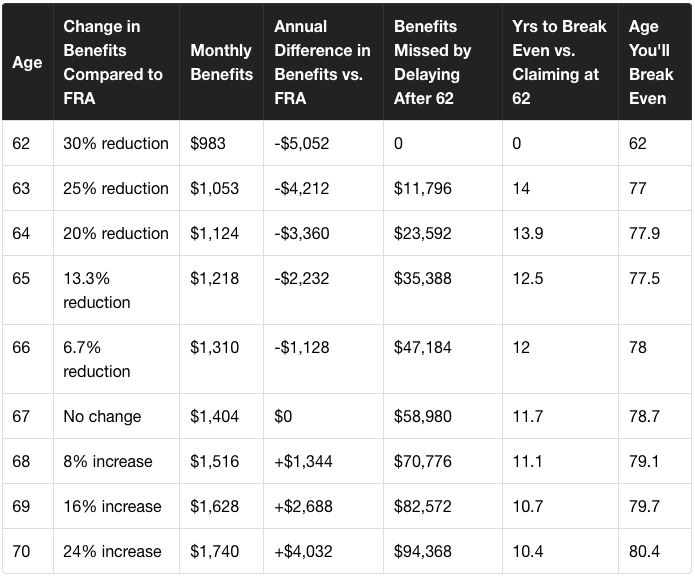
Generally speaking, you’re eligible to receive 100% of your Social Security benefit at your full retirement age (FRA) which is currently between the ages of 66 and 67. If you decide to claim before your FRA, the benefit amount will be reduced. For each month you delay claiming Social Security your benefit increases until you reach age 70. If you were born between 1943 and 1954 here’s an illustration that provides some context to your benefit percentage:

Social Security.png

Notice that between your FRA and age 70 your benefit increases at a rate of 8% per year. This is risk free rate of return that you receive just for delaying your benefit. Note that investors in the stock market who have the potential to lose 10% of their money in a given week are very pleased with an 8% rate of return in a given year!

2. Finding Break Even Points

Once you have an understanding of why it might make sense to wait to take your benefit, combine that with a knowledge of your personal health and family history, and you're ready to make an educated guess regarding when to take your benefit. Below are a couple key numbers to keep in mind.

Between 77 and 78

Is the age where an individual who files at FRA today catches up and exceeds the age 62 filer in total money collected. Also remember that the FRA filer has higher monthly payments going forward so the gap is only going to increase.

Between 80 and 81

Is the age where an individual who files at age 70 catches up with and exceeds the age 62 filer in total money collected.

Between 82 and 83:

Is the age when the age 70 filer catches up with and exceeds the FRA filer in total money collected. Many variables can factor into these equations such as; taxes, employment status, and other financial considerations. While I encourage you to dig into these calculations on your own, make sure to consult a financial professional (like Human Investing) when making these decisions.

3. Additional Income and Social Security

While there are many things to consider when filing for Social Security don’t forget how other income affects your benefit. Many people that I've spoken with about this issue commonly confuse "keeping" your benefit at FRA vs. "being taxed on" your benefit at FRA. The short of it is once you reach FRA you can keep all of your benefits, but you can also be taxed on those benefits contrary to what some people think. See below for a summary on the differences between keeping your benefit and being taxed on your benefit when accounting for additional income:

  • If you work, and are full retirement age or older, you may keep all of your benefit, no matter how much you earn. If you’re younger than full retirement age, there is a limit to how much you can earn and still receive full Social Security benefits. If you’re younger than full retirement age during all of 2015, the government must deduct $1 from your benefits for each $2 you earn above $15,720. If you reach full retirement age during 2015, the government must deduct $1 from your benefits for each $3 you earn above $41,880 until the month you reach full retirement age. This brochure provides some additional commentary on how working income factors into your benefit.

  • Some people have to pay federal income taxes on their Social Security benefits. This usually happens only if you have other substantial income (such as wages, self-employment, interest, dividends and other taxable income that must be reported on your tax return) in addition to your benefits. This link provides some more details on the taxes you pay on your social security when factoring in other income. Lastly, this web page gives the best example I've seen when factoring in taxes and Social Security.

By looking at the advantages of waiting to take your benefit, some break-even points, and tax strategies for social security hopefully you see that it takes time and effort to make the most of your benefit. It’s possible to literally leave tens of thousands, if not hundreds of thousands of dollars on the government's table if you’re not thoughtful in how you receive this benefit.

So, if you have questions on your Social Security benefit and how it affects your retirement timeline, feel free to email or call Human Investing at any point. We’d love to partner with you in making the most of this benefit.


Related Articles

Paying Off Mortgage vs. Investing in Your 401k
 

During my time leading our participant education efforts for the retirement plans we manage, I’ve received all kinds of questions. Questions ranging from, “How do I start a 401k?” to “What’s the best way to consolidate my student loans?” However, a question I’ve gotten more frequently is:

“If I have the ability to save more, should I pay off my mortgage or should I put more towards retirement saving?”

I feel like this question has been on people’s minds as our economy has made a nice recovery since 2008. For people I’ve talked with, the question has come up due to a change in financial circumstances such as; an inheritance or some form of windfall, the sale of a home, or a recent bonus. Regardless of the circumstances, these individuals have been sitting on this money in low interest rate saving accounts and are looking for ways to have their money work harder for them. While there is no all-inclusive answer, I’ll do my best to outline some of the pros and cons of paying off your mortgage/making additional payments or saving more toward your retirement account.

Your home.

You will not change the value of your home by contributing more to the mortgage, or even paying it off. If your house is worth $350k, it’s always going to be worth $350k until the market determines otherwise. When you put more money into paying off your house, it’s not doing anything to change the value of the house…you’re basically putting money into an illiquid asset that you can only access when you sell the home or take a HELOC.

Additionally, your house is most likely financed at a low/tax-deductible interest rate. Your interest rate might be in the 4.5% ballpark. With your tax deduction, you’re most likely paying a real interest rate of 3% to 3.5%. That’s pretty cheap money. If interest rates were much higher (like in the 8% to 9% range), then it would be a different story and paying off your mortgage might make more sense.

Investing.

When putting money into a long-term retirement account and investing appropriately, you’re building an asset that can grow at 9% per year, using the S&P 500 as a benchmark, over a long period of time. By putting money in, you’re actually giving those dollars the ability to grow over the years. Unlike putting money into your mortgage, your deferrals will directly affect the type of return and the growth of that account over time. So, the more you put in, the more you will get out in the end.

Example: Keep in mind that nothing you do, except making updates to your home, will increase the value of it. Compare that with an investment/retirement account. Let’s assume there are two different people…one has been putting a fair amount of savings in their retirement account, the other has contributed a much smaller amount. For the sake of the example, let’s call them Kelly and Chip.

Kelly has a $110k account. Chip has a $10k account. It’s 2014 and they are both invested in the Vanguard Target Retirement 2040 fund. The return on that fund in 2014 was 7.15%.

So, to start 2015 and without additional savings, Kelly now has an account worth $117,865 and has gained $7,865 just on return alone. Chip now has an account worth $10,715 and has gained $715 on return alone. Both are good, but Kelly is setting herself up to have a suitable retirement account. By the way, if we assume that neither Kelly or Chip contribute another dollar to this account forever, in the year 2040 (assuming an average 7% rate of return per year) Kelly will have an account value of about $640k, while Chip will have an account worth about $58k. That’s a huge difference! Personally, I’ll take the investment accounts over paying off my mortgage a few years earlier.

Regardless of your views on this specific question, know that if you’re wrestling with anything retirement account related feel free to reach out by phone at 503.905.3100 or email 401k@humaninvesting.com anytime. We would love to connect with you!


Related Articles

Hiking and Retirement
 

A transplant to the Northwest, I recently developed a penchant for hiking. It’s necessary to point out the fact that I’m not a native of the Pacific Northwest, if only to highlight the amount of wonder that I experience every time I venture beyond the city limits. For me, every step reveals something new and exciting that I never encountered in the Midwest. Hiking in Ohio is quite literally a walk in the park compared to the trails out here, and I’ve learned the importance of being organized and prepared. Not long ago, I was packing for a trip to Mount St. Helens, going through my checklist, and my thoughts turned to retirement planning. In part because I knew that I had this blog to write once I returned, but also because I’m actually passionate about the subject. Much like hiking, planning for retirement requires some forethought and strategy. With that in mind, here are my top three hiking/retirement planning tips!

Don’t lose sight of the trail while hunting for Sasquatch...

We’re often asked, “what is the best investment?” This is a simple question that warrants a complicated answer because factors like age, risk tolerance, and estimated retirement date can all influence an individual’s investment strategy.

The Putnam Institute completed a study in 2012 that showed the impact of selecting the top performing investments quarter over quarter (labeled the “crystal ball strategy”) vs. increasing your savings rate. The study revealed that while the crystal ball strategy yielded a higher account balance than the base case, a 1% increase in savings rate “had a wealth accumulation impact 30% larger than the crystal ball fund selection strategy”. In other words, we can’t always control selecting the “best” fund, but we can control how much we save.

I’m not saying that we should stop trying to invest well, (or that we should stop hunting for Sasquatch for that matter). I am suggesting that focusing too much on finding the best investments, can distract from other facets of retirement planning that are just as important.

Quality gear is worth the extra expense...

The retirement planning side of this tip is that saving more now, will greatly impact your savings in the long run. This is something that we all know, but it can be difficult to commit to increasing your savings rate until you see the actual numbers. For example, saving in your 20’s and 30’s has a greater impact on your lifetime savings than saving later in life. Due to, compounding returns, someone who saves $4,000 a year from age 30 to age 40 will end up with a greater balance at 65 than someone saving $4,000 a year from 40- 65, assuming a 7% rate of return. I know that statistic seems hard to believe, but check it out, it’s true!

There’s always another mountain...

It’s important to remember that the day you retire isn’t the end of your journey. A 2012 CDC study reported that life expectancy is 78.8 years, which is up from 70.8 in 1970. The point being, often times when transitioning into retirement, retirees feel the need to preserve their “nest egg”. When in reality taxes, inflation, and health care expenses are eating away at their savings. By recognizing the dual purpose of retirement accounts; providing cash flow and growing for the future, you can climb the mountain right in front of you while also planing for the ones on the horizon.

Have questions about the transition from retirement savings to retirement income? We can help with that!

Dog-Mountain-300x225.jpg

As far as the hiking goes, it’s going to take a long time for me to see all there is to see around the Pacific Northwest. Personally, Dog Mountain (seen on the right) is one of my favorites.

You should also note that if you’re hiking in the rain, “windbreaker” does not equal “rain jacket.” I may or may not have made that mistake.

Call or email us at 503-905-3100 or 401k@humaninvesting.com


Related Articles