Posts in Financial Planning
A Bird’s Eye View of Today’s Tax Rates

“In this world nothing can be said to be certain except death and taxes” – Benjamin Franklin.

HERE’S A SNAPSHOT OF HISTORICAL TAX RATES

Historical Highest Marginal Income Tax Rate.jpg

You can compare 2020’s highest marginal income tax rate to years dating back to 1913. Although this chart is not an all-inclusive story about someone’s individual tax situation, it does suggest that overall tax rates are lower today than they have been in the recent past.

How to Take Advantage

The current tax rates are locked until December 31, 2025, unless there is an update to the Tax Cuts and Jobs Act (TCJA). Without a crystal ball, we do not know where tax rates are heading. However, as this image illustrates, we do know tax rates can increase in the future. 

One way to take advantage of today’s low tax rates is to utilize accounts like a Roth IRA or saving Roth inside your 401k plan.

Do you have questions?

We know that interpreting the tax code is an unpleasant and complicated experience. We have a team of CPA’s at Human Investing who are ready to answer any questions you may have.


Related Articles

How to Build an Emergency Fund
 
andrik-langfield-ujx_KIIujRg-unsplash.jpg

“You need to make more money…”

My budget coach and I sat there silent in the face of what seemed like an impossible reality.

For me, and perhaps for some of you, the option to make more money was laughable.  At that life stage, I was in the midst of a financial tornado: our nation’s economy was hung-over from the market crash of 2008, my employer at the time lost a grant that substantially reduced my paycheck, and an unexpected illness and injury lead to weighty bills and rendered additional work next to impossible.

Each month I felt like I was scraping up pennies just to make ends meet – Maybe some of you feel the same today.

Unavoidable realities like a job loss, illness, injury, and accidents are financial burdens that most of us will face at some point in our life.  The support of a funded emergency savings account is a solid way to ease some of the financial blows that come our way.

I am happy to report that, though it took some time and sacrifice, I was able to meet my “impossible” goal to have a funded emergency-savings account, and I would like to share with you some of the helpful tips I learned along the way.

organize where your dollars are going

There is a link between paying attention and success, so consider paying close attention to where your dollars are going.  List all purchases, spending, and expenses for the month and ask: What, When, How Much and Why are dollars leaving my account?  What are the “surprise” expenses?  Take a moment to consider needs vs. wants.

Next, (you may have guessed it—and even groaned) consider making a budget. If you hate dealing with money or do not even know where to start, there is HOPE!  There are many creative ways to budget that do not take a lot of time or effort but help you to pay attention and stay on track.

  • If you don’t have a budget consider: YNAB; Mint; Cash Envelope System (or digital); The  50/30/20 method, value-based budget, or unconventional alternatives such as a visa cash card loaded weekly/monthly with your budgeted amount.  I found success with the 50/30/20 method combined with the envelope system.

  • If you do have a budget, look closely at the How Much and Why.  Consider setting a goal to check on your spending and expenses once a week and ask:  How am I doing?  What can I change to improve?

Open a Savings Account and Set Goals

This is not just wishful thinking – it is preparing to succeed.  Many financial institutions will allow you to open a savings account simply and easily online.

Here are a few recommended examples for high yield online savings:

For most households, an appropriate emergency-savings buffer is three-months of your living expenses.  Write it down.  Take a moment to imagine that amount and how you will feel when you meet your goal.

Set a goal: Ask your employer about directing a portion of your paycheck directly to your savings account.  An alternative is to set monthly, automatic transfers from your checking to your savings account.  It is generally best to have this occur the day after payday to give your funds a day to settle.

Setup auto-deposits: This also may help with large, annual bills.  Take your annual bill and divide it by twelve – this is how much you need to save every month to pay for this bill outright – Plus, you may actually save money when you pay in full!

Boost your savings when that “Free Money” comes your way

You just got your tax return.  You just got a stimulus check.  Your grandma just sent you a birthday card.  Your company gave you an unexpected bonus.

Your heart, your peers, and your social network cheer:  Treat yourself!

It is easy to think of unexpected cash as “free money.” Yet if your goal is to build up an emergency savings fund, “free money” is a great way to get a big boost.  To satisfy that itch to have a treat, consider making a deal with yourself:  I will set aside 20% (or $20, or whatever you feel you can stick to) into my savings account, and the rest I can use for a treat.

If you plan for your treats and stick to your plan, you gain a double reward.

hustle and Ask for deals

While it may not be a benefit to bundle in services you will not use, it is a wise idea to call your service providers to ask about unadvertised promotions.  Our household was able to keep our high-speed internet bill at $30/mo for nearly 5 years by calling once a year to ask about current promotions, specials, and loyalty rewards.  This annual phone call saved a total of $240 per year.

Tighten Your budget’s Belt

Unsubscribe: Do you know how much you really spend on your subscriptions? Look at your credit or debit card statements for a few months and see what you find.  Often, we sign up for a free month trial and forget to cancel, we don’t notice the $50 because it’s billed annually, or we don’t actually use what the subscription offers.  

Take what is free: Did you know that most libraries have free audio, video, and eBook apps?  Did you know that Harvard offers a whole range of classes for free?!  As you make good choices about reducing your subscriptions, consider taking advantage of the huge range of free courses, events, activities, and entertainment.

Dine-in: Eating out is to your budget what driving a semi-truck is to fuel efficiency: a drain.  Your budget will stretch further on fewer dollars when you eat at home.  Consider leveraging the percent principle noted above – Make a goal for eating at home so that eating out becomes a treat. Don’t know how to cook?  Learning can be easy! Or fancy!  Hate cooking and think you don’t have time?  Cooking can be simple!

Every little bit counts: One of the key-ways dollars sneak away from our wallet is thinking, “It’s only $10 a month” or “Three-dollars won’t go very far” – Perhaps it’s just the cost of your morning coffee. If the only thing you do is make your coffee at home, you stand to save approximately $800 a year or more.  And look closely:  that’s only one cup of coffee a day!

Make it fun: There are dozens of ways to save money and even have fun while you’re at it! Here are a few to get started:  Staycation!  Be a Winner! Grocery Wins!  Become a Hunter! Up-Cycle!  “Use it up, wear it out, make it do or do without…” – Calvin Coolidge

CELEBRATE THE LITTLE VICTORIES

I hope this has given you some practical steps and encouragement to begin an emergency savings account for when life, inevitably, happens.  In closing, I want to offer the most powerful tool you have: Hope.

“Success is failure turned inside out—the silver tint of the clouds of doubt.” - John Greenleaf Whittier


Related Articles

Raising the Bar With B Corp
bcorpxhi.jpg

As one of currently sixty-four B Corp investment advisory firms in the United States, we get asked why Human Investing decided to pursue the B Corp certification. In the spirit of B Corp’s “Together We Are A Force for Good,” I thought I would share a few insights along with highlights from our most-recent recertification.

Why B Corp?

Like training for any number of professions, mastering a skill, or even raising children, becoming a B Corp involves many considerations. These considerations range from how a company is structured to how it operates, the impact its products and services have within the marketplace, and the company’s desire to support new initiatives towards growth. Additionally, assessing the ability to measure and track progress is key, as well as the ability to support the financial commitment. A not-so-secret ingredient and common denominator among B Corps is a strong (even passionate) desire to provide a better workplace for all. Beyond the structural considerations, the reason(s) a company pursues this certification may stem from a grass-roots motivation, a desire to take part in a rigorous assessment of their business practices, or more formal ESG (environmental, social, and governance) goals. Whatever the reason may be, it is available to for-profit companies of all sizes and industries with at least one year of operations. In many states, while the B Corp is not within the tax code, it is acknowledged as a benefit corporation. The purpose of this is to focus on and highlight stakeholder benefits along with shareholder benefits. Stakeholders are clients/customers, employees, vendors, as well as the community and the environment we live and work in. Once certified, a company’s legal documents (i.e. operating agreement), are required to be revised to include this language.

We have often communicated our B Corp certification as: what LEED certification is to a building or Organic is to milk, B Corp is to Human Investing. Becoming a B Corp is about stepping into the rigors of a standard that expects more. Attaining the certification has allowed us to verify how we operate and highlight what sets us apart. When initially hearing about the B corporation, we felt that being a B Corp already existed in the DNA of Human Investing. Walking through the initial certification gave us the first look into whether that was true and where we needed to focus our improvements.

Entering the initial and ongoing B Corp re-certifications have and continue to be a mirror by which we reflect on who we say we are against actual company data. In today’s world, it is easy to espouse ‘to be’ something. It is quite a different story to invite the effort and rigors into that narrative which, in turn, give validation to the words. As we learned more about what the B Corp organization was trying to accomplish, with its Declaration of Interdependence stating: “That we must be the change we seek in the world. That all business ought to be conducted as if people and place mattered. That, through their products, practices, and profits, business should aspire to do no harm and benefit all. To do so requires that we act with the understanding that we are each dependent upon another and thus responsible for each other and future generations,” we saw how it might fit with our structure as a for-profit company, our desire to be a company with high ideals, and our mission to serve the financial pursuits of all people.

The Certification Process 

Our initial certification process in 2014 included questions from 5 different areas: governance, workers, community, environment, and customers. It was like lifting the lid on a shiny car to find out what was really going on under the hood. Accompanying answers to the questions were our company financials along with various forms of data and information to corroborate our responses. Once our B-Corp submission was reviewed, accepted, and exceeded the 80-point minimum we were certified and ready to share the story.

We have recently completed our second re-certification and can confirm the process is becoming more stringent. Data has entered the certification (as with the rest of the business world) in a whole new way.  While the depth and breadth of the questions brought new challenges this time around, it also gave us the opportunity to give feedback to help shape future questions.

Keep Reaching Higher

Our story as a B Corporation continues to grow and evolve. We continue to communicate with clients and vendors not only what the certification is about but why it matters. More and more prospective clients are recognizing the logo on our website and expressing their desire to work with a registered investment advisory firm who is also a B Corp. We have encouraged some institutional clients to consider the certification as well. The challenges of our day are greater, but there is no time like the present to keep reaching higher, for the good of all!

If your firm is considering the B Corp certification and you have questions, please reach out to me at jill@humaninvesting.com, or check out the various resources from B Corp below. And remember that at the heart of it all, becoming a B Corp is a verb.

Additional Resources:

Assessment Info

Certification Requirements


$5 Today is Worth More than $5 Tomorrow
 

Saving your hard-earned dollars is a better game plan than frivolously spending money. However, keeping your savings in cash (not investing the dollars) is also risky. This risk is called inflation. To substantiate inflation, we found the increase in price of Stumptown Coffee Roasters lattes since 2014.  

**This article is not about Stumptown increasing the costs of their lattes. Suppliers, just like buyers, pay more for the goods they buy when inflation is rising. Stumptown consistently ranks among the best coffee shops in Portland!**

Flashback! It’s 2014…

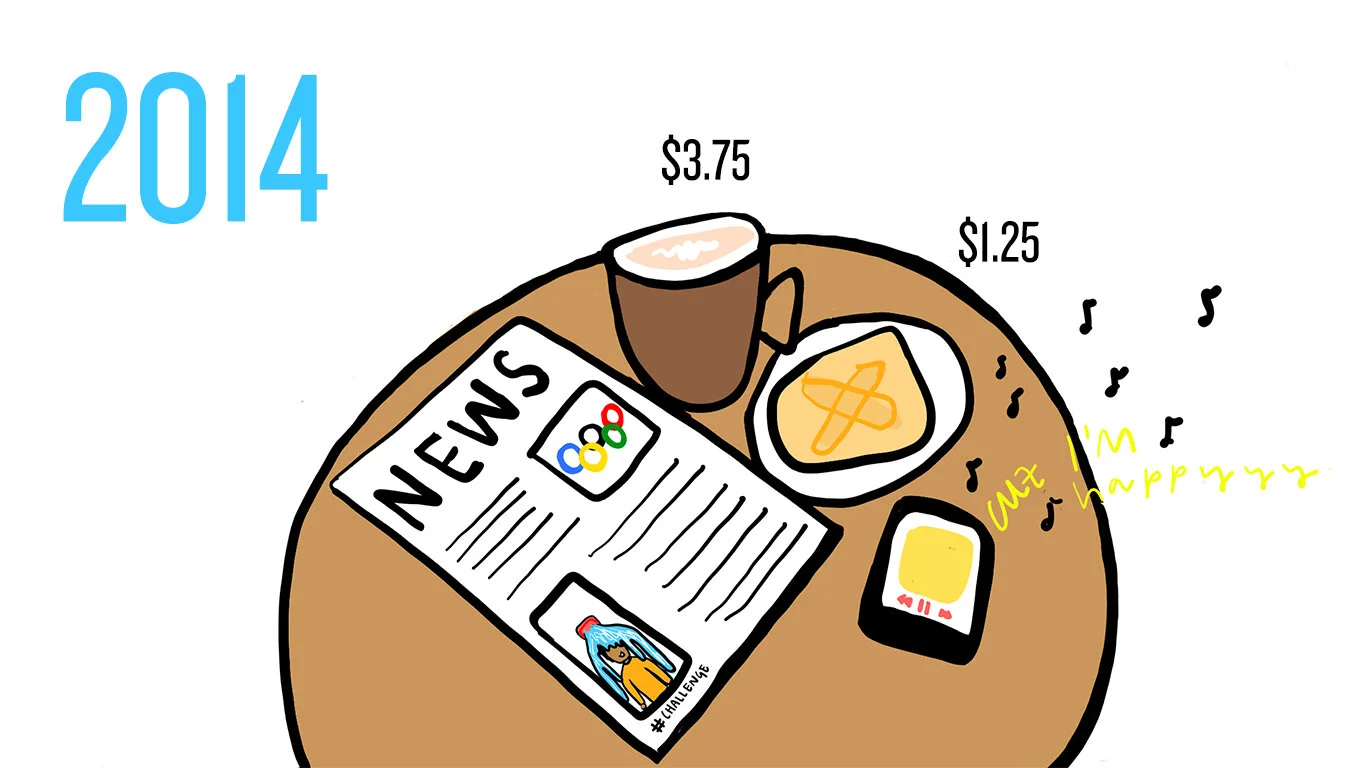
You have $5.00 to go spend at Stumptown Roasters. That will buy you a delicious medium latte for $3.75 and a shortbread cookie for $1.25. Treat yourself!

2014.jpg

Let’s say, instead of spending that $5.00 in 2014, you put it under your mattress for safe keeping. You find the $5.00 a few years later and still frequent Stumptown. We are going to run through a few scenarios of the purchasing power of that same $5.00 bill.

Two years have passed, and it is now 2016.

Your beloved medium latte now costs $4.00, and the shortbread cookie costs $1.35. You find $.35 in your pocket (does finding coins ever happen anymore?!), so you make the purchase possible.

2016.jpg

Four years have passed, and it is now 2018.

That same tasty medium latte now costs $4.50, and the shortbread cookie costs $1.50. You might be going home hungry.

2018.jpg

Fast forward six years to 2020…

Your medium latte now costs $4.75, and the shortbread cookie costs $1.60. Assuming you would leave the barista a tip, your $5.00 bill cannot even buy you a coffee. You might be going home thirsty and hungry.

2020.jpg

Magnifying inflation’s effects on bigger life decisions

In this example, the cost of a coffee and a cookie only changed by $1.33 over six years. While that may not seem significant (the increase is less than $2!), the cost of goods did increase by 26%. If you apply that percent increase to a larger purchase like a home, a car, or education savings, you may not be able to afford what you intended.

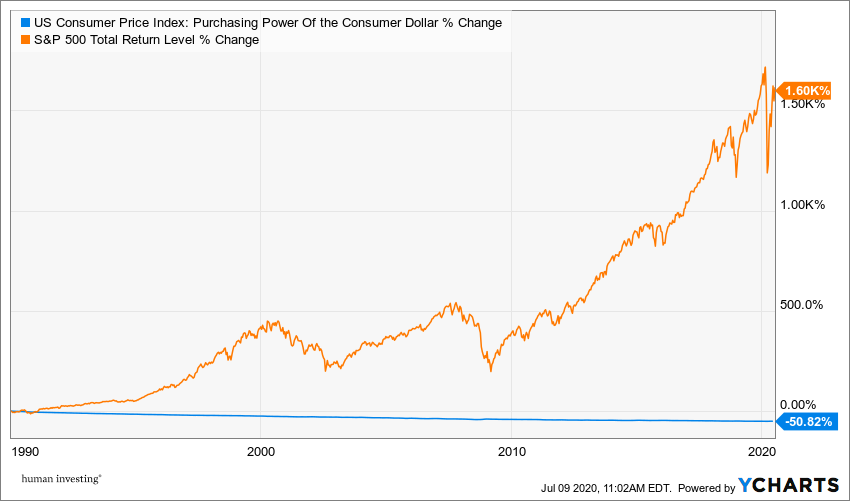
One way to maintain purchasing power is to invest the $5.00 into the stock market. If you bought the S&P 500 in 2014, then that same $5.00 would be worth around $9.40 today in 2020, which is enough to pay for a coffee and cookie from Stumptown. For simplicity purposes, we only looked at the rising cost of coffee and S&P 500 return since 2014. To further substantiate the decrease of purchasing power over time, we included a chart that compares the S&P 500 total return to the purchasing power of a dollar since 1990. 

Coffee Chart.png

If you have questions or need help preparing an investment strategy for your savings, please contact our team at Human Investing. We drink good coffee.  


Related Articles

College Savings and 529 plans: The Significant Benefits of Starting Early
 
gift-habeshaw-PGaKmphvsrI-unsplash.jpg

Why Save for College?

For many reasons, planning and saving for college is essential. The pursuit of a college education is a wise investment. In most cases, college graduates will earn significantly more over their lifetime than those who opt out of post-secondary education. However, this comes at a high cost. Beyond the purchase of a home, the decision to pursue higher education is commonly the second largest expense of an individual’s/family’s lifetime. Importantly, the inability to save and plan for college early can dramatically impact assets set aside for other savings goals such as retirement or paying off a primary residence.  

You Can Fund Your College Tuition Out of Pocket and with Loans

Let’s say for whatever reason, funding college now for your child is not an option. The estimated annual cost of college at a four-year, in-state university is $27,000. When including inflation, from birth to sending a student away to college, total costs are estimated at over $190,000. Assuming you or your child, through student loans, need to borrow to fund schooling, the estimated cost balloons to nearly $250,000, which includes interest at 5% on the borrowed tuition over ten years.  

Or You Can Start Saving at Birth

Using the same assumptions as before, but this time you pre-fund college (start now) over the course of 18 years at $6,000 per year. You should have just about enough to pay the balance of school. In short, the savings of $108,000 over 18 years, plus the growth of $88,500 (just over 6% compounded monthly), covers the cost of higher education.  

What’s the Difference?

Funding college early reduces the future funding liability by six figures. If there is an ability to pre-fund college, in whole or part, it is a great choice with lasting financial implications. By saving at the birth of a child or grandchild, a family could save approximately $140,000 per child ($250,000 versus $108,000), if they desired to fund 100% of college expenses at a 4-year, in-state university by saving to a 529 plan versus paying through student loans.  

Paying with a home equity line of credit (HELOC), a student loan, or even out of present cashflow should be avoided if possible. Even less optimal is pulling funds from retirement accounts. Although sometimes necessary, taking retirement account distributions to pay for college will potentially increase your tax bracket and the could be subject to penalties. More importantly, it reduces assets available for your retirement when earning additional income is often difficult. 

What are the Benefits of 529 College Savings Plans?

Your 529 Dollars Will Grow without Being Taxed. There are a plethora of benefits for a 529 account—but the most important is tax-exempt investment growth. If 529 funds are used toward qualifying education expenses (tuition, room & board, books, computer, etc.), there is no taxation on the earnings. If the college savings account has remaining funds after all tuition is paid, the parent or custodian could change the beneficiary to another family member or sibling. If there are no other beneficiaries to use the funds, the funds can be drawn out and used for anything. However, if designated 529 funds are used for the “anything” bucket, the growth on the account will be taxed at ordinary income levels and earnings will be subject to a 10% penalty. 

If the student receives a scholarship, funds equal to that amount of the scholarship could be withdrawn from the 529 and not subject to a 10% penalty, but there would still be ordinary income taxation on the earnings withdrawn for purposes other than qualified education expenses.

Another benefit of a 529 plan is that it has a low impact on FAFSA, in qualifying for federal aid.   

You Can Maximize Tax Credits. Depending on the state in which you live, there may be a state tax deduction for contributions to a state-sponsored 529 plan. For example, if you live in Oregon, you can receive a state tax credit of 5% of your contribution up to 100% of your contribution, depending on income limits. The maximum tax credit in any year is $300. There are also college tax credits on tuition that may be available depending on your income level. 

It is important to coordinate the use of your 529 plan dollars with your tax advisor to maximize these potential credits.

COLLEGE SAVINGS PLANS ADAPT AS YOUR CHILD APPROACHES COLLEGE

College savings plans have a shorter overall time horizon than a typical investment or retirement account. If an account is open when the child is born, 18 years will pass before funds are set for distribution. By the time the student is applying for colleges, funds should be invested more conservatively so as not to put funds at risk of loss at the time of liquidation and use for college expenses. As a rule of thumb, the earlier you start saving, the more aggressive you can be—but as college approaches, getting more conservative is a wise approach. This can often be solved with an age-based, target-date fund offered by 529 plans, in which the investments automatically adjust from stocks to bonds and cash as the child approaches college. 

Talk about These Things During “Windshield Time”

There are many financial considerations when sending your children to college. Optimally, you and your significant other are making a choice early in life about how you hope to partner with your child in paying for school—if at all. If the choice is to help pay for some, or all expenses, discussions surrounding what paying for school looks like is essential. 

Does paying for school include a two-year stint at a community college? What about a state school, private school, or a school of their choice? Each of these questions and considerations are great for a road-trip—something we like to call “windshield time.”


Related Articles

Test Your Financial Literacy With These 5 Core Questions
 

The financial world can be a confusing place filled with jargon, technicalities, and little to no guarantees. Research suggests that those who are financially literate tend to have better financial outcomes. Financially literacy is typically measured by asking some core financial concept questions. Let’s walk through some financial literacy questions from the National Financial Capability Study, and explain the why behind the answer. Feel free to guess and score yourself at the end:


Question 1 - interest:

Suppose you had $100 in a savings account and the interest rate was 2% per year. After 5 years, how much do you think you would have in the account if you left the money to grow?

A. Less than $102
B. Exactly $102
C. More than $102


Answer: C, more than $102.

Explanation: The key part here is “After 5 years”. We are told the interest rate is 2% per year. That means every year, 2% gets added to our principal balance. To break it down year by year:


q1 copy.jpg

The interest earned increases each year. This is due to compound interest: the original principal ($100) grows, and the interest you earned previously (in year 2, $2) both earn interest. At the end of 5 years, we have $110.41 which is C More than $102.

Why this matters: Interest affects you when you save money to grow it, or borrow money to pay it back later. Knowing how interest can work for or against you is critical for financial success.

Question 2 - inflation:

Imagine the interest rate on your savings account was 1% per year and inflation was 2% per year. After 1 year, how much would you be able to buy with the money in this account?

A. Less than today
B. Exactly the same
C. More than today


Answer: A, Less Than today.

Explanation: They key here is the inflation rate is higher than the savings rate. Inflation is growing at 2%, meaning the price of goods (rent, utilities, food, cars, etc.) is going up by 2% each year. The cost of $100 of goods today will be $102 in 1 year. Your interest on savings is growing at 1% a year. That means in 1 year you will have $101 to spend on goods. In 1 year, you will have $101 to buy $102 worth of goods. Your ability to buy is A less than today.

Why this matters: Even if you keep your money “safe” in the bank or under the mattress, inflation is going to make that money less and less valuable. Thus why investing is so important. Investing can be scary due to downturns in the market, but ultimately the odds are in your favor to grow your money over time. Unless you can save significant portions of your income, growing your savings faster than inflation is critical for being able to retire.

q2 copy.jpg

Question 3 - Risk Diversification:

Buying a single company’s stock usually provides a safer return than a stock mutual fund.

A. True
B. False


Answer: B, False.

Explanation: To answer this question correctly, it is important to understand both risk and that a mutual fund owns a variety of companies. They keyword here is safer. Financial markets have two types of risk: market risk and company-specific risk (aka systematic risk and nonsystematic risk respectively).

Market risk refers to risk all companies face. Examples of market risk include a change to the US tax code, a global pandemic, or shifts in consumer tastes like a shift from fast food to organic freshly prepared food. You will always face market risk because every company is exposed to these risks. Company-specific risk refers to risks unique to one company. Examples of company-specific risk include sudden changes in management, a press release about product defects, mass recalls, or a superior/cheaper product released by a rival company. Because you own a variety of companies in a stock mutual fund, you diversify away (i.e. reduce your risk) if any single, specific company has a terrible event.

Why this matters: Don’t invest all your money in one company. Especially if you work for that company, and your compensation is based on the company doing well. By spreading out your investments, you reduce your risk of catastrophic returns, and smooth out the ride so you can sleep at night.

Question 4 - interest of the life of a loan:

A 15-year mortgage typically requires higher monthly payments than a 30-year mortgage, but the interest paid over the life of the loan will be less

A. True
B. False


Answer: A, True.

Explanation: Because of the shorter life of the mortgage loan, you pay less interest. Remember in question 1, interest compounds every year. When you borrow money, that compounding works against you. Therefore, the faster you are paying off debt, the less time for interest to compound and grow the total amount you have to payoff. The monthly payments are typically larger, but the overall interest paid is less.

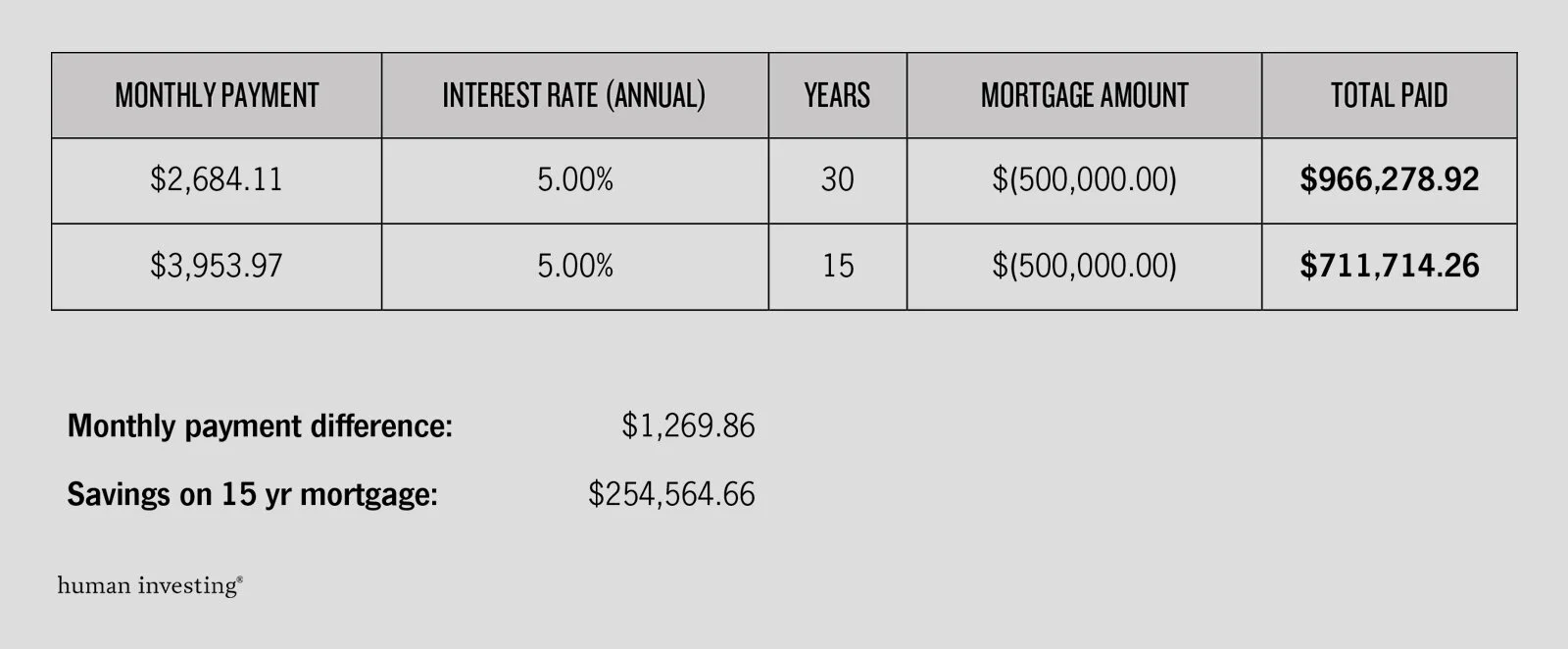
To illustrate with numbers, let’s look at the difference between a 15 year & 30 year mortgage, assuming a 5% interest rate for both:

q3 copy.jpg

Why this matters: You can see from the example how much money is saved by opting for a 15 year mortgage. Can you afford that extra monthly payment? That’s worth investigating, but you’ll never explore your choices if you don’t know what they are. You can also usually get a lower interest rate for shorter term debts, which saves you even more money. Anytime you borrow any amount of money, the faster you can pay it off, the less you will pay total. Even if you don’t get a lower rate on the debt, if you pay off the principal sooner, that means there’s less interest compounding against you. When looking to borrow money, evaluate what term (length of time) works best for you and your budget. You want to minimize your cost of borrowing, but you also want to give yourself enough flexibility that you’re confident you will make all those payments on time, regardless of what life brings.

Question 5 - Bond prices and interest:

If interest rates rise, what will typically happen to bond prices?

A. They will fall
B. They will stay the same
C. They will rise


Answer: A, they will fall.

Explanation: This is the question most people get wrong. A bond is government or corporate debt. The government or company pays you coupons (interest payments) based on the issued interest rate. At the end of the bond’s life, it matures, and you get the principal back.

Imagine Disney issues bonds paying 5% interest, the current market rate. You purchase a bond for $1,000, and you get a $50 coupon payment from Mickey Mouse every year until the bond matures. If interest rates rise next year (say to 8%), and Disney issues new bonds, they will issue them at the new interest rate. Your neighbor Laura decides to buy $1,000, and she gets an $80 coupon from Mickey Mouse every year. Because interest rates rose, the value of your bond paying $50/month goes down in value, less than $1,000, because the $1,000 could buy Laura’s bond paying $80/month. The reverse if also true. If rates had fallen to 3%, Laura’s bond would only pay her $30, and your $50/month bond would be worth more than $1,000.

Why this matters: Interest rates change over time. This causes bond prices to change. Bonds will still be less volatile than equities, but they do also fluctuate in value. Don’t panic when you see interest rates rise, and your bond prices going down in value. This is both normal and expected. Rising interest rates are also usually a healthy sign for the economy, and so your equities will generally be rising in value to help offset the loss in value of your bonds. The reverse is also true here. Falling interest rates tend to indicate a less healthy economy (think about when rates have dropped significantly & quickly; the 07-08 financial crisis and COVID-19) which means falling stock prices. Because they don’t tend to move together (uncorrelated), bonds and stocks are an excellent pair for smoothing out your investment returns.

How did you do?

If you got some questions wrong, I hope you understand the why behind the answers and how to utilize this knowledge to better your financial life. If you have questions about financial vocabulary or systems you’d like me to blog about, please email me at andrewg@humaninvesting.com. If want to talk to an advisor, please email us at hi@humaninvesting.com.


Related Articles

Nike Restricted Stock: Understanding RSUs and RSAs
 
Nike Restricted Stock.png

Until recently, the availability of Nike Restricted Stock was limited to a select group of Nike Executives.  In 2018, Nike shifted its Stock Award program to include Restricted Stock Units (RSUs) to pair with the traditional Stock Options benefit.  This brought the concept of restricted stock to a wider base of Nike Executives, including more VPs and Directors.  With this broader availability, more questions have arisen about what Restricted Stock Units (RSUs) are, how to maximize this benefit, and what strategies should be considered.

RSU (Restricted stock units)

What exactly are RSUs?  An RSU is a form of stock-based compensation where the company grants the employee a specific number of shares of Nike stock that are restricted and will not be issued until they vest.  The shares are released and issued each year according to the vesting schedule, which is typically in equal installments over 3-4 years.  Each Nike executive has an individual account at Fidelity that is tied to the stock plan and receives and holds RSU shares as they vest.    

RSA (Restricted stock awards)

RSAs appear almost identical to RSUs and many executives may not notice the difference between them.  The main difference between the two is that with RSAs, shares are issued at the time of grant and you own them even before they vest.  With RSUs, the shares are not issued and owned until the shares vest and subsequently become available.  In either case, you cannot sell the shares until they vest.  RSAs at Nike are marginally better for one reason: they pay out dividends to the Executive even before the shares vest.  With RSUs, you only receive dividends after the shares vest.  

Taxes

As RSUs and RSAs vest, they are taxed as compensation and are subject to the same federal and state tax rates as your salary/bonus.  A portion of shares that vest is immediately sold to withhold taxes and are paid directly to the IRS and Oregon.  A common challenge that we see with tax planning is that the amount withheld for taxes is often much lower than what is needed for the high-income tax brackets that Nike Executives fall in to.  We typically see a tax withholding shortfall of up to 17%.  This can contribute to a frustrating experience during tax filing in April, where painful checks need to be written to the IRS and Oregon.  With proper tax planning and coordination with a CPA, this can be mitigated by calculating the tax shortfall and setting aside the cash necessary to cover that shortfall.

Once the shares vest and become available, they are identical to Nike stock shares that anyone could purchase on their own in an individual, joint, or trust account funded with money you have already paid taxes on, like a checking account.  The growth or decline of the stock from the day it vests is now subject to capital gain/loss tax rules, which is triggered when it is sold.  If the stock grows and you sell it in 12 months or less, it is subject to short-term capital gains rates, which is the same as your regular income.  If you hold the stock for more than 12 months, it would be subject to long-term capital gains, a rate that can be up to 20% lower than short-term capital gains.

Risk/Return

When compared to Nike stock options, Nike restricted stock is a more conservative form of stock compensation.  RSUs/RSAs will follow the exact movement, up or down, of Nike stock while stock option values move significantly higher or lower than the actual stock price.  Put simply, stock options have a much higher upside and downside than RSU/RSAs.  This difference is a significant factor in the decision that many Nike executives must make each year between RSUs, stock options, or a combination of the two. 

Planning Strategies

What planning strategies and opportunities exist for RSUs and RSAs?

  1. Cash Needs – If you have needs for cash, whether for college expenses or a vacation and need to sell some of your Nike stock, RSUs/RSAs are typically your best option.  The tax impact is typically lower than Stock Options and ESPP shares.  Additionally, you are not sacrificing the significant growth opportunity that exists with stock options.

  2. Tax Loss Diversification - Most Nike executives own a significant amount of Nike stock that makes up most of their overall net worth.  This may represent such a large portion within your overall investment portfolio that it poses a significant amount of risk.  Many want to diversify out of Nike stock into other investments, but the tax bill that would be generated by doing so is so painful that no action is taken.  Tax-Loss Diversifying is a way to diversify out of Nike by identifying and selling very specific stock shares that are at a loss during a market downturn. 

    We do not believe that you should sell an investment at the bottom of a market drop and leave it in cash, so it is important to execute the next step, which is reinvesting the proceeds. Proceeds should be reinvested by diversifying into many different stocks that have also dropped in value during the downturn.  This can come in the form of low-cost, diversified funds, that hold thousands of stocks in large, mid, small, and international stock companies.  In addition to diversifying, the tax loss that is created can lower your current or future taxes by offsetting capital gains or deducting up to $3,000/year from your ordinary income, like your salary.

  3. Charitable Giving - Instead of using cash, make your charitable contributions from your RSUs/RSAs.  If you transfer this stock directly to the charity organization, you can still get the tax deduction for the value of the stock, and the charity can sell the stock to completely avoid any capital gains tax that would normally be due if you sold the stock on your own.  Please note that only stock that has been held for over 12 months is eligible for this preferential tax treatment.  For more details on utilizing Nike stock for charitable purposes see this article.

Nike RSUs and RSAs are an effective tool for Executives to both participate in the success of the company and to meet their personal financial goals.  They are a great compliment to Nike Stock Options and provide many planning opportunities to minimize the tax burden due to their flexibility.

If you want to know more about how to maximize your RSUs and RSAs, please get in touch.

You can schedule time with me on Calendly (click here to schedule an appointment), e-mail me at marc@humanvesting.com, or call or text me at (503) 608-2968.


Related Articles


Spend Time on Saving Money
 
@blankerwahnsinn

@blankerwahnsinn

Your team at Human Investing is here to serve you. Though our physical workplace has changed for the short-term, our company’s missions remain as strong as ever: to faithfully serve the financial pursuit of all people.  

We are entering a financially burdensome time. Many individuals and businesses are projected to suffer financially. The impact will look different for everyone.  

If you are seeking ways to change your spending habits, something you will certainly need is time.  Said differently, cash outflow is unlikely to change unless we take the time to research, contemplate, and change current routines. 

Here is a list of ten ways you can help cushion financial burdens that have either occurred already or are expected in the future:  

  1. Check your credit card points.  

    When is the last time you used credit card points? If you are in a financial crunch, now might be a wise time to cash out your credit card points. Not all credit cards include cashback rewards, but examples of companies that offer cash back cards include Chase, CapitalOne, and Discover.  

    Regardless of the cashback options available to you now, take the time to review whether you utilize the benefits of your existing credit cards. While you are reviewing your credit cards, this site is a helpful tool to figure out which credit card fits best with your lifestyle and spending habits: Nerdwallet - Credit Card Comparison  

  2. Eat the food you buy for quarantine.  

    This sounds obvious. But for some households, this will be challenging since we have purchased an allotment of random items. Was the store sold out of spaghetti?  Did you instinctively grab the only noodles left? If so, make it a fun activity for your family to express some creativity or try new recipes in the kitchen.  

  3. Consider refinancing your mortgage.  

    Do you have a mortgage? Rates have come down considerably this year and refinancing your mortgage is worth a looking into. Refinancing your mortgage can lower your monthly mortgage payments, offering both short-term and long-term savings. If you are interested in learning more about refinancing your home, see our recent post by Will Kellar: “How to refinance your home.”

  4. Save the money you would be spending.  

    We all have had to cancel upcoming plans. In many cases, that means extra savings. Put aside those dollars and use the money as needed. 

  5. Create or monitor your emergency fund.

    We realize many people do not have an emergency reserve. Traditionally a family should have three-to-six months of expenses saved in an emergency fund (three months for dual-income families and six months for single-income families). We encourage individuals to create an emergency reserve regardless of the economic forecast, but it becomes especially important during turbulence.  If you do have an emergency fund and are experiencing financial hardship, now is an appropriate time to use it. 

  6. Shop and spend mindfully.  

    Personally, I love the 24-hour rule. It’s a practice of self-restraint. If you feel the urge to purchase something (new shoes, a different laundry basket, extra-spicy BBQ sauce), wait 24 hours before you make the purchase. The time-lapse often mitigates a compulsive purchase.  

    Due to the economic uncertainty of tomorrow, we must be willing to make drastic changes to our spending habits. We are all compromising our normal routine in some way, shape, or form. With that said, it’s important to be cognizant of how these changes are impacting our cash outflows.

  7. Consider selling unnecessary household items.  

    I predict that people will spend more time selling their unused or unwanted household items. Take some time to go through your storage or extra items. Craigslist, Facebook Market, Poshmark, and Nextdoor are all great resources for buying and selling things second-hand. One man’s trash is another one’s treasure. 

  8. Create a budget.  

    A budget can provide financial awareness and reassurance. Now is a great time to revisit your budget or create one if you have yet to do that. Here is a budget template to get you started - Budget Template There are also online budgeting tools available such as mint.comYNAB.com, or everydollar.com.

  9. Unsubscribe.  

    Out of sight, out of mind. Take this time to unsubscribe to unnecessary social media accounts that tempt you to splurge or spend extra money. To minimize your current expenses, it may also be worthwhile to unsubscribe from unused memberships like online streaming services or gyms.

  10. Create ‘no-spend days’.  

    Since many Americans are working from home, ‘no-spend days’ are a good family challenge. It’s important to vocalize the game to your family so everyone can participate and be mindful of not spending money.  

Please feel free to share with others and let our team know if you have other examples of financially savvy savings that we can add to this list. We are open to new ideas and challenges!   


Related Articles

Blowing up the Compensation Model
 

In our last post, we addressed the most significant anchor that is working against the financial planning industry, how it’s kept from adapting within changing market expectations, and that we need to move towards something better for clients. This anchor is the “Assets Under Management” business model that is the dominant form of revenue generation for financial advisory and wealth management firms. 

In this piece, we will highlight a related aspect of compensation but look at it from the planner/advisor perspective. In other words, our focus will be on compensation structures for planners and the role of incentives. To be sure, these two topics are interrelated and often confounded. These real and heavy anchors are keeping us from a state of optimal outcomes. Charlie Munger could not have been any more right when he said, “Show me the incentive and I’ll show you the outcome.” Let’s take a look. 

An “Agency Problem”

Before we get into compensation models, it is imperative that we identify and define a concept called an agency problem. In its simplest form, an agency problem is one that contains a conflict of interest. It is a situation when someone (called an “agent”) is entrusted to act in the best interest of another party (called a “principal”) but has interests that are different (and often competing). 

Remember that term “fiduciary?” A fiduciary standard is imposed and regulated due to the inherent agency problem that exists between the client and the financial services professional (and/or industry). To review, the CFP Board defines fiduciary through the lens of the interaction between a financial planner and a client. Its fiduciary standard of care “requires that a financial advisor act solely in the client’s best interest when offering personalized financial advice.” 

Think about that for a second

Who else’s interest would they be serving when they offer advice? The very fact that a fiduciary standard is required reveals the problematic state of the industry. It is worth repeating…we can and simply must do better! However, the business models of financial planning firms and the compensation of financial advisors are anchors that necessitate considerable and seemingly insurmountable effort to move beyond the current climate. 

So how are advisors paid? 

In a commission and fee firm (often termed a “hybrid model”), advisors are often paid based on the commissions generated on the products sold. More directly, commissions are charged to buy and/or sell a mutual fund and when selling an insurance product such as a cash-value life insurance policy or an annuity. These commissions are called gross dealer concessions (GDCs) to the brokerage firm and the advisor receives a percentage of the GDC. The percentage that the advisor receives is most often determined by their relative tier based on the volume of sales dollars, meaning that the more products sold, the higher the percentage of GDC received.

In a fee-only firm, it is common for advisors to receive a salary as well as bonuses based on a percentage of their book. That means that the more assets they manage, the greater their additional compensation. More money can be made by bringing in new clients.

So what is the dominant incentive? It is quite clear that the incentive in the former is to sell investment and insurance products, and the incentive in the latter is to build and protect their book of business. But what about the amount and quality of financial advice? What about the degree of service and attention? What about providing an unbiased perspective? These are the conflicts that exist.

Citing these conflicts is not intended to suggest that a particular individual within any of the systems above is not providing high quality financial advice and excellent client service. It is meant to clearly call out the inherent conflict of interests that exists within these compensation models. 

Conflicts everywhere

And since Charlie Munger’s quote has been proven true for decades, we would be wise to pay attention. Truly, it is the case…find the incentive and you will likely find the outcome. So what outcomes are naturally linked to these incentives? At worst, if the incentives are large bonuses that are paid for selling products that generate a (very large!) commission, the interest of the advisor is to sell as many of these products as possible. 

Selling = more $$. The interest of the client is sound, comprehensive, and objective advice and purchasing only products that best meet their needs. If the incentive is bonuses that are paid based on the volume of assets managed, the interest of the advisor is to provide advice that results in more managed assets and allocate time on only activities that build and retain assets.

More assets managed = more $$. The interest of the client is sound, comprehensive, and objective advice and purchasing only products that best meet their needs. This is not about the character or the quality of the advisor. It is simply about incentives. Incentives lead to behaviors, and behaviors lead to outcomes. Or as Peter Drucker once said, “What gets measured gets managed, and what gets managed gets done.” 

The conflicts of interest in a fee and commission model have been highlighted and bantered about for a long time. In fact, the strong movement towards a fee-only business model has been fueled by the increasing visibility of these challenges. So we would like to devote most of our time to the primary fee-only advisor compensation model which is salary plus a bonus paid on the advisor’s book of business (amount of assets managed). 

Even a fee-only structure has its limitations

This might look harmless, but there are conflicts that remain. If a large portion of compensation is determined through a percentage of the assets you manage (“your book”), the incentive is to protect the book. This means employing a time allocation method that first considers the question, “Does this activity help me build and/or maintain my book of business?” Activities that result in a “yes” response to that question are prioritized while the incentive is to minimize or eliminate activities that result in a “no” response to that question. The big problem is that many of the important services that clients are looking for do not involve activities that yield bigger books. For example, conversations around topics like financial literacy education, budgeting, debt management, benefit planning, educational funding strategies, talking through goals and values, and charitable giving rarely lead to more assets under management. So conversations are primarily directed at wealth management, retirement funding, and risk management/insurance needs at the expense of ignoring or minimizing these other vital topics. Why? Because they do not align with the incentive.

Look for comprehensive planning vs. product-focused planning

Further, for some clients the best thing they could do is to pay down debt, invest through their company’s 401(k) plan, invest in real estate, and/or engage in charitable giving. However, none of these activities builds assets under management and all of them could potentially subtract from managed assets. Again, the incentive is aligned toward advisor behaviors/advice that is contrary to the best interests of the client. Anything that takes away from the percentage bonus for the advisor is incentivized to be avoided. This dynamic is what has predominantly contributed to the difference between product-focused financial planning and truly comprehensive financial planning that we discussed several months ago and is reflected again in the graphic at the end of this post.

Truly comprehensive financial planning is such a small portion of overall financial planning due to the inherent compensation incentives. 

Finally, the fee-only compensation model helps illuminate why many individuals and families do not have access to financial planning assistance. Simply and crudely put, they are not worth the time because they do not have enough assets for the planner/advisor to manage. This client may be willing and able to pay for services, but the current compensation method does not incentivize the advisor for spending time with this client. 

Compensation methods need to change. It is not only a matter of preference. Real outcomes are at stake. We can and simply must do better! 

puzzle-04.jpg

Check out the rest of the series with Ryan and Marc:

  1. Financial Planning: A New Mindset

  2. Bracing Ourselves For Rough Seas Ahead

  3. Isn’t Financial Planning a Dying Profession?

  4. What Financial Planning Should Look Like

  5. How Product Sales Is Ruining Financial Planning

  6. How Business Models Created the Culture of Financial Advisory Firms

Ryan Halley, Ph.D., CFP® is Director of Planning Practices and Research at Human Investing. He holds a doctorate in Personal Financial Planning from Texas Tech University and an MBA with a concentration in Finance from The Ohio State University. Ryan has his CERTIFIED FINANCIAL PLANNER™ certification. Dr. Halley is also a Professor of Finance and Financial Planning at George Fox University, where he directs a CFP® Registered Program located near Portland, Oregon. He has co-authored a book and has numerous peer-reviewed journal articles. Additionally, he has been an invited professor and lecturer at various universities in the United States, Canada and China. 


Related Articles

How Business Models Created The Culture of Financial Advisory Firms
 
financial-planning-compensation.jpg

Why not just make the necessary changes to correct what’s broken? 

At this point in our blog series, you might be asking yourself the question, “If things are so bad with the current state of financial planning, why not just make the necessary changes to correct what’s broken?” That is a logical conclusion, but while the problems are obvious, the solutions are challenging (possibly a little like some of the political debate topics you will be hearing for the next few months!). 

There are two real challenges here

One that we have already mentioned: nothing big is wrong. It is a host of smaller pieces that are broken, and those small pieces accumulate into a perception of confusion and mistrust and suboptimal financial planning outcomes.

A second challenge is that the core problems are so deeply rooted in the culture and systems that make up the industry that even obvious needed changes are difficult to address. It is the proverbial turning of the Titanic, if you will. So, a better place to begin might be defining the culture through the lens of how we arrived at where we are currently and identifying some of the elements of the culture that make it so sticky and unwieldy. 

As forecasted last time, there are many weighty systemic issues woven into the culture of financial services that make this move to a better model extremely difficult. These are true anchors working against a migration to something better. In this piece, we are going to start at the top and take a look at the business model of most financial planning firms and set the stage for why things are as they are. 

How financial services make money

As we have discussed, the financial planning profession has its roots in investment services and the insurance industry. Firms make money largely be selling either investment products (stocks, bonds, mutual funds, real estate trusts, options, etc.) or insurance products (whole life, variable life, annuities, etc.). 

Each of these products are sold with a commission and the firm makes money with each product sold. It is quite possible that a firm gets paid $10,000, $15,000 or even $20,000 or more for selling one variable annuity product. So, as you can imagine, this system is full of agency problems or conflicts of interest and has brought about many pieces of regulation to try to control these built-in conflicts. Selling products often comes at the expense of offering services. 

It is for this reason that we ended our last post talking about “fiduciary.” Fiduciary is a legal requirement imposed to make sure that planners/advisors are acting in a way that is in the client’s best interest. And, as we asked last time, who else’s interest would they be serving when they offer advice?

The very fact that a fiduciary standard is required reveals the problematic state of the industry 

This problem and others have led to a slow migration to other business models. Improvement. The commission-only paradigm began to change into a business model that is comprised of both fees for service and commission on products. This has further extended into a model where revenue comes exclusively from fees, with no commissioned products being sold. In fact, the CFP Board recognizes three different categories of compensation for planners:

  • Commission only

  • Commission and fee

  • Fee only

In order to be considered a fee-only advisor (or firm), no commissioned products can be sold. The CFP Board has defined the term “fee only” in the following way: “A certificant may describe his or her practice as “fee-only” if, and only if, all of the certificant’s compensation from all of his or her client work comes exclusively from the clients in the form of fixed, flat, hourly, percentage or performance-based fees.” 

While the definition might seem to align with what you would expect of a fee-for-service relationship, the dominate model looks much different. Instead of being paid to produce a financial plan or paid on an hourly basis, the vast majority of financial planning firms generate most of their revenue through what is called an “assets under management” (AUM) model.

WHAT THE ASSETS-UNDER-MANAGEMENT model MISSES

There are planners who do hourly work or charge by the plan, but that is the extreme minority of revenue dollars produced. The assets under management model assigns a percentage fee to the client assets that are managed by the firm. The more assets managed, the more money made. It is typical for the amount charged to be on a sliding scale so that the percentage applied to assets goes down if you hit certain targets. For example, if a firm charges 1.25% of AUM for assets under $1 million and 1.00% of AUM for assets over $1 million, a client with $500,000 invested would pay $6,250 for the year. A similar fee structure would be used to calculate annual fees during each future year. If the client had $3,000,000 invested, that client would pay $30,000 annually. 

There is nothing inherently wrong with this model, but it does explain why most financial planning firms look like investment service firm silos, or what we have termed “product-focused financial planning.” Other services can be offered and truly comprehensive financial planning can be conducted, but it is most often done without direct compensation. In other words, you are not paid for it. This is the largest and heaviest anchor working against a change from a culture of product-focused financial planning to truly comprehensive financial planning. 

The incentives are stacked too heavily towards products and wealth management. In order to change the incentive, the entire business model would need to change. And as you can imagine, that is a big ask. The more hidden cost is one of being stuck—of knowing what would and could be better, but experiencing the seemingly impossible task of getting there. In life, the one thing more frustrating than not knowing or being able to figure something out is the ability to observe, understand and know what needs to happen but not being able to do anything about it.

Associated costs are a continued and mired state of public distrust, a ridiculous amount of regulation and required disclosure, an opaque world in which terms like “advisor” and “planner” are almost impossible to decipher, and ultimately failing to offer the community the entirety of what they need… truly comprehensive financial planning. 

Check out the rest of the series with Ryan and Marc:

  1. Financial Planning: A New Mindset

  2. Bracing Ourselves For Rough Seas Ahead

  3. Isn’t Financial Planning a Dying Profession?

  4. What Financial Planning Should Look Like

  5. How Product Sales Is Ruining Financial Planning


Want to talk about your financial plan?
Want to learn more?
Come talk to us or e-mail Jill at jill@humaninvesting.com.

Ryan Halley, Ph.D., CFP® is Director of Planning Practices and Research at Human Investing. He holds a doctorate in Personal Financial Planning from Texas Tech University and an MBA with a concentration in Finance from The Ohio State University. Ryan has his CERTIFIED FINANCIAL PLANNER™ certification. Dr. Halley is also a Professor of Finance and Financial Planning at George Fox University, where he directs a CFP® Registered Program located near Portland, Oregon. He has co-authored a book and has numerous peer-reviewed journal articles. Additionally, he has been an invited professor and lecturer at various universities in the United States, Canada and China. 


Related Articles

How Product Sales is Ruining Financial Planning
 
product-sales.jpg

In our last several posts, we have been highlighting the necessary distinction between truly comprehensive financial planning and product-focused financial planning. We deem it necessary because the term financial planning is often wrongly used, which comes at the client’s expense. The term financial planning is regularly used to represent what is solely product-focused financial planning. We proposed that we are largely stuck in an industry of confusion, and we are having a difficult time moving on from this place. There are apparent yet opaque reasons as to why this is the case. These are contained within an earlier list of systemic factors we cited which have impaired financial planning outcomes and distorted the way in which financial planning is done. 

Let’s return to the medical analogy. Imagine being a patient with an illness

A patient would never want to go to a doctor who has a drug or pill already identified and evaluates the condition of the patient by searching for ways to use that drug or pill to treat the patient. Instead, a patient would want a doctor who evaluates the medical situation with an unbiased lens and only uses a drug or pill if it is the most effective way to treat the identified condition. Isn’t that the way you would want your financial life approached as well – to have someone look over your entire financial picture (including your values, goals, dreams, concerns, fears, etc.) and advise from that perspective instead of looking for a way to sell a financial product?

Within the medical context, think about what may be missed and how often the product (drug) would be the wrong form of treatment! The patient is seeking a service, not a product. The product is a potential outcome of the service, but it is not what the patient or client pursues. If so clearly a problem within a medical context (or almost any other professional context), why does this phenomenon of product sales disguised as financial planning remain so apparent within the financial services industry? Sure, financial products (insurance and investments) will be part of most financial plans; however, they should only be used when designed to meet a specific need identified through a comprehensive and unbiased financial planning process. If the product (drug) comes at the expense of a comprehensive evaluation, it compromises the best interest of the patient…or, in this case, the client. 

Why is this happening?

It is the tethering of product sales and commissions to a "financial plan" which is at the core of the challenge. This persistent culture of product sales paraded around as financial planning is a systemic issue. The prevailing practice and system around “financial planning” has weakened the full potential of the financial planning profession. Tragically, for clients, this dislocation has weakened outcomes for the humans we are attempting to serve humanely. The focus needs to be directed squarely on service, not products. While this right move seems obvious, there are many weighty systemic issues woven into the culture of financial services that make this move extremely difficult. The list below identifies the most significant anchors working against a migration to something better, and we are going to use upcoming posts to focus specifically on each of these: 

  • Business models of financial planning firms 

  • Compensation structure for planners 

  • Role of incentives 

  • Career status and prestige based solely on sales achievements 

  • Measures of success and effectiveness tied to a book of business 

  • Conflicts of interest that are not transparent 

  • Academic preparation, credentialing, and pathway to a profession in financial planning 

There is much talk in the financial services industry about the term and concept of “fiduciary.” Besides being an odd word and slightly fun to say, what is it? The CFP Board defines fiduciary through the lens of the interaction between a financial planner and a client. Its fiduciary standard of care “requires that a financial adviser act solely in the client’s best interest when offering personalized financial advice.” Think about that for a second. Who else’s interest would they be serving when they offer advice? The very fact that a fiduciary standard is required reveals the problematic state of the industry. We can and simply must do better. 

Ryan Halley, Ph.D., CFP® is Director of Planning Practices and Research at Human Investing. He holds a doctorate in Personal Financial Planning from Texas Tech University and an MBA with a concentration in Finance from The Ohio State University. Ryan has his CERTIFIED FINANCIAL PLANNER™ certification. Dr. Halley is also a Professor of Finance and Financial Planning at George Fox University, where he directs a CFP® Registered Program located near Portland, Oregon. He has co-authored a book and has numerous peer-reviewed journal articles. Additionally, he has been an invited professor and lecturer at various universities in the United States, Canada and China. 


Related Articles