Posts in Retirement Planning
Retirees, here’s how the Secure Act 2.0 can positively impact your RMDs and retirement plan
 

A newly passed bill known as Secure Act 2.0 will change how retirees withdraw from their retirement nest eggs. This fundamental change increases the age at which investors must take money from their retirement accounts, bringing about some impactful financial planning opportunities.

What is an RMD?

Once an investor reaches a specific age, they must withdraw a required minimum distribution (RMD) from their retirement account, such as an IRA or 401(k). The RMD amount is determined by the account holder's age and account balance at the end of the previous year. The Internal Revenue Service (IRS) requires RMDs to ensure account holders pay taxes on their retirement savings. RMDs, therefore, can be taxed on both federal and state taxes.

After reaching their RMD age, account holders must begin taking withdrawals from retirement accounts by April 1. Each subsequent year, RMDs must be taken by December 31st of that same year. The IRS may levy a sizable penalty for failure to take the mandatory distribution.

Good news, RMDs will be delayed by a year

A notable update from Secure Act 2.0 is the delay of RMDs. RMDs will start at age 73 instead of 72 for those born in 1951-1959. For those born in 1960 or later, RMDs will be delayed even further to age 75.

For those who turn 72 in 2023, you will not need to start your RMDs this year. Your first RMD can either be taken by December 31, 2024 or delayed until April 1, 2025.

There is no impact on a retiree if they have already started taking their RMDs or need their IRA to cover their cost of living. For others, who only take RMDs because they are required to, this significant modification to the RMD age provides additional retirement planning opportunities.

Retirement Planning opportunities

There will be more time for growth.

The new RMD regulation will give retirees a simple yet powerful benefit, more time for compounding growth. As the billionaire investor Charlie Munger states, “The first rule of compounding is to never interrupt it unnecessarily.”

This benefit must be highlighted, especially after a year of market losses.

An 8% return on a million-dollar IRA is $80,000. Additional returns undisturbed by an unnecessary RMD can have a snowball effect, providing an exponential lifetime benefit.

A longer window before RMDs can allow for additional planning and time, the essential ingredients in building wealth.  

QCDs can still be maximized.

Amidst the RMD age adjustment, the age at which account holders can use their IRAs to make Qualified Charitable Contributions (QCDs) was untouched. Thus, preserving one of the most powerful tax-saving strategies available to charitably inclined retirees 70.5 and older.

A QCD is a tax-free transfer of funds from an individual's IRA directly to an IRS-recognized charity. This charitable distribution allows taxpayers to avoid paying taxes on the withdrawn funds.

Retiree “Gap Years” are extended.

"Gap Years" are the years that occur between a person's retirement and the beginning of their RMDs. These Gap Years are often the years with the lowest taxable incomes in a person's adult life. As a result, they frequently serve as ideal years for accelerating income that would otherwise be taxable in a subsequent, higher-income year. The Secure Act 2.0's changes will give additional time for Tax Bracket optimization strategies such as Roth Conversions and Capital Gain Realization to reduce an investor's lifetime tax bill.

You may be pushed into a higher tax bracket in your later years.

Like all financial planning strategies, there is no one-size fits. The unanticipated pitfall of postponing RMDs can lead to more significant withdrawals in subsequent years when RMDs do start. An unexpected boost in income from RMDs might push you into a much higher tax bracket, phase you out of a tax credit, or trigger a surtax. Taking the time to understand the applicable tax implications are crucial when building a tax-sensitive retirement income plan.

This is a great time to reevaluate your retirement plan

The retirement system has undergone numerous changes due to Secure Act 2.0's policy reforms, adding to the difficulty of retirement planning. Recognizing the planning opportunities and risks that relate to you and your financial plan is essential.




Related Articles

Retirement Income Planning: Tax Bracket Optimization
 

We help our clients organize and implement tax bracket optimization. In your early years of retirement, even if you do not have earned income, there are important tax considerations. I will illustrate two recurring tax planning strategies: Roth Conversions and Capital Gain Realization.

Consider a retired married couple (both age 65) living in Oregon this year.

In this example, this couple has $36,700 of taxable income. This places them in the 12% federal tax bracket and provides $52,750 more room inside the 12% bracket before moving into the 22% bracket.

Considering the wiggle room before the increased tax rate, this client could decide between the following options:

OPTION 1: Realize Capital Gains

Realize (sell and reinvest) up to $52,750 of long-term (held longer than 12 months) capital gains to take advantage of the 0% Federal Capital Gains rate within the 12% bracket. This couple living in Oregon would still pay 9% State. Ideally, they pay less taxes today to avoid realizing those gains at 15% Federal and 9% State later, likely during the required distribution timeframe starting at age 73. They would keep 15% more of the growth on their investments.

Option 2: Conduct Roth Conversions

If a client does not have any taxable accounts or unrealized capital gains, they could use the room in the 12% bracket to conduct Roth conversions. This would consist of transferring funds from a traditional IRA, paying the taxes now (12% Federal and 9% State), and putting the net amount into the Roth IRA to grow tax-free overtime. This strategy is helpful to maximize the 12% bracket, since the 12% bracket will revert to the 15% bracket in 2026, when the Tax Cuts and Jobs Act (TCJA) ends. Additionally, when a client turns 73 and is required to take distributions from IRAs, this required distribution amount cannot be converted to a Roth IRA but must be distributed.

Required distributions could also push income from IRAs into the 22% bracket. Another benefit of Roth conversion is that Roth IRAs are not subject to required distribution rules and therefore can continue to grow tax-free for the life of the married couple.

Option 3: Combination of realizing Capital Gains and Roth Conversions

This requires year-by-year income and deductions tracking from all sources to ensure the right amount of money is being realized or converted.

Tax bracket optimization is not an after-thought, but a pivotal component of holistic financial planning offered at Human Investing. If this kind of planning would be helpful to you, please schedule a time to review your situation.


5 Things You Can Actively Do To Get Ahead of a Recession


Are you fearful a recession might be around the corner?

There’s been a lot of chatter about the state of the economy and whether we’re in a recession, or if one’s already passed. Whatever the situation, we wanted to help put things into perspective and remind you of the things you can (and cannot) control if uncertainty is on the horizon.

The widespread definition of a recession is two consecutive quarters of a decline in real GDP (Gross Domestic Product). However, the National Bureau of Economic Research (NBER) defines a recession as “a significant decline in economic activity that is spread across the economy and lasts more than a few months." No matter which yardstick we use to measure a recession, here is what you need to know:

  • Recessions are a natural part of the business cycle. There have been 34 recessions since 1857, ranging from more than five years to the pandemic-driven contraction of 2020 that lasted two months.

  • Recessions do not necessarily coincide with a decrease in the stock markets.

  • No two recessions are alike in cause, length, or intensity.

  • Recessions are marked as a time of heavy uncertainty and an increase in job insecurity.

Planning for a recession is difficult.

Using the general definition, we won't know we are in a recession until six months after it starts. Rather than worrying about a recession (which is out of our control), investors should focus on things that they can control. When future economic uncertainties arise, here is a list of things that you can do to prepare yourself better:

1. Re-evaluate the size of your emergency fund.

The amount someone should keep on hand should correspond with their living expenses, income instability, stage of life, risk tolerance, etc. This amount is typically 3 to 12 months of living expenses. An unforeseen medical bill or a temporary lapse in employment can happen anytime. Arming yourself with a cash safety net is your first defense against debt or selling your investments during a market downturn. For more information, read our blog about understanding the role of cash in a financial plan.

2. Analyze your spending.

Watching how much you spend builds awareness of your current spending habits. Understanding essential vs. nonessential expenses will make it easier to navigate your budget if your income disappears. Bonus: a better understanding of your spending can help you spend less and thus help you save more.

3. Bolster your professional network and skills.

Prioritize efforts to develop strong long-term relationships with essential connections. You may also invest in yourself with job-related skills and by polishing your résumé to ensure you are prepared for an unanticipated lapse in your employment.

4. Assess your investment portfolio.

Recessions don't always coincide with a stock market selloff. However, ensuring your investments are aligned with your goals is essential. Before a downturn in the market is the best time to position your portfolio based on your risk tolerance, time horizon, and financial goals. If you are unsure of your investment strategy, get in touch with a financial advisor to ensure you have the formula for successful investing.

5. Review your insurance coverage.

Start with the basics. Review what you have vs. what you need.

  • What kind do you have? Is your protection tied to your job?

  • Do you have enough dollar-amount coverage?

  • Do you need to adjust, more or less?

Remember the things you can and cannot control. Take your time to examine what you want to prioritize. While we can't predict precisely when a recession will occur, we can plan, prepare, and adjust appropriately to survive any economic storm. If you want to talk with one of our advisors, please call Jill at 503-905-3100.


Related Articles

Retire Early With the Rule of 55
 

Taking a distribution from a tax-qualified retirement plan, like a 401(k) before age 59.5, is generally subject to a 10% penalty for early withdrawal. The exceptions to paying this 10% penalty are:

Are you familiar with how the Rule of 55 works? If you want to retire early, this blog post is significant for you.

What is the Rule of 55?

The Rule of 55 is an IRS provision that allows employees who leave their job on or after age 55 to take penalty-free distributions from their retirement accounts. It’s a life hack! Typically, individuals would face a 10% early-withdrawal penalty if they access their retirement account before age 59.5. The 10% penalty and account accessibility are two of the reasons why people plan to work until at least age 59.5. 

If you are someone who is thinking about retiring early, the following Rule of 55 requirements are necessary:

  1. You leave your job (voluntarily or involuntarily) in or after the year you turn 55 years old.

  2. Your plan must allow for withdrawals before age 59.5.

  3. Your dollars must be kept in your employer’s retirement plan. If you roll them over to an IRA, you lose the Rule of 55 protection.

  4. You will likely want your plan to allow partial distributions when you are terminated.

Access to your retirement account at age 55 is available for all employees with an employer-sponsored retirement account. However, if you are considering retiring after age 55 and using funds from this retirement account, you must check whether your plan allows partial distributions. This feature is an opt-in feature for employers to select. We recommend that you work closely with your recordkeeper to ensure you can take advantage of the Rule of 55 in a way that benefits you.

3 Examples of the Rule of 55

Look at a few examples of employees with partial distributions compared to employees without partial distributions allowed in their plan.

Example 1: Partial Distributions Allowed

Danielle can take any amount from her PDX 401(k) account. For example, in October 2022, she can request $30,000. She doesn’t have to take anything out in 2023. She could take another $65,000 out in January 2024.

EXAMPLE 2: Partial Distributions Disallowed

Martin’s employer-sponsored retirement plan does not permit partial distributions. If he wants to access his retirement account at age 57 without incurring a 10% early-withdrawal penalty, he would have to withdraw the entire $450,000. This would result in reporting $450,000 of taxable income for the year of his distribution. Given the tax bracket optimization strategies that exist during retirement years, this may not be Martin’s best solution for accessing dollars before age 59.5.

A couple of alternative solutions for Martin are:

  1. Ideally, Martin would have a cash-flow plan to support his expenses until he reaches age 59.5.

  2. Initiate a direct rollover of his $450,000 retirement account into a IRA account. Then take distributions as needed but expect to pay a 10% penalty on these dollars. Before paying a 10% penalty on an early-distribution from a IRA, we would recommend that Martin review other cashflow options he may have.

Example 3: Partial Distributions Disallowed

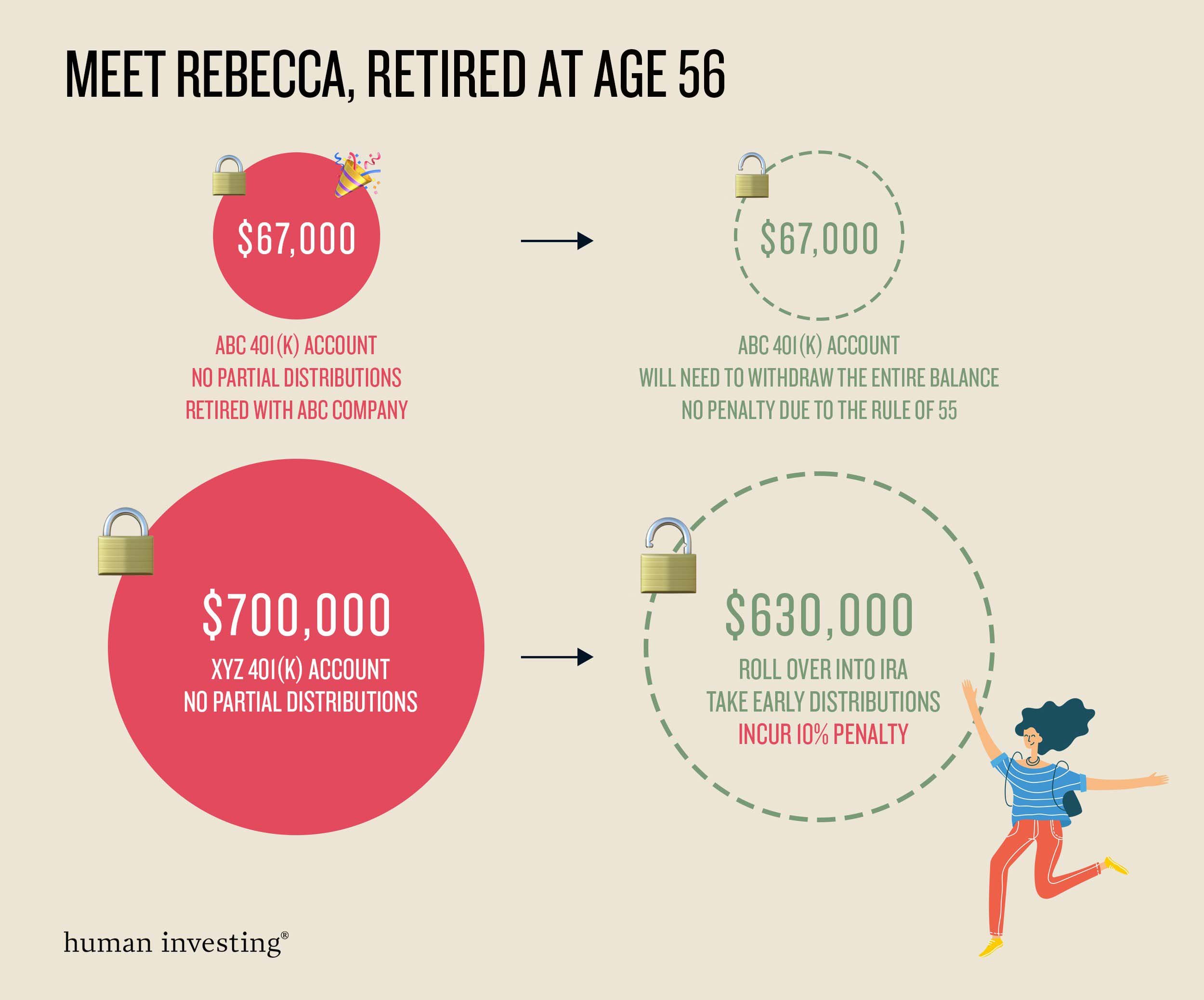
Rebecca, age 56, has $67,000 saved in her most recent 401(k) account with ABC Company. She also has $700,000 saved in her previous 401(k) account with XYZ Company. Neither of these retirement plans allow for partial distributions.

Rebecca retired at age 56 from ABC Company, so she can take the entire $67,000 balance out in one lump sum distribution. She will not owe a 10% penalty on these dollars due to the Rule of 55.

If she were to access any of her $700,000 saved in her previous 401(k) account with XYZ Company before age 59.5, then she would incur a 10% penalty. Not to mention the $700,000 is sitting in a plan that disallows partial distributions so that would be significant taxable income to report in the same tax year. Similar to the example above, Rebecca may consider initiating a direct rollover of her $700,000 into a IRA account for more flexible distribution choices.

What About Other 401(k) Accounts from Previous Jobs?

To qualify for the Rule of 55, you must be terminated as an employee on or after age 55. Therefore, if you have multiple retirement accounts, the only ones that will qualify for a penalty-free distribution between ages 55 and 59.5 are accounts with your termination date reflecting that age range.

One consideration is to roll over a previous retirement account into your current account before you retire. We recommend speaking with your recordkeeper to confirm that your retirement plan features are designed so rollover sources can be accessible by partial distributions.

For example, if Danielle from above had another 401(k) account, she could have rolled that into her PDX 401(k) account before retiring. All the dollars in the account would be eligible for Rule of 55 distributions.

What if I Decide to go Back to Work but have Taken Distributions Already?

Going back to work after you have taken a Rule of 55 distribution should not result in a 10% penalty. If you go back to work for the same company, then you may lose the ability to access funds as an active employee. However, your distributions will not be impacted if you go back to work at another organization.

How are Rule of 55 Distributions Tracked for Tax Reasons?

Custodians and recordkeepers are responsible for providing a Form 1099-R. This tax form reports any distributions from a retirement account. If you take a distribution under the Rule of 55, you would expect to see code 2 in box 7 of your 1099-R form. Code 2 specifies the following:

2 - Early distribution, exception applies (under age 59.5)

If your 1099-R form includes Code 2 in box 7, you will not owe a 10% penalty. Before you initiate a withdrawal between ages 55-59.5, we recommend confirming your record keeper will issue the 1099 in this format.

What Other Resources do you Have?

Retirement is a transition that only happens once in life. You probably haven’t retired before, and you likely won’t retire again. Retirement transitions involve several financial planning considerations and we wanted to conclude this article with additional resources that may be helpful to you:

Your Pre-Retirement Checklist

The 3 Questions to Ask to Build a Solid Retirement Income Plan

Why an IRA Makes More Sense in Retirement than your 401(k)

While the articles are supplemental information, we believe the best way to prepare for your upcoming retirement is to collaborate with our team at Human Investing. Please use this scheduling link to meet with our team to review your unique financial landscape before you start planning your retirement celebration(s): Schedule here.


Related Articles

Payback Periods: How long to Make your Money Back?
 

As I write this in May 2022, most major asset classes are down for the year. Stocks, bonds, foreign or domestic, it’s hard to find an investment producing positive returns right now. Since no investor likes to see the balance in their account drop, we have received an uptick in client inquiries about whether it’s worth staying invested. The short answer is yes; we still recommend staying invested. Markets have historically recovered, and grown to new highs. Panicking and selling your investments when they’ve gone down in price is unhelpful for achieving your long-term investment goals. Staying invested when the markets are roiling is easy to say, hard to do.

If you’re interested in a longer, more data driven response about why you should stay invested, keep reading. A lot of client’s concerns boil down to “How long is it going to take for me to make my money back?”. Let’s call this amount of time it takes to hit a new all-time high for a portfolio the “payback period”.

For the returns, I pulled the Ibbotson SBBI US Large-Cap Stocks for equity, and the Ibbotson SBBI US Intermediate-term (5-year) Government Bonds for fixed income. This data compiles the monthly returns from January 1926 to March 2022. I took a 100% equity portfolio (100/0) and added 10% bonds to compare different allocations (i.e. 60/40 is 60% equity 40% fixed income). I assumed monthly rebalancing.

Source: CFA Institute

As the graph shows, the more conservative your allocation, the shorter the time-frame necessary to make your money back. The most aggressive allocations (100/0 and 90/10) can take about 15 years to make your money back. A more balanced investor (40/60 to 80/20) would expect around 7 years as the worst case to make their money back.

I want to emphasize these numbers reflect the absolute worst scenarios over nearly a century of investing. We could always see a new worst case. Typical experiences are usually not as extreme. Even just looking at the 2nd longest time-frame to make your money back, and the longest payback is just over 6 years.


Source: CFA Institute

In most cases, you will make money in a relatively short amount of time if you remain invested. The final graph shows how long your investment horizon needs to be to have made money 95% of the time. As you can see, a majority of the time markets reward investors who stay invested for at least 9 months. That 5% of times where you haven’t made money in 9 months, we have seen some major draw-downs that took years to recover from. Make sure you have positioned yourself in a way where you are comfortable with all possible outcomes.

Source: CFA Institute

So, what do we do with this information? Some perspective for us all:

Understand the Time-frame you’re Investing For

If you’re not accessing funds for 15+ years, you shouldn’t worry about how long it takes to make the money back.

  • If you are investing in a retirement account, keep doing that.

  • If you move money monthly into a brokerage account, keep doing that.

If you are planning on accessing the funds in 10 years or less, consider incorporating bonds in your allocation to reduce risk, and shorten the time frame to recover a loss in value for your portfolio.

If you’re currently accessing your funds, have a financial plan to understand how you handle downturns in the markets and still achieve your financial goals

  • Strategies for this include having a certain amount of cash on hand to cover market downturns, adjusting your budget as needed, etc.

Stay Invested

When you see your account balance down, know that remaining invested is the best way to recover lost value. Most of the time, you won’t have to wait for years to see your balance recover.

Plan in a way that Helps you Sleep at Night

If you can’t handle the thought of waiting seven years to make your money back, a 70/30 allocation may not be right for you. Have a financial plan in place that accounts for the worst-case scenarios, so you know you’ll be able to ride out any volatility in the markets.

Understand History can Only Tell us so Much

The markets could always find a new worst-case scenario. Use history as a guide for setting expectations, not absolute certainty of what is to come.


Related Articles

Are Series I Bonds right for you to hedge against inflation?
 

There has been a lot of news on high inflation coming and its looming effects on everything from investment portfolios to the price of milk.

As people are searching for ways to combat high inflation and preserve how far their money can go, we’ve been receiving many questions on an investment option called I Bonds. Questions about what they are and why they haven’t heard of them before.

Our hope is to shed some light on Series I Savings Bonds (I Bonds), available here, and outline how the investment works before offering our recommendations.

How risky is an I Bond?

I Bonds are US treasury bonds, meaning they are backed by the full faith and credit of the US government, making them one of the safest, lowest risk investments possible.

What is the interest rate on an I Bond?

There are two parts to the interest rate on an I Bond.

  • A nominal (fixed) rate — currently 0% as of November 2, 2021.

  • An inflation (floating or adjustable) rate that changes every 6 months — currently 3.56% as of November 1, 2021.

These two rates are added together to determine the interest rate on an I Bond, so the current rate on the I Bonds for 6 months is 0% (nominal) + 3.56% (inflation) = 3.56% total (which is 7.12% annually). This interest rate cannot drop below 0% even if there is ever a negative inflation adjustment. See here for historical I Bond interest rates.

The floating rate on I Bonds will adjust as inflation adjusts. Today, inflation rates are high, but as the historical rates table in the link above shows, inflation rates can be lower.

When can I access my money?

An important factor to consider is that I Bonds only pay interest upon maturity, so you will not receive cash flows from the I Bond as you hold it.

I bonds have no secondary market, so you cannot resell your I Bond, you can only redeem it. I Bonds have no liquidity for the first year after purchase, so it’s important that you will not need to access the funds for at least one year. For years 1-5 after purchase, you may redeem your I Bond early by forfeiting the last 3 months of interest. After 5 years, you may redeem the bond early without penalty. I Bonds will mature 30 years after purchase.

How do the taxes work?

I Bonds only pay interest upon maturity. You can claim (pay) the taxes on the earned interest every year on your I Bonds, or you can pay taxes on all interest upon maturity of the I Bond. I Bond interest is not subject to state or local taxes. See here for more information.

How do I purchase I Bonds?

You have to purchase I Bonds directly through treasurydirect.gov, or with your federal income tax refund. See here for more information.

You are limited to $10,000 of I Bonds through electronic purchase, and $5,000 of I Bonds through paper purchase via your tax refund, for a total limit of $15,000 of I Bonds in a calendar year.

The pros and cons of waiting to get paid out

If you’re still wondering if these bonds are right for you and your financial plan, weigh the pros and cons below against your goals.

Pros:

  • The inflation adjustment makes I Bonds a great inflation hedge

Cons:

  • Interest is only paid out upon maturity, so don’t utilize I Bonds as a source of cash flows over time

  • Funds are locked up for 1 year, so don’t use I Bonds for any funds you might need before then

Other considerations:

  • I Bonds must be purchased on your own, so they’re for a more DIY inclined investor

  • The inflation adjustment rate will change adjust over time, so the precise amount of interest an I Bond will earn is uncertain

  • Consider the potential taxes of having all interest hitting upon maturity of the I Bond, or having to pay taxes each year on interest you have not yet received

  • You are limited on how much you can purchase in a year

I Bonds are typically best for medium term (i.e. around 5 year) savings goals.

The inflation adjustment reduces your risk of losing purchasing power due to inflation. The low nominal rates on I Bonds today means your funds will not grow faster than inflation.

For longer term savings goals (i.e. retirement in 10+ years), equities are a great long-term inflation hedge, because companies can adjust their prices (and therefore dividends & earnings) based on inflation. Treasury Inflation Protected Securities (TIPS) are another, lower risk than equities, investment that adjust for inflation.

If you have more questions about I Bonds, or would like to speak to a financial professional about other investments, please reach out to us at hi@humaninvesting.com or 503-905-3100.


Related Articles

Medicare Must Know's When Turning 65
 

Medicare is an important part of your retirement plan. We hope this overview is a helpful resource to know when to apply and how much it may cost.

Before you turn 65…

Most people turning age 65 should sign up for Medicare during their Initial Enrollment Period (IEP). During your IEP, which starts 3 months prior to the month you turn 65 and lasts until 3 months after, you can enroll in Medicare Part A (Hospital coverage), and Medicare Part B (Doctor visits). Medicare Part B pays 80% of most medically necessary healthcare services and the beneficiary pays the remaining 20%. You may also join a Medicare Part D plan (Prescription Drugs) within 3 months of when Medicare coverage begins to avoid any late enrollment penalties.

What if I’m still working past age 65?

If you are still working and have employer-based health insurance at a company with 20 employees or more, you can delay enrollment in Medicare until retirement. If, however, you work for a company with less than 20 employees, you will likely need to sign up for Medicare at age 65.

When your employment health plan coverage ends, you will need to add Part B within eight months of either a) the end of your employment or b) then end of your group health coverage. COBRA can help bridge the gap between employment coverage and Medicare. COBRA will end once Medicare begins.

If you are still working past age 65 and want to continue contributing to a Health Savings Account (HSA) with a high deductible plan, you will need to delay your Medicare Part A coverage.

What does Medicare cost?

Most beneficiaries will only pay the standard premium amount for Part B ($158.50 in 2022). They may be required to pay a premium based on their income represented in the chart below. Medicare uses the modified adjusted income from the beneficiary’s IRS tax return two years prior.

Typical cost for Part B is shown below with income ranges that increase Medicare premiums:

If you do not enroll in Medicare Part B when you are first eligible:

  • Your Part B monthly premium will increase 10% for each 12-month period that you are not enrolled.

  • You will pay a higher premium for the remainder of your life.

What if I need additional coverage?

Your IEP is also when you can buy Medicare Supplemental Insurance (also known as Medigap) from insurance companies. This is an additional policy that Medicare beneficiaries can purchase to cover the gaps in their Part A and Part B Medicare coverage. You are guaranteed the right to purchase this insurance without going through medical underwriting (i. e. you can’t be denied). This is critical if you have one or more chronic health conditions. Cost for Supplemental Insurance can typically range from $200 to $300 per month.

How do I sign up?

Sources: medicare.gov

Medicare can be a complicated concept, but the help of a professional can make all the difference. Please reach out to our team if you could use some guidance as you approach retirement.


Related Articles

The IRS Has Increased Contribution Limits for 2022
 

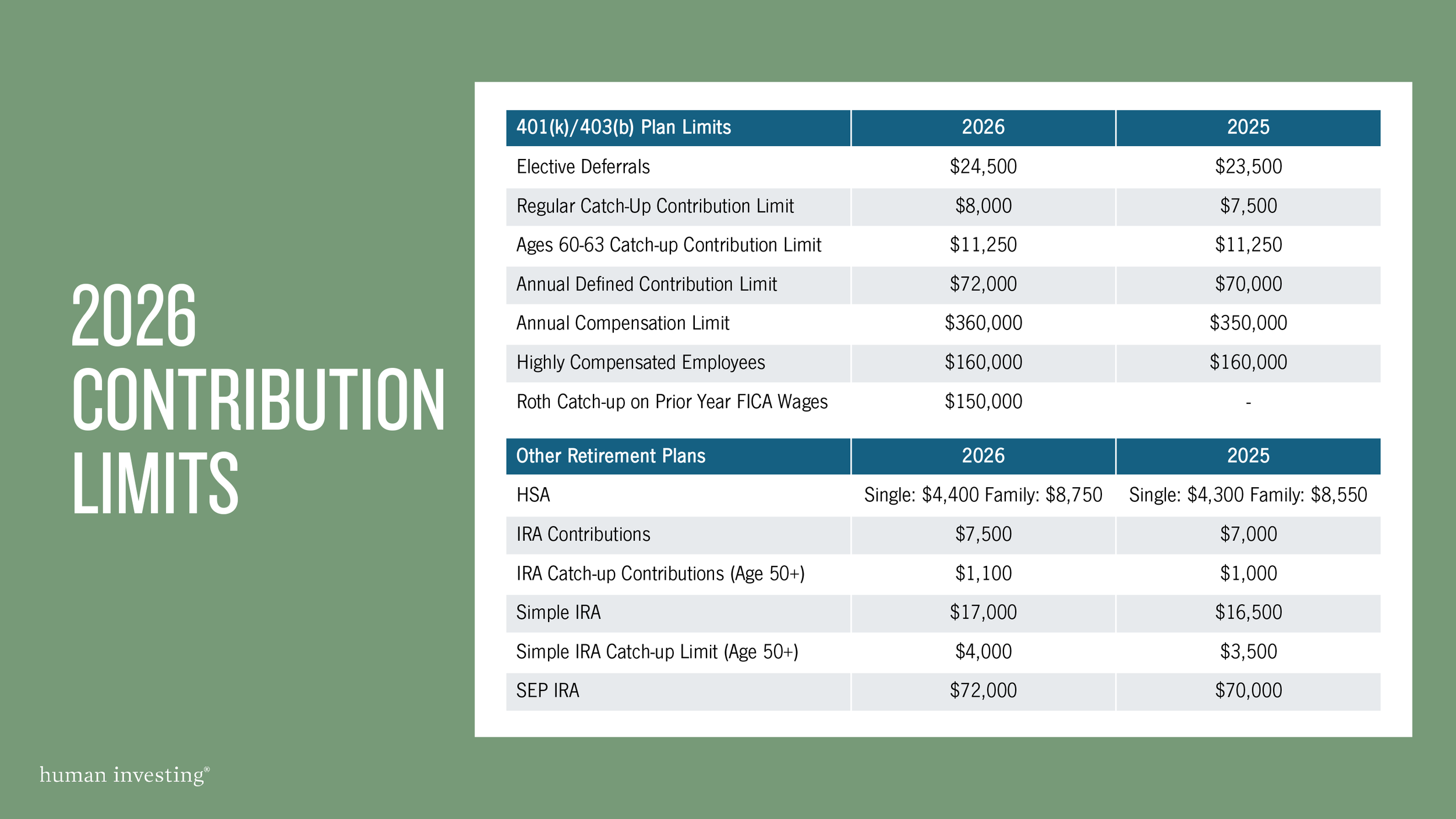
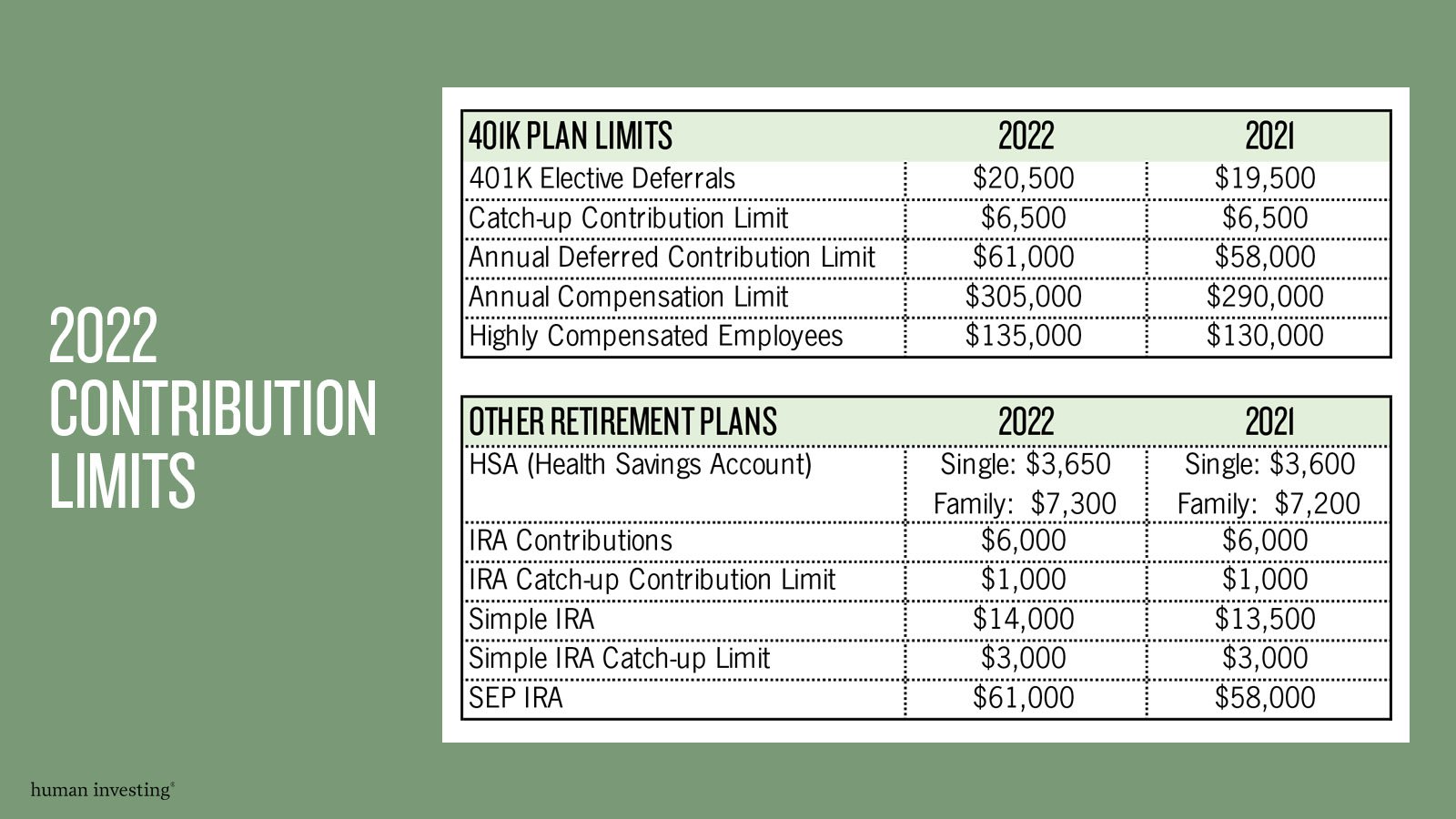
There is good news for retirement accounts! The IRS has increased the contribution limits for the upcoming year. As you can see below, an important change for 2022 is that 401(k) elective deferrals increased from $19,500 to $20,500. That’s not all! Please see below for the applicable updates for the coming year:

How do these changes impact your savings in the upcoming year? Are there any changes you should be making? Use this link to schedule a time to meet one-on-one with our team. We look forward to working with you in 2022!


Related Articles

The Real Risk of Owning Bonds: Too Much in Bonds May Hurt Your Purchasing Power
 

We talk to a lot of different people about investing. A common request is something along the lines of: “I don’t want to lose anything, and I want my money to grow.” This is a challenging, if not impossible mission. The investment world is full of opportunities to grow your money. However, there is an inherent risk when you put your money in any investment.

Finance has a lot of ways of measuring risk. Standard deviation is used to try to show a range of the possible returns. Max drawdown displays your worst-case scenario. Sharpe ratio provides a risk-adjusted measure of performance. However, very few investors ask about standard deviation, max drawdown, and Sharpe ratios. The people we talk to are most likely to ask “What are the odds of losing money” because they don’t want to see their current savings drop in value.

How strong is your purchasing power?

An important consideration when talking about losing money is purchasing power: the ability to buy goods with your money. Inflation has consistently pushed prices up over time, reducing the purchasing power of a single dollar. Wanting to avoid losing money is completely understandable. The danger of keeping your money under your mattress or sitting in cash is that inflation is constantly reducing your purchasing power.

When concerned with losing money, many investors are focused on nominal returns. Nominal returns are the raw return values, unadjusted for inflation, and are simple to calculate and digest. I would argue that most investors should be focused on real returns: returns adjusted for inflation. Real returns are a more accurate measure of your change in purchasing power. Ultimately, very few outside of Scrooge McDuck want a giant pile of money. Most people want to spend that money on goods, like food, travel, or a home, therefore purchasing power is likely what investors really care about.

Real return = (1+Nominal Return) ÷ (1+inflation rate)

Historically, stocks deliver positive returns, and those returns are in your favor. However, stocks are down (i.e. lose money) more frequently than bonds. The safety bonds offer also means they provide lower returns. What blend of stocks and bonds is most likely to protect your purchasing power (i.e. produce a positive real return)?

inflation is dwindling BOND power

To try and answer this question, I looked at the Stocks, Bonds, Bills, and Inflation (SBBI) data from the CFA Institute from 1926-2020. This data included monthly and annual returns; the annual data is for each calendar year. For stocks, I used the Ibbotson SBBI US Large-Cap Stocks total return.

For Bonds, I used the Ibbotson US intermediate-term (5 year) Government Bonds total return. I looked at several different portfolios which include a variety of stocks and bonds. Specifically, I blended the stocks and bonds in 10% increments, from 100% stocks, to 90% stocks 10% bonds, to 80% stocks 20% bonds, and so on to 0% stocks 100% bonds. I also assumed the portfolios were rebalanced at the start of each return period (i.e. the weights were reset at the start of each month for monthly data, and the start of each calendar year for annual data).

I took these different stock/bond portfolio mixes, and I calculated the nominal and real returns from 1926-2020 for both monthly and annual (calendar year) returns. I then calculated what percentage of returns were positive to measure the chance of losing money (nominal returns) or purchasing power (real returns). I’ve graphed the nominal vs real returns for monthly and annual returns below.

bonds-monthly-returns.jpg
bonds-annual-returns-v2.jpg

You’ll notice the nominal monthly returns paint a clear picture. If you want positive nominal returns more often, you want to own more bonds, hence the steady upward trend to the graph. If you look at the annual nominal returns and want to maximize your chances of a positive nominal return, you actually want a 10/90 portfolio (10% stocks, 90% bonds). As risky as stocks seem, having at least a sliver of stocks actually increases the chances of a positive nominal return

The real returns tell a slightly different story. For the monthly real returns, the stock/bond mix is almost irrelevant for producing a positive return, and hovers right around 60%. There is a drop off after 10/90 (10% stocks, 90% bonds), indicating owning even just 10% stocks in your portfolio helps increase your chances of positive real returns better than owning 100% bonds.

For the annual real returns, you can see that your odds of a positive real return are better with at least some bonds in the portfolio. Interestingly, the 70/30 portfolio and the 20/80 portfolios produce the highest chance of a positive real return. The all bond portfolio, 0/100, has the worst chance of maintaining your purchasing power (i.e. producing a positive real return).

Stocks can seem risky, and the loss of value can make many investors shy away. Even just a small amount of stocks can protect your purchasing power better than owning only bonds. There are still many considerations for how you should invest including your risk tolerance, time horizon, and holistic financial plan. If you’re interested in talking to an advisor, please reach out to us at hi@humaninvesting.com or 503-905-3100.


Related articles

Your Pre-Retirement Checklist
 

Transitioning into retirement can be an exciting time. For many it can also be a daunting reality. We hope the following Pre-Retirement Checklist is a helpful tool as you intentionally prepare for your retirement years.

5-10 years out 

  • Create a plan to pay down debt.   

  • Maintain Emergency Fund – Emergencies still happen in retirement.  

  • Familiarize yourself with Social Security, Pension, and/or Defined Benefit options.  

  • Consider Long Term Care (LTC) options – LTC Insurance vs Self-insuring using other assets.  

  • Maximize all tax-advantaged savings accounts – 2021 Contribution Limits.  

  • Review your investment strategy to make sure your retirement accounts are in line with your risk tolerance and timeline.   

  • Strategize how to divest from company stock.  

2-4 years out 

  • Devise a retirement spending plan:   

  • Begin developing a plan for a fulfilling retirement (goals, purpose, health).  

  • Practice being retired – take a long vacation in the location you plan to retire and live within your retirement budget. 

  • Retirement Living Plan:  

    • Evaluate downsizing a home or relocation and the associated tax implications.  

    • If a mortgage is required, relocate while you still have the income to qualify for the mortgage preapproval process. 

  • Formulate a plan to exercise your stock options. 

  • Review insurance needs – potentially to cancel or lower life/disability insurance.  

< 1 Year out 

  • Formulate a health care plan:   

    • Investigate Medicare, Medigap, and Medicare Advantage plans.  

    • Compare Individual Insurance policy or COBRA if you are younger than age 65.  

    • Enroll in Medicare 3 months before age 65.  

  • Apply for Social Security benefits 3-4 months before you want benefits to start.  

  • Determine how much monthly income you need from your portfolio to cover your expenses.   

  • Analyze your retirement income plan.

  • Consider a HELOC while you still have the income to qualify.  

  • Update estate plan documents with retirement changes.  

  • Take advantage of employer medical plans.   

Download this as a printable one-sheeter.

Planning for retirement should be exciting. Please reach out if our team of credentialed experts can help you navigate the road to retirement.


Related Articles