Posts in Tax
5 Ways To Make Tax Season Predictable, Not Painful
 

Tax season creates stress for a lot of people. It often starts with tracking down documents from multiple places, turns into uncertainty about what might be missing, and ends with concern about an unexpected tax bill at exactly the wrong time.

As a financial advisor at a firm that prepares taxes in house, I get a unique view behind the scenes. Each year, I see which situations go smoothly and which ones lead to stress, surprises, and last‑minute scrambling.

With another tax season behind us, here are five ways to make the next one more predictable and far less stressful.

1) Eliminate any surprises

One of the biggest drivers of tax stress is uncertainty. 

The best way to create more certainty is to complete Tax Planning Projections during the prior year. Not only do they help identify tax‑saving opportunities while there is still time to act, but they also do something just as important, which is to set expectations and eliminate the surprises.

A good projection can answer questions like:

  • Will you owe or receive a refund and approximately how much will it be?

  • Do you need to set aside cash or plan where funds will come from?

  • Are there any estimated tax payments that I should make before the end of year to increase my deductions or minimize any interest or penalties?

When you understand the likely outcome ahead of time, April becomes about execution, instead of a scramble.

2) capture tax savings before the windows close

Capturing tax savings requires planning ahead of time and acting before specific deadlines.  If you wait too long, you can miss out on the available opportunities.

Some strategies that often help clients reduce taxes now and in future years include:

  • Bunching charitable contributions using appreciated stock

  • Using Oregon tax credits funded with appreciated securities

  • Contributing to Deferred Compensation Plans

  • Roth conversions in lower‑income years

  • Strategically realizing capital gains in the 0 percent federal bracket

  • Tax loss harvesting

  • Managing income to qualify for ACA premium tax credits while avoiding Medicaid or the Oregon Health Plan

  • Funding self‑employed retirement accounts such as Solo 401(k)s and SEP IRAs

It is also easy to overlook contributions that can still be made right up until April 15:

  • Traditional or Roth IRA

  • Health Savings Accounts

  • Solo 401(k)s or SEP IRAs

  • Oregon 529 plan contributions

Planning ahead helps ensure these opportunities do not get missed simply because the deadline arrives quickly.

3) tackle your tax season in waves, not all at once

Tax season does not unfold evenly, it comes in waves so doing a small amount of work during each wave is helpful.

The First Wave: Late January through mid‑February is when the first wave of core documents arrives, including W‑2s, mortgage, and bank interest documents.  I would recommend beginning to gather these documents as they arrive.

The Second + Final Wave: Mid-Late February: The second and typically last wave is Final investment 1099s for dividends, interest and capital gains from custodians like Schwab or Fidelity generally arrive later, and revisions are common. If you already have your first wave documents ready and submit those with your second wave of documents early enough you can often get to the front of the line for preparation.

As deadlines approach, CPAs and tax preparers experience capacity constraints. Submitting everything right before spring travel or just ahead of April 15 often means landing at the back of the line. If the goal is to wrap up your return earlier, having information ready before the surge makes a real difference.

Even if you plan to file an extension, these timelines still matter—an extension doesn’t eliminate penalties or interest if taxes aren’t paid on time.

4) make a proactive plan for your tax bill

Often the most stressful part of filing taxes is owing taxes. There can be a mental pain of parting with cash, which can be compounded by the question of where to get the funds.  Is it going to come from your checking account, savings account or high yield savings account? If you don’t have enough cash, should you sell investments (which can create even more tax for future years) or should you take a temporary loan on your investment portfolio or your home via a home equity line of credit?

Other common challenges include:

  • Payment to one jurisdiction like the IRS while waiting for a refund from another like the state of Oregon.

  • Finding liquidity when funds are not readily available.

  • Making sure payments are applied to the correct tax year rather than misclassified as estimates for a different tax year.

Mistakes here can cause payments to be misapplied or returned, creating the frustrating experience of being told you never paid.

Having a professional help you determine the best funding source and even facilitating tax payments on your behalf can remove much of this complexity and significantly reduce the risk of error.

5) Remember that april 15th is two tax deadlines, not one

April 15th marks both the end of one tax year and the beginning of another deadline, which is Quarter 1 estimated taxes.

First‑quarter estimated tax payments are due on the same day. Many people default to a safe‑harbor approach based on the prior year’s income. This can help avoid penalties, but it is not always the most efficient option.

  • If last year’s income was unusually high, your estimates may require overpayment and effectively give the IRS an interest‑free loan.

  • If income is similar year to year, this can be an effective approach.

  • If income is rising, the safe harbor approach may keep you penalty free but still result in a large bill the following April that requires planning.

The right approach depends on where your income is headed in the next year, not just what tax software defaults to from the previous year.

These estimated taxes can add to the already painful tax bill due from the previous year, making proactive Tax Planning Projections even more important.

Bringing it all together

Most people will not execute all five of these steps perfectly, and that is okay. Even doing a few of them consistently can meaningfully reduce stress and improve outcomes.

Because these decisions span timing, tax strategy, cash management, and coordination, many people find greater value in having a partner help integrate the process rather than managing everything alone.

If you are evaluating tax preparation services, it is worth considering how well planning, execution, and follow‑through are connected, and whether you are realistically set up to do this on your own.

Tax strategy isn't a standalone service for us, it's woven into every financial plan we build. If you're ready to be more proactive about your taxes, our team at Human Investing is here to help.


Disclosure: This material is provided for informational and educational purposes only. It should not be construed as investment, legal, or tax advice, nor does it constitute a recommendation or solicitation to buy or sell any security. Any market commentary, forward-looking statements, projections, or return expectations discussed are based on assumptions and current information and are subject to change. There is no guarantee that these views will be realized. Investors should consult with a qualified financial professional before making any investment decisions. There is no guarantee that any investment strategy will achieve its objectives, and investing involves risk, including the potential loss of principal. References to market indexes (including the S&P 500 and blended stock/bond allocations) are for illustrative purposes only, are unmanaged, and do not reflect the performance of any specific investment or client account. Index returns do not reflect the deduction of fees or expenses. Historical returns, projections, or economic conditions are illustrative only and should not be considered indicative of future results. Past performance is not a guarantee of future outcomes. Asset allocation and diversification strategies do not ensure a profit or protect against loss. Advisory services offered through Human Investing, an SEC-registered investment adviser.


Related Articles

What The New IRS Rule Means For Plan Sponsors & Workers Over 50


If you’re 50 or older and use catch-up contributions to bulk up your retirement savings, or you help run a plan that offers them, there’s a rule change that should be on your radar.

In mid-September, the IRS and Treasury finalized how a piece of the SECURE 2.0 Act will work. The short version: starting in 2026, certain higher-earning workers will only be able to make their catch-up contributions as Roth (after-tax) dollars.

Getting ahead of the change now will make 2026 a lot less painful.

First, What Are Catch-Up Contributions and Why Do THey Matter?

Once you hit age 50, you can put extra money into your 401(k), 403(b), or similar plan, above the standard IRS limit. That’s been true for years.

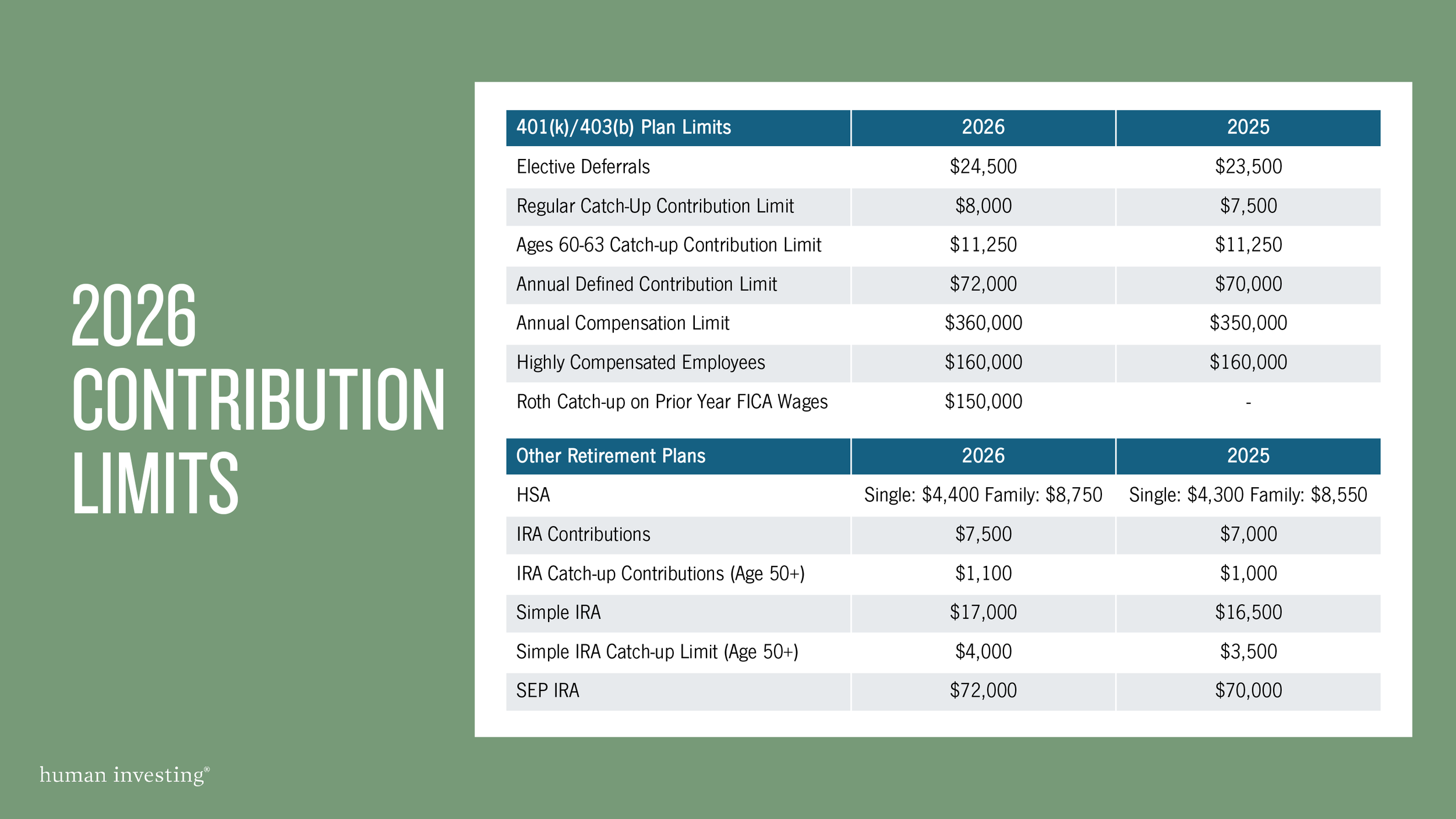
Here is the breakdown for 2026:

  • Under age 50: $24,500

  • Ages 50–59 and 64+: $32,500 (includes a $8,000 catch-up)

  • Ages 60–63: $35,750 (includes an $11,250 “super” catch-up)

SECURE 2.0 added another layer on top: starting in 2025, workers ages 60–63 get access to “super” catch-up contributions, up to 150% of the regular catch-up limit (or 110% for SIMPLE plans).

It is possible that catch-up contribution may be required to be made as a Roth contribution, especially if your income exceeds certain thresholds.

For employees, the downside is giving up the upfront tax break on catch-up contributions. The upside? Tax-free withdrawals later.

For employers, the stakes are higher: if the plan isn’t set up to handle Roth catch-ups, some employees could lose access to them entirely.

Diving Into the New Rule: Roth Required for Some

Here’s the key change:

If you make more than $150,000 in FICA wages in 2026 (adjusted annually), all your catch-up dollars will have to go in as Roth contributions, after tax dollars, starting January 1, 2026.

This means if you fall into the higher-income category, your Roth catch-up will be automatically applied to your eligible contributions once you hit age 50.

A few quick clarifications:

  • This does not apply to SIMPLE IRAs or SEP plans.

  • Wages are measured using Box 3 on your W-2.

  • If your plan does not include a Roth deferral option, catch-up contributions won’t be permitted in your plan regardless of income.

Congress delayed this rule once (from 2024 to 2026) to give employers time to adjust. That grace period is ending soon.

Two Types of Catch-Up Contributions

Depending on your age and plan setup, catch-ups may fall into these buckets:

  1. Standard age-50 catch-ups
    These are the usual “extra” contributions, and the ones subject to the Roth rule if you’re over the wage limit.

  2. “Super” catch-ups at ages 60–63
    Optional, but attractive for late-career savers (and yes, Roth rule applies to these as well).

If You Sponsor a Plan, Start Here

A survey from the Plan Sponsor Council of America says only 5% of plan sponsors feel fully ready.

Payroll providers will bear the heavy lifting here. Plan sponsors should lean on their payroll providers and ensure that there is clarity on how catch-up contributions are being made.

To facilitate administration of this new rule and employee experience, we suggest permitting “Deemed” Roth contributions. This means that there is an assumption that catch-up contributions will be considered Roth, even if an employee has elected pre-tax deferrals for their base contribution. Deemed Roth feature is typically setup as a function of payroll and must be included in your governing plan documents.

To avoid last-minute scrambling, here’s what employers should be doing in 2025 and into 2026:

  • Check whether your plan even offer Roth - this is a great deferral option for all employees, regardless of income.

  • Talk to payroll and your recordkeeper about tracking who’s subject to the rule.

  • Permit “Deemed” Roth contributions and amend plan document(s).  

  • Review catch-up provisions for ages 60–63 and for 403(b) service-based rules.

  • Create employee communications, especially for those over the wage limit.

  • Work with your Recordkeeper or TPA on plan amendments.

What’s the Timeline?

Here’s how the rollout shakes out:

  • Now — Setup a call with payroll and recordkeeper.

  • December 31, 2025 — New catch-up limits kick in.

  • January 1, 2026 — Roth requirement becomes real.

  • Late 2026 — Formal plan amendments are due.

We’re here to help

For the workers affected, the downside is giving up the upfront tax break on catch-up contributions. The upside? Tax-free withdrawals later.

For employers, the stakes are higher: if the plan isn’t set up to handle Roth catch-ups, some employees could lose access to them entirely.

Bottom line: Roth is about to move from optional to unavoidable for a lot of savers. Getting ahead of the change now will make 2026 less stressful. If you or someone you know may need assistance, let’s meet!


Disclosure: This material is for informational and educational purposes only and should not be considered personalized tax, legal, or investment advice. You should consult your own qualified tax, legal, and financial professionals before making any decisions based on this information. Tax laws and regulations, including those discussed here, may change and can vary based on individual circumstances. The examples and explanations provided are for general understanding and should not be relied upon to predict or guarantee outcomes. Investing and retirement planning involve risk, including possible loss of principal. Past performance does not guarantee future results. Advisory services are offered through Human Investing, LLC, an SEC-registered investment adviser.


Related Articles

Tax-Smart Philanthropy: How OBBBA Could Shape Giving in 2026


New Tax Breaks and Rules for Charitable Donations

People give because they care. That’s the heart of generosity. Yet the rhythm of giving is often set by the tax code. It can make giving feel natural and rewarding, or it can add friction that makes it harder.

When the One Big Beautiful Bill Act was signed on July 4, 2025, the headlines focused on spending and tax rates. Less noticed were the provisions that quietly change how Americans give.

Starting in 2026, millions of households, high-income donors, and businesses will face new incentives and new hurdles when they decide how much to give.

The details are technical, but the story is simple: with the right strategy, you can give more, save more, and make sure your money tells the story you want it to.

A Universal Deduction for a Majority of Taxpayers

For years, most families gave to charity without any tax benefit. Unless you itemized, your generosity was invisible to the IRS. You gave because it mattered, not because it saved you money.

That changes in 2026. Under the new law, taxpayers who claim the standard deduction will also be able to deduct charitable contributions. This is no longer a benefit limited to those who itemize. According to the Tax Foundation, a nonpartisan research group, roughly 85% of taxpayers take the standard deduction, making this one of the broadest incentives for charitable giving.

Here is how it works: taxpayers who claim the standard deduction can now also deduct up to $1,000 in cash contributions each year, or $2,000 for married couples. The gifts must be made in cash, not appreciated assets, and they must go directly to eligible charities.

Why it matters: After 2025, everyday giving like your monthly tithe, your holiday donation, or your support of a local nonprofit will show up on your tax return. The small checks you were already writing now carry extra weight.

What this means for you: For illustrative purposes, take a family who does not itemize and donate $100 each month to charity. That is $1,200 over the year. Beginning in 2026, that full amount can be deducted from their taxable income, up to the $2,000 limit for married couples, $1,000 single filers. A family in the 22% bracket giving $1,200 saves about $264 in taxes.

Note: The figures here represent Federal tax savings. For Oregonians, there may be an extra layer of benefit. If the state aligns with the new Federal rules, that same $1,200 donation could also reduce state taxes by up to 10%, or $120. States are currently evaluating whether to adopt these provisions, so this piece is still unfolding.

The catch is that families used to the standard deduction often don’t track their giving. It never mattered before. Starting in 2026, it will. The habit of generosity now comes with a second habit: record keeping.

‘Bunching’ and a New Hurdle for Itemizers

Beginning in 2026, all itemizers will also face a new rule. Charitable contributions will only be deductible above 0.5% of your adjusted gross income (AGI).

Here is how it works: Suppose your AGI is $200,000 and you itemize deductions. If you give $10,000 to charity, the first $1,000 ($200,000 x 0.5% = $1,000) does not count. Only $9,000 reduces your taxable income. Any 0.5% disallowed amount will be suspended and carried forward for up to 5 years, to hopefully be deducted in a future year when eligible.

Why it matters: On paper, half a percent sounds small. But in practice, this will likely shift how people give. Smaller, steady donations may no longer deliver the same benefit, nudging families to think more strategically about timing and structure.

What this means for you: It is not the size of your gift that changes, but the rhythm. Two larger checks can sometimes be more effective than four smaller ones. Instead of giving the same amount every year, consider making larger gifts less often, a strategy often called “bunching.”

For example, donating $20,000 every two years rather than $10,000 annually. In the larger year, your gift clears the new floor and provides a stronger deduction. In the smaller year, you take the standard deduction and still come out ahead. A $20,000 gift, above the 0.5% AGI floor, in the bunching year may yield roughly $6,400 in tax savings (assuming 32% bracket).

The increased State & Local Tax (SALT) deduction in 2026 can make this even more attractive. Take a household with $25,000 in SALT deductions and $20,000 in charitable giving every other year. That totals $45,000 of deductions, easily clearing the standard deduction and ensuring the charitable contribution counts well above the 0.5% threshold. In the off years, they simply return to the standard deduction.

Donor-advised funds (DAFs) make this easier. You can contribute a larger amount in one year, capture the deduction, and then spread your giving out over time so your favorite causes don’t feel the gap. Many DAFs even allow you to invest the balance, which means your dollars can grow before they’re granted. In that sense, a DAF turns one act of generosity today into even more generosity tomorrow. 

A 37% Deduction, Now 35%

If you itemize deductions and are in the top tax bracket, another change arrives in 2026. The maximum tax benefit you can receive from charitable deductions is limited to the equivalent of a 35% tax rate.

Here is how it works: Charitable gifts must first clear the new 0.5% of AGI floor. On top of that, the benefit of any eligible gifts above that floor will be limited to 35% rather than today’s 37%.

For example, with an AGI of $1,000,000 and a gift of $100,000, the first $5,000 provides no tax benefit today because of the 0.5% floor. The remaining $95,000 is deductible, producing a maximum tax savings of $33,250 in 2026. Under the current rates, a $95,000 gift would save $35,150.

The 0.5% floor can carry forward, but the difference between the 35% and 37% deduction rates does not.

Why it matters: For wealthy donors, the change is modest in dollars but meaningful in psychology. Even small shifts in after-tax cost can alter behavior at the margins, which is why thinking ahead about timing and tools matters more than ever.

What this means for you: For wealthy donors, every dollar still counts, but in 2026, each one counts a little less. It may make sense to accelerate some giving into 2025 before the new rules take effect.

C-Corp Business Owners and the New 1% Floor

Starting in 2026, C Corporations (C-Corp) will also face a new threshold. Charitable giving will only be deductible once it exceeds 1% of taxable income.

Here is how it works: If your company is a C-Corp and earns $1,000,000 and donates $8,000 (0.8% of income), you’ll no longer get a tax deduction for that gift. But if you give $15,000, you’ve crossed the 1% threshold, and the portion above $10,000 (the first 1%) is deductible.

The long-standing 10% cap on corporate deductions still stands, along with the five-year carryforward. The key difference is that smaller contributions that once carried a tax benefit may no longer qualify.

Why it matters: This rule discourages token giving and pushes companies toward more intentional generosity. Businesses that want their contributions to count, for both taxes and impact, will need to plan gifts as part of a larger strategy rather than as one-off gestures.

What this means for you: For C-Corp business owners, this change means smaller charitable gifts may no longer have a tax benefit. To maximize impact, you may choose to either increase your giving to clear the 1% threshold or bunch donations in certain years to secure the deduction.

A Special Planning Window in 2025

Before the new rules take effect, 2025 offers a unique chance to be more strategic with your generosity. The changes do not begin until 2026, which means as an itemizer you can still give under today’s more favorable framework: there is no 0.5% AGI floor for individuals, no 1% floor for corporations, and top-bracket donors can still receive up to a 37% deduction.

Why it matters: 2025 is one of the most favorable years in recent memory for charitable giving for itemizers. Acting before the rules change can mean more tax savings and more dollars flowing to the causes you care about.

What this means for you:

  • A family giving $20,000 in 2025 can deduct the full amount. In 2026, with a $200,000 AGI, only $19,000 would count toward a deduction.

  • A high-income donor with an AGI of $1,000,000 giving $100,000 in 2025 could reduce their taxable income by up to $37,000. The same gift in 2026 would shrink to $33,250 in savings, raising the after-tax cost of generosity.

  • C Corporations who typically make smaller annual gifts may want to accelerate donations into 2025 before the 1% corporate threshold applies.

For those who want to keep supporting their favorite charities steadily, donor-advised funds can be especially effective. By contributing a larger amount in 2025, your secure today’s tax benefits while giving yourself flexibility to distribute grants to nonprofits over time.

Bringing It All Together

The new law will change how taxpayers experience charitable giving. Some will gain new opportunities, while others will need to be more intentional to keep their giving tax efficient.

  1. Individuals & Families who do not itemize will now enjoy a tax break for giving.

  2. Itemizers will need to plan gifts to rise above the new floor.

  3. High-income donors will face a slightly smaller size tax benefit.

  4. C Corporations will need to give more intentionally to secure deductions.

  5. 2025 offers a last-chance window to maximize giving before the new rules take hold.

Why it matters: These rules will shape how generosity shows up, but not why we give. With planning, your giving can still tell the story of what matters most to you. The new law will not change the reasons we give, but it will change the timing, structure, and strategy that make generosity as efficient as possible.

At Human Investing, we see our job as more than managing investments. We help align your values with your financial life so that every dollar reflects what matters most. That way, your giving becomes not only a tax-smart decision, but a lasting legacy.


Tax Foundation. (2025). FAQ: The One Big Beautiful Bill Act tax changes. Retrieved from https://taxfoundation.org/research/all/federal/one-big-beautiful-bill-act-tax-changes/ Tax Foundation

Government Publishing Office. (2025). Public Law 119-21: One Big Beautiful Bill Act. Retrieved from https://www.congress.gov/119/plaws/publ21/PLAW-119publ21.pdf

Kitces, M. (2025, July). Breaking down the “One Big Beautiful Bill Act” (OBBBA): Tax planning, SALT cap, senior deduction, QBI deduction, Tax Cuts and Jobs Act (TCJA), AMT, “Trump Accounts”. Nerd’s Eye View. Retrieved from https://www.kitces.com/blog/obbba-one-big-beautiful-bill-act-tax-planning-salt-cap-senior-deduction-qbi-deduction-tax-cut-and-jobs-act-tcja-amt-trump-accounts/

Disclosure: This material is provided for informational and educational purposes only and should not be construed as tax, legal, or investment advice. Examples are hypothetical and for illustration purposes only; actual results will vary. Tax laws are subject to change, and their application may vary depending on individual circumstances. Clients should consult their own tax and legal advisors before making any charitable giving decisions. Advisory services offered through Human Investing, LLC, an SEC registered investment adviser.


Related Articles

A Big Tax Break for Retirees: How To Put the New $6,000 Deduction To Work Before It’s Gone


On July 4, the One Big Beautiful Bill Act (OBBBA) became law, as a broad tax and spending package aimed at easing inflation and delivering financial relief to Americans. One of the most notable provisions for retirees is a new $6,000 “senior bonus deduction” for individuals age 65 and older.

The $6,000 bonus deduction is available to all eligible seniors, whether they take the standard deduction or choose to itemize. This is different from the age-based standard deduction, which is only allowed if you take the standard deduction.

Unlike the age-based standard deduction, this new bonus stacks on top of your existing deductions, making it one of the most generous tax breaks retirees have seen in years.

Here’s what’s changing and how to take advantage of it in your retirement plan.

How the stacked tax deduction will work

Starting for tax year 2025, taxpayers age 65 and older will be able to combine:

  • A standard deduction of $15,750 (single) or $31,500 (married filing jointly), with

  • An age-based addition of $2,000 (single) or $1,600 per spouse if married, and

  • A new $6,000 senior bonus deduction under the OBBBA.

That means a single filer over 65 could deduct up to $23,750(previously $16,550). A married couple where both spouses are 65 or older could deduct $46,700 (previously $32,300).

The catch?

Eligibility is income-based. The full deduction is available to those with modified adjusted gross income (MAGI) up to $75,000 for single filers or $150,000 for joint filers. The deduction begins to phase out once above those thresholds and is fully phased out at $175,000 for single filers and $250,000 for joint filers.

It’s also worth noting that this senior bonus deduction is temporary. As of now, it only applies for the 2025 through 2028 tax years. It’s possible Congress could extend it further, but we likely know until 2028.

Why It Matters: Five Planning Opportunities Worth Exploring

This deduction will reduce taxes for many retirees. But its real value lies in the doors it opens for proactive planning. Here are several strategies we’re helping clients explore:

1. Rethinking Roth Conversions

Roth conversions allow you to shift money from traditional IRAs to Roth IRAs, paying tax now to enjoy tax-free withdrawals later. The bonus deduction gives retirees more room to convert IRA dollars at lower effective tax rates.

By combining the standard deduction, the age-based addition, and this new $6,000 bonus, some retirees may be able to convert dollars each year with minimal tax impact. This can lower future required minimum distributions (RMDs), reduce lifetime taxes, and create more income flexibility down the road.

There’s a sweet spot between retirement and RMDs where this approach can have the most impact.

2. Smoothing Income Over Multiple Years

Retirees often experience uneven income from asset sales, business wind-downs, or large IRA distributions. With this senior bonus deduction in place for four years, now is the time to think about spreading income more evenly across tax years, so you can qualify for this deduction while it’s available.

To make the most of the deduction each year from 2025–2028, consider ways to spread income more evenly across those years:

  • Delaying large sales or distributions to avoid spiking above the income threshold in a single year.

  • Accelerating income from future high-tax years into lower-income years.

  • Using multi-year tax projections to identify the optimal path.

This smoothing strategy can help avoid unnecessary spikes in tax liability while making full use of the available deduction each year.

Same Income, Different Results - This chart compares two retirees, each with an average annual income of $160,000 over four years.

  • Uneven Income: Income spikes in 2026 and 2028 push this retiree above the $175,000 phaseout limit, causing them to miss out on the $6,000 deduction in two years. Total lost deductions: $12,000

  • Smoothed Income: By spreading income more evenly across all four years, this retiree stays under the threshold and qualifies for the full $6,000 deduction every year.  Total deductions preserved: $24,000

Strategic income timing can preserve valuable deductions, even when total income stays the same.

3. Funding the Cashflow Gap Before Claiming Social Security

Delaying Social Security often results in higher lifetime benefits. The challenge is funding those interim years. The senior bonus deduction provides a helpful cushion, allowing retirees to generate income from taxable or IRA accounts without incurring as much tax.

This deduction could help bridge the gap, making it easier to delay Social Security while keeping tax costs under control.

4. Revisiting Withdrawal Order

The traditional guidance suggests pulling from taxable accounts first, then IRAs, and Roth accounts last. But with this expanded deduction, it may be worth adjusting that sequence.

You might instead:

  • Draw more from IRAs early, taking advantage of low tax rates and the temporary senior deduction. You’re essentially using the government’s tax break to convert IRA assets into spending money at a low cost. This can also reduce future IRA balances (and future taxable RMDs).

  • Reserve taxable accounts for later, especially after the senior bonus deduction expires.

  • Preserve Roth assets for high-income years or future tax flexibility.

Coordinating withdrawals across all account types with the new deduction in mind can improve long-term tax efficiency.

5. Aligning With Charitable Giving

If you’re charitably inclined, this is a good time to revisit your giving strategy.

Qualified Charitable Distributions (QCDs) from IRAs remain a powerful tool to give directly to charity without increasing taxable income. This also keeps your MAGI lower, which may help you stay under the $250k Joint/$175k Single threshold to qualify for the senior bonus deduction.

For others, donor-advised funds can be used to bunch gifts in one year to claim a high itemized deduction, then take advantage of the standard deduction in the next. In both cases, retirees can still benefit from the new $6,000 bonus deduction each year they qualify.

This new deduction adds flexibility, helping you give with greater intention and less tax friction.

Bottom Line

If you’re 65 or older, the next few years offer a unique window of opportunity. From 2025 through 2028, this new deduction can help lower your tax bill today and create long-term planning advantages that stretch well into the future.

It’s a reminder that good tax laws are only as valuable as the plans they inspire. Used thoughtfully, this expanded deduction can help you reduce lifetime taxes, generate tax-efficient income, and leave a stronger legacy.

The next four years offer a rare opportunity to rethink how you generate income in retirement. Whether you're considering a Roth conversion, adjusting withdrawal strategies, or supporting causes you care about, we’re here to help you build a plan that puts this deduction to work.


Disclosure: This material is for informational and educational purposes only and is not intended as personalized tax, legal, or investment advice. You should consult your own tax, legal, and financial professionals before making any decisions based on the information provided. Tax laws and regulations are subject to change, and their application can vary based on your individual circumstances. While the strategies discussed may be appropriate for some individuals, there is no guarantee that any specific tax outcome or investment result will be achieved. Any examples, scenarios, or case studies are hypothetical and for illustrative purposes only. They do not represent actual client situations and should not be relied upon to predict or project results. Investing involves risk, including the potential loss of principal. Past performance does not guarantee future results. All investments and tax strategies carry certain risks and may not be suitable for all investors. Advisory services offered through Human Investing, LLC, an SEC registered investment adviser.


Related Articles

What the One Big Beautiful Bill Act Means for Your Taxes


Signed into law July 2025, the One Big Beautiful Bill Act brings a wave of tax changes including bigger deductions, new savings tools, and key incentives. Whether you're filing as an individual, managing a household, or running a business, understanding these updates is key to maximizing your benefits and minimizing surprises. Here’s what you need to know.

All U.S. taxpayers

The following provisions affect all U.S. Taxpayers with most taking effect for calendar year 2025, and a few scheduled to begin in 2026.

Tax Brackets Remain Unchanged

With the One Big Beautiful Bill Act (OBBBA), federal income tax brackets remain intact, and are set to be permanent for the future. The seven marginal rates continue to be:
10%, 12%, 22%, 24%, 32%, 35%, and 37%.
More importantly, these rates did not revert to their pre-2018 levels, which were generally higher for many income brackets. 

Bigger Standard Deductions for Everyone – Starting 2025

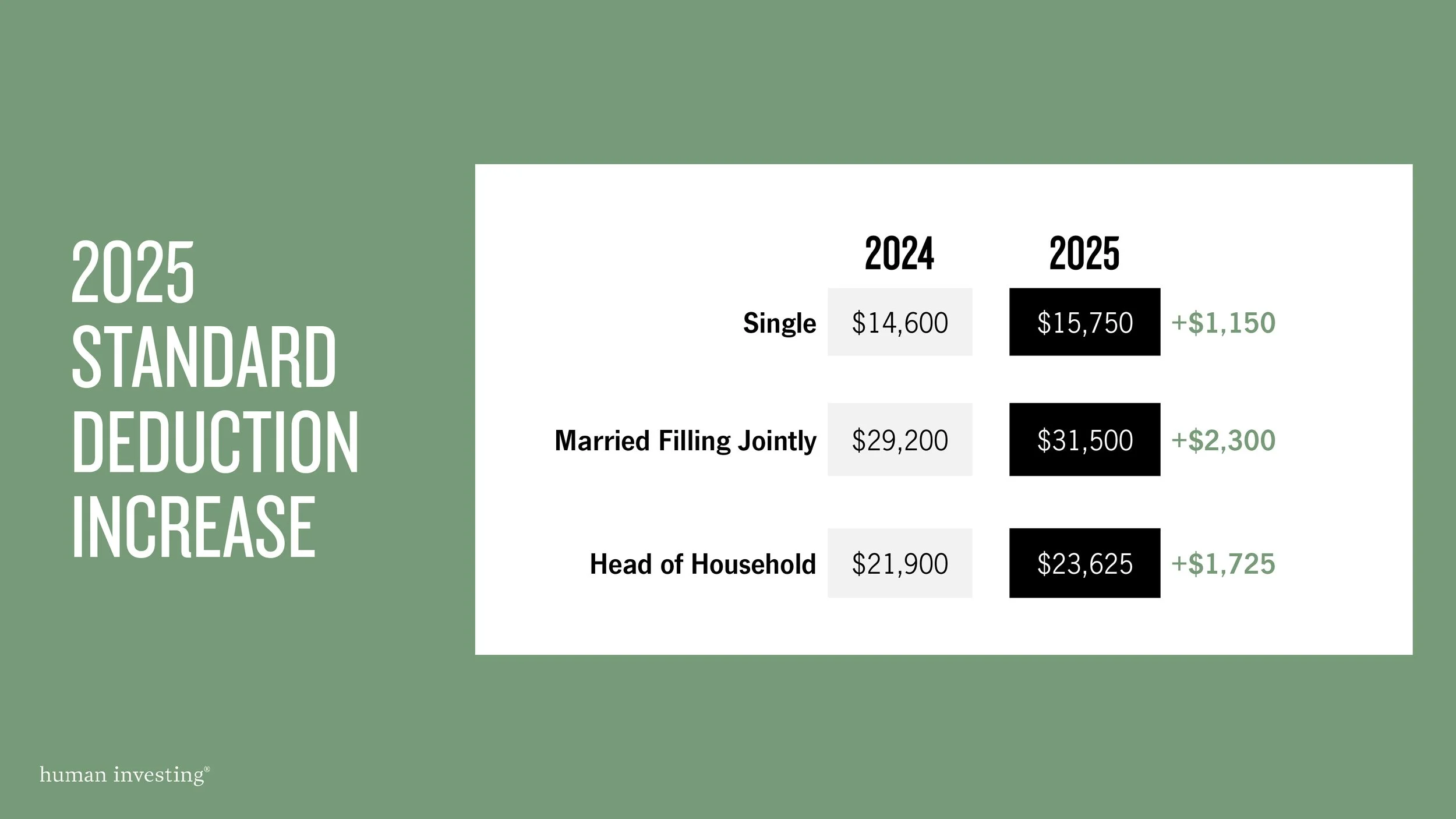
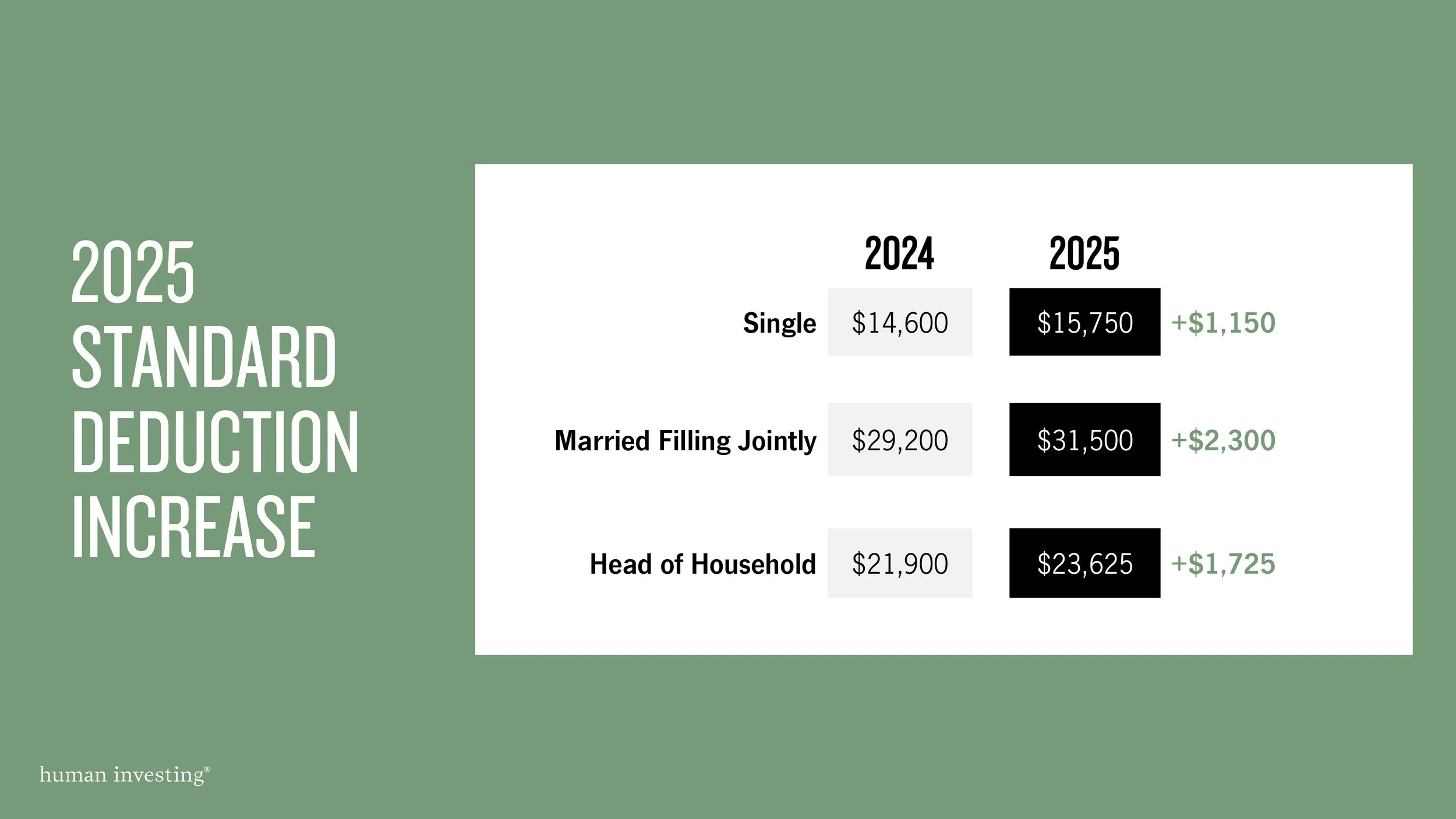
The OBBBA raises the standard deduction amounts across all filing statuses:

- Married Filing Jointly: $31,500 (up from $30,000)

- Single: $15,750 (up from $15,000)

- Head of Household: $23,625 (up from $22,500)

Charitable Giving for Non-Itemizers – Starting 2026

Under the new law, everyone is able to have a tax benefit for making charitable contributions.

If you normally don’t itemize your deductions during tax time you can now deduct your charitable contributions:

- Up to $2,000 for joint filers

- Up to $1,000 for others

Tip:  If you typically don’t itemize, there may be tax planning opportunities near year-end to move your charitable contributions into January 2026 to get a better tax benefit.

Clean Energy Incentives Update – Ending 2025

The 30% federal tax credit for residential solar and battery storage systems expires on December 31, 2025. To qualify, your system must be fully installed and operational by that date, there’s no grace period or retroactive eligibility. If your project is underway, be sure to complete it before year-end 2025 to claim the full credit.

Elimination of Federal Clean Vehicle Tax Credits – Ending September 2025

The federal tax credits for clean vehicles are being phased out earlier than expected. If you are planning to purchase an EV and qualify for the credit, you must do so by September 30, 2025 to claim it. These credits will not be renewed or extended under the new law.

Trump/MAGA Accounts – Starting 2025

These are new savings accounts for children, modeled after IRAs but designed specifically for minors. Each child born between Jan. 1st, 2025 and Jan. 1st, 2029 will automatically receive an account with a $1,000 government contribution to help jumpstart long-term savings.

Contributions

Parents can contribute up to $5,000 per year until the child turns 18. Funds must be invested in ETFs and grow tax-free for qualified uses like education, a first home, or starting a business.

Distributions

Funds are partially accessible at age 18 for qualified expenses, with full access at age 25. After age 30, funds can be used for any purpose without penalty. Early, non-qualified withdrawals before age 30 are subject to tax and a 10% penalty.

Estate & Gift Tax Exemption – Starting 2026

Before the One Big Beautiful Bill Act, the estate and gift tax exemption was set to drop from $13.99 million to $7.2 million per person in 2026 due to the TCJA sunset, OBBBA permanently raises it to $15 million per person starting in 2026, indexed for inflation.

For taxpayers making $500k or less

SALT Deduction – Starting 2025

Under the OBBBA, if you have an Adjusted Gross Income (AGI) under $500,000 you are eligible to deduct up to $40,000 in state and local taxes, including income tax or sales tax, and property taxes from your federal taxable income. This expanded cap is in effect for five years through 2029 and offers a significant increase from the previous $10,000 limit.  For many Oregonians, this is seen as a win, with Oregon being a high-income tax state.

Tip: Careful planning can help maximize this deduction. To take full advantage of the increased limit, consider:

  1. Paying your full 2025 property tax bill within the 2025 tax year, if feasible.

  2. Making your Q4 estimated state income tax payment due January 15, 2026 by December 31, 2025. This ensures it counts toward your 2025 deduction cap of $40,000 and helps preserve the full benefit if your AGI is under $500,000.

Taxpayers with AGI over $500,000 can still deduct state and local taxes, but the $40,000 cap is reduced by 30% of the amount exceeding $500,000, with a minimum deduction of $10,000. At $600,000 AGI, the deduction is reduced by $30,000, bringing it down to the $10,000 floor. Note: This effectively creates a high-income tax bracket between $500K and $600K (45.5%) if you are itemizing. These rules remain in effect through 2029.

Child Tax Credit (CTC) – Starting 2025

The CTC has increased to $2,200 per qualifying child through 2028, after which it reverts to $2,000; the credit is nonrefundable and phases out for AGI above $400,000 MFJ and $200,000 for others.

Enhanced Deductions for Taxpayers Age 65+ - Starting 2025

A new $6,000 bonus standard deduction is available for taxpayers aged 65 and older, but it begins to phase out at AGI of $150,000 MFJ ($75,000 Single) and phases out completely once above $250,000 MFJ ($175,000 Single).

Tip: Careful planning around Roth conversions is recommended, as such conversions increase AGI and could reduce or eliminate eligibility for the bonus deduction. 

Tip: To help remain under these thresholds, taxpayers aged 70½ or older can make a Qualified Charitable Distribution (QCD) from their IRA to a qualified charity. This counts towards their annual Required Minimum Distribution (RMD) while excluding the amount from taxable income, and preserving eligibility for deductions under OBBBA.

Car Loan Interest Deduction – Starting 2025

If you purchased a new car with financing anytime in 2025, you may qualify for a deduction of up to $10,000 if the following apply:

  • Your adjusted gross income (AGI) is below $250,000

  • The vehicle was brand new and assembled in the United States

  • You purchased the car (not leased it)

This deduction applies only to interest paid on the loan and is designed to support domestic manufacturing and personal vehicle ownership.

For Business Owners

Section 179 & Bonus Depreciation – Starting 2025

- 100% bonus depreciation is back (for assets placed in service after January 19, 2025) and is now made permanent by the Act.

- Expense limit: $2.5M

- Phaseout threshold: $4M

Qualified Business Income (QBI) Deduction – Starting 2026

- OBBBA proposed raising the QBI deduction to 23%, but the final law kept it at 20%. However, it increased the phaseout thresholds to $150,000 for MFJ and $75,000 for others up from $100,000 and $50,000, respectively. These changes will take effect in 2026.

- $400 minimum deduction if you have at least $1,000 in business net income.

Employer Student Loan Help – Starting 2026

- Employers can contribute up to $5,250/year tax-free toward paying off student loans. Limitations may apply.

Excess Business Losses – Starting 2026

- Cap: $500K (joint) / $250K (others).

- Losses above this become net operating losses and are carried forward to future years.

The OBBBA reshapes the tax landscape for nearly every American. Whether you're a parent saving for your child’s future, a retiree managing income thresholds, or a business owner investing in growth, the new law offers expanded opportunities and new complexities. With many provisions taking effect in 2025 and 2026, now is the time to review your financial plan, optimize deductions, and take advantage of available tools.


Disclosure: The information presented herein is for educational and informational purposes only and is not intended to be construed as personalized tax, legal, or investment advice. Tax laws and financial regulations are subject to change, and the implications of the One Big Beautiful Bill Act may vary based on individual circumstances. Please consult a qualified tax professional or financial advisor before making any decisions based on this content. Advisory services offered through Human Investing, an SEC registered investment adviser.


Related Articles

Why Portland Area Executives Are Getting Hit at Tax Time and What to Do About It


As a leader at your company, you are provided a comprehensive range of benefits that help achieve your financial and retirement goals. However, things can go awry at tax time. The newer Metro and Multnomah County taxes, in addition to regular Federal and Oregon taxes, are becoming an increasing burden for executives to navigate. 

By implementing a proactive forward-looking tax strategy and payment plan, company leaders have a significant opportunity to improve their financial situation, relieve stress related to taxes, and reduce unwanted April surprises!

In this article, we’ll examine a few of the biggest reasons you could get hit with an unexpected tax bill and ways to navigate it differently.

Tax hit #1: Limiting your withholdings on supplemental pay

Many sources of compensation beyond salary (such as PSP, LTIP/PSU vests, RSU vests, and stock option exercises) are taxed as “supplemental pay.” This comes with a fixed tax withholding percentage, regardless of your tax bracket or withholding elections on your base salary. For example, the fixed withholding rates set by the government on supplemental pay is 22% Federal and 8% Oregon. The reality is most executives are in a much higher income tax bracket, sometimes as much as 17% higher than the amount withheld. This discrepancy leaves a significant gap in the amount of taxes that should have been withheld versus the actual amount that was withheld.

As an example, Charlotte an executive has $50K of RSUs that vested on September 1st. With all her income sources (salary, PSP, LTIP/PSU, RSUs) her total taxable income is $400K. The taxes automatically withheld on the $50K vested RSUs would be about $15K (22% Federal + 8% Oregon). However, her total income puts her in the 35% Federal tax bracket + roughly 10% Oregon bracket. This makes the withholding on her RSUs about $7,500 short ($50K x 15% short).

To get this paid in, she could use Quarterly Estimated Tax vouchers to submit the underpaid tax to the IRS and Oregon. Or, depending on her overall tax situation, she may be able to wait and pay the balance due with her tax return in April without incurring underpayment penalties and interest – although this determination may require a tax professional to run a detailed tax projection. For many people, being hit with a large bill all at once in April may not feel great and they may opt for Quarterly Estimated Payments instead.

If Charlotte doesn’t realize that her withholding was short until she files her tax return next April, she could face yet another surprise – 7 months of underpayment interest and penalties. Depending on her overall tax picture, the IRS and Oregon may have been accruing this since September. Yet another unwanted surprise for Charlotte.

Tax hit #2: Not withholding enough (or at all) for Multnomah County’s “Preschool for All” tax

The Preschool for All tax is 1.5% on taxable income over $125,000 for individuals or $200,000 for joint filers, with an additional 1.5% on taxable income over $250,000 for individuals or $400,000 for joint filers. The rate is currently scheduled to increase by 0.8% in future years. If you live or work in Multnomah County, you are likely subject to the “Preschool for All” tax that started in 2021.

Unfortunately, your company might not use payroll withholding to cover this tax, in which case you would be responsible to fully submit this tax on your own. Multnomah County expects these payments to be received quarterly to avoid interest and penalties. This can be submitted using vouchers or paying online.

We often see the most challenges for residents of Multnomah County who travel outside the county boundaries to work for an employer that does not currently have Preschool tax withholding options. Determining how much to pay and navigating this alone can be stressful. And for any late or underpaid tax, the county is quick to send notices in the mail. To reduce this headache, we recommend finding trusted advisors or tax professionals to serve as a guide to help you navigate complexities throughout the year.

Tax hit #3: A lack of coordination on how much to withhold for the Metro tax if you and your spouse both work

The Metro Supportive Housing Services tax (a.k.a. the Homeless tax) also began in 2021. It is a 1% tax on applicable income over $125,000 for single filers or $200,000 for joint filers.  If you don’t know whether your residence or your workplace is located within the Metro, you can look up the address here: Metro Link.

The challenges described above for the Preschool tax are similar for the Metro tax. Additional issues arise for families when each spouse works at a different company, and we see this frequently because the Metro area is larger. The income threshold for this tax is based on total household income. Since the spouses’ two different employers likely do not communicate with each other, there can be significant over or under withholding of these local taxes.

For example, Nike is located within the Metro boundary. If a Nike executive has income of $400K, Nike will start to withhold Metro tax once the executive’s income for the year is over $200K. Let’s say their spouse earns $90K by working for a different company, ABC Co., located across town but still within the Metro. Since this $90K alone is under the threshold, ABC Co. does not automatically withhold Metro tax. However, we know the total household income of $490K is over the threshold, which means all of the ABC Co. income is subject to Metro tax too. You see how this can create an issue? Unless the spouse realizes this and works with ABC Co.’s HR department to turn on withholding or diligently submits quarterly payments to the Metro on their own, the family may discover a balance of tax, penalties, and interest to pay in March/April right around a spring break vacation with their kids. Not fun!

In short, if you live or work in the Metro boundaries, it is important to be aware of the withholding options that your employer provides, and to be certain you are opted in or out accordingly.

Tax hit #4: Incorrectly reporting stock transactions and the complexity that comes with it

Up to this point, we’ve discussed withholdings on your salary and benefits. What about company stock that you own and decide to sell – what can go wrong there?      

When you sell company stock (whether you’re still at the company or have moved on), it is reported to you and to the IRS by the custodian (i.e. Fidelity, Schwab, Computershare) on a Form 1099. On this form, the custodian clearly reports the sale date, quantity, sales price, and name of the company’s stock that was sold. What is not so clear is the basis – the portion of sales proceeds that is not taxable because it has already been taxed on your W-2.

If the stock was acquired as part of your employee benefits package, this information is often buried within dozens of pages in the Form 1099. And these pages can be detailed, complex and confusing to read - especially as each custodian has a different template and the layout can change from year to year. We recommend seeking the help of a professional if you are unsure about your basis or how to report it. An experienced tax preparer sees MANY of these forms each season. They know where to look to find the basis of the company stock you sell, and how to translate that information accurately onto your tax return.

Without reporting the basis, or reporting it incorrectly, your taxable income could potentially be overstated significantly and you may accidentally pay more money to the IRS than is actually due. Fixing this after your tax return has been filed can require a time consuming process of preparing an amended return and waiting for the government to return your money. If you suspect you overpaid your taxes, you can always reach out to a tax professional to review your tax return. CPAs within our firm often provide this review to clients throughout the year as part of our financial planning services. 

While tax is a complex subject, it is only a piece of your unique financial picture. Planning appropriately for taxes should be done cooperatively with other parts of your financial plan, such as cash flow, retirement and estate planning. Done right, they’ll fit together like a perfect puzzle.  

Want to minimize the tax headache? A few Actions you can take now

Action #1:  Bring in experienced tax professionals.

Tax professionals can work with you to run “tax projections” to track how much you need to pay and monitor your April balance. These tax projections can be done any time throughout the year and can be refined near year-end to give you peace of mind and limit unwanted surprises.

If you’re looking for tax savings now or in retirement, we highly recommend proactive tax planning. A professional who is well-versed in your company’s benefits can use your tax projection to provide customized strategies to minimize your tax liabilities.

Action #2:  Talk with your financial planner.

We know that for many company executives, setting aside additional tax payments from your monthly household cash flow can become stressful, especially since the amounts can be so inconsistent. If you’re feeling that stress, tell your financial planner – they’ll want to know so they can help you navigate it well and feel more confident going forward. 

One strategy we may suggest is the “Pay as You Receive” method, which calculates an estimated amount of taxes due from each type of supplemental income when it hits your bank account. Making tax payments at the time you receive the income- while you have the funds to do it- will leave your monthly cash flow separate and unaffected.

These estimated tax payments, when combined with your payroll withholding, should be equal to your anticipated tax bracket for the calendar year. This approach helps ensure that your total payment to the IRS, Oregon, Multnomah County, and Metro aligns with your overall tax obligations.

Action #3:  Find a team that has BOTH!

It is important to note that any tax payment and mitigation strategies should be part of a comprehensive financial plan that is tailored to your specific financial situation. If you’re considering a firm that can look at your full financial picture, we’d love to help. At our Lake Oswego office, our team has licensed CERTIFIED FINANCIAL PLANNER® professionals and Certified Public Accountants, and we constantly share knowledge with one another.

We’re here to talk you through local, state, and federal complexities and we want to help you get things right the first time. Our mission is to serve you faithfully and be there to guide you through your benefits packages as you advance in your career or make a move.

If you have questions about how to set up a proactive forward-looking tax strategy, please contact our team to learn more.


Disclosures: The information provided in this communication is for informational and educational purposes only and should not be construed as investment advice, a recommendation, or an offer to buy or sell any securities. Market conditions can change at any time, and there is no assurance that any investment strategy will be successful. Investing involves risk, including the potential loss of principal. Past performance is not indicative of future results.

Diversification does not guarantee a profit or protect against a loss in declining markets. Asset allocation and portfolio strategies do not ensure a profit or guarantee against loss.

This material is not intended to provide, and should not be relied upon for, tax advice. Please consult your tax advisor regarding your specific situation.

Scenarios discussed are hypothetical and for illustrative purposes only. They do not represent actual clients or outcomes and should not be interpreted as guarantees of future results.

The opinions expressed in this communication reflect our best judgment at the time of publication and are subject to change without notice. Any references to specific securities, asset classes, or financial strategies are for illustrative purposes only and should not be considered individualized recommendations.

Human Investing is a SEC Registered Investment Adviser. Registration as an investment adviser does not imply any level of skill or training and does not constitute an endorsement by the Commission. Please consult with your financial advisor to determine the appropriateness of any investment strategy based on your individual circumstances.


Related Articles

Really? My Bonus is Taxed the Same as my Paycheck?
 

Your bonus is not taxed more than regular income.

Have you ever noticed the discrepancy between the bonus payment that was communicated to you and the actual bonus payout? As an example, let’s say your employer announced that you will get a $5,000 bonus, but the upcoming paycheck is only $3,500. What happened?! The common and incorrect narrative is something along the lines of “Bonuses are taxed more than regular income!”

This is not true. Bonuses are taxed at the same rate as your regular income. Please keep reading if you would like to see an example.

Why do we think that bonuses are taxed more than regular income?

Probably because bonus payments are treated by the IRS as ‘supplemental income’, whereas your regular income is treated as ‘ordinary income’ by the IRS.

Supplement and ordinary income are taxed at the same rate. However, supplemental income (like bonuses, overtime pay, severance, and tips) require employers to withhold more taxes. Due to the tax withholding, it feels like bonuses are taxed more than regular pay. And yes, they do have more taxes withheld up front so it does impact your cash-flow.

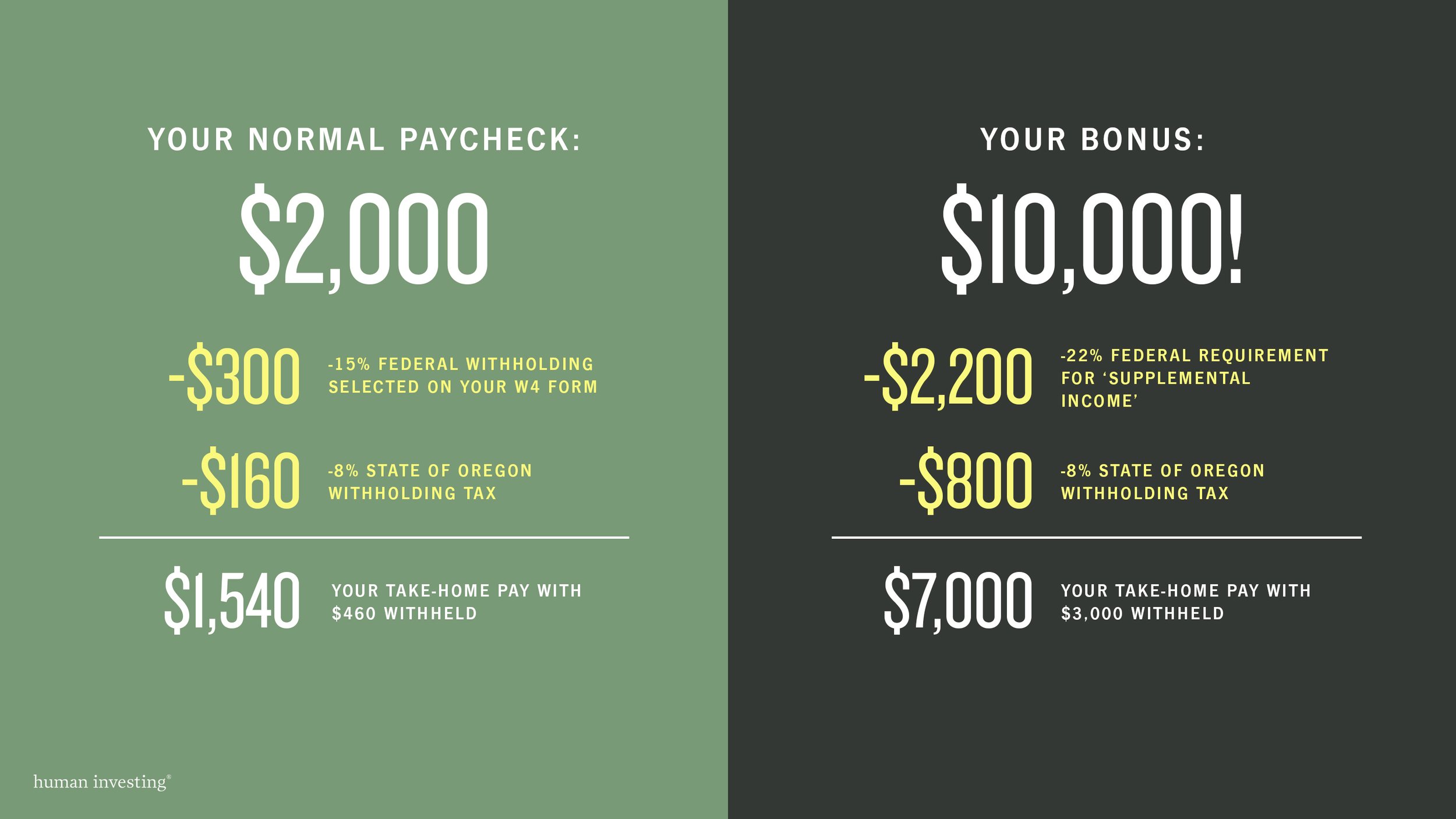
Because we love round numbers, let’s look at an example of for someone that normally receives a $2,000 paycheck and a one-time $10,000 bonus.

$10,000 Example

January 5, 2025: Your employer informs you that you will receive a $10,000 bonus.

January 10, 2025: You receive your paycheck that includes your typical income and the bonus payment.


Your regular income of $2,000 was subject to the following tax withholdings:

15% - federal withholding selected on your W4 Form

8% - state of Oregon withholding tax

23% - total withholding (federal + Oregon)

Your take-home pay is $1,540.


Your bonus paycheck was subject to the following tax withholdings:

22% - federal requirement for ‘supplemental income’

8% - state of Oregon withholding tax

30% - total withholding (federal + Oregon)

Your take-home bonus payment is $7,000. As you can see in this example, the total tax withholding for the bonus payment is greater than the tax withholdings for typical paychecks.


Your tax withholdings are not the same thing as your tax payments.

As shown in the example above, $3,000 was withheld from the bonus payment. This is an upfront payment to the IRS, but it doesn’t mean that this person will actually pay $3,000 in taxes for this bonus At the time of filing their tax return, they may receive some of that money back (a tax refund) or they could end up owing more taxes if they have significant income during the year.

As illustrated above, supplemental income has a 22% tax withholding rate. However, most taxpayers have a lower effective tax rate than that which means they will receive money back from the IRS once they have filed their taxes. We have included an example below to help clarify this concept.

The taxes paid on bonuses are the same as taxes paid on ordinary income.

While tax withholdings are different for regular income and bonus payments, the actual tax rate you pay is the same. Once you file your tax return the actual taxes paid are trued up.

Here is an example of a single tax-payer making a salary of $48,000 a year and a $10,000 bonus. They would see $58,000 appear in box 1 of their W2 Form issued by their employer. The total combined income of $58,000 is then subject to income tax brackets.

The key point is their entire income of $58,000 is subject to the same income tax brackets and end up with the same tax treatment. The difference is only the amount withheld when the bonus is paid out. We know that the $10,000 bonus had 22% in federal tax withholdings, but we can also infer that this person’s effective tax rate is probably lower based on the progressive tax brackets shown in this image.


To be clear, the first $11,925 gets taxed at 10%. The next $36,550 (range is dollars above $11,926 and below $48,475) get taxed at 12%. The remaining $9,525 is taxed at 22%. We encourage you to read the blog post titled 2025 Tax Updates and A Refresh On How Tax Brackets Work if you want a detailed explanation of our progressive tax brackets.

Whether or not this person will receive a tax refund or owes more taxes at the time of filing their tax return depends on the rest of their financial landscape. We can save that information for another blog post.

Disclosure: This material is for informational and educational purposes only and should not be considered personalized tax, legal, or investment advice. You should consult your own qualified tax, legal, and financial professionals before making any decisions based on this information. Tax laws and regulations, including those related to bonuses and supplemental income, are subject to change and may vary depending on individual circumstances. The examples provided are hypothetical and intended to illustrate general tax concepts; they should not be relied upon to determine your actual tax liability. Investing and financial planning involve risk, including the possible loss of principal. Past performance does not guarantee future results. Advisory services are offered through Human Investing, LLC, an SEC-registered investment adviser.


Related Articles

Updated for 2025: Tips on Minimizing Hefty Tax Bills For Different Income Tax Brackets
 

Don’t let time run out on these end-of-year tax plays. Not having a tax projection done can be a costly mistake. Besides giving you peace of mind in April, in order for you to pay the lowest percentage of taxes over your lifetime, you have to plan and utilize every opportunity. Sometimes this means paying more dollars in tax in the current year to seize and maximize that lower rate.

For Lower Income Tax Brackets

 While your income is low, it may make sense for you to realize more income now and better utilize your low tax rates. 

  1. Roth 401K and Roth IRA contributions: Contributing to a Roth 401k or Roth IRA may cost you more in taxes today, but it allows those dollars to grow tax-free. If you can do this early in your career and give your retirement dollars a long time to grow, the tax savings will be enormous.

  2. 0% federal tax on capital gains: Many people are unaware that the IRS actually allows for a 0% tax on capital gains (Example: Gain from sale of stock). If your taxable income is below $48,350 Single $96,700 Married-Filed-Jointly in 2025, you may want to realize additional gains this year by selling stock to take advantage of these low rates. Keep in mind you may still need to pay state & local taxes on these sales but selling at the 0% federal tax bracket is an opportunity you can’t afford to pass up.

  3. Lower your tax bracket when your income is low in retirement: Sometimes this situation occurs not when you are starting your career but when you are ending it. In the years between retirement and age 73, when Required Minimum Distributions start, there are opportunities to take advantage of these low tax brackets as well.

  4. Lower your tax withholdings in January: If you are getting a large refund, adjust your withholdings on your paycheck for the next year. Adjusting early in the year keeps more money in your pocket each month. Do not give the IRS an interest-free loan.

For Middle Income Tax Brackets

As you start making more money and entering higher tax brackets, this is the time to start looking for deductions. 

  1. Maximize your employee benefits: Have you maximized your employee benefits such as retirement contributions (including catch-up for those age 50+, and an extra catch-up for those age 60-63), H.S.A. contributions (including catch-up for those age 55+), and other benefits? When you are a W-2 employee, the best place to look for deductions is at work. Many companies will also offer some sort of match on retirement contributions. By not putting enough or anything into your workplace retirement plan, you may be leaving money on the table.

  2. Tax loss harvesting: One place you might go looking for additional deductions is your brokerage account. While no one likes to lose money on their investments, Capital losses can offset up to $3,000 of ordinary income each year. If your income is high you may want to harvest losses for two reasons:

    1. Taking losses now allows you to put off paying tax in favor of paying down the road when it might be cheaper, potentially 0% or 15% federally.

    2. To stay out of the 20% highest capital gains bracket $533,400 Single, $600,050 Married-Filed-Jointly for 2025).

  3. Non-Deductible IRA contribution: If you are already doing the items above and want to put more away for retirement, you might consider funding a non-deductible IRA. You (and your spouse) can put up to $7,000 (for 2025) into an IRA each year. This puts after-tax dollars into an IRA which could later be converted to a Roth IRA, which can grow tax-free. Keep in mind that the IRS views all of your IRAs as one IRA. Any distribution or conversion must be done proportionally to your taxable and non-taxable balances. If you have taxable amounts in your IRA, you may owe tax on any conversions.

  4. Raise your tax withholdings in January: If you owed a lot in April last year, it may be an indicator that you need to adjust your withholdings for the coming year or make estimated payments. The IRS requires you to pay the tax due at least quarterly. January is a good time to adjust your withholdings because you have the entire year for the changes to take effect. This means you can make the smallest change to your net pay and still yield the desired effect at year-end.

For Higher Income Tax Brackets

When you find yourself with a surplus of money, living generously may yield additional tax savings.

  1. Charitable contributions using stocks: While contributing to charity generally does not save you more than you spend on your taxes, if you have the heart to give there are efficient tax strategies that can allow your donation to go further. As changes to itemized deductions have vastly limited the amount of benefit many people can get from making charitable contributions, with careful planning, there are ways you may still save big.

    1. Contributing long-term appreciated stock may allow you to gain a charitable contribution for the fair market value of the stock and never pay the capital tax from the sale.

    2. Utilizing a donor-advised fund may allow you to bunch several years of donations into a single year. This could allow you to take larger deductions over several years.

    3. If you are over age 70.5 and not itemizing your deductions it may make sense for you to donate straight out of your IRA with a Qualified Charitable Distribution. These donations get paid straight from your IRA and are not taxed.

  2. $19,000 gifts to your children: If you are planning to transfer a large estate to your children upon your death it may make sense for you to utilize the annual gift limits and give each year to potentially lower taxes on your estate. These gift limits are annual and adjust with inflation. Current limits are $19,000 per year per individual. This means a husband and wife could give $19,000 each to a child for a total of $38,000. If that child is married, they could also give their child’s spouse the same amount without filing a tax return.

    To be clear, you can give all the way up to your lifetime limit in a given year without paying taxes, but giving more than $19,000 requires you to file a gift tax return and reduce your lifetime estate.

When it comes to taxes, Benjamin Franklin said it best when he said “failing to plan is planning to fail”. If you have not done so already, get your tax plan going before the end of the year. 


Disclosures: Human Investing is a SEC Registered Investment Adviser. Registration as an investment adviser does not imply any level of skill or training and does not constitute an endorsement by the Commission. Please consult with your financial advisor to determine the appropriateness of any investment strategy based on your individual circumstances.

This material is not intended to provide, and should not be relied upon for, tax advice. Please consult your tax advisor regarding your specific situation.

The information provided in this communication is for informational and educational purposes only and should not be construed as investment advice, a recommendation, or an offer to buy or sell any securities. Market conditions can change at any time, and there is no assurance that any investment strategy will be successful. Investing involves risk, including the potential loss of principal. Past performance is not indicative of future results.


Related Articles

2025 Tax Updates and a Refresh on How Tax Brackets Work
 

The IRS has announced inflation-adjustments and tax code updates for the 2025 tax year. While change may be modest for many households, being aware of the updates can help you with budgeting, planning, and tax-optimization.

What has changed?

The standard deduction amounts have increased for the 2025 tax year.

Additionally, taxpayers who are 65 or older and/or blind may claim an extra standard deduction amount. These increases mean more of your income is shielded from taxation upfront.

Federal income tax brackets continue to be the seven-rate structure.

Note: These are for taxable income (i.e., gross income minus deductions). Items like the standard deduction and any adjustments reduce your taxable income.

What does this mean for you?

For many households, these adjustments yield some benefit — fewer dollars of your income get taxed, and more income is taxed at the lower rates — but they typically aren’t game-changing by themselves.

Portions of Your Income Get Taxed at Different Rates

Because the U.S. uses a progressive tax system, each portion of your taxable income is taxed at the rate for the bracket into which it falls.

For example, a Single filers first $11,925 is taxed at 10%, then the next tier is taxed at 12%, then 22%, etc., as your taxable income rises.

If you can shift income (or deductions) so that more income falls into the lower brackets, you reduce your overall tax burden.

Why the Increase in Standard Deduction & Bracket Thresholds Matters

  • A higher standard deduction means less of your income is subject to taxation, which is good.

  • A “bracket creep” adjustment (thresholds rising) means you’re less likely to be nudged into a higher tax rate solely because of inflation, which is good.

  • The increases are modest in the context of pay raises, cost-of-living increases, and other tax changes (e.g., credits, deductions) so changes to your particular situation may be small.

Final Thoughts

The 2025 tax year brings meaningful updates: a higher standard deduction and higher thresholds mean more of your income avoids higher taxation. But savvy tax planning is still useful, especially if your income is growing, you have complex sources of income, or you have major deductions. Use these updated numbers as a baseline for your planning and then dig into the details with your CPA or advisor.


Disclosure: The information provided in this article is for educational purposes only and should not be interpreted as personalized tax, legal, accounting, or financial advice. While efforts have been made to ensure accuracy, tax laws and regulations are subject to change and may vary based on individual circumstances. Human Investing is an SEC-registered investment advisor; registration does not imply a certain level of skill or training. Before making any financial or tax-related decisions, please consult with a qualified tax professional, CPA, attorney, or financial advisor who understands your individual situation.


Related Articles

FinCen BOI Reporting: What you need to know


If you’re a business owner, own a rental property, or receive self-employment income and are registered with a Secretary of State, you may be subject to Beneficial Ownership Information (BOI) reporting. To provide ownership security to U.S. licensed companies, the U.S. Treasury Financial Crimes Enforcement Network (FinCEN), is requiring initial BOI reports as of January 1, 2024 from domestic and foreign companies who file with a Secretary of State or similar offices in the United States.

Know when to file a report now to avoid headaches later

Whether you are involved in a partnership, LLC, or corporation, the importance of reporting to FinCEN is not just for security purposes. If not filed on time, BOI reporting can become a personal financial burden. There is no fee associated with BOI reporting, however those who fail to report or willfully violate the BOI requirements may be subject to civil penalties of up to $500 for each day the violation continues. Below are deadlines that will help individuals determine when they will need to file a BOI report:

  • Entities created or registered on or after 1/1/2024: 90 calendar days after receiving notice of the company’s creation or registration to file its initial BOI report.

  • Entities created or registered before 1/1/2024: Must report an initial BOI before 1/1/2025.

  • Entities created or registered after 1/1/2025: 30 calendar days from actual or public notice that the company’s creation or registration is effective to file their initial BOI reports with FinCEN.

This is a one-time filing, but keep tabs on your future business changes

If changes occur with required information about your company or its beneficial owners, your company must file an updated report no later than 30 days after the date of the change.

Please note, company applicants cannot be removed from a BOI report even if that individual no longer has a relationship with the company.

Any individual associated with the reporting company is eligible to file the report on behalf of that group, but to mitigate any mistakes, seeking out a trusted legal professional such as an attorney, is recommended. Please visit the FinCEN BOI E-filing website and their thorough Q&A section for further information on BOI reporting.


Related Articles

The Ultimate Guide to Navigating and Lowering Taxes for Nike Execs and Leaders


A growing complexity

As a Nike leader, you are provided a comprehensive range of benefits that help achieve financial and retirement goals. The downside is that these benefits often create confusing tax implications. Multiple measures over the last few years have passed to increase taxes on high-income earners, including the Metro and Multnomah County taxes. These tax measures in addition to regular Federal and Oregon taxes are becoming an increasing burden for Nike executives. 

A clear understanding of the tax implications with these benefits is crucial. Employing appropriate strategies can both reduce your tax burden and also prevent any surprises during tax season in April.

Let’s examine the three biggest reasons you could get hit with a tax bill and review a recommended solution.

The 3 leading causes to tax surprises

1. Wrong tax withholding on supplemental pay

Many compensation sources at Nike beyond salary (such as PSP, LTIP/PSU vests, RSU vests, and stock option exercises) are taxed as “supplemental pay,” which come with a set percentage of tax withholding (22% Federal + 8% Oregon) regardless of your tax bracket or tax withholding elections on your salary. The reality is most Nike executives are in a much higher income tax bracket, sometimes as much as 17% higher than the amount withheld. This discrepancy leaves a significant gap in the amount taxes that should have been withheld versus the actual amount.

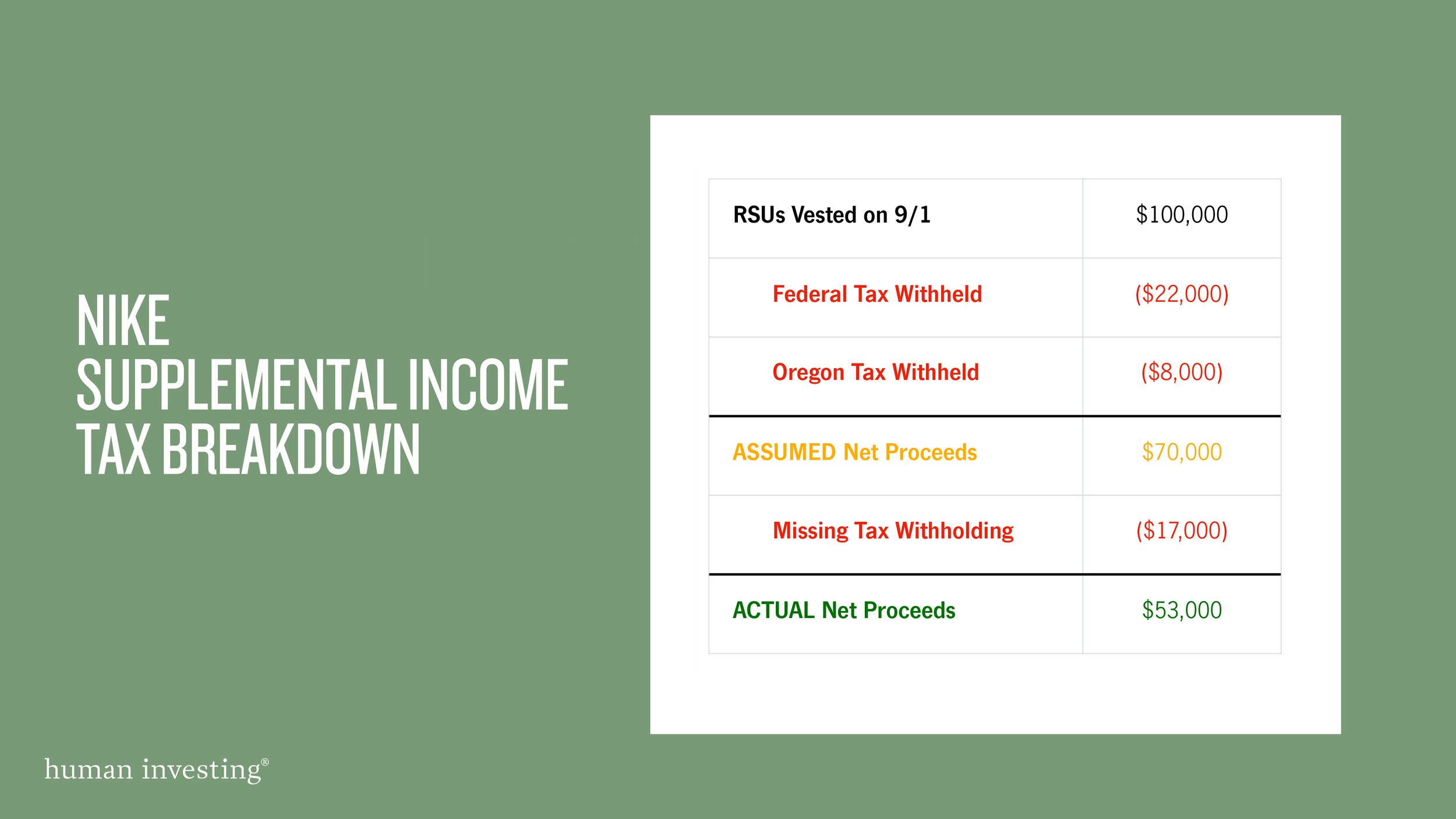
For example, Kate Executive has $100K of RSUs that vested on September 1st. With all her income sources (salary, PSP, LTIP/PSU, RSUs) her taxable income is $700K. The taxes automatically withheld on the $100K RSU vests would be about $30K (22% Federal + 8% State).  However, based on her tax bracket, Kate will owe another $17,000 on that RSU vest.

2. No tax withholding for Multnomah County’s “Preschool for All” tax

For those who live in Multnomah County, you are likely subject to the “Preschool for All” tax that started in 2021. Unfortunately, Nike does not withhold taxes from payroll to cover this tax, so you will be responsible to fully cover this on your own. Multnomah County expects these payments to be received quarterly to avoid interest and penalties.

The Preschool for All tax is 1.5% on taxable income over $125,000 for individuals and $200,000 for joint filers, with an additional 1.5% on taxable income over $250,000 for individuals and $400,000 for joint filers. The rate will increase by 0.8% in 2026.

3. No coordination of Portland Metro tax payments for 2 working spouses

Since Nike headquarters is located within the Portland Metro, they do withhold taxes for the Metro Supportive Housing tax (a.k.a. Homeless tax) that also started in 2021. The Metro Supportive Housing Tax is a 1% tax that is applied on income over $125,000 single filer or $200,000 joint filer. 

A common issue arises when you have two working spouses at different companies, since the income threshold for this tax is based on household income and the two different employers obviously do not communicate with each other.   

For example, once a Nike executive’s income reaches $200K, Nike will start to withhold the Metro tax on any income above that amount. However, the other spouse’s employer does not know about the income at Nike and assumes that the spouse’s income is the household income. So, if that spouse earns $90K, no Metro tax is withheld on that amount even though all of it is subject to the Metro tax.

The 3 tax payment issues identified above often lead to a frustrating situation, where you either end up with a significant tax bill in April or you have been paying in the wrong quarterly estimated tax payment amounts given to you by your CPA.

Our recommended solution: The pay as you receive strategy

For many Nike executives, setting aside additional tax payments into your monthly household cash flow can become stressful, since the amounts can be so inconsistent.   

The “Pay as You Receive” strategy is calculating the estimated amount of taxes due from each type of “Bonus Compensation” as you receive it and making those tax payments at that time, while you have the funds to do it. This will leave your monthly cash flow separate and unaffected.

If this sounds like a lot of work, you can make it simpler by applying this method during 2 key time periods. 

  • Time Period #1: August – PSP, LTIP/PSU bonus’

  • Time Period #2: Early September: September 1st RSU vests

A more thorough approach is the also include any February retention RSU vests and stock option exercises as they occur.

These supplemental estimated tax payments, when combined with the withholding, should be equal to your anticipated tax bracket for the calendar year. This approach helps ensure that your total payment to the IRS, Oregon, Multnomah County, and Metro aligns with your tax obligations.

Additional strategies for minimizing your tax liabilities

If you’re looking for more tax savings or want to use your stock benefits to take care of tax payments, we highly recommend proactive tax planning. This involves looking beyond the past year and anticipating opportunities to reduce taxes in the future.

Proactive tax planning common solutions include:

1. Maxing out your Nike 401(k) with pre-tax contributions

This is a simple strategy, yet it is often missed.  With the maximum contribution amount increasing periodically with inflation and with opportunities for additional catch-up contributions at age 50, forgetting to review your contribution percentage each year is common.  We recommend reviewing your 401k contribution amount after your PSP bonus is paid, since it is a variable amount that is part of the equation.

2. Selling the right type of Nike stock

If you ever need funds from Nike stock, find the most optimal type of Nike stock to sell to minimize your taxes. Typically, RSUs are preferred over ESPP from a tax standpoint, but this can depend on when it was purchased/vested, how long it has been held, and what the stock price is at the time.

3. Utilizing the Nike deferred compensation plan to defer your taxable income to a later date 

Nike’s deferred compensation plan is generally the most powerful tax savings tool available for Nike leaders.  There are specific IRS rules and many important considerations to plan around when using this strategy.  To learn more click here.

4. Charitable giving

Most people assume that all donations to charities are tax-deductible.  They can be tax-deductible but are not always, depending on your individual tax situation. To receive a charitable deduction, you need to exceed a certain threshold each year, and it may make sense to “bunch” donations (make multiple years-worth of contributions in a year) to cross that threshold and capture tax benefits. Coordinating your charitable strategy with the Nike charitable match can be an effective way to lower your taxes and benefit your desired charities at the same time. To find out more click here.

5. Residence planning

If you currently live in Multnomah County, you might consider moving to another county, such as Clackamas or Washington Counties, to avoid the Preschool for All tax. This solution should consider the estimated tax savings compared to the cost of selling your home, the tax implications of selling your home, the purchase price of a new home, and the difference in a new mortgage payment (especially because mortgage rates have increased significantly).

6. Planning around the Oregon state kicker

Oregon law has a provision known as the “kicker” credit. This is a surplus credit that is returned to you on your tax return when tax revenue is larger than predicted.  By accounting for this, you can strategically recognize more income in “kicker” qualifying years so that your potential kicker credit is increased.  The last kicker payment was 17.34% of the Oregon taxes you paid in 2020 and the next one is estimated to be even larger

Bring in experienced experts

By implementing a proactive forward-looking tax strategy and payment plan, Nike leaders have a significant opportunity to improve their financial situation and relieve stress related to taxes. It is important to note that any tax payment and mitigation strategies should be part of a comprehensive financial plan that is tailored to your specific financial situation.

If you have questions about how to set up a proactive forward-looking tax strategy, please contact our team to learn more.


Related Articles

2023 Tax Updates: Brackets and Rates Adjusted to Hedge Against Inflation
 

The IRS adjusts tax brackets and rates each year to account for inflation and combat “bracket creep.” Bracket creep is when taxpayers are pushed into higher income tax brackets or do not receive adequate credits and deductions due to inflation. Are you aware of how an increase in the standard deduction and tax brackets will impact you?

What has changed?

1. The standard deduction will increase for the 2023 tax year. See below for a summary of the increases:

 2. Federal income tax brackets will increase to account for inflation in 2023:

What does this mean for you?

While this is welcomed news, these updates will not significantly impact your taxes, cash flow, or budget. These updates are enacted to hedge against inflation and keep things consistent for taxpayers.

In sum, the increase in standard deduction means households will have less income subject to taxes, and the income subject to taxes will be subject to better tax brackets.

We wanted to re-vamp our tax example from 2022 with the updated 2023 numbers to provide a familiar and helpful guide to your taxes. Read on to see a fictitious example of the impact of the increased standard deduction and tax brackets in 2023.

Meet Martin & Angela

Below is a breakdown of their taxable income and taxes due in 2022 compared to 2023.

As you can see, they reported $100,000 of combined income, which is reduced by their pre-tax 401(k) contributions and the standard deduction of $27,700. Because the standard deduction increased from $25,900 in 2022 to $27,700 in 2023, Martin and Angela’s taxable income decreased. This means they are on track to pay less this year in federal taxes.

PORTIONS OF YOUR INCOME GET TAXED AT DIFFERENT RATES

Tax brackets calculate the tax rate you will pay on each portion of your income. Tax brackets are part of our progressive tax system, which means the tax rate increases as someone’s income grows. There are seven federal tax brackets in 2023 (see image 2).

As shown in the image above, Martin and Angela’s taxable income will be split to take advantage of the lowest tax bracket. This means they will be taxed at 10% on the first $22,000 of their joint income, and their remaining taxable income will be taxed at 12%. In 2022, the maximum income allowed at the lowest tax bracket of 10% was $20,550. In 2023, the maximum income allowed will be $22,000.

If Martin and Angela fall into a higher tax bracket in the future, their taxable income will be broken down into each respective bracket to take advantage of the lower rates on what they can.

DRUMROLL, PLEASE…

After completing this exercise for all their taxable income, you can see that Martin and Angela’s total taxes owed in 2022 is $7,881 compared to $7,636 in 2023. This means they will pay $245 less federal taxes in 2023 than in 2022. While this is welcomed news, it is not a life-changing update.

If you have questions about your unique tax situation, please schedule a time to connect with our team. As always, we would love to hear from you!

Disclaimer: This post is for educational purposes and not predictive of your 2022 tax situation. The fictitious example is not a complete presentation of a tax filing.


Related Articles